REVIEW 3 major objections 6 minor 4 cited by
EnergyMoGen: Compositional Human Motion Generation with Energy-Based Diffusion Model in Latent Space
T0 review · 3 major / 6 minor · reviewed 2026-08-11 · deepseek-v4-flash
Pith's one-line read A latent motion diffusion model can compose multiple text concepts into one motion by adding and subtracting denoiser energies.
desk verdict Solid compositional motion generation with an overreaching EBM story; the experiments are good enough to warrant review despite the shaky theory. read the letter →
The pith
A machine-rendered reading of the paper's core claim, the machinery that carries it, and where it could break.
The reading
What carries the argument
The load-bearing object is the equivalence between the diffusion denoising step and Langevin dynamics, which lets the denoiser's output be treated as the gradient of an energy potential in latent space. This turns the logical operations of conjunction and negation into linear combinations of score estimates, mirroring products and ratios of Boltzmann distributions through classifier-free guidance. A second mechanism is energy-based cross-attention, where text-derived keys are updated by gradient descent on an energy function, refining multi-concept text embeddings during inference. Synergistic Energy Fusion (Equation 10) is the mechanism that combines the latent-aware score, the semantic-aware score, and a single-text multi-concept score into one denoising estimate, with fixed weights chosen by ablation.
What would settle it
Compute the Jacobian of the denoiser output $\epsilon_\theta(z,t,c)$ with respect to $z$ at fixed $t$ and $c$ across many latent points; if $\partial(\epsilon_\theta)_i/\partial z_j$ and $\partial(\epsilon_\theta)_j/\partial z_i$ differ beyond numerical tolerance, no scalar energy $E_\theta$ exists with $\nabla_z E_\theta = \epsilon_\theta$, and the composition rules in Equations 7 and 8 cannot be exact energy compositions. A cheaper behavioral check: hold the semantic-aware and multi-concept terms fixed, replace the latent-aware composed score with a same-scale random perturbation, and see whether the reported MTT gains survive; if they do, the latent-aware energy term is not carrying the claimed compositional signal.
Extended reading notes
Core claim
The central claim is that the denoising network of a motion latent diffusion model can be read as defining an energy function in latent space, because the reverse step $z_{t-1} = z_t - \epsilon_\theta(z_t,c,t) + \mathcal{N}(0,\tilde{\beta}_t I)$ has the same form as Langevin dynamics with step size one. On that reading, composing concepts means composing energies: conjunction is the score combination $\epsilon^l_\theta = \epsilon_\theta(z_t,t) + \sum_i w_i^l(\epsilon_\theta(z_t,t,c_i) - \epsilon_\theta(z_t,t))$, and negation subtracts an unwanted concept's conditional score. Separately, the paper treats cross-attention as an energy-based update that refines text embeddings by adaptive gradient descent, and finds that neither spectrum alone is sufficient: latent-aware composition misaligns text, semantic-aware composition produces foot sliding and jitter. The paper's empirical discovery is that fusing the two spectra with a multi-concept single-text score, $\hat{\epsilon}_\theta = \lambda_l \epsilon^l_\theta + \lambda_s \epsilon^s_\theta + \lambda_m \epsilon_\theta(z_t,t,c_{1,n})$, with the stated weights, outperforms prior methods on compositional and multi-concept benchmarks and yields strong text-to-motion results, plus a 5000-sample CompML dataset that improves text-to-motion when used as training data.
Load-bearing premise
The load-bearing premise is that the denoiser's score estimate behaves like the gradient of a single additive energy function in latent space, so that adding and subtracting score estimates corresponds to multiplying and dividing Boltzmann distributions; in practice the learned score is a regression target over many noise levels and need not be the gradient of any one potential.
Editorial extensions
If this is right
- Conjunction, negation, and their combination become available at inference time on a pretrained latent motion diffusion model, with no per-frame skeleton composition or retraining.
- Multi-concept motion generation from a single text improves through adaptive gradient descent on text embeddings inside energy-based cross-attention.
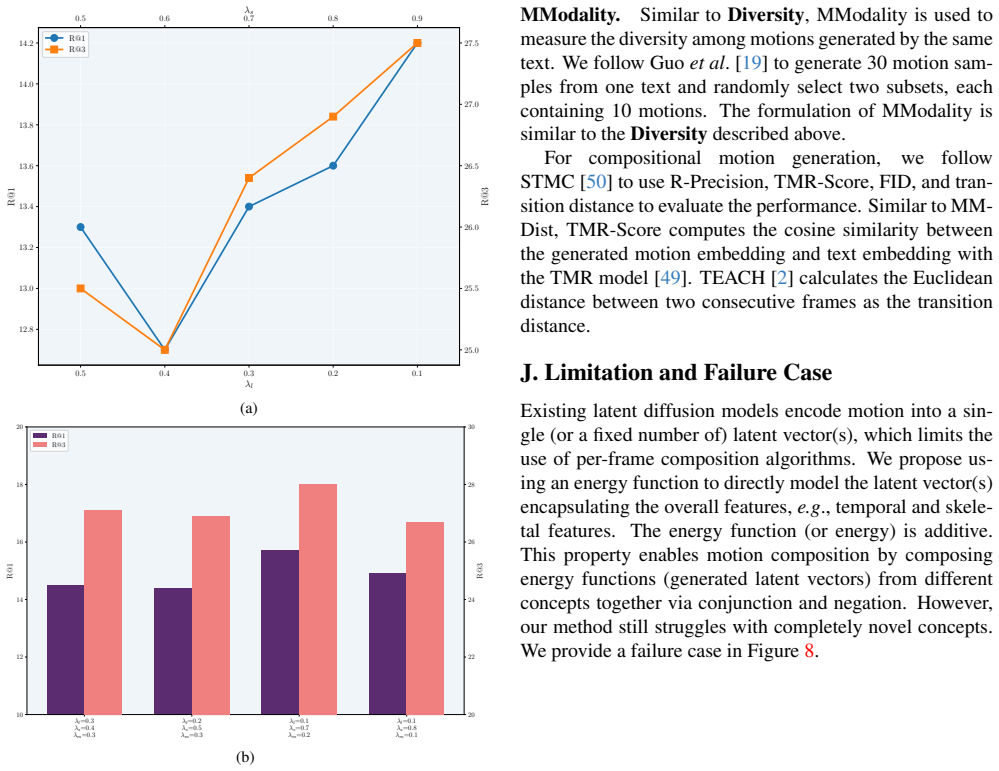
- The fixed fusion weights (0.1 latent, 0.7 semantic, 0.2 multi-concept) balance text alignment against motion smoothness, with the best measured trade-off on the MTT benchmark.
- The same energy composition recipe transfers to skeleton-based diffusion models, where the paper reports gains on HumanML3D and MTT.
- Compositionally generated motions can be collected into a dataset (CompML, 5000 text-motion pairs) and used to finetune the text-to-motion model, improving its test-set performance.
Reading between the lines
- If the energy interpretation is taken literally, the same additive-score recipe should transfer to any score-matched latent diffusion model in other modalities, making training-free composition a general property of such models rather than a motion-specific trick.
- The reported failure on completely novel concepts suggests the composed energy mostly interpolates between training concepts; a testable extension is to measure composition quality as a function of concept-pair co-occurrence in the training set.
- Because the learned score is a regression target across noise levels, it may not be the exact gradient of one potential; checking the symmetry of the denoiser Jacobian with respect to its latent input would show whether Equations 7 and 8 are exact energy compositions or merely effective heuristics.
- The fusion weights are fixed constants; making them depend on the diffusion timestep or noise level is a natural next experiment, since early and late denoising stages likely need different balances of semantic fidelity and physical smoothness.
Signed reviews
Editorial analysis
A structured set of objections, weighed in public.
Referee Report
Summary. This manuscript proposes EnergyMoGen, a latent-diffusion framework for compositional human motion generation. The method interprets a pre-trained latent motion diffusion model as a latent-aware energy-based model, so that conjunction and negation of concepts can be realized by linearly combining score estimates (Eqs. 7-8). It also treats cross-attention as a semantic-aware energy model and refines text embeddings via adaptive gradient descent (Eqs. 3-4). The two components are merged with a third multi-concept single-text term through Synergistic Energy Fusion (Eq. 10). Experiments on HumanML3D, KIT-ML, and MTT evaluate text-to-motion, compositional, and multi-concept generation, and a 5000-pair CompML dataset is introduced as data augmentation.
Significance. If the theoretical bridge held, the paper would offer a principled way to compose motion concepts in latent space with a fixed pre-trained diffusion model, avoiding per-frame skeleton composition. The empirical effort is broad and careful in several respects: 20 repeats with 95% confidence intervals on standard benchmarks, per-component ablations, hyperparameter sensitivity tables, PFC foot-sliding evaluation, generalization to skeleton-based diffusion, and an explicit failure case. However, the central Eq. (5) to Eq. (6) identification is asserted rather than derived, and the main compositional gains rest on hyperparameters tuned on the evaluation set. The framework may still work as an engineered combination of classifier-free guidance, cross-attention mixing, and test-time text optimization; the energy-based interpretation is currently not substantiated.
major comments (3)
- [§3.2, Eqs. (5)-(8)] The bridge between diffusion and EBMs is load-bearing and is not established. The reverse step in Eq. (5) omits the schedule-dependent coefficients of the actual DDPM update, which in Ho et al. is z_{t-1} = (1/sqrt(alpha_t))(z_t - (beta_t/sqrt(1-alpha_t)) epsilon_theta) + sigma_t noise. Even if these coefficients are ignored, the score-energy relation epsilon_theta = -sigma_t grad_z log p(z_t,t) requires a noise-level-dependent scaling that cannot be absorbed into a fixed step size eta = 1. Moreover, a network trained with the MSE objective (Eq. 2) over many noise levels is not guaranteed to be the exact gradient of a single scalar potential on the latent space, and the paper reports no integrability check. Since Eqs. (7) and (8) are derived from the Boltzmann-product composition p(z|c_1,...,c_n) proportional to p(z) times the product of p(z|c_i)/p(z), the central claim that latent diffusion models can be interpreted as latent-aware EBMs is unsupported. The resulting formulas coincide with multi-condition classifier-free guidance and with composable diffusion, so the empirical results may survive without the energy interpretation; the authors should either supply a rigorous derivation or explicitly state that Eq. (6) is used only as an analogy.
- [§5.2, §5.5, Appendix C, Table 7] The main compositional results are tuned on the evaluation set. The weights lambda_l = 0.1, lambda_s = 0.7, lambda_m = 0.2 and the step sizes gamma_attn = 0.001, gamma_reg = 0.002 are selected using MTT, and Tables 7 and 9 show that performance varies strongly with these values: R@1 ranges from 9.7 to 15.7 in Table 7 and drops to 1.4 for gamma = 0.1/0.2 in Table 9. The paper does not report a separate validation split or protocol that prevents the selected configuration from being the best on the test set. As a result, the state-of-the-art claims in Table 3 are partially circular: the comparison reflects hyperparameter fitting rather than a predicted property of the method. The authors should report results on a held-out split, fix hyperparameters using a validation set, or clearly state that the reported numbers are best-over-test.
- [§3.2, Eq. (9), Appendix J] The semantic-aware composition operation is introduced as a weighted average of unnormalized cross-attention features (Eq. 9) with no derivation connecting this average to the energy-based formalism or to Eqs. (7)-(8). An energy function is never specified for this second spectrum, so the claim that cross-attention constitutes a semantic-aware EBM is not supported by the text. The failure case in Appendix J also shows that the method struggles with completely novel concepts, which is a useful limitation but should be stated more prominently; the abstract and introduction currently present composition as a general mechanism without this caveat.
minor comments (6)
- [Table 3] The header 'R-Presicion' contains a typo; it should read 'R-Precision'.
- [§5.2] The sentence 'we split gamma into [gamma_attn, gamma_reg] for compositional and multi-concept motion generation' is ambiguous; clarify which task uses [0.0004, 0.0004] and which uses [0.001, 0.002].
- [Appendix I.2, Eq. (12)] The FID formula has a minus sign before the trace term, but the standard FID uses a plus sign: FID = ||mu_m - mu_mhat||^2 + Tr(Sigma_m + Sigma_mhat - 2(Sigma_m Sigma_mhat)^{1/2}).
- [Appendix B, Table 5] The table entry 'FineMoGen [56]' cites reference [56], which is PriorMDM; the citation should point to FineMoGen [75].
- [§3.1 and Appendix A] The text states that '10 additional tokens' are used to sample N = 5 latent vectors, but the relationship between the 10 tokens and the 5 latent vectors is never explained.
- [General] No code or reproducible evaluation scripts are provided; given the hyperparameter sensitivity shown in Tables 7 and 9, releasing code would substantially increase confidence in the empirical claims.
Circularity Check
EBM interpretation is a stipulated definition and the headline MTT gains come from test-set-tuned fusion weights, but the composition core is standard CFG, so partial circularity.
-
self definitional
[Section 3.2, 'Bridging Diffusion Models and Energy-Based Models', after Equations 5 and 6]
"By representing the energy function Eθ(zt, c) using the denoising autoencoder ϵθ, diffusion models can be interpreted as EBMs under the gradient descent step η = 1 , enabling compositional motion generation via composing a set of diffusion models."
The identification is imposed by definition rather than derived. If Eθ is represented by ϵθ and η is set to 1, Equation 6 is made to coincide with the denoising update in Equation 5 by construction; no independent energy function is defined and no integrability condition is checked. The subsequent Boltzmann-factor composition in Equations 7 and 8 inherits this stipulated identification, so the paper's 'latent-aware EBM' framing reduces to defining an energy whose gradient is the network output, rather than establishing that such a potential exists.
-
fitted input called prediction
[Section 5.2 (implementation) and Appendix C (Table 7)]
"'λs, λl, and λm are set to 0.7, 0.1, and 0.2 for compositional generation evaluation.' 'It can be seen that Synergistic Energy Fusion with λl = 0 .1, λs = 0 .7, and λm = 0.2 achieves best performance.'"
The headline compositional results on MTT are reported with hyperparameters selected on the MTT benchmark itself. Table 7 shows R@1 varying from 9.7 to 15.7 across nearby weight settings, and the final 'Ours + SEF' row is the maximum of that search. Thus the main empirical claim is a tuned-to-test maximum rather than a prediction made by a fixed method with a priori weights. The conclusion that SEF outperforms prior methods is therefore partly forced by the hyperparameter selection procedure.
full rationale
The paper's core composition formula (Equation 7) is the standard multi-condition classifier-free-guidance combination and can be grounded independently of the EBM narrative, so the central mechanism still has independent content; the same applies to the semantic-aware cross-attention energy, which is imported from externally cited work. There is no load-bearing self-citation chain: the cited composition and cross-attention results come from prior non-overlapping authors. The CompML self-augmentation experiment is a self-training loop but is evaluated on the independent HumanML3D test set, so it is not a by-construction circular prediction. The main circularity concerns are (1) the 'diffusion-as-EBM' identification is a stipulated equivalence made true by defining the energy through the denoising network, and (2) the MTT fusion weights are tuned on the same benchmark used to claim state-of-the-art performance, making the reported gains partly artifacts of test-set selection. These issues raise the score to 4, but they do not make the entire derivation equivalent to its inputs; the composition formulas remain externally grounded and testable.
Assumptions & free parameters
free parameters (4)
- lambda_l, lambda_s, lambda_m (Synergistic Energy Fusion weights) =
0.1, 0.7, 0.2
- gamma_attn, gamma_reg (adaptive gradient descent step sizes) =
0.001, 0.002
- N (number of latent vectors in the motion VAE) =
5
- Classifier-free guidance weight for the latent composition terms wl_i =
not specified independently
assumptions (4)
- ad hoc to paper The learned denoising score function is the gradient of a potential energy function, making Equation 5 equivalent to Langevin dynamics in Equation 6.
- domain assumption The energy-based composition formulas from Du et al. 2020 and Liu et al. 2022 transfer to latent motion diffusion without modification.
- domain assumption The cross-attention energy refinement formula from Park et al. 2024 applies to motion latents with the same MAP interpretation.
- domain assumption MTT evaluation metrics computed with frozen CLIP and TMR embeddings are a valid test of compositional correctness.
Cite this review
Pith. "Pith review of EnergyMoGen: Compositional Human Motion Generation with Energy-Based Diffusion Model in Latent Space." pith.science (2026). https://pith.science/paper/ZJEBTNFV
@misc{pith2026241214706,
  author       = {Pith},
  title        = {Pith review of: EnergyMoGen: Compositional Human Motion Generation with Energy-Based Diffusion Model in Latent Space},
  year         = {2026},
  howpublished = {\url{https://pith.science/paper/ZJEBTNFV}},
  note         = {Machine review of arXiv:2412.14706}
}
read the original abstract
Diffusion models, particularly latent diffusion models, have demonstrated remarkable success in text-driven human motion generation. However, it remains challenging for latent diffusion models to effectively compose multiple semantic concepts into a single, coherent motion sequence. To address this issue, we propose EnergyMoGen, which includes two spectrums of Energy-Based Models: (1) We interpret the diffusion model as a latent-aware energy-based model that generates motions by composing a set of diffusion models in latent space; (2) We introduce a semantic-aware energy model based on cross-attention, which enables semantic composition and adaptive gradient descent for text embeddings. To overcome the challenges of semantic inconsistency and motion distortion across these two spectrums, we introduce Synergistic Energy Fusion. This design allows the motion latent diffusion model to synthesize high-quality, complex motions by combining multiple energy terms corresponding to textual descriptions. Experiments show that our approach outperforms existing state-of-the-art models on various motion generation tasks, including text-to-motion generation, compositional motion generation, and multi-concept motion generation. Additionally, we demonstrate that our method can be used to extend motion datasets and improve the text-to-motion task.
Figures


Figures from the paper (5 more)




Forward citations
Cited by 4 Pith papers
-
MoRAE: Flow-Friendly Self-Supervised Latents for Text-to-Motion Generation
Distilling frozen Motion-JEPA features into a compact 32-D latent whose geometry is coupled to the decoder lets a standard non-autoregressive flow-matching DiT reach state-of-the-art text-to-motion quality on HumanML3...
-
Text Dictates, Music Decorates: Energy-based Attention for Editable Dance Motion Generation
STREAM decouples text (via AdaLN) from music (via energy-based BEAM attention) to generate editable, musically aligned dance motions with a new annotated dataset and editability metric.
-
Absolute Coordinates Make Motion Generation Easy
Using absolute 3D joint coordinates with a plain Transformer and velocity-prediction diffusion outperforms the standard local-relative motion representation, improving fidelity and enabling direct control.
-
Rethinking Diffusion for Text-Driven Human Motion Generation: Redundant Representations, Evaluation, and Masked Autoregression
A masked-autoregressive diffusion model trained on a compact essential-feature latent space claims state-of-the-art text-to-motion generation under a new essential-dimension evaluation protocol.
Reference graph
Works this paper leans on
-
[1]
Lan- guage2pose: Natural language grounded pose forecasting
Chaitanya Ahuja and Louis-Philippe Morency. Lan- guage2pose: Natural language grounded pose forecasting. In International Conference on 3D Vision (3DV), 2019. 5
2019
-
[2]
Nikos Athanasiou, Mathis Petrovich, Michael J. Black, and G¨ul Varol. TEACH: Temporal Action Compositions for 3D Humans. In International Conference on 3D Vision (3DV) ,
-
[3]
Nikos Athanasiou, Mathis Petrovich, Michael J. Black, and G¨ul Varol. SINC: Spatial composition of 3D human motions for simultaneous action generation. In Proceedings of the International Conference on Computer Vision (ICCV), 2023. 1, 5
work page 2023
-
[4]
Locke: Epistemology and ontology
Michael Ayers. Locke: Epistemology and ontology. Rout- ledge, 1991. 1
work page 1991
-
[5]
Attribute-centric compositional text-to-image generation
Yuren Cong, Martin Renqiang Min, Li Erran Li, Bodo Rosenhahn, and Michael Ying Yang. Attribute-centric compositional text-to-image generation. arXiv preprint arXiv:2301.01413, 2023. 5
arXiv 2023
-
[6]
Mofusion: A frame- work for denoising-diffusion-based motion synthesis
Rishabh Dabral, Muhammad Hamza Mughal, Vladislav Golyanik, and Christian Theobalt. Mofusion: A frame- work for denoising-diffusion-based motion synthesis. In Proceedings of the Conference on Computer Vision and Pat- tern Recognition (CVPR), 2023. 5
work page 2023
-
[7]
Implicit generation and mod- eling with energy based models
Yilun Du and Igor Mordatch. Implicit generation and mod- eling with energy based models. Advances in Neural Infor- mation Processing Systems (NeurIPS), 2019. 1, 2, 3, 5
work page 2019
-
[8]
Compositional visual generation with energy based models
Yilun Du, Shuang Li, and Igor Mordatch. Compositional visual generation with energy based models. Advances in Neural Information Processing Systems (NeurIPS), 2020. 3, 4, 5
work page 2020
Show all 81 references
-
[9]
Improved contrastive divergence training of energy based models
Yilun Du, Shuang Li, Joshua Tenenbaum, and Igor Mor- datch. Improved contrastive divergence training of energy based models. arXiv preprint arXiv:2012.01316, 2020. 1, 2
2012 arXiv
-
[10]
Unsupervised learning of compositional en- ergy concepts
Yilun Du, Shuang Li, Yash Sharma, Josh Tenenbaum, and Igor Mordatch. Unsupervised learning of compositional en- ergy concepts. Advances in Neural Information Processing Systems (NeurIPS), 2021. 5
2021
-
[11]
Reduce, reuse, recycle: Compositional generation with energy-based diffusion models and mcmc
Yilun Du, Conor Durkan, Robin Strudel, Joshua B Tenen- baum, Sander Dieleman, Rob Fergus, Jascha Sohl-Dickstein, Arnaud Doucet, and Will Sussman Grathwohl. Reduce, reuse, recycle: Compositional generation with energy-based diffusion models and mcmc. In International Conference...
2023
-
[12]
Training- free structured diffusion guidance for compositional text-to- image synthesis
Weixi Feng, Xuehai He, Tsu-Jui Fu, Varun Jampani, Ar- jun Reddy Akula, Pradyumna Narayana, Sugato Basu, Xin Eric Wang, and William Yang Wang. Training- free structured diffusion guidance for compositional text-to- image synthesis. In International Conference on Learning Repres...
2023
-
[13]
Guess gradually enrich- ing synthesis for text-driven human motion generation
Xuehao Gao, Yang Yang, Zhenyu Xie, Shaoyi Du, Zhongqian Sun, and Yang Wu. Guess gradually enrich- ing synthesis for text-driven human motion generation. IEEE Transactions on Visualization and Computer Graph- ics, 2024. 5, 6
2024
-
[14]
Guess: Gradually en- riching synthesis for text-driven human motion generation
Xuehao Gao, Yang Yang, Zhenyu Xie, Shaoyi Du, Zhongqian Sun, and Yang Wu. Guess: Gradually en- riching synthesis for text-driven human motion generation. IEEE Transactions on Visualization and Computer Graph- ics, 2024. 5, 7
2024
-
[15]
Compositional sculpt- ing of iterative generative processes
Timur Garipov, Sebastiaan De Peuter, Ge Yang, Vikas Garg, Samuel Kaski, and Tommi Jaakkola. Compositional sculpt- ing of iterative generative processes. Advances in Neural Information Processing Systems (NeurIPS), 2023. 5
2023
-
[16]
Synthesis of compositional animations from textual descriptions
Anindita Ghosh, Noshaba Cheema, Cennet Oguz, Christian Theobalt, and Philipp Slusallek. Synthesis of compositional animations from textual descriptions. In Proceedings of the International Conference on Computer Vision (ICCV), 2021. 5
2021
-
[17]
Iterative motion editing with natural language
Purvi Goel, Kuan-Chieh Wang, C Karen Liu, and Kayvon Fatahalian. Iterative motion editing with natural language. In ACM SIGGRAPH 2024 Conference Papers, 2024. 5
2024
-
[18]
Mamba: Linear-time sequence modeling with selective state spaces
Albert Gu and Tri Dao. Mamba: Linear-time sequence modeling with selective state spaces. arXiv preprint arXiv:2312.00752, 2023. 5
2023 arXiv
-
[19]
Generating diverse and natural 3d human motions from text
Chuan Guo, Shihao Zou, Xinxin Zuo, Sen Wang, Wei Ji, Xingyu Li, and Li Cheng. Generating diverse and natural 3d human motions from text. In Proceedings of the Conference on Computer Vision and Pattern Recognition (CVPR), 2022. 2, 5, 6, 7, 12, 13, 14, 15, 16
2022
-
[20]
Tm2t: Stochastic and tokenized modeling for the reciprocal gener- ation of 3d human motions and texts
Chuan Guo, Xinxin Zuo, Sen Wang, and Li Cheng. Tm2t: Stochastic and tokenized modeling for the reciprocal gener- ation of 3d human motions and texts. In Proceedings of the European Conference on Computer Vision (ECCV), 2022. 5
2022
-
[21]
Momask: Generative masked model- ing of 3d human motions
Chuan Guo, Yuxuan Mu, Muhammad Gohar Javed, Sen Wang, and Li Cheng. Momask: Generative masked model- ing of 3d human motions. In Proceedings of the Conference on Computer Vision and Pattern Recognition (CVPR), 2024. 5
2024
-
[22]
Amd: Autoregressive motion diffusion
Bo Han, Hao Peng, Minjing Dong, Yi Ren, Yixuan Shen, and Chang Xu. Amd: Autoregressive motion diffusion. In Pro- ceedings of the AAAI Conference on Artificial Intelligence ,
-
[23]
Classifier-free diffusion guidance
Jonathan Ho and Tim Salimans. Classifier-free diffusion guidance. arXiv preprint arXiv:2207.12598, 2022. 2, 4, 12
2022 arXiv
-
[24]
Denoising dif- fusion probabilistic models
Jonathan Ho, Ajay Jain, and Pieter Abbeel. Denoising dif- fusion probabilistic models. In Advances in Neural Informa- tion Processing Systems (NeurIPS), 2020. 1
2020
-
[25]
Energy transformer
Benjamin Hoover, Yuchen Liang, Bao Pham, Rameswar Panda, Hendrik Strobelt, Duen Horng Chau, Mohammed Zaki, and Dmitry Krotov. Energy transformer. Advances in Neural Information Processing Systems (NeurIPS), 2024. 3
2024
-
[26]
Prov- ably optimal memory capacity for modern hopfield mod- 9 els: Transformer-compatible dense associative memories as spherical codes
Jerry Yao-Chieh Hu, Dennis Wu, and Han Liu. Prov- ably optimal memory capacity for modern hopfield mod- 9 els: Transformer-compatible dense associative memories as spherical codes. arXiv preprint arXiv:2410.23126, 2024
2024 arXiv
-
[27]
On statistical rates and provably efficient criteria of latent diffusion transformers (dits)
Jerry Yao-Chieh Hu, Weimin Wu, Zhuoru Li, Sophia Pi, Zhao Song, and Han Liu. On statistical rates and provably efficient criteria of latent diffusion transformers (dits). Ad- vances in Neural Information Processing Systems (NeurIPS),
-
[28]
Composer: Creative and controllable im- age synthesis with composable conditions
Lianghua Huang, Di Chen, Yu Liu, Yujun Shen, Deli Zhao, and Jingren Zhou. Composer: Creative and controllable im- age synthesis with composable conditions. arXiv preprint arXiv:2302.09778, 2023. 5
2023 arXiv
-
[29]
Estimation of non- normalized statistical models by score matching
Aapo Hyv ¨arinen and Peter Dayan. Estimation of non- normalized statistical models by score matching. Journal of Machine Learning Research (JMLR), 2005. 2
2005
-
[30]
Motiongpt: Human motion as a foreign language
Biao Jiang, Xin Chen, Wen Liu, Jingyi Yu, Gang Yu, and Tao Chen. Motiongpt: Human motion as a foreign language. arXiv, 2023. 5
2023
-
[31]
Act as you wish: Fine-grained control of mo- tion diffusion model with hierarchical semantic graphs
Peng Jin, Yang Wu, Yanbo Fan, Zhongqian Sun, Wei Yang, and Li Yuan. Act as you wish: Fine-grained control of mo- tion diffusion model with hierarchical semantic graphs. Ad- vances in Neural Information Processing Systems (NeurIPS),
-
[32]
Guided motion diffusion for controllable human motion synthesis
Korrawe Karunratanakul, Konpat Preechakul, Supasorn Suwajanakorn, and Siyu Tang. Guided motion diffusion for controllable human motion synthesis. In Proceedings of the International Conference on Computer Vision (ICCV), 2023. 5
2023
-
[33]
Guided motion diffusion for controllable human motion synthesis
Korrawe Karunratanakul, Konpat Preechakul, Supasorn Suwajanakorn, and Siyu Tang. Guided motion diffusion for controllable human motion synthesis. In Proceedings of the International Conference on Computer Vision (ICCV), 2023. 1, 5
2023
-
[34]
Auto-encoding varia- tional bayes
Diederik P Kingma and Max Welling. Auto-encoding varia- tional bayes. In International Conference on Learning Rep- resentations (ICLR), 2014. 3
2014
-
[35]
Priority-centric human motion genera- tion in discrete latent space
Hanyang Kong, Kehong Gong, Dongze Lian, Michael Bi Mi, and Xinchao Wang. Priority-centric human motion genera- tion in discrete latent space. In Proceedings of the Confer- ence on Computer Vision and Pattern Recognition (CVPR) ,
-
[36]
A tutorial on energy-based learning.Predicting structured data, 2006
Yann LeCun, Sumit Chopra, Raia Hadsell, M Ranzato, Fujie Huang, et al. A tutorial on energy-based learning.Predicting structured data, 2006. 1, 2
2006
-
[37]
Stylet2i: Toward compositional and high-fidelity text- to-image synthesis
Zhiheng Li, Martin Renqiang Min, Kai Li, and Chenliang Xu. Stylet2i: Toward compositional and high-fidelity text- to-image synthesis. In Proceedings of the Conference on Computer Vision and Pattern Recognition (CVPR), 2022. 5
2022
-
[38]
Spatio-temporal graph diffusion for text-driven human motion generation
Chang Liu, Mengyi Zhao, Bin Ren, Mengyuan Liu, Nicu Sebe, et al. Spatio-temporal graph diffusion for text-driven human motion generation. In Proceedings of the British Ma- chine Vision Conference (BMVC), 2023. 5
2023
-
[39]
Learning to compose visual relations
Nan Liu, Shuang Li, Yilun Du, Josh Tenenbaum, and An- tonio Torralba. Learning to compose visual relations. Ad- vances in Neural Information Processing Systems (NeurIPS),
-
[40]
Compositional visual generation with composable diffusion models
Nan Liu, Shuang Li, Yilun Du, Antonio Torralba, and Joshua B Tenenbaum. Compositional visual generation with composable diffusion models. In Proceedings of the Euro- pean Conference on Computer Vision (ECCV) , 2022. 3, 4, 5
2022
-
[41]
Vision-language nav- igation with energy-based policy
Rui Liu, Wenguan Wang, and Yi Yang. Vision-language nav- igation with energy-based policy. In Advances in Neural In- formation Processing Systems (NeurIPS), 2024. 2
2024
-
[42]
Diversemotion: Towards diverse human motion generation via discrete diffusion
Yunhong Lou, Linchao Zhu, Yaxiong Wang, Xiaohan Wang, and Yi Yang. Diversemotion: Towards diverse human motion generation via discrete diffusion. arXiv preprint arXiv:2309.01372, 2023. 5
2023 arXiv
-
[43]
Hu- mantomato: Text-aligned whole-body motion generation
Shunlin Lu, Ling-Hao Chen, Ailing Zeng, Jing Lin, Ruimao Zhang, Lei Zhang, and Heung-Yeung Shum. Hu- mantomato: Text-aligned whole-body motion generation. arxiv:2310.12978, 2023. 5
2023 arXiv
-
[44]
Amass: Archive of motion capture as surface shapes
Naureen Mahmood, Nima Ghorbani, Nikolaus F Troje, Ger- ard Pons-Moll, and Michael J Black. Amass: Archive of motion capture as surface shapes. In Proceedings of the In- ternational Conference on Computer Vision (ICCV) , 2019. 15
2019
-
[45]
Control- lable and compositional generation with latent-space energy- based models
Weili Nie, Arash Vahdat, and Anima Anandkumar. Control- lable and compositional generation with latent-space energy- based models. Advances in Neural Information Processing Systems (NeurIPS), 2021. 5
2021
-
[46]
Energy-based cross attention for bayesian context update in text-to-image diffusion mod- els
Geon Yeong Park, Jeongsol Kim, Beomsu Kim, Sang Wan Lee, and Jong Chul Ye. Energy-based cross attention for bayesian context update in text-to-image diffusion mod- els. Advances in Neural Information Processing Systems (NeurIPS), 2024. 1, 2, 3, 5, 7, 13
2024
-
[47]
Black, and G ¨ul Varol
Mathis Petrovich, Michael J. Black, and G ¨ul Varol. Action- conditioned 3D human motion synthesis with transformer V AE. In Proceedings of the International Conference on Computer Vision (ICCV), 2021. 5
2021
-
[48]
Black, and Gul Varol
Mathis Petrovich, Michael J. Black, and Gul Varol. TEMOS: Generating diverse human motions from textual descriptions. In Proceedings of the European Conference on Computer Vi- sion (ECCV), 2022
2022
-
[49]
Tmr: Text-to-motion retrieval using contrastive 3d human motion synthesis
Mathis Petrovich, Michael J Black, and G ¨ul Varol. Tmr: Text-to-motion retrieval using contrastive 3d human motion synthesis. In Proceedings of the International Conference on Computer Vision (ICCV), 2023. 5, 16
2023
-
[50]
Black, G¨ul Varol, Xue Bin Peng, and Davis Rempe
Mathis Petrovich, Or Litany, Umar Iqbal, Michael J. Black, G¨ul Varol, Xue Bin Peng, and Davis Rempe. Multi-track timeline control for text-driven 3d human motion generation. In Proceedings of the Conference on Computer Vision and Pattern Recognition Workshops (CVPRW), 2024. 2...
2024
-
[51]
Mmm: Generative masked motion model
Ekkasit Pinyoanuntapong, Pu Wang, Minwoo Lee, and Chen Chen. Mmm: Generative masked motion model. In Pro- ceedings of the Conference on Computer Vision and Pattern Recognition (CVPR), 2024. 5
2024
-
[52]
The kit motion-language dataset
Matthias Plappert, Christian Mandery, and Tamim Asfour. The kit motion-language dataset. Big data, 2016. 2, 6, 14
2016
-
[53]
Hopfield networks is all you need
Hubert Ramsauer, Bernhard Sch ¨afl, Johannes Lehner, Philipp Seidl, Michael Widrich, Thomas Adler, Lukas Gruber, Markus Holzleitner, Milena Pavlovi ´c, Geir Kjetil Sandve, et al. Hopfield networks is all you need. arXiv preprint arXiv:2008.02217, 2020. 3 10
2008 arXiv
-
[54]
Realistic human mo- tion generation with cross-diffusion models
Zeping Ren, Shaoli Huang, and Xiu Li. Realistic human mo- tion generation with cross-diffusion models. arXiv preprint arXiv:2312.10993, 2023. 5
2023 arXiv
-
[55]
High-resolution image synthesis with latent diffusion models
Robin Rombach, Andreas Blattmann, Dominik Lorenz, Patrick Esser, and Bj ¨orn Ommer. High-resolution image synthesis with latent diffusion models. In Proceedings of the Conference on Computer Vision and Pattern Recognition (CVPR), 2022. 1
2022
-
[56]
Human motion diffusion as a generative prior
Yoni Shafir, Guy Tevet, Roy Kapon, and Amit Haim Bermano. Human motion diffusion as a generative prior. In International Conference on Learning Representations (ICLR), 2024. 1, 5, 12, 13
2024
-
[57]
Exploring compositional visual generation with latent classifier guidance
Changhao Shi, Haomiao Ni, Kai Li, Shaobo Han, Mingfu Liang, and Martin Renqiang Min. Exploring compositional visual generation with latent classifier guidance. In Pro- ceedings of the Conference on Computer Vision and Pattern Recognition (CVPR), 2023. 5
2023
-
[58]
Deep unsupervised learning using nonequilibrium thermodynamics
Jascha Sohl-Dickstein, Eric Weiss, Niru Maheswaranathan, and Surya Ganguli. Deep unsupervised learning using nonequilibrium thermodynamics. In International Confer- ence on Machine Learning (ICML), 2015. 1
2015
-
[59]
Score-based generative modeling through stochastic differential equa- tions
Yang Song, Jascha Sohl-Dickstein, Diederik P Kingma, Ab- hishek Kumar, Stefano Ermon, and Ben Poole. Score-based generative modeling through stochastic differential equa- tions. arXiv preprint arXiv:2011.13456, 2020. 2
2011 arXiv
-
[60]
Motionclip: Exposing human motion generation to clip space
Guy Tevet, Brian Gordon, Amir Hertz, Amit H Bermano, and Daniel Cohen-Or. Motionclip: Exposing human motion generation to clip space. In Proceedings of the European Conference on Computer Vision (ECCV), 2022. 5
2022
-
[61]
Human motion dif- fusion model
Guy Tevet, Sigal Raab, Brian Gordon, Yonatan Shafir, Amit H Bermano, and Daniel Cohen-Or. Human motion dif- fusion model. arXiv, 2022. 1, 5, 6, 7, 13, 14
2022
-
[62]
Edge: Editable dance generation from music
Jonathan Tseng, Rodrigo Castellon, and C Karen Liu. Edge: Editable dance generation from music. arXiv preprint arXiv:2211.10658, 2022. 13
2022 arXiv
-
[63]
Attention is all you need
Ashish Vaswani, Noam Shazeer, Niki Parmar, Jakob Uszko- reit, Llion Jones, Aidan N Gomez, Łukasz Kaiser, and Illia Polosukhin. Attention is all you need. In Advances in Neural Information Processing Systems (NeurIPS), 2017. 5
2017
-
[64]
Fg-t2m: Fine-grained text-driven human motion generation via diffusion model
Yin Wang, Zhiying Leng, Frederick WB Li, Shun-Cheng Wu, and Xiaohui Liang. Fg-t2m: Fine-grained text-driven human motion generation via diffusion model. In Proceed- ings of the International Conference on Computer Vision (ICCV), 2023. 1, 5, 6, 7
2023
-
[65]
Bayesian learning via stochas- tic gradient langevin dynamics
Max Welling and Yee W Teh. Bayesian learning via stochas- tic gradient langevin dynamics. In International Conference on Machine Learning (ICML), 2011. 3
2011
-
[66]
Omnicontrol: Control any joint at any time for human motion generation
Yiming Xie, Varun Jampani, Lei Zhong, Deqing Sun, and Huaizu Jiang. Omnicontrol: Control any joint at any time for human motion generation. arXiv preprint arXiv:2310.08580,
-
[67]
Towards detailed text-to- motion synthesis via basic-to-advanced hierarchical diffu- sion model
Zhenyu Xie, Yang Wu, Xuehao Gao, Zhongqian Sun, Wei Yang, and Xiaodan Liang. Towards detailed text-to- motion synthesis via basic-to-advanced hierarchical diffu- sion model. In Proceedings of the AAAI Conference on Arti- ficial Intelligence, 2024. 5
2024
-
[68]
Executing your commands via motion diffusion in latent space
Chen Xin, Biao Jiang, Wen Liu, Zilong Huang, Bin Fu, Tao Chen, Jingyi Yu, and Gang Yu. Executing your commands via motion diffusion in latent space. arXiv, 2022. 1, 3, 5, 6, 7
2022
-
[69]
Synthesizing long- term human motions with diffusion models via coherent sampling
Zhao Yang, Bing Su, and Ji-Rong Wen. Synthesizing long- term human motions with diffusion models via coherent sampling. In Proceedings of the ACM International Con- ference on Multimedia (ACMMM), 2023. 5
2023
-
[70]
Physdiff: Physics-guided human motion diffusion model
Ye Yuan, Jiaming Song, Umar Iqbal, Arash Vahdat, and Jan Kautz. Physdiff: Physics-guided human motion diffusion model. In Proceedings of the International Conference on Computer Vision (ICCV), 2023
2023
-
[71]
Language-guided human motion synthesis with atomic actions
Yuanhao Zhai, Mingzhen Huang, Tianyu Luan, Lu Dong, Ifeoma Nwogu, Siwei Lyu, David Doermann, and Jun- song Yuan. Language-guided human motion synthesis with atomic actions. In Proceedings of the ACM International Conference on Multimedia (ACMMM), 2023. 5
2023
-
[72]
Generating human motion from textual descriptions with discrete representations
Jianrong Zhang, Yangsong Zhang, Xiaodong Cun, Yong Zhang, Hongwei Zhao, Hongtao Lu, Xi Shen, and Ying Shan. Generating human motion from textual descriptions with discrete representations. In Proceedings of the Confer- ence on Computer Vision and Pattern Recognition (CVPR) ,
-
[73]
Motiondif- fuse: Text-driven human motion generation with diffusion model
Mingyuan Zhang, Zhongang Cai, Liang Pan, Fangzhou Hong, Xinying Guo, Lei Yang, and Ziwei Liu. Motiondif- fuse: Text-driven human motion generation with diffusion model. arXiv, 2022. 5, 6, 7, 12, 13, 14
2022
-
[74]
Remodiffuse: Retrieval-augmented motion diffusion model
Mingyuan Zhang, Xinying Guo, Liang Pan, Zhongang Cai, Fangzhou Hong, Huirong Li, Lei Yang, and Ziwei Liu. Remodiffuse: Retrieval-augmented motion diffusion model. arXiv, 2023. 1, 5, 6, 7, 12, 13, 14
2023
-
[75]
Finemogen: Fine-grained spatio- temporal motion generation and editing
Mingyuan Zhang, Huirong Li, Zhongang Cai, Jiawei Ren, Lei Yang, and Ziwei Liu. Finemogen: Fine-grained spatio- temporal motion generation and editing. Advances in Neural Information Processing Systems (NeurIPS), 2023. 1, 5, 6, 7, 12, 13, 14
2023
-
[76]
Mo- tiongpt: Finetuned llms are general-purpose motion genera- tors
Yaqi Zhang, Di Huang, Bin Liu, Shixiang Tang, Yan Lu, Lu Chen, Lei Bai, Qi Chu, Nenghai Yu, and Wanli Ouyang. Mo- tiongpt: Finetuned llms are general-purpose motion genera- tors. arXiv, 2023. 5
2023
-
[77]
Motion mamba: Efficient and long sequence motion generation
Zeyu Zhang, Akide Liu, Ian Reid, Richard Hartley, Bohan Zhuang, and Hao Tang. Motion mamba: Efficient and long sequence motion generation. In European Conference on Computer Vision, pages 265–282. Springer, 2025. 5, 6, 7, 13
2025
-
[78]
Energy- based generative adversarial networks
Junbo Zhao, Michael Mathieu, and Yann LeCun. Energy- based generative adversarial networks. InInternational Con- ference on Learning Representations (ICLR), 2017. 1, 2
2017
-
[79]
Attt2m: Text-driven human motion generation with multi- perspective attention mechanism
Chongyang Zhong, Lei Hu, Zihao Zhang, and Shihong Xia. Attt2m: Text-driven human motion generation with multi- perspective attention mechanism. In Proceedings of the In- ternational Conference on Computer Vision (ICCV) , 2023. 5
2023
-
[80]
Ude: A unified driv- ing engine for human motion generation
Zixiang Zhou and Baoyuan Wang. Ude: A unified driv- ing engine for human motion generation. In Proceedings of the Conference on Computer Vision and Pattern Recognition (CVPR), 2023. 5 11 Appendix In this appendix, we present: • Section A: Training details of E NERGY MOGEN. • S...
2023
-
[81]
first take
⊕ M t c2 [N ′ :], (11) where M t c1,c2 is the final score at t-th step, ⊕ is the con- catenate operation. We conduct experiments on the Hu- manML3D dataset, and the results are shown in Table 5. We implement MotionDiffuse [73], ReMoDiffuse [74], and FineMoGen [75] using the “f...
Reviewed August 11, 2026 · model on record in the stance chip above.
Discussion (0). Continue with ORCID to comment.