REVIEW 2 major objections 4 minor 38 references
On the modified logarithmic Sobolev inequality for the heat-bath dynamics for 1D systems
T0 review · 2 major / 4 minor · reviewed 2026-08-14 · deepseek-v4-flash
Pith's one-line read On one-dimensional chains, if the Gibbs state of a local commuting Hamiltonian satisfies a mixing condition and a strong quasi-factorization of relative entropy, the heat-bath dynamics has a strictly positive modified logarithmic Sobolev…
desk verdict A clean conditional reduction showing heat-bath MLSI positivity in 1D follows from a mixing condition plus a strong quasi-factorization, but the latter has no known nontrivial quantum instance, so the open problem remains open. read the letter →
The pith
A machine-rendered reading of the paper's core claim, the machinery that carries it, and where it could break.
The reading
What carries the argument
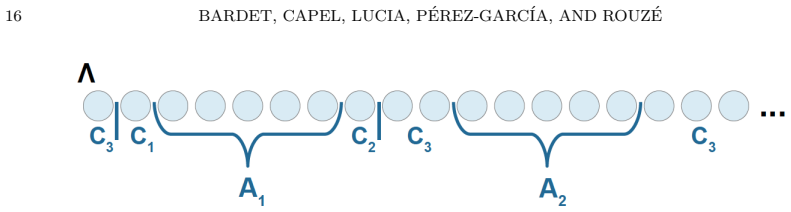
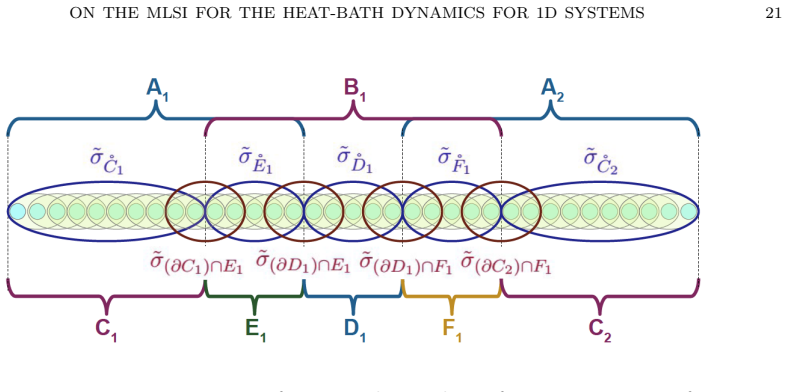
The load-bearing object is the conditional modified logarithmic Sobolev constant, $\alpha_\Lambda(L^*_A) = \inf_\rho \mathrm{EP}_A(\rho)/(2D_A(\rho\|\sigma_\Lambda))$, where $\mathrm{EP}_A$ is the entropy production of the heat-bath generator restricted to $A$ and $D_A$ is the conditional relative entropy. The proof machinery also rests on a geometric splitting of the one-dimensional chain into overlapping fixed-size segments $A_i, B_i$ whose pairwise intersections have length $l$, on a quasi-factorization inequality bounding $D(\rho\|\sigma)$ by $D_A + D_B$ times a factor controlled by the mixing condition, and on Lemma 4, which shows each single-site entropy production dominates the single-site conditional relative entropy. Theorem 6 shows that recovery on a region is equivalent to recovery on every site of that region, which is what lets the argument pass from block statements to per-site statements. These pieces combine to reduce a global inequality on a chain of arbitrary length to finitely many inequalities on blocks of fixed size.
What would settle it
Find one 1D commuting-Hamiltonian Gibbs state satisfying the mixing condition for which the strong quasi-factorization quotient $\sup_\rho D_{AB}(\rho\|\sigma_\Lambda)/(D_A(\rho\|\sigma_\Lambda)+D_B(\rho\|\sigma_\Lambda))$ is finite yet grows without bound as $|\Lambda|$ increases, with $A$ and $B$ adjacent fixed-size blocks; that would falsify Assumption 2 for that state while leaving the mixing condition intact. More directly, any explicit state $\rho$ violating inequality (37) for a commuting-Hamiltonian Gibbs state would show the theorem's hypothesis fails.
Extended reading notes
Core claim
The central claim is Theorem 7: for a finite chain $\Lambda$, a $k$-local commuting potential, and its Gibbs state $\sigma_\Lambda$, if the mixing condition (Assumption 1) and the strong quasi-factorization (Assumption 2) hold, then the modified logarithmic Sobolev constant $\alpha(L^*_\Lambda)$ of the heat-bath generator is strictly positive and independent of $|\Lambda|$. The heat-bath generator is the sum over sites of Petz recovery maps for the partial trace; the assumptions are static properties of the Gibbs state. The proof decomposes $\Lambda$ into two families of fixed-size overlapping segments, bounds the global relative entropy by a sum of conditional relative entropies on those segments using a quasi-factorization inequality with an error term controlled by the mixing condition, and then bounds each conditional relative entropy by the corresponding entropy production using Assumption 2 and a per-site data-processing inequality. The paper is explicit that the strong quasi-factorization is the part for which no non-trivial example is currently known.
Load-bearing premise
The argument stands or falls on Assumption 2, the strong quasi-factorization bound with a finite, size-independent constant $f_X(\sigma_\Lambda)$, for which the paper supplies no non-trivial example; the authors explicitly state that the only known case is the tensor-product fixed point, where the theorem was already known.
Editorial extensions
If this is right
- If Assumptions 1 and 2 hold, every initial state converges to the Gibbs state in trace norm with an exponential rate $\alpha$ independent of $|\Lambda|$; the paper recalls that this gives rapid mixing, an exponential improvement over the bound provided by a spectral gap.
- Rapid mixing for the heat-bath dynamics implies, by previously known results cited in the paper, stability of the fixed point against perturbations and a mutual-information area law for the fixed point.
- The proof shows the global MLSI constant is at least $\tilde K$ times the minimum conditional MLSI constant on fixed-size blocks, so checking positivity of MLSI becomes a finite, size-independent verification task.
- As a byproduct, the paper's Theorem 6 gives a criterion: a state is recoverable from a region if and only if it is recoverable from each site in that region, which is a property of Gibbs states of commuting Hamiltonians.
Reading between the lines
- The theorem is conditional in a way that matters: Section 5.2 and Question 1 concede that the only known instance of Assumption 2 is a tensor-product Gibbs state, for which MLSI positivity was already known; if no non-trivial commuting-Hamiltonian Gibbs state satisfies the assumption, Theorem 7 adds no new example.
- Section 5.2 shows that nearby any state close to the identity, only an additive-error quasi-factorization follows; this suggests a testable route to counterexamples — numerically evaluate the quotient $D_{AB}/(D_A+D_B)$ for adjacent blocks in small non-trivial chains (for instance, transverse-field Ising or XXZ chains) to see whether the multiplicative bound can hold.
- The dependence on the quantum Markov chain structure of Gibbs states, rather than on 1D geometry alone, suggests the same block-splitting strategy might transfer to other geometries where the Gibbs state has the shielding property; the obstruction to dimension two is the lack of a three-way quasi-factorization, which the authors note is open.
- If a non-trivial example satisfying Assumption 2 is found, the five-step strategy would immediately give the first size-independent MLSI constant for heat-bath dynamics beyond the tensor-product case; the paper notes that a modified version of this strategy already worked for Schmidt generators.
Signed reviews
Editorial analysis
A structured set of objections, weighed in public.
Referee Report
Summary. This paper develops a strategy for proving positivity of the modified logarithmic Sobolev (MLSI) constant for the heat-bath generator associated with a 1D commuting local Hamiltonian, conditional on two assumptions on the Gibbs state: an exponential clustering/mixing condition (Assumption 1) and a strong quasi-factorization of the conditional relative entropy (Assumption 2). Theorem 7 states that if both assumptions hold, the MLSI constant is strictly positive and independent of the chain length. The proof has four steps: a quasi-factorization bound in terms of conditional relative entropies on two overlapping regions, a decomposition of the conditional relative entropy into fixed-size regions using the quantum Markov network property, a comparison of the global entropy production with the conditional entropy productions under Assumption 1, and a lower bound on the conditional MLSI constants using Lemma 4 and Assumption 2. Section 5 discusses the two assumptions, and Section 6 lists open problems, including the lack of non-trivial examples for Assumption 2.
Significance. The four-step proof of Theorem 7 is careful and, as far as I can check, logically valid. The introduction of a conditional MLSI constant and the use of the quantum Markov network structure of commuting-Hamiltonian Gibbs states to cancel boundary logarithms are useful techniques that may be applicable beyond this setting. The technical results Theorem 6 and Corollary 3 are of independent interest. If Assumption 2 is ever verified for a genuinely quantum, non-product Gibbs state, the result would give the first size-independent positive MLSI constant for heat-bath dynamics in 1D, with implications for rapid mixing. However, the paper currently provides no such verification: Section 5.2 and Section 6, Question 1 state explicitly that the only known case is the tensor-product fixed point, for which the conclusion was already known from [8]. Thus the significance of the paper depends on an open assumption, and the advertised 1D result is not yet instantiated beyond the classical/tensor-product regime. The authors are honest about this limitation, but the abstract and title currently overstate what is demonstrated.
major comments (2)
- [Section 5.2, Eq. (37); Section 6, Question 1] The central result is gated by Assumption 2, yet no non-tensor-product Gibbs state satisfying it is exhibited. The text explicitly states that 'we lack a proof that, in general, it satisfies the necessary conditions for (37) to hold' and Question 1 records that the only known example is a tensor-product fixed point with f=1, exactly the case where MLSI positivity was already established in [8]. Consequently, Theorem 7 does not currently apply to any genuinely quantum, non-product Gibbs state of a 1D commuting Hamiltonian, and the abstract's 'In particular ... for 1D systems' overstates what is established. I request either a non-trivial example, or a proof of (37) for a concrete class of commuting Hamiltonians, or a substantial reframing of the paper as a conditional strategy with the open status of Assumption 2 stated in the abstract.
- [Section 5.2, final paragraph] The authors' own analysis shows that the high-temperature perturbation argument, which works for Assumption 1 in Proposition 6, fails for Assumption 2: it yields only an additive bound D_AB(rho||sigma) <= D_A(rho||sigma) + D_B(rho||sigma) + 3 log((1+epsilon)/(1-epsilon)), which the text correctly notes cannot be used to prove positivity of an MLSI constant. This reinforces Major Comment 1 and should be acknowledged prominently, so that readers do not infer that the assumptions are known to be satisfiable in the quantum regime.
minor comments (4)
- [Step 4, p. 19] The sentence 'only depends on sigma_Lambda and does depend on the size of Lambda' appears to contain a typo; the context and the desired independence of |Lambda| indicate it should read 'does not depend on the size of Lambda'.
- [Section 5.1, Proposition 7] The proof of Proposition 7 is sketched rather than fully rigorous; in particular, the derivation of the bounds on the normalization constant Z and the passage from (33) to (A1-weaker) via (34) are not displayed in detail. Since this is one of the few concrete illustrations of Assumption 1, an expanded proof would improve reproducibility.
- [Introduction, p. 3] There is a typo: 'analyizing' should be 'analyzing'.
- [General] The figures are referenced in the proof but the captions are minimal; defining the labels Ai, Bi, Ci, Di, Ei, Fi in the captions would make Sections 4 and 5 easier to follow.
Circularity Check
No circularity: Theorem 7 is an explicit conditional theorem, and the admitted lack of nontrivial examples of Assumption 2 is an applicability gap, not a circular derivation.
full rationale
The derivation chain is non-circular. Theorem 7 states a conditional implication: if the Gibbs state satisfies Assumption 1 (mixing condition) and Assumption 2 (strong quasi-factorization), then the heat-bath MLSI constant is positive and size-independent. The proof proceeds by four explicit steps: Step 1 bounds the global relative entropy by two conditional relative entropies using a quasi-factorization inequality from [8]/[9]; Step 2 decomposes a conditional relative entropy over a fixed-size partition using the quantum Markov chain structure of commuting-Hamiltonian Gibbs states (Corollary 1 and Proposition 5); Step 3 converts the conditional relative entropy bounds into a lower bound on the global MLSI constant using Assumption 1; Step 4 lower-bounds the conditional MLSI constant on each fixed-size region via Lemma 4 (which follows from data processing) together with Assumption 2. None of these steps assumes the positivity of the global MLSI constant; Assumption 2 is an explicitly stated hypothesis, not a re-labeling of the conclusion. The self-citations to [8] and [9] are load-bearing in Step 1, but they are independent published mathematical results with their own proofs and do not contain the target theorem; they are not invoked as a uniqueness theorem or as an unverified ansatz. The paper is transparent that Assumption 2 is not known to hold in interesting quantum cases: Section 5.2 states 'we lack a proof that, in general, it satisfies the necessary conditions for (37) to hold' and defers examples to future work, and Section 6, Question 1 records that the only known instance is a tensor-product fixed point. This is an honest limitation about instantiation, not a circularity: the conditional logic remains valid. Therefore no step reduces, by the paper's own equations or by self-citation, to its own input.
Assumptions & free parameters
assumptions (5)
- ad hoc to paper Assumption 1 (Mixing condition): for C,D unions of disjoint finite segments, ||sigma_C^{-1/2} tensor sigma_D^{-1/2} sigma_CD sigma_C^{-1/2} tensor sigma_D^{-1/2} - 1_CD||_inf <= K1 e^{-K2 d(C,D)} with K1,K2 independent of Lambda.
- ad hoc to paper Assumption 2 (Strong quasi-factorization): for every X subset Lambda and every state rho_Lambda, D_X(rho||sigma) <= f_X(sigma) sum_{x in X} D_x(rho||sigma), with f_X finite and independent of |Lambda|.
- domain assumption Gibbs states of k-local commuting Hamiltonians are quantum Markov networks (Theorem 3 of [6]): for disjoint A,B,C with B shielding A from C and d(A,C)>k, I_sigma(A:C|B)=0.
- domain assumption Equivalence of Dirichlet forms for heat-bath generators (Lemma 5 of [27]): constants c_A,C_A independent of Lambda satisfy c_A sum_x <f, f-E_x f>_sigma <= <f, f-E_A f>_sigma <= C_A sum_x <f, f-E_x f>_sigma.
- standard math Standard quantum information facts: strong subadditivity of von Neumann entropy, data processing inequality, Petz recovery map and equality conditions, additivity and superadditivity of relative entropy.
Cite this review
Pith. "Pith review of On the modified logarithmic Sobolev inequality for the heat-bath dynamics for 1D systems." pith.science (2026). https://pith.science/paper/ZJJQDIS7
@misc{pith2026190809004,
  author       = {Pith},
  title        = {Pith review of: On the modified logarithmic Sobolev inequality for the heat-bath dynamics for 1D systems},
  year         = {2026},
  howpublished = {\url{https://pith.science/paper/ZJJQDIS7}},
  note         = {Machine review of arXiv:1908.09004}
}
read the original abstract
The mixing time of Markovian dissipative evolutions of open quantum many-body systems can be bounded using optimal constants of certain quantum functional inequalities, such as the modified logarithmic Sobolev constant. For classical spin systems, the positivity of such constants follows from a mixing condition for the Gibbs measure, via quasi-factorization results for the entropy. Inspired by the classical case, we present a strategy to derive the positivity of the modified logarithmic Sobolev constant associated to the dynamics of certain quantum systems from some clustering conditions on the Gibbs state of a local, commuting Hamiltonian. In particular we show that for the heat-bath dynamics for 1D systems, the modified logarithmic Sobolev constant is positive under the assumptions of a mixing condition on the Gibbs state and a strong quasi-factorization of the relative entropy.
Figures


Figures from the paper (1 more)
Reference graph
Works this paper leans on
- [8]
-
[1]
I. Bardet. Estimating the decoherence time using non-commutative functional inequalities. preprint, arxiv:1710.01039, 2017
arXiv 2017
-
[2]
Approximate tensorization of the relative entropy for noncommuting conditional expectations
I. Bardet, A. Capel, and C. Rouz´ e. Approximate tensorization of the relative entropy for noncommut- ing conditional expectations. arXiv preprint, arXiv:2001.07981 , 2020
work page Pith review arXiv 2001
- [3]
-
[4]
L. Bertini, N. Cancrini, and F. Cesi. The spectral gap for a glauber-type dynamics in a continuous gas. Ann. Inst. Henri Poincare , 38:91171908, 2002
work page 2002
-
[5]
F. G. S. L. Brandao, T. S. Cubitt, A. Lucia, S. Michalakis, and D. Perez-Garcia. Area law for fixed points of rapidly mixing dissipative quantum systems. J. Math. Phys. , 56:102202, Oct 2015
work page 2015
-
[6]
W. Brown and D. Poulin. Quantum markov networks and commuting hamiltonians. preprint, arXiv:1206.0755, 2012
arXiv 2012
-
[7]
A. Capel. Quantum Logarithmic Sobolev Inequalities for Quantum Many-Body Systems: An approach via Quasi-Factorization of the Relative Entropy . Ph.D. thesis at Universidad Aut´ onoma de Madrid, 2019
work page 2019
Show all 38 references
-
[9]
Capel, A
A. Capel, A. Lucia, and D. P´ erez-Garc´ ıa. Superadditivity of quantum relative entropy for general states. IEEE Trans. Inf. Theory , 64(7):4758–4765, 2018
2018
-
[10]
Capel, C
A. Capel, C. Rouz´ e, and D. Stilck Fran¸ ca. The modified logarithmic Sobolev inequality for quantum spin systems: classical and commuting nearest neighbour interactions. arXiv preprint, arXiv:2009.11817, 2020. ON THE MLSI FOR THE HEAT-BATH DYNAMICS FOR 1D SYSTEMS 27
2009 arXiv
-
[11]
F. Cesi. Quasi-factorization of the entropy and logarithmic sobolev inequalities for gibbs random fields. Probab. Theory Relat. Fields , 120:569–584, 2001
2001
-
[12]
T. S. Cubitt, A. Lucia, S. Michalakis, and D. Perez-Garcia. Stability of Local Quantum Dissipative Systems. Commun. Math. Phys. , 337(3):1275–1315, apr 2015
2015
-
[13]
Dai Pra, A
P. Dai Pra, A. M. Paganoni, and G. Posta. Entropy inequalities for unbounded spin systems. Ann. Probab., 30(4):1959–1976, 10 2002
1959
-
[14]
E. B. Davies. Generators of dynamical semigroups. J. Funct. Anal. , 34(3):421–432, 1979
1979
-
[15]
Dobrushin
R. Dobrushin. Description of a random field by means of conditional probabilities and the conditions governing its regularity. Theor. Probab. Appl. , 13:1977224, 1968
1968
-
[16]
Dobrushin and S
R. Dobrushin and S. B. Shlosman. Constructive criterion for the uniqueness of gibbs field. Statistical Physics and Dynamical Systems , pages 347–370, 1985
1985
-
[17]
Dobrushin and S
R. Dobrushin and S. B. Shlosman. Complete analytical interactions: Constructive description. J. Stat. Phys., 46:983–1014, 1987
1987
-
[18]
Fannes and R
M. Fannes and R. Werner. Boundary conditions for quantum lattice systems. preprint, arXiv:9504090, 1995
1995
-
[19]
Gorini, A
V. Gorini, A. Kossakowski, and E. C. G. Sudarshan. Complete positive dynamical semigroups of n-level systems. J. Math. Phys. , 17:821, 1976
1976
-
[20]
Hayden, R
P. Hayden, R. Jozsa, D. Petz, and A. Winter. Structure of states which satisfy strong subadditivity of quantum entropy with equality. Commun. Math. Phys. , 246(2):359–374, Apr 2004
2004
-
[21]
M. J. Kastoryano and F. G. S. L. Brand˜ ao. Quantum Gibbs samplers: The commuting case.Commun. Math. Phys. , 344(3):915–957, Jun 2016
2016
-
[22]
M. J. Kastoryano and K. Temme. Quantum logarithmic Sobolev inequalities and rapid mixing. J. Math. Physics , 54(5), 2013
2013
-
[23]
Kraus, H
B. Kraus, H. B¨ uchler, S. Diehl, A. Kantian, A. Micheli, and P. Zoller. Preparation of entangled states by quantum markov processes. Phys. Rev. A , 78:042307, 2013
2013
-
[24]
Lanford and D
O. Lanford and D. Ruelle. Observables at infinity and states with short range correlations in statistical mechanics. Commun. Math. Phys. , 13:19417215, 1969
1969
-
[25]
E. H. Lieb and M. B. Ruskai. Proof of the strong subadditivity of quantum mechanical entropy. J. Math. Phys. , 14:1938–1941, 1973
1938
-
[26]
Lindblad
G. Lindblad. On the generators of quantum dynamical semigroups. Commun. Math. Phys. , 48(2):119– 130, 1976
1976
-
[27]
Majewski, R
A. Majewski, R. Olkiewicz, and B. Zegarlinski. Dissipative dynamics for quantum spin systems on a lattice. J. Phys. A: Math. Gen. , 31:2045, 1998
1998
-
[28]
Martinelli
F. Martinelli. Lectures on glauber dynamics for discrete spin models. Lectures on Probability Theory and Statistics. Lecture Notes in Math , 1717:93–191, 1999
1999
-
[29]
Martinelli and E
F. Martinelli and E. Olivieri. Approach to equilibrium of glauber dynamics in the one phase region i: The attractive case. Commun. Math. Phys. , 161:447, 1994
1994
-
[30]
Michalakis and J
S. Michalakis and J. Pytel. Stability of frustration free hamiltonians. Commun. Math. Phys. , 332(2):277–302, 2013
2013
-
[31]
Mueller, E
M. Mueller, E. Adlam, L. Masanes, and N. Wiebe. Thermalization and canonical typicality in trans- lationinvariant quantum lattice systems. Commun. Math. Phys. , 340(2):499–561, 2015
2015
-
[32]
Ohya and D
M. Ohya and D. Petz. Quantum Entropy and Its Use . Springer Verlag, Berlin, texts and monographs in physics edition, 1993
1993
-
[33]
D. Petz. Sufficient subalgebras and the relative entropy of states of a von neumann algebra. Commun. Math. Phys. , 105(1):123–131, 1986
1986
-
[34]
D. Petz. Monotonicity of quantum relative entropy revisited. Rev. Math. Phys. , 15:79–91, 2003
2003
-
[35]
Riera, C
A. Riera, C. Gogolin, and J. Eisert. Thermalization in nature and on a quantum computer. Phys. Rev. Lett., 108:080402, 2012
2012
-
[36]
Temme, M
K. Temme, M. J. Kastoryano, M. B. Ruskai, M. M. Wolf, and F. Verstraete. The χ2-divergence and mixing times of quantum Markov processes. J. Math. Phys. , 51(12), 2010
2010
-
[37]
Verstraete, M
F. Verstraete, M. Wolf, and J. Cirac. Quantum computation, quantum state engineering, and quantum phase transitions driven by dissipation. Nat. Phys. , 5:633–636, 2009
2009
-
[38]
A. Wehrl. General properties of entropy. Rev. Mod. Phys. , 50(2):221–260, 1978. (Bardet) Inria Paris, France Email address : bardetivan@gmail.com 28 BARDET, CAPEL, LUCIA, P ´EREZ-GARC´IA, AND ROUZ ´E (Capel) Instituto de Ciencias Matem´aticas (CSIC-UAM-UC3M-UCM), C/ Nicol ´as ...
1978
Reviewed August 14, 2026 · model on record in the stance chip above.
Discussion (0). Continue with ORCID to comment.