REVIEW 2 major objections 2 minor 88 references
Inclusive charm and bottom quark pair production cross sections at hadron colliders at next-to-next-to-leading-order accuracy
T0 review · 2 major / 2 minor · reviewed 2026-05-20 · grok-4.3
Pith's one-line read NNLO QCD calculations enhance charm and bottom quark pair production cross sections by up to a factor of two.
desk verdict NNLO calculations with the new MaunaKea code boost heavy-quark pair cross sections by up to a factor of two and tighten scale uncertainties, but the low-energy convergence claim needs closer checks. read the letter →
The pith
A machine-rendered reading of the paper's core claim, the machinery that carries it, and where it could break.
The reading
What carries the argument
Fixed-order next-to-next-to-leading-order perturbative QCD computations of heavy-quark pair production cross sections, performed with different sets of parton distribution functions.
What would settle it
An experimental measurement of the charm pair production cross section at a center-of-mass energy of about 10 GeV that lies well outside the NNLO uncertainty range but inside the NLO range would show that the NNLO approximation breaks down at low energies.
Extended reading notes
Core claim
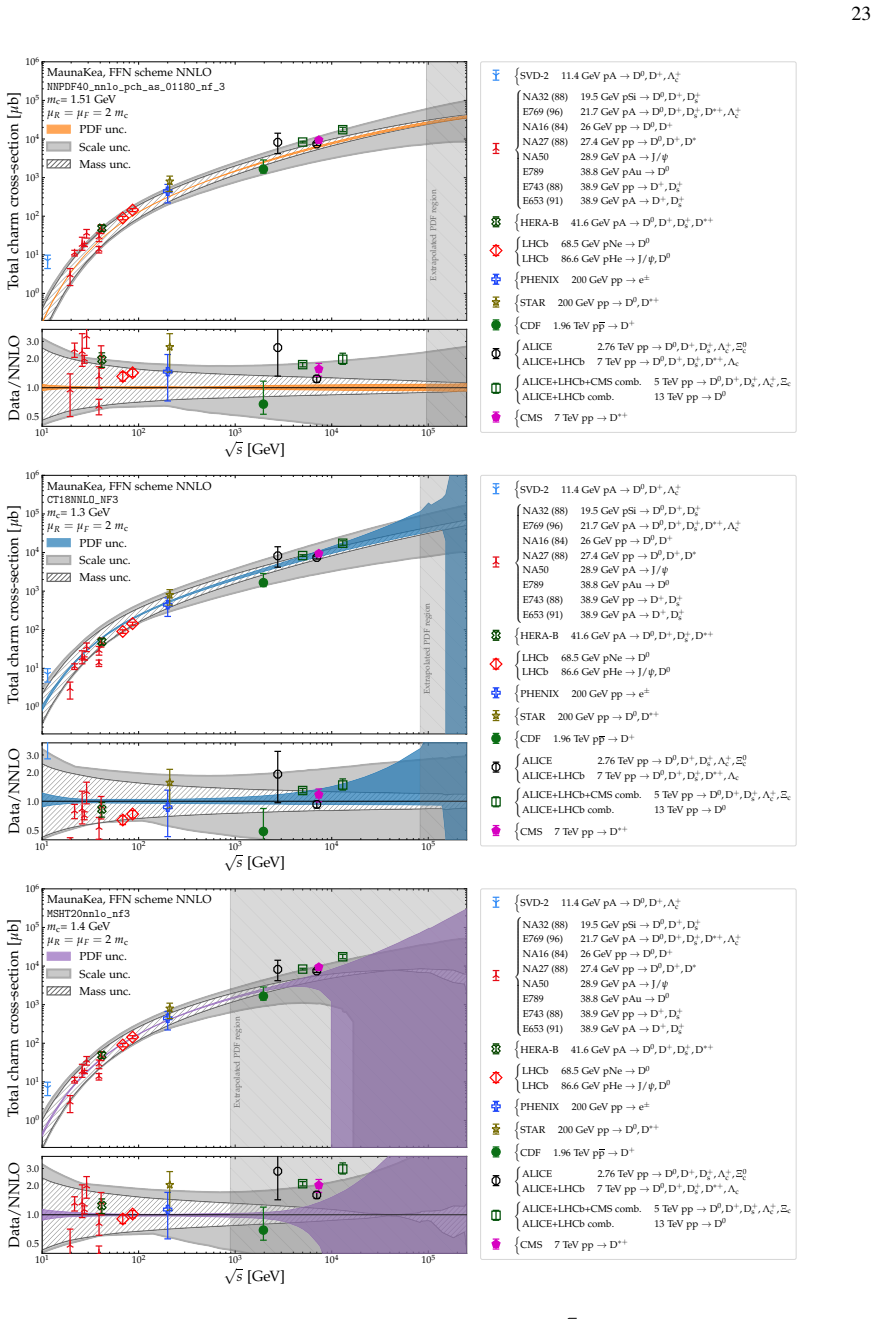
At next-to-next-to-leading order in perturbative QCD, the inclusive cross sections for charm and bottom quark pair production are larger by up to a factor of two than at next-to-leading order, with correspondingly smaller scale uncertainties. These NNLO predictions agree with experimental measurements across the full range of available collision energies from approximately 10 GeV to 14 TeV. The calculations also allow for potential constraints on the small-x gluon distribution from multi-TeV charm data and on the bottom-quark pole mass from low-energy bottom data.
Load-bearing premise
The perturbative expansion in QCD converges sufficiently well at NNLO even at low collision energies around 10 GeV, and the chosen parton distributions and quark masses do not introduce large biases for this process.
Editorial extensions
If this is right
- NNLO results agree with experimental data over the entire energy range from 10 GeV to 14 TeV.
- Scale uncertainties in the theoretical predictions are reduced by up to a factor of two compared to NLO.
- Charm pair production cross sections at multi-TeV energies can provide additional constraints on the gluon density at very small x.
- More precise bottom pair production measurements at low energies can help determine the bottom-quark pole mass.
Reading between the lines
- Higher-order QCD corrections appear essential for describing heavy quark production accurately even at moderate collision energies.
- The same computational approach could be applied to predict cross sections at proposed future high-energy colliders.
- These NNLO results may encourage updates to global parton distribution fits that incorporate heavy quark data for better small-x determinations.
Editorial analysis
A structured set of objections, weighed in public.
Referee Report
Summary. The manuscript computes inclusive charm and bottom quark-antiquark pair production cross sections at NNLO accuracy using the new MaunaKea fixed-order code for pp, pA, and pbar p collisions over √s ≈ 10 GeV to 400 TeV. It collects all existing data up to 14 TeV, reports up to factor-of-two enhancement relative to NLO with correspondingly reduced scale uncertainties, demonstrates agreement with data across the energy range, compares to NLO SACOT-mT GM-VFNS predictions, and discusses prospective constraints on small-x gluons from high-energy ccbar data and on the bottom pole mass from low-energy bbbar data.
Significance. If the NNLO results hold, the work supplies the first comprehensive fixed-order NNLO benchmark for heavy-quark pair production over a wide kinematic range, strengthens the case for using such data in global PDF fits at small x, and offers a path to tighter bottom-mass constraints; the open-source MaunaKea implementation and explicit data compilation are additional strengths that would facilitate reproducibility and further phenomenological studies.
major comments (2)
- [Results section (low-energy comparisons)] The headline claim of controlled NNLO enhancement (up to ×2) and data agreement at the lowest energies (√s ≈ 10 GeV) rests on the assumption that the perturbative series remains reliable when the hard scale is set by m_c ≈ 1.5 GeV and α_s(m_c) ≈ 0.3; the manuscript should provide explicit comparisons at these points to threshold-resummed or GM-VFNS calculations to quantify the size of power-suppressed corrections.
- [PDF dependence and discussion of future constraints] The PDFs employed are taken from prior global fits that already incorporate some heavy-quark production data; the manuscript should quantify the degree of interdependence when proposing that the new NNLO ccbar results can furnish additional small-x gluon constraints, for example by repeating the comparison with PDFs fitted after removal of existing heavy-flavor data.
minor comments (2)
- [Abstract] The abstract would be strengthened by quoting at least one or two representative numerical enhancement factors and uncertainty reductions at specific energies rather than stating only the maximum values.
- [Methods / computational setup] Notation for the heavy-quark pole masses and the precise definition of the central scale choice should be stated explicitly in the methods section to allow direct reproduction of the quoted results.
Simulated Author's Rebuttal
We thank the referee for the positive overall assessment and the constructive major comments. We address each point below and have revised the manuscript accordingly where feasible to strengthen the presentation.
read point-by-point responses
-
Referee: [Results section (low-energy comparisons)] The headline claim of controlled NNLO enhancement (up to ×2) and data agreement at the lowest energies (√s ≈ 10 GeV) rests on the assumption that the perturbative series remains reliable when the hard scale is set by m_c ≈ 1.5 GeV and α_s(m_c) ≈ 0.3; the manuscript should provide explicit comparisons at these points to threshold-resummed or GM-VFNS calculations to quantify the size of power-suppressed corrections.
Authors: We appreciate the referee drawing attention to the perturbative reliability at the lowest energies. While α_s(m_c) ≈ 0.3 indicates that higher-order corrections are sizable, the observed reduction in scale uncertainty from NLO to NNLO and the improved agreement with data support the stability of the expansion. To address the request, we have added explicit low-energy comparisons to the existing NLO SACOT-mT GM-VFNS results in the revised Results section, together with a quantitative discussion of the expected size of power-suppressed corrections drawn from threshold-resummation studies in the literature. A complete NNLO threshold-resummed calculation for the inclusive cross section is not yet available in the literature, but the added material now quantifies the relevant corrections more clearly. revision: partial
-
Referee: [PDF dependence and discussion of future constraints] The PDFs employed are taken from prior global fits that already incorporate some heavy-quark production data; the manuscript should quantify the degree of interdependence when proposing that the new NNLO ccbar results can furnish additional small-x gluon constraints, for example by repeating the comparison with PDFs fitted after removal of existing heavy-flavor data.
Authors: We agree that the PDFs used already contain some heavy-flavor data and that this creates a degree of interdependence when advocating for additional small-x constraints. Performing a new global PDF fit after explicitly removing all existing heavy-flavor data is a major computational effort that lies outside the scope of the present phenomenological study. In the revised manuscript we have expanded the discussion to explicitly acknowledge this interdependence, to note that the NNLO results are intended as supplementary input for future dedicated fits, and to illustrate sensitivity by comparing several PDF sets that differ in their heavy-flavor treatment. revision: partial
Circularity Check
Fixed-order NNLO computation of heavy-quark pair production using external PDFs and MaunaKea code
full rationale
The paper computes inclusive c cbar and b bbar cross sections at NNLO accuracy via the MaunaKea code over a wide energy range and compares the results directly to collected experimental data. PDFs and quark masses are taken as inputs from prior global fits; the present work performs no new fit and presents the NNLO enhancement and uncertainty reduction as outcomes of the perturbative calculation itself. The forward-looking remark that the results could constrain small-x gluons in future PDF analyses is not part of the derivation chain or used to justify any current claim. No self-definitional loop, fitted parameter renamed as prediction, or load-bearing self-citation appears in the abstract or described content. The derivation is therefore self-contained as a standard perturbative QCD evaluation against external benchmarks.
Assumptions & free parameters
free parameters (2)
- renormalization and factorization scales
- heavy quark pole masses
assumptions (1)
- domain assumption Fixed-order perturbative QCD expansion converges sufficiently at NNLO for these processes over the full energy range
Cite this review
Pith. "Pith review of Inclusive charm and bottom quark pair production cross sections at hadron colliders at next-to-next-to-leading-order accuracy." pith.science (2026). https://pith.science/paper/ZK3F36DO
@misc{pith2026260516019,
  author       = {Pith},
  title        = {Pith review of: Inclusive charm and bottom quark pair production cross sections at hadron colliders at next-to-next-to-leading-order accuracy},
  year         = {2026},
  howpublished = {\url{https://pith.science/paper/ZK3F36DO}},
  note         = {Machine review of arXiv:2605.16019}
}
abstract
The inclusive cross sections for charm ($\mathrm{c}\overline{\mathrm{c}}$) and bottom ($\mathrm{b}\overline{\mathrm{b}}$) quark-antiquark pair production in proton-proton, proton-antiproton, and proton-nucleus collisions are studied over a wide range of center-of-mass energies, $\sqrt{s}\approx 10$ GeV--400 TeV. All existing data over $\sqrt{s}\approx 10$ GeV--14 TeV are collected and compared to calculations at next-to-next-to-leading-order (NNLO) accuracy using the new fixed-order MaunaKea open-source code for varying sets of parton distribution functions (PDFs). Relative to next-to-leading-order (NLO) predictions, the NNLO cross sections are enhanced by up to a factor of two, with the associated theoretical scale uncertainties reduced by the same amount, leading to agreement with experimental data over the full range of collision energies. The NNLO results are also compared with NLO predictions obtained within the SACOT-$m_{_\mathrm{T}}$ general-mass variable-flavour-number scheme. Despite still sizable theoretical and experimental uncertainties, $\mathrm{c}\overline{\mathrm{c}}$ cross section at multi-TeV energies can provide extra constraints on the gluon density at very small-$x$ in global PDF analyses. In the bottom sector, more precise cross section measurements at low energies, $\sqrt{s}\approx 10$--100 GeV, can help constraint the bottom-quark pole mass.
Figures


Figures from the paper (12 more)




Reference graph
Works this paper leans on
- [1]
-
[2]
Les Houches 2023: Physics at TeV Colliders: Standard Model Working Group Report,
J. Andersenet al., “Les Houches 2023: Physics at TeV Colliders: Standard Model Working Group Report,” inPhysics of the TeV Scale and Beyond the Standard Model: Intensifying the Quest for New Physics. June, 2024.arXiv:2406.00708 [hep-ph]
-
[3]
Les Houches 2023 -- Physics at TeV Colliders: Report on the Standard Model Precision Wishlist
A. Huss, J. Huston, S. Jones, M. Pellen, and R. R ¨ontsch, “Les Houches 2023 – Physics at TeV Colliders: Report on the Standard Model Precision Wishlist,”arXiv:2504.06689 [hep-ph]
work page Pith review arXiv 2023
-
[4]
F. Caola, W. Chen, C. Duhr, X. Liu, B. Mistlberger, F. Petriello, G. Vita, and S. Weinzierl, “The Path forward to N3LO,” in Snowmass 2021. 3, 2022.arXiv:2203.06730 [hep-ph]. [5]Particle Data GroupCollaboration, S. Navaset al., “Review of particle physics,”Phys. Rev. D110(2024) 030001
-
[5]
Factorization of Hard Processes in QCD
J. C. Collins, D. E. Soper, and G. F. Sterman, “Factorization of Hard Processes in QCD,”Adv. Ser . Direct. High Energy Phys.5(1989) 1–91,arXiv:hep-ph/0409313
work page Pith review arXiv 1989
-
[6]
Deep inelastic e p scattering in perturbation theory,
V . N. Gribov and L. N. Lipatov, “Deep inelastic e p scattering in perturbation theory,”Sov. J. Nucl. Phys.15(1972) 438–450
work page 1972
-
[7]
Y . L. Dokshitzer, “Calculation of the Structure Functions for Deep Inelastic Scattering and e+e− Annihilation by Perturbation Theory in Quantum Chromodynamics.,”Sov. Phys. JETP46(1977) 641–653
work page 1977
-
[8]
Asymptotic Freedom in Parton Language,
G. Altarelli and G. Parisi, “Asymptotic Freedom in Parton Language,”Nucl. Phys. B126(1977) 298–318
work page 1977
Show all 88 references
-
[9]
HATHOR: HAdronic Top and Heavy quarks crOss section calculatoR,
M. Aliev, H. Lacker, U. Langenfeld, S. Moch, P. Uwer, and M. Wiedermann, “HATHOR: HAdronic Top and Heavy quarks crOss section calculatoR,”Comput. Phys. Commun.182(2011) 1034–1046,arXiv:1007.1327 [hep-ph]
2011 arXiv
-
[10]
Top++: A program for the calculation of the top-pair cross-section at hadron colliders,
M. Czakon and A. Mitov, “Top++: A program for the calculation of the top-pair cross-section at hadron colliders,”Comput. Phys. Commun.185(2014) 2930,arXiv:1112.5675 [hep-ph]
2014 arXiv
-
[11]
Total top-quark pair-production cross section at hadron colliders throughO(α4 s),
M. Czakon, P. Fiedler, and A. Mitov, “Total top-quark pair-production cross section at hadron colliders throughO(α4 s),” Phys. Rev. Lett.110(2013) 252004,arXiv:1303.6254 [hep-ph]
2013 arXiv
-
[12]
NNLO corrections to top pair production at hadron colliders: the quark-gluon reaction,
M. Czakon and A. Mitov, “NNLO corrections to top pair production at hadron colliders: the quark-gluon reaction,”JHEP 01(2013) 080,arXiv:1210.6832 [hep-ph]
2013 arXiv
-
[13]
Percent Level Precision Physics at the Tevatron: First Genuine NNLO QCD Corrections to qq→t t+X,
P. B ¨arnreuther, M. Czakon, and A. Mitov, “Percent Level Precision Physics at the Tevatron: First Genuine NNLO QCD Corrections to qq→t t+X,”Phys. Rev. Lett.109(2012) 132001,arXiv:1204.5201 [hep-ph]. [15]A TLASCollaboration, G. Aadet al., “Climbing to the Top of the ATLAS 13 T...
2012 arXiv
-
[14]
Parton distributions from LHC, HERA, Tevatron and fixed target data: MSHT20 PDFs,
S. Bailey, T. Cridge, L. A. Harland-Lang, A. D. Martin, and R. S. Thorne, “Parton distributions from LHC, HERA, Tevatron and fixed target data: MSHT20 PDFs,”Eur . Phys. J. C81(2021) 341,arXiv:2012.04684 [hep-ph]
2021
-
[15]
New CTEQ global analysis of quantum chromodynamics with high-precision data from the LHC,
T.-J. Houet al., “New CTEQ global analysis of quantum chromodynamics with high-precision data from the LHC,”Phys. Rev. D103(2021) 014013,arXiv:1912.10053 [hep-ph]
2021
-
[16]
NNLO PDFs driven by top-quark data,
S. Alekhin, M. V . Garzelli, S. O. Moch, and O. Zenaiev, “NNLO PDFs driven by top-quark data,”Eur . Phys. J. C85(2025) 162,arXiv:2407.00545 [hep-ph]. [21]CMSCollaboration, A. Hayrapetyanet al., “Review of top quark mass measurements in CMS,”Phys. Rept.1115(2025) 116–218,arXiv:...
2025
-
[17]
Determination of the strong coupling constantα s(mZ) from measurements of the total cross section for top-antitop quark production,
T. Klijnsma, S. Bethke, G. Dissertori, and G. P. Salam, “Determination of the strong coupling constantα s(mZ) from measurements of the total cross section for top-antitop quark production,”Eur . Phys. J. C77(2017) 778, arXiv:1708.07495 [hep-ph]. [23]CMSCollaboration, A. M. Sir...
2017 arXiv
-
[18]
The strong coupling constant: state of the art and the decade ahead,
D. d’Enterriaet al., “The strong coupling constant: state of the art and the decade ahead,”J. Phys. G51(2024) 090501, arXiv:2203.08271 [hep-ph]
2024
-
[19]
Heavy quark correlations in hadron collisions at next-to-leading order,
M. L. Mangano, P. Nason, and G. Ridolfi, “Heavy quark correlations in hadron collisions at next-to-leading order,”Nucl. Phys. B373(1992) 295–345
1992
-
[20]
Thep T spectrum in heavy-flavour hadroproduction,
M. Cacciari, M. Greco, and P. Nason, “Thep T spectrum in heavy-flavour hadroproduction,”JHEP05(1998) 007, arXiv:hep-ph/9803400
1998 arXiv
-
[21]
InclusiveD ∗± production in p¯p collisions with massive charm quarks,
B. A. Kniehl, G. Kramer, I. Schienbein, and H. Spiesberger, “InclusiveD ∗± production in p¯p collisions with massive charm quarks,”Phys. Rev. D71(2005) 014018,arXiv:hep-ph/0410289
2005 arXiv
-
[22]
Collinear subtractions in hadroproduction of heavy quarks,
B. A. Kniehl, G. Kramer, I. Schienbein, and H. Spiesberger, “Collinear subtractions in hadroproduction of heavy quarks,” Eur . Phys. J. C41(2005) 199–212,arXiv:hep-ph/0502194
2005 arXiv
-
[23]
Finite-mass effects on inclusiveBmeson hadroproduction,
B. A. Kniehl, G. Kramer, I. Schienbein, and H. Spiesberger, “Finite-mass effects on inclusiveBmeson hadroproduction,” Phys. Rev. D77(2008) 014011,arXiv:0705.4392 [hep-ph]
2008 arXiv
-
[24]
Inclusive B-Meson Production at the LHC in the GM-VFN Scheme,
B. A. Kniehl, G. Kramer, I. Schienbein, and H. Spiesberger, “Inclusive B-Meson Production at the LHC in the GM-VFN Scheme,”Phys. Rev. D84(2011) 094026,arXiv:1109.2472 [hep-ph]. 41
2011 arXiv
-
[25]
Revisiting the D-meson hadroproduction in general-mass variable flavour number scheme,
I. Helenius and H. Paukkunen, “Revisiting the D-meson hadroproduction in general-mass variable flavour number scheme,” JHEP05(2018) 196,arXiv:1804.03557 [hep-ph]
2018 arXiv
-
[26]
A general-mass scheme for prompt charm production at hadron colliders,
K. Xie, J. M. Campbell, and P. M. Nadolsky, “A general-mass scheme for prompt charm production at hadron colliders,” SciPost Phys. Proc.8(2022) 084,arXiv:2108.03741 [hep-ph]
2022
-
[27]
B-meson hadroproduction in the SACOT-mT scheme,
I. Helenius and H. Paukkunen, “B-meson hadroproduction in the SACOT-mT scheme,”JHEP07(2023) 054, arXiv:2303.17864 [hep-ph]
2023
-
[28]
Theoretical predictions for charm and bottom production at the LHC,
M. Cacciari, S. Frixione, N. Houdeau, M. L. Mangano, P. Nason, and G. Ridolfi, “Theoretical predictions for charm and bottom production at the LHC,”JHEP10(2012) 137,arXiv:1205.6344 [hep-ph]
2012 arXiv
-
[29]
Gluon PDF constraints from the ratio of forward heavy-quark production at the LHC at √ S=7 and 13 TeV,
M. Cacciari, M. L. Mangano, and P. Nason, “Gluon PDF constraints from the ratio of forward heavy-quark production at the LHC at √ S=7 and 13 TeV,”Eur . Phys. J. C75(2015) 610,arXiv:1507.06197 [hep-ph]
2015 arXiv
-
[30]
Matching NLO QCD computations with Parton Shower simulations: the POWHEG method,
S. Frixione, P. Nason, and C. Oleari, “Matching NLO QCD computations with Parton Shower simulations: the POWHEG method,”JHEP11(2007) 070,arXiv:0709.2092 [hep-ph]
2007 arXiv
-
[31]
A general framework for implementing NLO calculations in shower Monte Carlo programs: the POWHEG BOX,
S. Alioli, P. Nason, C. Oleari, and E. Re, “A general framework for implementing NLO calculations in shower Monte Carlo programs: the POWHEG BOX,”JHEP06(2010) 043,arXiv:1002.2581 [hep-ph]
2010 arXiv
-
[32]
PYTHIA 6.4 Physics and Manual,
T. Sjostrand, S. Mrenna, and P. Z. Skands, “PYTHIA 6.4 Physics and Manual,”JHEP05(2006) 026, arXiv:hep-ph/0603175
2006 arXiv
-
[33]
A comprehensive guide to the physics and usage of PYTHIA 8.3,
C. Bierlichet al., “A comprehensive guide to the physics and usage of PYTHIA 8.3,”SciPost Phys. Codeb.2022(2022) 8, arXiv:2203.11601 [hep-ph]
2022 arXiv
-
[34]
Bottom-quark production at hadron colliders: fully differential predictions in NNLO QCD,
S. Catani, S. Devoto, M. Grazzini, S. Kallweit, and J. Mazzitelli, “Bottom-quark production at hadron colliders: fully differential predictions in NNLO QCD,”JHEP03(2021) 029,arXiv:2010.11906 [hep-ph]
2021
-
[35]
B-hadron production in NNLO QCD: application to LHC tt events with leptonic decays,
M. L. Czakon, T. Generet, A. Mitov, and R. Poncelet, “B-hadron production in NNLO QCD: application to LHC tt events with leptonic decays,”JHEP10(2021) 216,arXiv:2102.08267 [hep-ph]
2021
-
[36]
B-hadron production at the LHC from bottom-quark pair production at NNLO+PS,
J. Mazzitelli, A. Ratti, M. Wiesemann, and G. Zanderighi, “B-hadron production at the LHC from bottom-quark pair production at NNLO+PS,”Phys. Lett. B843(2023) 137991,arXiv:2302.01645 [hep-ph]
2023
-
[37]
Open B-Hadron Production at Hadron Colliders in QCD at Next-to-Next-to-Leading-Order and Next-to-Next-to-Leading-Logarithmic Accuracy,
M. Czakon, T. Generet, A. Mitov, and R. Poncelet, “Open B-Hadron Production at Hadron Colliders in QCD at Next-to-Next-to-Leading-Order and Next-to-Next-to-Leading-Logarithmic Accuracy,”Phys. Rev. Lett.135(2025) 161903, arXiv:2411.09684 [hep-ph]
2025
-
[38]
Fully differential NNLO computations with MATRIX,
M. Grazzini, S. Kallweit, and M. Wiesemann, “Fully differential NNLO computations with MATRIX,”Eur . Phys. J. C78 (2018) 537,arXiv:1711.06631 [hep-ph]
2018 arXiv
-
[39]
Analytic NNLO transverse-momentum-dependent soft function for heavy quark pair hadroproduction at threshold,
H.-S. Shao and G. Wang, “Analytic NNLO transverse-momentum-dependent soft function for heavy quark pair hadroproduction at threshold,”JHEP10(2025) 164,arXiv:2506.23791 [hep-ph]
2025
-
[40]
Triple parton scatterings in high-energy proton-proton collisions,
D. d’Enterria and A. M. Snigirev, “Triple parton scatterings in high-energy proton-proton collisions,”Phys. Rev. Lett.118 (2017) 122001,arXiv:1612.05582 [hep-ph]
2017 arXiv
-
[41]
Triple-parton scatterings in proton–nucleus collisions at high energies,
D. d’Enterria and A. M. Snigirev, “Triple-parton scatterings in proton–nucleus collisions at high energies,”Eur . Phys. J. C 78(2018) 359,arXiv:1612.08112 [hep-ph]
2018 arXiv
-
[42]
A Critical Appraisal and Evaluation of Modern PDFs,
A. Accardiet al., “A Critical Appraisal and Evaluation of Modern PDFs,”Eur . Phys. J. C76(2016) 471, arXiv:1603.08906 [hep-ph]. [49]LHCbCollaboration, R. Aaijet al., “Prompt charm production in pp collisions at √s=7 TeV,”Nucl. Phys. B871(2013) 1–20,arXiv:1302.2864 [hep-ex]. [5...
2016 arXiv
-
[43]
Suppression of non-photonic electrons from enhancement of charm baryons in heavy ion collisions,
P. R. Sorensen and X. Dong, “Suppression of non-photonic electrons from enhancement of charm baryons in heavy ion collisions,”Phys. Rev. C74(2006) 024902,arXiv:nucl-th/0512042
2006 arXiv
-
[44]
Consequences of aΛ c/Denhancement effect on the non-photonic electron nuclear modification factor in central heavy ion collisions at RHIC energy,
G. Martinez-Garcia, S. Gadrat, and P. Crochet, “Consequences of aΛ c/Denhancement effect on the non-photonic electron nuclear modification factor in central heavy ion collisions at RHIC energy,”Phys. Lett. B663(2008) 55–60, arXiv:0710.2152 [hep-ph]. [Erratum: Phys.Lett.B 666, ...
2008 arXiv
-
[45]
Heavy baryon/meson ratios in relativistic heavy ion collisions,
Y . Oh, C. M. Ko, S. H. Lee, and S. Yasui, “Heavy baryon/meson ratios in relativistic heavy ion collisions,”Phys. Rev. C79 (2009) 044905,arXiv:0901.1382 [nucl-th]
2009 arXiv
-
[46]
Heavy-flavour and quarkonium production in the LHC era: from proton–proton to heavy-ion collisions,
A. Andronicet al., “Heavy-flavour and quarkonium production in the LHC era: from proton–proton to heavy-ion collisions,”Eur . Phys. J. C76(2016) 107,arXiv:1506.03981 [nucl-ex]
2016 arXiv
-
[47]
Towards the understanding of heavy quarks hadronization: from leptonic to heavy-ion collisions,
J. Altmann, A. Dubla, V . Greco, A. Rossi, and P. Skands, “Towards the understanding of heavy quarks hadronization: from leptonic to heavy-ion collisions,”Eur . Phys. J. C85(2025) 16,arXiv:2405.19137 [hep-ph]
2025
-
[48]
Heavy-flavour spectra in high energy nucleus-nucleus collisions,
W. M. Alberico, A. Beraudo, A. De Pace, A. Molinari, M. Monteno, M. Nardi, and F. Prino, “Heavy-flavour spectra in high energy nucleus-nucleus collisions,”Eur . Phys. J. C71(2011) 1666,arXiv:1101.6008 [hep-ph]
2011 arXiv
-
[49]
New feature of lowp T charm quark hadronization inppcollisions at √s=7 TeV,
J. Song, H.-h. Li, and F.-l. Shao, “New feature of lowp T charm quark hadronization inppcollisions at √s=7 TeV,”Eur . Phys. J. C78(2018) 344,arXiv:1801.09402 [hep-ph]. 42
2018
-
[50]
Charm hadrons in pp collisions at LHC energy within a coalescence plus fragmentation approach,
V . Minissale, S. Plumari, and V . Greco, “Charm hadrons in pp collisions at LHC energy within a coalescence plus fragmentation approach,”Phys. Lett. B821(2021) 136622,arXiv:2012.12001 [hep-ph]. [62]ALICECollaboration, S. Acharyaet al., “Charm fragmentation fractions and c c c...
2021
-
[51]
Confronting current NLO parton fragmentation functions with inclusive charged-particle spectra at hadron colliders,
D. d’Enterria, K. J. Eskola, I. Helenius, and H. Paukkunen, “Confronting current NLO parton fragmentation functions with inclusive charged-particle spectra at hadron colliders,”Nucl. Phys. B883(2014) 615–628,arXiv:1311.1415 [hep-ph]
2014 arXiv
-
[52]
Physics at a 100 TeV pp Collider: Standard Model Processes,
M. L. Manganoet al., “Physics at a 100 TeV pp Collider: Standard Model Processes,”arXiv:1607.01831 [hep-ph]. [66]FCCCollaboration, A. Abadaet al., “FCC-hh: The Hadron Collider: Future Circular Collider Conceptual Design Report V olume 3,”Eur . Phys. J. ST228(2019) 755–1107
2019 arXiv
-
[53]
Impact of QCD jets and heavy-quark production in cosmic-ray proton atmospheric showers up to 1020 eV,
D. d’Enterria, T. Pierog, and G. Sun, “Impact of QCD jets and heavy-quark production in cosmic-ray proton atmospheric showers up to 1020 eV,”Astrophys. J.874(2019) 152,arXiv:1809.06406 [astro-ph.HE]
2019 arXiv
-
[54]
felixhekhorn/maunakea: Initial release for zenodo,
F. Hekhorn, “felixhekhorn/maunakea: Initial release for zenodo,” Nov., 2024. https://doi.org/10.5281/zenodo.14185847
2024 doi
-
[55]
PineAPPL: combining EW and QCD corrections for fast evaluation of LHC processes,
S. Carrazza, E. R. Nocera, C. Schwan, and M. Zaro, “PineAPPL: combining EW and QCD corrections for fast evaluation of LHC processes,”JHEP12(2020) 108,arXiv:2008.12789 [hep-ph]
2020
-
[56]
Nnpdf/pineappl: v1.0.0,
C. Schwan, T. R. Rabemananjara, A. Candido, F. Hekhorn, T. Sharma, S. Carrazza, A. Barontini, J. Wissmann, and J. M. Cruz-Martinez, “Nnpdf/pineappl: v1.0.0,” June, 2025.https://doi.org/10.5281/zenodo.15635174
2025 doi
-
[57]
Heavy Quarkonium: Progress, Puzzles, and Opportunities,
N. Brambillaet al., “Heavy Quarkonium: Progress, Puzzles, and Opportunities,”Eur . Phys. J. C71(2011) 1534, arXiv:1010.5827 [hep-ph]
2011 arXiv
-
[58]
New Observables in Inclusive Production of Quarkonia,
J.-P. Lansberg, “New Observables in Inclusive Production of Quarkonia,”Phys. Rept.889(2020) 1–106, arXiv:1903.09185 [hep-ph]
2020
-
[59]
Prospects for quarkonium studies at the high-luminosity LHC,
E. Chaponet al., “Prospects for quarkonium studies at the high-luminosity LHC,”Prog. Part. Nucl. Phys.122(2022) 103906,arXiv:2012.14161 [hep-ph]. [74]ALEPH, DELPHI, L3, OPAL, SLD, LEP Electroweak Working Group, SLD Electroweak Group, SLD Heavy Flavour GroupCollaboration, S. Sc...
2022
-
[60]
Fragmentation fractions ofcandbquarks into charmed hadrons at LEP,
L. Gladilin, “Fragmentation fractions ofcandbquarks into charmed hadrons at LEP,”Eur . Phys. J. C75(2015) 19, arXiv:1404.3888 [hep-ex]
2015 arXiv
-
[61]
Combined analysis of charm-quark fragmentation-fraction measurements,
M. Lisovyi, A. Verbytskyi, and O. Zenaiev, “Combined analysis of charm-quark fragmentation-fraction measurements,” Eur . Phys. J. C76(2016) 397,arXiv:1509.01061 [hep-ex]. [77]ALICECollaboration, S. Acharyaet al., “Charm production and fragmentation fractions at midrapidity in ...
2016 arXiv
-
[62]
Charm hadron production fractions,
L. Gladilin, “Charm hadron production fractions,”arXiv:hep-ex/9912064. [79]ZEUSCollaboration, S. Chekanovet al., “Measurement of charm fragmentation ratios and fractions in photoproduction at HERA,”Eur . Phys. J. C44(2005) 351–366,arXiv:hep-ex/0508019. [80]Particle Data GroupC...
2005 arXiv
-
[63]
Open charm production cross section from combined LHC experiments in pp collisions at √s=5.02 TeV,
C. Bierlich, J. Wilkinson, J. Sun, G. Manca, R. Granier de Cassagnac, and J. Otwinowski, “Open charm production cross section from combined LHC experiments in pp collisions at √s=5.02 TeV,”Eur . Phys. J. Plus139(2024) 593, arXiv:2311.11426 [hep-ph]. [114]CDFCollaboration, T. A...
2024
-
[64]
Heavy flavour hadro-production from fixed-target to collider energies,
C. Lourenco and H. K. Wohri, “Heavy flavour hadro-production from fixed-target to collider energies,”Phys. Rept.433 (2006) 127–180,arXiv:hep-ph/0609101. [127]E789Collaboration, M. J. Leitchet al., “Nuclear dependence of neutral D meson production by 800-GeV/c protons,”Phys. Re...
2006 arXiv
-
[65]
D-Meson Production in 800-GeV/c p Pinteractions,
R. Ammaret al., “D-Meson Production in 800-GeV/c p Pinteractions,”Phys. Rev. Lett.61(1988) 2185–2188. [129]NA38, NA50Collaboration, M. C. Abreuet al., “Dimuon and charm production in nucleus-nucleus collisions at the CERN SPS,”Eur . Phys. J. C14(2000) 443–455. [130]LEBC-EHSCol...
1988
-
[66]
Implications of CTEQ global analysis for collider observables,
P. M. Nadolsky, H.-L. Lai, Q.-H. Cao, J. Huston, J. Pumplin, D. Stump, W.-K. Tung, and C. P. Yuan, “Implications of CTEQ global analysis for collider observables,”Phys. Rev. D78(2008) 013004,arXiv:0802.0007 [hep-ph]. [138]NNPDFCollaboration, R. D. Ballet al., “Parton distribut...
2008 arXiv
-
[67]
A novel phenomenological approach to total charm cross-section measurements at the LHC,
Y . Yang, A. Geiser, S.-O. Moch, and O. Zenaiev, “A novel phenomenological approach to total charm cross-section measurements at the LHC,”Eur . Phys. J. C86(2026) 225,arXiv:2506.22616 [hep-ph]
2026 arXiv
-
[68]
Data-driven analysis of the beauty hadron production in pp collisions at the LHC with Bayesian unfolding,
X. Bai, G. Li, Y . Zhang, Q. Situ, and X. Chen, “Data-driven analysis of the beauty hadron production in pp collisions at the LHC with Bayesian unfolding,”JHEP11(2024) 018,arXiv:2405.01444 [nucl-ex]. [141]ALICECollaboration, D. Ali Hassan Abdallahet al., “Measurement of theB 0...
2024
-
[69]
Measurement of the bottom quark production cross-section in 800-GeV/c proton - gold collisions,
D. M. Jansenet al., “Measurement of the bottom quark production cross-section in 800-GeV/c proton - gold collisions,” Phys. Rev. Lett.74(1995) 3118–3121. [180]NNPDFCollaboration, R. D. Ball, A. Candido, J. Cruz-Martinez, S. Forte, T. Giani, F. Hekhorn, K. Kudashkin, G. Magni, ...
1995
-
[70]
NNLO corrections to top-pair production at hadron colliders: the all-fermionic scattering channels,
M. Czakon and A. Mitov, “NNLO corrections to top-pair production at hadron colliders: the all-fermionic scattering channels,”JHEP12(2012) 054,arXiv:1207.0236 [hep-ph]
2012 arXiv
-
[71]
MaunaKea
F. Hekhorn, “MaunaKea.”https://github.com/felixhekhorn/MaunaKea
-
[72]
The Pole mass of the heavy quark. Perturbation theory and beyond,
I. I. Y . Bigi, M. A. Shifman, N. G. Uraltsev, and A. I. Vainshtein, “The Pole mass of the heavy quark. Perturbation theory and beyond,”Phys. Rev. D50(1994) 2234–2246,arXiv:hep-ph/9402360. 46
1994 arXiv
-
[73]
Heavy quark effective theory beyond perturbation theory: Renormalons, the pole mass and the residual mass term,
M. Beneke and V . M. Braun, “Heavy quark effective theory beyond perturbation theory: Renormalons, the pole mass and the residual mass term,”Nucl. Phys. B426(1994) 301–343,arXiv:hep-ph/9402364. [185]Particle Data GroupCollaboration, R. L. Workmanet al., “Review of Particle Phy...
1994 arXiv
-
[74]
Parton distributions with small-x resummation: evidence for BFKL dynamics in HERA data,
R. D. Ball, V . Bertone, M. Bonvini, S. Marzani, J. Rojo, and L. Rottoli, “Parton distributions with small-x resummation: evidence for BFKL dynamics in HERA data,”Eur . Phys. J. C78(2018) 321,arXiv:1710.05935 [hep-ph]. [187]xFitter Developers’ TeamCollaboration, H. Abdolmaleki...
2018 arXiv
-
[75]
A new simple PDF parametrization: improved description of the HERA data,
M. Bonvini and F. Giuli, “A new simple PDF parametrization: improved description of the HERA data,”Eur . Phys. J. Plus 134(2019) 531,arXiv:1902.11125 [hep-ph]
2019
-
[76]
Differential heavy quark pair production at small x,
F. Silvetti and M. Bonvini, “Differential heavy quark pair production at small x,”Eur . Phys. J. C83(2023) 267, arXiv:2211.10142 [hep-ph]
2023
-
[77]
Signatures of gluon saturation from structure-function measurements,
N. Armesto, T. Lappi, H. M ¨antysaari, H. Paukkunen, and M. Tevio, “Signatures of gluon saturation from structure-function measurements,”Phys. Rev. D105(2022) 114017,arXiv:2203.05846 [hep-ph]
2022
-
[78]
A Determination of the Top Mass from a Global PDF Analysis,
R. D. Ball, J. ter Hoeve, and R. Stegeman, “A Determination of the Top Mass from a Global PDF Analysis,” arXiv:2603.28865 [hep-ph]
-
[79]
LHAPDF6: parton density access in the LHC precision era,
A. Buckley, J. Ferrando, S. Lloyd, K. Nordstr ¨om, B. Page, M. R¨ufenacht, M. Sch¨onherr, and G. Watt, “LHAPDF6: parton density access in the LHC precision era,”Eur . Phys. J. C75(2015) 132,arXiv:1412.7420 [hep-ph]
2015 arXiv
-
[80]
Asymptotic properties of electroproduction structure functions,
H. D. I. Abarbanel, M. L. Goldberger, and S. B. Treiman, “Asymptotic properties of electroproduction structure functions,” Phys. Rev. Lett.22(1969) 500–502
1969
-
[81]
R. G. Roberts,The Structure of the proton: Deep inelastic scattering. Cambridge Monographs on Mathematical Physics. Cambridge University Press, 2, 1994
1994
-
[82]
A data-based parametrization of parton distribution functions,
S. Carrazza, J. M. Cruz-Martinez, and R. Stegeman, “A data-based parametrization of parton distribution functions,”Eur . Phys. J. C82(2022) 163,arXiv:2111.02954 [hep-ph]
2022
-
[83]
Smallxextrapolation for parton distributions,
R. Stegeman, S. Carrazza, and J. Cruz-Martinez, “Smallxextrapolation for parton distributions,”PoSEPS-HEP2021 (2022) 371
2022
-
[84]
Double asymptotic scaling at HERA,
R. D. Ball and S. Forte, “Double asymptotic scaling at HERA,”Phys. Lett. B335(1994) 77–86,arXiv:hep-ph/9405320. [198]NNPDFCollaboration, R. D. Ballet al., “Parton distributions from high-precision collider data,”Eur . Phys. J. C77(2017) 663,arXiv:1706.00428 [hep-ph]. [199]NNPD...
1994 arXiv
-
[85]
Whyα s cannot be determined from hadronic processes without simultaneously determining the parton distributions,
S. Forte and Z. Kassabov, “Whyα s cannot be determined from hadronic processes without simultaneously determining the parton distributions,”Eur . Phys. J. C80(2020) 182,arXiv:2001.04986 [hep-ph]
2020
-
[86]
Extractions of the strong coupling from collider data without PDF refitting are biased,
S. Forte, J. Rojo, and R. Stegeman, “Extractions of the strong coupling from collider data without PDF refitting are biased,” in2025 European Physical Society Conference on High Energy Physics. 11, 2025.arXiv:2511.22561 [hep-ph]
2025
-
[87]
Charmed-meson fragmentation functions with finite-mass corrections,
T. Kneesch, B. A. Kniehl, G. Kramer, and I. Schienbein, “Charmed-meson fragmentation functions with finite-mass corrections,”Nucl. Phys. B799(2008) 34–59,arXiv:0712.0481 [hep-ph]
2008 arXiv
-
[88]
EPPS21: a global QCD analysis of nuclear PDFs,
K. J. Eskola, P. Paakkinen, H. Paukkunen, and C. A. Salgado, “EPPS21: a global QCD analysis of nuclear PDFs,”Eur . Phys. J. C82(2022) 413,arXiv:2112.12462 [hep-ph]
2022
Reviewed May 20, 2026 · model on record in the stance chip above.
Discussion (0). Sign in to comment.