REVIEW 3 minor 1 cited by
Cumulants of mean transverse momentum and elliptic flow in the hydrodynamic model of heavy-ion collisions
T0 review · 0 major / 3 minor · reviewed 2026-07-01 · grok-4.3
Pith's one-line read Hydrodynamic simulations of heavy-ion collisions satisfy derived quantitative relations between cumulants of mean transverse momentum and moments of elliptic flow.
desk verdict The paper derives explicit relations between pT cumulants and flow moments that hold in the hydro runs and could serve as an experimental test. read the letter →
The pith
A machine-rendered reading of the paper's core claim, the machinery that carries it, and where it could break.
The reading
What carries the argument
Event-by-event predictors constructed from the initial-state entropy distribution, which map initial geometry to final-state cumulants and thereby encode the centrality dependence.
What would settle it
Experimental measurement of the same cumulants in heavy-ion data that deviates systematically from the predicted quantitative relations with flow moments.
Extended reading notes
Core claim
The cumulants of mean transverse momentum and elliptic flow in the hydrodynamic model obey the derived quantitative relations with moments of the harmonic flow, and the hydrodynamic simulations satisfy those relations very well.
Load-bearing premise
That predictors built from the initial entropy distribution capture the full centrality dependence of the higher cumulants after complete hydrodynamic evolution.
Editorial extensions
If this is right
- The derived relations provide an experimental signature for the collective hydrodynamic origin of mean-pT and flow correlations.
- The initial-state predictors quantitatively reproduce the centrality trends seen in the full hydrodynamic calculation.
- The same relations can be checked order-by-order for higher harmonics or other flow coefficients.
- Deviations from the relations would indicate the presence of non-collective contributions.
Reading between the lines
- If the relations are confirmed in data, they constrain the allowed range of initial-state fluctuations more tightly than flow moments alone.
- The approach can be extended to test whether the same relations survive when viscosity or other transport coefficients are varied.
- A direct comparison with non-hydrodynamic models (e.g., transport or cascade) would show whether the relations are unique to collective expansion.
Editorial analysis
A structured set of objections, weighed in public.
Referee Report
Summary. The manuscript calculates higher-order cumulants involving the mean transverse momentum and elliptic flow v_2 within a relativistic viscous hydrodynamic model of heavy-ion collisions. Hydrodynamic results are compared to event-by-event predictors constructed from the initial-state entropy distribution; these predictors are reported to capture the centrality dependence of the cumulants quantitatively. The authors derive explicit quantitative relations linking the cumulants of mean p_T to moments of the harmonic flow and demonstrate that the hydrodynamic simulations satisfy these relations to high accuracy. The relations are proposed as an experimental test of the collective hydrodynamic origin of the observed correlations.
Significance. If the derived relations hold under viscous hydrodynamic evolution, they furnish a largely model-independent diagnostic for the collective character of p_T–flow correlations that can be confronted directly with experimental multi-particle cumulants. The quantitative success of initial-state entropy predictors for higher-order cumulants reinforces the utility of such predictors beyond mean values and strengthens the connection between initial geometry fluctuations and final-state observables. The work therefore supplies both a theoretical benchmark and a practical experimental handle in the study of collective dynamics in heavy-ion collisions.
minor comments (3)
- [Abstract] Abstract: the sentence 'The predictors describes quantitatively centrality dependence...' contains a subject-verb agreement error ('describes' should be 'describe').
- [Results section (near the statement on satisfaction of relations)] The manuscript states that the hydrodynamic simulations 'satisfy those relation very well,' but does not specify a quantitative metric (e.g., relative deviation or χ² per degree of freedom) or identify the figure/table that displays the comparison; this should be added for reproducibility.
- [Section introducing the cumulant definitions] Notation for the higher-order cumulants (e.g., whether they are normalized or un-normalized) should be defined explicitly at first use, as conventions differ across the heavy-ion literature.
Simulated Author's Rebuttal
We thank the referee for the positive assessment of our manuscript, the detailed summary, and the recommendation for minor revision. No specific major comments were listed in the report.
Circularity Check
No significant circularity; derivation is self-contained
full rationale
The paper derives quantitative relations between cumulants of mean pT and moments of harmonic flow from general hydrodynamic considerations, then verifies them via independent viscous hydro simulations and separate initial-state entropy predictors. No load-bearing step reduces by construction to a fitted parameter, self-citation chain, or renamed input; the satisfaction of the relations is presented as a numerical outcome of the evolution rather than an algebraic identity. The central claim therefore rests on external verification against simulations and is not forced by the paper's own definitions or prior self-citations.
Assumptions & free parameters
free parameters (2)
- shear and bulk viscosity coefficients
- initial entropy deposition parameters
assumptions (2)
- domain assumption Relativistic viscous hydrodynamics provides an accurate description of the space-time evolution in heavy-ion collisions.
- domain assumption Initial-state entropy distributions can be used to construct reliable event-by-event predictors for final-state collective observables.
Cite this review
Pith. "Pith review of Cumulants of mean transverse momentum and elliptic flow in the hydrodynamic model of heavy-ion collisions." pith.science (2026). https://pith.science/paper/ZO26XDC4
@misc{pith2026260526737,
  author       = {Pith},
  title        = {Pith review of: Cumulants of mean transverse momentum and elliptic flow in the hydrodynamic model of heavy-ion collisions},
  year         = {2026},
  howpublished = {\url{https://pith.science/paper/ZO26XDC4}},
  note         = {Machine review of arXiv:2605.26737}
}
read the original abstract
Higher order cumulants between the mean transverse momentum and elliptic flow are calculated in a relativistic viscous hydrodynamic model of relativistic heavy-ion collisions. The results of the hydrodynamic simulations are compared with calculations using event-by-event predictors of the final collective observables constructed from the initial state entropy distribution. The predictors describes quantitatively centrality dependence of the higher cumulants considered in the paper. We derive a quantitative relations between the cumulants of the mean transverse momentum and different moments of the harmonic flow. The hydrodynamic simulations satisfy those relation very well. Those relations could be used to test experimentally the collective origin of the observed correlations between the mean transverse momentum and harmonic flow.
Figures
Forward citations
Cited by 1 Pith paper
-
Nonlinear collective flow reveals the breakdown of quadrupole--hexadecapole scaling in heavy ion collisions
The nonlinear flow coefficient ξ6,222 in simulated U+U collisions separates the four (β2, β4) nuclear topology classes, making the sign of the hexadecapole deformation β4 experimentally accessible.
Reference graph
Works this paper leans on
-
[1]
(solid line), ρ2,1([pT ], v2
-
[2]
(dashed line with squares),ρ 3,1([pT ], v2
-
[3]
(dot- ted line),ρ 1,2([pT ], v2
-
[4]
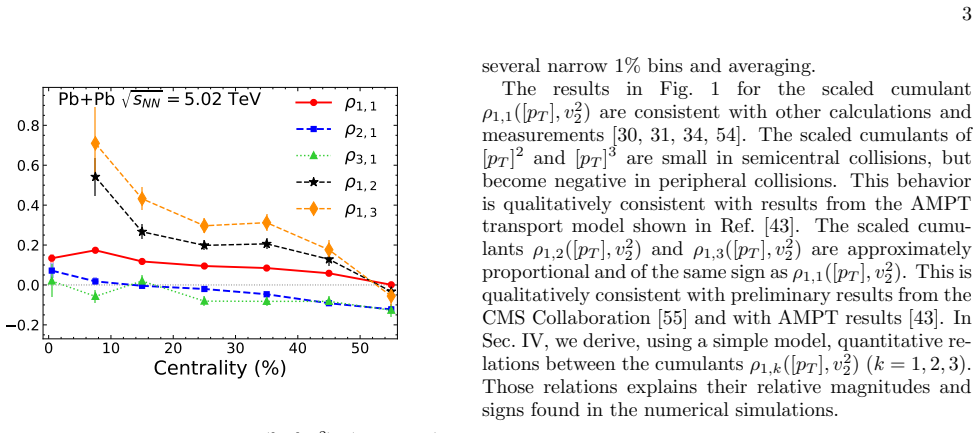
(dashed line with stars),ρ 13([pT ], v2 2) (dashed line with diamonds), calculated in the relativistic hy- drodynamic model for Pb+Pb collisions as a function of col- lision centrality. withT ±(x, y) denoting the thickness functions of the pro- jectile and target participants, respectively. Centrality classification is performed using minimum-bias T RENTo...
-
[5]
are consistent with other calculations and measurements [30, 31, 34, 54]. The scaled cumulants of [pT ]2 and [p T ]3 are small in semicentral collisions, but become negative in peripheral collisions. This behavior is qualitatively consistent with results from the AMPT transport model shown in Ref. [43]. The scaled cumu- lantsρ 1,2([pT ], v2
-
[6]
are approximately proportional and of the same sign asρ1,1([pT ], v2 2). This is qualitatively consistent with preliminary results from the CMS Collaboration [55] and with AMPT results [43]. In Sec. IV, we derive, using a simple model, quantitative re- lations between the cumulantsρ 1,k([pT ], v2
-
[7]
Those relations explains their relative magnitudes and signs found in the numerical simulations
(k= 1,2,3). Those relations explains their relative magnitudes and signs found in the numerical simulations. IV. RELA TION BETWEEN THE CUMULANT OF THE SECOND AND FIRST ORDER INv 2 2 Assuming a Gaussian distribution of eccentricity fluc- tuations around the geometric deformation of the interac- tion region, the event-by-event elliptic-flow distribution can...
-
[8]
=A e − (p−˜p)2 2s2p + κ(v2 −v2 0 −2s2 v)(p−˜p) sp s2v B(v2),(29) assuming a Gaussian distribution inp, with a term in the exponent that correlatespandv 2 with strengthκ. The presence of correlations between the elliptic flow and the mean transverse momentum modifies the averages of the v2 andpvariables. The normalization coefficient is A= 1√ 2πsp 1 +κ 2 2...
Show all 80 references
-
[9]
(solid line), ρ1,2([pT ], v2
-
[10]
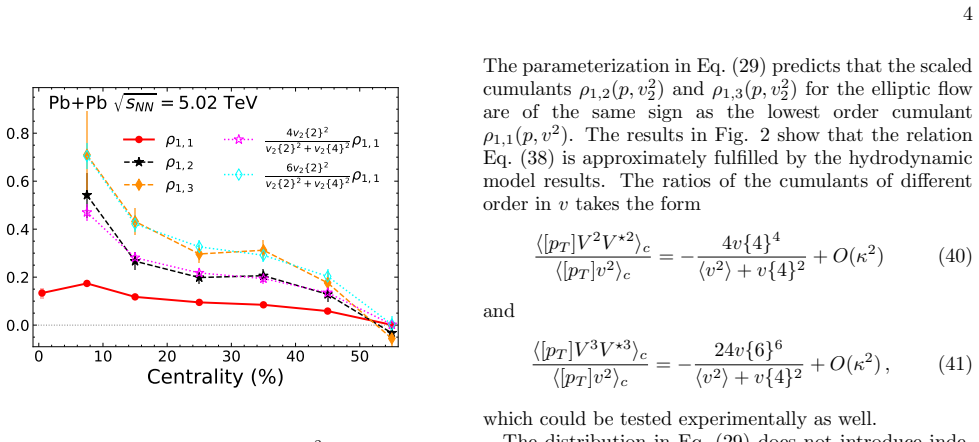
The dotteded lines represent the estimates ofρ 1,2 andρ 1,3 obtained fromρ 1,1 using the scaling relations (38) and (39)
(dashed line with stars), andρ 1,3([pT ], v2 2) (dashed line with diamonds) calculated in the relativistic hy- drodynamic model for Pb+Pb collisions as a function of col- lision centrality. The dotteded lines represent the estimates ofρ 1,2 andρ 1,3 obtained fromρ 1,1 using th...
-
[11]
The results in Fig
for the elliptic flow are of the same sign as the lowest order cumulant ρ1,1(p, v2). The results in Fig. 2 show that the relation Eq. (38) is approximately fulfilled by the hydrodynamic model results. The ratios of the cumulants of different order invtakes the form ⟨[pT ]V 2V ...
-
[12]
[panel (b)],ρ 3,1([pT ], v2
-
[13]
[panel (c)],ρ 1,2([pT ], v2
-
[14]
[panel (d)], andρ 1,3([pT ], v2
-
[15]
Estimates using predictors [Eq
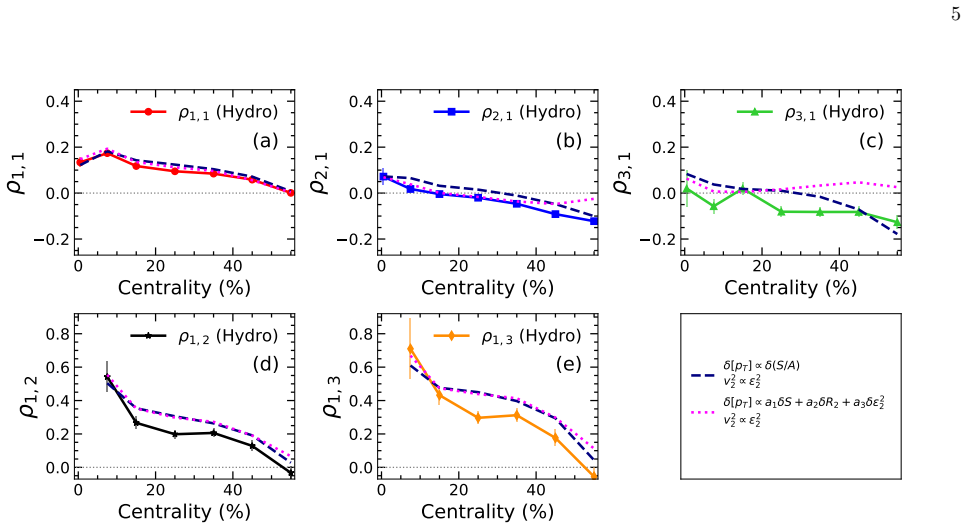
[panel (e)]. Estimates using predictors [Eq. (49)] and [Eq. (50)] are shown with dashed, and dotted lines, respectively. transverse plane, [m] = R m(x, y)s(x, y)dxdyR s(x, y)dxdy .(44) The moments of the initial density used are defined as S= Z s(x, y)dxdy ,(45) ϵ2 2 = [x2 −y ...
-
[16]
3, panel (a)]
is reproduced qualitatively by all formulas [Fig. 3, panel (a)]. The hydrodynamic-model re- sults for the cumulantρ 2,1([pT ], v2
-
[17]
3, panel (b)]
are also reproduced qualitatively the predictors [Fig. 3, panel (b)]. All of them show a change of sign as a function of centrality. However, the predictors do not reproduce well the hy- drodynamic results for the cumulantρ3,1([pT ], v2
-
[18]
3, panel (c)]
[Fig. 3, panel (c)]. Only the simplest predictor [Eq. (49)], shows a change of sign, but its centrality dependence is too steep compared with the hydrodynamic simulations. The cen- trality dependence of the fourth and six-order cumulants 6 in elliptic flow,ρ 1,2([pT ], v2
-
[19]
3, panels (d) and (e)]
is repro- duced qualitatively by the predictors [Fig. 3, panels (d) and (e)]. It is expected for any predictor reproducing the lowest oreder scaled cumulantρ 1,1([pT ], v2 2), due to the relations (38) and (39). The linear approximation for the mean transverse mo- mentum can b...
-
[20]
andρ 1,3([pT ], v2 2) are of the same order as lowest-order cumulant ρ1,1([pT ], v2 2). Assuming a simple Gaussian form for the joint probability distribution of [p T ] andv 2 2, we derive a simple relation between these the scaled cumulants of [pt] and higher orders ofv 2. Th...
2023
-
[21]
Ollitrault, J
J.-Y. Ollitrault, J. Phys. Conf. Ser.312, 012002 (2011), arXiv:1008.3323 [nucl-th]
2011 arXiv
-
[22]
Heinz and R
U. Heinz and R. Snellings, Ann.Rev.Nucl.Part.Sci.63, 123 (2013), arXiv:1301.2826 [nucl-th]
2013 arXiv
-
[23]
C. Gale, S. Jeon, and B. Schenke, Int.J.Mod.Phys.A28, 1340011 (2013), arXiv:1301.5893 [nucl-th]
2013 arXiv
-
[24]
S. A. Voloshin, V. Koch, and H. G. Ritter, Phys. Rev. C60, 024901 (1999), arXiv:nucl-th/9903060
1999 arXiv
-
[25]
Adamset al.(STAR), Phys
J. Adamset al.(STAR), Phys. Rev. C71, 064906 (2005), arXiv:nucl-ex/0308033
2005 arXiv
-
[26]
B. B. Abelevet al.(ALICE), Eur. Phys. J. C74, 3077 (2014), arXiv:1407.5530 [nucl-ex]
2014 arXiv
-
[27]
Anticicet al.(NA49), Phys
T. Anticicet al.(NA49), Phys. Rev. C70, 034902 (2004), arXiv:hep-ex/0311009
2004 arXiv
-
[28]
Gavin, Phys
S. Gavin, Phys. Rev. Lett.92, 162301 (2004), nucl- th/0308067
2004
-
[29]
Broniowski, M
W. Broniowski, M. Chojnacki, and L. Obara, Phys. Rev. C80, 051902(R) (2009), arXiv:0907.3216 [nucl-th]
2009 arXiv
-
[30]
I. J. Abualrobet al.(ALICE), JHEP11, 076 (2025), arXiv:2506.10394 [nucl-ex]. 7
2025
-
[31]
Aadet al.(ATLAS), Phys
G. Aadet al.(ATLAS), Phys. Rev. Lett.136, 032301 (2026), arXiv:2503.24125 [nucl-ex]
2026
-
[32]
Jia, Phys
J. Jia, Phys. Rev. Lett.136, 112301 (2026), arXiv:2507.14399 [nucl-th]
2026
-
[33]
Parida, R
T. Parida, R. Samanta, and J.-Y. Ollitrault, Phys. Lett. B857, 138985 (2024), arXiv:2407.17313 [nucl-th]
2024
-
[34]
Aadet al.(ATLAS), Phys
G. Aadet al.(ATLAS), Phys. Rev. Lett.133, 252301 (2024), arXiv:2407.06413 [nucl-ex]
2024
-
[35]
Borghini, P
N. Borghini, P. M. Dinh, and J.-Y. Ollitrault, Phys. Rev. C63, 054906 (2001), nucl-th/0007063
2001 arXiv
-
[36]
Borghini, P
N. Borghini, P. M. Dinh, and J.-Y. Ollitrault, Phys.Rev. C64, 054901 (2001), arXiv:nucl-th/0105040 [nucl-th]
2001 arXiv
-
[37]
Adleret al.(STAR), Phys
C. Adleret al.(STAR), Phys. Rev. C66, 034904 (2002), arXiv:nucl-ex/0206001
2002 arXiv
-
[38]
Aamodtet al.(ALICE), Phys
K. Aamodtet al.(ALICE), Phys. Rev. Lett.107, 032301 (2011), arXiv:1105.3865 [nucl-ex]
2011 arXiv
-
[39]
Aadet al.(ATLAS), Eur
G. Aadet al.(ATLAS), Eur. Phys. J. C74, 3157 (2014), arXiv:1408.4342 [hep-ex]
2014 arXiv
-
[40]
Chatrchyanet al.(CMS), Phys
S. Chatrchyanet al.(CMS), Phys. Lett. B724, 213 (2013), arXiv:1305.0609 [nucl-ex]
2013 arXiv
-
[41]
Bilandzic, C
A. Bilandzic, C. H. Christensen, K. Gulbrandsen, A. Hansen, and Y. Zhou, Phys. Rev. C89, 064904 (2014), arXiv:1312.3572 [nucl-ex]
2014 arXiv
-
[42]
Teaney and L
D. Teaney and L. Yan, Phys. Rev.C86, 044908 (2012), arXiv:1206.1905 [nucl-th]
2012 arXiv
-
[43]
Aadet al.(ATLAS Collaboration), Phys
G. Aadet al.(ATLAS Collaboration), Phys. Rev.C90, 024905 (2014), arXiv:1403.0489 [hep-ex]
2014 arXiv
-
[44]
Adamet al.(ALICE Collaboration), Phys
J. Adamet al.(ALICE Collaboration), Phys. Rev. Lett. 117, 182301 (2016), arXiv:1604.07663 [nucl-ex]
2016 arXiv
-
[45]
J. Qian, U. W. Heinz, and J. Liu, Phys. Rev.C93, 064901 (2016), arXiv:1602.02813 [nucl-th]
2016 arXiv
-
[46]
X. Zhu, Y. Zhou, H. Xu, and H. Song, Phys. Rev.C95, 044902 (2017), arXiv:1608.05305 [nucl-th]
2017 arXiv
-
[47]
F. G. Gardim, F. Grassi, M. Luzum, and J. Noronha-Hostler, Phys. Rev.C95, 034901 (2017), arXiv:1608.02982 [nucl-th]
2017 arXiv
- [48]
- [49]
-
[50]
Schenke, C
B. Schenke, C. Shen, and D. Teaney, Phys. Rev. C102, 034905 (2020), arXiv:2004.00690 [nucl-th]
2020
-
[51]
Aadet al.(ATLAS), Eur
G. Aadet al.(ATLAS), Eur. Phys. J. C79, 985 (2019), arXiv:1907.05176 [nucl-ex]
2019
-
[52]
Giacalone, Phys
G. Giacalone, Phys. Rev. C102, 024901 (2020), arXiv:2004.14463 [nucl-th]
2020
-
[53]
Giacalone, F
G. Giacalone, F. G. Gardim, J. Noronha-Hostler, and J.-Y. Ollitrault, Phys. Rev. C103, 024909 (2021), arXiv:2004.01765 [nucl-th]
2021
-
[54]
J. Jia, S. Huang, and C. Zhang, Phys. Rev. C105, 014906 (2022), arXiv:2105.05713 [nucl-th]
2022
-
[55]
Bally, M
B. Bally, M. Bender, G. Giacalone, and V. Som` a, Phys. Rev. Lett.128, 082301 (2022), arXiv:2108.09578 [nucl- th]
2022
-
[56]
N. M. Fortier, S. Jeon, and C. Gale, Phys. Rev. C111, L011901 (2025), arXiv:2405.17526 [nucl-th]
2025
-
[57]
Giacaloneet al., Phys
G. Giacaloneet al., Phys. Rev. Lett.135, 012302 (2025), arXiv:2402.05995 [nucl-th]
2025
-
[58]
M. I. Abdulhamidet al.(STAR), Nature635, 67 (2024), arXiv:2401.06625 [nucl-ex]
2024
-
[59]
P. Li, B. Zhou, and G.-L. Ma, Phys. Rev. Lett.136, 082302 (2026), arXiv:2504.04688 [nucl-th]
2026
-
[60]
Tumasyanet al.(CMS), (2024), arXiv:2410.04578 [nucl-ex]
A. Tumasyanet al.(CMS), (2024), arXiv:2410.04578 [nucl-ex]
2024
-
[61]
Bo˙ zek and R
P. Bo˙ zek and R. Samanta, Phys. Rev. C104, 014905 (2021), arXiv:2103.15338 [nucl-th]
2021
-
[62]
Acharyaet al.(ALICE), Phys
S. Acharyaet al.(ALICE), Phys. Lett. B834, 137393 (2022), arXiv:2111.06106 [nucl-ex]
2022
-
[63]
E. G. D. Nielsen, N. Nathanson, K. Gulbrandsen, and Y. Zhou, Eur. Phys. J. C85, 1016 (2025), arXiv:2504.03044 [nucl-th]
2025
-
[64]
Zhao, H.-j
S. Zhao, H.-j. Xu, Y. Zhou, Y.-X. Liu, and H. Song, Phys. Rev. Lett.133, 192301 (2024), arXiv:2403.07441 [nucl-th]
2024
-
[65]
Giacalone, Eur
G. Giacalone, Eur. Phys. J. A59, 297 (2023), arXiv:2305.19843 [nucl-th]
2023
-
[66]
Mehrabpour, G
H. Mehrabpour, G. Giacalone, and M. W. Luzum, (2026), arXiv:2604.00619 [nucl-th]
2026
-
[67]
Parida, R
T. Parida, R. Samanta, and J.-Y. Ollitrault, Phys. Lett. B868, 139729 (2025), arXiv:2506.18690 [nucl-th]
2025
-
[68]
Schenke, S
B. Schenke, S. Jeon, and C. Gale, Phys. Rev. C82, 014903 (2010), arXiv:1004.1408 [hep-ph]
2010 arXiv
-
[69]
Schenke, S
B. Schenke, S. Jeon, and C. Gale, Phys. Rev. Lett.106, 042301 (2011), arXiv:1009.3244 [hep-ph]
2011 arXiv
-
[70]
Paquet, C
J.-F. Paquet, C. Shen, G. S. Denicol, M. Luzum, B. Schenke, S. Jeon, and C. Gale, Phys. Rev. C93, 044906 (2016), arXiv:1509.06738 [hep-ph]
2016 arXiv
-
[71]
J. S. Moreland, J. E. Bernhard, and S. A. Bass, Phys. Rev. C92, 011901(R) (2015), arXiv:1412.4708 [nucl-th]
2015 arXiv
-
[72]
J. S. Moreland, J. E. Bernhard, and S. A. Bass, (2018), arXiv:1808.02106 [nucl-th]
2018
-
[73]
J. S. Moreland and R. A. Soltz, Phys. Rev. C93, 044913 (2016), arXiv:1512.02189 [nucl-th]
2016 arXiv
-
[74]
Bo˙ zek and H
P. Bo˙ zek and H. Mehrabpour, Phys. Rev. C101, 064902 (2020), arXiv:2002.08832 [nucl-th]
2020
-
[75]
Tuo (CMS), Acta Phys
S. Tuo (CMS), Acta Phys. Polon. Supp.16, 67 (2023)
2023
-
[76]
S. A. Voloshin, A. M. Poskanzer, A. Tang, and G. Wang, Phys. Lett.B659, 537 (2008), arXiv:0708.0800 [nucl-th]
2008 arXiv
-
[77]
Teaney and L
D. Teaney and L. Yan, Phys. Rev.C83, 064904 (2011), arXiv:1010.1876 [nucl-th]
2011 arXiv
-
[78]
Mazeliauskas and D
A. Mazeliauskas and D. Teaney, Phys. Rev.C93, 024913 (2016), arXiv:1509.07492 [nucl-th]
2016 arXiv
-
[79]
Zhang, A
C. Zhang, A. Behera, S. Bhatta, and J. Jia, Phys. Lett. B822, 136702 (2021), arXiv:2102.05200 [nucl-th]
2021
-
[80]
Cumulants of mean transverse momentum and elliptic flow in the hydrodynamic model of heavy-ion collisions [data set]. zenodo,
T. Parida and P. Bozek, “Cumulants of mean transverse momentum and elliptic flow in the hydrodynamic model of heavy-ion collisions [data set]. zenodo,” (2026)
2026
Reviewed July 1, 2026 · model on record in the stance chip above.
Discussion (0). Continue with ORCID to comment.