REVIEW 4 major objections 5 minor 14 references
An LLM can be made to aim its outputs at requested points in a frozen 3D coordinate space, turning generation into endpoint search.
Reviewed by Pith at T0; open to challenge. T0 means a machine referee read the full paper against a public rubric. the ladder, T0–T4 →
T0 review · deepseek-v4-flash
2026-08-03 07:03 UTC pith:ZO64LCKH
load-bearing objection New and honestly scoped interface — but z* is really an exemplar-library index, not a directly actuated coordinate, which limits the outer-loop claim; worth a careful referee. the 4 major comments →
Output-Space Search: Targeting LLM Generations in a Frozen Encoder-Defined Output Space
The pith
A machine-rendered reading of the paper's core claim, the machinery that carries it, and where it could break.
Core claim
On the paper's own terms, the discovery is that an autoregressive model can act as an actuator for a frozen, encoder-defined 3D coordinate space. The coordinates are z(x)=U^T(E(x)-mu), fit once per domain; the model is trained with sequence-level RL to follow requests z* and to self-report its own coordinates. The downstream objective is never used during training, so the actuator is objective-agnostic. Evidence in both domains: story grid sweeps yield much higher judged branch diversity than chained sampling, and code Bayesian search over targets, updating at realized coordinates z(x), improves a withheld executable score under a matched budget of valid programs.
What carries the argument
The central object is the frozen coordinate map z(x)=U^T(E(x)-mu), a 3D projection of a frozen encoder's embedding, fit once per domain by PCA followed by Varimax rotation and then never changed during RL. The mechanism that makes a numeric target actionable is retrieval grounding: each request z* is instantiated by retrieving the two nearest exemplars to z* and one contrast exemplar near -z* from a library indexed in Z, and the policy is trained with group-based sequence-level RL to follow the neighborhood. Empirically, the numeric coordinate line can be hidden with almost no loss, while removing or mismatching exemplars collapses control, so exemplar selection in the frozen space is what c
Load-bearing premise
Control is carried by library coverage, not by the numeric target: the paper's ablations show nearly unchanged targeting when the numeric target is hidden but near-collapse when exemplars are removed, so any target region without dense exemplars disables the interface.
What would settle it
Pick a target z* in a region of Z that has no near exemplars and has not been seen in training, ask the trained controller to land within ±0.05 on all three axes, and score best-of-5; if success stays near zero, as it does when exemplars are removed (Bo5 ≈ 0.001), then the apparent control is library coverage rather than coordinate targeting.
If this is right
- Diversity becomes parallel and context-free: branches sampled at different targets are conditionally independent, so context never grows and branches can be generated concurrently; the story results show a 3.1x judged-diversity ratio over the strongest chained baseline in the paper's harness.
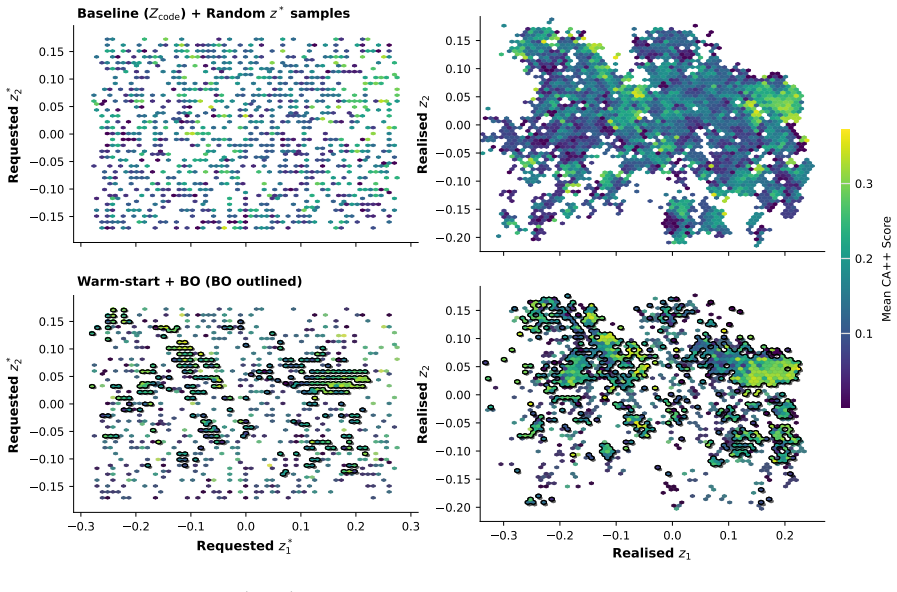
- Outer loops can optimize arbitrary withheld objectives over the same actuator; the code results show a surrogate-based search over targets improving a score that never appeared in the RL reward.
- Search moves from high-dimensional discrete token or program space to a 3D continuous space, so standard continuous optimizers and grids become applicable to LLM sampling.
- Best-of-k at a fixed target sharpens accuracy, giving a small, tunable accuracy-versus-compute knob at inference time.
- The same coordinate space is reusable across prompts, and the code setup shows the exemplar library can grow online during RL, absorbing new valid examples without retraining the encoder.
Where Pith is reading between the lines
- An implication the author stops short of: the ablations suggest the RL-trained policy is largely a vehicle for exemplar-following, so a sufficiently capable base model might achieve similar targeting with a dense enough library and no RL at all; this is testable by swapping the trained policy for a strong instruction-following model at the same prompt schema.
- A testable extension: make reachability explicit by building a coverage map of Z from the exemplar library, and let the outer loop query only regions above a density threshold; this directly addresses the paper's own non-uniform reachability limitation.
- An extension implicit in the anchoring experiment: other anchor sets could produce interpretable axes for genre, sentiment, or formality; the paper validates only one anchored axis, so the generality of axis semantics is open.
- The paper's safety warning implies a constructive caution: if extreme-tail targets can elicit graphic content, a guardrail could be implemented as a bounding box or density constraint on z* in addition to content filtering.
Editorial analysis
A structured set of objections, weighed in public.
Referee Report
Summary. OS-Search proposes to turn LLM generation into endpoint search in a frozen, encoder-defined 3D output space Z. An outer loop proposes a target z*, a retrieval-grounded policy trained with GRPO/GSPO generates samples whose embedded <text> coordinates are rewarded to lie near z*, and the model self-reports a calibration estimate. The paper evaluates two applications: story diversity by sweeping a grid in an anchored Ztext (Tab. 2, LLMScore 57.15 vs. best chained baseline 18.45, rho_div ≈ 3.10), and code search over constrained make_seed() programs by Bayesian optimization over Zcode under a withheld CA++ objective (Fig. 6, best CA++ 0.395 vs. library baseline 0.371). The paper is explicitly framed as a feasibility/interface study and discusses its limitations in detail.
Significance. If the results hold, the paper contributes a concrete recipe for a reusable low-dimensional control interface for LLM outputs: a frozen representation, retrieval grounding, and sequence-level RL. The code-domain experiments are the strongest part: calibration curves, a clean prompt ablation (App. Tab. 5), three-seed BO ablations, and a disclosed synthetic benchmark. The paper is honest about non-uniform reachability and library dependence. However, the ablation that gives the paper credibility also reveals that the numeric target is nearly redundant in code, so the contribution is best characterized as an exemplar-neighborhood search interface indexed by z* rather than direct coordinate actuation. The story diversity claim lacks error bars and judge replication, which limits its evidentiary weight.
major comments (4)
- [§4.1 and App. Tab. 5] The load-bearing claim in §1 is that an outer loop chooses z* and the model generates x with z(x) near z*, enabling sweep/optimization of the coordinate. App. Tab. 5 shows that in the code domain, hiding the REQUESTED TARGET line leaves Bo1 Success@0.05 almost unchanged (0.658 vs. 0.664 with the default prompt), while removing exemplars collapses control to 0.001 and validity to 35.3%. Thus the policy primarily follows the retrieved near/contrast exemplars; z* acts as an index into the exemplar library. The outer loop is consequently an exemplar-neighborhood search, whose reachability is bounded by library density. The paper discloses non-uniform reachability (§6, Fig. 11), but the abstract and introduction still present the numeric coordinate as the control interface. Please either reframe the contribution accordingly or demonstrate direct numeric actuation (e.g., vary z* while holding
- [§4.3 / Tab. 2] The headline diversity gain (LLMScore 57.15 vs. 18.45, rho_div ≈ 3.10) is a point estimate over 20 prompts with a single GPT-5.1 judge configuration. No prompt-level variance, bootstrap interval, or repeated-judge agreement is reported. Because the method comparison rests on this ratio, report the per-prompt distribution and a confidence interval (e.g., bootstrap over prompts and/or judge calls), and state whether the judge is blind to the sampling condition.
- [§4.4 / Fig. 6 / App. I] The BO comparison may give the optimizer free evaluations: the warm-start phase uses 1,375 pre-scored random-z* rollouts before the plotted BO segment (App. I). If these scored programs are not counted in Nok for both BO and path-based sampling, the 'matched budget' claim is not satisfied. Please present a version where the warm-start evaluations are explicitly included in the budget for all methods, or run BO from scratch, and clarify the status of the Baseline (Zcode) sweep (fixed library) versus the budget-matched baseline.
- [§4.1 / Fig. 3 and Tabs. 3–4] Success@ε curves are computed on 'usable completions' only (stories N=6,946, code N=6,860), but invalid outputs count as failures in some places. Please make the denominator convention consistent across Fig. 3, Tabs. 3–4, and App. Tab. 5, and report the raw validity rate per domain. This matters because the code validity drop to 35.3% without exemplars affects the interpretation of control.
minor comments (5)
- [§3.1 / App. A] The Z-space hyperparameter selection uses a fixed scalar preference with fixed weights; report sensitivity of downstream results to these choices.
- [§4.3 / Tab. 2] Degen for OS-Search (0.09) is slightly higher than the best baseline (0.07); report whether this is significant and whether the LLMScore ratio is robust to Degen-matching.
- [§6 / Resources] Story-domain training data and checkpoints are not released; at minimum release the 20 WritingPrompts prompts and exact prompt templates to allow reproduction of Tab. 2.
- [App. G] The 15-branch truncation of the 18-target grid is deterministic but arbitrary; report whether the headline ratio changes if the omitted three targets differ.
- [Fig. 4] The Slop-Score correlation is on rollouts from the final 10% of training; clarify whether these rollouts used fixed prompts or varied prompts, and whether the correlation is dominated by a few prompts.
Circularity Check
No significant circularity: the paper's central claims are empirical and rest on external measures, with the key retrieval-dependence explicitly disclosed.
full rationale
The paper reports an empirical interface study rather than a derivation from first principles. The output space Z is constructed by a frozen encoder plus PCA/Varimax, and the controller is trained with sequence-level RL to place outputs near requested coordinates; headline evaluations use external measures (lexical/embedding overlap, GPT-5.1 judge, Slop-Score analyzer, executable CA++ scores). Target-tracking accuracy is a trained behavior, not a prediction from an input, and the paper does not disguise it as an independent result; the calibration curves and ablations (App. Tab. 5) explicitly show that actuation is carried largely by exemplar retrieval, which scopes but does not circularize the claim. The z1/Slop-Score correlation is explicitly labeled a post-hoc axis-validation diagnostic, and the anchor construction is disclosed, so it is not presented as an independent derivation. The diversity gain from choosing a spread-out target grid is the intended mechanism of the method, not a circular prediction. No load-bearing self-citation or uniqueness argument appears; the only self-citation (Materzok 2025) is contextual related work. Hence no step reduces by construction to its inputs.
Axiom & Free-Parameter Ledger
free parameters (7)
- Anchor set A for Z_text z1 axis =
small hand-picked set of Qwen3-generated 'default-style' stories (size not stated)
- Reward shaping weights (3, 3, 1.5) =
3·R_dist, 1.5·R_hon
- Z-construction hyperparameters =
d_inter ∈ {8..48}, whitening on/off, dz = 3 (best by preference grid search)
- Distance exponent alpha curriculum =
annealed 1.5 → 0.8 per 1500-update phase
- Target sampling bands and story grid targets =
text ≤1.75·s_i, code ≤1.5·s_i; story grid z1∈{½s1,s1}, z2,z3∈{-s_i,0,+s_i}
- CA++ benchmark weights =
0.30 act + 0.20 div + 0.25 pent + 0.20 ccont + 0.05 bal; T_N=64/96; LIFE/HIGHLIFE/SEEDS
- Frozen per-axis scales s_i =
max(|q0.10|, |q0.90|, 1e−4)
axioms (6)
- domain assumption Frozen encoder embeddings (all-mpnet-base-v2 for text, jina-embeddings-v2-base-code for code) capture task-relevant style/semantic structure
- domain assumption PCA + (anchored) Varimax directions correspond to coherent output variation
- domain assumption GRPO/GSPO group-relative RL reliably learns the target-hitting policy
- domain assumption GPT-5.1 judge scores diversity and degeneration validly for these outputs
- ad hoc to paper CA++ composite score is a meaningful objective for make_seed programs
- domain assumption Exemplar library covers the reachable part of Z
Cite this review
Pith. "Pith review of Output-Space Search: Targeting LLM Generations in a Frozen Encoder-Defined Output Space." pith.science (2026). https://pith.science/paper/ZO64LCKH
@misc{pith2026260121169,
  author       = {Pith},
  title        = {Pith review of: Output-Space Search: Targeting LLM Generations in a Frozen Encoder-Defined Output Space},
  year         = {2026},
  howpublished = {\url{https://pith.science/paper/ZO64LCKH}},
  note         = {Machine review of arXiv:2601.21169}
}
read the original abstract
We introduce Output-Space Search (OS-Search), which turns LLM generation into endpoint search. An outer loop selects a target z* in a frozen encoder-defined 3D output space Z, and a retrieval-grounded policy trained with sequence-level RL generates outputs whose coordinates land near z* under standard autoregressive decoding. This enables parallel sweeps and black-box optimization in Z without path-dependent token/program search. On stories, sweeping Z (text) yields 3.1x higher LLM-scored diversity than prompt-chaining. On code, Bayesian optimization over Z (code) improves an objective withheld from the controller under matched inference budgets while preserving validity.
Figures




Reference graph
Works this paper leans on
-
[2]
feed all previously generated outputs back into the input
story_2 . . . PROMPT:<original prompt> where story_1, . . . ,story_b-1 are the previously generated branches for that prompt, stripped of any <think> content. We include all earlier branches as negatives. This procedure reproduces the “feed all previously generated outputs back into the input” sampling baselines in Park et al. (2025). Decoding grids.We sw...
2025
-
[3]
, TN } and cell location (i, j), we ex- tract the 3×3 Moore neighborhood pattern around (i, j)with wraparound, yielding a 9- bit code in {0,
Patch entropy: for every time t∈ {0, . . . , TN } and cell location (i, j), we ex- tract the 3×3 Moore neighborhood pattern around (i, j)with wraparound, yielding a 9- bit code in {0, . . . ,511}. Let pk be the em- pirical frequency of codekover all neighbor- hoods across the full spacetime. The normal- ized entropy is pent = 1 9 − X k:p k>0 pk log2 pk , ...
-
[4]
AlphaEvolve: A coding agent for scientific and algorithmic discovery.arXiv preprint. ArXiv:2506.13131 [cs]. OpenAI. 2026. GPT-5.1 Model | OpenAI API. OpenAI, Aaron Jaech, Adam Kalai, Adam Lerer, Adam Richardson, Ahmed El-Kishky, Aiden Low, Alec Helyar, Aleksander Madry, Alex Beutel, Alex Carney, Alex Iftimie, Alex Karpenko, Alex Tachard Passos, Alexander ...
Pith/arXiv arXiv 2026
-
[5]
Avoidance Decoding for Diverse Multi-Branch Story Generation.arXiv preprint. ArXiv:2509.02170 [cs]. 12 William H. Paulsen. 2003. Creating Large Life Forms with Interactive Life.Complex Systems, 14(3). Nils Reimers and Iryna Gurevych. 2019. Sentence-BERT: Sentence Embeddings using Siamese BERT-Networks.arXiv preprint. ArXiv:1908.10084 [cs]. Bernardino Rome...
Pith/arXiv arXiv 2003
-
[8]
Group Sequence Policy Optimization.arXiv preprint. ArXiv:2507.18071 [cs]. Yaoming Zhu, Sidi Lu, Lei Zheng, Jiaxian Guo, Weinan Zhang, Jun Wang, and Yong Yu. 2018. Texygen: A Benchmarking Platform for Text Generation Models. arXiv preprint. ArXiv:1802.01886 [cs]. Appendices A Output-space construction and evaluation We detail the construction of the frozen...
Pith/arXiv arXiv 2018
-
[9]
not X, but Y
as an automatic proxy for stereotyped, tem- plated “AI slop” writing. The analyzer compares a model completion against a fixed list of over- represented slop words and trigrams, and also de- tects overused contrast constructions of the form “not X, but Y” using a two-stage pattern-matching pipeline (regex followed by a lightweight POS- tag-based check) (P...
2025
-
[11]
Define c= 1 TN TNX t=1 c(xt),div = min 1, c N 2/4
Diversity (components): let c(xt) be the number of 4-neighbor connected components of live cells in xt (with wraparound adjacency on the torus). Define c= 1 TN TNX t=1 c(xt),div = min 1, c N 2/4
-
[13]
Compression contrast: we serialize the full spacetime (xt)TN t=0 into a row-major ASCII string over {0,1} of length L= (T N + 1)N2. We compress this byte string using DEFLATE at maximum compression level (9), let r= |compressed| |raw| be the byte-length ratio, and define ccont = 2 min(r,1−r) with |compressed| never being larger than |raw|
-
[14]
spaceship
Balance: let ℓt = 1 N 2 P i,j xt[i, j]be the live- cell fraction and ¯ℓ= 1 TN PTN t=1 ℓt its mean (ex- cluding x0). We define the balanced-density score bal = 4 ¯ℓ(1− ¯ℓ). CA++ composite score.For each run (N,rule) we compute the weighted sum score(N,rule) = 0.30 act + 0.20 div + 0.25 pent + 0.20 ccont + 0.05 bal. The overall CA++ score is the mean over a...
2000
-
[2016]
Mastering the game of Go with deep neural networks and tree search.Nature, 529(7587):484–489. David Silver, Thomas Hubert, Julian Schrittwieser, Ioannis Antonoglou, Matthew Lai, Arthur Guez, Marc Lanctot, Laurent Sifre, Dharshan Kumaran, Thore Graepel, Timothy Lillicrap, Karen Simonyan, and Demis Hassabis. 2017. Mastering Chess and Shogi by Self-Play with...
Pith/arXiv arXiv 2017
-
[2023]
Controllable Text Generation via Probability Density Estimation in the Latent Space.arXiv preprint. ArXiv:2212.08307 [cs]. Rafael Gómez-Bombarelli, Jennifer N. Wei, David Duvenaud, José Miguel Hernández-Lobato, Benjamín Sánchez-Lengeling, Dennis Sheberla, Jorge Aguilera-Iparraguirre, Timothy D. Hirzel, Ryan P. Adams, and Alán Aspuru-Guzik. 2018. Automatic...
Pith/arXiv arXiv 2018
-
[2024]
AlphaMath Almost Zero: Process Supervision without Process.arXiv preprint. ArXiv:2405.03553. Paul Christiano, Jan Leike, Tom B. Brown, Miljan Martic, Shane Legg, and Dario Amodei. 2023. Deep reinforcement learning from human preferences.arXiv preprint. ArXiv:1706.03741 [stat]. Hoagy Cunningham, Aidan Ewart, Logan Riggs, Robert Huben, and Lee Sharkey. 2023...
Pith/arXiv arXiv 2023
-
[2025]
Understanding R1-Zero-Like Training: A Critical Perspective.arXiv preprint. ArXiv:2503.20783 [cs]. Ilya Loshchilov and Frank Hutter. 2019. Decoupled Weight Decay Regularization.arXiv preprint. ArXiv:1711.05101 [cs]. Tobias Materzok. 2025. COS(M+O)S: Curiosity and RL-Enhanced MCTS for Exploring Story Space via Language Models.arXiv preprint. ArXiv:2501.171...
Pith/arXiv arXiv 2019
-
[2026]
Learning to Discover at Test Time.arXiv preprint. ArXiv:2601.16175 [cs]. Chujie Zheng, Shixuan Liu, Mingze Li, Xiong-Hui Chen, Bowen Yu, Chang Gao, Kai Dang, Yuqiong Liu, Rui Men, An Yang, Jingren Zhou, and Junyang Lin
discussion (0)
Sign in with ORCID, Apple, or X to comment. Anyone can read and Pith papers without signing in.