REVIEW 1 major objections 4 minor
Quantum Turing Patterns
T0 review · 1 major / 4 minor · reviewed 2026-08-01 · deepseek-v4-flash
Pith's one-line read This paper constructs an explicit family of Lindblad lattice generators whose first-moment limit undergoes a supercritical Turing bifurcation at a nonzero wave number, with analytic stripe branches, extensive Bragg order in the semiclassica
desk verdict A serious constructive paper on quantum Turing patterns in Lindblad lattices — real new results, but the stability claim is narrower than the abstract suggests, so the verdict should be conditional. read the letter →
The pith
A machine-rendered reading of the paper's core claim, the machinery that carries it, and where it could break.
The reading
What carries the argument
The central object is the reaction–transport equation (2.32), a two-component cubic system for quadrature expectations (q, p) with differential diffusion coefficients D_q, D_p and a rotation frequency Ω_λ. The Lindblad construction realizes this equation in the local coherent-state topology with explicit couplings: a local Hamiltonian with onsite rotation and squeezing, a bond squeezing-hopping Hamiltonian whose coefficient is (D_q − D_p)/2, one-photon loss with rate b − a, dissipative hopping with rate (D_q + D_p)/2, and on-site two-photon loss γ/N with γ = 2ν. The spectral design makes the linearized determinant a perfect square in the lattice symbol, giving a quadratic zero at a finite wa
What would settle it
Compute the sign of the commensurate phase-locking eigenvalue (the soft spectral abscissa) in the full period-cell space for the explicit stripe branch at small λ (e.g., λ = 0.05–0.4). The paper reports a scaling ∝ λ^5 with undetermined sign; if the sign is positive for any small λ, local asymptotic stability in the full space is false. Alternatively, numerically integrate the full first-moment dynamics with initial conditions breaking the site or bond reflection symmetry near the branch and see if the trajectory leaves the stripe basin.
Extended reading notes
Core claim
The central claim is that the same instability that organizes classical reaction–diffusion patterns — differential transport destabilizing a homogeneous state at finite wave number while the homogeneous mode stays stable — can be realized in quantum Markov (Lindblad) lattice dynamics, and the pattern is not a mean-field artifact: it survives in the quantum fluctuations. The paper proves existence of an explicit family of Lindblad generators (with one-photon loss, bond dissipative hopping, squeezing-hopping Hamiltonians, and two-photon loss scaled as 1/N) whose coherent first moments follow a two-component cubic reaction–transport equation. At a carefully tuned point, this equation has a Turi
Load-bearing premise
The claimed local stability of the stripe branches is established only inside reflection-fixed subspaces; if the undetermined-sign phase-locking eigenvalue in the full period-cell space turns out positive, the pattern would not be stable against symmetry-breaking perturbations, and the central 'stable quantum Turing pattern' claim would collapse.
Editorial extensions
If this is right
- The selected Turing wavelength is a genuine quantum observable: the Bragg peak is extensive and persists on bounded time intervals for projected coherent states, so pattern order exists at the microscopic quantum level, not just in mean-field equations.
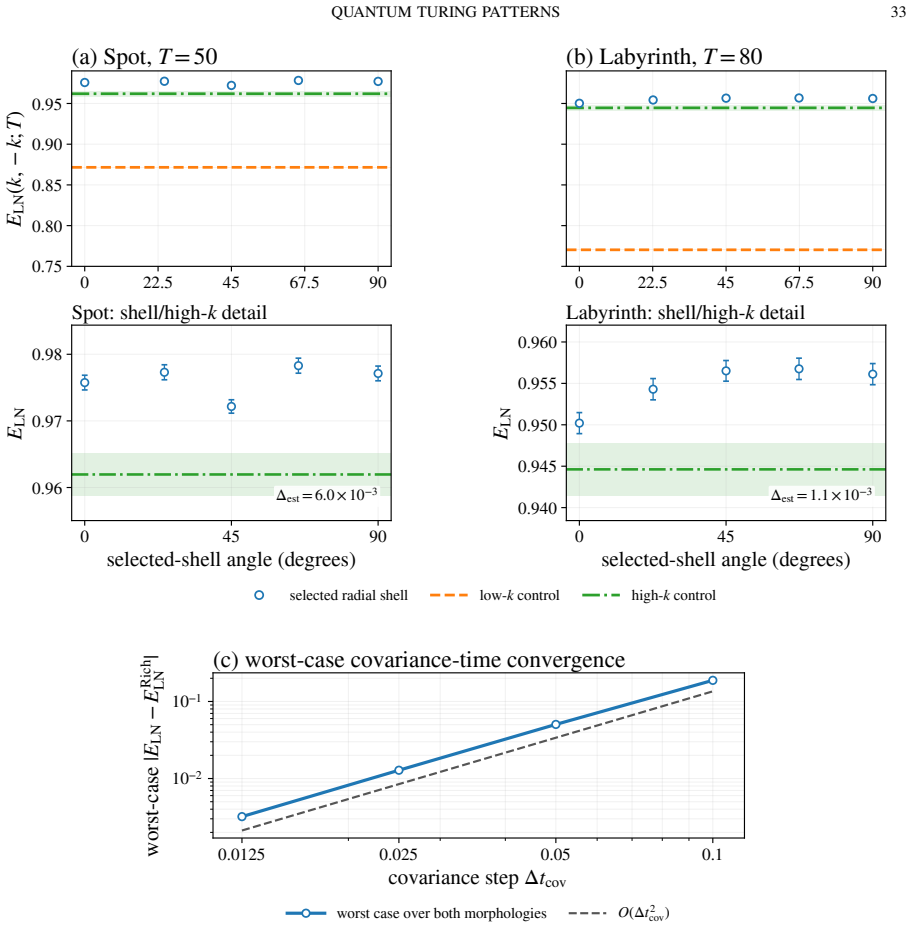
- The fluctuation covariance converges to a Gaussian Lyapunov flow at rate N^{-1/2}, so quantum corrections are controlled and strict partial-transpose violations at the Gaussian level transfer to finite-N microscopic states.
- In the homogeneous Gaussian sector, wavelength selection and opposite-momentum entanglement are governed by the same ratio η_k; the Turing threshold coincides with η_k = 1, and at threshold the logarithmic negativity of the critical pair has a universal one-sided limit E_LN = 1.
- Differential transport (D_q ≠ D_p) is essential: it moves the strongest opposite-momentum correlation from the infrared to finite wave numbers, while scalar transport leaves the entanglement strongest at the smallest nonzero momentum.
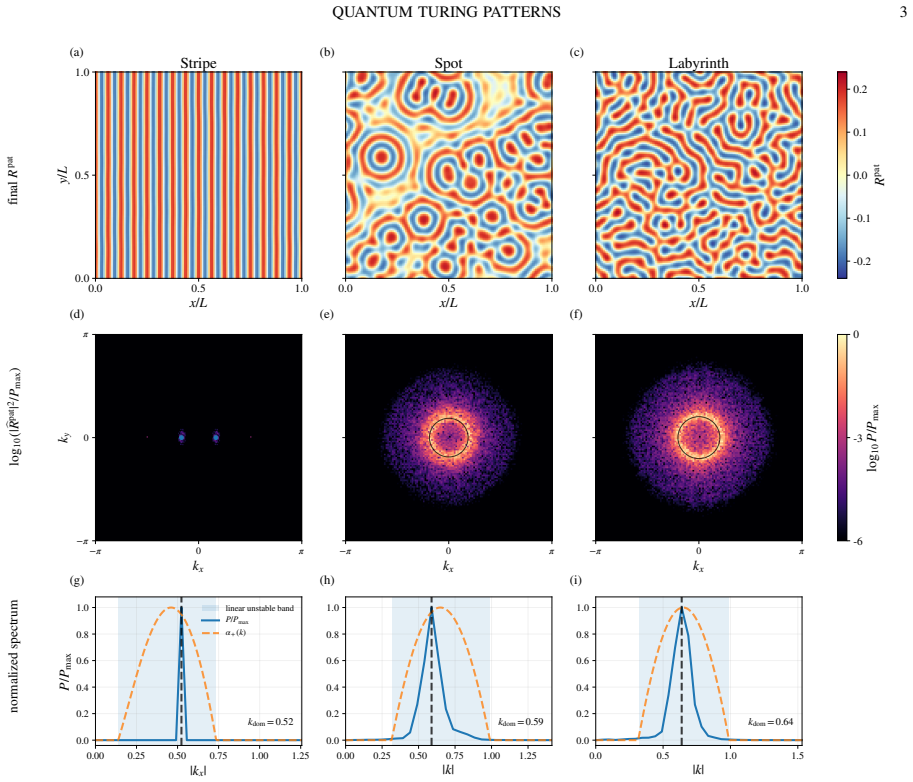
- Numerical continuation shows stripe, spot, and labyrinth morphologies concentrate their power on the same selected wave-number shell as the linear unstable band.
Reading between the lines
- If the stability caveat is resolved (the sign of the O(λ^5) phase-locking eigenvalue turning out negative), the construction would provide the first fully rigorous example of a stable quantum Turing pattern in the full state space; as written, the reader must accept the reflection-fixed subspace restriction.
- The η_k relation suggests a general principle for open quantum systems: any differential-transport-driven instability that survives the semiclassical limit will imprint its selected wavelength on the Gaussian fluctuation spectrum, so momentum-resolved entanglement measurements could serve as a quantum fingerprint of Turing-scale selection.
- The construction may extend to other lattice geometries and higher-order radial odd-polynomial nonlinearities via the local channels γ_m N^{1−m} D[a^m], potentially producing quantum analogs of hexagons or other planforms; this is an extension the paper sketches but does not prove.
- A testable experimental direction: a driven-dissipative array of photonic or atomic modes with engineered loss and hopping (realizing the same Lindblad terms) should show momentum-space correlations peaked at the Turing wave number, with logarithmic negativity concentrated at that same momentum pair.
Editorial analysis
A structured set of objections, weighed in public.
Referee Report
Summary. The paper constructs an explicit translation-invariant Lindblad generator on a two-dimensional bosonic lattice whose semiclassical first moments reduce to a two-component cubic reaction–transport system with differential transport. The parameters are chosen so that the linearization has a simple zero eigenvalue at a nonzero lattice wavevector, k*=π/6, leading to a supercritical pitchfork bifurcation. The main results are: (i) an existence theorem for analytic site- and bond-centered commensurate stripe branches (Theorem 3.8), (ii) local asymptotic stability of these branches in reflection-fixed period-cell spaces (Theorem 3.9), (iii) extensive semiclassical Bragg order for projected coherent states (Corollary 3.6), and (iv) an O(N^{-1/2}) convergence of microscopic covariances to a nonautonomous Gaussian Lyapunov flow (Theorem 4.5). A homogeneous Gaussian sector is solved in closed form, relating a single dimensionless ratio η_k to both the classical Turing stability determinant and the logarithmic negativity of opposite momenta (Theorem 4.9). Numerical simulations show stripe, spot, and labyrinth morphologies.
Significance. If the results are taken at their full stated scope, this is the first rigorous constructive theory of quantum Turing patterns in a Lindblad lattice, with finite-range couplings, explicit bifurcation branches, controlled semiclassical limits, and machine-checked algebraic identities (Lean 4 formalization). The closed-form relation between the Turing threshold and opposite-momentum entanglement is elegant and potentially useful. However, the stability result is restricted to reflection-fixed subspaces of a finite period cell, and the paper explicitly leaves the sign of the full-space phase-locking eigenvalue undetermined. This limits the physical interpretation of the stripes as robust attractors of the full dynamics, which is a central ingredient in the notion of a 'Turing pattern'.
major comments (1)
- [§3, Theorem 3.9 and Remark 3.10] Stability is proven only in the reflection-fixed subspaces X_site and X_bond. In the full period-12 space the reduced equation contains the locking term σ B^{11} (Theorem 3.8), and the associated phase-locking eigenvalue is O(λ^5) with sign depending on σ. The paper states explicitly: 'No claim is made here about stability in the full period-cell space.' This is load-bearing for Theorem 1.1(ii) and for the paper's description of 'stable commensurate stripe branches': if σ>0, each branch is a saddle in the full phase space and is not robust to reflection-symmetry-breaking perturbations. The numerical point (λ,ν)=(0.4,4) shows a negative soft eigenvalue (−8.51×10^{-6}), but one parameter point cannot rule out a sign change near onset. The finite-cell analysis also does not address sideband/Eckhaus perturbations at nearby wavevectors. I request either an analytic computation of σ (or a sign
minor comments (4)
- [§4, Eq. (4.26)] The displayed second equality is algebraically incorrect: ν_phys(k)=R_k/(2√Δ_k)=1/(2√(1−η_k^2)), not (1/2)√(1−η_k^2). The subsequent formulas are consistent with the correct expression, so this appears to be a typographical error.
- [§3, Lemma 3.13] 'Since 2k∗ .0 (mod 2π)' should read '2k∗ ≢ 0 (mod 2π)' (or '2k∗ ∉ 2πZ'). The current notation is ambiguous.
- [Theorem 4.9 and abstract] The notation 'log 2(1+η_k)' is ambiguous; write \log_2(1+η_k) to clarify the base of the logarithm.
- [References] Reference [20] has a malformed DOI ('10.1103/l54l-sff5') which appears to be a placeholder and should be corrected.
Circularity Check
No circular derivation: the explicit family is a constructive existence proof with parameters chosen to fix a wavenumber, not a fitted prediction; all substantive results are derived from the stated equations.
full rationale
The construction is inherently parameter-selective: Theorem 3.1 imposes Omega^2 = ab + (aD_p - bD_q)^2/(4D_qD_p), forcing the discriminant of the Fourier determinant to vanish at omega* = (aD_p - bD_q)/(2D_qD_p), so the selected wavenumber is an input to the existence construction. This is reverse-engineering of coefficients, which is legitimate for an existence theorem; the paper does not claim to predict k* from unconstrained microscopic data. The Lindblad realization (Theorem 3.11) is verified by direct commutator and Lindblad calculations, with the coherent-state remainders bounded in Lemma 2.3 and Proposition 2.8. The analytic branch and its stability in reflection-fixed spaces (Theorems 3.3, 3.8, 3.9) follow from standard Lyapunov-Schmidt reduction using external references [26-29]; the O(lambda^5) full-period-cell phase-locking eigenvalue and its undetermined sign are explicitly disclosed as a limitation of the stability claim, not a hidden input. The covariance convergence (Theorem 4.5) is proven from the shifted two-photon expansion and explicit remainder estimates, with no fitted parameter. The homogeneous Gaussian relations (Theorem 4.9, Corollary 4.11) are obtained by solving 2x2 Lyapunov equations; the identity det A_k^(+) = (R_k^2/4)(1 - eta_k^2) is an algebraic consequence, not a definitional identification. The Lean 4 formalization is cited as machine-checked verification of algebraic identities, and the paper also contains self-contained proofs, so it is not an unverified self-citation. No fitted-input-called-prediction step, load-bearing self-citation, or ansatz-smuggled-via-citation step was found.
Assumptions & free parameters
free parameters (5)
- reaction coefficients (a,b) =
a=1, b=3
- transport coefficients (D_q, D_p, D_y) =
D_q=1, D_p=3+2√3, D_y>0 (0.2 in numerics)
- rotation coupling Ω_λ =
Ω_λ = √(2√3 - λ)
- cubic saturation ν (and γ=2ν) =
ν>0 arbitrary (γ=2ν in Theorem 3.11)
- seed phase and translation sector =
φ_0=0 (site) or π/12 (bond); m=0,...,11
assumptions (4)
- domain assumption Assumption 2.11: at the critical orbit the homogeneous state is a Turing point, the critical kernel in the symmetry-fixed space is one-dimensional, the range operator is invertible, and the critical eigenvalue crosses with positive slope.
- domain assumption Assumption 2.12 (Bragg conditions G1-G3): the period cell tiles compatible tori, a nonzero critical Fourier coefficient exists, and the pattern covector has nonzero overlap with the critical eigenvector.
- domain assumption Standing semiclassical generator class in §2.2: finite-range Lindblad terms with on-site quadratic Hamiltonians, bond quadratic Hamiltonians, one-photon loss, bond jumps, and (γ/N) two-photon loss with γ>0.
- standard math Lyapunov-Schmidt / equivariant bifurcation theory and the Gaussian two-mode PPT criterion.
Cite this review
Pith. "Pith review of Quantum Turing Patterns." pith.science (2026). https://pith.science/paper/ZPKDOTHR
@misc{pith2026260726331,
  author       = {Pith},
  title        = {Pith review of: Quantum Turing Patterns},
  year         = {2026},
  howpublished = {\url{https://pith.science/paper/ZPKDOTHR}},
  note         = {Machine review of arXiv:2607.26331}
}
abstract
We construct quantum Turing patterns in Lindblad lattice dynamics and establish a rigorous theory of their nonlinear order and quantum fluctuations. For an explicit family of completely positive lattice generators with finite-range couplings, the first-moment equations undergo a supercritical instability at a nonzero wave number and admit analytic site- and bond-centered commensurate stripe branches. These branches are locally asymptotically stable in their reflection-fixed period-cell spaces, and projected coherent states exhibit extensive Bragg order on every bounded time interval in the semiclassical limit. We prove $O(N^{-1/2})$ convergence of microscopic covariances to a nonautonomous Gaussian Lyapunov flow, transferring strict partial-transpose uncertainty violations to sufficiently large $N$. In the homogeneous Gaussian sector, a single dimensionless ratio controls both the Turing stability determinant and the logarithmic negativity of opposite momenta, relating wavelength selection directly to quantum entanglement. Differential transport shifts the strongest opposite-momentum correlations from the infrared to the selected Turing scale. Numerical continuation and two-dimensional simulations display stripe, spot, and labyrinth morphologies whose Fourier modes and fluctuation spectra concentrate at the same selected wave numbers.
Figures


Figures from the paper (2 more)

Reviewed August 1, 2026 · model on record in the stance chip above.
Discussion (0). Continue with ORCID to comment.