REVIEW 2 major objections 4 minor 80 references
A Linearly Convergent Algorithm for Computing the Petz-Augustin Mean
T0 review · 2 major / 4 minor · reviewed 2026-08-08 · deepseek-v4-flash
Pith's one-line read The paper proves that a powered fixed-point iteration computes the Petz-Augustin mean with linear convergence in the Thompson metric, yielding the first non-asymptotic guarantees for Petz capacity and Fisher-market equilibria.
desk verdict Solid non-asymptotic result for the Petz-Augustin mean; the Petz-capacity application overclaims by ignoring inner-solve error. read the letter →
The pith
A machine-rendered reading of the paper's core claim, the machinery that carries it, and where it could break.
The reading
What carries the argument
The workhorse is the corrected Thompson contraction operator $T_F(U)=(\sum_j w[j] A_j^\alpha/\operatorname{Tr}[A_j^\alpha U])^{(1-\alpha)/\alpha}$ on the positive-definite cone. The argument iterates in the powered variable $U=Q^{1-\alpha}$: Lemma 5.2 proves $d_T(T_F(V),T_F(U))\le |1-1/\alpha| d_T(V,U)$, Lemma 5.3 identifies the unique fixed point with $Q_\star^{1-\alpha}$, and Lemma 5.8 shows trace normalization changes the Thompson distance by at most a factor of two. The exponent $(1-\alpha)/\alpha$ lies in $(-1,1)$ for $\alpha\in(1/2,1)\cup(1,\infty)$, exactly the range in which the power-map inequality $d_T(U^r,V^r)\le |r|d_T(U,V)$ applies; this repair is what makes the linear contraction possible.
What would settle it
A numerical search over random positive-definite pairs $(U,V)$ and orders $\alpha\in(1/2,1)\cup(1,\infty)$ could settle Lemma 5.2 directly: if any pair satisfies $d_T(T_F(V),T_F(U))>|1-1/\alpha|\,d_T(V,U)$, the contraction step fails and Theorem 5.1 collapses. A cheaper surrogate is to run the iteration from two random initializations and check whether $d_T(Q_1^{1-\alpha},Q_2^{1-\alpha})$ is multiplied by at most $|1-1/\alpha|$ at every step.
Extended reading notes
Core claim
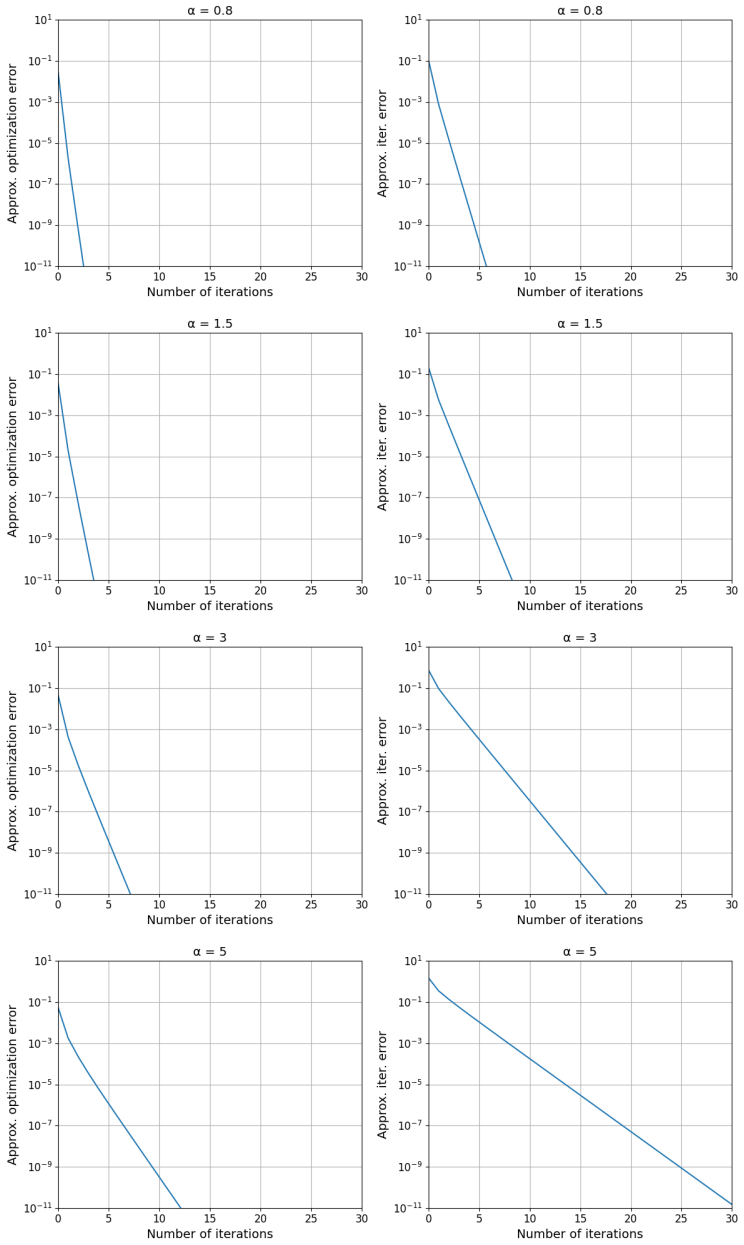
The central claim is that the corrected operator $T_F(U)=(\sum_j w[j] A_j^\alpha/\operatorname{Tr}[A_j^\alpha U])^{(1-\alpha)/\alpha}$, viewed on positive-definite matrices, is a contraction with ratio $|1-1/\alpha|$ in the Thompson metric, and that its unique fixed point is $Q_\star^{1-\alpha}$, the powered Petz-Augustin mean. Hence the iteration $Q_{t+1}=T_F(Q_t^{1-\alpha})^{1/(1-\alpha)}$ satisfies $d_T(Q_\star^{1-\alpha}, Q_{T+1}^{1-\alpha}) \le |1-1/\alpha|^T d_T(Q_\star^{1-\alpha}, Q_1^{1-\alpha})$, and after trace normalization the objective gap obeys the bound in Theorem 5.1 with the same linear rate. The corrected operator matters because the naive update with exponents $1-\alpha$ and $1/\alpha$ fails to be order-preserving for $\alpha>2$, and the paper exhibits a pair of matrices for which the direct contraction bound is violated. Putting the exponent $(1-\alpha)/\alpha$ in the defining map keeps the matrix powers within the range where Thompson-metric power estimates apply, and for $\alpha>1$ the iterates also have non-increasing objective values.
Load-bearing premise
The load-bearing premise is that the sum of the given quantum states, $\sum_j A_j$, has full rank, so the minimizer and every iterate can be kept positive definite; when that sum is singular, the paper only suggests projecting onto a lower-dimensional subspace and does not analyze what the projection does to the convergence rate or the initialization.
Editorial extensions
If this is right
- For any $\alpha\in(1/2,1)\cup(1,\infty)$, the Petz-Augustin mean can be computed to $\epsilon$ accuracy in the Thompson metric in $O(\log(1/\epsilon)/\log(1/|1-1/\alpha|))$ iterations, each costing $O(nd^2+d^3)$.
- The Petz capacity of order $\alpha\in(1/2,1)$ is computable with objective error $O(\log(n)/T)$, giving numerical access to the classical-quantum channel-coding error-exponent bounds that call for $C_\alpha$.
- In the commuting case, the algorithm is a tâtonnement dynamic that reaches Fisher-market equilibrium prices linearly for CES utilities with elasticity $\rho=1-1/\alpha\in(0,1)$, a regime where earlier tâtonnement-type guarantees were sublinear or incomparable.
- For inhomogeneous Fisher markets with weak-gross-substitutes CES utilities and seller-held upper bounds $\hat\rho_i$, asynchronous price updates converge as $\hat\rho^T$ in the Thompson metric, with $\hat\rho=\max_i\hat\rho_i$.
- For $\alpha>1$, objective values are non-increasing along the iterates, so the normalized iteration is simultaneously a monotone descent method.
Reading between the lines
- The same repair—iterate on the powered variable so every matrix power in the map has exponent in $(-1,1)$—may yield non-asymptotic rates for other noncommutative divergence minimizers whose natural updates are not order-preserving.
- Because the contraction ratio $|1-1/\alpha|$ tends to zero as $\alpha\to1$ while the constant $1/|\alpha-1|$ in the objective bound diverges, the worst-case bound near $\alpha=1$ is likely pessimistic; a refined analysis could separate the contraction rate from the objective-gap constant.
- The asynchronous market update suggests a randomized per-coordinate version of the quantum iteration that would cut the $d^3$ matrix-power cost per step, but such a scheme is not analyzed in the paper.
- Numerical divergence for $\alpha\le1/2$ indicates the proven range may be sharp; a useful test is to search for a modified fixed-point operator that contracts on the complementary interval.
Editorial analysis
A structured set of objections, weighed in public.
Referee Report
Summary. The paper studies the computation of the Petz-Augustin mean, defined as the minimizer of a weighted sum of Petz-Renyi divergences of order alpha over the set of quantum states. It proposes the fixed-point iteration (11), analyzes it through a corrected operator T_F on the positive-definite cone, and proves in Theorem 5.1 a linear convergence rate O(|1-1/alpha|^T) with respect to the Thompson metric for alpha in (1/2,1) union (1,infty), with initialization cost O(nd^3) and per-iteration cost O(nd^2+d^3). The paper then applies this algorithm to compute the Petz capacity of order alpha in (1/2,1), claiming an O(log(n)/T) rate for entropic mirror descent with approximate inner solves, and to compute equilibrium prices in CES Fisher markets, including an asynchronous tatonnement variant with rate O(hat_rho^T). The core contraction argument for the Petz-Augustin mean is coherent and detailed; the two application-level guarantees are less complete.
Significance. If the main theorem is correct, it is a genuinely useful algorithmic contribution: it appears to be the first non-asymptotic convergence guarantee for computing the Petz-Augustin mean, and the per-iteration cost is attractive compared with standard first-order methods. The use of the Thompson metric and the correction from the naive operator to T_F is a sound and non-obvious idea. The paper also gives a clear discussion of why the natural contractivity hypothesis fails, with a concrete counterexample. The Petz capacity and Fisher market applications are potentially significant, but as written the Petz capacity guarantee applies to an exact-gradient oracle rather than to the implemented approximate-gradient routine, and the Fisher market convergence proof in Section 7.3 contains a scaling error. These issues prevent the paper from being acceptable in its current form, although the central Petz-Augustin mean result appears sound and likely repairable.
major comments (2)
- [Section 6.2, Remark 6.1, Theorem 6.5] The advertised O(log(n)/T) guarantee for computing the Petz capacity is proved only for an exact-gradient oracle model. Theorem 6.5 applies Lemma 6.4 to the update (14) using the exact gradient nabla g(w_t), but the algorithm as described in Section 6.2 computes nabla g(w_t) and g(w_{t+1}) only to error epsilon by truncating the inner iteration (11) at T = O(log(1/epsilon)) steps (Remark 6.1). No perturbation analysis is provided that translates the inner-solve error into an outer suboptimality bound, and no total iteration or bit complexity is given. In particular, Lemma 6.2 only bounds the error of the approximate gradient in terms of the Thompson metric between Q_star(w_t) and the truncated iterate; it does not show that the approximate mirror-descent update stays within the regime in which Lemma 6.4 applies. Consequently, Theorem 6.5 as stated does not establish a non-asymptotic guarantee for the algorithm that is actually run.
- [Section 7.3, proof of Theorem 7.1] The coordinate-wise contraction argument in the proof of Theorem 7.1 contains a scaling error. In the displayed inequality after the definition of the update, replacing p_t by exp(d_T(p_star,p_t)) p_star gives a factor exp((1/(1-hat_rho_i) - 1/(1-rho_j)) d_T) in the numerator and exp(+rho_j/(1-rho_j) d_T) in the reciprocal denominator; the total exponent inside the sum is d_T/(1-hat_rho_i). Raising to the power 1-hat_rho_i therefore yields exp(d_T), not exp(hat_rho_i d_T). The same issue affects the lower bound. Thus the claimed inequality log(max(p_{t+1}[i]/p_star[i], p_star[i]/p_{t+1}[i])) <= hat_rho_i d_T(p_star,p_t) is not established by the proof as written, and the advertised tatonnement rate O(hat_rho^T) rests on this step. If a more refined argument is intended, it is not present in the manuscript.
minor comments (4)
- [Section 1] The full-rank assumption on sum_j A_j is stated, but the one-sentence reduction 'project all matrices onto a lower-dimensional subspace' is not analyzed. It would be helpful to spell out the support projection, the induced problem on that subspace, and how the initialization and convergence guarantees transfer; otherwise the reader cannot tell whether the singular case is fully covered.
- [Lemma 5.7 proof] In the proof of Lemma 5.7, the symbol sigma appears in the displayed equality 'Tr[TF(sigma^{1-alpha})^{alpha/(1-alpha)} TF(sigma^{1-alpha})]' without being defined; it should presumably be Q, the matrix introduced at the start of the proof.
- [Lemma C.2] In the definition of the operator L_2 within Lemma C.2, the summation index is written as m instead of n (the summation runs over k=1 to m, but the problem has n states). This should be corrected to avoid confusion.
- [Section 5.2.2] The fixed-point property for alpha in (1/2,1) is imported from Cheng et al. [2019, Proposition 2(b)] rather than proved in the paper. This is acceptable as a citation, but the paper should state more explicitly that the self-contained proof of Lemma 5.3 covers alpha>1 only, and that the lower range depends on the external result.
Circularity Check
No significant circularity: Theorem 5.1's rate is derived from an external contraction argument and an independently cited fixed-point characterization, with no load-bearing self-citation.
full rationale
The core derivation is self-contained. Lemma 5.2 proves contractivity of TF directly from the Thompson metric order inequalities and the power-contraction lemma (Lemma 3.2), without assuming the target rate. Lemma 5.3 identifies the fixed point with the minimizer using Cheng et al. 2019 for alpha < 1, an external result by different authors, and an optimality-based argument for alpha > 1. Lemmas 5.8 and 5.10 convert Thompson-metric contraction into optimization-error bounds via trace normalization and trace monotonicity; none of these steps defines its output in terms of itself. The acknowledged algorithmic overlap with Cheng and Nakiboglu 2024a is disclosed, and their result is asymptotic and for alpha > 1 only, so it is not used to prove the new non-asymptotic rate. Self-citations such as Tsai et al. 2024, Wang et al. 2024, and You et al. 2022 appear only in related-work and complexity comparisons, not as load-bearing premises. The Section 6 Petz-capacity analysis invokes external results, including Lu et al. 2018 and the Cheng-Nakiboglu gradient formula; the gap between Theorem 6.5's exact-gradient model and Remark 6.1's approximate inner solves is a missing perturbation analysis, which is a correctness or completeness concern rather than a circular reduction.
Assumptions & free parameters
assumptions (4)
- domain assumption The sum of the quantum states, sum_j A_j, is full-rank.
- domain assumption Petz-Renyi divergence objective is finite only for full-rank Q, and the algorithm restricts to positive definite iterates.
- standard math Standard matrix inequalities: Araki-Lieb-Thirring (Lemma 5.4), Holder (Lemma 5.5), Lieb-Ando concavity (Lemma C.3), and Thompson metric power bounds (Lemma 3.2).
- standard math For alpha in (0,1), the fixed-point property of Q_star^{1-alpha} under TF is taken from Cheng et al. 2019 Proposition 2(b).
Cite this review
Pith. "Pith review of A Linearly Convergent Algorithm for Computing the Petz-Augustin Mean." pith.science (2026). https://pith.science/paper/ZPMNLFPT
@misc{pith2026250206399,
  author       = {Pith},
  title        = {Pith review of: A Linearly Convergent Algorithm for Computing the Petz-Augustin Mean},
  year         = {2026},
  howpublished = {\url{https://pith.science/paper/ZPMNLFPT}},
  note         = {Machine review of arXiv:2502.06399}
}
abstract
We study the computation of the Petz-Augustin mean of order $\alpha \in (0,1) \cup (1,\infty)$, defined as the minimizer of a weighted sum of $n$ Petz-R\'enyi divergences of order $\alpha$ over the set of $d$-by-$d$ quantum states, where the Petz-R\'enyi divergence is a quantum generalization of the classical R\'enyi divergence. We propose the first algorithm with a non-asymptotic convergence guarantee for solving this optimization problem. The iterates are guaranteed to converge to the Petz-Augustin mean at a linear rate of \( O\left( \lvert 1 - 1/\alpha \rvert^T \right) \) with respect to the Thompson metric for $\alpha\in(1/2,1)\cup(1,\infty)$, where \( T \) denotes the number of iterations. The algorithm has an initialization time complexity of $O\left(nd^3\right)$ and a per-iteration time complexity of $O\left(nd^2 + d^3\right)$. Two applications follow. First, we propose the first iterative method with a non-asymptotic convergence guarantee for computing the Petz capacity of order $\alpha\in(1/2,1)$, which generalizes the quantum channel capacity and characterizes the optimal error exponent in classical-quantum channel coding. Second, we establish that the Petz-Augustin mean of order $\alpha$, when all quantum states commute, is equivalent to the equilibrium prices in Fisher markets with constant elasticity of substitution (CES) utilities of common elasticity $\rho=1-1/\alpha$, and our proposed algorithm can be interpreted as a t\^{a}tonnement dynamic. We then extend the proposed algorithm to inhomogeneous Fisher markets, where buyers have different elasticities, and prove that it achieves a faster convergence rate compared to existing t\^{a}tonnement-type algorithms.
Figures

Reference graph
Works this paper leans on
-
[1]
H. Araki. On an inequality of L ieb and T hirring. Lett. Math. Phys., 19: 0 167--170, 1990
work page 1990
-
[2]
S. Arimoto. Computation of random coding exponent functions. IEEE Trans. Inf. Theory, 22 0 (6): 0 665--671, 1976
work page 1976
- [3]
-
[4]
H. H. Bauschke, J. Bolte, and M. Teboulle. A descent lemma beyond L ipschitz gradient continuity: first-order methods revisited and applications. Math. Oper. Res., 42 0 (2): 0 330--348, 2017
work page 2017
-
[5]
X. Bei, J. Garg, and M. Hoefer. Ascending-price algorithms for unknown markets. ACM Trans. Algorithms, 15 0 (3): 0 1--33, 2019
work page 2019
-
[6]
R. Bhatia. Matrix Analysis. Springer, New York, NY, 1997
work page 1997
-
[7]
B. Birnbaum, N. R. Devanur, and L. Xiao. Distributed algorithms via gradient descent for F isher markets. In Proc. 12th ACM Conf. Electronic Commerce, pages 127--–136, New York, NY, 2011
work page 2011
-
[8]
S. Br\^ a nzei, N. Devanur, and Y. Rabani. Proportional dynamics in exchange economies. In Proc. 22nd ACM Conf. Economics and Computation, pages 180--201, 2021
work page 2021
Show all 80 references
-
[9]
Brown, H
P. Brown, H. Fawzi, and O. Fawzi. Device-independent lower bounds on the conditional von N eumann entropy. 2024. arXiv:2106.13692v3
2024 arXiv
-
[10]
L. Burri. Alternating minimization for computing doubly minimized P etz R enyi mutual information, 2025. arXiv:2507.05205
2025 arXiv
-
[11]
Cheng and B
H.-C. Cheng and B. Nakibo g lu. A new characterization of A ugustin information and mean. In IEEE Int. Symp. Information Theory, pages 2538--2543, 2024 a
2024
-
[12]
Cheng and B
H.-C. Cheng and B. Nakibo g lu. A ugustin information in the vicinity of A ugustin capacity-achieving input distributions. In IEEE Inf. Theory Workshop, pages 567--572, 2024 b
2024
-
[13]
Cheng, L
H.-C. Cheng, L. Gao, and M.-H. Hsieh. Properties of noncommutative R \'e nyi and A ugustin information. 2018. arXiv:1811.04218v1
2018 arXiv
-
[14]
Cheng, M.-H
H.-C. Cheng, M.-H. Hsieh, and M. Tomamichel. Quantum sphere-packing bounds with polynomial prefactors. IEEE Trans. Inf. Theory, 65 0 (5): 0 2872--2898, 2019
2019
-
[15]
Cheng, L
H.-C. Cheng, L. Gao, and M.-H. Hsieh. Properties of noncommutative R \'e nyi and A ugustin information. Commun. Math. Phys., 390: 0 501--544, 2022
2022
-
[16]
Y. K. Cheung, R. Cole, and A. Rastogi. Tatonnement in ongoing markets of complementary goods. In Proc. 13th ACM Conf. Electronic Commerce, pages 337–--354, 2012
2012
-
[17]
Y. K. Cheung, R. Cole, and Y. Tao. Dynamics of distributed updating in F isher markets. In Proc. 2018 ACM Conf. Economics and Computation, pages 351--368, New York, NY, 2018
2018
-
[18]
Y. K. Cheung, R. Cole, and N. R. Devanur. Tatonnement beyond gross substitutes? gradient descent to the rescue. Games Econ. Behav., 123: 0 295--326, 2020
2020
-
[19]
Y. K. Cheung, R. Cole, and Y. Tao. Proportional response dynamics in gross substitutes markets. 2025. arXiv:2506.02852
2025 arXiv
-
[20]
Codenotti, B
B. Codenotti, B. McCune, and K. Varadarajan. Market equilibrium via the excess demand function. In Proc. 37th Annu. ACM Symp. Theory of Computing, pages 74--83, 2005
2005
-
[21]
M. B. Cohen and R. Peng. _p row sampling by L ewis weights. In Proc. 47th Annu. ACM Symp. Theory of Computing, pages 183--192, 2015
2015
-
[22]
Cole and L
R. Cole and L. Fleischer. Fast-converging tatonnement algorithms for one-time and ongoing market problems. In Proc. 40th Annu. ACM Symp. Theory of Computing, pages 315--324, 2008
2008
-
[23]
R. Cole, L. Fleischer, and A. Rastogi. Discrete price updates yield fast convergence in ongoing markets with finite warehouses. 2010. arXiv:1012.2124
2010 arXiv
-
[24]
M. Dalai. Lower bounds on the probability of error for classical and classical-quantum channels. IEEE Trans. Inf. Theory, 59 0 (12): 0 8027--8056, 2013
2013
-
[25]
Dalai and A
M. Dalai and A. Winter. Constant compositions in the sphere packing bound for classical-quantum channels. In IEEE Int. Symp. Information Theory, pages 151--155, 2014
2014
-
[26]
Durfee, K
D. Durfee, K. A. Lai, and S. Sawlani. _1 regression using L ewis weights preconditioning and stochastic gradient descent. In Proc. 31st Conf. Learning Theory, pages 1626--1656, 2018
2018
-
[27]
Dvijotham, Y
K. Dvijotham, Y. Rabani, and L. J. Schulman. Convergence of incentive-driven dynamics in F isher markets. Games Econ. Behav., 134: 0 361--375, 2022
2022
-
[28]
Fawzi and J
H. Fawzi and J. Saunderson. Optimal self-concordant barriers for quantum relative entropies. SIAM J. Optim., 33 0 (4): 0 2858--2884, 2023
2023
-
[29]
P. E. Frenkel. Integral formula for quantum relative entropy implies data processing inequality. Quant. , 7: 0 1102, 2023
2023
-
[30]
Goktas, J
D. Goktas, J. Zhao, and A. Greenwald. T\^ a tonnement in homothetic F isher markets. In Proc. 24th ACM Conf. Economics and Computation, pages 760--781, 2023
2023
-
[31]
Hayashi and G
M. Hayashi and G. Liu. Generalized quantum A rimoto-- B lahut algorithm and its application to quantum information bottleneck. Quantum Sci. Technol., 9 0 (4): 0 045036, 2024
2024
-
[32]
K. He, J. Saunderson, and H. Fawzi. A B regman proximal perspective on classical and quantum B lahut- A rimoto algorithms. IEEE Trans. Inf. Theory, 70 0 (8): 0 5710--5730, 2024 a
2024
-
[33]
K. He, J. Saunderson, and H. Fawzi. Exploiting structure in quantum relative entropy programs. 2024 b . arXiv:2407.00241v2
2024 arXiv
-
[34]
K. He, J. Saunderson, and H. Fawzi. Operator convexity along lines, self-concordance, and sandwiched r \' e nyi entropies, 2025. arXiv:2502.05627
2025 arXiv
-
[35]
R. A. Horn and C. R. Johnson. Matrix Analysis. Cambridge Univ. Press, Cambridge, UK, 2nd edition, 2013
2013
-
[36]
Huang and M
Z. Huang and M. M. Wilde. Semi-definite optimization of the measured relative entropies of quantum states and channels. 2024. arXiv:2406.19060
2024
-
[37]
Je n cov\' a
A. Je n cov\' a . Recoverability of quantum channels via hypothesis testing. Lett. Math. Phys, 114, 2024
2024
-
[38]
Jiang and Y
M. Jiang and Y. Chen. Regularized D ikin walks for sampling truncated logconcave measures, mixed isoperimetry and beyond worst-case analysis. 2024. arXiv:2412.11303
2024 arXiv
-
[39]
Jitsumatsu and Y
Y. Jitsumatsu and Y. Oohama. A new iterative algorithm for computing the correct decoding probability exponent of discrete memoryless channels. IEEE Trans. Inf. Theory, 66 0 (3): 0 1585--1606, 2020
2020
-
[40]
Johansson, P
J. Johansson, P. Nation, and F. Nori. QuTiP : An open-source P ython framework for the dynamics of open quantum systems. Comput. Phys. Commun., 183 0 (8): 0 1760--1772, 2012
2012
-
[41]
Joshi, J
S. Joshi, J. Ghosh, M. Reid, and O. Koyejo. R \'e nyi divergence minimization based co-regularized multiview clustering. Mach. Learn., 104 0 (2): 0 411--439, 2016
2016
-
[42]
Kamatsuka, Y
A. Kamatsuka, Y. Ishikawa, K. Kazama, and T. Yoshida. New algorithms for computing S ibson capacity and A rimoto capacity. In IEEE Int. Symp. Information Theory, pages 729--734, 2024 a
2024
-
[43]
Kamatsuka, K
A. Kamatsuka, K. Kazama, and T. Yoshida. Algorithms for computing the A ugustin-- C sisz\' a r mutual information and L apidoth-- P fister mutual information. 2024 b . arXiv:2404.10950v2
2024 arXiv
-
[44]
Kamatsuka, K
A. Kamatsuka, K. Kazama, and T. Yoshida. A new algorithm for computing -capacity. In IEEE Int. Symp. Information Theory and Its Applications, pages 440--445, 2024 c
2024
-
[45]
Karakos, S
D. Karakos, S. Khudanpur, and C. E. Priebe. Computation of C sisz\' a r's mutual information of order . In IEEE. Int. Symp. Information Theory, pages 2106--2110, 2008
2008
-
[46]
Kolumbus, M
Y. Kolumbus, M. Levy, and N. Nisan. Asynchronous proportional response dynamics: convergence in markets with adversarial scheduling. In Adv. Neural Information Processing Systems 37, pages 25409--25434, 2023
2023
-
[47]
Kook and S
Y. Kook and S. S. Vempala. G aussian cooling and D ikin walks: T he interior-point method for logconcave sampling. In S. Agrawal and A. Roth, editors, Proc. 37th Conf. Learning Theory, pages 3137--3240, 2024
2024
-
[48]
Ko mann and R
G. Ko mann and R. Schwonnek. Optimising the relative entropy under semi definite constraints - a new tool for estimating key rates in QKD . 2024. arXiv:2404.17016
2024
-
[49]
Ko mann and M
G. Ko mann and M. M. Wilde. Semidefinite optimization of the quantum relative entropy of channels. 2024. arXiv:2410.16362
2024 arXiv
-
[50]
U. Krause. Positive Dynamical Systems in Discrete Time. De Gruyter, Berlin, DE, 2015
2015
-
[51]
D. M. Kreps. Game Theory and Economic Modelling. Oxford Univ. Press, 1990
1990
-
[52]
Larotonda
G. Larotonda. The case of equality in H \" o lder's inequality for matrices and operators. Math. Proc. R. Ir. Acad., 118A 0 (1): 0 1--4, 2018
2018
-
[53]
Y. T. Lee and A. Sidford. Solving linear programs with O ( rank ) linear system solves. 2020. arXiv:1910.08033v2
2020 arXiv
-
[54]
Lemmens and R
B. Lemmens and R. Nussbaum. Nonlinear P erronr- F robenius Theory . Cambridge Univ. Press, Cambridge, UK, 2012
2012
-
[55]
Li and N
H. Li and N. Cai. A B lahut- A rimoto type algorithm for computing classical-quantum channel capacity. In IEEE Int. Symp. Information Theory, pages 255--259, 2019
2019
-
[56]
Li and V
Y.-H. Li and V. Cevher. Convergence of the exponentiated gradient method with A rmijo line search. J. Optim. Theory Appl., 181: 0 588--607, 2019
2019
-
[57]
Z. Li. Proportional response dynamics in the F isher market. Theor. Comput. Sci., 412 0 (24): 0 2691--2698, 2011
2011
-
[58]
E. Lieb. Convex trace functions and the W igner- Y anase- D yson conjecture. Adv. Math., 11 0 (3): 0 267--288, 1973
1973
-
[59]
H. Lu, R. M. Freund, and Y. Nesterov. Relatively smooth convex optimization by first-order methods, and applications. SIAM J. Optim., 28 0 (1): 0 333--354, 2018
2018
-
[60]
Milgrom and J
P. Milgrom and J. Roberts. Adaptive and sophisticated learning in normal form games. Games Econ. Behav., 3: 0 82--100, 1991
1991
-
[61]
Mosonyi and T
M. Mosonyi and T. Ogawa. Strong converse exponent for classical-quantum channel coding. Commun. Math. Phys., 355: 0 373--426, 2017
2017
-
[62]
Mosonyi and T
M. Mosonyi and T. Ogawa. Divergence radii and the strong converse exponent of classical-quantum channel coding with constant compositions. IEEE Trans. Inf. Theory, 67 0 (3): 0 1668--1698, 2021
2021
-
[63]
H. Nagaoka. Algorithms of A rimoto- B lahut type for computing quantum channel capacity. In IEEE Int. Symp. Information Theory, pages 354--, 1998
1998
-
[64]
Nakibo g lu
B. Nakibo g lu. The A ugustin capacity and center. Probl. Inf. Transm., 55: 0 299--342, 2019
2019
-
[65]
T. Nan, Y. Gao, and C. Kroer. On the convergence of t\^ a tonnement for linear F isher markets. In Proc. AAAI Conf. Artificial Intelligence, volume 39, pages 14027--14035, 2025
2025
-
[66]
Nesterov
Y. Nesterov. Lectures on convex optimization. Springer, Cham, CH, second edition, 2018
2018
-
[67]
R. D. Nussbaum. Hilbert's projective metric and iterated nonlinear maps. Amer. Math. Soc., Providence, RI, 1988
1988
-
[68]
Parulekar, A
A. Parulekar, A. Parulekar, and E. Price. L1 regression with L ewis weights subsampling. In Int. Workshop on Approximation, Randomization, and Combinatorial Optimization. Algorithms and Techniques, 2021
2021
-
[69]
D. Petz. Quasi-entropies for finite quantum systems. Rep. Math. Phys., 23 0 (1): 0 57--65, 1986
1986
-
[70]
Ramakrishnan, R
N. Ramakrishnan, R. Iten, V. B. Scholz, and M. Berta. Computing quantum channel capacities. IEEE Trans. Inf. Theory, 67 0 (2): 0 946--960, 2021
2021
-
[71]
J. M. Renes. Tight lower bound on the error exponent of classical-quantum channels. IEEE Trans. Inf. Theory, 71 0 (1): 0 530--538, 2025
2025
-
[72]
Shikhman, Y
V. Shikhman, Y. Nesterov, and V. Ginsburgh. Power method t\^ a tonnements for C obb- D ouglas economies. Math. Econ., 75: 0 84--92, 2018
2018
-
[73]
A. J. Storkey, J. J. Millin, and K. J. Geras. Isoelastic agents and wealth updates in machine learning markets. In Proc. 29th Int. Conf. Machine Learning, pages 1019--1026, 2012
2012
-
[74]
A. J. Storkey, Z. Zhu, and J. Hu. Aggregation under bias: R \'e nyi divergence aggregation and its implementation via machine learning markets. In Machine Learning and Knowledge Discovery in Databases, pages 560--574, Cham, 2015. Springer
2015
-
[75]
A. C. Thompson. On certain contraction mappings in a partially ordered vector space. Proc. Am. Math. Soc., 14 0 (3): 0 438--443, 1963
1963
-
[76]
Tsai, G.-R
C.-E. Tsai, G.-R. Wang, H.-C. Cheng, and Y.-H. Li. Linear convergence in H ilbert's projective metric for computing A ugustin information and a R \'e nyi information measure. 2024. arXiv:2409.02640v2
2024 arXiv
-
[77]
L. Walras. Elements of Theoretical Economics, or The Theory of Social Wealth. Cambridge Univ. Press, 2014. Translated and edited by Donald A. Walker and Jan van Daal
2014
-
[78]
Wang, C.-E
G.-R. Wang, C.-E. Tsai, H.-C. Cheng, and Y.-H. Li. Computing A ugustin information via hybrid geodesically convex optimization. In IEEE Int. Symp. Information Theory, pages 2532--2537, 2024
2024
-
[79]
Wu and L
F. Wu and L. Zhang. Proportional response dynamics leads to market equilibrium. In Proc. 39th Annu. ACM Symp. on Theory of Computing, pages 354--363, 2007
2007
-
[80]
You, H.-C
J.-K. You, H.-C. Cheng, and Y.-H. Li. Minimizing quantum R \'e nyi divergences via mirror descent with P olyak step size. In IEEE Int. Symp. Information Theory, pages 252--257, 2022
2022
Reviewed August 8, 2026 · model on record in the stance chip above.
Discussion (0). Continue with ORCID to comment.