Projecting the ultimate pulsar timing sensitivity to dark matter substructure in a stochastic gravitational wave background
Pith reviewed 2026-06-26 23:08 UTC · model grok-4.3
The pith
A stochastic gravitational wave background substantially weakens pulsar timing array sensitivity to dark matter substructures, leaving only Shapiro searches viable.
A machine-rendered reading of the paper's core claim, the machinery that carries it, and where it could break.
Core claim
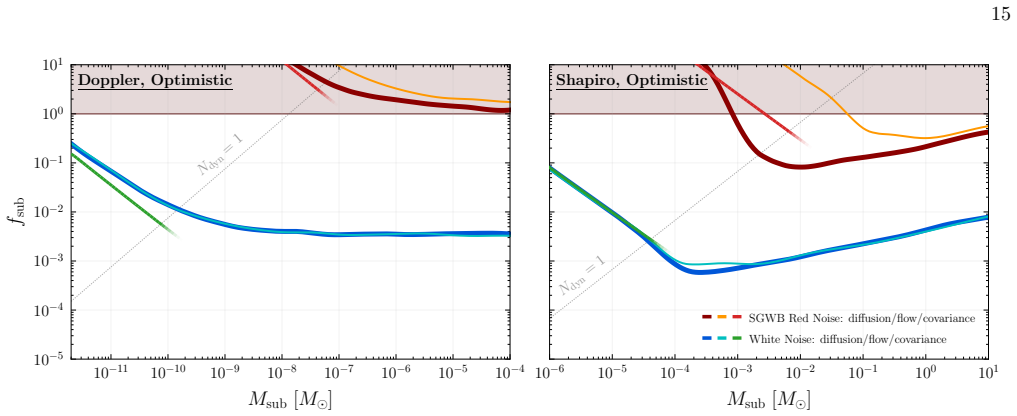
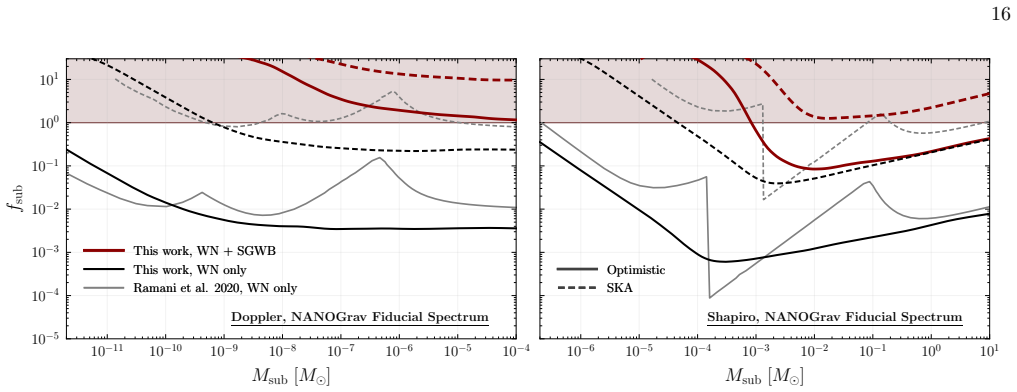
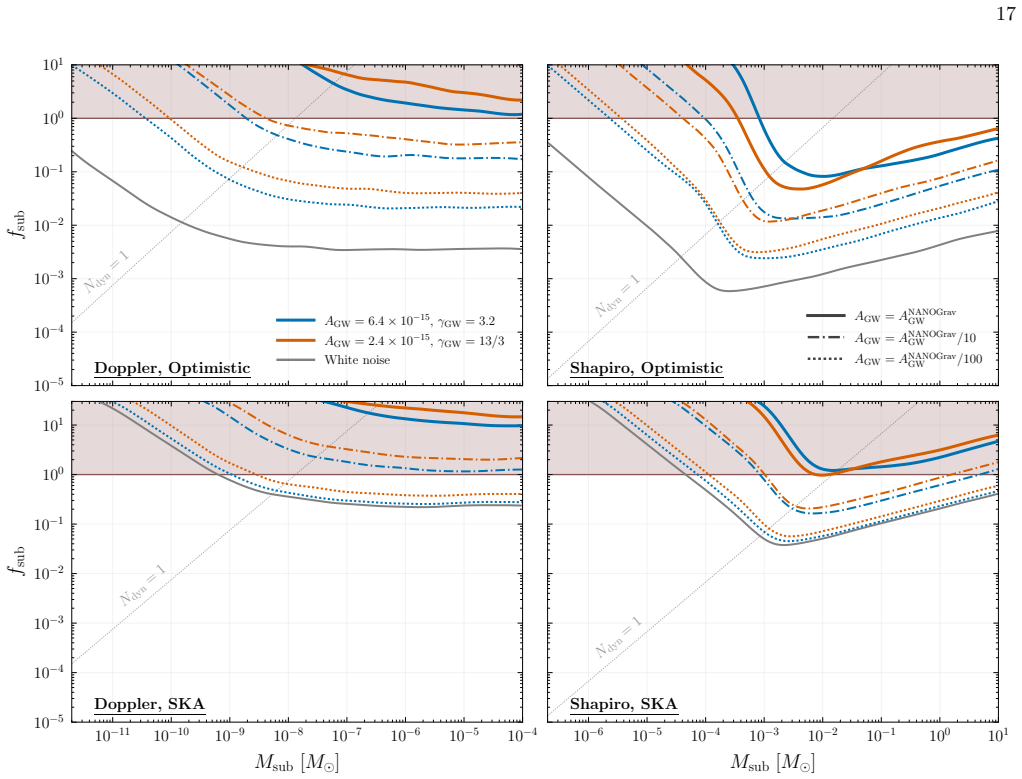
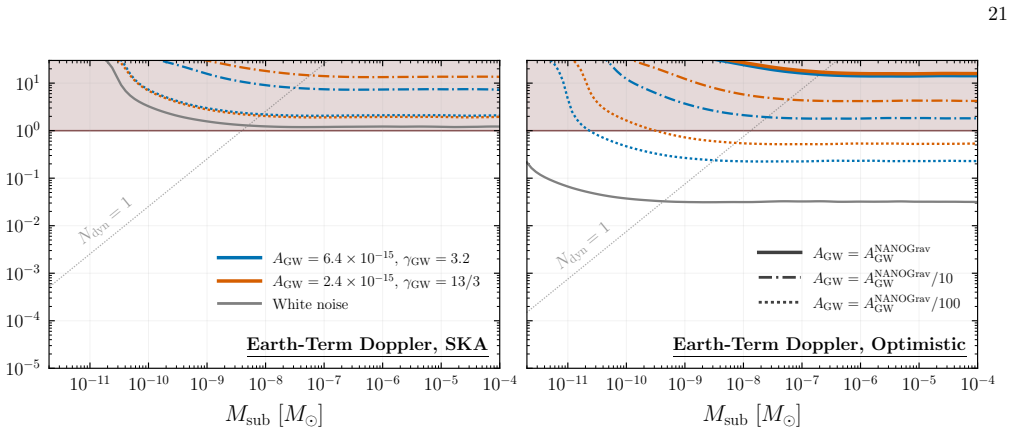
The authors develop a framework combining Monte Carlo signal modeling and machine-learned surrogate likelihoods to perform a unified likelihood-level analysis of pulsar timing signals from compact dark matter substructures across rare static encounters, dynamic flybys, and the stochastic limit. Applying the framework reveals that the stochastic gravitational wave background substantially weakens the sensitivity, such that only a Shapiro search retains sensitivity to subdominant dark matter components in the most optimistic observing scenario when assuming SGWB parameters inferred from current measurements.
What carries the argument
A framework that combines Monte Carlo signal modeling and machine-learned surrogate likelihoods for unified analysis of Doppler and Shapiro timing signals from dark matter substructures in the presence of a stochastic gravitational wave background.
If this is right
- The stochastic gravitational wave background reduces pulsar timing array sensitivity to compact dark matter substructures in all signal regimes.
- Only searches based on Shapiro timing delays retain sensitivity to subdominant dark matter components under current SGWB parameters.
- Unified likelihood analysis replaces separate treatments of rare encounters, flybys, and stochastic limits.
- Optimistic future observing scenarios still leave Doppler-based searches ineffective against the background.
Where Pith is reading between the lines
- PTA data analysis pipelines may need dedicated Shapiro-channel isolation techniques to maintain dark matter reach alongside gravitational wave background measurements.
- The same surrogate-likelihood approach could be applied to test whether other proposed backgrounds produce comparable degradation in substructure sensitivity.
- Longer observation baselines or denser pulsar arrays might partially offset the weakening only if they improve Shapiro delay resolution more than Doppler resolution.
Load-bearing premise
The machine-learned surrogate likelihoods accurately reproduce the full Monte Carlo likelihood across the full range of signal regimes and SGWB amplitudes considered.
What would settle it
A calculation or observation showing that the surrogate likelihoods deviate from Monte Carlo results at the SGWB amplitudes inferred from current data would invalidate the sensitivity projections.
Figures
read the original abstract
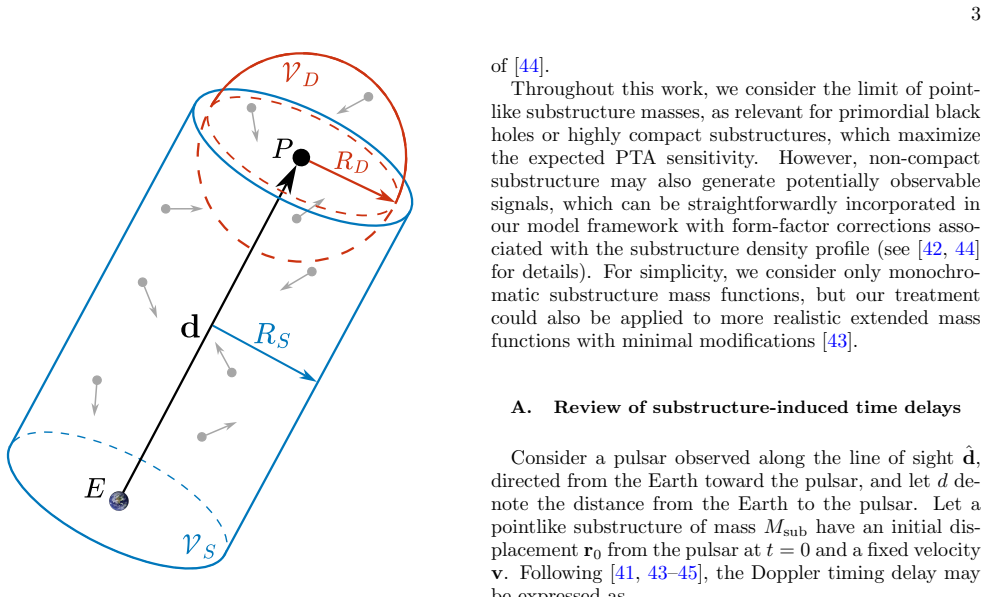
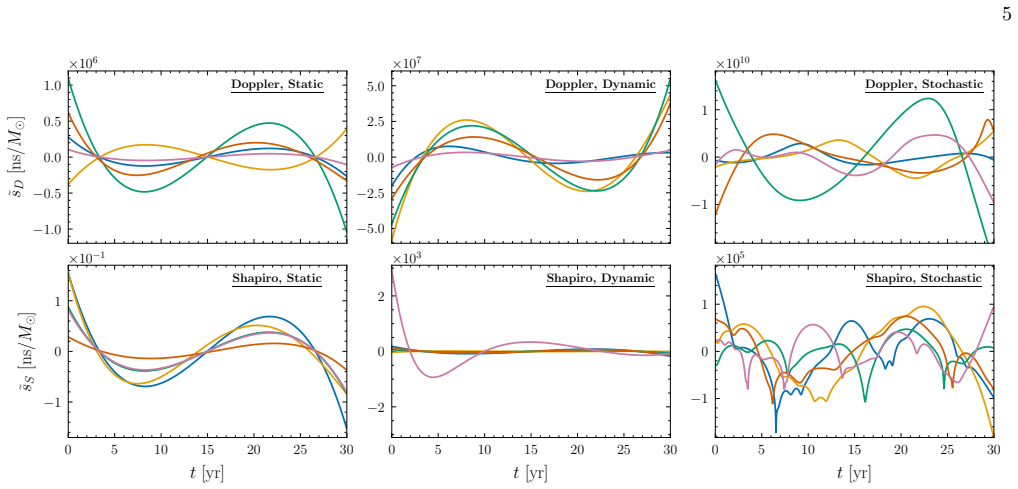
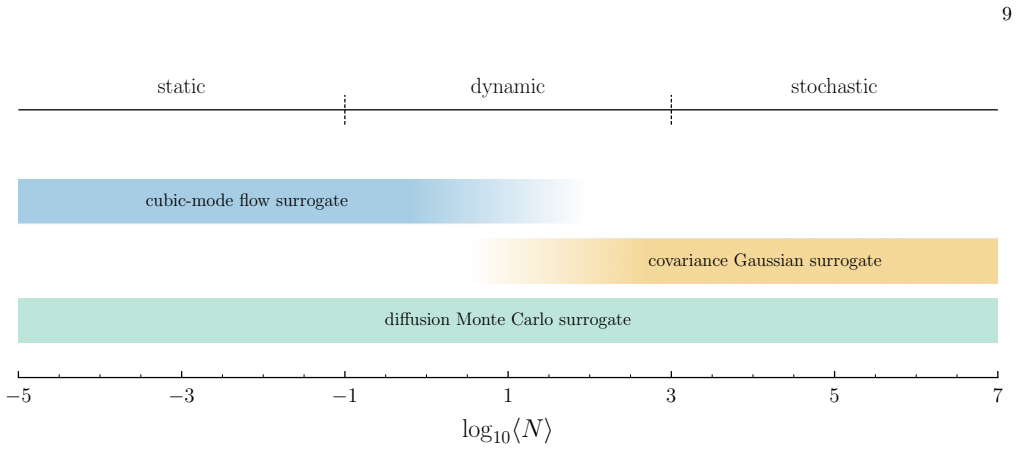
Pulsar timing arrays (PTAs) are sensitive to the gravitational influence of passing compact substructures, which can produce Doppler timing delays by accelerating pulsars or the Solar System barycenter, and Shapiro timing delays when passing near Earth--pulsar lines of sight. Projections for the complete PTA sensitivity to compact dark matter (DM) substructures, such as primordial black holes and axion miniclusters, are challenging due to the variety of signal types ranging from rare, nearly static encounters, to dynamic flybys, to the stochastic limit of many substructures. We address this challenge with a framework that combines Monte Carlo signal modeling and machine-learned surrogate likelihoods, enabling a unified likelihood-level analysis of signals previously treated only in simplified limiting regimes. We then use this framework to precisely assess the impact of a stochastic gravitational wave background (SGWB), for which evidence was recently found, on the PTA sensitivity to compact DM substructures. The SGWB substantially weakens the sensitivity, and we find that in even the most optimistic observing scenario only a Shapiro search retains sensitivity to subdominant DM components when assuming SGWB parameters inferred from current measurements.
Editorial analysis
A structured set of objections, weighed in public.
Referee Report
Summary. The paper develops a framework that combines Monte Carlo realizations of Doppler, Shapiro, and stochastic dark matter (DM) signals with machine-learned surrogate likelihoods to enable a unified likelihood-level analysis of pulsar timing array (PTA) sensitivity to compact DM substructures across rare, dynamic, and stochastic regimes. It then applies this framework to quantify the degradation in sensitivity caused by a stochastic gravitational wave background (SGWB) whose parameters are drawn from current PTA inferences, concluding that the SGWB substantially weakens reach and that only Shapiro searches retain sensitivity to subdominant DM components even in the most optimistic observing scenarios.
Significance. If the surrogate likelihoods prove accurate, the work supplies a concrete, quantitative assessment of how the recently detected SGWB affects PTA DM searches, moving beyond simplified limiting regimes to joint marginalization over SGWB parameters. The unified treatment of signal types and the explicit use of current SGWB inferences are strengths that could inform observing strategies and data-analysis pipelines for ongoing and future PTAs.
major comments (2)
- [Section describing surrogate likelihood training and marginalization over SGWB parameters] The headline result that the SGWB substantially weakens sensitivity (and that only Shapiro retains reach) rests directly on the machine-learned surrogate likelihoods. No section supplies quantitative validation metrics (KL divergence, coverage, or point-wise log-likelihood error) on held-out Monte Carlo draws that include the SGWB component at the amplitudes and spectral indices reported by NANOGrav/EPTA; this validation gap is load-bearing for the central claim.
- [Results section on sensitivity projections with SGWB] The projections assume SGWB parameters are fixed external inputs drawn from current measurements; the manuscript does not show how the sensitivity curves shift when those parameters are varied within their posterior uncertainties or when the SGWB spectrum deviates from the assumed power-law form.
minor comments (2)
- Figure captions and axis labels should explicitly distinguish the three DM signal regimes (Doppler, Shapiro, stochastic) and the SGWB-only case for clarity.
- A short table summarizing the surrogate training hyperparameters, network architecture, and loss function would aid reproducibility.
Simulated Author's Rebuttal
We thank the referee for their constructive comments and positive assessment of the work's significance. We address each major comment below and will revise the manuscript accordingly where appropriate.
read point-by-point responses
-
Referee: [Section describing surrogate likelihood training and marginalization over SGWB parameters] The headline result that the SGWB substantially weakens sensitivity (and that only Shapiro retains reach) rests directly on the machine-learned surrogate likelihoods. No section supplies quantitative validation metrics (KL divergence, coverage, or point-wise log-likelihood error) on held-out Monte Carlo draws that include the SGWB component at the amplitudes and spectral indices reported by NANOGrav/EPTA; this validation gap is load-bearing for the central claim.
Authors: We agree that explicit quantitative validation metrics for the surrogate likelihoods in the presence of the SGWB are necessary to support the central claims. The original manuscript emphasized the framework and its application but omitted these specific metrics on held-out draws including the SGWB. We will add a dedicated subsection in the revised manuscript reporting KL divergence, coverage probabilities, and point-wise log-likelihood errors computed on Monte Carlo realizations that incorporate the SGWB at the amplitudes and spectral indices from NANOGrav/EPTA inferences. revision: yes
-
Referee: [Results section on sensitivity projections with SGWB] The projections assume SGWB parameters are fixed external inputs drawn from current measurements; the manuscript does not show how the sensitivity curves shift when those parameters are varied within their posterior uncertainties or when the SGWB spectrum deviates from the assumed power-law form.
Authors: The manuscript employs SGWB parameters drawn from current PTA inferences as representative fixed inputs to quantify the degradation under realistic conditions. We acknowledge the value of demonstrating robustness to parameter variations. We will include additional analysis in the revised results section showing how the sensitivity curves respond when SGWB amplitude and spectral index are varied within the reported posterior uncertainties. For deviations from the power-law spectrum, this lies outside the present scope given that the power-law form is the standard model consistent with current inferences; we will explicitly note this limitation in the revised discussion. revision: partial
Circularity Check
No significant circularity; projections use external SGWB parameters and surrogate likelihoods trained on independent Monte Carlo realizations
full rationale
The paper's chain starts from Monte Carlo generation of Doppler, Shapiro, and stochastic DM signals, followed by training of machine-learned surrogate likelihoods on those realizations. SGWB parameters are imported as fixed external inputs drawn from current PTA inferences (NANOGrav/EPTA), not fitted or derived inside the present work. The headline sensitivity projections are then obtained by marginalizing the surrogates over those external parameters. No equation equates a derived quantity to a fitted input from the same dataset, no self-citation supplies a load-bearing uniqueness theorem, and no ansatz is smuggled via prior author work. The framework therefore remains self-contained against external benchmarks.
Axiom & Free-Parameter Ledger
Reference graph
Works this paper leans on
-
[1]
In this regime, no adap- tive volume expansion is invoked in our standard pro- cedure, so this test directly probes whether the fiducial radius itself is sufficiently large
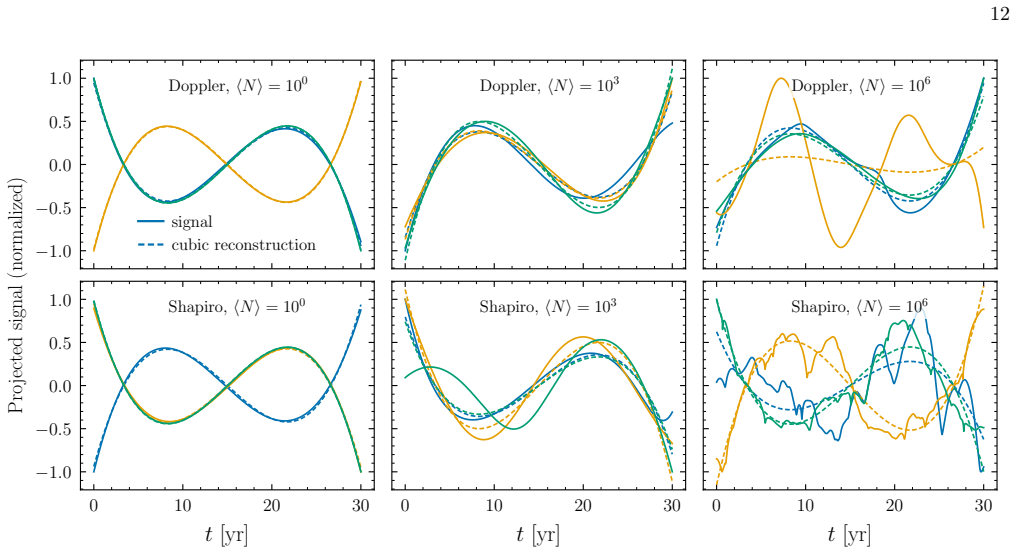
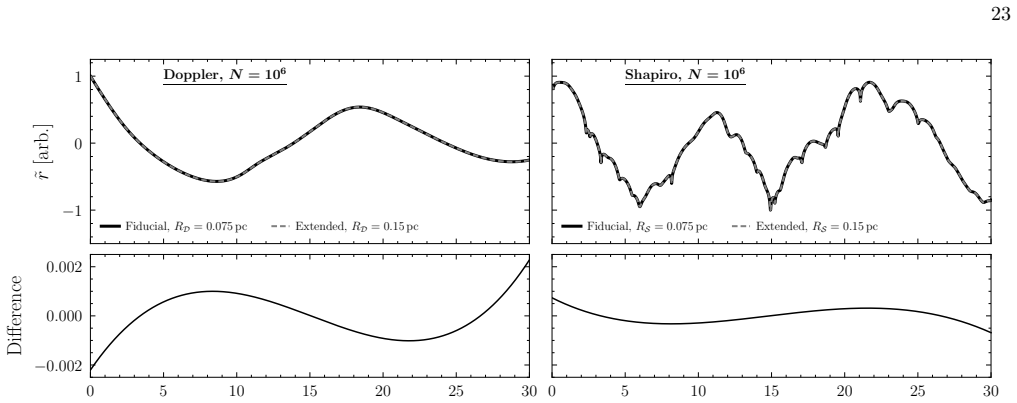
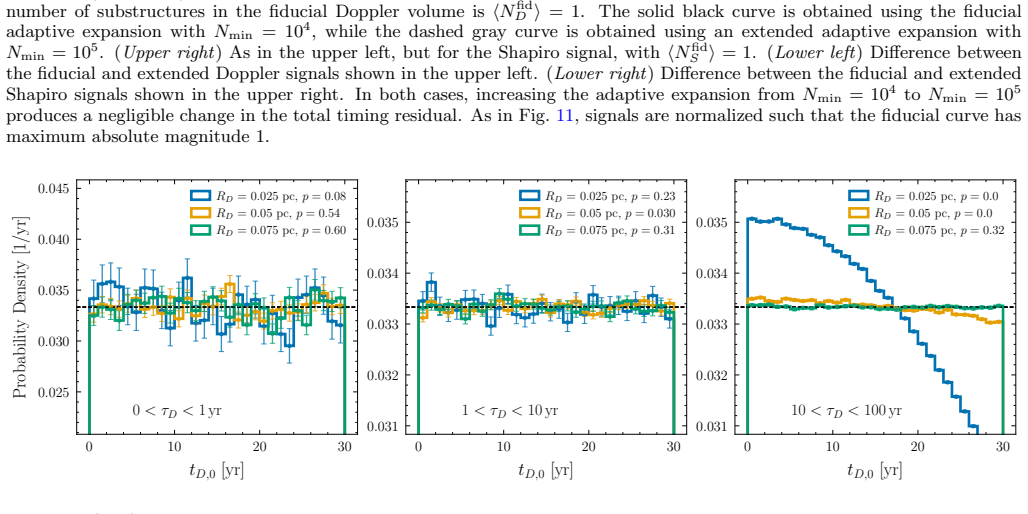
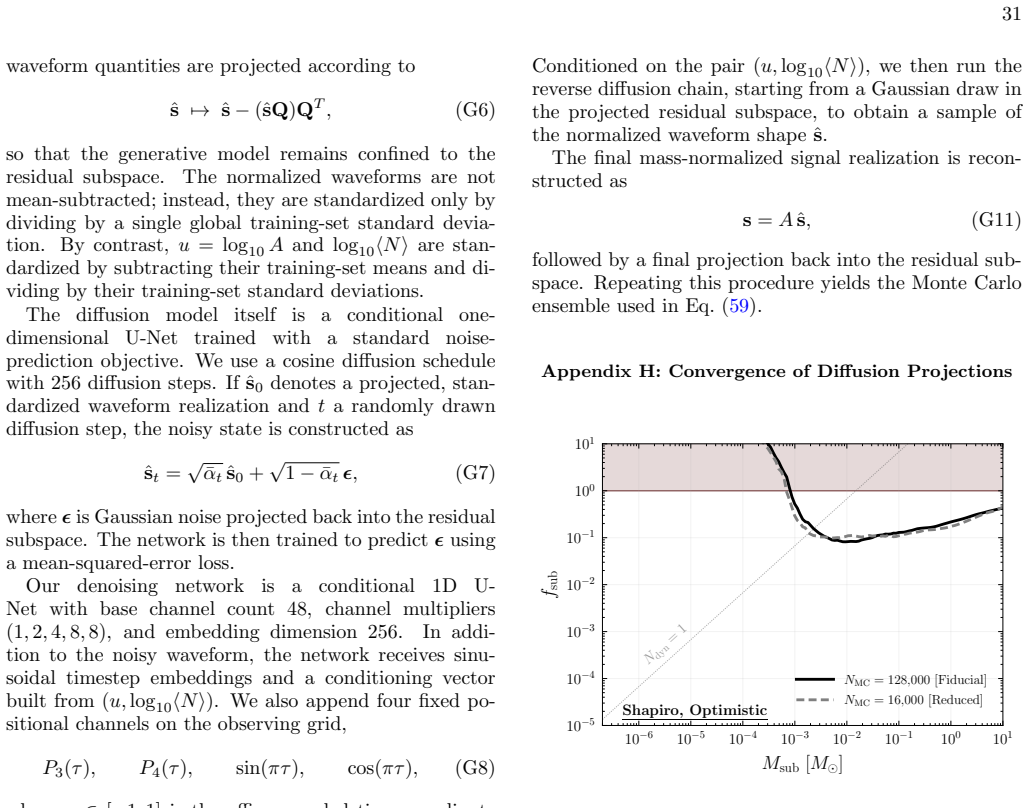
Substructure beyond the sampling region We first consider a high-density scenario in which the expected number of substructures in the corresponding fiducial sampling volume is 106. In this regime, no adap- tive volume expansion is invoked in our standard pro- cedure, so this test directly probes whether the fiducial radius itself is sufficiently large. 2...
-
[2]
In our standard pre- scription, this requires expanding the sampling region un- til the expected number of sampled substructures reaches Nmin = 10 4
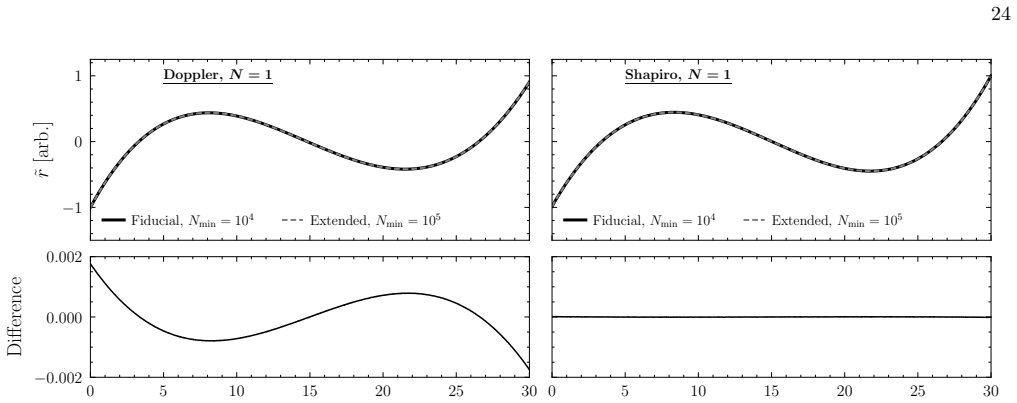
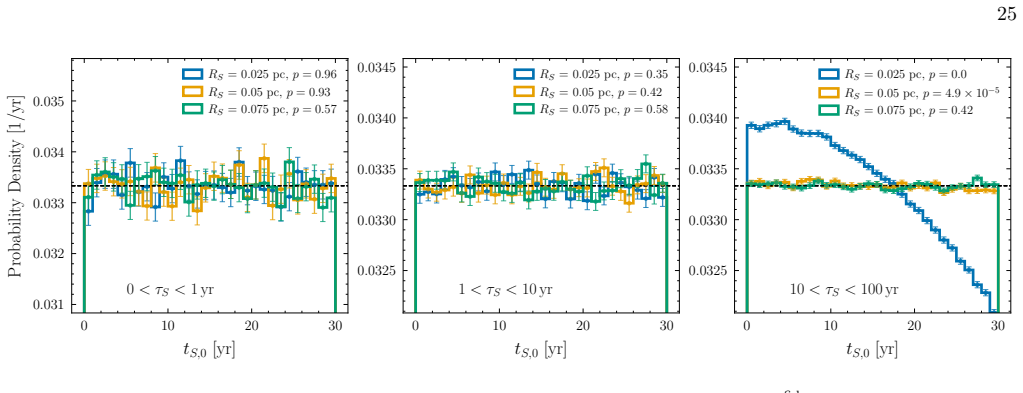
Examining the adaptive volume expansion We now turn to the low-density regime, in which the expected number of substructures in the corresponding fiducial sampling volume is unity. In our standard pre- scription, this requires expanding the sampling region un- til the expected number of sampled substructures reaches Nmin = 10 4. The purpose of this test i...
-
[3]
(2) and (4)
The distribution of times of closest approach We now perform a more quantitative test of the Monte Carlo signal model by examining the distribution of closest-approach times,t D,0 for Doppler signals andt S,0 for Shapiro signals, as defined in Eqs. (2) and (4). Under our physical assumptions, the substructure population is spatially homogeneous and its ve...
-
[4]
We then define u≡log 10 A.(G2) The role of the scale model is to capture the distribution of this overall normalization as a function of log 10⟨N⟩
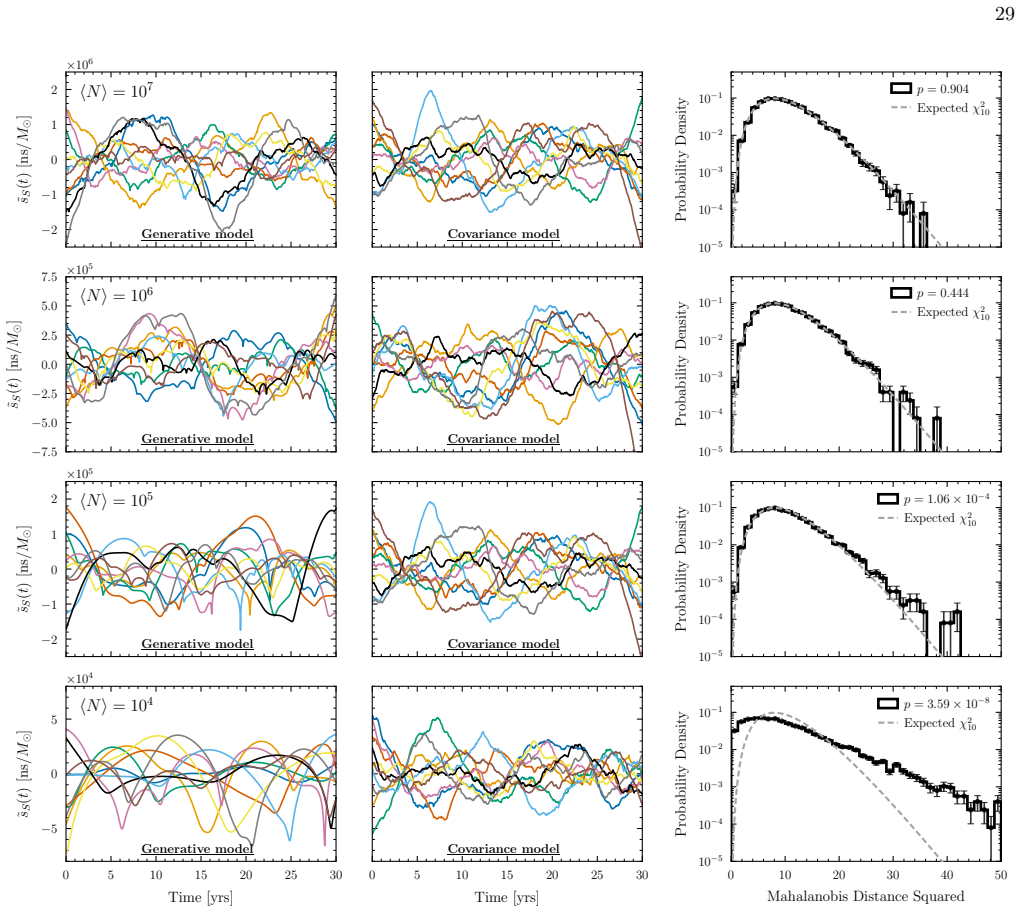
Scale model For each projected mass-normalized signal realization s, we define a robust amplitude scale A≡q 95[s]−q 05[s] (G1) whereq 95 andq 05 denote the 95th and 5th percentiles of the realization. We then define u≡log 10 A.(G2) The role of the scale model is to capture the distribution of this overall normalization as a function of log 10⟨N⟩. Rather t...
-
[5]
Training is carried out entirely in the projected resid- ual subspace
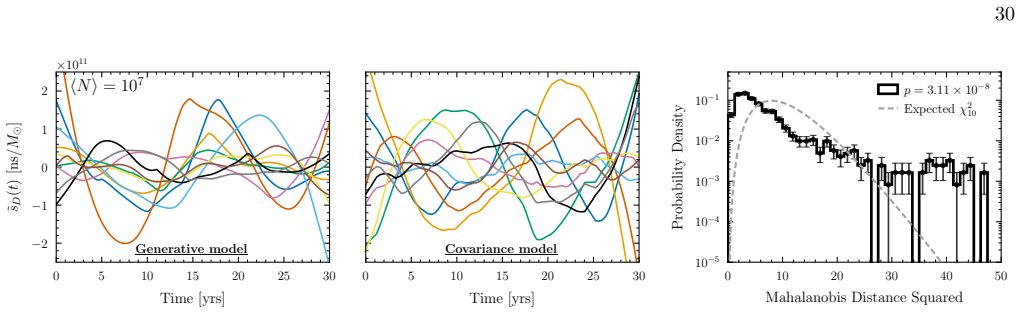
Diffusion model for normalized waveform shapes Given the scaleA, we define the normalized waveform shape ˆs≡ s A .(G5) The purpose of the diffusion model is to learn the condi- tional distribution of ˆs, that is, the waveform morphology after the overall normalization has been removed. Training is carried out entirely in the projected resid- ual subspace....
-
[6]
Sampling procedure At inference time, the scale and shape models are com- bined hierarchically. For a chosen value of log 10⟨N⟩, we first draw a logarithmic scale u∼p(u|log 10⟨N⟩) (G9) from the scale flow, and then set A= 10 u.(G10) Conditioned on the pair (u,log 10⟨N⟩), we then run the reverse diffusion chain, starting from a Gaussian draw in the project...
-
[7]
Nonlinear ax- ion dynamics and formation of cosmological pseudosoli- tons,
Edward W. Kolb and Igor I. Tkachev, “Nonlinear ax- ion dynamics and formation of cosmological pseudosoli- tons,” Phys. Rev. D49, 5040–5051 (1994), arXiv:astro- ph/9311037
arXiv 1994
-
[8]
Astrophysical Effects of Scalar Dark Mat- ter Miniclusters,
Kathryn M. Zurek, Craig J. Hogan, and Thomas R. Quinn, “Astrophysical Effects of Scalar Dark Mat- ter Miniclusters,” Phys. Rev. D75, 043511 (2007), arXiv:astro-ph/0607341
Pith/arXiv arXiv 2007
-
[9]
Vector Dark Matter from Inflationary Fluctua- tions,
Peter W. Graham, Jeremy Mardon, and Surjeet Rajen- dran, “Vector Dark Matter from Inflationary Fluctua- tions,” Phys. Rev. D93, 103520 (2016), arXiv:1504.02102 [hep-ph]
Pith/arXiv arXiv 2016
-
[10]
Early-Universe Simulations of the Cosmolog- ical Axion,
Malte Buschmann, Joshua W. Foster, and Benjamin R. Safdi, “Early-Universe Simulations of the Cosmolog- ical Axion,” Phys. Rev. Lett.124, 161103 (2020), arXiv:1906.00967 [astro-ph.CO]
arXiv 2020
-
[11]
Simulations of axion minihalos,
Huangyu Xiao, Ian Williams, and Matthew McQuinn, “Simulations of axion minihalos,” Phys. Rev. D104, 023515 (2021), arXiv:2101.04177 [astro-ph.CO]
arXiv 2021
-
[12]
Structure of axion miniclusters,
David Ellis, David J. E. Marsh, Benedikt Eggemeier, Jens Niemeyer, Javier Redondo, and Klaus Dolag, “Structure of axion miniclusters,” Phys. Rev. D106, 103514 (2022), arXiv:2204.13187 [hep-ph]
arXiv 2022
-
[13]
Miniclusters from axion string simulations,
Giovanni Pierobon, Javier Redondo, Ken’ichi Saikawa, Alejandro Vaquero, and Guy D. Moore, “Miniclusters from axion string simulations,” (2023), arXiv:2307.09941 [hep-ph]
arXiv 2023
-
[14]
Dark Matter Self- interactions and Small Scale Structure,
Sean Tulin and Hai-Bo Yu, “Dark Matter Self- interactions and Small Scale Structure,” Phys. Rept. 730, 1–57 (2018), arXiv:1705.02358 [hep-ph]
Pith/arXiv arXiv 2018
-
[15]
Asimina Arvanitaki, Savas Dimopoulos, Marios Gala- nis, Luis Lehner, Jedidiah O. Thompson, and Ken Van Tilburg, “Large-misalignment mechanism for the formation of compact axion structures: Signatures from the QCD axion to fuzzy dark matter,” Phys. Rev. D101, 083014 (2020), arXiv:1909.11665 [astro-ph.CO]
arXiv 2020
-
[16]
Constraints on primordial black holes,
Bernard Carr, Kazunori Kohri, Yuuiti Sendouda, and Jun’ichi Yokoyama, “Constraints on primordial black holes,” Rept. Prog. Phys.84, 116902 (2021), arXiv:2002.12778 [astro-ph.CO]
Pith/arXiv arXiv 2021
-
[17]
Reheating Ef- fects in the Matter Power Spectrum and Implications for Substructure,
Adrienne L. Erickcek and Kris Sigurdson, “Reheating Ef- fects in the Matter Power Spectrum and Implications for Substructure,” Phys. Rev. D84, 083503 (2011), arXiv:1106.0536 [astro-ph.CO]
Pith/arXiv arXiv 2011
-
[18]
Nonthermal histories and implications for structure formation,
JiJi Fan, Ogan ¨Ozsoy, and Scott Watson, “Nonthermal histories and implications for structure formation,” Phys. Rev. D90, 043536 (2014), arXiv:1405.7373 [hep-ph]
Pith/arXiv arXiv 2014
-
[19]
Cannibal domination and the matter power spectrum,
Adrienne L. Erickcek, Pranjal Ralegankar, and Jessie Shelton, “Cannibal domination and the matter power spectrum,” Phys. Rev. D103, 103508 (2021), arXiv:2008.04311 [astro-ph.CO]
arXiv 2021
-
[20]
E. O. Nadleret al.(DES), “Milky Way Satellite Cen- sus. III. Constraints on Dark Matter Properties from Observations of Milky Way Satellite Galaxies,” Phys. Rev. Lett.126, 091101 (2021), arXiv:2008.00022 [astro- ph.CO]
arXiv 2021
-
[21]
Dark matter sub-halo counts via star stream crossings,
R. G. Carlberg, “Dark matter sub-halo counts via star stream crossings,” The Astrophysical Journal748, 20 (2012)
2012
-
[22]
Ana Bonaca, David W. Hogg, Adrian M. Price-Whelan, and Charlie Conroy, “The Spur and the Gap in GD- 1: Dynamical evidence for a dark substructure in the Milky Way halo,” (2018), 10.3847/1538-4357/ab2873, arXiv:1811.03631 [astro-ph.GA]
-
[23]
Duncan K. Adams, Aditya Parikh, Oren Slone, Rou- ven Essig, Manoj Kaplinghat, and Adrian M. Price- Whelan, “Semianalytic Modeling of Dark Matter Sub- halo Encounters with Thin Stellar Streams: Statistical Predictions for GD-1-like Streams in Cold Dark Matter,” Astrophys. J.991, 66 (2025), arXiv:2412.13144 [astro- ph.GA]
Pith/arXiv arXiv 2025
-
[24]
Detectability of dark matter subhalo impacts in Milky Way stellar streams,
Junyang Lu, Tongyan Lin, Mukul Sholapurkar, and Ana Bonaca, “Detectability of dark matter subhalo impacts in Milky Way stellar streams,” (2025), 10.33232/001c.155386, arXiv:2502.07781 [astro-ph.GA]
-
[25]
Constraints on MACHO Dark Matter from Compact Stellar Systems in Ultra-Faint Dwarf Galaxies,
Timothy D. Brandt, “Constraints on MACHO Dark Matter from Compact Stellar Systems in Ultra-Faint Dwarf Galaxies,” Astrophys. J. Lett.824, L31 (2016), arXiv:1605.03665 [astro-ph.GA]
Pith/arXiv arXiv 2016
-
[26]
Peter W. Graham and Harikrishnan Ramani, “Con- straints on dark matter from dynamical heating of stars in ultrafaint dwarfs. I. MACHOs and primor- dial black holes,” Phys. Rev. D110, 075011 (2024), arXiv:2311.07654 [hep-ph]
arXiv 2024
-
[27]
Peter W. Graham and Harikrishnan Ramani, “Con- straints on dark matter from dynamical heating of stars in ultrafaint dwarfs. II. Substructure and the primor- dial power spectrum,” Phys. Rev. D110, 075012 (2024), arXiv:2404.01378 [hep-ph]
arXiv 2024
-
[28]
Robust bounds on MACHOs from the faintest galaxies,
Peter W. Graham, Harikrishnan Ramani, and Maxi- milian Ruhdorfer, “Robust bounds on MACHOs from the faintest galaxies,” Phys. Rev. D113, 023047 (2026), arXiv:2510.01310 [hep-ph]
arXiv 2026
-
[29]
The end of the MACHO era: limits on halo dark matter from stellar halo wide binaries,
Jaiyul Yoo, Julio Chaname, and Andrew Gould, “The end of the MACHO era: limits on halo dark matter from stellar halo wide binaries,” Astrophys. J.601, 311–318 (2004), arXiv:astro-ph/0307437
Pith/arXiv arXiv 2004
-
[30]
Con- straining dark matter substructure with Gaia wide bi- naries,
Edward D. Ramirez and Matthew R. Buckley, “Con- straining dark matter substructure with Gaia wide bi- naries,” Mon. Not. Roy. Astron. Soc.525, 5813–5830 (2023), arXiv:2209.08100 [hep-ph]
arXiv 2023
-
[31]
Dark Matter 33 Subhalos In the Fermi First Source Catalog,
Matthew R. Buckley and Dan Hooper, “Dark Matter 33 Subhalos In the Fermi First Source Catalog,” Phys. Rev. D82, 063501 (2010), arXiv:1004.1644 [hep-ph]
Pith/arXiv arXiv 2010
-
[32]
Annihilation Signatures of Hidden Sector Dark Matter Within Early-Forming Microhalos,
Carlos Blanco, M. Sten Delos, Adrienne L. Erickcek, and Dan Hooper, “Annihilation Signatures of Hidden Sector Dark Matter Within Early-Forming Microhalos,” Phys. Rev. D100, 103010 (2019), arXiv:1906.00010 [astro- ph.CO]
arXiv 2019
-
[33]
Transient Radio Sig- natures from Neutron Star Encounters with QCD Ax- ion Miniclusters,
Thomas D. P. Edwards, Bradley J. Kavanagh, Luca Visinelli, and Christoph Weniger, “Transient Radio Sig- natures from Neutron Star Encounters with QCD Ax- ion Miniclusters,” Phys. Rev. Lett.127, 131103 (2021), arXiv:2011.05378 [hep-ph]
arXiv 2021
-
[34]
New constraints on primordial black holes abundance from femtolensing of gamma-ray bursts,
A. Barnacka, J.-F. Glicenstein, and R. Moderski, “New constraints on primordial black holes abundance from femtolensing of gamma-ray bursts,” Physical Review D 86(2012), 10.1103/physrevd.86.043001
-
[35]
Limits on the Macho Con- tent of the Galactic Halo from the EROS-2 Survey of the Magellanic Clouds,
P. Tisserandet al.(EROS-2), “Limits on the Macho Con- tent of the Galactic Halo from the EROS-2 Survey of the Magellanic Clouds,” Astron. Astrophys.469, 387– 404 (2007), arXiv:astro-ph/0607207
Pith/arXiv arXiv 2007
-
[36]
Constraints on Earth-mass primordial black holes from OGLE 5-year microlensing events,
Hiroko Niikura, Masahiro Takada, Shuichiro Yokoyama, Takahiro Sumi, and Shogo Masaki, “Constraints on Earth-mass primordial black holes from OGLE 5-year microlensing events,” Phys. Rev. D99, 083503 (2019), arXiv:1901.07120 [astro-ph.CO]
Pith/arXiv arXiv 2019
-
[37]
Gravitational microlensing by dark matter in ex- tended structures,
Djuna Croon, David McKeen, and Nirmal Raj, “Gravitational microlensing by dark matter in ex- tended structures,” Phys. Rev. D101, 083013 (2020), arXiv:2002.08962 [astro-ph.CO]
arXiv 2020
-
[38]
Subaru-HSC through a different lens: Microlens- ing by extended dark matter structures,
Djuna Croon, David McKeen, Nirmal Raj, and Zihui Wang, “Subaru-HSC through a different lens: Microlens- ing by extended dark matter structures,” Phys. Rev. D 102, 083021 (2020), arXiv:2007.12697 [astro-ph.CO]
arXiv 2020
-
[39]
Mi- crolensing of fast and slow compact objects,
Manish Tamta, Nirmal Raj, and Himanshu Verma, “Mi- crolensing of fast and slow compact objects,” (2026), arXiv:2604.25434 [astro-ph.CO]
Pith/arXiv arXiv 2026
-
[40]
Probing Dark Matter Substructure with Pulsar Tim- ing,
Ethan R. Siegel, M. P. Hertzberg, and J. N. Fry, “Probing Dark Matter Substructure with Pulsar Tim- ing,” Mon. Not. Roy. Astron. Soc.382, 879 (2007), arXiv:astro-ph/0702546
Pith/arXiv arXiv 2007
-
[41]
Searching for primor- dial black hole dark matter with pulsar timing arrays,
Naoki Seto and Asantha Cooray, “Searching for primor- dial black hole dark matter with pulsar timing arrays,” Astrophys. J. Lett.659, L33–L36 (2007), arXiv:astro- ph/0702586
arXiv 2007
-
[42]
Prospects for Detecting Dark Matter Halo Sub- structure with Pulsar Timing,
Shant Baghram, Niayesh Afshordi, and Kathryn M. Zurek, “Prospects for Detecting Dark Matter Halo Sub- structure with Pulsar Timing,” Phys. Rev. D84, 043511 (2011), arXiv:1101.5487 [astro-ph.CO]
Pith/arXiv arXiv 2011
-
[43]
Enhanced explo- ration for primordial black holes using pulsar timing ar- rays: Exploration for pbhs using ptas,
Kazumi Kashiyama and Naoki Seto, “Enhanced explo- ration for primordial black holes using pulsar timing ar- rays: Exploration for pbhs using ptas,” Monthly No- tices of the Royal Astronomical Society426, 1369–1373 (2012)
2012
-
[44]
Hamish A. Clark, Geraint F. Lewis, and Pat Scott, “Investigating dark matter substructure with pulsar timing – I. Constraints on ultracompact minihaloes,” Mon. Not. Roy. Astron. Soc.456, 1394–1401 (2016), [Erratum: Mon.Not.Roy.Astron.Soc. 464, 2468 (2017)], arXiv:1509.02938 [astro-ph.CO]
Pith/arXiv arXiv 2016
-
[45]
Pulsar timing can con- strain primordial black holes in the LIGO mass window,
Katelin Schutz and Adrian Liu, “Pulsar timing can con- strain primordial black holes in the LIGO mass window,” Phys. Rev. D95, 023002 (2017), arXiv:1610.04234 [astro- ph.CO]
Pith/arXiv arXiv 2017
-
[46]
Detectability of Small-Scale Dark Matter Clumps with Pulsar Timing Arrays,
Kazumi Kashiyama and Masamune Oguri, “Detectability of Small-Scale Dark Matter Clumps with Pulsar Timing Arrays,” (2018), arXiv:1801.07847 [astro-ph.CO]
Pith/arXiv arXiv 2018
-
[47]
Pulsar Timing Probes of Primordial Black Holes and Subhalos,
Jeff A. Dror, Harikrishnan Ramani, Tanner Trickle, and Kathryn M. Zurek, “Pulsar Timing Probes of Primordial Black Holes and Subhalos,” Phys. Rev. D100, 023003 (2019), arXiv:1901.04490 [astro-ph.CO]
Pith/arXiv arXiv 2019
-
[48]
Observability of Dark Matter Substructure with Pulsar Timing Correlations,
Harikrishnan Ramani, Tanner Trickle, and Kathryn M. Zurek, “Observability of Dark Matter Substructure with Pulsar Timing Correlations,” JCAP12, 033 (2020), arXiv:2005.03030 [astro-ph.CO]
arXiv 2020
-
[49]
Probing Small-Scale Power Spectra with Pulsar Timing Arrays,
Vincent S. H. Lee, Andrea Mitridate, Tanner Trickle, and Kathryn M. Zurek, “Probing Small-Scale Power Spectra with Pulsar Timing Arrays,” JHEP06, 028 (2021), arXiv:2012.09857 [astro-ph.CO]
arXiv 2021
-
[50]
Bayesian Forecasts for Dark Matter Substructure Searches with Mock Pulsar Timing Data,
Vincent S. H. Lee, Stephen R. Taylor, Tanner Trickle, and Kathryn M. Zurek, “Bayesian Forecasts for Dark Matter Substructure Searches with Mock Pulsar Timing Data,” JCAP08, 025 (2021), arXiv:2104.05717 [astro- ph.CO]
arXiv 2021
-
[51]
The NANOGrav 15 yr Data Set: Search for Signals from New Physics,
Adeela Afzalet al.(NANOGrav), “The NANOGrav 15 yr Data Set: Search for Signals from New Physics,” Astrophys. J. Lett.951, L11 (2023), [Erratum: Astro- phys.J.Lett. 971, L27 (2024), Erratum: Astrophys.J. 971, L27 (2024)], arXiv:2306.16219 [astro-ph.HE]
Pith/arXiv arXiv 2023
-
[52]
Physics beyond the Standard Model with the DSA-2000,
Kim V. Berghaus, Yufeng Du, Vincent S. H. Lee, Anirudh Prabhu, Robert Reischke, Liam Connor, and Kathryn M. Zurek, “Physics beyond the Standard Model with the DSA-2000,” JCAP12, 035 (2025), arXiv:2505.23892 [hep-ph]
arXiv 2000
-
[53]
The NANOGrav 15 yr Data Set: Evidence for a Gravitational-wave Background,
Gabriella Agazieet al.(NANOGrav), “The NANOGrav 15 yr Data Set: Evidence for a Gravitational-wave Background,” Astrophys. J. Lett.951, L8 (2023), arXiv:2306.16213 [astro-ph.HE]
Pith/arXiv arXiv 2023
-
[54]
J. Antoniadiset al.(EPTA, InPTA:), “The second data release from the European Pulsar Timing Array - III. Search for gravitational wave signals,” Astron. Astro- phys.678, A50 (2023), arXiv:2306.16214 [astro-ph.HE]
Pith/arXiv arXiv 2023
-
[55]
Search for an Isotropic Gravitational-wave Background with the Parkes Pul- sar Timing Array,
Daniel J. Reardonet al., “Search for an Isotropic Gravitational-wave Background with the Parkes Pul- sar Timing Array,” Astrophys. J. Lett.951, L6 (2023), arXiv:2306.16215 [astro-ph.HE]
Pith/arXiv arXiv 2023
-
[56]
Heng Xuet al., “Searching for the Nano-Hertz Stochastic Gravitational Wave Background with the Chinese Pulsar Timing Array Data Release I,” Res. Astron. Astrophys. 23, 075024 (2023), arXiv:2306.16216 [astro-ph.HE]
Pith/arXiv arXiv 2023
-
[57]
Matthew T. Mileset al., “The MeerKAT Pulsar Timing Array: the first search for gravitational waves with the MeerKAT radio telescope,” Mon. Not. Roy. Astron. Soc. 536, 1489–1500 (2024), arXiv:2412.01153 [astro-ph.HE]
arXiv 2024
-
[58]
UPPER LIMITS ON THE ISOTROPIC GRAVITATIONAL RADIATION BACKGROUND FROM PULSAR TIMING ANALY- SIS,
R. w. Hellings and G. s. Downs, “UPPER LIMITS ON THE ISOTROPIC GRAVITATIONAL RADIATION BACKGROUND FROM PULSAR TIMING ANALY- SIS,” Astrophys. J. Lett.265, L39–L42 (1983)
1983
-
[59]
Colloquium: Annual modulation of dark matter,
Katherine Freese, Mariangela Lisanti, and Christo- pher Savage, “Colloquium: Annual modulation of dark matter,” Rev. Mod. Phys.85, 1561–1581 (2013), arXiv:1209.3339 [astro-ph.CO]
Pith/arXiv arXiv 2013
-
[60]
Conor Durkan, Artur Bekasov, Iain Murray, and George Papamakarios, “Neural Spline Flows,” arXiv e-prints , arXiv:1906.04032 (2019), arXiv:1906.04032 [stat.ML]
arXiv 1906
-
[61]
Normalizing Flows for Probabilistic Mod- eling and Inference,
George Papamakarios, Eric Nalisnick, Danilo Jimenez Rezende, Shakir Mohamed, and Balaji Lakshmi- narayanan, “Normalizing Flows for Probabilistic Mod- eling and Inference,” arXiv e-prints , arXiv:1912.02762 34 (2019), arXiv:1912.02762 [stat.ML]
arXiv 1912
-
[62]
Denoising diffusion probabilistic models,
Jonathan Ho, Ajay Jain, and Pieter Abbeel, “Denoising diffusion probabilistic models,” (2020), arXiv:2006.11239 [cs.LG]
Pith/arXiv arXiv 2020
-
[63]
Improved denoising diffusion probabilistic models,
Alex Nichol and Prafulla Dhariwal, “Improved denoising diffusion probabilistic models,” (2021), arXiv:2102.09672 [cs.LG]
Pith/arXiv arXiv 2021
-
[64]
The square kilometre array,
Peter E. Dewdney, Peter J. Hall, Richard T. Schilizzi, and T. Joseph L. W. Lazio, “The square kilometre array,” Proceedings of the IEEE97, 1482–1496 (2009)
2009
-
[65]
The Nanohertz Gravitational Wave Astronomer,
Stephen R. Taylor, “The Nanohertz Gravitational Wave Astronomer,” (2021), arXiv:2105.13270 [astro-ph.HE]
arXiv 2021
-
[66]
The NANOGrav 15 yr Data Set: Observations and Timing of 68 Mil- lisecond Pulsars,
Gabriella Agazieet al.(NANOGrav), “The NANOGrav 15 yr Data Set: Observations and Timing of 68 Mil- lisecond Pulsars,” Astrophys. J. Lett.951, L9 (2023), arXiv:2306.16217 [astro-ph.HE]
arXiv 2023
-
[67]
A Cosmic Census of Radio Pul- sars with the SKA,
E. F. Keaneet al., “A Cosmic Census of Radio Pul- sars with the SKA,” PoSAASKA14, 040 (2015), arXiv:1501.00056 [astro-ph.IM]
Pith/arXiv arXiv 2015
-
[68]
Gabriella Agazieet al.(NANOGrav), “The NANOGrav 15 yr Data Set: Constraints on Supermassive Black Hole Binaries from the Gravitational-wave Background,” Astrophys. J. Lett.952, L37 (2023), arXiv:2306.16220 [astro-ph.HE]
arXiv 2023
-
[69]
Center for high throughput computing,
Center for High Throughput Computing, “Center for high throughput computing,” (2006)
2006
-
[70]
W. J. Conover,Practical Nonparametric Statistics, 3rd ed. (John Wiley & Sons, New York, 1999)
1999
-
[71]
Vallisneriet al.(NANOGrav), (2020), 10.3847/1538- 4357/ab7b67, arXiv:2001.00595 [astro-ph.HE]
Ross J. Jennings, James M. Cordes, and Shami Chat- terjee, “Detecting Gravitational Scattering of Interstellar Objects Using Pulsar Timing,” (2019), 10.3847/1538- 4357/ab64df, arXiv:1910.08608 [astro-ph.HE]
-
[72]
Anderson,An Introduction to Multivariate Statistical Analysis, 3rd ed
Theodore W. Anderson,An Introduction to Multivariate Statistical Analysis, 3rd ed. (Wiley-Interscience, Hobo- ken, NJ, 2003)
2003
discussion (0)
Sign in with ORCID, Apple, or X to comment. Anyone can read and Pith papers without signing in.