REVIEW 3 major objections 4 minor 19 references
MemoGuard claims that validating episodic memories against three contracts before reuse cuts battery safety violations 76.6% and fallback calls 21.4%.
Reviewed by Pith at T0; open to challenge. T0 means a machine referee read the full paper against a public rubric. the ladder, T0–T4 →
T0 review · deepseek-v4-flash
2026-08-01 22:50 UTC pith:ZTH4ORR2
load-bearing objection Useful framing of a real failure mode, but the headline numbers are oracle-bound and partly built into the trap design; worth refereeing. the 3 major comments →
MemoGuard: An Adaptive Runtime for Guarding Against Memory Traps in Communication-Limited Robot Navigation
The pith
A machine-rendered reading of the paper's core claim, the machinery that carries it, and where it could break.
Core claim
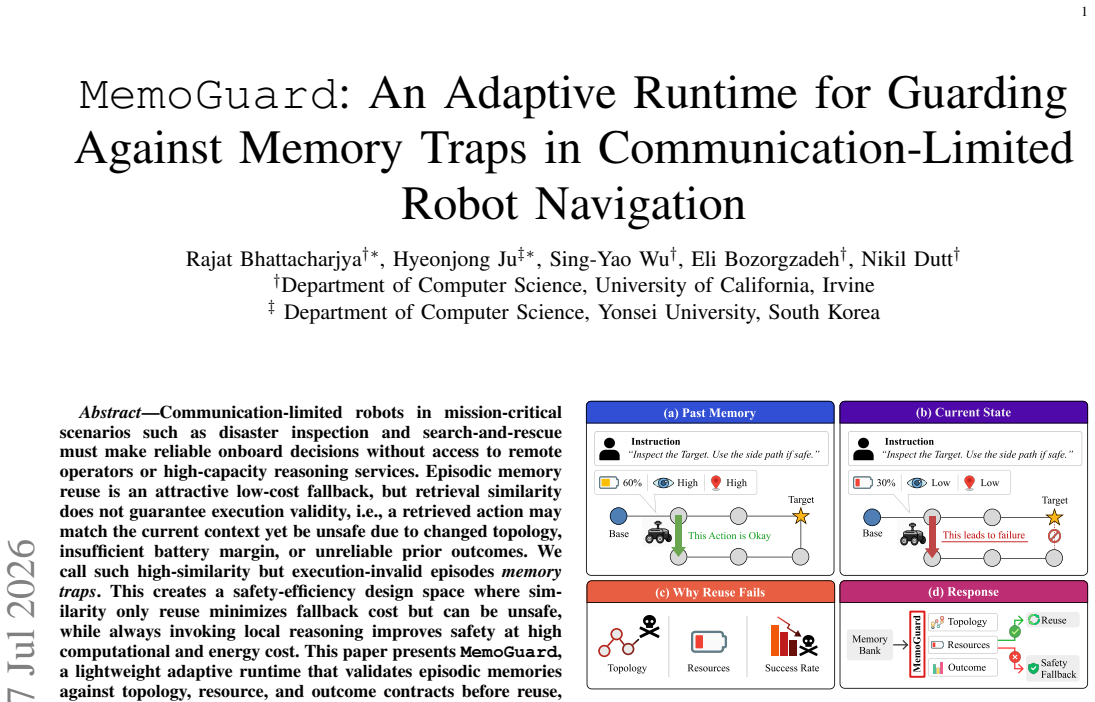
The central claim is that retrieval similarity and execution validity are different properties, and a cheap pre-execution check can catch most memory traps. MemoGuard models each memory as an episodic action memory and validates it with three hard gates: a topology gate that rejects memories whose structural assumptions no longer hold, a resource gate that enforces the battery floor after executing the remembered action, and an outcome gate that requires a reliable prior success ratio. Only when all gates pass is the remembered action reused; otherwise the runtime invokes a planner or local reasoning fallback. The paper demonstrates in trap scenarios that this contract validation shifts the
What carries the argument
The load-bearing object is the 'episodic action memory'—a compact record of intent context, retrieval key, remembered action, execution contract, and outcome statistics—together with three hard feasibility gates: topology (blocked edges and unavailable viewpoints), resource (current battery minus estimated action cost must stay above the safety floor), and outcome reliability (success ratio above a threshold). These gates, composed through the validity predicate Φ, decide reuse versus fallback and carry the entire safety argument.
Load-bearing premise
The runtime can evaluate each topology, resource, and outcome contract exactly from the current state, meaning it knows which edges are blocked, whether viewpoints are available, and what the remembered action would cost in battery.
What would settle it
Run the same trap scenarios on a physical robot where blocked edges and battery cost are inferred from noisy sensors; if battery safety violations climb back toward the similarity-only baseline, the exact-contract assumption is falsified. A simpler simulator experiment would inject controlled error into C_act(s_t, m_i) and measure how fast the 76.6% violation reduction degrades.
If this is right
- Similarity-only retrieval, even with a similarity threshold, is not a sufficient safety guarantee for memory reuse because memory traps can be high-confidence matches.
- Contract validation before reuse yields a concrete safety gain: battery safety violations drop from 67.4% to 15.8% in the evaluated trap scenarios.
- Validation can substitute for much of the cost of always-reasoning: fallback calls drop from 18.58 to 14.60 per trial, about 3.67 seconds and 36.97 joules of avoided local-reasoning overhead per trial on the tested edge device.
- Trap types differ in difficulty: discrete topology and affordance changes (blocked edges, removed alternate viewpoints) are caught most effectively, while reduced-battery traps remain more sensitive to cost estimation.
- The paper expects the approach to extend beyond graph-level contracts toward cross-layer contracts accounting for localization uncertainty, communication quality, and energy trajectories.
Where Pith is reading between the lines
- If a real robot must infer blocked edges, viewpoint availability, and future battery cost from noisy sensors, MemoGuard's gates will both miss some traps and falsely reject valid memories; the reported 76.6% reduction is therefore an upper bound that should shrink with sensing uncertainty—a testable prediction from the paper's design.
- The resource gate is the weak link because it depends on an accurate cost estimate C_act(s_t, m_i); an estimator that underestimates cost directly converts into battery safety violations, which the evaluation partially acknowledges in the reduced-battery trap results.
- A natural extension is adaptive fallback triggering: instead of a fixed all-or-nothing validation, the runtime could invoke reasoning only when validation confidence or cost-model uncertainty is high, potentially reducing fallback calls further on top of the 21.4% reduction.
- The bounded supervisory action set is a key enabler; if the action space grows or becomes continuous, the cost of contract validation itself may grow, changing the claimed safety-efficiency tradeoff.
Editorial analysis
A structured set of objections, weighed in public.
Referee Report
Summary. The paper introduces MemoGuard, a runtime layer that validates retrieved episodic memories against topology, resource, and outcome contracts before executing them, and invokes an LLM/planner fallback only when validation fails. Memory traps are formalized as high-similarity but execution-invalid episodes. The evaluation, in a graph-based corridor-inspection simulator with three trap mechanisms (blocked edges, reduced battery, removed alternate viewpoint), reports a 76.6% reduction in battery safety violations over top-1 reuse and a 21.4% reduction in fallback calls over always reasoning. Jetson measurements translate the fallback reduction into 3.67 s and 36.97 J of avoided LLM overhead per trial. The paper concludes that MemoGuard improves the safety-efficiency tradeoff.
Significance. The problem is real and the contract-validation idea is simple, plausible, and potentially useful for embedded robot navigation under communication constraints. The paper formally characterizes memory traps, gives an operational validation procedure, and evaluates on a simulator with three distinct trap mechanisms. The open-source release and the hardware calibration on a Jetson AGX Xavier are concrete strengths. If the quantitative results are robust, the contribution is a lightweight, model-agnostic filter that could be applied to episodic memory systems. The main limitation is that the evidence currently rests on a single-seed, oracle-information simulation: the gates use ground-truth topology and costs, and the trap generator injects exactly the conditions the gates detect. The paper acknowledges some of this only in the future-work sentence, so the headline percentages should be interpreted as upper bounds until noisy-perception experiments or explicit scoping are provided.
major comments (3)
- [Sec. IV.A/IV.C, Table I] The evaluation uses a single fixed seed: "the retriever samples up to 2,000 memories using a fixed seed." Table I reports averages without standard deviations, confidence intervals, or trial counts. The headline percentages (76.6%, 21.4%) are arithmetic transforms of these averages, but without variance information we cannot assess whether the results are stable across random scenario realizations or across the three trap mechanisms. Please rerun with multiple seeds, report per-seed distributions or bootstrap CIs, and state the number of trials per trap mechanism. This is load-bearing for the quantitative claims.
- [Sec. III.B, Eq. (9); Sec. IV.A] The outcome gate compares R(m_i) to a threshold τ_out, but τ_out is never specified. R(m_i) is also undefined when n_s + n_f = 0, and no prior or minimum count is given. Since this threshold directly controls how many memories are reused versus sent to fallback, the reported 84.2% mission success, 15.8% safety violations, and 14.60 fallback calls are all functions of an undisclosed parameter. Provide τ_out, the handling of zero-count memories, and a sensitivity analysis over τ_out and B_safe.
- [Sec. III.B, Sec. IV.A-B, Conclusion] The validation gates are evaluated with exact information: blocked edges, alternate-viewpoint availability, and C_act(s_t, m_i) in Eq. (8) are known from the simulator's global graph and computed by Dijkstra over that graph. The trap generator in Sec. IV.B injects exactly the conditions that Φ_topo and Φ_res are designed to detect. Thus the measured 76.6% safety-violation reduction is an oracle upper bound. Under noisy perception, the gates would both miss traps and falsely reject valid memories, raising both safety violations and fallback calls. The paper's future-work sentence about localization uncertainty is an acknowledgment but not an evaluation. Please add experiments with noisy edge-blocked/availability estimates and battery-cost uncertainty, or explicitly scope the claims to the oracle-information setting and discuss expected degradation.
minor comments (4)
- [Sec. IV.C, Fig. 3] The text says MemoGuard "approaches Always Reasoning safety," but Fig. 3 shows that in the Reduced Battery mechanism MemoGuard has 20.1% safety violations versus 17.9% for Always Reasoning. Please state this per-mechanism exception explicitly and clarify how the aggregate Table I averages are weighted across the three trap mechanisms.
- [Sec. IV.A] The Threshold Reuse baseline threshold value is not specified. Without stating the value and tuning procedure, the baseline comparison is incomplete.
- [Sec. IV.A] The memory bank construction is described only as 11,558 memories from rollouts. Please report the number of rollouts and the matching rule for accumulating success/failure counts, since the outcome statistics in Eq. (9) depend on this.
- [Sec. II.B heading] Minor typographical issues: "T op-k" in the heading, "V alidation" in Sec. III.B heading, and inconsistent spacing around "MemoGuard" in the abstract. These do not affect the science.
Circularity Check
No significant circularity: MemoGuard's gains are measured simulator outcomes, not fitted predictions; oracle-style state knowledge is a limitation, not a circular derivation.
full rationale
The paper's central claim is that contract-validated episodic memory reuse (Eq. 10) reduces battery safety violations by 76.6% over similarity-only reuse and fallback calls by 21.4% over always reasoning (Table I). This is an empirical result from a graph-based simulator, not a quantity derived from the runtime's own definition. The validation gates Φ_topo, Φ_res, and Φ_out are hand-specified tests (Eqs. 8-10), not parameters fitted to the trap scenarios; the trap generator (Sec. IV-B) modifies edges, battery, and viewpoints, but MemoGuard's success is not guaranteed—it still incurs 15.8% violations and its advantage over always reasoning on fallback calls depends on the actual behavior of the local llama3.2:3b fallback. Thus no 'prediction' reduces by construction to an input. The self-citations (e.g., Refs. [1], [13]) support background framing (disaster response, adaptive communication-computation codesign) and are not load-bearing for the validation mechanism. The most substantial weakness is that the simulator provides MemoGuard with exact topology and action costs (Dijkstra-based C_act in Eq. 8), and the paper itself concedes this gap: 'Future work will extend MemoGuard from graph-level contracts to cross-layer execution contracts that incorporate localization uncertainty...' (Conclusion). This is a real-world applicability caveat—the reported 76.6% is an upper bound under perfect state estimation—but it is not circularity, because the validation equations do not presuppose the measured safety or efficiency metrics. The paper is self-contained against its own simulator; the derivation chain is not circular.
Axiom & Free-Parameter Ledger
free parameters (3)
- λ_env, λ_agent (retrieval weights) =
0.8, 0.2
- B_safe (battery safety floor) =
25
- τ_out (outcome reliability threshold) =
not reported
axioms (5)
- domain assumption Topological graph G_t=(V_t,E_t) with edge cost, obstacle state, and visibility is a faithful model of the robot's environment.
- domain assumption Retrieval similarity ranking S_ret identifies candidate memories whose features are comparable to the current state.
- domain assumption All relevant execution contracts (topology, resource, outcome) are exactly evaluable from current state s_t and memory m_i.
- standard math Dijkstra's algorithm computes minimum-cost paths on the graph.
- domain assumption LLM fallback constrained to the supervisory action set A selects a valid action.
read the original abstract
Communication-limited robots in mission-critical scenarios such as disaster inspection and search-and-rescue must make reliable onboard decisions without access to remote operators or high-capacity reasoning services. Episodic memory reuse is an attractive low-cost fallback, but retrieval similarity does not guarantee execution validity, i.e., a retrieved action may match the current context yet be unsafe due to changed topology, insufficient battery margin, or unreliable prior outcomes. We call such high-similarity but execution-invalid episodes memory traps. This creates a safety-efficiency design space where similarity only reuse minimizes fallback cost but can be unsafe, while always invoking local reasoning improves safety at high computational and energy cost. This paper presents MemoGuard, a lightweight adaptive runtime that validates episodic memories against topology, resource, and outcome contracts before reuse, invoking fallback only when validation fails. In a graph-based corridor-inspection simulator, MemoGuard reduces battery safety violations by 76.6% over similarity-only top-1 reuse while reducing fallback calls by 21.4% over always reasoning. On an NVIDIA Jetson AGX Xavier with local llama3.2:3b fallback reasoning, this corresponds to 3.67 s and 36.97 J of avoided fallback-reasoning overhead per trial. We open-source MemoGuard at https://github.com/hetheiin/memoguard.
Figures


Reference graph
Works this paper leans on
-
[1]
R. Bhattacharjya, S.-Y . Wu, H. Oh, C. Nam, S. Koo, M. Imani, E. Bo- zorgzadeh, and N. Dutt, “Avery: Adaptive vlm split computing through embodied self-awareness for efficient disaster response systems,”arXiv preprint arXiv:2511.18151, 2025
arXiv 2025
-
[2]
Air-ground col- laboration for language-specified missions in unknown environments,
F. Cladera, Z. Ravichandran, J. Hughes, V . Murali, C. Nieto-Granda, M. A. Hsieh, G. J. Pappas, C. J. Taylor, and V . Kumar, “Air-ground col- laboration for language-specified missions in unknown environments,” IEEE Transactions on Field Robotics, 2025. 5
2025
-
[3]
Co-design of communication and machine inference for cloud robotics,
M. Nakanoya, S. S. Narasimhan, S. Bhat, A. Anemogiannis, A. Datta, S. Katti, S. Chinchali, and M. Pavone, “Co-design of communication and machine inference for cloud robotics,”Autonomous Robots, vol. 47, no. 5, pp. 579–594, 2023
2023
-
[4]
Multi- uav exploration with limited communication and battery,
K. Cesare, R. Skeele, S.-H. Yoo, Y . Zhang, and G. Hollinger, “Multi- uav exploration with limited communication and battery,” in2015 IEEE international conference on robotics and automation (ICRA). IEEE, 2015, pp. 2230–2235
2015
-
[5]
Case-based reasoning: Foundational issues, methodological variations, and system approaches,
A. Aamodt and E. Plaza, “Case-based reasoning: Foundational issues, methodological variations, and system approaches,”AI Commun., 1994
1994
-
[6]
Deep episodic memory: Encoding, recalling, and predicting episodic expe- riences for robot action execution,
J. Rothfuss, F. Ferreira, E. E. Aksoy, Y . Zhou, and T. Asfour, “Deep episodic memory: Encoding, recalling, and predicting episodic expe- riences for robot action execution,”IEEE Robotics and Automation Letters, vol. 3, no. 4, pp. 4007–4014, 2018
2018
-
[7]
Freqcache: Accelerating embodied vln models with adaptive frequency-guided token caching,
Z. Zheng, X. Zhou, Z. Mao, S. Sun, L. Zhang, Y . Ao, Y . Feng, Q. Zhang, Y . Lin, and X. Chen, “Freqcache: Accelerating embodied vln models with adaptive frequency-guided token caching,”arXiv preprint arXiv:2604.24391, 2026
Pith/arXiv arXiv 2026
-
[8]
Vlingnav: Embodied navigation with adaptive reasoning and visual-assisted linguistic memory,
S. Wang, Y . Luo, X. Chen, A. Luo, D. Li, C. Liu, S. Chen, Y . Zhang, and J. Yu, “Vlingnav: Embodied navigation with adaptive reasoning and visual-assisted linguistic memory,”arXiv preprint arXiv:2601.08665, 2026
arXiv 2026
-
[9]
Do as i can, not as i say: Grounding language in robotic affordances,
A. Brohan, Y . Chebotar, C. Finn, K. Hausman, A. Herzog, D. Ho, J. Ibarz, A. Irpan, E. Jang, R. Julianet al., “Do as i can, not as i say: Grounding language in robotic affordances,” inConference on robot learning. PMLR, 2023, pp. 287–318
2023
-
[10]
Reca: Integrated acceleration for real-time and efficient cooperative embodied autonomous agents,
Z. Wan, Y . Du, M. Ibrahim, J. Qian, J. Jabbour, Y . Zhao, T. Krishna, A. Raychowdhury, and V . J. Reddi, “Reca: Integrated acceleration for real-time and efficient cooperative embodied autonomous agents,” in Proceedings of the 30th ACM International Conference on Architectural Support for Programming Languages and Operating Systems, V olume 2, 2025, pp. 982–997
2025
-
[11]
Data- efficient multi-agent spatial planning with llms,
H. Su, A. Walsman, D. Garces, S. Kakade, and S. Gil, “Data- efficient multi-agent spatial planning with llms,”arXiv preprint arXiv:2502.18822, 2025
Pith/arXiv arXiv 2025
-
[12]
From building blocks to planning: Multi-step spatial reasoning in llms with reinforcement learning,
A. Tahmasbi, S. Majidi, K. Taram, and A. Bera, “From building blocks to planning: Multi-step spatial reasoning in llms with reinforcement learning,”arXiv preprint arXiv:2512.24532, 2025
arXiv 2025
-
[13]
R. Bhattacharjya, A. Sarkar, I. Kool, S. Baidya, and N. Dutt, “Access- av: Adaptive communication-computation codesign for sustainable autonomous vehicle localization in smart factories,”ACM Trans. Embed. Comput. Syst., vol. 25, no. 1, Jan. 2026. [Online]. Available: https://doi.org/10.1145/3771770
-
[14]
Joint communication and computation design for mobile embodied ai network (mean),
C. Wu, Z. Zhao, J. Wang, R. Xu, C. Zhu, Z. Yang, and Z. Zhang, “Joint communication and computation design for mobile embodied ai network (mean),”arXiv preprint arXiv:2605.14300, 2026
Pith/arXiv arXiv 2026
-
[15]
Scalable multi-robot informative path planning for target mapping via deep reinforcement learning,
A. Vashisth, M. Kulshrestha, D. Conover, and A. Bera, “Scalable multi-robot informative path planning for target mapping via deep reinforcement learning,”IEEE Robotics and Automation Letters, vol. 11, no. 3, pp. 3414–3421, 2026
2026
-
[16]
Learning altruistic collaboration in heterogeneous multi-team systems,
R. Karam, R. Lin, B. A. Butler, and M. Egerstedt, “Learning altruistic collaboration in heterogeneous multi-team systems,”arXiv preprint arXiv:2605.21723, 2026
Pith/arXiv arXiv 2026
-
[17]
Collaboration in multi-robot systems: Tax- onomy and survey over frameworks for collaboration,
R. Karam, A. A. Nguyen, R. Lin, D. R. Martin, D. Morales, B. A. Butler, and M. Egerstedt, “Collaboration in multi-robot systems: Tax- onomy and survey over frameworks for collaboration,”arXiv preprint arXiv:2603.23898, 2026
arXiv 2026
-
[18]
Cocoplan: Adaptive coordination and communication for multi-robot systems in dynamic and unknown environments,
X. Zhang, J. Chen, Y . Zhu, B. Luo, and M. Guo, “Cocoplan: Adaptive coordination and communication for multi-robot systems in dynamic and unknown environments,”IEEE Robotics and Automation Letters, vol. 11, no. 3, pp. 3270–3277, 2026
2026
-
[19]
Z. Ravichandran, F. Cladera, A. Prabhu, J. Hughes, V . Murali, C. Taylor, G. J. Pappas, and V . Kumar, “Heterogeneous robot collaboration in unstructured environments with grounded generative intelligence,”arXiv preprint arXiv:2510.26915, 2025
arXiv 2025
discussion (0)
Sign in with ORCID, Apple, or X to comment. Anyone can read and Pith papers without signing in.