REVIEW 3 major objections 4 minor 3 cited by
Using SPTpol, Planck 2015, and non-CMB data to constrain tilted spatially-flat and untilted non-flat $\Lambda$CDM, XCDM, and $\phi$CDM dark energy inflation cosmologies
T0 review · 3 major / 4 minor · reviewed 2026-08-14 · deepseek-v4-flash
Pith's one-line read Adding small-scale SPTpol polarization data to Planck and non-CMB data still leaves spatially-closed, untilted cosmological models favored over their flat limits.
desk verdict First SPTpol analysis of six dark energy models; closed-universe preference reproduces but is conditional on an untilted non-flat spectrum and the consistency tests have a tau-prior circularity. read the letter →
The pith
A machine-rendered reading of the paper's core claim, the machinery that carries it, and where it could break.
The reading
What carries the argument
The machinery is the set of inflation-generated primordial power spectra that define the models, combined with a Markov-chain Monte Carlo analysis of CMB power spectra. For tilted flat models the spectrum is P(k) = As (k/k0)^{ns}; for untilted non-flat models it is P(q) ∝ (q² − 4K)²/[q(q² − K)], where q = $\sqrt$(k² + K) and K = −(H0²/c²)Ωk, and where the spectral tilt ns is replaced by the curvature parameter Ωk as a free parameter. The paper contrasts this with Planck's non-flat spectrum P_Planck(q) ∝ (q² − 4K)²/[q(q² − K)] (k̄/k0)^{ns−1}, which appends a tilt factor that has not been derived from inflation. The power spectrum choice is what carries the curvature inference: it converts the measured CMB anisotropy band powers into constraints on Ωk.
What would settle it
Re-analyze the same Planck plus SPTpol plus non-CMB data with a non-flat primordial spectrum derived from non-slow-roll inflation, or with any alternative with a different q dependence, and check whether Ωk remains negative above 3σ; if the closed-universe preference disappears or drops below 3σ, the paper's central claim would be refuted.
Extended reading notes
Core claim
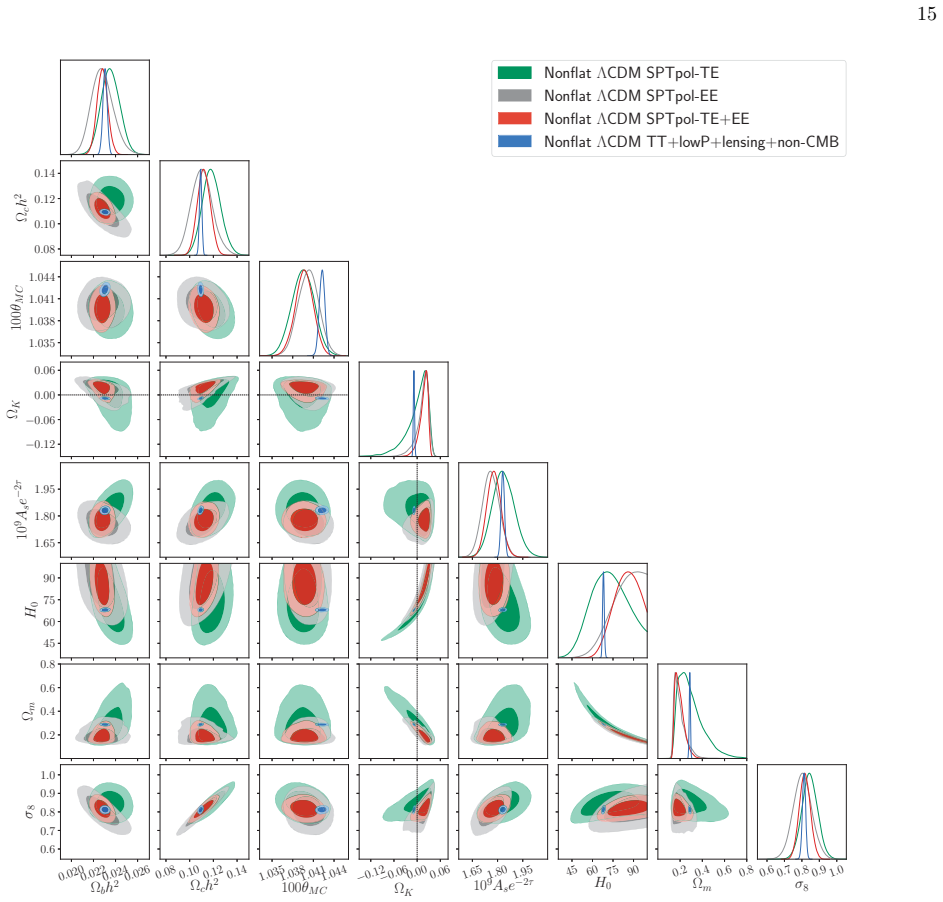
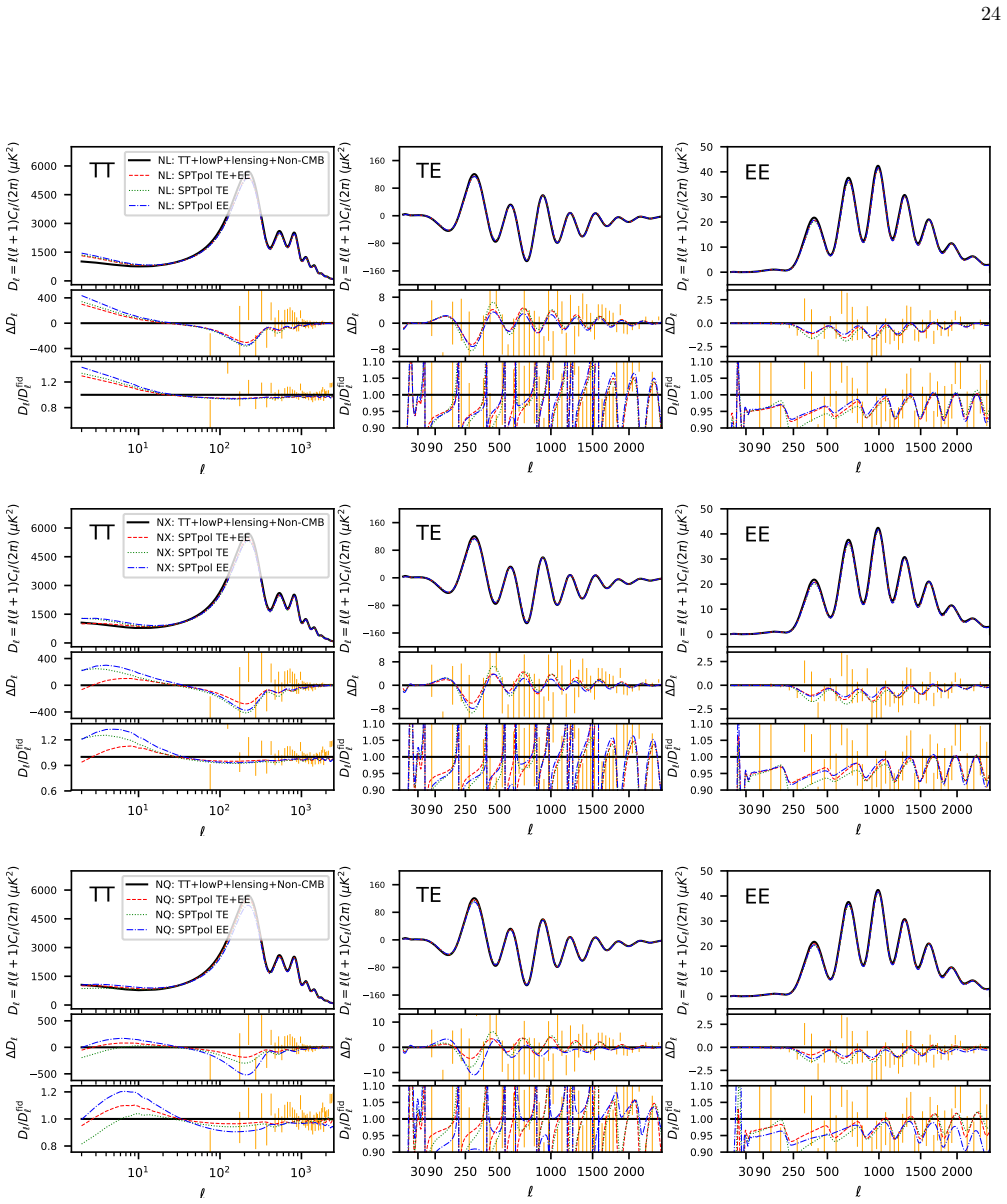
On the paper's own terms, the central discovery is that the closed-universe signal is not an artifact of the Planck data alone: when the smaller-scale SPTpol TE+EE data are added to Planck 2015 TT+lowP+lensing, with or without non-CMB data, untilted non-flat ΛCDM, XCDM, and φCDM models continue to favor Ωk < 0 over the flat Ωk = 0 limit. The significance is 1.0–1.6σ for Planck plus SPTpol and 3.1–5.0σ when Pantheon supernovae, BAO, H(z), and growth-rate data are included. The paper also establishes that the best-fit models from Planck plus non-CMB data do not themselves fit the SPTpol spectra well, with minimum χ² exceeding expectation by 2.2σ–3.1σ, yet the cosmological parameters preferred by the two data sets are not significantly inconsistent, so joint constraints are legitimate.
Load-bearing premise
The curvature inference assumes that the primordial density-fluctuation spectrum in a curved universe is the slow-roll inflation spectrum of Eq. (6); if the true non-flat spectrum has a different shape, the inferred Ωk values and the preference for a closed universe could change.
Editorial extensions
If this is right
- Joint Planck plus SPTpol analyses of untilted non-flat models favor a closed universe over flat at 1.0–1.6σ; adding non-CMB data raises this to 3.1–5.0σ, so the curvature signal persists at smaller angular scales.
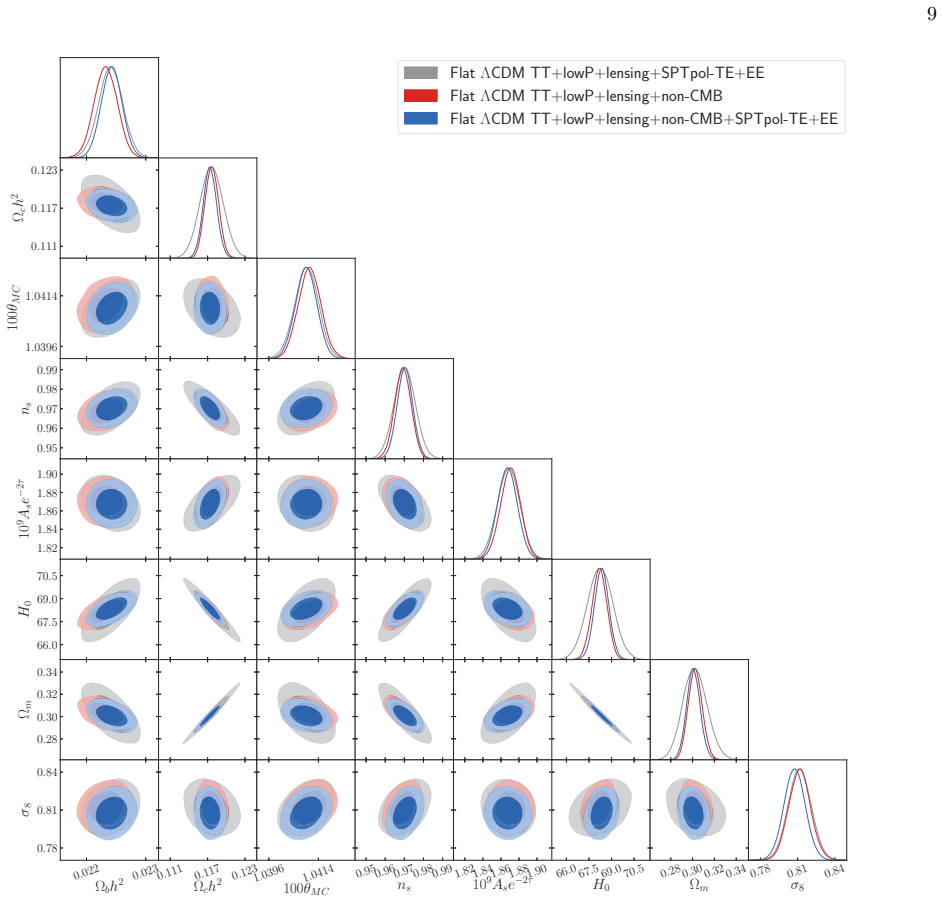
- Parameter constraints from SPTpol and from Planck plus non-CMB data are largely consistent, so combining them does not introduce significant tension.
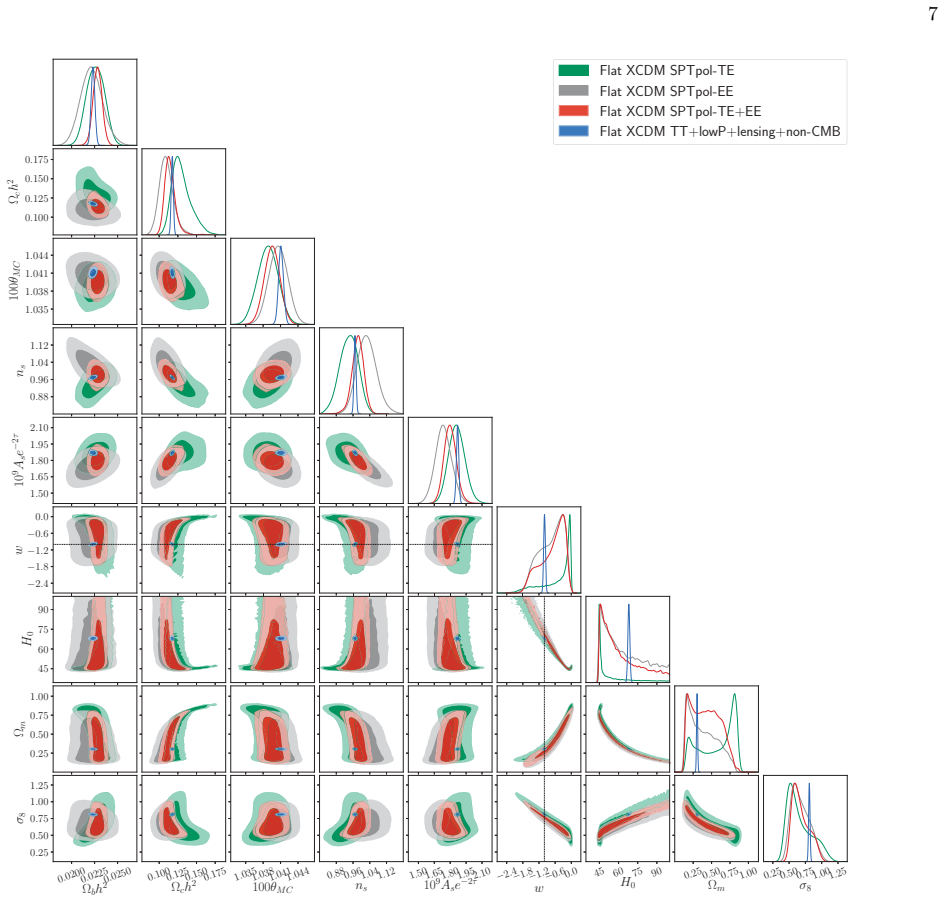
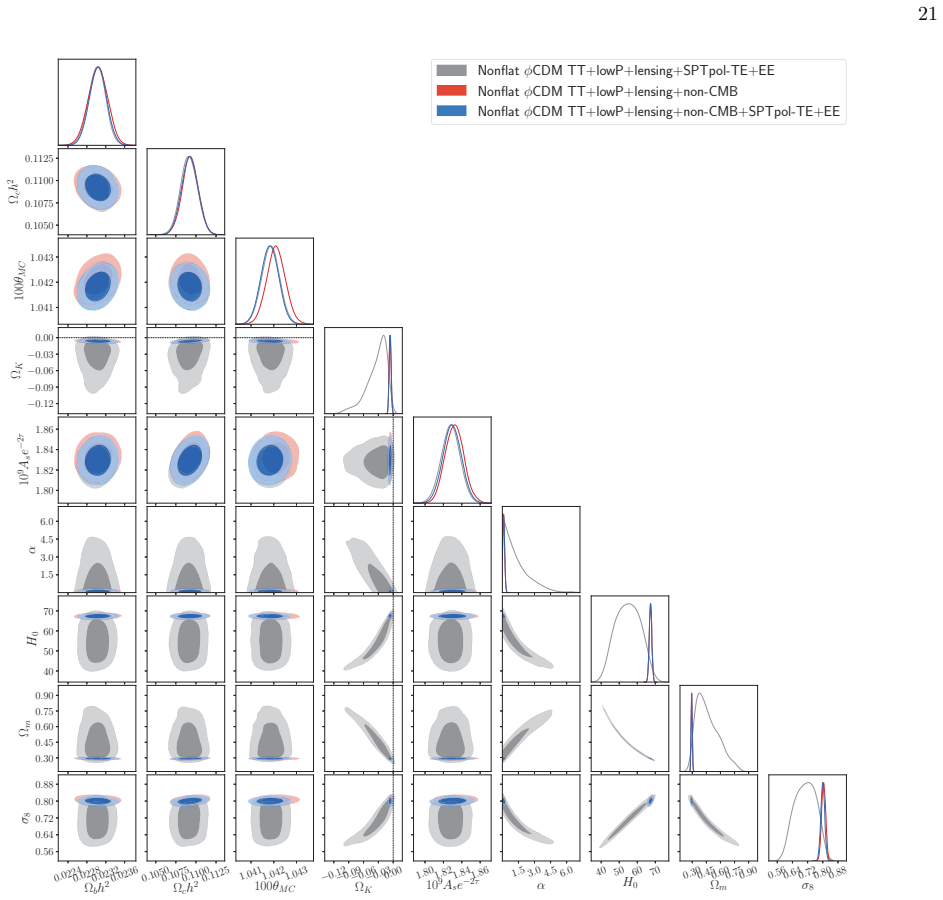
- When combined with Planck data, BAO and other non-CMB data tighten dark-energy and curvature constraints far more than SPTpol data do; SPTpol mainly tightens Ωbh² and θMC slightly.
- In most models SPTpol data favor a lower σ8 than Planck does, moving the σ8–Ωm contours slightly toward easing tension with weak-lensing measurements, but the effect is small.
- The SPTpol data alone cannot tightly constrain the dark-energy parameters w and α, and in φCDM they allow large α and a significantly lower H0.
Reading between the lines
- If the closed-universe preference really holds across these data combinations, then the spatially flat ΛCDM model may be missing a degree of freedom, and curvature should be included in future parameter forecasts rather than marginalized away.
- The curvature inference leans heavily on the assumed non-flat inflation spectrum of Eq. (6); a different theoretically motivated spectrum, for instance one derived from non-slow-roll inflation in curved space, could shift Ωk and should be tested before treating the closed-universe claim as settled.
- A separate recent analysis of Planck 2018 spectra reports positive curvature at high confidence using a tilted non-flat model; the present paper's untilted non-flat models avoid the low H0 and σ8 discordance seen there, suggesting the two curvature signals may be partly model-dependent.
- Because SPTpol data are largely consistent with Planck plus non-CMB data, future high-resolution CMB polarization experiments should be able to sharpen the closed-universe test to a decisive level.
Signed reviews
Editorial analysis
A structured set of objections, weighed in public.
Referee Report
Summary. This paper uses Markov chain Monte Carlo methods to constrain six cosmological models—tilted spatially-flat and untilted non-flat ΛCDM, XCDM, and φCDM—with SPTpol CMB data alone and in combination with Planck 2015 TT+lowP+lensing data and non-CMB data (Pantheon SNe, BAO, H(z), fσ8). The authors find that models best fitting Planck+non-CMB data do not provide good χ² fits to the SPTpol TE+EE data, yet parameter constraints from the two data groups are reported as largely mutually consistent. Their central claim is that adding SPTpol TE+EE to Planck or to Planck+non-CMB leaves the preference for spatially-closed untilted non-flat models intact, at 1.0–1.6σ and 3.1–5.0σ depending on the dark energy model. The paper also quantifies that BAO data have more constraining power than SPTpol when combined with Planck data.
Significance. The paper is a careful, transparent consistency study. Its tabulated constraints are internally consistent and it extends earlier SPTpol/Planck comparisons from tilted flat ΛCDM to dynamical dark energy and non-flat models. The central conclusion is, however, a robustness claim rather than a new detection: the closed-universe preference is dominated by the Planck+non-CMB data, and SPTpol adds almost no constraining power. If the results hold, they demonstrate that the closed-universe signal previously reported in untilted non-flat models is not destroyed by high-resolution SPTpol polarization data. The paper's own caveats—the τ prior dependence and the undetermined non-slow-roll non-flat spectrum—limit the generality of the claim, but the manuscript is honest about them.
major comments (3)
- [Section III; Eq. (8); Tables IV and VII] The SPTpol-only constraints used in the consistency statistic χ²_p are generated with a Gaussian prior on τ taken from the Planck+non-CMB fit of the same model. The paper states that "the resulting SPTpol parameter constraints strongly depend on the choice of the prior of τ," but the PTEs in Tables IV and VII are then presented as if they were independent cross-checks. Because both the mean parameters and the covariance matrix C_p in Eq. (8) are conditioned on the comparison data set, the "largely mutually consistent" conclusion is partly built in. Please provide a sensitivity analysis (e.g., a broad τ prior, the SPTpol-team prior 0.078±0.019, or a prior from Planck-only data) and report how χ²_p and PTE change for each model.
- [Section IV; Eq. (6)] The non-flat models fix n_s=1 by adopting the slow-roll untilted power spectrum, while the flat models require n_s≈0.97. Since both a tilt and a negative Ω_k alter the low-multipole spectrum, Ω_k<0 may be partially absorbing the spectral tilt that flat fits describe through n_s<1. The paper explicitly notes that a non-slow-roll non-flat spectrum has not yet been derived. The internal comparison with the "corresponding flat limit" (n_s=1) is well defined, but the physical interpretation of a 5σ closed universe is not robust to a plausible tilt. I ask for at least one sensitivity run: allow a tilt factor in the non-flat spectrum (e.g., the Planck parametrization of Eq. (7), or a generalized (k̄/k0)^{n_s−1}) for ΛCDM and report the posterior on Ω_k and the closed-vs-flat significance. Even a single run would show whether the closed-universe preference is an artifact of fixing n_s=1.
- [Section V; Table IV, φCDM rows] For the tilted flat φCDM model with SPTpol TE+EE data, the consistency statistic gives PTE=0.001 when H0 is the active parameter—the parametrization in which the φCDM model is defined—and PTE=0.093 when θMC is active. The text concludes "there is no significant evidence of tension" without resolving this discrepancy. A PTE of 0.001 is conventionally strong evidence of tension, so the "largely mutually consistent" claim is not supported for this model unless the authors explain why the θMC version is the valid test or why the H0 version should be discounted. Please address this explicitly.
minor comments (4)
- [Abstract and Section VI] The statement that SPTpol data used jointly with Planck "still results in a detection of non-zero spatial curvature" should explicitly state that the detection is dominated by Planck+non-CMB data and is conditional on the untilted slow-roll non-flat spectrum; otherwise readers may infer that SPTpol strengthens the closed-universe evidence.
- [Section V; Table IV] The phrase "no significant evidence of tension" is an overstatement given Nσ values of 2.2–3.1 for all SPTpol TE+EE fits; the difference between poor absolute χ² and overlapping parameter contours should be stated more prominently in the abstract.
- [Section II and Section VI] There are typos: "the devitation is less than 0.6σ" should read "the deviation is less than 0.6σ," and "given the uncertainities" should be "given the uncertainties."
- [Footnote [37]] The DIC values for SPTpol-only data prefer flat over non-flat φCDM (DIC 166.44 vs 169.52); reporting ΔDIC for the joint analyses in the main text would help support the closed-vs-flat claims, which currently rest on Ω_k error bars.
Circularity Check
SPTpol-only constraints are conditioned on tau priors taken from the Planck+non-CMB fits they are then compared against, making part of the consistency finding circular; the closed-universe claim itself is not circular.
-
fitted input called prediction
[Section III (Methods), SPTpol-only fitting paragraph; Tables II and V notes; Section V, Eq. (8) consistency statistic.]
"When we constrain the parameters of each model using the SPTpol data alone we use a Gaussian prior for τ, adapted from the τ value of the corresponding model constrained using the Planck 2015 CMB and the non-CMB data sets, and instead of As and τ we use the combination 109Ase−2τ as an alternative free parameter following the SPTpol team [25]. However, it should be emphasized that the resulting SPTpol parameter constraints strongly depend on the choice of the prior of τ."
The SPTpol-alone posterior is conditioned on a Gaussian τ prior whose central value is taken from the very Planck+non-CMB fits that the paper then compares against it, as shown in the Table II and V subheadings (e.g., τ = 0.066 ± 0.012 [13], τ = 0.112 ± 0.012 [13]) for each model. The consistency statistic in Eq. (8), χ2p = ΔpT Cp−1 Δp, uses the covariance matrix Cp of these SPTpol-alone constraints and the difference Δp from the Planck+non-CMB best-fit parameters. Because τ is an active parameter strongly correlated with As and σ8, the SPTpol posterior is pulled toward the comparison values; the resulting 'no significant evidence of tension' PTEs in Tables IV and VII are therefore partly guaranteed by construction.
full rationale
The central 'closed universe remains favored' claim is not circular: the joint Planck+SPTpol and Planck+non-CMB+SPTpol analyses do not use the Gaussian τ prior (Section V states that no such prior is used because Planck provides a tight constraint), and Table VI shows that adding SPTpol shifts Ωk only from −0.0083 ± 0.0016 to −0.0080 ± 0.0016, so the closed-universe preference is inherited from the Planck+non-CMB data rather than manufactured by the comparison setup. The non-flat power spectrum of Eq. (6) is a stated slow-roll, untilted inflation assumption with independent literature antecedents; whether a tilted non-flat spectrum would move Ωk is a model-dependence caveat, not a circular step. The one concrete circularity is the SPTpol-only τ prior: those 'constraints' are constructed from the comparison dataset itself and then fed into the consistency test, making the mutual-consistency conclusion partly by construction. This does not infect the closed-universe claim, but it does compromise a headline claim of the abstract and summary, so a moderate score is appropriate.
Assumptions & free parameters
free parameters (11)
- Omega_b h^2 (baryon density) =
0.02243 +/- 0.00018 (flat Lambda CDM, all data)
- Omega_c h^2 (cold dark matter density) =
0.1174 +/- 0.0011 (flat Lambda CDM, all data)
- 100 theta_MC (sound horizon scale) =
1.04096 +/- 0.00038 (flat Lambda CDM, all data)
- tau (reionization optical depth) =
0.064 +/- 0.012 (flat Lambda CDM, all data)
- ln(10^10 A_s) =
3.054 +/- 0.023 (flat Lambda CDM, all data)
- n_s (scalar spectral index) =
0.9703 +/- 0.0041 (flat Lambda CDM, all data)
- H0 (Hubble constant, active in phiCDM) =
67.76 +/- 0.62 (flat phiCDM, all data)
- Omega_k (curvature density parameter) =
-0.0080 +/- 0.0016 (non-flat Lambda CDM, all data)
- w (XCDM dark energy equation of state) =
-0.989 +/- 0.032 (flat XCDM, all data)
- alpha (inverse power-law potential slope) =
<0.32 (flat phiCDM, all data, 95.4% C.L.)
- tau Gaussian prior for SPTpol-only runs =
0.066 +/- 0.012 (flat Lambda CDM); 0.068 +/- 0.015 (flat XCDM); 0.074 +/- 0.014 (flat phiCDM)
assumptions (6)
- domain assumption Background expansion equations of Lambda CDM, XCDM, and phiCDM models (Eqs. 1-4)
- domain assumption Inflation power spectra: Eq. (5) for tilted flat, Eq. (6) for untilted non-flat
- domain assumption Neutrino sector with Neff=3.04 and one massive neutrino of 0.06 eV
- domain assumption Flat priors and parameter ranges listed in Section III
- ad hoc to paper Gaussian prior on tau for SPTpol-only analyses taken from Planck+non-CMB fits of the same model
- domain assumption SPTpol band powers and covariance matrices are accurate
Cite this review
Pith. "Pith review of Using SPTpol, Planck 2015, and non-CMB data to constrain tilted spatially-flat and untilted non-flat $\Lambda$CDM, XCDM, and $\phi$CDM dark energy inflation cosmologies." pith.science (2026). https://pith.science/paper/ZUCN6AIB
@misc{pith2026190808477,
  author       = {Pith},
  title        = {Pith review of: Using SPTpol, Planck 2015, and non-CMB data to constrain tilted spatially-flat and untilted non-flat $\Lambda$CDM, XCDM, and $\phi$CDM dark energy inflation cosmologies},
  year         = {2026},
  howpublished = {\url{https://pith.science/paper/ZUCN6AIB}},
  note         = {Machine review of arXiv:1908.08477}
}
abstract
We use six tilted spatially-flat and untilted non-flat dark energy cosmological models in analyses of South Pole Telescope polarization (SPTpol) cosmic microwave background (CMB) data, alone and in combination with Planck 2015 CMB data and non-CMB data, namely, the Pantheon Type Ia supernovae apparent magnitudes, a collection of baryon acoustic oscillation data points, Hubble parameter measurements, and growth rates. Although the cosmological models that best-fit the Planck CMB and non-CMB data do not provide good fits to the SPTpol data, with the $\chi^2$'s exceeding the expected value, given the uncertainties, in each model the cosmological parameter constraints from the SPTpol data and from the Planck CMB and non-CMB data are largely mutually consistent. When the smaller angular scale SPTpol data are used jointly with either the Planck data alone or with the Planck CMB and the non-CMB data to constrain untilted non-flat models, spatially-closed models remain favored over their corresponding flat limits. When used in conjunction with Planck data, non-CMB data (baryon acoustic oscillation measurements in particular, from six experiments) have significantly more constraining power than the SPTpol data.
Figures


Figures from the paper (11 more)





Forward citations
Cited by 3 Pith papers
-
Updated observational constraints on $\phi$CDM dynamical dark energy cosmological models
Updated φCDM constraints from Planck 2018 + non-CMB data find α=0.055±0.041, consistent with a cosmological constant and only mildly favoring evolving quintessence.
-
Is excess smoothing of Planck CMB ansiotropy data partially responsible for evidence for dark energy dynamics in other $w(z)$CDM parametrizations?
In three new w(z)CDM parametrizations, Planck CMB plus non-CMB data favor evolving dark energy over a cosmological constant at roughly 2 sigma when the Planck lensing anomaly parameter is fixed, and at roughly 1 sigma...
-
Quasar X-ray and UV flux, baryon acoustic oscillation, and Hubble parameter measurement constraints on cosmological model parameters
Quasar X-ray and UV flux data are weak but consistent with BAO and H(z) data, and the joint data mildly favor closed spatial geometry and dynamical dark energy over flat LambdaCDM.
Reference graph
Works this paper leans on
-
[1]
P. J. E. Peebles, Astrophys. J. 284, 439 (1984)
1984
-
[2]
for the ΛCDM and XCDM models and Ref. [17] for the φCDM model. 11 0.75 0.90 1.05 σ8 0.113 0.117 0.121 Ωch2 1.040 1.041 1.042 100θMC 0.95 0.97 0.99 ns 1.83 1.86 1.89 109Ase−2τ −2.0 −1.6 −1.2 −0.8 −0.4 w 60 75 90H0 0.1 0.2 0.3 0.4 0.5 Ωm 0.02150.02200.02250.0230 Ωbh2 0.75 0.90 1.05 σ8 0.1130.1170.121 Ωch2 1.0401.0411.042 100θMC 0.95 0.97 0.99 ns 1.83 1.86 1...
-
[3]
for the ΛCDM and XCDM models and from Ref. [17] for the φCDM model. For the SPTpol analyses, a different Gaussian prior for τ (indicated in the subheadings) has been used for each cosmological model (see main text for discussions and details). 15 0.6 0.7 0.8 0.9 1.0 σ8 0.08 0.10 0.12 0.14 Ωch2 1.035 1.038 1.041 1.044 100θMC −0.12 −0.06 0.00 0.06 ΩK 1.65 1....
-
[4]
D. M. Scolnic et al., Astrophys. J. 859, 101 (2018) [arXiv:1710.00845]
arXiv 2018
-
[5]
P. A. R. Ade et al., Astron. Astrophys. 594, A13 (2016) [arXiv:1502.01589]
arXiv 2016
- [6]
-
[7]
A. J. Ross, L. Samushia, C. Howlett et al., Mon. Not. R. Astron. Soc. 449, 835 (2015) [arXiv:1409.3242]
arXiv 2015
-
[8]
S. Alam et al., Mon. Not. R. Astro. Soc. 470, 2617 (2017) [arXiv:1607.03155]
arXiv 2017
Show all 44 references
-
[9]
Beutler, C
F. Beutler, C. Blake, M. Colless et al., Mon. Not. R. Astron. Soc. 416, 3017 (2011) [arXiv:1106.3366]
2011 arXiv
-
[10]
Font-Ribera, D
A. Font-Ribera, D. Kirkby, N. Busca et al. J. Cosmol. Astropart. Phys. 1405, 027 (2014) [arXiv:1311.1767]
2014 arXiv
-
[11]
M. Ata, F. Baumgarten, J. Bautista et al., Mon. Not. R. Astron. Soc. 473, 4773 (2018) [arXiv:1705.06373]
2018 arXiv
-
[12]
J. E. Bautista, N. G. Busca, J. Guy et al., Astron. As- trophys. 603, A12 (2017) [arXiv:1702.00176]
2017 arXiv
-
[13]
[17] for the φCDM model
for the ΛCDM and XCDM models and Ref. [17] for the φCDM model. For the SPTpol analyses, a different Gaussian prior for τ (indicated in the subheadings) has been used for each cosmological model (see main text for discussion and details). 7 0.250.500.751.001.25 σ8 0.100 0.125 0....
2015
-
[14]
Moresco et al., JCAP, 1605, 014 (2016) [arXiv:1601:01701]
M. Moresco et al., JCAP, 1605, 014 (2016) [arXiv:1601:01701]
2016
-
[15]
Farooq, F
O. Farooq, F. R. Madiyar, S. Crandall, and B. Ratra, Astrophys. J. 835, 26 (2017) [arXiv:1607.03537]
2017 arXiv
-
[16]
Park and B
C.-G. Park and B. Ratra, Astrophys. Space Sci. 364, 82 (2019) [arXiv:1803.05522]
2019 arXiv
-
[17]
J. Ooba, B. Ratra, and N. Sugiyama, Astrophys. J. 864, 80 (2018) [arXiv:1707.03452]. 22 TABLE VII: Minimumχ2 values for the SPTpol TE+EE, TE, EE spectra in the best-fit untilted non-flat ΛCDM, XCDM, and φCDM models constrained by using Planck 2015 TT+lowP+SN+BAO+ H(z)+fσ8 data [...
2018 arXiv
-
[18]
Park and B
C.-G. Park and B. Ratra, Astrophys. J. 882, 158 (2019) [arXiv:1801.00213 [astro-ph.CO]]
2019 arXiv
-
[19]
J. Ooba, B. Ratra, and N. Sugiyama, Astrophys. Space Sci. 364, 176 (2019) [arXiv:1802.05571]
2019 arXiv
- [20]
-
[21]
Chen and B
Earlier discussions of observational constraints on dark energy dynamics may be traced through G. Chen and B. Ratra, Astrophys. J. 612, L1 (2004) [arXiv:astro- ph/045636]; L. Samushia, G. Chen, and B. Ratra, arXiv:0706.1963; M. Yashar, B. Bozek, A. Abrahamse, A. Albrecht, and ...
2004 arXiv
-
[22]
P. J. E. Peebles and B. Ratra, Astrophys. J. 325, L17 (1988); B. Ratra and P. J. E. Peebles, Phys. Rev. D 37, 3406 (1988); A. Pavlov, S. Westmoreland, K. Saaidi, and B. Ratra, Phys. Rev. D 88, 123513 (2013) [arXiv:1307.7399]
1988 arXiv
-
[23]
J. Ooba, B. Ratra, and N. Sugiyama, Astrophys. J. 869, 34 (2018) [arXiv:1710.03271]. 23 0 1500 3000 4500 6000 D = ( + 1)C /(2 ) ( K2) TT FL: TT+lowP+lensing+Non-CMB FL: SPTpol TE+EE FL: SPTpol TE FL: SPTpol EE 250 0 250 D 101 102 103 0.90 1.05 D /Dfid 160 80 0 80 160 D = ( + 1...
2018 arXiv
-
[24]
J. Ooba, B. Ratra, and N. Sugiyama, Astrophys. J. 866, 68 (2018) [arXiv:1712.08617]
2018 arXiv
-
[25]
Farooq, D
Earlier discussions of observational constraints on spa- tial curvature may be traced through O. Farooq, D. Mania, and B. Ratra, Astrophys. Space Sci. 357, 11 (2015) [arXiv:1308.0834]; Y. Chen, B. Ratra, M. Biesi- ada, S. Li, and Z.-H. Zhu, Astrophys. J. 829, 61 (2016) [arXiv:...
2015 arXiv
-
[26]
Das et al., JCAP 1404, 014 (2014) [arXiv:1301.1037]
S. Das et al., JCAP 1404, 014 (2014) [arXiv:1301.1037]
2014 arXiv
-
[27]
K. T. Story et al., Astrophys. J. 779, 86 (2013) [arXiv:1210.7231]; E. M. George et al., Astrophys. J.799, 177 (2015) [arXiv:1408.3161]
2013 arXiv
-
[28]
J. W. Henning et al., Astrophys. J, 852, 97 (2018) [arXiv:1707.09353]
2018 arXiv
-
[29]
Ratra et al., Astrophys
B. Ratra et al., Astrophys. J, 517, 549 (1999) [arXiv:astro-ph/9901014]
1999 arXiv
-
[30]
Challinor and A
A. Challinor and A. Lasenby, Astrophys. J. 513, 1 (1999) [arXiv:astro-ph/9804301]; A. Lewis, A. Challinor, and A. Lasenby, Astrophys. J. 538, 473 (2000) [arXiv:astro- ph/9911177]; A. Lewis and S. Bridle, Phys. Rev. D 66, 103511 (2002) [arXiv:astro-ph/0205436]
1999 arXiv
-
[31]
Lucchin and S
F. Lucchin and S. Matarrese, Phys. Rev. D 32, 1316 (1985); B. Ratra, Phys. Rev. D 45, 1913 (1992); Phys. Rev. D 40, 3939 (1989)
1985
-
[32]
J. R. Gott, Nature 295, 304 (1982)
1982
-
[33]
S. W. Hawking, Nucl. Phys. B 239, 257 (1984); B. Ratra, Phys. Rev. D 31, 1931 (1985)
1984
-
[34]
Ratra and P
B. Ratra and P. J. E. Peebles, Phys. Rev. D 52, 1837 (1995)
1995
- [35]
-
[36]
C. G. Park and B. Ratra, Astrophys. Space Sci. 364, 134 (2019) [arXiv:1809.03598]
2019 arXiv
-
[37]
In the last panel of Table IV (VII), for the tilted flat (untilted non-flat)φCDM model, the numerical values in the upper half of this panel assume θMC as a dependent parameter and H0 as a free parameter (see discussion in Ref. [17]) while the numerical values in the lower half ...
-
[38]
See J. R. Gott, M. S. Vogeley, S. Podariu, and B. Ratra, Astrophys. J. 549, 1 (2001) [arXiv:astro-ph/0006103]; G. Chen, J. R. Gott, and B. Ratra, Publ. Astron. Soc. Pac. 115, 1269 (2003) [arXiv:astro-ph/0308099]; G. Chen and B. Ratra, Publ. Astron. Soc. Pac. 123, 1127 (2011) [...
2001 arXiv
-
[39]
Planck Collaboration 2015, Planck 2015 Re- sults: Cosmological Parameter Tables at wiki.cosmos.esa.int/planckpla2015/images/f/f7/Baseline para ms table 2015 limit68.pdf
2015
-
[40]
For a more quantitative analysis, we can compute the deviance information criterion (DIC) [see D. J. Spiegel- halter, N. G. Best, B. P. Carlin and A. van der Linde, J. Roy. Statist. Soc. B 64, 583 (2002)] to compare the tilted flat and untilted non-flat dark energy models con- s...
2002
-
[41]
Di Valentino, A
E. Di Valentino, A. Melchiorri and J. Silk, Nat. Astron. (2019) [arXiv:1911.02087]
2019 arXiv
-
[42]
G. E. Addison et al., Astrophys. J. 818, 132 (2016) [arXiv:1511.00055]. 26
2016 arXiv
-
[43]
Aghanim et al., Astron
N. Aghanim et al., Astron. Astrophys. 607, A95 (2017) [arXiv:1608.02487]
2017 arXiv
-
[44]
Aylor et al., Astrophys
K. Aylor et al., Astrophys. J. 850, 101 (2017) [arXiv:1706.10286]
2017 arXiv
Reviewed August 14, 2026 · model on record in the stance chip above.
Discussion (0). Continue with ORCID to comment.