REVIEW 2 major objections 1 minor 25 references
Predicting the Neutrino Mass Ordering Using Neural Networks
T0 review · 2 major / 1 minor · reviewed 2026-06-28 · grok-4.3
Pith's one-line read A neural network classifier matches the performance of standard statistical fits when determining neutrino mass ordering from synthetic long-baseline data.
desk verdict A basic neural net matches chi-squared on idealized synthetic neutrino data for mass ordering but the comparison skips the systematics that matter in real experiments. read the letter →
The pith
A machine-rendered reading of the paper's core claim, the machinery that carries it, and where it could break.
The reading
What carries the argument
Feed-forward neural-network classifier trained on synthetic long-baseline datasets that include three-flavour oscillation probabilities, matter effects, and statistical fluctuations; it outputs a classification score for normal versus inverted ordering.
What would settle it
Applying the trained network to actual data from a long-baseline experiment and checking whether its mass-ordering discrimination matches or exceeds the chi-squared result on the same dataset.
Extended reading notes
Core claim
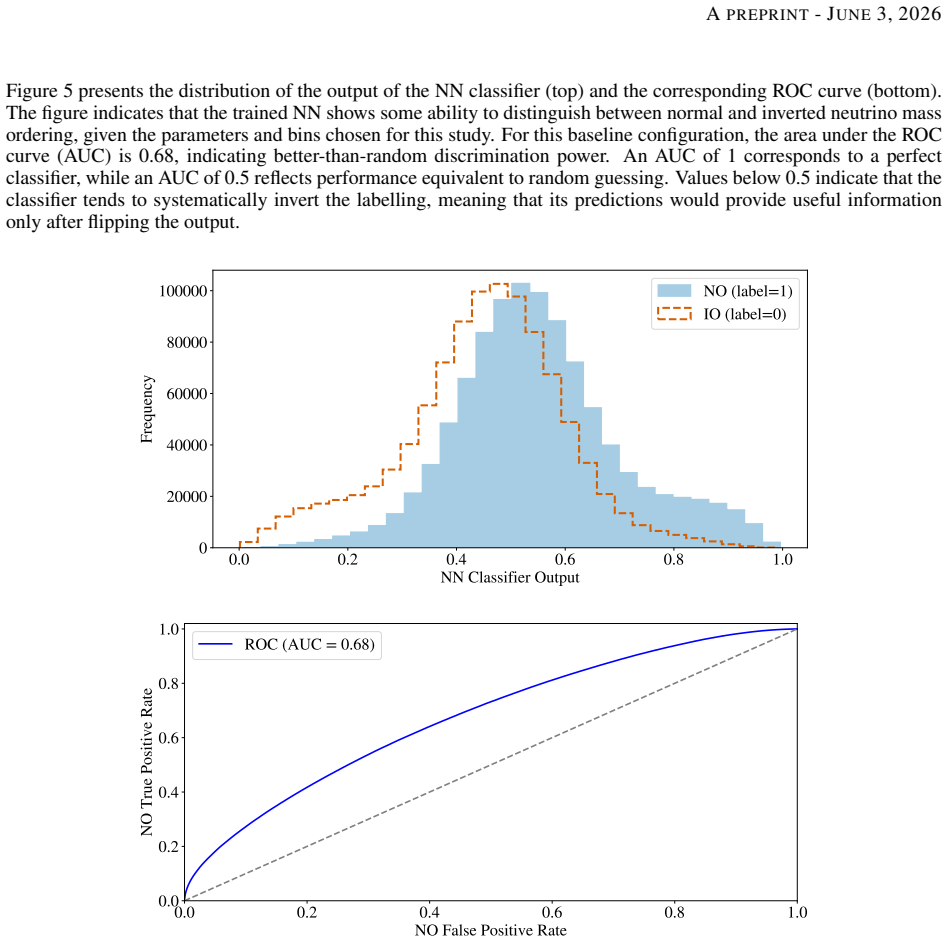
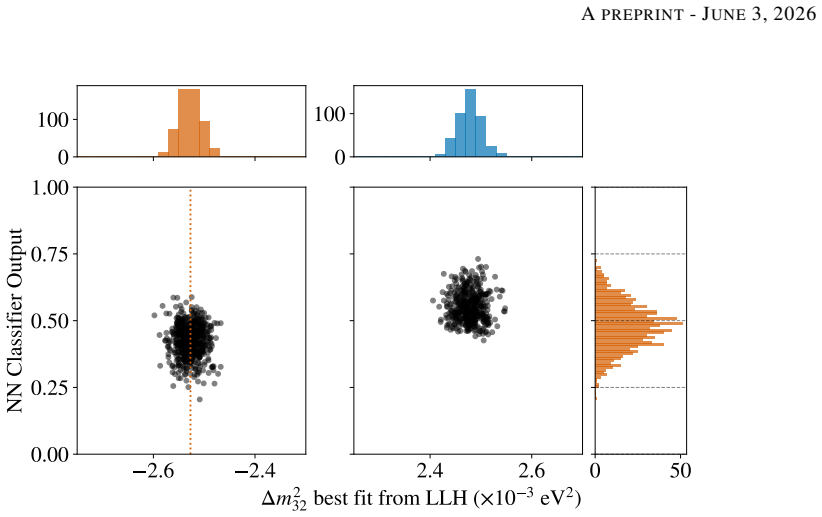
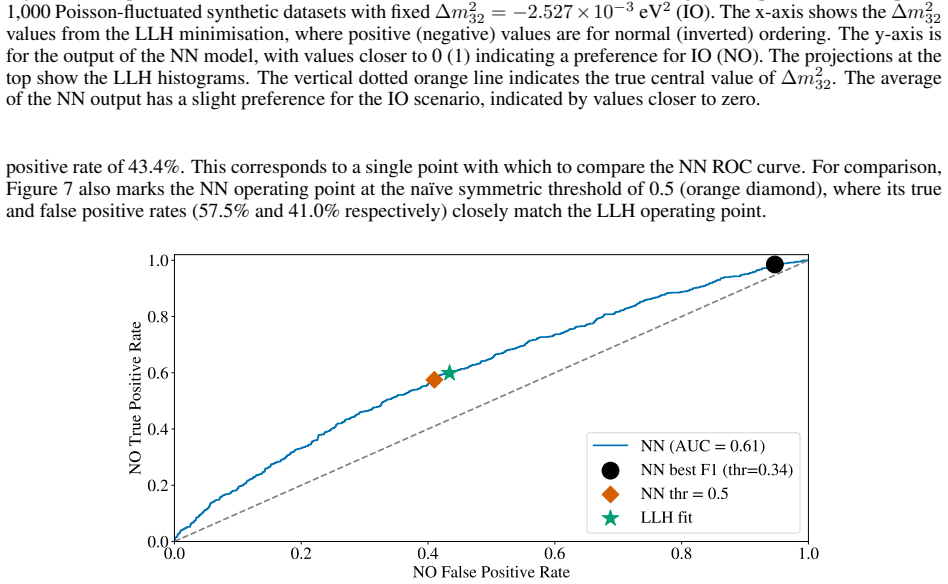
The neural network achieves performance comparable to conventional fits for the scenarios studied, providing a flexible, independent cross-check of established analyses for neutrino mass ordering determination.
Load-bearing premise
The synthetic datasets used for training and testing are representative enough of real experimental conditions to make the performance comparison meaningful.
Editorial extensions
If this is right
- Operating points on the classifier can be chosen to favour either higher purity or higher efficiency in mass-ordering assignment.
- The same framework can incorporate systematic uncertainties in future extensions.
- Joint inference of multiple oscillation parameters becomes feasible within the neural-network approach.
- The method offers a potential pedagogical example for applying machine learning to neutrino oscillation problems.
Reading between the lines
- If the network learns correlations missed by traditional fits, it could improve sensitivity in experiments where parameter degeneracies are severe.
- Retraining on more detailed detector simulations might reveal whether the comparable performance persists under realistic backgrounds and efficiencies.
- The classifier could be combined with existing likelihood analyses to produce ensemble predictions that reduce reliance on any single method.
Signed reviews
Editorial analysis
A structured set of objections, weighed in public.
Referee Report
Summary. The manuscript investigates a feed-forward neural-network classifier for determining neutrino mass ordering (normal vs. inverted) trained on synthetic long-baseline oscillation datasets generated from three-flavour probabilities including matter effects and Poisson statistical fluctuations. Performance is compared to standard χ² and log-likelihood fits via ROC curves and related discrimination metrics, with the conclusion that the NN achieves comparable results for the scenarios studied and can serve as a flexible, independent cross-check.
Significance. If the central comparison holds under the stated conditions, the work supplies a controlled proof-of-concept for machine-learning methods as a complementary tool in neutrino oscillation phenomenology, with noted extensibility to systematics and potential pedagogical utility. The idealized synthetic-data setting allows clean isolation of statistical effects but restricts immediate relevance to real experiments.
major comments (2)
- [Abstract] Abstract: the assertion that the neural network 'achieves performance comparable to conventional fits' is presented without any quantitative metrics (AUC values, specific ROC operating points, error estimates, or training hyperparameters), rendering the central claim unverifiable from the stated text.
- [Data-generation description (likely §2–3)] Data-generation description (likely §2–3): the synthetic events incorporate only oscillation probabilities, matter effects, and statistical fluctuations; detector smearing, energy-scale uncertainties, flux normalizations, and other systematics that must be marginalized in actual χ² analyses are omitted. This choice means the reported ROC performance does not test robustness against the dominant uncertainties of established methods, weakening the claim of an 'independent cross-check of established analyses'.
minor comments (1)
- [Abstract] Abstract and results section: include at least one table or figure caption with explicit numerical performance values (e.g., AUC or efficiency at fixed purity) to support the comparability statement.
Simulated Author's Rebuttal
We thank the referee for the careful reading and constructive comments on our manuscript. We respond to each major comment below and indicate planned revisions.
read point-by-point responses
-
Referee: [Abstract] Abstract: the assertion that the neural network 'achieves performance comparable to conventional fits' is presented without any quantitative metrics (AUC values, specific ROC operating points, error estimates, or training hyperparameters), rendering the central claim unverifiable from the stated text.
Authors: We agree that the abstract would benefit from quantitative metrics to support the comparability statement. In the revised version we will insert specific AUC values (extracted from the ROC curves already shown in the body), a note on selected operating points, and the main training hyperparameters. This change will make the central claim directly verifiable from the abstract text. revision: yes
-
Referee: [Data-generation description (likely §2–3)] Data-generation description (likely §2–3): the synthetic events incorporate only oscillation probabilities, matter effects, and statistical fluctuations; detector smearing, energy-scale uncertainties, flux normalizations, and other systematics that must be marginalized in actual χ² analyses are omitted. This choice means the reported ROC performance does not test robustness against the dominant uncertainties of established methods, weakening the claim of an 'independent cross-check of established analyses'.
Authors: The manuscript is explicitly framed as a controlled proof-of-concept that isolates statistical discrimination power; the absence of detector smearing and systematic uncertainties is stated in §§2–3 and is intentional for this scope. We acknowledge that the present results therefore cannot demonstrate robustness against the dominant experimental uncertainties. In revision we will expand the discussion section to restate this limitation clearly, moderate the phrasing of the 'independent cross-check' claim to reflect the idealized statistical setting, and reiterate the extensibility to systematics already noted in the abstract. revision: partial
Circularity Check
No significant circularity; empirical comparison on synthetic data is self-contained
full rationale
The paper generates synthetic long-baseline datasets from three-flavour oscillation probabilities (including matter effects and Poisson fluctuations), trains a feed-forward NN classifier to discriminate mass ordering, and reports ROC-based performance metrics that are compared directly to standard χ² and logℒ fits on the same held-out synthetic events. No load-bearing step reduces a claimed prediction to a quantity defined by the same fit, no self-citation chain is invoked to justify uniqueness or an ansatz, and the central claim remains an empirical observation on independently generated test data rather than a definitional identity. The enumerated circularity patterns are absent; the result is therefore scored at the low end of the allowed range.
Assumptions & free parameters
assumptions (1)
- domain assumption Three-flavour neutrino oscillation probabilities with matter effects accurately describe the synthetic data generation process
Cite this review
Pith. "Pith review of Predicting the Neutrino Mass Ordering Using Neural Networks." pith.science (2026). https://pith.science/paper/ZV2OA6ML
@misc{pith2026260603745,
  author       = {Pith},
  title        = {Pith review of: Predicting the Neutrino Mass Ordering Using Neural Networks},
  year         = {2026},
  howpublished = {\url{https://pith.science/paper/ZV2OA6ML}},
  note         = {Machine review of arXiv:2606.03745}
}
abstract
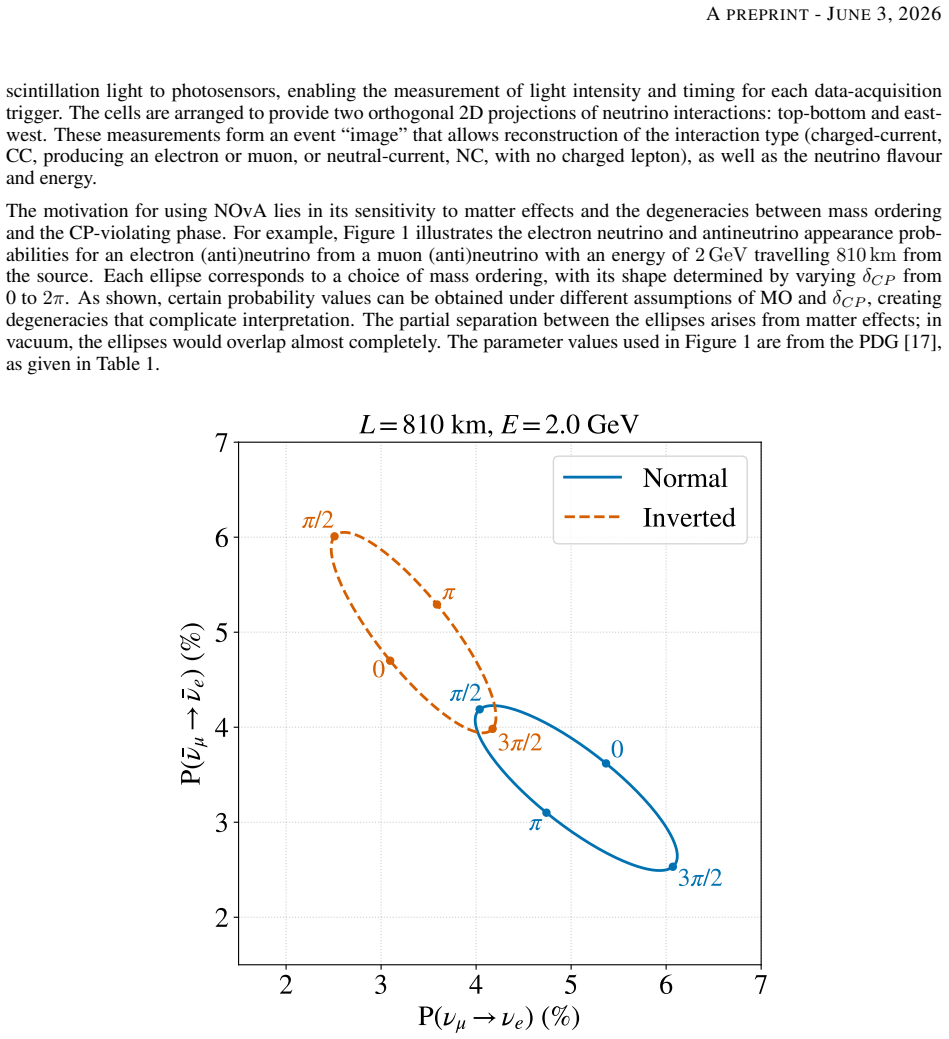
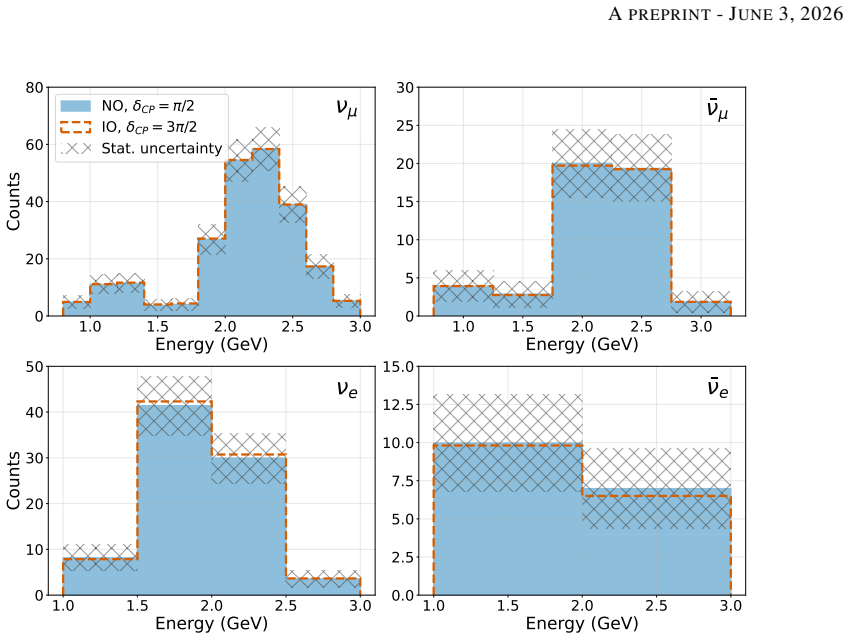
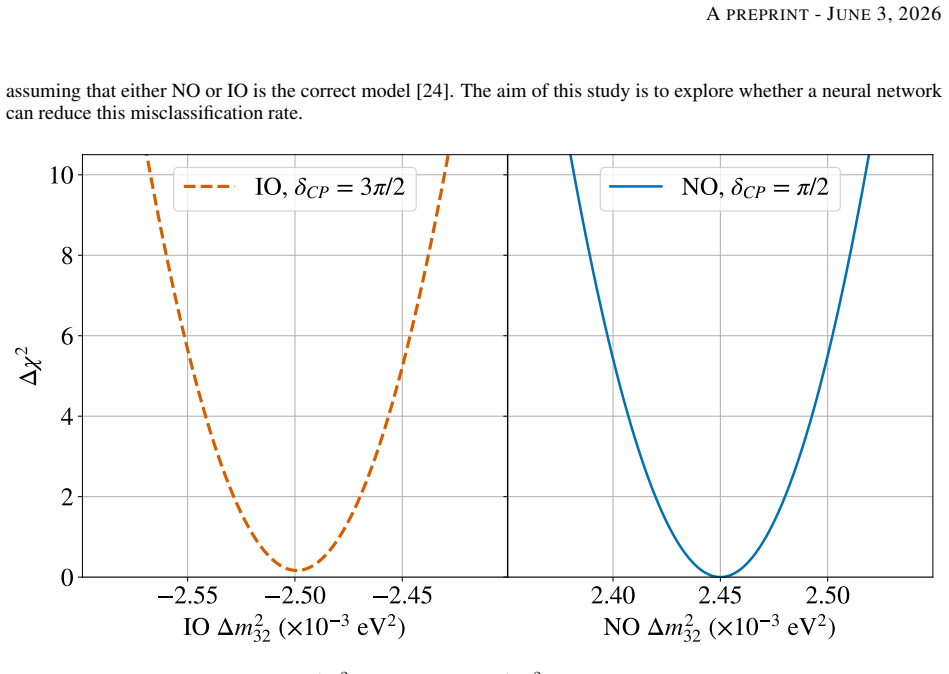
Determining the neutrino mass ordering remains a central open problem in particle physics. While next-generation long-baseline experiments are expected to resolve this question, current data provide limited sensitivity because the spectral differences between normal and inverted ordering are subtle and entangled with parameter degeneracies. We investigate a machine-learning strategy for mass-ordering determination using a feed-forward neural-network classifier trained on synthetic long-baseline datasets generated with three-flavour oscillation probabilities, matter effects, and statistical fluctuations. We evaluate the classifier against standard $\chi^2$ and $\log\mathcal{L}$ approaches using common discrimination metrics, including receiver-operating-characteristic curves, to quantify sensitivity and to illustrate how operating points can be selected to prioritise purity or efficiency. We find that the neural network achieves performance comparable to conventional fits for the scenarios studied, providing a flexible, independent cross-check of established analyses. The framework can be extended to incorporate systematic uncertainties and to explore joint inference of oscillation parameters, and it may also serve as a pedagogical tool for introducing machine-learning methods in neutrino physics.
Figures
Figures from the paper (4 more)
Reference graph
Works this paper leans on
-
[1]
Suekane.Neutrino oscillations: a practical guide to basics and applications
F. Suekane.Neutrino oscillations: a practical guide to basics and applications. Springer Tokyo, 2015
2015
-
[2]
Qian and P
X. Qian and P. V ogel. Neutrino mass hierarchy.Progress in Particle and Nuclear Physics, 83:1–30, 2015
2015
-
[3]
Agostini et al
M. Agostini et al. Comprehensive measurement of pp-chain solar neutrinos.Nature, 562:505–510, 2018
2018
-
[4]
J. D. Vergados, H. Ejiri, and F. Šimkovic. Neutrinoless double beta decay and neutrino mass.International Journal of Modern Physics E, 25:1630007, 2016
2016
-
[5]
Kajino, G.J
T. Kajino, G.J. Mathews, and T. Hayakawa. Neutrinos in core-collapse supernovae and nucleosynthesis.Journal of Physics G: Nuclear and Particle Physics, 41:044007, 2014
2014
-
[6]
Lesgourgues and S
J. Lesgourgues and S. Pastor. Neutrino mass from cosmology.Advances in High Energy Physics, 2012:608515, 2012
2012
-
[7]
Wolfenstein
L. Wolfenstein. Neutrino oscillations in matter.Phys. Rev. D, 17:2369, 1978
1978
-
[8]
Mikheyev and A.Y
S.P. Mikheyev and A.Y . Smirnov. Resonance amplification of oscillations in matter and spectroscopy of solar neutrinos.Sov. J. Nucl. Phys., 42:913–917, 1985. 10 APREPRINT- JUNE3, 2026
1985
Show all 25 references
-
[9]
Petcov and M
S.T. Petcov and M. Piai. The lma msw solution of the solar neutrino problem, inverted neutrino mass hierarchy and reactor neutrino experiments.Physics Letters B, 533:94–106, 2002
2002
-
[10]
Ahn et al
M.H. Ahn et al. Measurement of neutrino oscillation by the K2K experiment.Phys. Rev. D, 74:072003, 2006
2006
-
[11]
Adamson et al
P. Adamson et al. Electron neutrino and antineutrino appearance in the full MINOS data sample.Phys. Rev. Lett., 110:171801, 2013
2013
-
[12]
Joint neutrino oscillation analysis from the T2K and NOvA experiments.Nature, 646:818–824, 2025
NOvA and T2K Collaborations. Joint neutrino oscillation analysis from the T2K and NOvA experiments.Nature, 646:818–824, 2025
2025
-
[13]
Long-Baseline Neutrino Facility (LBNF) and Deep Underground Neutrino Experiment (DUNE) Conceptual Design Report V olume 2: The Physics Program for DUNE at LBNF
R.Acciarri et al. Long-Baseline Neutrino Facility (LBNF) and Deep Underground Neutrino Experiment (DUNE) Conceptual Design Report V olume 2: The Physics Program for DUNE at LBNF. 2015
2015
-
[14]
Abe et al
K. Abe et al. Hyper-Kamiokande Design Report. 2018
2018
-
[15]
Ayres et al
D.S. Ayres et al. The NOvA technical design report. Technical Report FERMILAB-DESIGN-2007-01, Fermilab National Accelerator Laboratory, 2007
2007
-
[16]
R. L. Talaga et al. PVC Extrusion Development and Production for the NOvA Neutrino Experiment.Nucl. Instrum. Meth. A, 861:77–89, 2017
2017
-
[17]
Navas et al
S. Navas et al. Review of particle physics.Phys. Rev. D, 110(3):030001, 2024. With 2025 update
2024
-
[18]
Abubakar et al
S. Abubakar et al. Precision measurement of neutrino oscillation parameters with 10 years of data from the NOvA experiment.Phys. Rev. Lett., 136:011802, 2026
2026
-
[19]
Acero et al
M.A. Acero et al. Improved measurement of neutrino oscillation parameters by the NOvA experiment.Phys. Rev. D, 106:032004, 2022
2022
-
[20]
Denton and S.J
P.B. Denton and S.J. Parke. Fast and accurate algorithm for calculating long-baseline neutrino oscillation proba- bilities with matter effects.Phys. Rev. D, 110:073005, 2024
2024
-
[21]
D. P. Kingma and J. Ba. Adam: A method for stochastic optimization. https://arxiv.org/abs/1412.6980, 2015
2015 arXiv
-
[22]
Chollet et al
F. Chollet et al. Keras.https://keras.io. Accessed: 2026-02-02
2026
-
[23]
Abadi et al
M. Abadi et al. TensorFlow: Large-scale machine learning on heterogeneous systems.https://www. tensorflow.org/. Accessed: 2026-02-02
2026
-
[24]
Blennow et al
M. Blennow et al. Quantifying the sensitivity of oscillation experiments to the neutrino mass ordering.J. High Energ. Phys., 28(2014), 2014
2014
-
[25]
Predicting the Neutrino Mass Ordering Using Neural Networks
T.J.C. Bezerra, L. Asquith, E. Bannister, and W. Shorrock. Companion data for "Predicting the Neutrino Mass Ordering Using Neural Networks": pre-trained models and training dataset .https://doi.org/10.5281/ zenodo.20492586, June 2026. 11
2026
Reviewed June 28, 2026 · model on record in the stance chip above.
Discussion (0). Continue with ORCID to comment.