REVIEW 3 major objections 4 minor 28 references
Event multiplicity, transverse momentum and energy dependence of charged particle production, and system thermodynamics in $pp$ collisions at the Large Hadron Collider
T0 review · 3 major / 4 minor · reviewed 2026-08-14 · deepseek-v4-flash
Pith's one-line read This paper reports that a thermodynamically consistent Tsallis distribution describes the full transverse-momentum spectra of charged particles in proton-proton collisions at 5.02 and 13 TeV, while a blast-wave model captures only the…
desk verdict Competent Tsallis and BGBW fits to new ALICE pp data, but the thermodynamic trends are only as solid as the arbitrary fit range and the missing error bars. read the letter →
The pith
A machine-rendered reading of the paper's core claim, the machinery that carries it, and where it could break.
The reading
What carries the argument
The load-bearing object is the thermodynamically consistent Tsallis distribution, Eq. (11): a two-parameter $(T,q)$ invariant yield for charged particles in which the power-law exponent carries an extra factor of $q$ so that entropy, energy, pressure, and particle number satisfy standard thermodynamic relations. Fitting this form to the $p_{T}$ spectra yields the Tsallis temperature $T$ and the non-extensive parameter $q$, interpreted as kinetic freeze-out temperature and distance from equilibrium. The comparison mechanism is the BGBW model, Eq. (14), using modified Bessel functions $K_{1}$ and $I_{0}$ with a linear flow profile, which gives the average radial flow $\langle\beta\rangle$ and $T_{\rm kin}$ from the bulk $p_{T}$ region. The paper's central systematic tool is a scan of the upper $p_{T}$ fitting boundary from 1.2 to 20 GeV/$c$, showing opposite $q$ and $T$ trends for the highest and lowest multiplicity classes and a saturation threshold near 8 GeV/$c$.
What would settle it
Re-fit the $pp$ spectra at $\sqrt{s}=5.02$ and 13 TeV with a fixed upper boundary, say $p_{T,\max}=3$ GeV/$c$, for every multiplicity class; if $q$ no longer saturates above $\mathrm{d}N_{\rm ch}/\mathrm{d}\eta\sim15$ or $T_{\rm kin}$ no longer rises with multiplicity, the reported trends are consequences of the changing fitting range rather than properties of the collision system.
Extended reading notes
Core claim
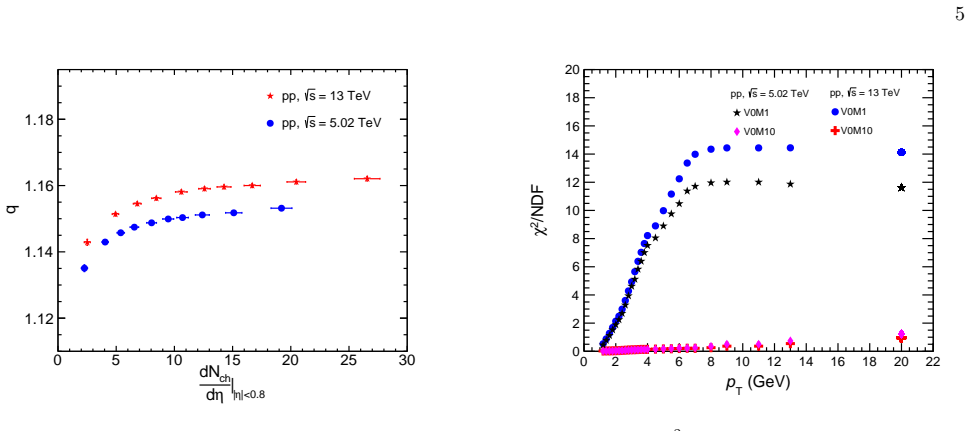
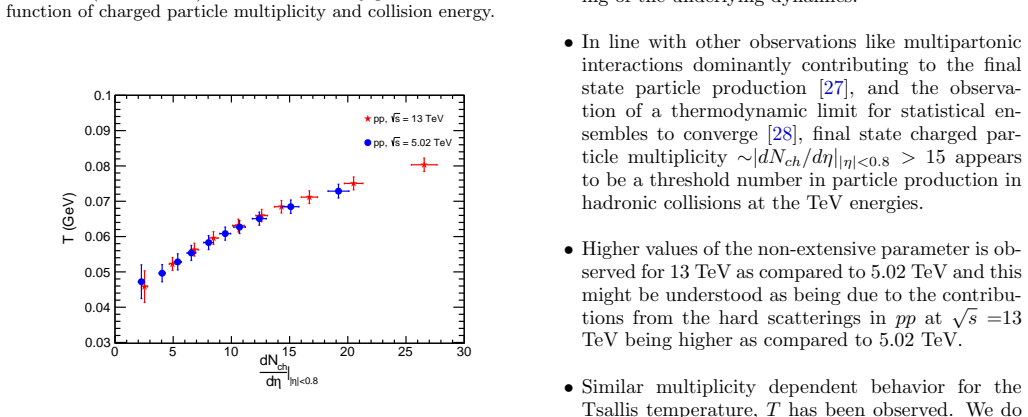
The paper's central claim is that the charged-particle $p_{T}$ spectra in $pp$ collisions at $\sqrt{s}=5.02$ and 13 TeV separate into two regimes: a bulk component below $\sim 2.5$ GeV/$c$ captured by the Boltzmann-Gibbs blast-wave model, and a full-range component captured by Tsallis non-extensive statistics. Using the thermodynamically consistent Tsallis form (with an extra power of $q$ in the exponent), the fitted $q$ rises from about 1.12 to 1.18 with multiplicity and saturates above $\mathrm{d}N_{\rm ch}/\mathrm{d}\eta \sim 15$, while the fitted temperature $T$ rises into the $\sim 0.1$ GeV range and is higher at 13 TeV. The BGBW fits yield a radial-flow velocity $\langle\beta\rangle$ that is essentially independent of collision energy and multiplicity, and a kinetic freeze-out temperature $T_{\rm kin}$ that increases with multiplicity. The paper further claims that $p_{T}\sim 8$ GeV/$c$ is a threshold: above it, $q$, $T$ and $\chi^{2}/{\rm ndf}$ saturate, and high-multiplicity fits worsen when the upper fit boundary exceeds $\sim 2$ GeV/$c$.
Load-bearing premise
The results stand or fall on the choice of the thermodynamically consistent Tsallis formula as the correct statistics for the system: if that functional form is wrong, the fitted temperatures and $q$-values are properties of the fitting function, not of the collisions.
Editorial extensions
If this is right
- At both collision energies, the Tsallis distribution tracks the measured charged-particle spectra over the full measured $p_{T}$ range in all multiplicity classes, while the BGBW model underpredicts the low-$p_{T}$ region below about 0.3 GeV/$c$, attributed to resonance decays.
- The non-extensive parameter $q$ and the Tsallis temperature $T$ both increase with charged-particle multiplicity, with $q$ saturating above $\mathrm{d}N_{\rm ch}/\mathrm{d}\eta\sim15$ and taking higher values at 13 TeV than at 5.02 TeV.
- The BGBW analysis gives a radial-flow velocity $\langle\beta\rangle$ that is almost constant across collision energy and multiplicity, and a kinetic freeze-out temperature $T_{\rm kin}$ that rises with multiplicity.
- Fitting-range scans show that $q$ and $T$ move in opposite directions for the highest (V0M1) and lowest (V0M10) multiplicity classes as the upper $p_{T}$ cutoff grows, with $p_{T}\sim8$ GeV/$c$ marking a saturation threshold; for V0M1, $\chi^{2}/{\rm ndf}$ degrades once the fit extends beyond about 2 GeV/$c$.
- Together these results support a two-component picture: the bulk of the system behaves thermally with a multiplicity-dependent freeze-out temperature, while the high-$p_{T}$ tail requires a non-extensive power-law description.
Reading between the lines
- Re-fitting the same spectra with an event-shape or jet-veto selection, as the paper itself suggests, would test whether the $q$ rise at high multiplicity comes from jet fragmentation rather than from genuine non-extensive equilibration.
- The demonstrated sensitivity of $q$ and $T$ to the upper $p_{T}$ cutoff implies that freeze-out parameters extracted with different fitting windows should not be compared directly; a fixed, pre-registered window would make cross-energy and cross-experiment comparisons cleaner.
- If the saturation threshold near $\mathrm{d}N_{\rm ch}/\mathrm{d}\eta\sim15$ is real, it gives a concrete target for multi-parton-interaction models and for future LHC Run 3 $pp$ measurements at higher multiplicities.
- Applying the BGBW fit separately to identified pions, kaons, and protons would test whether the multiplicity-independent radial flow and multiplicity-dependent $T_{\rm kin}$ persist per species, rather than only in the charged-particle sum with fixed weight factors.
Signed reviews
Editorial analysis
A structured set of objections, weighed in public.
Referee Report
Summary. The paper fits the ALICE inclusive charged-particle transverse momentum spectra in pp collisions at sqrt(s) = 5.02 and 13 TeV, in ten V0M multiplicity classes, using two functional forms: a 'thermodynamically consistent' Tsallis distribution (Sec. II A) and the Boltzmann-Gibbs Blast Wave (BGBW) model (Sec. II B). From the Tsallis fits the authors extract the non-extensive parameter q and the Tsallis temperature T as functions of charged-particle multiplicity and collision energy, and they carry out a fit-range scan for the highest and lowest multiplicity classes. From the BGBW fits to the bulk region (pT up to about 2.5 GeV/c) they extract the average radial flow <beta> and the kinetic freeze-out temperature Tkin. The main claims are that the Tsallis form describes the complete pT range better than BGBW, that q increases with multiplicity and saturates above dNch/deta around 15, that q is larger at 13 TeV than at 5.02 TeV, that T increases with multiplicity, that <beta> is almost independent of multiplicity and collision energy, and that Tkin depends clearly on multiplicity class.
Significance. If the claimed trends were quantitatively established, this would be a useful phenomenological map of freeze-out parameters across multiplicity classes in small systems, directly relevant to current discussions of collectivity and equilibration in high-multiplicity pp collisions. The paper has real strengths: it uses recent ALICE data, shows data/fit ratios in the lower panels, reports chi2/ndf values, and includes a fit-range study that is often missing from such analyses. Its main weaknesses are that the extracted parameters are presented without uncertainties and that the paper's own fit-range scan shows strong variation of q and T with the upper pT cutoff for the high-multiplicity class. The transition from 'we observe a trend' to 'the data demonstrate a property of the collision system' therefore requires error propagation and a defended choice of fit range. The paper does not provide code, parameter tables with uncertainties, or independent validation of the thermodynamic form, which limits reproducibility.
major comments (3)
- [Sec. III A, Figs. 3-7] The central multiplicity and energy trends of q and T are read from fits performed with a single upper limit of pT,max = 20 GeV/c for all classes, while the paper's own fit-range scan shows that for the high-multiplicity V0M1 class the extracted q decreases and T increases as the upper boundary is extended (Figs. 6 and 7), and chi2/ndf grows strongly above roughly pT = 2 GeV/c (Fig. 5). Because Figs. 3 and 4 show no parameter uncertainties, the reported ordering of q and T across multiplicity classes could be an artifact of the chosen fit range rather than a property of the collision system. Please report fit uncertainties and either use a common fit range in which the chi2/ndf is acceptable for all classes or demonstrate explicitly that the trends in Figs. 3 and 4 persist when the same physically motivated pT,max is used consistently.
- [Sec. II A, Eqs. (1)-(6) and (11)] The thermodynamic interpretation of q and T rests on the 'addition power of q' in Eq. (1), which is imported from the authors' own earlier papers (refs. [3,4,6]) rather than derived or independently verified here. If that form is not the correct thermostatistical normalization for the system, the fitted q and T are only shape parameters of an ad-hoc function and the abstract's thermodynamic claims do not follow. As a concrete test, please provide the derivation of Eq. (6) or a precise citation to a derivation, and perform a robustness check by fitting the same data with the standard Tsallis form (without the extra power of q) and showing whether the q and T trends and the fit-range behavior survive.
- [Sec. III B, Figs. 10-12] The BGBW conclusions that <beta> is almost independent of multiplicity and energy while Tkin depends clearly on multiplicity are stated without parameter uncertainties, so 'almost independent' cannot be distinguished from 'consistent within large errors'. In addition, the bottom panels of Figs. 8 and 9 show a systematic low-pT deviation, and the interpretation that this is due to resonance decays is not demonstrated. Please report the fit uncertainties for beta_s, <beta>, and Tkin, provide per-class chi2/ndf values, and state whether the observed Tkin variation is statistically significant relative to those uncertainties.
minor comments (4)
- [Sec. II A, after Eq. (2)] The phrase 'an addition power of q' should read 'an additional power of q'.
- [Sec. III A, Fig. 5] The ordinate label chi2/NDF is not defined; stating whether NDF is the number of data points minus the number of fit parameters would make the goodness-of-fit values interpretable.
- [Sec. IV, summary bullets] The bullet 'pT ~ 8 GeV/c ... needs a closure look' contains a typo ('closure' should be 'closer') and the claimed threshold at 8 GeV/c is not supported by a quantitative test of, for example, a change in slope or saturation.
- [Sec. II A, Eq. (8)] The pion, kaon, and proton weights (0.8, 0.12, 0.08) are stated to follow experimental yields, but no uncertainties or reference values are given; a short table of weights and the result of the pion-fraction sensitivity test would make this statement more concrete.
Circularity Check
No circular reduction: the paper's claims are fit extractions against ALICE data, and the self-cited Tsallis form is a modeling ansatz rather than a prediction derived from the data.
full rationale
The paper makes no first-principles claim: it fits ALICE pT spectra with the Tsallis form and the BGBW model, and the abstract and summary describe q, T, <beta>, and Tkin as extracted ("extract", "observed"), not predicted. The thermodynamic interpretation rests on the q-weighted Tsallis form, whose consistency is supported by refs. [3,4,6]; these are self-citations, but they provide a mathematical normalization, and the empirical fit quality and parameter trends are judged against the external ALICE data, so the central fit results do not reduce to the citations. The paper's own fit-range scan (Figs. 5-7) shows that q and T depend on the upper pT cutoff and that chi2/ndf degrades for the high-multiplicity class, which is a robustness limitation on the interpretation of T and q as physical freeze-out parameters, not a circularity. No fitted parameter is renamed as an independent prediction, and the observed T-q correlation is a property of the fit, not a prediction claimed from the ansatz. The self-citations to prior Tsallis analyses are relevant background, not an unverified uniqueness theorem, so the score is low rather than high. A higher circularity score would require the paper to claim it derives the Tsallis thermodynamics from data or to predict a quantity that is identical to a fitted parameter; neither occurs here.
Assumptions & free parameters
free parameters (6)
- q, Tsallis non-extensive parameter =
roughly 1.12 to 1.18 depending on energy and multiplicity (Figs. 3 and 6)
- T, Tsallis temperature =
roughly 0.04 to 0.14 GeV depending on multiplicity (Figs. 4 and 7)
- A, normalization of the Tsallis yield =
not tabulated; fitted per spectrum
- T_kin, BGBW kinetic freeze-out temperature =
roughly 0.03 to 0.10 GeV depending on multiplicity (Fig. 12)
- beta_s, BGBW maximum surface velocity (with n = 1 fixed) =
reported through <beta> around 0.4 to 0.9 (Fig. 11)
- Particle weights w_pi = 0.8, w_K = 0.12, w_p = 0.08 =
fixed constants
assumptions (5)
- domain assumption The thermodynamically consistent Tsallis distribution requires an additional power of q in the distribution function (Eqs. (1)-(3))
- domain assumption Chemical potential mu is zero at LHC energies
- domain assumption Charged particle spectra are dominated by pions, kaons and protons with fixed, pT-independent weights
- domain assumption Bjorken correlation y = eta holds for the BGBW integration
- domain assumption Linear radial flow profile n = 1 in BGBW
Cite this review
Pith. "Pith review of Event multiplicity, transverse momentum and energy dependence of charged particle production, and system thermodynamics in $pp$ collisions at the Large Hadron Collider." pith.science (2026). https://pith.science/paper/ZVQFGGDU
@misc{pith2026190804208,
  author       = {Pith},
  title        = {Pith review of: Event multiplicity, transverse momentum and energy dependence of charged particle production, and system thermodynamics in $pp$ collisions at the Large Hadron Collider},
  year         = {2026},
  howpublished = {\url{https://pith.science/paper/ZVQFGGDU}},
  note         = {Machine review of arXiv:1908.04208}
}
abstract
In the present work, we study the recent collision energy and multiplicity dependence of the charged particle transverse momentum spectra as measured by the ALICE collaboration in $pp$ collisions at $\sqrt{s}$ = 5.02 and 13 TeV using the non-extensive Tsallis distribution and the Boltzmann-Gibbs Blast Wave (BGBW) model. A thermodynamically consistent form of the Tsallis distribution is used to extract the kinetic freeze-out parameters from the transverse momentum spectra of charged particles at mid-rapidity. In addition, a comprehensive study of fitting range dependence of transverse momentum spectra on the freeze-out parameters is done using Tsallis statistics. The applicability of BGBW model is verified by fitting the transverse momentum spectra of the bulk part ($\sim 2.5~ {\rm GeV}/c$)for both 5.02 and 13 TeV energies and also in different multiplicity classes. The radial flow, $<\beta>$ is almost independent of collision energy and multiplicity whereas the behavior of kinetic freeze-out temperature significantly depends on multiplicity classes. It is found that the Tsallis distribution generally leads to a better description for the complete transverse momentum spectra whereas the BGBW model explains the bulk part of the system.
Figures


Figures from the paper (5 more)


Reference graph
Works this paper leans on
- [1]
- [2]
- [3]
- [4]
-
[5]
J. Cleymans, G. I. Lykasov, A. S. Parvan, A. S. Sorin, O. V. Teryaev, D. Worku, Phys. Lett. B 723 351 (2013)
work page 2013
-
[6]
M. D. Azmi, J. Cleymans, J. Phys. G 41, 065001 (2014)
work page 2014
-
[7]
C. Y. Wong and G. Wilk, Phys. Rev. D 87 , 114007 (2013)
work page 2013
-
[8]
C. Y. Wong, G. Wilk, L. J. L. Cirlo, C. Tsallis, EPJ Web Conf. 90, 04002 (2015)
work page 2015
Show all 28 references
-
[9]
G. Wilk, Z. Wlodarczyk, Physics A 413 , 53 (2014)
2014
-
[10]
G. Wilk, Z. Wlodarczyk, arXiv: 1403.3508[hep-ph]
-
[11]
Urmossy, G
K. Urmossy, G. G. Barnaf¨ oldi, S. Harangoz´ o, T. S. Bir´ o and Z. Xu, J. Phys. Conf. Ser. 805, 012010 (2017)
2017
-
[12]
Khuntia, H
A. Khuntia, H. Sharma, S. Kumar Tiwari, R. Sahoo and J. Cleymans, Eur. Phys. J. A 55, 3 (2019)
2019
-
[13]
Khuntia, S
A. Khuntia, S. Tripathy, R. Sahoo and J. Cleymans, Eur. Phys. J. A 53, 103 (2017)
2017
-
[14]
L. J. L. Cirto, C. Tsallis, C. Y. Wong, G. Wilk, arXiv:1409.3278 [hep-ph]
-
[15]
Tsallis, J
C. Tsallis, J. Stat. Phys. 52, 479 (1988)
1988
-
[16]
Bhattacharyya, J
T. Bhattacharyya, J. Cleymans, A. Khuntia, P. Pareek and R. Sahoo, Eur. Phys. J. A 52, 30 (2016)
2016
-
[17]
Bhattacharyya, P
T. Bhattacharyya, P. Garg, R. Sahoo and P. Samantray, Eur. Phys. J. A 52, 283 (2016)
2016
-
[18]
Wilk and Z
G. Wilk and Z. Wlodarczyk, Phys. Rev. Lett. 84, 2770 (2000)
2000
-
[19]
A. S. Parvan, arXiv:1910.13840 [nucl-th]
1910 arXiv
-
[20]
Acharya et al
S. Acharya et al. [ALICE Collaboration], Eur. Phys. J. C 79, 857 (2019)
2019
-
[21]
Rybczynski, Z
M. Rybczynski, Z. Wlodarczyk, Eur. Phys. J. C 74, 2785 (2014). 9
2014
-
[22]
Acharya et al
S. Acharya et al. [ALICE Collaboration], Phys. Rev. C 99, 024906 (2019)
2019
-
[23]
Schnedermann, J
E. Schnedermann, J. Sollfrank and U. W. Heinz, Phys. Rev. C 48, 2462 (1993)
1993
-
[24]
J. D. Bjorken, Phys. Rev. D 27, 140 (1983)
1983
-
[25]
Huovinen, P
P. Huovinen, P. F. Kolb, U. W. Heinz, P. V. Ruuskanen and S. A. Voloshin, Phys. Lett. B 503, 58 (2001)
2001
-
[26]
Tang et al
Z. Tang et al. , Chin. Phys. Lett. 30, 031201 (2013)
2013
-
[27]
Thakur, S
D. Thakur, S. De, R. Sahoo and S. Dansana, Phys. Rev. D 97, 094002 (2018)
2018
-
[28]
Sharma, J
N. Sharma, J. Cleymans, B. Hippolyte and M. Paradza, Phys. Rev. C 99, 044914 (2019)
2019
Reviewed August 14, 2026 · model on record in the stance chip above.
Discussion (0). Continue with ORCID to comment.