REVIEW 3 major objections 1 minor 6 references
Context-aware narrative enrichment substantially improves story rewriting alignment with reader preferences over style adaptation.
Reviewed by Pith at T0; open to challenge. T0 means a machine referee read the full paper against a public rubric. the ladder, T0–T4 →
T0 review · grok-4.3
2026-06-29 13:31 UTC pith:ZXJ7MY2Q
load-bearing objection New benchmark and GRPO-based model for story rewriting add something concrete, but the 24.5% pilot gain is not shown to transfer to the benchmark or real preferences. the 3 major comments →
StoryLens: Preference-Aligned Story Rewriting via Context-Aware Narrative Enrichment
The pith
A machine-rendered reading of the paper's core claim, the machinery that carries it, and where it could break.
Core claim
Story rewriting for preference alignment demands context-aware narrative enrichment beyond stylistic changes, demonstrated by a 24.5 percent improvement in user preference alignment from context-enhanced methods compared to 2.3 percent from style adaptation alone, enabled by STORYLENSBENCH, STORYLENSEVAL, and STORYLENSWRITER.
What carries the argument
Context-aware narrative enrichment, which incorporates structured story books and multi-dimensional reader preference profiles to guide rewriting while maintaining plot consistency.
Load-bearing premise
The pilot human study findings generalize to the large benchmark and the preference profiles accurately represent real reader preferences.
What would settle it
A follow-up study measuring reader preference alignment percentages for model outputs versus style-only baselines on the full STORYLENSBENCH dataset.
If this is right
- STORYLENSBENCH allows for large-scale testing of preference-aligned story rewrites.
- STORYLENSEVAL provides an automated way to score reader satisfaction.
- STORYLENSWRITER's combination of supervised fine-tuning and GRPO reinforcement learning yields superior results in fidelity, coherence, and satisfaction.
- The evaluation framework covers key aspects of rewritten story quality.
Where Pith is reading between the lines
- If the context enrichment approach scales, it could apply to adapting other narrative forms such as scripts or articles for individual readers.
- Explicit modeling of reader preferences might allow for more efficient creation of personalized content libraries.
- Future systems could dynamically adjust enrichment levels based on detected reader profiles.
Editorial analysis
A structured set of objections, weighed in public.
Referee Report
Summary. The paper claims that style adaptation alone yields only marginal reader satisfaction gains (2.3%) while context-enhanced rewriting improves preference alignment by 24.5% (per an unreported pilot human study); motivated by this, it introduces STORYLENSBENCH (structured stories + multi-dimensional preference profiles + ranked rewrites), STORYLENSEVAL (a reward model), and STORYLENSWRITER (SFT + GRPO RL), which outperforms baselines on fidelity, coherence, and satisfaction metrics.
Significance. If the central empirical claims hold after proper validation, the work would usefully shift focus in personalized narrative generation from surface style transfer to context-aware enrichment, and the released benchmark plus two-stage RL pipeline could serve as a reproducible testbed for future preference-aligned rewriting systems.
major comments (3)
- [Abstract] Abstract: the motivating claim that context-enhanced rewriting yields a 24.5% gain (vs. 2.3% for style adaptation) rests exclusively on an unreported pilot human study; no participant count, study protocol, preference elicitation method, or statistical significance is supplied, so it is impossible to assess whether these signals transfer to the multi-dimensional profiles in STORYLENSBENCH.
- [Evaluation framework] Evaluation framework (and § on STORYLENSWRITER training): STORYLENSEVAL is used both as the reward model inside GRPO and as the primary reader-satisfaction metric; without an independent human validation set or cross-check against the original pilot preferences, this creates a circularity risk that undermines the claim that STORYLENSWRITER improves “reader satisfaction.”
- [STORYLENSBENCH] STORYLENSBENCH construction: the paper provides no evidence that the multi-dimensional preference profiles or ranked rewrites were validated against actual reader behavior outside the pilot; the extrapolation from the pilot sample to the benchmark therefore remains an untested assumption load-bearing for the entire pipeline.
minor comments (1)
- [Abstract] Notation for STORYLENSBENCH, STORYLENSEVAL, and STORYLENSWRITER is introduced without an explicit acronym table or first-use definition, which reduces readability.
Simulated Author's Rebuttal
We appreciate the referee's insightful comments, which highlight important aspects of our evaluation and benchmark construction. We provide point-by-point responses below and indicate where revisions will be made to address the concerns.
read point-by-point responses
-
Referee: [Abstract] the motivating claim that context-enhanced rewriting yields a 24.5% gain (vs. 2.3% for style adaptation) rests exclusively on an unreported pilot human study; no participant count, study protocol, preference elicitation method, or statistical significance is supplied, so it is impossible to assess whether these signals transfer to the multi-dimensional profiles in STORYLENSBENCH.
Authors: We agree that details of the pilot human study are necessary to substantiate the motivating claim in the abstract. In the revised manuscript, we will expand the relevant section to include the participant count, study protocol, preference elicitation method, and statistical significance testing. This will clarify how the pilot results inform the preference profiles used in STORYLENSBENCH. revision: yes
-
Referee: [Evaluation framework] STORYLENSEVAL is used both as the reward model inside GRPO and as the primary reader-satisfaction metric; without an independent human validation set or cross-check against the original pilot preferences, this creates a circularity risk that undermines the claim that STORYLENSWRITER improves “reader satisfaction.”
Authors: The concern about circularity is valid given the dual use of STORYLENSEVAL. We will revise the evaluation framework to incorporate an independent human validation set consisting of new reader judgments on a held-out portion of stories. We will report the correlation between the model's scores and these human preferences to provide external validation of the satisfaction improvements. revision: yes
-
Referee: [STORYLENSBENCH] the paper provides no evidence that the multi-dimensional preference profiles or ranked rewrites were validated against actual reader behavior outside the pilot; the extrapolation from the pilot sample to the benchmark therefore remains an untested assumption load-bearing for the entire pipeline.
Authors: We acknowledge that the benchmark construction relies on the pilot without additional external validation reported. To address this, the revised paper will include results from a new validation experiment with additional readers to verify that the multi-dimensional profiles and ranked rewrites reflect actual reader preferences beyond the initial pilot sample. revision: yes
Circularity Check
No significant circularity in derivation chain
full rationale
The paper's motivation rests on an independent pilot human study (2.3% vs 24.5% gains) whose results are presented as external evidence rather than derived from the benchmark or models. STORYLENSBENCH is newly constructed with structured stories and preference profiles; STORYLENSEVAL and STORYLENSWRITER are trained on it using standard SFT + RL; evaluation uses a multi-aspect framework (fidelity, coherence, satisfaction) that does not reduce by construction to the training inputs or self-citations. No self-definitional equations, fitted inputs renamed as predictions, or load-bearing self-citation chains appear in the provided text.
Axiom & Free-Parameter Ledger
Cite this review
Pith. "Pith review of StoryLens: Preference-Aligned Story Rewriting via Context-Aware Narrative Enrichment." pith.science (2026). https://pith.science/paper/ZXJ7MY2Q
@misc{pith2026260528073,
  author       = {Pith},
  title        = {Pith review of: StoryLens: Preference-Aligned Story Rewriting via Context-Aware Narrative Enrichment},
  year         = {2026},
  howpublished = {\url{https://pith.science/paper/ZXJ7MY2Q}},
  note         = {Machine review of arXiv:2605.28073}
}
read the original abstract
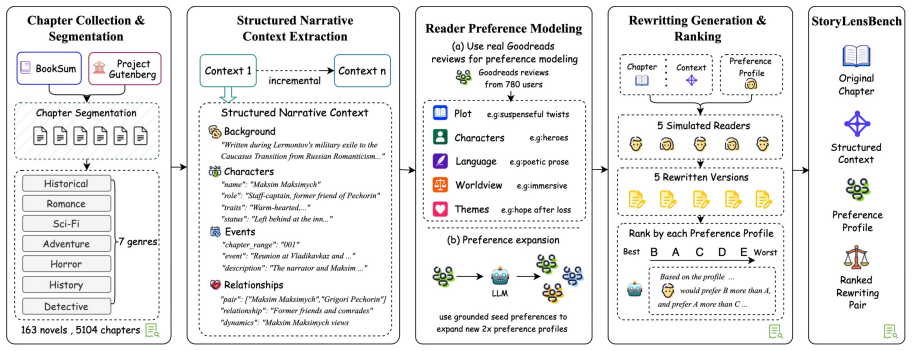
Story rewriting aims to adapt existing narratives to diverse reader preferences while preserving plot consistency and narrative coherence. Unlike conventional work on style transfer, we argue that effective story rewriting demands context-aware narrative enrichment beyond surface-level stylistic adaptation. Our pilot human study shows that style adaptation alone provides only marginal gains in reader satisfaction (2.3%), while context-enhanced rewriting substantially improves user preference alignment (24.5%). Motivated by this, we introduce STORYLENSBENCH, a large-scale benchmark for preference-aligned story rewriting, comprising structured story books, multi-dimensional reader preference profiles, and ranked context-aware rewritten stories. Building on this benchmark, we propose STORYLENSEVAL, a reward model for estimating reader satisfaction over rewritten stories, and STORYLENSWRITER, a two-stage rewriting model combining supervised fine-tuning with GRPO-based reinforcement learning. We further establish a comprehensive evaluation framework covering fidelity, coherence, and reader satisfaction. Experimental results demonstrate that STORYLENSWRITER consistently outperforms strong generation and personalization baselines, highlighting the importance of context-aware narrative enrichment for personalized story rewriting.
Figures



Reference graph
Works this paper leans on
-
[1]
arXiv preprint arXiv:2310.00785 , year=
Booookscore: A systematic exploration of book-length summarization in the era of llms.arXiv preprint arXiv:2310.00785. DeepSeek-AI, Daya Guo, and 1 others. 2025. Deepseek-r1: Incentivizing reasoning capability in llms via reinforcement learning.arXiv preprint arXiv:2501.12948. DeepSeek-AI, Aixin Liu, and 1 others. 2024. Deepseek-v3 technical report.arXiv ...
-
[2]
Word2world: Generating stories and worlds through large language models.arXiv preprint arXiv:2405.06686. Lin Ning, Luyang Liu, Jiaxing Wu, Neo Wu, Devora Berlowitz, Sushant Prakash, Bradley Green, Shawn O’Banion, and Jun Xie. 2025. User-llm: Efficient llm contextualization with user embeddings. InCom- panion Proceedings of the ACM on Web Conference 2025, ...
-
[3]
InFindings of the Association for Computational Linguistics: ACL 2025, pages 1598– 1645
A character-centric creative story generation via imagination. InFindings of the Association for Computational Linguistics: ACL 2025, pages 1598– 1645. Qwen Team. 2026. Qwen3.5-9b model card. Accessed: 2026-05-22. Alireza Salemi, Julian Killingback, and Hamed Zamani
2025
-
[4]
Alireza Salemi, Sheshera Mysore, Michael Bendersky, and Hamed Zamani
Expert: Effective and explainable evaluation of personalized long-form text generation.arXiv preprint arXiv:2501.14956. Alireza Salemi, Sheshera Mysore, Michael Bendersky, and Hamed Zamani. 2024. Lamp: When large lan- guage models meet personalization. InProceedings of the 62nd Annual Meeting of the Association for Computational Linguistics (Volume 1: Lon...
-
[5]
InProceedings of the 28th Conference on Computational Natural Language Learning, pages 400–418
Translating across cultures: Llms for intralin- gual cultural adaptation. InProceedings of the 28th Conference on Computational Natural Language Learning, pages 400–418. V olcengine. 2026. Doubao-seed-2.0: Api release an- nouncement. Accessed: 2026-05-22. Alex Wang, Kyunghyun Cho, and Mike Lewis. 2020. Asking and answering questions to evaluate the factua...
-
[6]
and GPT-5 (OpenAI, 2025a) perform better in vocabulary control, while GPT-5 achieves the lowest syntactic complexity. However, the differ- ences across models, including Claude 3.5 (An- thropic, 2024) and DeepSeek R1 (DeepSeek-AI et al., 2025), indicate that even strong LLMs still vary in satisfying fine-grained audience constraints. B.2 Pilot Study B Tab...
2024
discussion (0)
Sign in with ORCID, Apple, or X to comment. Anyone can read and Pith papers without signing in.