REVIEW 3 major objections 4 minor 23 references
Learning Sexism Detection Using Multi-Agent Perspectivist Preference Optimization
T0 review · 3 major / 4 minor · reviewed 2026-08-08 · deepseek-v4-flash
Pith's one-line read The paper argues that when annotators disagree about sexism, the disagreement is signal, not noise, and that a multi-agent system with one language model per annotator perspective can preserve it.
desk verdict The GRPO team-reward design is inert at the claimed α values, so the paper's four-setting 'team anchor' claim rests on only one setting; the DPO polarization result, however, is real and worth engaging with. read the letter →
The pith
A machine-rendered reading of the paper's core claim, the machinery that carries it, and where it could break.
The reading
What carries the argument
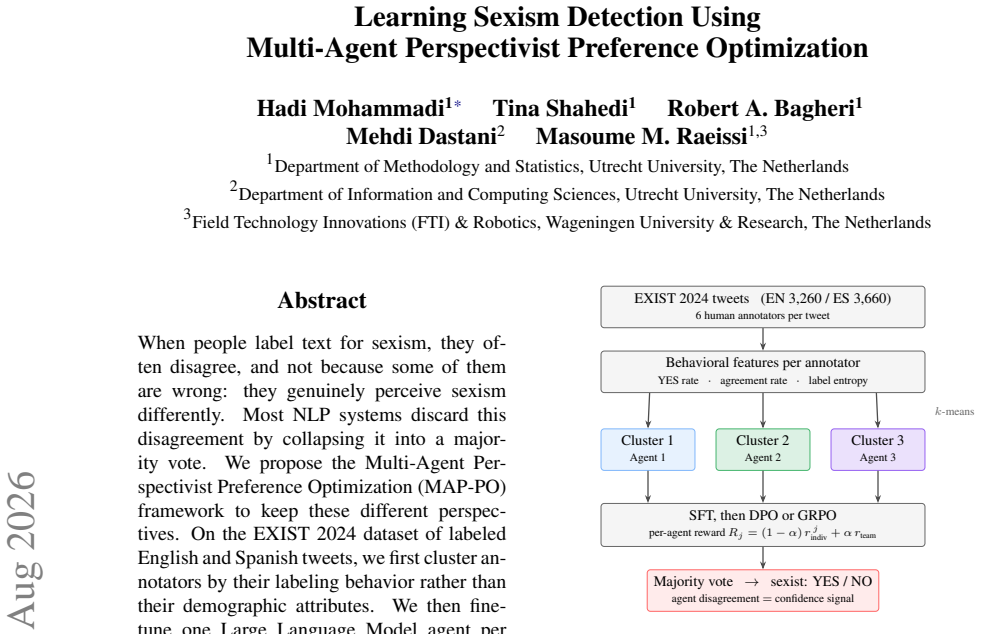
The central mechanism is the team anchor: a shared training signal that counteracts the polarizing pull of per-cluster objectives. Agents are first clustered by three behavioral features (YES rate, agreement rate, label entropy) and fine-tuned per cluster. Then preference optimization—DPO, Mars-PO, or GRPO with the convex reward $R_j = (1-\alpha) r_j^{\text{indiv}} + \alpha r_{\text{team}}$—either includes or omits team-level feedback. The comparison across variants shows that whenever the team anchor is present (shared positive examples in SFT, team preference pairs in Mars-PO, or a non-zero $\alpha$ in GRPO), agents stay near their cluster's labeling rate; without it, they collapse toward 0% or 100% YES regardless of the KL penalty $\beta$.
What would settle it
Evaluate the method on the subset of test texts where every cluster has at least two (or three) annotators, and compare GRPO and Mars-PO against DPO-only and SFT. If the calibration and Cluster F1 advantage of the team anchor shrinks or reverses on that cleaner subset, the claim that a team signal restores calibration would be called into question.
Extended reading notes
Core claim
The paper's central claim is that a 'team anchor' is necessary and sufficient to keep individually trained perspective agents faithful to their clusters. Annotators are clustered by behavioral features—YES rate, agreement rate, and label entropy—into three groups, and one agent is fine-tuned per cluster with SFT followed by either DPO, Mars-PO, or GRPO. The GRPO reward is convex: $R_j = (1-\alpha) r_j^{\text{indiv}} + \alpha r_{\text{team}}$, where the individual term rewards matching the cluster majority and the team term rewards matching the annotator majority. Across all four settings, individual-only DPO drives the low-YES cluster below 2% YES and the high-YES cluster above 95% YES, with calibration error of 18.7–25.1 percentage points, while any variant with a shared anchor—shared positive examples in SFT, team preference pairs in Mars-PO, or a non-zero team weight $\alpha$ in GRPO—keeps agents within a few points of their cluster targets. The best reported system, GRPO at $\alpha=0.17$ in the GPT-EN setting, reaches 90.3% team accuracy and 89.9 Team F1, but the paper emphasizes that the team anchor, not the headline score, is the reproducible result across all four settings.
Load-bearing premise
The evaluation assumes that each cluster's majority label on a text is the correct target for that cluster's agent, but for the smallest clusters many texts are labeled by just one annotator from that cluster, so the 'cluster majority' is often a single person's judgment, making calibration and Cluster F1 noisy.
Editorial extensions
If this is right
- A multi-agent classifier for any subjective task should include an explicit or implicit team-level objective; per-perspective losses alone will over-specialize agents.
- Agent disagreement can be reported as a confidence signal: texts where the agents split are exactly the contested texts humans disagree on.
- Fine-tuning each agent on cluster labels is necessary—zero-shot agents are essentially identical—but insufficient; the team anchor is what makes cluster-specific training usable.
- The method's success depends on behavioral clustering of annotators, which the paper shows outperforms demographic grouping for sexism detection.
Reading between the lines
- If the team-anchor principle generalizes, it suggests a design rule for other perspectivist NLP tasks (e.g., hate speech, offensive language): reward functions should combine individual faithfulness with team accuracy, and the weight $\alpha$ may need tuning per task.
- The cluster labels for Clusters 1 and 3, which often rest on a single annotator, are noisy targets; a direct test would be to re-run the comparison on texts with at least two annotators from every cluster and check whether the calibration ranking still holds.
- A testable extension is to use the agents' disagreement rate as an input to human review workflows, e.g., routing only texts with disagreement to manual moderation; the paper hints at this but does not test its operational value.
Editorial analysis
A structured set of objections, weighed in public.
Referee Report
Summary. The paper introduces MAP-PO, a multi-agent framework for preserving annotator perspectives in sexism detection. Annotators from the EXIST 2024 corpus are clustered by three behavioral features (YES rate, agreement rate, label entropy) into three clusters per language; one LLM agent is fine-tuned per cluster via SFT followed by DPO, Mars-PO, or GRPO, with a convex individual/team reward. The authors evaluate in a 2x2 design (GPT-4.1-mini vs. Qwen3-8B; English vs. Spanish) and report two central findings: first, untuned agents behave almost identically, so cluster-specific training is necessary; second, individual-only preference optimization polarizes agents beyond their clusters, while adding a shared team-level signal (implicit via data mixing, explicit via Mars-PO team pairs, or explicit via GRPO team reward) restores calibration. The best system, GRPO at alpha=0.17 in GPT-EN, reaches 90.3% team accuracy and 89.9 Team F1. The paper includes extensive diagnostics, cluster-fidelity analyses, ablations, and a candid limitations section.
Significance. If the central claims are correct, the paper makes a useful contribution to perspectivist NLP by showing how to train a small set of cluster-representative agents while preserving a coherent team prediction. The paper is commendably transparent: it reports calibration errors, agreement rates, per-cluster metrics, Wilson intervals, the small all-clusters subset, and the single-annotator limitation for some cluster targets. The experimental design is strong in that evaluation is on held-out texts and cluster/team targets are defined independently of the trained predictions. The main risk to significance is that the GRPO 'team reward' implementation, as specified in Eq. (2) and Section 4.6, appears behaviorally inert for the alpha values used in the cross-setting replication, so the claimed four-setting support for the team-anchor principle is not yet established by the data as presented.
major comments (3)
- [Section 4.6, Eq. (2); Table 10; Section 7] The GRPO keep rule R_j >= 0.5, with binary r_indiv and r_team, makes the team reward ineffective for all reported alpha < 0.5. For alpha in {0, 0.17, 0.2, 0.33}, a sample with r_indiv=0 and r_team=1 has R_j=alpha<0.5 and is discarded, while any sample with r_indiv=1 is kept regardless of r_team. Therefore the filtered training set is identical to alpha=0. The alpha=0 and alpha=0.17 and alpha=0.33 rows of Table 10 differ (89.9, 90.3, 88.6 Team Accuracy; 42.7, 43.6, 36.3 disagreement), which indicates stochastic variation rather than an effect of the team weight. Consequently, Section 6.4's claim that 'a small but non-zero team weight is optimal' is not supported, and the Section 7.2 statement that GRPO with the team-weighted reward 'pulls every agent back toward its cluster' in GPT-ES, Qwen-EN, and Qwen-ES is not supported either, because those runs use alpha=0.2 and are behaviorally equivalent to alpha=0. To test the team-signal hypothesis in GRPO, the authors need to use alpha=0.5 (where r_team can alter the kept set) or modify the filtering rule so that r_team actually influences selection; they should also report repeated-seed variability for any alpha sweep.
- [Section 5.2, Table 7, Limitations] The cluster-majority target is noisy for exactly the clusters where calibration is argued to be restored. Table 7 shows that on the English test set, 171 of 342 texts have k=1 annotator for Cluster 1 and 57 have k=1 for Cluster 3, so the 'cluster majority' is a single annotator's label for many test texts. The paper acknowledges this in the Limitations, but the calibration-error and Cluster F1 comparisons between methods (e.g., Table 8 and the Section 7.2 calibration numbers) still treat these noisy targets as ground truth. Since the central claim is that agents become 'calibrated to their clusters,' the authors should quantify the sensitivity of the calibration comparisons to this target noise—for example, by repeating the per-cluster calibration analysis on the subset of texts with k>=2 annotators in the cluster, or by reporting bounds under an assumed annotation error model. The all-clusters subset in Appendix D is a useful first step but is too small (47 non-tied English texts) to resolve this concern.
- [Section 3.2 and Appendix F] The choice of k=3 on Spanish is defensible but is a modeling assumption that the paper partly justifies by architectural symmetry with English. The silhouette criterion prefers k=2 for Spanish, and the paper instead relies on YES-rate separation and cluster-size arguments. Because the number of clusters is a free parameter that determines how many agents are trained and how 'cluster majority' targets are defined, the paper should present a sensitivity analysis over k (at least k=2 and k=4) for the main team-anchor claims, rather than only reporting the clustering ablation in Appendix F. The current Appendix F compares 3-feature vs. 2-feature clustering but does not test whether the central 'team anchor restores calibration' result is robust to k.
minor comments (4)
- [Figure 6] The legend label 'BehAv-PO SFT' is undefined and does not appear anywhere else in the paper; it should be replaced with the actual method name (e.g., 'SFT-mixed' or 'Cluster SFT').
- [Section 4.3 and Table 5] The training-data sizes per agent in Table 5 sum to more than the total training texts because a text can contain multiple clusters; a short clarifying sentence next to the table would prevent a misreading of the numbers.
- [Section 6.4, Table 10 caption] The alpha-sweep table reports Team Accuracy, F1, and disagreement, but the main text says the full results are in Appendix C (Table 10) without giving bootstrap CIs for those numbers; adding CIs to the sweep table would help readers judge whether the 0.4 pp difference between alpha=0 and alpha=0.17 is meaningful.
- [Appendix E, Table 12] The z-scores in Table 12 are useful, but the connection to the Section 7.2 statement 'mean calibration error is 2.0 pp on Qwen-EN' is not immediate; explicitly deriving calibration error from the z-score table (or vice versa) would improve traceability.
Circularity Check
The GRPO team-reward evidence reduces to individual-only selection by construction: for every reported α<0.5 the midpoint keep rule makes r_team inert, so the cross-setting 'team anchor' replication is not a test of a team signal.
-
other
[Section 4.6, Eq. (2) and midpoint keep rule; applied in Section 6.4/Table 10 and Section 7.2 (α=0.2)]
"Rj = (1−α) r_indiv + α r_team, α∈[0,1], where r_indiv = 1 if agent j’s prediction matches its cluster majority (else 0), r_team = 1 if the agent majority matches the annotator majority (else 0) ... We keep the samples whose reward reaches the midpoint of the achievable range (Rj ≥ 1/2) ... at α=0.5 (equal weight) this rule keeps a sample if either reward fires. ... GRPO at α=0.17 achieves our highest team accuracy, 90.3% ... All three settings run GRPO at α=0.2."
With binary r_indiv and r_team, for any α<0.5 the condition Rj≥1/2 is logically equivalent to r_indiv=1: if r_indiv=0, Rj≤α<1/2 even when r_team=1; if r_indiv=1, Rj≥1−α>1/2 even when r_team=0. Hence the rejection-sampling filter selects exactly the α=0 set for α∈{0,0.17,0.2,0.33}; r_team never changes which samples are kept. Table 10's differences across α=0, 0.17, and 0.33 therefore cannot be causal team-weight effects, and the Section 7.2 GRPO 'repair' runs at α=0.2 test only individual reward. The claim that 'adding a shared team-level training signal consistently keeps each agent calibrated' is thus not exercised by any GRPO run with α<0.5; the team-signal interpretation of those rows is equivalent by construction to individual-only selection.
full rationale
The paper's central claim has two independent legs in GPT-EN: SFT-mixed versus SFT-pure and Mars-PO versus DPO are genuine controlled comparisons of a shared anchor, and all methods are evaluated on held-out cluster-majority targets, which are not functions of the trained predictions. The self-citations (Mohammadi et al. 2025a,b) support background or consistency claims only and are not load-bearing. The acknowledged limitations—sparse one-annotator 'cluster majorities', label entropy as a deterministic function of YES rate, and the small all-clusters subset—are data-quality issues, not circularity. The one construction-equivalent step is the GRPO team-weight sweep: because Eq. (2) uses binary rewards and the keep rule is Rj≥1/2, every α<0.5 row is behaviorally α=0, so Table 10's 'small non-zero team weight is optimal' and Section 7.2's three-setting GRPO 'team anchor repairs calibration' do not actually involve r_team. That leaves the four-setting generalization of the team-signal finding supported only by the GPT-EN Mars-PO/SFT comparisons and by GRPO only at α=0.5, which is never used in the cross-setting runs. This is partial, not total, circularity: the GPT-EN team-anchor result is independently meaningful, and the evaluation framework itself is method-fair, but the GRPO replication arm reduces by construction to individual-only selection.
Assumptions & free parameters
free parameters (6)
- number of clusters k =
3 for both languages
- team weight alpha (GRPO) =
0.17 (GPT-EN), 0.2 (other settings)
- DPO KL weight beta =
0.1
- SFT mix percentages =
30% shared positive, 20% team-alignment
- GRPO sample count K =
8
- reward midpoint threshold =
R >= 0.5
assumptions (5)
- domain assumption EXIST 2024 annotator labels are a valid population of sexism perceptions
- domain assumption Three behavioral features (YES rate, agreement rate, label entropy) sufficiently characterize annotator perspectives
- ad hoc to paper Three clusters per language is the correct decomposition
- domain assumption Annotator majority is the appropriate team-level reference
- domain assumption Base LLMs can learn cluster-specific annotation behavior through SFT and preference optimization
Cite this review
Pith. "Pith review of Learning Sexism Detection Using Multi-Agent Perspectivist Preference Optimization." pith.science (2026). https://pith.science/paper/ZZSNSN4D
@misc{pith2026260804056,
  author       = {Pith},
  title        = {Pith review of: Learning Sexism Detection Using Multi-Agent Perspectivist Preference Optimization},
  year         = {2026},
  howpublished = {\url{https://pith.science/paper/ZZSNSN4D}},
  note         = {Machine review of arXiv:2608.04056}
}
read the original abstract
When people label text for sexism, they often disagree, and not because some of them are wrong: they genuinely perceive sexism differently. Most NLP systems discard this disagreement by collapsing it into a majority vote. We propose the Multi-Agent Perspectivist Preference Optimization (MAP-PO) framework to keep these different perspectives. On the EXIST 2024 dataset of labeled English and Spanish tweets, we first cluster annotators by their labeling behavior rather than their demographic attributes. We then fine-tune one Large Language Model agent per cluster to reproduce that cluster's annotation behavior, and coordinate the agents with preference optimization that combines individual and team-level rewards. We evaluate MAP-PO in four settings defined by two languages and two backbone language models, asking whether each agent reproduces the annotations of its own cluster and whether the agents together reproduce the majority label. Two findings hold in all four settings. First, without fine-tuning the agents behave almost identically, so cluster-specific training is necessary. Second, we show that training each agent only on the labels of its own cluster pushes the agents far beyond the clusters they should represent, while adding a shared team-level training signal consistently keeps each agent calibrated to its cluster.
Figures


Figures from the paper (7 more)


Reference graph
Works this paper leans on
-
[1]
Valerio Basile, Michael Fell, Tommaso Fornaciari, Dirk Hovy, Silviu Paun, Barbara Plank, Massimo Poesio, and Alexandra Uma. 2021. We need to consider disagreement in evaluation. In Proceedings of the 1st Workshop on Benchmarking: Past, Present and Future, pages 15--21. Association for Computational Linguistics
work page 2021
-
[2]
Kay Henning Brodersen, Cheng Soon Ong, Klaas Enno Stephan, and Joachim M Buhmann. 2010. The balanced accuracy and its posterior distribution. In 20th International Conference on Pattern Recognition (ICPR), pages 3121--3124
work page 2010
-
[3]
Paul F Christiano, Jan Leike, Tom B Brown, Miljan Martic, Shane Legg, and Dario Amodei. 2017. Deep reinforcement learning from human preferences. In Advances in Neural Information Processing Systems, volume 30
work page 2017
-
[4]
Aida Mostafazadeh Davani, Mark D \' az, and Vinodkumar Prabhakaran. 2022. Dealing with disagreements: Looking beyond the majority vote in subjective annotations. Transactions of the Association for Computational Linguistics, 10:92--110
2022
-
[5]
Mitchell L Gordon, Michelle S Lam, Joon Sung Park, Kayur Patel, Jeff Hancock, Tatsunori Hashimoto, and Michael S Bernstein. 2022. Jury learning: Integrating dissenting voices into machine learning models. In Proceedings of the 2022 CHI Conference on Human Factors in Computing Systems (CHI)
work page 2022
-
[6]
Awni Hannun, Jagrit Digani, Angelos Katharopoulos, and Ronan Collobert. 2023. MLX : Efficient and flexible machine learning on apple silicon. https://github.com/ml-explore/mlx
work page 2023
-
[7]
Edward J Hu, Yelong Shen, Phillip Wallis, Zeyuan Allen-Zhu, Yuanzhi Li, Shean Wang, Lu Wang, and Weizhu Chen. 2022. LoRA : Low-rank adaptation of large language models. In International Conference on Learning Representations (ICLR)
work page 2022
-
[8]
Soda Marem Lo and Valerio Basile. 2023. Hierarchical clustering of label-based annotator representations for mining perspectives. In Proceedings of the 2nd Workshop on Perspectivist Approaches to NLP ( NLP erspectives) . CEUR Workshop Proceedings, Vol.\ 3494
work page 2023
Show all 23 references
-
[9]
Xiaoxuan Lou, Chaojie Wang, and Bo An. 2024. Mars- PO : Multi-agent reasoning system preference optimization. arXiv preprint arXiv:2411.19039
2024 arXiv
-
[10]
Hadi Mohammadi, Anastasia Giachanou, and Ayoub Bagheri. 2023. Towards robust online sexism detection: A multi-model approach with BERT , XLM-R o BERT a, and D istil BERT for EXIST 2023 tasks. In Working Notes of the Conference and Labs of the Evaluation Forum (CLEF 2023), volu...
2023
-
[11]
Hadi Mohammadi, Anastasia Giachanou, and Ayoub Bagheri. 2024. A transparent pipeline for identifying sexism in social media: Combining explainability with model prediction. Applied Sciences, 14(19):8620
2024
-
[12]
Hadi Mohammadi, Tamas Kozak, and Anastasia Giachanou. 2025 a . Evaluating GRPO and DPO for faithful chain-of-thought reasoning in LLM s. arXiv preprint arXiv:2512.22631
2025
-
[13]
Hadi Mohammadi, Tina Shahedi, Pablo Mosteiro, Massimo Poesio, Ayoub Bagheri, and Anastasia Giachanou. 2025 b . Assessing the reliability of LLM s annotations in the context of demographic bias and model explanation. In Proceedings of the 6th Workshop on Gender Bias in Natural ...
2025
-
[14]
Laura Plaza, Jorge Carrillo-de Albornoz, Roser Morante, Enrique Amig \'o , Julio Gonzalo, and Damiano Spina. 2024. EXIST 2024: sexism identification in social networks. In Experimental IR Meets Multilinguality, Multimodality, and Interaction: Proceedings of CLEF 2024
2024
-
[15]
Laura Plaza, Jorge Carrillo-de Albornoz, Roser Morante, Enrique Amig \'o , Julio Gonzalo, Damiano Spina, and Paolo Rosso. 2023. Overview of EXIST 2023: sexism identification in social networks. In Experimental IR Meets Multilinguality, Multimodality, and Interaction: Proceedin...
2023
-
[16]
Rafael Rafailov, Archit Sharma, Eric Mitchell, Christopher D Manning, Stefano Ermon, and Chelsea Finn. 2023. Direct preference optimization: Your language model is secretly a reward model. In Advances in Neural Information Processing Systems, volume 36
2023
-
[17]
Francisco Rodr \'i guez-S \'a nchez, Jorge Carrillo-de Albornoz, and Laura Plaza. 2020. Automatic classification of sexism in social networks: An empirical study on Twitter data. IEEE Access, 8:219563--219576
2020
-
[18]
John Schulman, Filip Wolski, Prafulla Dhariwal, Alec Radford, and Oleg Klimov. 2017. Proximal policy optimization algorithms. arXiv preprint arXiv:1707.06347
2017 arXiv
-
[19]
Claude E. Shannon. 1948. A mathematical theory of communication. The Bell System Technical Journal, 27(3):379--423
1948
-
[20]
Zhihong Shao, Peiyi Wang, Qihao Zhu, Runxin Xu, Junxiao Song, Xiao Bi, Haowei Zhang, Mingchuan Zhang, YK Li, Yu Wu, and Daya Guo. 2024. DeepSeekMath : Pushing the limits of mathematical reasoning in open language models. arXiv preprint arXiv:2402.03300
2024 arXiv
-
[21]
Wentao Shi, Mengqi Yuan, Junkang Wu, Qifan Wang, and Fuli Feng. 2024. Direct multi-turn preference optimization for language agents. arXiv preprint arXiv:2406.14868
2024 arXiv
-
[22]
Alexandra N Uma, Tommaso Fornaciari, Dirk Hovy, Silviu Paun, Barbara Plank, and Massimo Poesio. 2021. Learning from disagreement: A survey. Journal of Artificial Intelligence Research, 72:1385--1470
2021
-
[23]
An Yang, Anfeng Li, Baosong Yang, Beichen Zhang, Binyuan Hui, Bo Zheng, Bowen Yu, Chang Gao, Chengen Huang, Chenxu Lv, and 1 others. 2025. Qwen3 technical report. arXiv preprint arXiv:2505.09388
2025 arXiv
Reviewed August 8, 2026 · model on record in the stance chip above.
Discussion (0). Continue with ORCID to comment.