High Energy Physics - Lattice · arXiv:hep-lat/0409118 v1 · submitted 19 Sep 2004 · 5 references
Mobius Fermions: Improved Domain Wall Chiral Fermions
The paper says
“A new class of domain wall fermions is defined that interpolates between Shamir's and Boriçi's form without increasing the number of Dirac applications per CG iteration. This class represents a full (real) Möbius transformation of the Wilson kernel.”
more of the abstract
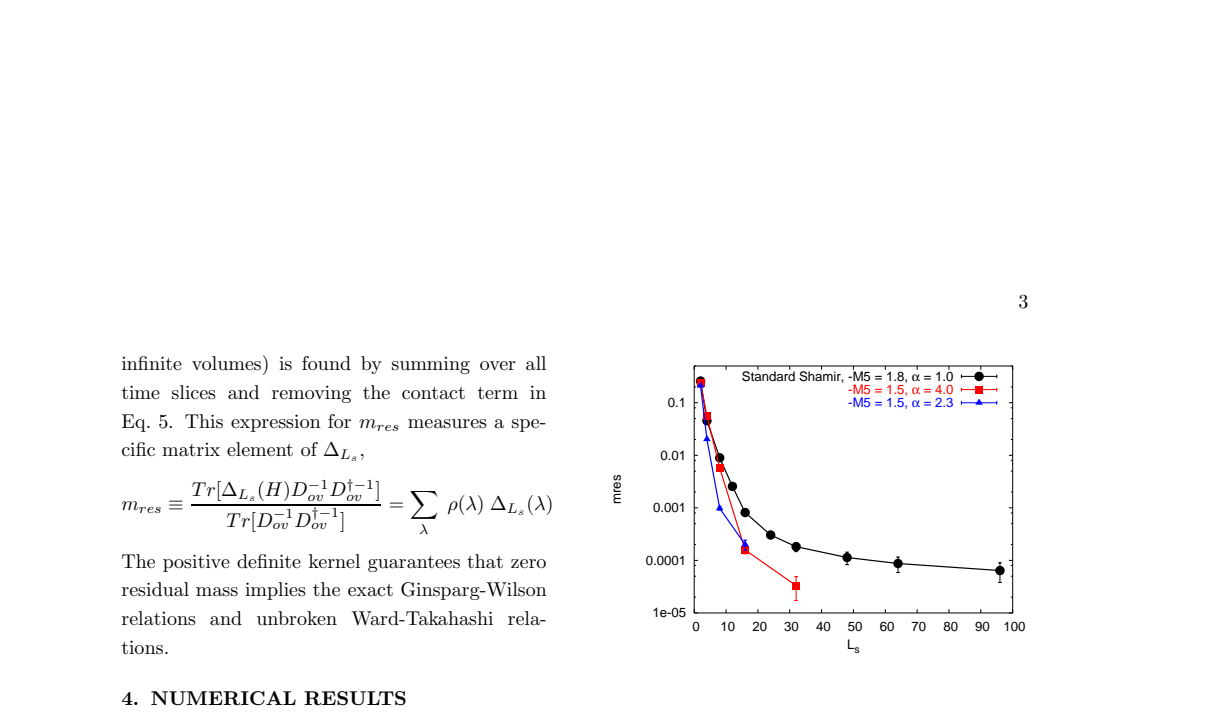
Simulations on quenched Wilson lattices with β = 6.0 show that the number of lattice sites (Ls) in the fifth dimension can be reduced by a factor of 2 or more at fixed value of chiral symmetry violations measured by the residual mass (mres).
from the abstract
Pith says
Machine review · deepseek-v4.1-flash · 13 Nov 2026 · what was read was not recorded · not checked by a person
Reviewed in 2026 with later literature in view.
It can be wrong. Challenge this review or reply to it.
Holds up, with conditions. The Möbius kernel is a real idea and worth knowing about, but the headline factor-of-two is a tuned-versus-default comparison on one quenched ensemble. This line is wrong
3 major objections · 11 minor
How often objections from reviews like this one are right: not yet measured
Not checked: figures, code, what the 5 references say.
The paper says, at Section 4 and Figure 1
The review did not quote this passage.
Pith says: Objection 1 of 3 · major
The factor-of-two claim rests on a comparison between a tuned Möbius point and what reads as an untuned Shamir baseline. Section 4 states explicitly that the Möbius parameters were optimized — 'For Ls = 8 our tests found that M5 = -1.5 is the optimal choice' and 'the optimal scale factor was α = 2.3' — whereas the Shamir curve is quoted at -M5 = 1.8 with no statement that this value was scanned or that it is near-optimal.
more of objection 1
Since mres at fixed Ls depends strongly on M5 through the spectrum of H = γ5 D(M5), an untuned Shamir point could sit well above its own minimum and inflate the apparent advantage. The comparison is fair in a5 (both operators at a5 = 1.0), so the asymmetry is confined to M5 and α, but that is precisely the axis on which the claim lives. A Shamir M5 scan at Ls = 16, reported alongside the Möbius scan, is needed before 'a factor of 2 or more' can be regarded as established rather than as a best-case-versus-default comparison.
The paper says, at Section 4 and Figure 1
The review did not quote this passage.
Pith says: Objection 2 of 3 · major
No statistical uncertainty is attached to any mres value, despite the stated use of 20 quenched configurations and despite mres being quoted down to the 10^-5 level in Figure 1. Without error bars the reader cannot judge whether the Ls = 8 Möbius point is actually coincident with the Ls = 16 Shamir point or merely nearby, nor whether the separation between the α = 2.3 and α = 4.0 curves at large Ls is significant.
more of objection 2
Relatedly, the statement that 'there appears to be a crossover at Ls = 16 for α = 4' is asserted without supporting numbers or explanation of its origin; if real, this non-monotonicity in α is interesting and should be shown and interpreted, and if it is a statistical fluctuation the reader should be told so.
The paper says, at Section 2, Eq. (4)
The review did not quote this passage.
Pith says: Objection 3 of 3 · major
The identity in Eq. (4) — that the LDU reduction of the 5-d Möbius matrix yields the polar-decomposition ǫ_Ls[H] for H = γ5 D_Möbius(M5) — is the bridge between the 5-d operator and the overlap operator, and it is stated without derivation, with the algebraic steps deferred to a forthcoming article.
more of objection 3
I appreciate that this is a proceedings and that the LDU reduction is standard, but the non-standard ingredient here is precisely the D_- conjugation required by the modified γ5-hermiticity, and the reader cannot check from the present text that the boundary operators qx and q̄y and the propagator relation in Eq. (5) follow correctly from it. A short sketch of the reduction, or at least the explicit form of the similarity transformation that removes D_-, would make the construction verifiable at proceedings length.
11 minor objections
The paper says, at Eq. (4)
Pith says: minor objection 1 of 11
The exponent in the second term of both the numerator and denominator is written as (1-H)^{-Ls/2}; the standard polar decomposition has (1-H)^{Ls/2}. This appears to be a typographical error and should be corrected, since as written the expression does not reduce to the sign function.
The paper says, at Eq. (5)
Pith says: minor objection 2 of 11
The prefactor is typeset as '11 - m'; this should presumably be 1/(1-m). Please also check the overall normalization against the definition of qx and q̄y.
show 9 more
The paper says, at Abstract and Section 4
Pith says: minor objection 3 of 11
The abstract's 'without increasing the number of Dirac applications per CG iteration' and Section 4's 'at fixed mres, the number of CG iterations increases only modestly for larger scale factors' refer to two different quantities — cost per iteration and total iteration count. The abstract phrasing could be read as a claim about total cost, which the body does not support. Please state both quantities explicitly so the cost accounting is unambiguous.
The paper says, at Section 1
Pith says: minor objection 4 of 11
The paper describes the construction as interpolating between Shamir's and Boriçi's forms, but the tuned values α = 2.3 and α = 4.0 appear to lie outside the interval spanned by those two endpoints. Please state explicitly the value of α at the Shamir limit and at the Boriçi limit (with a5 = 1 fixed), so the reader can see where the optimal point sits relative to the named limits.
The paper says, at Figure 1
Pith says: minor objection 5 of 11
No Boriçi data point is shown, even though Boriçi's operator is the natural third reference and is discussed at length in Section 1. Adding it would cost little and would substantially clarify how much of the gain comes from the Möbius extension as opposed to the choice of α alone.
The paper says, at Section 4
Pith says: minor objection 6 of 11
The statement that the new 4-d even-odd preconditioning gives 'an improvement factor of roughly 3' is quoted without any supporting timing or iteration-count data. Either show the comparison or soften the claim to a qualitative remark.
The paper says, at Section 4
Pith says: minor objection 7 of 11
The sentence 'The pion masses were adjusted so that Ls = 8 coincided with Shamir at Ls = 16' introduces a matching condition on the pion mass, whereas the abstract's claim is framed at fixed mres. Please state clearly which quantity is held fixed in the comparison and whether the two matching criteria give consistent conclusions.
The paper says, at Section 2
Pith says: minor objection 8 of 11
'Chiu's examples' are invoked without a reference. Please supply one.
The paper says, at References
Pith says: minor objection 9 of 11
References 1, 2, 3 and 5 lack page numbers, and reference 5 gives only surnames. Please complete the bibliography.
The paper says, at Acknowledgements
Pith says: minor objection 10 of 11
The second grant number is printed as 'DFFC02-94ER40818'; this is presumably DE-FC02-94ER40818.
The paper says, at Section 4
Pith says: minor objection 11 of 11
The numerical study is confined to one lattice spacing (β = 6.0), one quark mass (m = 0.06, m_pi ≈ 0.4) and the quenched approximation. Since mres is mass-dependent and the α optimization may be too, a sentence in the conclusions stating this scope explicitly would help the reader judge how far the factor-of-two expectation can be carried over to production ensembles.
What would settle it
On the same 20 quenched β=6.0 configurations, scan the Shamir M5 over the range bracketing its Aoki phases (e.g., -M5 from 1.4 to 2.0 in steps of 0.1) at Ls=16 with a5=1.0, and optionally scan a5 as well. Compare the minimum Shamir mres to the Möbius Ls=8 optimum (M5=-1.5, α=2.3). If the tuned Shamir mres falls within a factor of roughly 1.5 of the Möbius value, the quoted factor-of-two is largely a tuning artifact; if it remains a factor of roughly 2 or more below, the claim survives. Report jackknife or bootstrap errors on each mres so the comparison is statistically meaningful.
from the skeptic's reading
How the review went
4 readings by deepseek-v4.1-flash · 13 Nov 2026
- Reader holds up, with conditions
- Skeptic agrees
- Editor wrote the verdict above
- Referee major revision: 3 major objections, 11 minor
Not run on this paper: the simulated authors' defence.
Pith did not check this review's objections against the paper.
The review in full
The review in brief, machine-written
Worth your time, with one caveat about the headline number. The construction is genuinely new: they write the domain wall kernel as a general real Möbius transform of the Wilson operator, D = (b5+c5)Dw2 + (b5-c5)Dw, which contains Shamir (c5=0) and Boriçi (b5=c5) as limits and adds an independent scale alpha = b5+c5. The observation that alpha drops out at Ls = infinity by scale invariance of the sign function but matters at finite Ls is the actual insight, and it is correct. They also show the 5-d matrix still reduces to an overlap operator with the standard polar-decomposition epsilon_Ls, and they handle the modified gamma5-Hermiticity with the D_- factor and fifth-dimension reflection properly. The 4-d even-odd preconditioning trick (even-odd on each slice, not alternating in the fifth direction, so the even-even and odd-odd blocks are gauge-independent and invertible analytically) is a nice practical point that later implementations leaned on. No extra Dirac applications per CG iteration, as advertised in abstract:s0 — that is the reason anyone cared. On the soft spots: the stress-test concern lands. Section 4 says M5 = -1.5 and alpha = 2.3 were the optimal choices at Ls = 8, while the Shamir baseline sits at -M5 = 1.8 with no scan reported. So the 'factor of 2 or more' in abstract:s2 is a tuned point against a default, not a like-for-like comparison. They also state that pion masses were adjusted so Ls = 8 matched Shamir at Ls = 16, which is honest but means the match is partly arranged. No error bars on mres despite 20 lattices, so even the size of the gap is unquantified. The LDU reduction to Eq. 4 is deferred to a forthcoming article — fine for a proceedings, not fine for a journal version. The more interesting claim, that mres falls fast at large Ls with large alpha and that there is a crossover near Ls = 16, is stated with even less support than the Ls = 8 result. None of this undermines the construction; it undermines the precision of the advertised gain. Read it as a method announcement, which is what it is. It is the right paper to cite for Möbius DWF, and the direction held up. A serious referee should see it, mainly to ask for the Shamir M5 scan and error bars.
The strongest objection
The central claim (abstract:s2) is that Ls can be halved at fixed mres. Figure 1 compares three curves: Shamir at -M5=1.8, α=1.0; Möbius at -M5=1.5, α=2.3; and Möbius at -M5=1.5, α=4.0. Section 4 states the Möbius parameters were explicitly optimized: 'For Ls = 8 our tests found that M5 = -1.5 is the optimal choice' and 'the optimal scale factor was α = 2.3.' No corresponding scan of the Shamir M5 is reported; -1.8 reads as a conventional default. Because mres at fixed Ls depends strongly on M5 through the eigenvalue range of H = γ5 D(M5), an untuned Shamir baseline could sit well above its own minimum, inflating the apparent Möbius advantage. The structural argument is sound and suggests Möbius should win at finite Ls: α is a knob Shamir does not have, and it is irrelevant at Ls=∞ by scale invariance of the sign function. But the size of the win — 'a factor of 2 or more' — is exactly what a tuned-versus-default comparison cannot establish. Note that a5 is held at 1.0 for both operators, so the comparison is fair in a5; the asymmetry is confined to M5 and α. Compounding this, no error bars are shown on mres despite 20 lattices, so even the tuned-versus-default gap is not quantified statistically.
The reader's weakest_assumption identifies precisely the load-bearing soft spot: the Möbius parameters were tuned (M5=-1.5, α=2.3 at Ls=8) while the Shamir baseline at -M5=1.8 is not shown to be comparably optimized. This is the right concern because the headline number — a factor of two or more in Ls at fixed mres — is a quantitative comparison between two operators, and a tuned-versus-default comparison cannot establish its magnitude. The structural argument that α is a genuine new knob unavailable to Shamir, and irrelevant at Ls=∞, is correct and makes it plausible that Möbius wins at finite Ls; the open question is by how much. The other gaps the reader notes are real but secondary or already acknowledged. The LDU reduction to Eq. 4 is explicitly deferred by the authors ('The detailed algebraic steps will be published in a forthcoming article'), so it is an acknowledged limitation rather than a new finding, and Eq. 4 is stated explicitly enough to be checked. The absence of error bars on mres is a genuine reporting gap but is statistical rather than systematic, and it compounds rather than replaces the tuning concern. The paper's cost claim in abstract:s0 — no increase in Dirac applications per CG iteration — is supported by the 5-d structure, where D(i)± are linear in Dw, so that is not where the argument is weakest. I therefore agree with the reader's CONDITIONAL verdict and would leave it unchanged; the concern is a fair-comparison question that a targeted Shamir M5 scan would settle, not a refutation of the construction.
The referee's report
If the central claim holds, this is a practically useful result: a factor-of-two reduction in Ls at fixed chiral-symmetry violation translates directly into a factor-of-two reduction in the dominant cost of domain wall fermion simulations, obtained without adding Dirac applications per CG iteration. The construction is a genuine and economical extension of the Shamir operator — α is a knob that Shamir does not possess, and the argument that it is irrelevant at Ls = ∞ is correct — and the 4-d even-odd preconditioning trick, which keeps the even-even and odd-odd blocks gauge-field independent, is a sensible practical contribution in its own right. The paper also deserves credit for defining mres through the matrix elements of the GW breaking operator Δ_Ls rather than through an ad hoc ratio, which is the right measure and makes the comparison with Shamir meaningful in principle. The work is presented at proceedings length and the structural argument is sound; what is at issue is the strength of the numerical evidence for the size of the claimed gain.
Pith's reading of the paper (a machine's summary, not the authors')
Lattice QCD wants exact chiral symmetry at finite lattice spacing, and domain wall fermions approximate it by adding a fifth dimension of length $L_s$: the longer that dimension, the smaller the residual chiral breaking. Simulation cost grows with $L_s$, so the practical question is how short the fifth dimension can be while the breaking stays negligible. This paper argues that the standard Shamir kernel is a single point in a one-parameter family obtained by applying a real Möbius transformation to the Wilson operator, and that the new parameter $a = b_5 + c_5$ does real work at finite $L_s$ even though it cancels out of the sign function in the $L_s$ to infinity limit. On quenched lattices at $beta = 6.0$, the authors report that tuning $a$ lets $L_s = 8$ reach essentially the same residual mass as conventional Shamir at $L_s = 16$, which is where the factor-of-two saving comes from.
What carries the argument. The carrier of the argument is the five-dimensional domain wall matrix built from $D^{(i)}_+ = b_5 omega_i D_w(M_5) + 1$ and $D^{(i)}_- = c_5 omega_i D_w(M_5) - 1$, with the polar choice $omega_i = 1$ throughout. An LDU decomposition of that matrix reduces it to an effective four-dimensional overlap operator whose sign function is $epsilon_{L_s}[H] = [(1+H)^{L_s/2} - (1-H)^{L_s/2}]/[(1+H)^{L_s/2} + (1-H)^{L_s/2}]$ with Hamiltonian $H = gamma_5 D_{Mobius}(M_5)$; the chiral boundary fields $q_x = P_- Psi_{x,1} + P_+ Psi_{x,L_s}$ then reproduce the overlap propagator $langle q_x qbar_y rangle = [1/(1-m)][D_{ov}^{-1}(m) - 1]_{xy}$. The paper notes that $gamma_5$ Hermiticity now requires conjugating by $D_- = Diag[D^{(1)}_-, ..., D^{(L_s)}_-]$ together with a reflection in the fifth direction, which in turn changes the correct definition of the boundary states. Chirality violation is measured by the residual mass $m_{res} = Tr[Delta_{L_s}(H) D_{ov}^{-1} D_{ov}^{dagger -1}] / Tr[D_{ov}^{-1}D_{ov}^{dagger -1}]$, a specific matrix element of the Ginsparg-Wilson breaking term $Delta_{L_s} = (1 - epsilon_{L_s}^2)/4$, so that a vanishing residual mass implies unbroken Ginsparg-Wilson and axial Ward-Takahashi relations. Practical use also requires even-odd preconditioning, which the authors implement only on each four-dimensional slice (not alternating in the fifth direction) so that the even-even and odd-odd blocks are gauge-field independent and invertible analytically; they report roughly a factor of 3 improvement, comparable to what five-dimensional even-odd gave for Shamir. The paper defers the full algebraic steps of the decomposition to a forthcoming article and describes the numerical study as preliminary, with more detailed performance data across quenched and unquenched lattices still needed.
Core claim. The central claim is that replacing the Shamir overlap kernel $D_{Shamir}(M_5) = a_5 D_w(M_5)^2 + a_5 D_w(M_5)$ by the real Möbius kernel $D_{Mobius}(M_5) = (b_5+c_5)D_w(M_5)^2 + (b_5-c_5)D_w(M_5)$ gives a genuinely larger parameter space at no extra cost per conjugate-gradient iteration. Shamir's form is recovered by setting $b_5 = c_5 = a_5$; the new direction is the scale $a = b_5 + c_5$, which is invisible in the $L_s$ to infinity limit because the sign function satisfies $epsilon[a x] = epsilon[x]$, but which changes the finite-$L_s$ rational approximation. The authors' argument for why this helps is that a Möbius map can send three real values (for instance eigenvalues of the Wilson kernel) to arbitrary targets, so a single choice of $M_5$ can separate the physical chiral modes from doublers while simultaneously adjusting both the smallest and largest real eigenvalues entering the kernel. The evidence is a quenched study at $beta = 6.0$ on 20 configurations at bare quark mass $m = 0.06$: with $-M_5 = 1.5$ and $a = 2.3$, $L_s = 8$ gives essentially the same $m_{res}$ as Shamir at $L_s = 16$, and at larger $L_s$ the residual mass falls rapidly when large scale factors are used, with a crossover appearing at $L_s = 16$ for $a = 4$.
The premise it rests on. The factor-of-two saving rests on the assumption that the Shamir run at $-M_5 = 1.8$ is a fairly tuned reference, even though only the Möbius parameters were scanned for optimality.
If the paper is right (Pith's inferences, not the authors')
If the result holds, a fixed chiral-accuracy target costs half as many fifth-dimension sites, which cuts memory and, at fixed iteration count per site, roughly halves the dominant cost of a domain wall simulation.
Because the scale factor is a free knob rather than a fixed constant, the same code can be retuned for different lattice spacings, volumes, and quark masses without changing the operator structure or the number of Dirac applications per iteration.
At large $L_s$, where valence-quark measurements live, the residual mass falls rapidly with large scale factors, so high-precision valence physics may become affordable at fifth-dimension lengths previously considered impractical.
The construction contains Shamir and Boriçi as limits, so existing domain wall codes can be extended by adding one parameter rather than by rewriting the inverter.
The four-dimensional-slice even-odd preconditioning scheme is a reusable algorithmic ingredient for any kernel of this Möbius type, independent of the chirality claim.
The comparison would be much stronger if the Shamir baseline were tuned as carefully as the Möbius point: the paper reports an optimal scale of 2.3 at $L_s = 8$ but no corresponding scan over Shamir's $M_5$, so part of the quoted factor of two could be a tuned-versus-default comparison rather than a like-for-like one.
The mechanism suggests a broader design principle: any kernel whose finite-$L_s$ rational approximation can be reshaped by a parameter that cancels in the infinite-$L_s$ limit is a candidate for the same treatment, including overlap formulations that are not literally domain wall.
Because the advantage is largest where the spectrum of the kernel is widest, one would expect the optimal scale factor to drift with lattice spacing and volume; a table of optimal scale versus $beta$ would be the natural next artifact and would make the method usable without per-ensemble tuning.
The reported crossover at $L_s = 16$ for a scale factor of 4 hints that the optimal scale is not monotonic in $L_s$, which would mean the tuning recipe is a two-dimensional problem in $(M_5, a)$ rather than a single recommended number.
Check this review
Pith stored no record of this review's passes and took no fingerprint of it. Reviews made by code from 13 Nov 2026 on carry both.
How often reviews like this one are right
Reviews like this one: written by deepseek-v4.1-flash, where what was read was not recorded.
How often objections from reviews like this one are right: not yet measured
Reviews by people
This review was written by a machine. No person has reviewed this paper on Pith yet. A scientist listed on Pith can review it for a fee, and their review is published here whatever it concludes.
The paper
Abstract
A new class of domain wall fermions is defined that interpolates between Shamir's and Boriçi's form without increasing the number of Dirac applications per CG iteration. This class represents a full (real) Möbius transformation of the Wilson kernel. Simulations on quenched Wilson lattices with β = 6.0 show that the number of lattice sites (Ls) in the fifth dimension can be reduced by a factor of 2 or more at fixed value of chiral symmetry violations measured by the residual mass (mres).
The paper's own sentences, arranged, kept beside the review and separate from it. Each label is drawn from a closed vocabulary; the number beside it is the probability the classifier gave that label. No sentence in this record was written by a model.
abstract compiled · 2026-09-23
The authors' main claim, as the classifier picked it out 1.00
“Simulations on quenched Wilson lattices with $\beta = 6.0$ show that the number of lattice sites ($L_s$) in the fifth dimension can be reduced by a factor of 2 or more at fixed value of chiral symmetry violations measured by the residual mass ($m_{res}$).”
How the main claim is stated: asserted 1.00
What the abstract itself states, as probabilities: claims first 0.09 · states limitation 0.14 · human participants 0.01 · controlled comparison 0.39 · randomized assignment 0.01 · states quantitative result 0.97 · compares with prior results 0.91 · mentions code or data availability 0.02
The abstract, sentence by sentence
This table labels the abstract only (arXiv listing abstract v1). The number is the probability the classifier gave the label.
| Sentence | Role | The authors' own work | States the main conclusion | Strength |
|---|---|---|---|---|
| A new class of domain wall fermions is defined that interpolates between Shamir's and Bori\c{c}i's form without increasing the number of Dirac applications per CG iteration. | contribution 1.00 | 0.87 | 0.24 | asserted 1.00 |
| This class represents a full (real) M\"obius transformation of the Wilson kernel. | contribution 0.73 | 0.69 | 0.09 | asserted 1.00 |
| Simulations on quenched Wilson lattices with $\beta = 6.0$ show that the number of lattice sites ($L_s$) in the fifth dimension can be reduced by a factor of 2 or more at fixed value of chiral symmetry violations measured by the residual mass ($m_{res}$). | result 1.00 | 0.94 | 0.74 | asserted 1.00 |
What kind of paper the classifier reports this is: method or tool 0.97 · evidence from simulation or computation 1.00
What was examined, and what was not
Sources read
- arXiv listing abstract v1
Not examined
- full text
- figures and tables
- references and citing sentences
- relations to other papers
Levels run
- P abstract
Not run
- S sections
- T body sentences
- C citations
- R cross-paper relations
How the labels were made
Compiled by classifier-1.13-20260917 via OpenRouter, question bank abstract-p1-20260923, 2026-09-23: 1 request, 3,024 input tokens, $0.0001 reported.
Every quoted sentence on this record is the authors'. Every label is from Pith's closed vocabulary, with the probability shown beside it. This record as JSON
Figures (1)
Figures are the authors', reproduced from the paper.
References (5)
Cited by 14 Pith papers
Reviewed papers on Pith that cite this one. The full citation record
- Heavy physics contributions to neutrinoless double beta decay from QCD nucl-th · May 2018
- Symplectic lattice gauge theories in the Grid framework: domain wall fermions and continuum extrapolations hep-lat · Sep 2026
- Perturbative quantum electrodynamics with generalized domain wall fermions hep-lat · Jul 2026
- Reconstructing QCD Spectral Functions with Gaussian Processes hep-ph · Jul 2021
- An accurate calculation of the nucleon axial charge with lattice QCD hep-lat · Apr 2017
- Domain wall QCD with physical quark masses hep-lat · Nov 2014
- Aspects of the chiral crossover transition in (2+1)-flavor QCD with M\"{o}bius domain-wall fermions hep-lat · Nov 2024
- An update of Euclidean windows of the hadronic vacuum polarization hep-lat · Jan 2023
- The strong running coupling from the gauge sector of Domain Wall lattice QCD with physical quark masses hep-ph · Feb 2019
- The decay constants ${\mathbf{f_D}}$ and ${\mathbf{f_{D_{s}}}}$ in the continuum limit of ${\mathbf{N_f=2+1}}$ domain wall lattice QCD hep-lat · Jan 2017
- The Low Energy Constants of $SU(2)$ Partially Quenched Chiral Perturbation Theory from $N_{f}=2+1$ Domain Wall QCD hep-lat · Nov 2015
- The kaon semileptonic form factor in Nf=2+1 domain wall lattice QCD with physical light quark masses hep-lat · Apr 2015
- Neutral $B$ meson mixings and $B$ meson decay constants with static heavy and domain-wall light quarks hep-lat · Jun 2014
- A Fluctuation Theory of Topological Susceptibility hep-lat · Aug 2019
How the literature uses it
34 arXiv papers cite this in 49 sentences
Papers citing it · 22 sentences without a confident label
Builds on it 1 paper
-
Similarly to Boriçi's construction, Eq. [ref] now generalizes to [equation] and Eq. [ref] again to Eq. [ref], but now with [equation] as pointed out in Ref. [ref] .
Spectral properties and chiral symmetry violations of (staggered) domain wall fermions in the Schwinger model · Optimal construction · 0.88
Uses its method or tool 14 papers
-
In Ref. [ref] , we generated gauge ensembles with Möbius domain-wall (MDW) fermions [ref] and quantities measured on the MDW fermion ensembles are reweighted to those on overlap (OV) fermion ensembles by using the MDW/OV reweighting technique [ref] .
Axial U(1) symmetry at high temperatures in $N_f=2+1$ lattice QCD with chiral fermions · Introduction · 0.97
-
In this work, we perform lattice simulations with $2+1$-flavor dynamical Möbius domain-wall fermions [ref] with three-step stout link smearing [ref] and the tree-level Symanzik improved gauge action [ref] .
Renormalization of domain-wall bilinear operators with short-distance current correlators · Lattice Setup · 0.99
-
For the valence quarks used in this work, we employ the MDWF action [ref] , and tune the valence pseudoscalar masses to within 2% of the HISQ taste-5 pseudoscalar masses.
An accurate calculation of the nucleon axial charge with lattice QCD · Mixed action Lattice QCD · 1.00
Uses its data or values 1 paper
-
The lattice data employed in this work for the reconstruction were obtained from lattice configurations generated by the RBC/UKQCD collaboration, and firstly introduced in [ref] , with 2+1 dynamical quark flavors using the Iwasaki [ref] and domain wall fermion [ref] actions, respectively for the gauge and quark sectors, at the physical point (a pion mass amounting to 139 MeV) by the particular implementation of the Möbius kernel [ref] .
Reconstructing QCD Spectral Functions with Gaussian Processes · Lattice Simulations · 1.00
Cites it as background 7 papers
-
This work is devoted to investigating properties of the discretization effects appearing in Möbius domain-wall fermions [ref] , an extension of Shamir domain-wall fermions [ref] , at heavy quark masses.
Unphysical poles and dispersion relations for M\"obius domain-wall fermions in free field theory at finite $L_s$ · Introduction · 0.93
-
([ref]) to a four dimensional effective theory is well established in the literature, [ref] .
An exploratory study of heavy domain wall fermions on the lattice · Locality of the effective 4$d$ Dirac operator · 0.91
-
After this replacement, the Dirac operator takes the form [equation] or explicitly [equation] Moreover, the generalization of Eq. [ref] reads [equation] and the equivalent of Eq. [ref] takes the form [equation] (see Ref. [ref] ).
Theoretical and Computational Aspects of New Lattice Fermion Formulations · Boriçi's construction · 0.82
Challenges and discussion
Disagree with the review, or know something it missed? Leave a comment, or challenge this review formally: a challenge becomes a permanent entry in this paper's record, and its decision is published here.
Come back by email
A short list of the week's newly reviewed papers. Nothing is sent until you confirm from your inbox, and every email has a link that stops it. No account.
No comments yet.
Sign in to comment