High Energy Physics - Lattice · arXiv:hep-lat/0506013 v3 · submitted 10 Jun 2005 · 57 references
I=2 pi-pi Scattering from Fully-Dynamical Mixed-Action Lattice QCD
The paper says
“We compute the I=2 pi-pi scattering length at pion masses of m_pi 294, 348 and 484 MeV in fully-dynamical lattice QCD using Luscher's finite-volume method.”
more of the abstract
The calculation is performed with domain-wall valence-quark propagators on asqtad-improved MILC configurations with staggered sea quarks at a single lattice spacing, b 0.125 fm. Chiral perturbation theory is used to perform the extrapolation of the scattering length from lattice quark masses down to the physical value, and we find m_pi a_2 = -0.0426 +- 0.0006 +- 0.0003 +- 0.0018, in good agreement with experiment. The I=2 pi-pi scattering phase shift is calculated to be delta = -43 +- 10 +- 5 degrees at |p| 544 MeV for m_pi 484 MeV.
from the abstract
Pith says
Machine review · deepseek-v4.1-flash · 13 Nov 2026 · what was read was not recorded · not checked by a person
Reviewed in 2026 with later literature in view.
It can be wrong. Challenge this review or reply to it.
Holds up, with conditions. A solid first 2+1-flavor dynamical lattice calculation of the I=2 ππ scattering length; the direct lattice points are the real result, and the extrapolated precision is overstated by roughly a factor of two. This line is wrong
3 major objections · 9 minor
How often objections from reviews like this one are right: not yet measured
Not checked: figures, code, what the 57 references say.
The paper says, at §IV.B and footnote 8
The review did not quote this passage.
Pith says: Objection 1 of 3 · major
The third error in the headline result, ±0.0018, is described as an estimate of the chiral-truncation systematic, obtained by comparing the one-loop fit of Eq. (15) to two simplified two-loop fits (l(2)=l(3)=0, then l(3)=0). Footnote 8, however, reports a leading-order fit with an arbitrary coefficient A, which gives mπa2 = −0.0462 ± 0.0026 ± 0.0014 ± 0.0018, a shift of 0.0036 from the headline value — twice the quoted truncation error.
more of objection 1
As written, the reader cannot tell why the LO×A variation is excluded from the truncation estimate while the two-loop variations are included. Either the paper should justify why the LO×A ansatz is not a member of the family of reasonable extrapolations, or the truncation error should be widened to encompass the observed spread. This is load-bearing for the precision claim in the abstract, even though the central value remains consistent with the K(e4) result.
This review says the paper's mathematics is wrong. Pith did not check that against the paper's source.
The paper says, at §III.A and §IV
The review did not quote this passage.
Pith says: Objection 2 of 3 · major
The calculation is performed at a single lattice spacing with a mixed action, and the paper states that m_res ≠ 0 implies O(b) corrections that are 'exponentially suppressed with the extent of the fifth dimension and are therefore safely ignored given our current level of precision.'
more of objection 2
No quantitative bound accompanies this assertion, and the valence-sea matching is performed only to a few-per-cent precision in the pion mass (Table I). Given that the target precision on mπa2 is roughly 4%, an unquantified mixed-action systematic of this order would be comparable to the quoted truncation error. A quantitative estimate — for instance from the m_res values and L5 = 16 in Table I, or from a comparison of the domain-wall and staggered pion masses at the same parameters — would substantially strengthen the error budget. The paper acknowledges the absence of a continuum extrapolation, but the specific size of the residual mixed-action effect is not bounded.
The paper says, at §IV.B, Eq. (15), and Fig. 2
The review did not quote this passage.
Pith says: Objection 3 of 3 · major
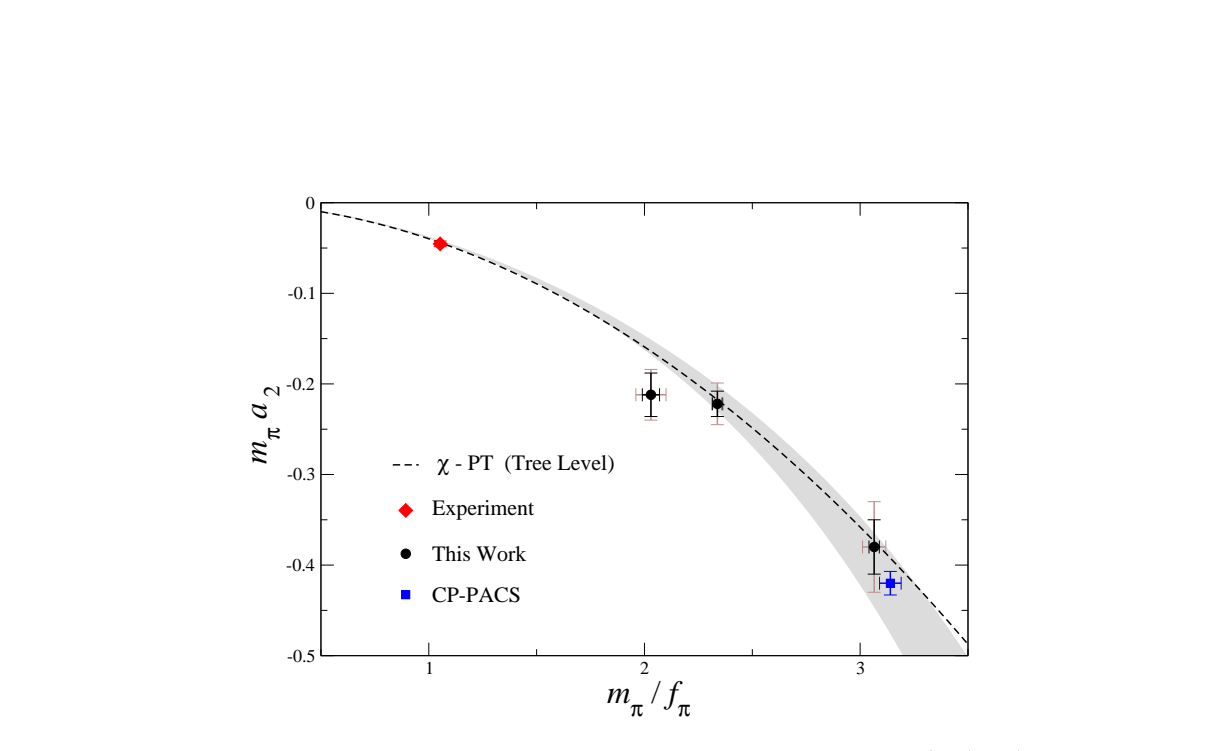
The extrapolation runs from mπ/fπ = 3.07 down to ≈ 1.04, and the data show essentially no curvature: the function C of Eq. (18) is 0.29 ± 0.16, 0.021 ± 0.067 and 0.017 ± 0.082, consistent with zero at the two lighter masses.
more of objection 3
The paper itself notes 'an almost perfect cancellation between the counterterm and the logarithm in eq. (15) in the range of mπ considered' and that 'a more refined lattice QCD calculation is required in order to detect the predicted chiral curvature.' With a single fitted parameter and no observed curvature, the extrapolated value is largely fixed by the fit ansatz rather than by the data. This is honestly acknowledged, but it should be reflected both in the error budget (see the preceding comment) and in the language: the word 'prediction' in §IV.B and §V overstates what is, in effect, an ansatz-dependent extrapolation of a one-parameter fit. A concrete remedy would be to quote the spread of the extrapolated value over an explicit family of ansätze (one-loop, the two two-loop variants, and LO×A) as the truncation error, and to describe the result as an extrapolated determination rather than a prediction.
9 minor objections
The paper says, at Abstract and §V
Pith says: minor objection 1 of 9
The abstract quotes b ≈ 0.125 fm while §V quotes b ≈ 0.127 fm, and Table II gives 12.72–12.78 × 10⁻² fm from the fπ scale setting. These should be harmonized, and the abstract should reflect the value the paper actually determines.
The paper says, at Fig. 1
Pith says: minor objection 2 of 9
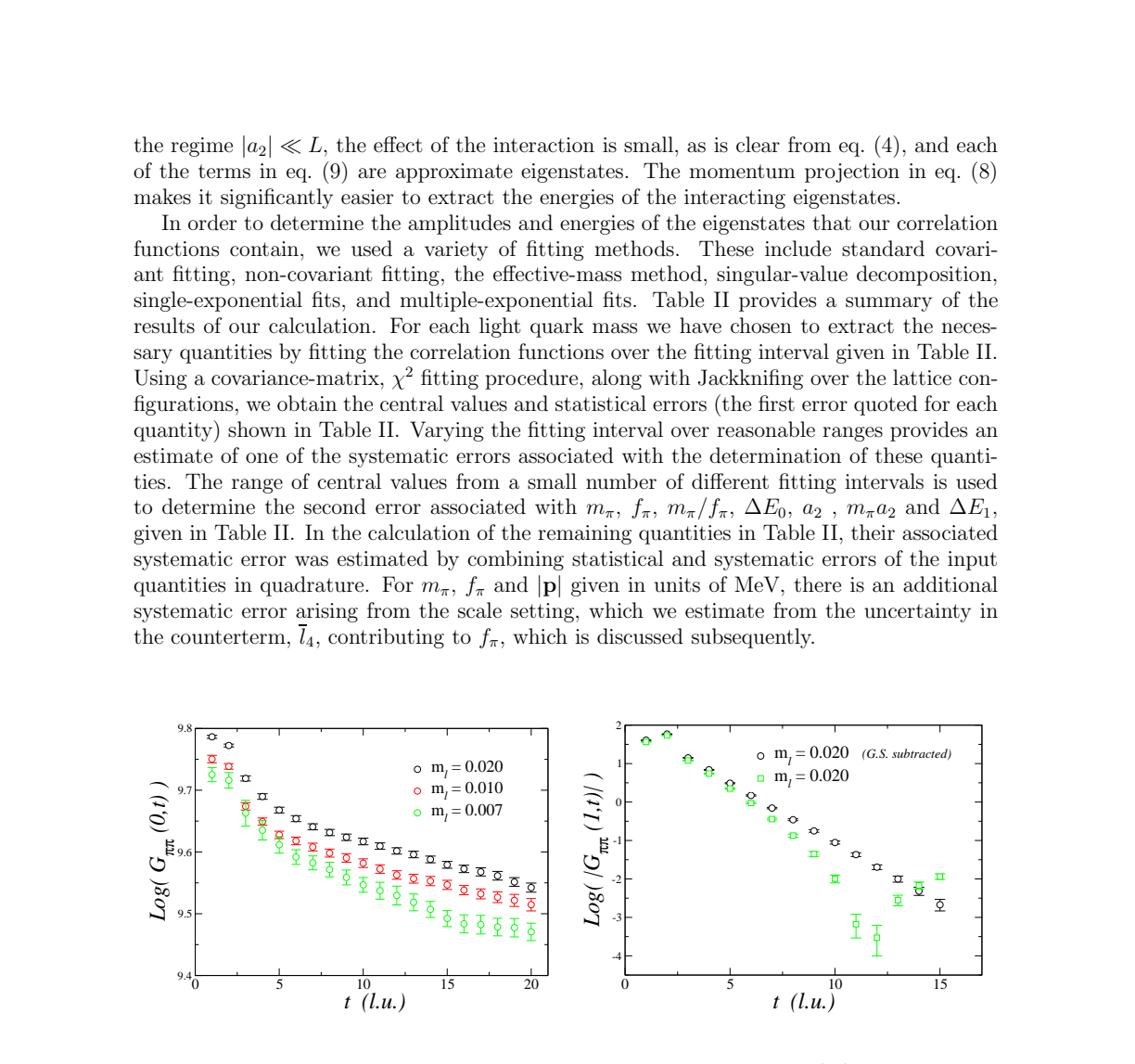
The right panel's vertical axis is labelled 'Log(|Gππ(1,t)|)' while the caption refers to Gππ(2π/L, t). The label should match the caption, and the meaning of the '(G.S. subtracted)' curve should be stated in the caption rather than only in the text.
show 7 more
The paper says, at Table II and Figs. 2–3
Pith says: minor objection 3 of 9
No χ²/d.o.f. is reported for the chiral fits to Eq. (15) or Eq. (18), although one is reported for the ΔE0 extraction. With three points and one parameter there are two degrees of freedom, and the fit quality is directly relevant to the truncation discussion. The paper should also state explicitly whether these fits are weighted by statistical errors only or by combined statistical and systematic errors.
The paper says, at Table II
Pith says: minor objection 4 of 9
The systematic uncertainty on mπ/fπ for ml = 0.007 is quoted as '±0.03' while the other two entries carry three significant digits. The entries should be given to a consistent precision.
The paper says, at Eq. (11)
Pith says: minor objection 5 of 9
The pion decay constant is computed from Eq. (11) using m_dwf and m_res, and the m_res values in Table I carry roughly 2% uncertainties. The paper should state whether these are propagated into the quoted fπ errors.
The paper says, at §IV.C and Table II
Pith says: minor objection 6 of 9
ΔE1 and |p| are tabulated for all three masses, but §IV.C explains that the phase shift can be extracted only at the heaviest mass because the first excited state lies near the four-pion inelastic threshold at the two lighter masses. The meaning of the ΔE1 entries for those two masses should be clarified, since they do not correspond to a clean ππ scattering state.
The paper says, at §IV.C
Pith says: minor objection 7 of 9
The extracted δ = −43 ± 10 ± 5° at |p| ≈ 544 MeV would be more informative if compared with the one-loop χPT prediction for the phase shift at that momentum, as a further cross-check of the same low-energy constants used in the scattering-length fit.
The paper says, at §IV.A
Pith says: minor objection 8 of 9
The statement that 'the chiral logarithm is resolved by our data at this order in the chiral expansion' is stronger than the fit quality supports; the alternative fit without the logarithm gives parameters inconsistent with l4^phy, which is suggestive but not decisive. The wording should be softened or supported with the fit quality.
The paper says, at Acknowledgments
Pith says: minor objection 9 of 9
The grant number for K.O. is printed as 'DF-FC02-94ER40818'; this appears to be a typographical error for 'DE-FC02-94ER40818'.
What would settle it
Recompute the truncation systematic as the spread over the paper's own extrapolations — one-loop eq. (15) (-0.0426), LO×A footnote 8 (-0.0462), and the simplified two-loop fits — rather than the single two-loop comparison used. If the spread exceeds ±0.0018 (it appears to be ≥0.0036), the headline error bar should be enlarged to at least ±0.0036. A stronger check: add a fourth, lighter pion mass (mπ ~ 250 MeV) and verify that the one-loop fit still describes the data and that the extrapolated value is stable against the fit form.
from the skeptic's reading
How the review went
4 readings by deepseek-v4.1-flash · 13 Nov 2026
- Reader holds up, with conditions
- Skeptic agrees
- Editor wrote the verdict above
- Referee minor revision: 3 major objections, 9 minor
Not run on this paper: the simulated authors' defence.
Pith did not check this review's objections against the paper.
The review in full
The review in brief, machine-written
Worth your time if you care about lattice determinations of χPT low-energy constants, but read it for the three direct lattice measurements, not the headline number. This is the first fully-dynamical 2+1-flavor calculation of the I=2 ππ scattering length down in the chiral regime — mπ = 294, 348, 484 MeV — using Lüscher's finite-volume method with domain-wall valence quarks on MILC asqtad configurations. That is a real step past CP-PACS's two-flavor work, and the machinery (jackknife, covariance-matrix fits, fit-range variation for systematics) is done properly. The phase shift at |p| ≈ 544 MeV, δ = −43 ± 10 ± 5°, is a genuine addition, though it is one point at one mass and nothing more can be said about it. The extraction of lππ = 3.3 ± 0.6 ± 0.3 is the useful byproduct for people doing χPT phenomenology. The soft spot is the extrapolation, and the stress-test note has it right. The data show essentially no curvature — C = 0.29, 0.02, 0.02, consistent with zero at the two lighter masses — and the authors say so plainly in §IV.B: there is 'an almost perfect cancellation between the counterterm and the logarithm.' So the fit form, not the data, is doing most of the work in getting from mπ/fπ ≈ 2–3 down to 1.04. The quoted ±0.0018 truncation error comes from comparing one-loop to simplified two-loop fits, but footnote 8's own LO×A alternative gives −0.0462, which is 0.0036 from the headline — twice the quoted truncation error. That is an internal inconsistency in the error budget, not a wrong central value. The result still sits comfortably on the K(e4) number, −0.0454 ± 0.0031, so the physics survives; the precision claim does not. Calling the extrapolated value a 'prediction' is a mild overreach, but a minor one. The other acknowledged limitations — single lattice spacing, mixed-action partial quenching not treated with the mixed-action χPT they cite in Ref. [43], heaviest mass at the chiral edge — are all stated and all fair. This deserves a serious referee, mainly to press on the error budget rather than the method. I would cite it for the lattice points and lππ.
The strongest objection
The central claim is the extrapolated value mπa2 = -0.0426 ± 0.0018 (truncation), obtained by fitting the one-loop χPT formula (eq. 15) to three points at mπ/fπ = 2.03, 2.34, 3.07 and running to mπ/fπ ≈ 1.04. The extrapolation is long (factor 2-3 in mπ) and the data show essentially no curvature: the 'curvature' function C of eq. (18) is 0.29, 0.02, 0.02, consistent with zero at the two lighter masses. The paper acknowledges (§IV.B) that 'there is an almost perfect cancellation between the counterterm and the logarithm in eq. (15),' so the fit form, not the data, largely fixes the extrapolated value. The quoted ±0.0018 truncation error is estimated by comparing the one-loop fit to simplified two-loop fits (l(2)=l(3)=0, then l(3)=0). But the paper's own footnote 8 presents an alternative LO×A fit giving mπa2 = -0.0462 ± 0.0026 ± 0.0014 ± 0.0018, which differs from the headline by 0.0036 — twice the quoted truncation error. Thus the paper's own family of reasonable extrapolations spans at least ±0.0036, not ±0.0018. This is an internal inconsistency in the error budget, not a disagreement with consensus. The central value still agrees with the K(e4) result (-0.0454 ± 0.0031), so the claim survives, but its precision is overstated.
The paper's direct lattice measurements of ΔE0 and a2 at mπ = 294, 348, 484 MeV are the solid core, and the finite-volume method (Lüscher, eqs. 1-4) is applied correctly; the <1% difference between eq. (1) and eq. (4) for a2 is stated and credible. The scale setting via fπ is cross-checked against MILC's r0-based scale and is consistent. The paper is candid about its limitations: single lattice spacing, mixed-action partial quenching not treated with the mixed-action χPT of Ref. [43], heaviest mass at the edge of the chiral regime, and the unresolved chiral curvature. The reader's weakest_assumption correctly identifies the chiral extrapolation as the load-bearing soft spot. My sharpening is that the paper's own footnote-8 alternative fit already demonstrates a spread (0.0036) twice the quoted truncation error (0.0018), so the error budget is internally inconsistent. This does not undermine the central value — which is close to the leading-order χPT prediction and agrees with experiment — but it does mean the quoted precision is overstated. CONDITIONAL remains the right verdict: the result is a genuine advance, but the extrapolated precision should be enlarged and the mixed-action χPT treatment (or a demonstration that its neglect is subdominant) would strengthen the claim. I do not see a soundness or circularity failure; the concern is a quantitative error-budget issue, not a flaw in the method.
The referee's report
If the result holds, this is the first fully-dynamical 2+1-flavor lattice determination of the I=2 ππ scattering length in the chiral regime, and it supplies a lattice determination of the next-to-leading-order constant lππ that is otherwise only estimated. The mixed-action strategy (domain-wall valence on staggered sea) is itself of methodological interest for the community. The paper is commendably transparent about its assumptions: the single lattice spacing and the absence of a continuum extrapolation are stated explicitly in §IV, the neglect of exponentially suppressed finite-volume corrections is justified through mπL ≫ 1, and the error budget is quoted as three separate contributions (statistical, fitting, chiral truncation). The cross-checks against the CP-PACS dynamical calculation [22] and against the K(e4) determination [57] are appropriate, and the comparison of the one-loop fit to simplified two-loop fits is a genuine, if heuristic, attempt to quantify truncation. The agreement of the extrapolated value with experiment is a nontrivial consistency check of the whole program.
Pith's reading of the paper (a machine's summary, not the authors')
The authors want to know whether lattice QCD, run with realistic dynamical quarks, can reproduce the strength of pion-pion scattering in the channel where the two pions carry isospin 2. That channel is the cleanest testing ground for the chiral symmetry of QCD: leading-order chiral perturbation theory makes a parameter-free prediction for the scattering length, and the corrections to it are the thing lattice data are supposed to pin down. Because a Euclidean lattice cannot give S-matrix elements directly, the authors use Lüscher's finite-volume method, in which the small shift in the energy of two pions in a box encodes their scattering length. Running at pion masses of roughly 294, 348 and 484 MeV on fully dynamical 2+1-flavor configurations, then extrapolating with the one-loop chiral formula, they obtain $m_2 a_2 = -0.0426$ with a dominant truncation uncertainty of $0.0018$, close to the measured value. If this holds, lattice QCD has for the first time delivered a controlled handle on the next-to-leading-order constant $l_{2 2}$ that governs this channel.
What carries the argument. The load-bearing device is Lüscher's finite-volume relation, $p coth 2(p) = (1/(2L)) S(p^2 L^2 / 4 2^2)$, which converts the energy of two interacting pions in a periodic box into their scattering phase shift; at small momentum it reduces to $E_0 = -4 a/(m L^3)[1 + c_1 a/L + c_2 (a/L)^2]$. The energy difference itself is isolated by forming the ratio $G_{22}(p,t) = C_{22}(p,t)/C_2(t)^2$, which cancels correlated fluctuations and behaves as a sum of exponentials in the energy shifts. The bridge from lattice masses to the physical point is the one-loop chiral expression $m_2 a_2 = -(m_2^2/8 f_2^2)[1 + (3 m_2^2/16 2^2 f_2^2)( (m_2^2/2^2) + l_{2 2})]$, with a single fitted constant $l_{2 2}$.
Core claim. The paper reports a fully dynamical lattice determination of the $I=2$ pion-pion scattering length in the chiral regime, and from it a value for the combination of next-to-leading-order chiral constants that enters that channel. The three lattice points give $m_2 a_2 = -0.212$, $-0.222$ and $-0.38$ at pion masses of about 294, 348 and 484 MeV; fitting the one-loop chiral expression to them yields $l_{2 2} = 3.3$ and, extrapolated to the physical pion mass, $m_2 a_2 = -0.0426$ with statistical, fitting and truncation errors of $0.0006$, $0.0003$ and $0.0018$. The authors also extract, at the heaviest pion mass only, the phase shift at nonzero momentum, $|p|$ around 544 MeV, finding $-43$ degrees with errors of 10 and 5 degrees. They note that the fitted counterterm and the chiral logarithm nearly cancel over the mass range they cover, so their data do not by themselves reveal the curvature the one-loop formula predicts.
The premise it rests on. The one-loop chiral formula with a single fitted constant correctly carries the scattering length from pion masses of 294 to 484 MeV down to 138 MeV, even though the authors themselves observe that the counterterm and the logarithm nearly cancel over the fitted range and that their data cannot resolve the predicted curvature.
If the paper is right (Pith's inferences, not the authors')
The $I=2$ channel acquires a lattice-anchored value of the next-to-leading-order chiral constant $l_{2 2}$, which can be inserted into chiral computations of more complex processes that are too costly to simulate directly.
The same technology transfers to the $I=0$ channel and to $K o 2 2$ amplitudes, where the relevant low-energy constants are otherwise poorly constrained.
The extracted phase shift at $|p|$ around 544 MeV gives a first nonzero-momentum check of the finite-volume machinery at these quark masses.
Because both $m_2 a_2$ and $m_2/f_2$ are dimensionless, the extrapolated scattering length carries no scale-setting uncertainty, making it a clean benchmark for future lattice calculations.
The agreement with the measured value and with the two-loop chiral prediction gives an independent consistency check on the chiral expansion of the pion-pion amplitude.
The quoted truncation error of $0.0018$ comes from comparing the one-loop fit against simplified two-loop fits with the higher constants set to zero; a genuine three-parameter two-loop fit, once enough mass points exist, could move the central value by more than that estimate rather than less.
Adding a fourth lattice ensemble near 200 MeV would do more for this channel than adding statistics at the existing masses, because it is the curvature, not the error bars, that the fit currently cannot see.
The near-cancellation the authors report between counterterm and logarithm means the same data are consistent with a family of chiral parameter sets; a determination of $l_{2 2}$ from an independent process would break the degeneracy.
The phase-shift extraction at only the heaviest mass suggests that pushing to lighter pions will require larger volumes or a dedicated multi-state variational analysis, since the first excited two-pion level crowds the four-pion threshold.
Check this review
Pith stored no record of this review's passes and took no fingerprint of it. Reviews made by code from 13 Nov 2026 on carry both.
How often reviews like this one are right
Reviews like this one: written by deepseek-v4.1-flash, where what was read was not recorded.
How often objections from reviews like this one are right: not yet measured
Reviews by people
This review was written by a machine. No person has reviewed this paper on Pith yet. A scientist listed on Pith can review it for a fee, and their review is published here whatever it concludes.
The paper
Abstract
We compute the I=2 pi-pi scattering length at pion masses of m_pi 294, 348 and 484 MeV in fully-dynamical lattice QCD using Luscher's finite-volume method. The calculation is performed with domain-wall valence-quark propagators on asqtad-improved MILC configurations with staggered sea quarks at a single lattice spacing, b 0.125 fm. Chiral perturbation theory is used to perform the extrapolation of the scattering length from lattice quark masses down to the physical value, and we find m_pi a_2 = -0.0426 +- 0.0006 +- 0.0003 +- 0.0018, in good agreement with experiment. The I=2 pi-pi scattering phase shift is calculated to be delta = -43 +- 10 +- 5 degrees at |p| 544 MeV for m_pi 484 MeV.
The paper's own sentences, arranged, kept beside the review and separate from it. Each label is drawn from a closed vocabulary; the number beside it is the probability the classifier gave that label. No sentence in this record was written by a model.
abstract compiled · 2026-09-23
The authors' main claim, as the classifier picked it out 1.00
“Chiral perturbation theory is used to perform the extrapolation of the scattering length from lattice quark masses down to the physical value, and we find m_pi a_2 = -0.0426 +- 0.0006 +- 0.0003 +- 0.0018, in good agreement with experiment.”
How the main claim is stated: asserted 1.00
What the abstract itself states, as probabilities: claims first 0.03 · states limitation 0.28 · human participants 0.01 · controlled comparison 0.04 · randomized assignment 0.01 · states quantitative result 0.99 · compares with prior results 0.82 · mentions code or data availability 0.02
The abstract, sentence by sentence
This table labels the abstract only (arXiv listing abstract v3). The number is the probability the classifier gave the label.
| Sentence | Role | The authors' own work | States the main conclusion | Strength |
|---|---|---|---|---|
| We compute the I=2 pi-pi scattering length at pion masses of m_pi ~ 294, 348 and 484 MeV in fully-dynamical lattice QCD using Luscher's finite-volume method. | contribution 0.93 | 0.97 | 0.10 | asserted 1.00 |
| The calculation is performed with domain-wall valence-quark propagators on asqtad-improved MILC configurations with staggered sea quarks at a single lattice spacing, b ~ 0.125 fm. | method 1.00 | 0.84 | 0.02 | asserted 1.00 |
| Chiral perturbation theory is used to perform the extrapolation of the scattering length from lattice quark masses down to the physical value, and we find m_pi a_2 = -0.0426 +- 0.0006 +- 0.0003 +- 0.0018, in good agreement with experiment. | result 1.00 | 0.96 | 0.79 | asserted 1.00 |
| The I=2 pi-pi scattering phase shift is calculated to be delta = -43 +- 10 +- 5 degrees at |p| ~ 544 MeV for m_pi ~ 484 MeV. | result 1.00 | 0.97 | 0.10 | asserted 1.00 |
What kind of paper the classifier reports this is: simulation study 1.00 · evidence from simulation or computation 1.00
What was examined, and what was not
Sources read
- arXiv listing abstract v3
Not examined
- full text
- figures and tables
- references and citing sentences
- relations to other papers
Levels run
- P abstract
Not run
- S sections
- T body sentences
- C citations
- R cross-paper relations
How the labels were made
Compiled by classifier-1.13-20260917 via OpenRouter, question bank abstract-p1-20260923, 2026-09-23: 1 request, 3,905 input tokens, $0.0002 reported.
Every quoted sentence on this record is the authors'. Every label is from Pith's closed vocabulary, with the probability shown beside it. This record as JSON
Figures (3)
Showing 2 of the paper's 3 figures. Figures are the authors', reproduced from the paper.
References (57)
- [43] O. Baer, C. Bernard, G. Rupak and N. Shoresh, [arXiv:hep -lat/0503009] on Pith
- [22] T. Yamazaki et al. [CP-PACS Collaboration], Phys. Rev. D 70, 074513 (2004) [arXiv:hep-lat/0402025] on PithPith's reviewarXiv
- [57] S. Pislak et al. , Phys. Rev. D 67, 072004 (2003) [arXiv:hep-ex/0301040]. 16 APPENDIX A: THE I = 2 SCA TTERING LENGTH A T TWO LOOPS To accuracy O(m6π) in χ-PT (two loops), the scattering length is given by [56] mπa2 = − m2π8πf 2π {1 − m2π8π2f 2π [2 + 16π2 B] + m4π64π4f 4π [262... on PithPith's reviewarXiv
- [1] L. Maiani and M. Testa, Phys. Lett. B 245, 585 (1990). 14 on Pith
- [2] K. Huang and C. N. Yang, Phys. Rev. 105, 767 (1957); H. W. Hamber, E. Marinari, G. Parisi and C. Rebbi, Nucl. Phys. B 225, 475 (1983); M. L¨ uscher, Commun. Math. Phys. 105, 153 (1986); M. L¨ uscher, Nucl. Phys. B 354, 531 (1991) on Pith
- [3] S. R. Sharpe, R. Gupta and G. W. Kilcup, Nucl. Phys. B 383, 309 (1992) on Pith
- [4] R. Gupta, A. Patel and S. R. Sharpe, Phys. Rev. D 48, 388 (1993) [arXiv:hep-lat/9301016] on PithPith's reviewarXiv
- [5] Y. Kuramashi, M. Fukugita, H. Mino, M. Okawa and A. Ukawa, Phys. Rev. Lett. 71, 2387 (1993) on Pith
- [6] Y. Kuramashi, M. Fukugita, H. Mino, M. Okawa and A. Ukawa, [arXiv:hep-lat/9312016] on PithPith's reviewarXiv
- [7] M. Fukugita, Y. Kuramashi, H. Mino, M. Okawa and A. Ukawa, Phys. Rev. Lett. 73, 2176 (1994) [arXiv:hep-lat/9407012] on PithPith's reviewarXiv
- [8] C. Gattringer, D. Hierl and R. Pullirsch [Bern-Graz-Reg ensburg Collaboration], Nucl. Phys. Proc. Suppl. 140, 308 (2005) [arXiv:hep-lat/0409064] on PithPith's reviewarXiv
- [9] M. Fukugita, Y. Kuramashi, M. Okawa, H. Mino and A. Ukawa, Phys. Rev. D 52, 3003 (1995) [arXiv:hep-lat/9501024] on PithPith's reviewarXiv
- [10] H. R. Fiebig, K. Rabitsch, H. Markum and A. Mihaly, Few Bo dy Syst. 29, 95 (2000) [arXiv:hep-lat/9906002] on PithPith's reviewarXiv
- [11] S. Aoki et al. [JLQCD Collaboration], Nucl. Phys. Proc. Suppl. 83, 241 (2000) [arXiv:hep-lat/9911025] on PithPith's reviewarXiv
- [12] C. Liu, J. h. Zhang, Y. Chen and J. P. Ma, [arXiv:hep-lat/ 0109010] on Pith
- [13] C. Liu, J. h. Zhang, Y. Chen and J. P. Ma, Nucl. Phys. B 624, 360 (2002) [arXiv:hep-lat/0109020] on PithPith's reviewarXiv
- [14] S. Aoki et al. [CP-PACS Collaboration], Nucl. Phys. Proc. Suppl. 106, 230 (2002) [arXiv:hep-lat/0110151] on PithPith's reviewarXiv
- [15] S. Aoki et al. [JLQCD Collaboration], Phys. Rev. D 66, 077501 (2002) [arXiv:hep-lat/0206011] on PithPith's reviewarXiv
- [16] S. Aoki et al. [CP-PACS Collaboration], Nucl. Phys. Proc. Suppl. 119, 311 (2003) [arXiv:hep-lat/0209056] on PithPith's reviewarXiv
- [17] S. Aoki et al. [CP-PACS Collaboration], Phys. Rev. D 67, 014502 (2003) [arXiv:hep-lat/0209124] on PithPith's reviewarXiv
show 37 more
- [18] K. J. Juge [BGR Collaboration], Nucl. Phys. Proc. Suppl . 129, 194 (2004) [arXiv:hep-lat/0309075] on PithPith's reviewarXiv
- [19] N. Ishizuka and T. Yamazaki, Nucl. Phys. Proc. Suppl. 129, 233 (2004) [arXiv:hep-lat/0309168] on PithPith's reviewarXiv
- [20] S. Aoki et al. [CP-PACS Collaboration], [arXiv:hep-lat/0503025] on PithPith's reviewarXiv
- [21] S. Aoki et al. [CP-PACS Collaboration], Nucl. Phys. Proc. Suppl. 140, 305 (2005) [arXiv:hep-lat/0409063] on PithPith's reviewarXiv
- [23] D. B. Kaplan, Phys. Lett. B 288, 342 (1992) [arXiv:hep-lat/9206013] on PithPith's reviewarXiv
- [24] Y. Shamir, Nucl. Phys. B 406, 90 (1993) [arXiv:hep-lat/9303005] on PithPith's reviewarXiv
- [25] V. Furman and Y. Shamir, Nucl. Phys. B 439, 54 (1995) [arXiv:hep-lat/9405004] on PithPith's reviewarXiv
- [26] H. Neuberger, Phys. Lett. B 417, 141 (1998) [arXiv:hep-lat/9707022] on PithPith's reviewarXiv
- [27] S. R. Beane, P. F. Bedaque, A. Parre˜ no and M. J. Savage, P hys. Lett. B 585, 106 (2004) [arXiv:hep-lat/0312004] on PithPith's reviewarXiv
- [28] W. Schroers et al. [LHPC collaboration], Nucl. Phys. Proc. Suppl. 129, 907 (2004) [arXiv:hep-lat/0309065]. 15 on PithPith's reviewarXiv
- [29] J. W. Negele et al. , Nucl. Phys. Proc. Suppl. 128, 170 (2004) [arXiv:hep-lat/0404005] on PithPith's reviewarXiv
- [30] D. B. Renner et al. [LHP Collaboration], Nucl. Phys. Proc. Suppl. 140, 255 (2005) [arXiv:hep-lat/0409130] on PithPith's reviewarXiv
- [31] F. D. R. Bonnet, R. G. Edwards, G. T. Fleming, R. Lewis and D. G. Richards [Lattice Hadron Physics Collaboration], [arXiv:hep-lat/0411028] on PithPith's reviewarXiv
- [32] S. D¨ urr and C. Hoelbling, Phys. Rev. D 69, 034503 (2004) [arXiv:hep-lat/0311002] on PithPith's reviewarXiv
- [33] K. C. Bowler, B. Joo, R. D. Kenway, C. M. Maynard and R. J. T weedie [UKQCD Collabora- tion], JHEP 0508, 003 (2005) [arXiv:hep-lat/0411005] on PithPith's reviewarXiv
- [34] K. Orginos, D. Toussaint and R. L. Sugar [MILC Collabora tion], Phys. Rev. D 60, 054503 (1999) [arXiv:hep-lat/9903032] on PithPith's reviewarXiv
- [35] K. Orginos and D. Toussaint [MILC collaboration], Phys . Rev. D 59, 014501 (1999) [arXiv:hep-lat/9805009] on PithPith's reviewarXiv
- [36] C. W. Bernard et al. , Phys. Rev. D 64, 054506 (2001) [arXiv:hep-lat/0104002], http://qcd.nersc.gov/ on PithPith's reviewarXiv
- [37] A. Hasenfratz and F. Knechtli, Phys. Rev. D 64, 034504 (2001) [arXiv:hep-lat/0103029] on PithPith's reviewarXiv
- [38] S. D¨ urr, C. Hoelbling and U. Wenger, Phys. Rev. D 70, 094502 (2004) [arXiv:hep-lat/0406027] on PithPith's reviewarXiv
- [39] R. G. Edwards and B. Joo [SciDAC Collaboration], [arXiv :hep-lat/0409003] on PithPith's reviewarXiv
- [40] C. Alexandrou, S. Gusken, F. Jegerlehner, K. Schilling and R. Sommer, Nucl. Phys. B 414, 815 (1994) [arXiv:hep-lat/9211042] on PithPith's reviewarXiv
- [41] S. R. Sharpe and R. J. Singleton, Phys. Rev. D 58, 074501 (1998) [arXiv:hep-lat/9804028] on PithPith's reviewarXiv
- [42] G. Rupak and N. Shoresh, Phys. Rev. D 66, 054503 (2002) [arXiv:hep-lat/0201019] on PithPith's reviewarXiv
- [44] C. W. Bernard and M. F. L. Golterman, Phys. Rev. D 53, 476 (1996) [arXiv:hep-lat/9507004] on PithPith's reviewarXiv
- [45] M. Golterman, T. Izubuchi and Y. Shamir, [arXiv:hep-la t/0504013] on Pith
- [46] C. R. Allton et al. , [arXiv:hep-lat/0504022] on PithPith's reviewarXiv
- [47] R. Sommer, Nucl. Phys. B 411, 839 (1994) [arXiv:hep-lat/9310022] on PithPith's reviewarXiv
- [48] B. Grinstein and I. Z. Rothstein, Phys. Lett. B 385, 265 (1996) [arXiv:hep-ph/9605260] on PithPith's reviewarXiv
- [49] C. Aubin et al. [MILC Collaboration], Phys. Rev. D 70, 114501 (2004) [arXiv:hep-lat/0407028] on PithPith's reviewarXiv
- [50] C. Aubin et al. , Phys. Rev. D 70, 094505 (2004) [arXiv:hep-lat/0402030] on PithPith's reviewarXiv
- [51] T. Blum et al. , Phys. Rev. D 69, 074502 (2004) [arXiv:hep-lat/0007038] on PithPith's reviewarXiv
- [52] J. Gasser and H. Leutwyler, Annals Phys. 158, 142 (1984) on Pith
- [53] G. Colangelo, J. Gasser and H. Leutwyler, Nucl. Phys. B 603, 125 (2001) [arXiv:hep-ph/0103088] on PithPith's reviewarXiv
- [54] S. Weinberg, Phys. Rev. Lett. 17, 616 (1966) on Pith
- [55] J. Bijnens, G. Colangelo, G. Ecker, J. Gasser and M. E. Sa inio, Phys. Lett. B 374, 210 (1996) [arXiv:hep-ph/9511397] on PithPith's reviewarXiv
- [56] J. Bijnens, G. Colangelo, G. Ecker, J. Gasser and M. E. Sa inio, Nucl. Phys. B 508, 263 (1997) [Erratum-ibid. B 517, 639 (1998)] [arXiv:hep-ph/9707291] on PithPith's reviewarXiv
Cited by 23 Pith papers
Reviewed papers on Pith that cite this one. The full citation record
- Nucleon-Nucleon Scattering From Fully-Dynamical Lattice QCD hep-lat · Feb 2006
- Mass and width of the lowest resonance in QCD hep-ph · Dec 2005
- Interactions of two and three mesons including higher partial waves from lattice QCD hep-lat · Jun 2021
- Finite-volume energy spectrum of the $K^-K^-K^-$ system hep-lat · Sep 2020
- Scattering of two and three physical pions at maximal isospin from lattice QCD hep-lat · Aug 2020
- Sparsening Algorithm for Multi-Hadron Lattice QCD Correlation Functions hep-lat · Aug 2019
- Machine learning action parameters in lattice quantum chromodynamics hep-lat · Jan 2018
- High Statistics Analysis using Anisotropic Clover Lattices: (III) Baryon-Baryon Interactions hep-lat · Dec 2009
- High Statistics Analysis using Anisotropic Clover Lattices: (I) Single Hadron Correlation Functions hep-lat · Mar 2009
- Light hadron spectroscopy using domain wall valence quarks on an Asqtad sea hep-lat · Jun 2008
- Nucleon Generalized Parton Distributions from Full Lattice QCD hep-lat · May 2007
- Hadron-Hadron Interactions from $N_f=2+1+1$ Lattice QCD: isospin-2 $\pi\pi$ scattering length hep-lat · Jun 2015
- Lattice QCD study of the s-wave $\pi\pi $ scattering lengths in the I=0 and 2 channels hep-lat · Mar 2013
- The Scalar Strange Content of the Nucleon from Lattice QCD hep-lat · Jan 2013
- Generalized L\"uscher Formula in Multi-channel Baryon-Meson Scattering hep-lat · Sep 2012
- Nuclear correlation functions in lattice QCD hep-lat · Jul 2012
- Extracting Scattering Phase-Shifts in Higher Partial-Waves from Lattice QCD Calculations hep-lat · Jan 2011
- Singly and Doubly Charmed J=1/2 Baryon Spectrum from Lattice QCD hep-lat · Sep 2009
- The neutral kaon mixing parameter B_K from unquenched mixed-action lattice QCD hep-lat · May 2009
- Universality of Mixed Action Extrapolation Formulae hep-lat · May 2007
- Lattice simulations for few- and many-body systems nucl-th · Apr 2008
- Multi-particle systems on the lattice and chiral extrapolations: a brief review hep-lat · Feb 2021
- Chiral perturbation theory hep-ph · Nov 2006
How the literature uses it
34 arXiv papers cite this in 68 sentences
Papers citing it · 38 sentences without a confident label
Uses its method or tool 2 papers
-
The NLO $χ$PT expression for $M_πa_0$ written as a function of $(M_π/f_π)$ at a $χ$PT renormalisation scale $μ_R=f_π,phys$ reads [ref] [equation] with $ℓ_ππ$ related to the Gasser-Leutwyler coefficients $ℓ̅_i$ as follows [ref] [equation] Moreover, one can show in Twisted mass $χ$PT that the leading lattice artefacts to $M_πa_0$ are of order $𝒪(a^2M_π^2)$ [ref] .
Hadron-Hadron Interactions from $N_f=2+1+1$ Lattice QCD: isospin-2 $\pi\pi$ scattering length · Chiral Extrapolation · 0.83
-
For each lattice ensemble, the energies $a E$ of the $ππ$ system for the $I = 0$ channel are secured from the “effective energy” plots, and chosen by looking for a combination of a “plateau” in the energy as the function of $D_min$, a good confidence level and $D_min$ large enough to suppress the excited states [ref] .
Lattice QCD study of the s-wave $\pi\pi $ scattering lengths in the I=0 and 2 channels · $I=0$ channel · 0.98
Uses its data or values 1 paper
-
We can study the size of higher order corrections by including the $m_π$ dependence of $M$, $f$ and $g_A$ (these are next-to-next-to-leading-order corrections) which is extracted from lattice data [ref] to Eqs.( [ref],[ref]).
On the Quark Mass Dependence of Two Nucleon Observables · Working in the BKV scheme as an explicit example · 1.00
Compares with it 5 papers
-
We obtain $M_πa_0 = -0.0481(86)$ (see <Ref> and recall $1/B_0 = M_πa_0$), which also agrees well with all phenomenological determinations [ref] , and other lattice results obtained indirectly by extrapolating to the physical point using ChPT [ref] , see <Ref>.
Scattering of two and three physical pions at maximal isospin from lattice QCD · Discussion · 0.98
-
These outcomes are comparable with the aforementioned results of theoretical (or phenomenological) studies [ref] , experimental determinations [ref] and lattice calculations [ref] within statistical errors.
Lattice QCD study of the s-wave $\pi\pi $ scattering lengths in the I=0 and 2 channels · $I=2$ channel · 1.00
-
The references for other determinations of the scattering length are, in order: NPLQCD2006 [ref] , NPLQCD2008 [ref] , ETMC2010 [ref] , ETMC2015 [ref] , Yagi2011 [ref] , Fu2013 [ref] , and PACS-CS2013 [ref] .
Pion scattering in the isospin I=2 channel from elongated lattices · Effective range expansion · 0.88
Cites it as support 1 paper
-
There have been several studies showing that NLO $SU(3)$ mixed-action and staggered chiral perturbation theory accurately describe the lattice discretization effects even at the rather large taste-splittings on the coarse MILC lattices [ref] .
The neutral kaon mixing parameter B_K from unquenched mixed-action lattice QCD · Chiral and continuum extrapolation of $B_K$ · 0.96
Cites it as background 11 papers
-
The infinite-volume extrapolation of the $π^+π^+$ system was the first physical application of the original Lüscher formalism, for the scattering length [ref] and extended to higher energies [ref] .
Pion scattering in the isospin I=2 channel from elongated lattices · Introduction · 0.93
-
With Lüscher's technique [ref] that relates two-pion energy in a finite box with the corresponding scattering phase shift, there have been many studies of two-pion scattering in lattice QCD at unphysical pion masses [ref] .
Isospin 0 and 2 two-pion scattering at physical pion mass using all-to-all propagators with periodic boundary conditions in lattice QCD · Introduction · 0.80
-
Fully-dynamical computation of the $I=2$ $ππ$ scattering was explored by NPLQCD with the domain-wall valence quarks on a fourth-rooted staggered sea quarks [ref] .
Lattice QCD study of the s-wave $\pi\pi $ scattering lengths in the I=0 and 2 channels · Introduction · 0.93
Challenges and discussion
Disagree with the review, or know something it missed? Leave a comment, or challenge this review formally: a challenge becomes a permanent entry in this paper's record, and its decision is published here.
Come back by email
A short list of the week's newly reviewed papers. Nothing is sent until you confirm from your inbox, and every email has a link that stops it. No account.
No comments yet.
Sign in to comment