High Energy Physics - Lattice · arXiv:hep-lat/0611017 v1 · submitted 13 Nov 2006 · 57 references
Quarkonium correlators and spectral functions at zero and finite temperature
The paper says
“We study quarkonium correlators and spectral functions at zero and finite temperature using the anisotropic Fermilab lattice formulation with anisotropy xi=2 and 4. To control cutoff effects we use several different lattice spacings.”
more of the abstract
The spectral functions were extracted from lattice correlators with Maximum Entropy Method based on a new algorithm. We find evidence for the survival of 1S quarkonium states in the deconfined medium till relatively high temperatures as well as for dissolution of 1P quarkonium states right above the deconfinement temperature.
from the abstract
Pith says
Machine review · deepseek-v4.1-flash · 13 Nov 2026 · what was read was not recorded · not checked by a person
Reviewed in 2026 with later literature in view.
It can be wrong. Challenge this review or reply to it.
Holds up, with conditions. Solid correlator-level lattice work with a new MEM algorithm; the abstract's flat 1P dissolution claim outruns what the body actually shows. This line is wrong
3 major objections · 10 minor
How often objections from reviews like this one are right: not yet measured
Not checked: figures, code, what the 57 references say.
The paper says, at Abstract (abstract:s3) vs. Sections VI.B, VII.B, X
The review did not quote this passage.
Pith says: Objection 1 of 3 · major
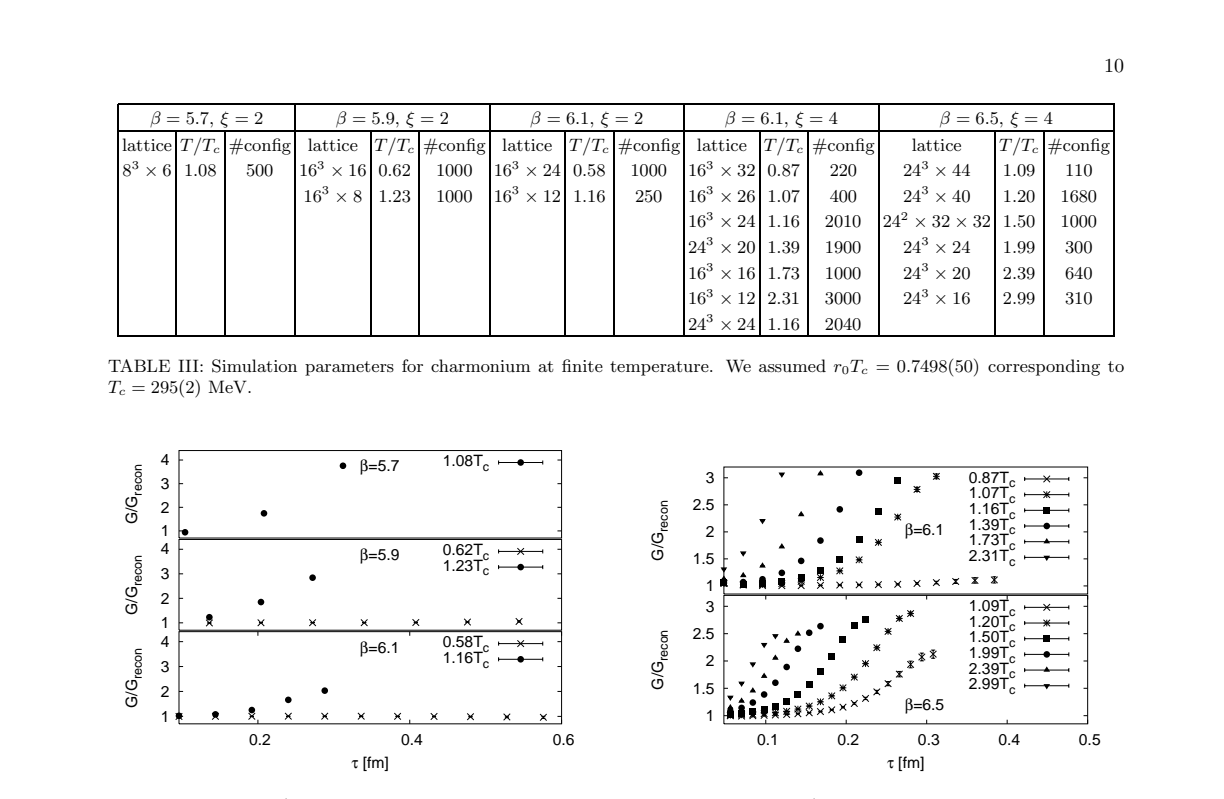
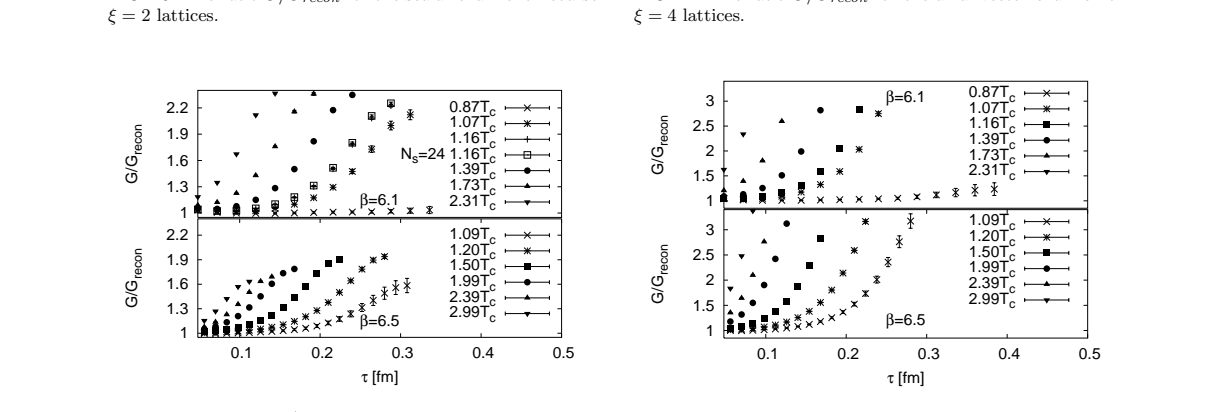
The abstract states as a finding the 'dissolution of 1P quarkonium states right above the deconfinement temperature', but the body supports only a weaker statement. Section VI.B says the scalar/axial/tensor enhancement 'indicates strong modification ... and, possibly the dissolution of 1P charmonia states', and Section VI.B also reports that 'the magnitude of the enhancement is largest on the coarsest lattice …
more of objection 1
… and decreases with decreasing lattice spacing' and that 'the cutoff dependence of G/G_recon is larger in the scalar channel than in the pseudo-scalar one' (Figs. 10, 11). A signal that shrinks toward the continuum limit cannot by itself ground a flat dissolution claim. Furthermore, Section X raises, for the bottomonium P-states and citing Ref. [11], exactly the alternative mechanism that is channel-generic and not excluded here: the change 'may be due to the modification of the continuum part of the spectral functions and not to the dissolution or strong modification of the ground state'. Finally, Section VII.B reports that for most default models P[α|D_m] has multiple maxima in the P-wave channels, so the finite-T P-wave spectral functions are not under control. I ask that the abstract be reworded to match the body (strong modification of 1P correlators, consistent with dissolution), and that a sentence be added quantifying how the scalar enhancement at fixed T/T_c trends across β = 5.7, 5.9, 6.1, 6.5.
The paper says, at Section VI.C and Fig. 15
The review did not quote this passage.
Pith says: Objection 2 of 3 · major
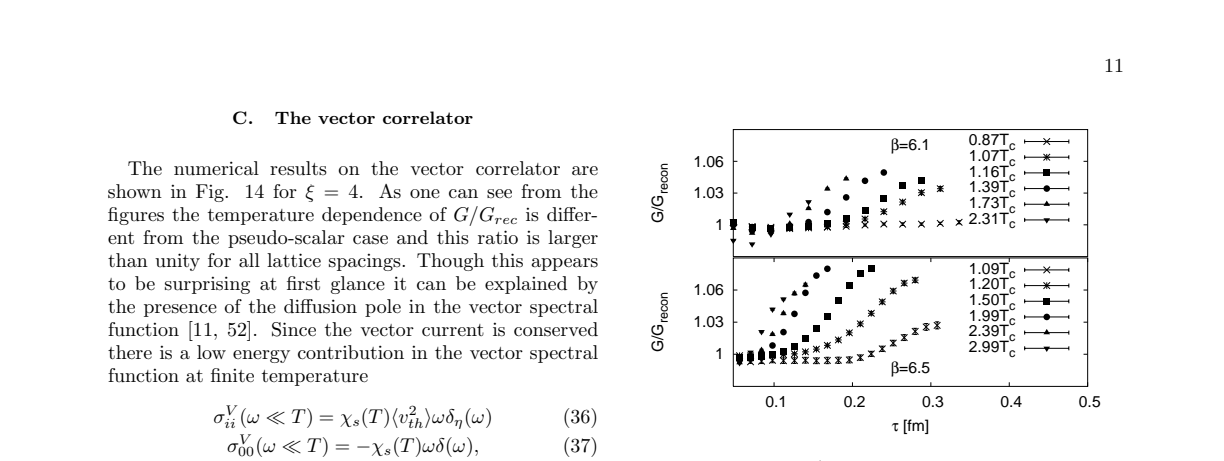
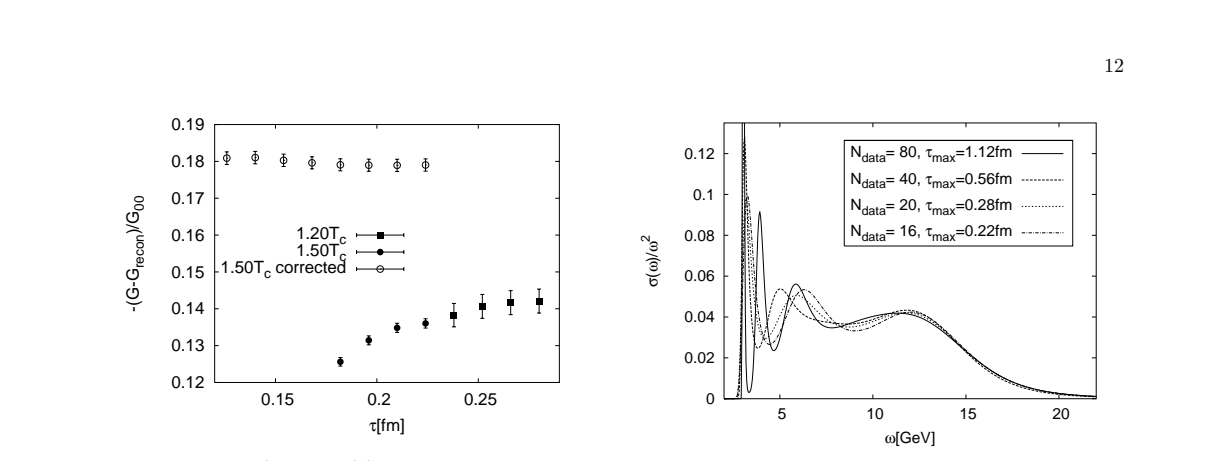
The 'corrected' points in Fig. 15 at 1.5 T_c are obtained by lowering the amplitude of the first peak in the zero-temperature spectral function by 7%, a number chosen so that G/G_recon in the pseudoscalar channel returns to approximately unity.
more of objection 2
The extracted values ⟨v²_th⟩ ≃ 0.13 at 1.2 T_c and ≃ 0.18 at 1.5 T_c therefore depend on that tuning, and the conclusion in Section XI that the paper identifies 'the transport contribution in the vector correlators for the first time' inherits that dependence. Please show the sensitivity explicitly, for example by repeating the construction with 0%, 7% and 15% amplitude reduction and quoting the spread in ⟨v²_th⟩, and state in the text that the quoted values are conditional on the correction. The statement that a non-zero η would produce curvature 'within present systematic uncertainties' should be tied to that same spread.
The paper says, at Section VII and Fig. 17 / Fig. 31
The review did not quote this passage.
Pith says: Objection 3 of 3 · major
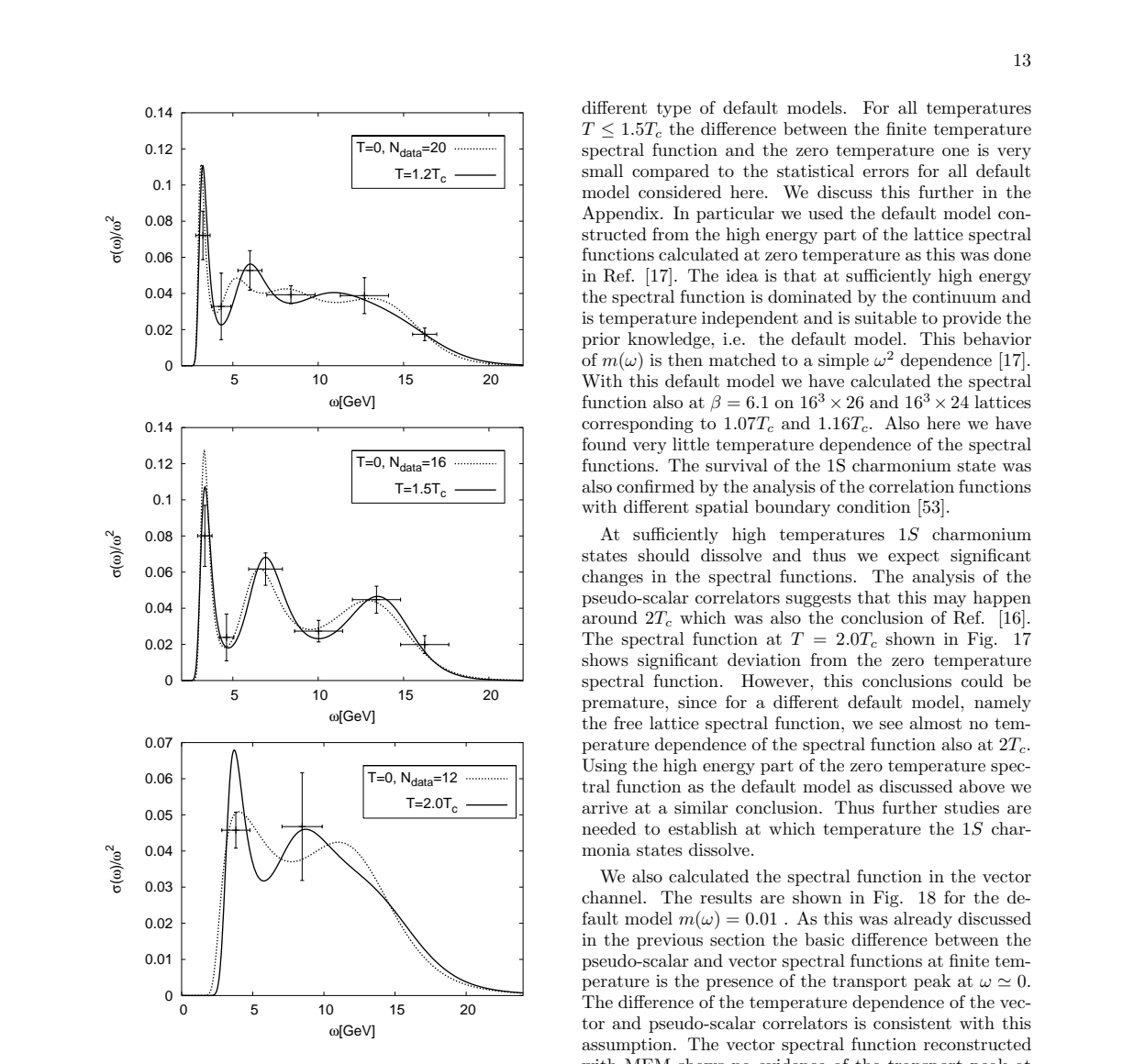
The upper end of the 1S survival claim is default-model dependent and the abstract does not say so. Section VII states that at T = 2.0 T_c the pseudoscalar spectral function 'shows significant deviation from the zero temperature spectral function' for m(ω) = 1, but that 'for a different default model, namely the free lattice spectral function, we see almost no temperature dependence of the spectral function also at 2 T_c'.
more of objection 3
The abstract's 'till relatively high temperatures' is therefore unquantified. Since Section XI correctly notes that the default-model independence of the small temperature dependence holds only up to 1.5 T_c, please state that number in the abstract or conclusions and say explicitly that the 2 T_c behaviour is not resolved. This is a small textual change but it is the difference between a bounded claim and an open-ended one.
10 minor objections
The paper says, at Fig. 17 caption vs. panel label
Pith says: minor objection 1 of 10
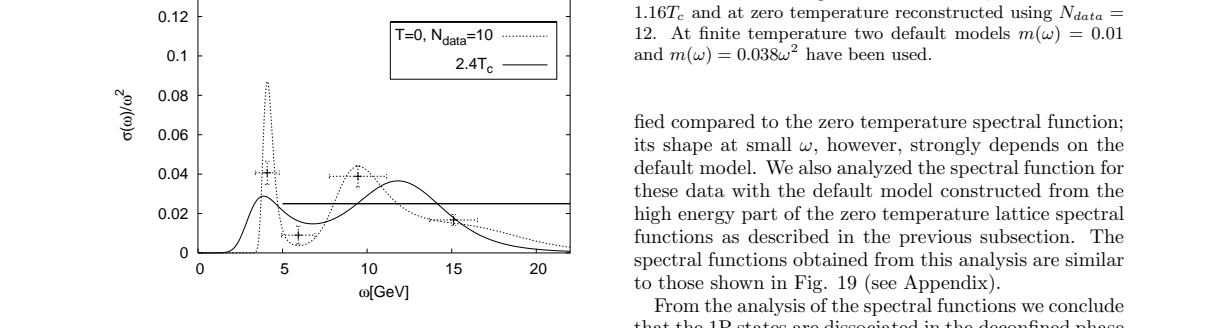
The caption describes the three panels as N_t = 40, 32, 20 corresponding to 1.2 T_c, 1.5 T_c and 2.4 T_c, while the third panel is labelled T = 2.0 T_c and the surrounding text discusses 2.0 T_c. Please reconcile the caption, the panel label and the text.
The paper says, at Table V and Figs. 23–24
Pith says: minor objection 2 of 10
Figs. 23 and 24 show a 2.49 T_c data set at β = 5.9 that does not appear in Table V, and Table V lists two distinct β = 5.9 entries both at 1.66 T_c (8³×12 and 8³×8). Please make the table and the figures consistent and state which configuration set each curve uses.
show 8 more
The paper says, at Table II and Section V.A
Pith says: minor objection 3 of 10
The column header reads 'N 2s × Nt' and the β = 6.5 entry reads '24 2 × 32 × 160', while Section V.A refers to a '24 2 × 32 × 160 lattice at β = 6.5'. Please give the lattice geometry in standard N_s³ × N_t form so that the reader can tell whether this is 24³×160 or something else.
The paper says, at Section IV and Table IV, Ref. [46]
Pith says: minor objection 4 of 10
The anisotropy parameters ξ_0 and the Sommer-scale values r_0/a used for scale setting at β = 5.9 and 6.1 are taken from Ref. [46], which is listed as unpublished. Since the entire temperature axis of Tables III and V depends on these numbers, please tabulate the values used or point to a publicly available source.
The paper says, at Table VII and Figs. 2, 5–7
Pith says: minor objection 5 of 10
The renormalization constants Z_H are described as ad hoc, chosen so that the continuum part of the spectral function roughly matches its free value at large ω. This is disclosed, which is fine, but it means the cross-spacing comparisons in Figs. 2, 5–7 are not reproducible from the paper alone. A sentence stating that the comparison across lattice spacings is qualitative because of this would help.
The paper says, at Fig. 2 and Fig. 5
Pith says: minor objection 6 of 10
The horizontal line labelled 'the spectral function in the free massless limit' should carry its numerical value in the σ/ω² units of the plot, so that the reader can judge the approach to the continuum curve without consulting Ref. [24].
The paper says, at Eqs. (36)–(39)
Pith says: minor objection 7 of 10
Please check the normalization and dimensions in Eqs. (36)–(39): the smeared delta δ_η(ω) = (1/π) η/(ω² + η²) should integrate to unity, and the relative sign between the ω δ_η(ω) term in σ_Vii and the −χ_s ω δ(ω) term in σ_V00 should be stated explicitly, since the extraction in Fig. 15 relies on it.
The paper says, at Section VIII
Pith says: minor objection 8 of 10
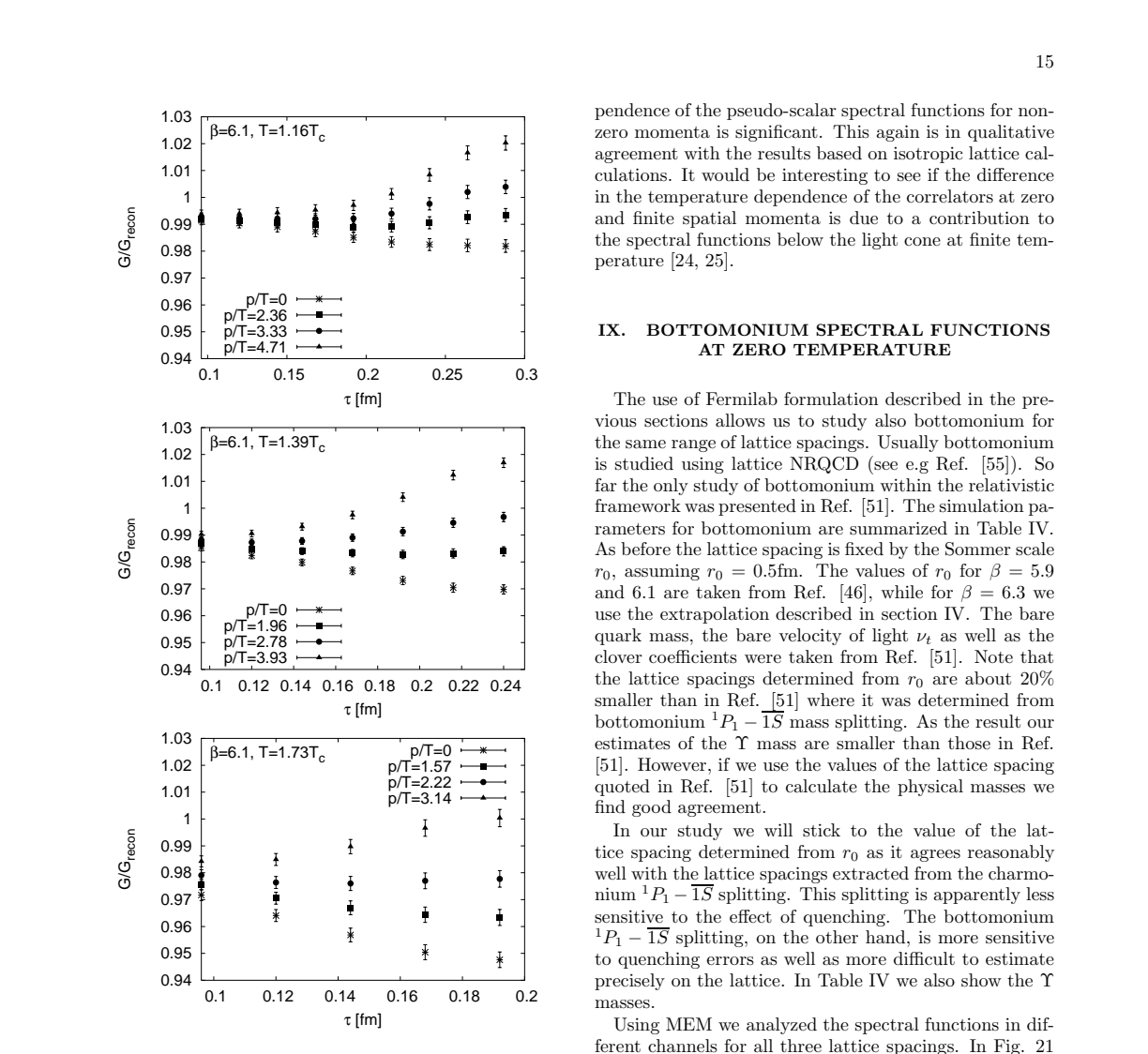
The finite-momentum subsection reports only correlator ratios (Fig. 20) and states that the spectral functions at non-zero momentum were calculated, but no spectral function at finite momentum is shown. Either show one representative case or state that these results are deferred to a later publication.
The paper says, at Abstract and Section XI
Pith says: minor objection 9 of 10
The calculations are quenched, but the abstract does not say so. Given that the dissolution temperatures are the headline numbers and are known to be sensitive to sea-quark effects, please state the quenched approximation in the abstract.
The paper says, at Typographical
Pith says: minor objection 10 of 10
A number of typographical errors should be corrected: 'Levenberg-Marquant' for Levenberg-Marquardt (Section III), 'Shannon-Janes entropy' for Shannon-Jaynes (Section III), 'tradition phenomenological value' for traditional (Section IV), 'r = 0.5 fm' for r_0 = 0.5 fm (Section IV), 'see quarks' for sea quarks (Section XI), 'Further investigation are needed' (Section X), and 'the lattice spacing is main limiting factor' (Section XI).
What would settle it
Take the zero-temperature scalar (or axial-vector) spectral function, modify only its continuum part above the 1P peak (broaden/shift it as expected at T ~ 1.1-1.2 Tc) while leaving the 1P peak area and position intact, insert into the finite-T kernel K(omega,tau) of Eq. (11), and compute G/G_recon. If this continuum-only modification reproduces the observed factor-of-2-to-4 enhancement in Figs. 10-13, then the correlator ratio does not require 1P dissolution and the abstract claim is unsupported. Repeat at the two finest lattice spacings to check whether the residual enhancement survives the continuum extrapolation.
from the skeptic's reading
How the review went
4 readings by deepseek-v4.1-flash · 13 Nov 2026
- Reader holds up, with conditions
- Skeptic partly agrees
- Editor wrote the verdict above
- Referee minor revision: 3 major objections, 10 minor
Not run on this paper: the simulated authors' defence.
Pith did not check this review's objections against the paper.
The review in full
The review in brief, machine-written
The thing worth your time here is the correlator analysis, not the spectral functions. The authors run five lattice spacings with two anisotropies in the Fermilab formulation and compare each finite-temperature correlator to one reconstructed from the zero-temperature spectral function through the finite-T kernel. That ratio, G/G_recon, is the load-bearing evidence, and it is a genuine comparison against an independently determined baseline rather than a circular one. The pseudoscalar ratio stays near unity to about 1.5 Tc on the two finest lattices; the scalar, axial and tensor ratios rise by factors of two to four just above Tc. That contrast is the real result, and it is robust in the sense that it does not depend on the MEM inversion at all. The second contribution is the MEM reformulation in Section III, which turns the maximization into a minimization in data-dimension space and, by the authors' account, converges where Bryan's algorithm stalls on long charmonium correlators. That looks like a genuine practical improvement, and the comparison in the appendix backs it up. The systematic-error program is also real: matched tau_max and N_data baselines, jackknife errors on binned spectral functions, a finite-volume check, and an honest appendix comparing MEM masses and amplitudes against two-exponential fits. Credit where due, this is careful work and the authors are candid about their own weak points, including the default-model dependence of the reconstruction and the ad-hoc renormalization constants in Table VII. Now the soft spot, and it is the abstract. [abstract:s3] states 1P dissolution just above Tc as a finding. The body does not support that strength. Section VI.B says the enhancement 'indicates strong modification ... and, possibly, the dissolution' of 1P states, and it also reports that the enhancement is largest on the coarsest lattice and shrinks toward finer spacing. A signal that decreases with the cutoff cannot ground a flat claim. Worse, the paper itself raises the alternative mechanism in Section X for bottomonium P-states, citing Ref. [11]: the change may come from modification of the continuum part rather than ground-state melting. That mechanism is channel-generic and nothing in the charmonium analysis excludes it. The finite-T P-wave spectral functions cannot settle the question either, since P[alpha|Dm] has multiple maxima for most default models. So the stress-test note is right, and I would push it further: the abstract should be rewritten to match the body. The reader's MEM-prior worry is also fair but less damaging, because the correlator ratios carry the 1S claim independently. Who should read this: lattice people working on quarkonium spectral functions, and anyone who wants the correlator-level statement rather than the spectral-function one. It deserves referees, mainly to force the abstract into line with Section VI.B and to ask for a cleaner statement of what the P-wave enhancement can and cannot distinguish.
The strongest objection
The abstract (abstract:s3) asserts 'dissolution of 1P quarkonium states right above the deconfinement temperature' as a finding. The body does not support that strength. Section VI.B states the scalar/axial/tensor enhancement 'indicates strong modification ... and, possibly the dissolution of 1P charmonia states' — 'possibly', not established. Three concrete problems sit under the flat abstract claim. (1) The enhancement is cutoff-dependent: Section VI.B says 'the magnitude of the enhancement is largest on the coarsest lattice and decreases with decreasing lattice spacing', and 'the cutoff dependence of G/G_recon is larger in the scalar channel than in the pseudo-scalar one'. A signal that shrinks toward the continuum limit cannot ground a flat dissolution claim. (2) The correlator ratio G/G_recon is an integral constraint, not a peak-existence test: a spectral function whose 1P peak has broadened but whose low-omega weight is redistributed can reproduce the same ratio. The paper itself raises exactly this alternative in Section X for bottomonium P-states, citing Ref. [11]: the large change 'may be due to the modification of the continuum part of the spectral functions and not to the dissolution or strong modification of the ground state'. That mechanism is channel-generic and is not excluded for charmonium. (3) The finite-T P-wave spectral functions are uncontrolled: Section VII.B reports multiple maxima of P[alpha|D_m] for most default models, so the MEM reconstruction cannot adjudicate. The reader's MEM-prior concern is real, but for the 1P half of the abstract the more load-bearing gap is that the correlator evidence is ambiguous between ground-state melting and continuum modification, and the paper's own text says so.
The reader's verdict (CONDITIONAL) and its weakest-assumption framing (MEM prior dependence) are sound and I do not overturn them. My concern is adjacent but distinct and, for the abstract's second clause, more load-bearing. The reader treats the correlator ratios as 'the most robust part of the paper because they do not depend on the MEM inversion', and for the 1S survival claim that is fair: G/G_recon near unity up to ~1.5 Tc on the two finest lattices (Figs. 8-9) is a genuine, prior-independent statement, and the paper is appropriately hedged there ('small but statistically significant deviations' at 1.5 Tc, and the 2 Tc conclusion 'could be premature'). For the 1P dissolution claim, however, the correlator ratio is not decisive, because the same ratio rises whether the 1P peak melts or the continuum is modified. The paper says this itself in Section X, citing Ref. [11], and Section VI.B only claims 'possibly the dissolution'. The abstract then states dissolution flatly. Add the cutoff dependence the authors report (enhancement largest on the coarsest lattice, shrinking with finer spacing) and the uncontrolled P-wave MEM (multiple P[alpha|D_m] maxima, Section VII.B), and the 1P clause is the least secure part of the central claim. This is an internal-tension concern (abstract vs body), not a disagreement with consensus, and it routes through correctness risk. The paper deserves credit for its systematic-error program (five spacings, two anisotropies, matched-time-extent zero-T baselines, jackknife errors, finite-volume check) and for stating the continuum-modification caveat at all; the fix is to soften the abstract's 1P clause to match the body and to run the continuum-only test above. That would not change the CONDITIONAL verdict, so I recommend UNCHANGED.
The referee's report
The systematic-error program is the paper's real contribution and is unusually thorough for its time: five lattice spacings, two anisotropies, a finite-volume check at β = 6.1 (Fig. 11), jackknife errors on binned spectral functions (Eq. 32), and — most importantly — a zero-temperature baseline reconstructed with the same number of time slices and the same τ_max as each finite-temperature set (Fig. 16), which removes the dominant trivial source of apparent temperature dependence. The new MEM algorithm is a genuine, reusable methodological advance: recasting the problem as the minimization of U in Eq. (19) with the positivity of ∂²U/∂s_i∂s_j stated, and demonstrating convergence where Bryan's algorithm required truncating to t_max = 24 (Figs. 27, 28), is a concrete and checkable improvement that later work can adopt. The identification of a transport contribution in the vector correlator (Fig. 15) is a falsifiable, physically meaningful statement that connects to heavy-quark diffusion. The conclusions are appropriately hedged in the body and the paper is candid about what it cannot do (bottomonium finite-T spectral functions, P-wave MEM reconstruction). If the 1S survival result and
Pith's reading of the paper (a machine's summary, not the authors')
This paper asks a question that heavy-ion physics needs answered: when the quark-gluon plasma forms, which quarkonium bound states actually disappear, and at what temperature? The authors compute charmonium and bottomonium correlation functions on quenched anisotropic lattices at several lattice spacings, then invert those correlators into spectral functions with a Maximum Entropy Method built on a new minimization algorithm. Their diagnostic is a ratio: the measured finite-temperature correlator divided by the correlator one would get by feeding the zero-temperature spectral function back through the finite-temperature kernel. If that ratio stays at one, the spectral function has not changed. They report that the ratio stays near one in the pseudoscalar channel up to roughly $1.5T_c$, but rises by factors of two to four in the scalar, axial-vector and tensor channels already near $1.1$-$1.2T_c$. If that reading holds, the $1S$ states ($J/ψ$, $η_c$) are still recognizable bound states well inside the plasma while the $1P$ states ($χ_c$, $h_c$) are already gone.
What carries the argument. Two pieces of machinery carry the argument. The first is a reformulation of the Maximum Entropy Method: instead of searching a large space of spectral functions, the authors show that the stationarity condition can be rewritten exactly in terms of $N$ variables $s_i$, one per data point, giving $σ(ω)=m(ω)exp[∑_i s_i K(ω,τ_i)]$ and reducing the problem to minimizing a function $U(s)$ whose Hessian is positive definite. This makes the inversion as fast as a $χ^2$ fit and, the authors report, numerically stable enough to use all $N_t/2$ time slices where the Bryan algorithm converged only with truncated data. The second is the ratio $G(τ,T)/G_{recon}(τ,T)$, with $G_{recon}$ built from the zero-temperature spectral function and the finite-temperature kernel $K(ω,τ)=cosh(ω(τ-1/2T))/sinh(ω/2T)$. Dividing out the trivial kernel dependence isolates the change in the spectral function itself, which is a much more robust signal than the shape of a single reconstructed peak.
Core claim. The central claim is a two-part temperature hierarchy for quarkonium in a deconfined medium. Using the ratio $G/G_{recon}$ of the lattice correlator to the correlator reconstructed from the zero-temperature spectral function, the authors find the pseudoscalar channel essentially unchanged up to about $1.5T_c$ on their two finest lattices ($a_t^{-1}=8.18$ and $14.12$ GeV), with medium modifications turning on only above that; the same near-flatness is seen in the vector channel apart from an additional low-frequency transport contribution. In the scalar, axial-vector and tensor channels, which host the $1P$ states, the same ratio departs from one sharply above $T_c$ and grows with decreasing $τ$, which the authors read as strong modification or dissolution of the $1P$ charmonia at $T ≃ 1.1$-$1.2T_c$. A Maximum Entropy reconstruction of the scalar spectral function at $1.16T_c$ is shown to differ visibly from the zero-temperature one reconstructed with the same number of time slices, supporting the correlator-level conclusion. In the bottomonium sector the $1S$ correlators stay flat to much higher temperatures, while the $1P$ bottomonium correlators change even more strongly than their charmonium counterparts, which the authors flag as unexpected.
The premise it rests on. The load-bearing premise is that the reconstructed finite-temperature spectral function is fixed by the lattice data rather than by the entropy prior, yet the authors themselves report that at $1.2T_c$ the first peak is absent for some default models and that at $2T_c$ a different default model shows almost no temperature dependence at all.
If the paper is right (Pith's inferences, not the authors')
Quarkonium suppression in heavy-ion collisions should be sequential in the way the paper describes: $1P$ charmonia melt almost immediately above $T_c$, while $1S$ charmonia need temperatures around $1.5T_c$ or above.
Because the $1S$ states survive, the low-energy part of the vector spectral function at finite temperature should contain a heavy-quark transport peak in addition to the $J/ψ$ peak, and the authors estimate the mean thermal velocity squared as roughly $0.13$ at $1.2T_c$ and $0.18$ at $1.5T_c$.
Cutoff effects in the temperature dependence of quarkonium correlators are modest: the authors argue the correlators can be studied reliably already at spatial lattice spacings around $a_s^{-1}=2$ GeV, which matters for extending the work to full QCD where the lattice spacing is the limiting resource.
The survival of $1S$ states is not established by the shape of the reconstructed peak alone, since that shape depends on the default model; the claim rests on the default-model-independent statement that the pseudoscalar correlator barely changes below $1.5T_c$.
The two diagnostics disagree in strength: the correlator ratio is a robust, prior-independent statement, while the spectral-function shape is not. A reader should treat the $1S$ survival claim as supported mainly by the ratio and the $1P$ dissolution claim as supported by both, since the $1P$ enhancement is large enough to be visible without any inversion at all.
The unexpected strength of the $1P$ bottomonium signal is a useful anomaly: if the effect were really about binding energy or state size, bottomonium $1P$ should sit between charmonium $1S$ and charmonium $1P$ in robustness, not beyond charmonium $1P$. That ordering suggests the effect lives in the high-frequency continuum of the spectral function rather than in the bound-state peak, which is a te
The transport-peak extraction, $-(G_V-G_V^{recon})/G_{00}$, is a template that could be pushed further: with higher statistics and several lattice spacings one could try to fit the curvature that a finite heavy-quark diffusion constant would imprint, turning a qualitative plateau into a numeric bound on $D$.
Because the whole study is quenched, the natural next check is whether dynamical sea quarks move the $1.5T_c$ survival threshold; the authors themselves note that no quantitative estimate of sea-quark effects exists yet.
Check this review
Pith stored no record of this review's passes and took no fingerprint of it. Reviews made by code from 13 Nov 2026 on carry both.
How often reviews like this one are right
Reviews like this one: written by deepseek-v4.1-flash, where what was read was not recorded.
How often objections from reviews like this one are right: not yet measured
Reviews by people
This review was written by a machine. No person has reviewed this paper on Pith yet. A scientist listed on Pith can review it for a fee, and their review is published here whatever it concludes.
The paper
Abstract
We study quarkonium correlators and spectral functions at zero and finite temperature using the anisotropic Fermilab lattice formulation with anisotropy xi=2 and 4. To control cutoff effects we use several different lattice spacings. The spectral functions were extracted from lattice correlators with Maximum Entropy Method based on a new algorithm. We find evidence for the survival of 1S quarkonium states in the deconfined medium till relatively high temperatures as well as for dissolution of 1P quarkonium states right above the deconfinement temperature.
The paper's own sentences, arranged, kept beside the review and separate from it. Each label is drawn from a closed vocabulary; the number beside it is the probability the classifier gave that label. No sentence in this record was written by a model.
abstract compiled · 2026-09-23
The authors' main claim, as the classifier picked it out 1.00
“We find evidence for the survival of 1S quarkonium states in the deconfined medium till relatively high temperatures as well as for dissolution of 1P quarkonium states right above the deconfinement temperature.”
How the main claim is stated: asserted 0.84
What the abstract itself states, as probabilities: claims first 0.03 · states limitation 0.21 · human participants 0.01 · controlled comparison 0.09 · randomized assignment 0.01 · states quantitative result 0.28 · compares with prior results 0.09 · mentions code or data availability 0.02
The abstract, sentence by sentence
This table labels the abstract only (arXiv listing abstract v1). The number is the probability the classifier gave the label.
| Sentence | Role | The authors' own work | States the main conclusion | Strength |
|---|---|---|---|---|
| We study quarkonium correlators and spectral functions at zero and finite temperature using the anisotropic Fermilab lattice formulation with anisotropy xi=2 and 4. | contribution 0.79 | 0.95 | 0.04 | asserted 0.90 |
| To control cutoff effects we use several different lattice spacings. | method 1.00 | 0.92 | 0.01 | asserted 0.98 |
| The spectral functions were extracted from lattice correlators with Maximum Entropy Method based on a new algorithm. | method 0.99 | 0.94 | 0.03 | asserted 1.00 |
| We find evidence for the survival of 1S quarkonium states in the deconfined medium till relatively high temperatures as well as for dissolution of 1P quarkonium states right above the deconfinement temperature. | result 1.00 | 0.97 | 0.92 | asserted 0.84 |
What kind of paper the classifier reports this is: simulation study 1.00 · evidence from simulation or computation 1.00
What was examined, and what was not
Sources read
- arXiv listing abstract v1
Not examined
- full text
- figures and tables
- references and citing sentences
- relations to other papers
Levels run
- P abstract
Not run
- S sections
- T body sentences
- C citations
- R cross-paper relations
How the labels were made
Compiled by classifier-1.13-20260917 via OpenRouter, question bank abstract-p1-20260923, 2026-09-23: 1 request, 3,591 input tokens, $0.0002 reported.
Every quoted sentence on this record is the authors'. Every label is from Pith's closed vocabulary, with the probability shown beside it. This record as JSON
Figures (31)



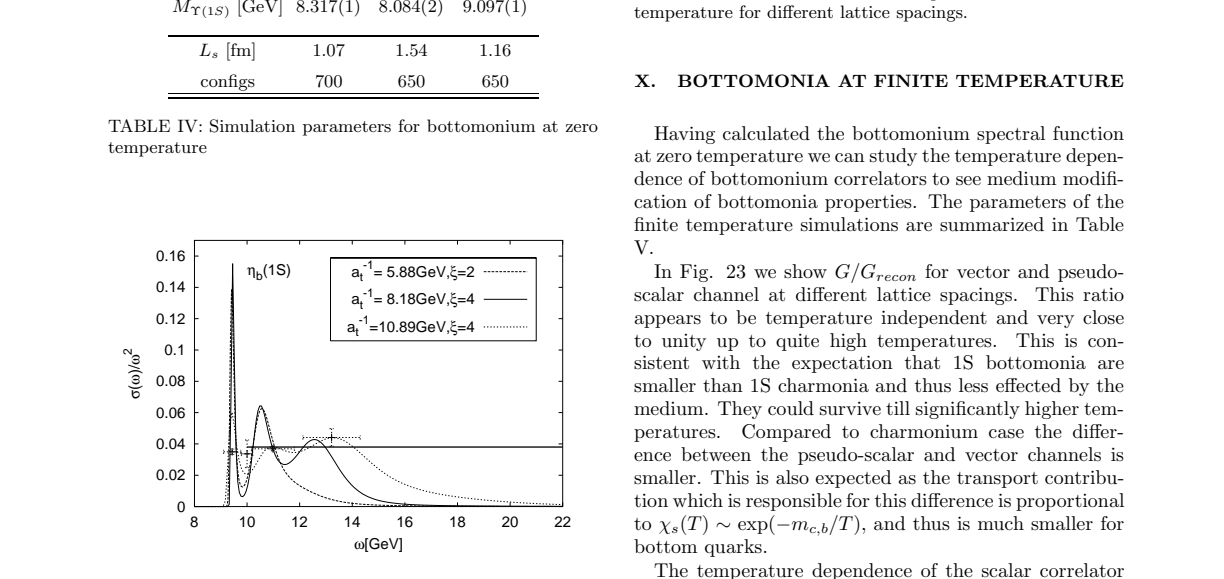

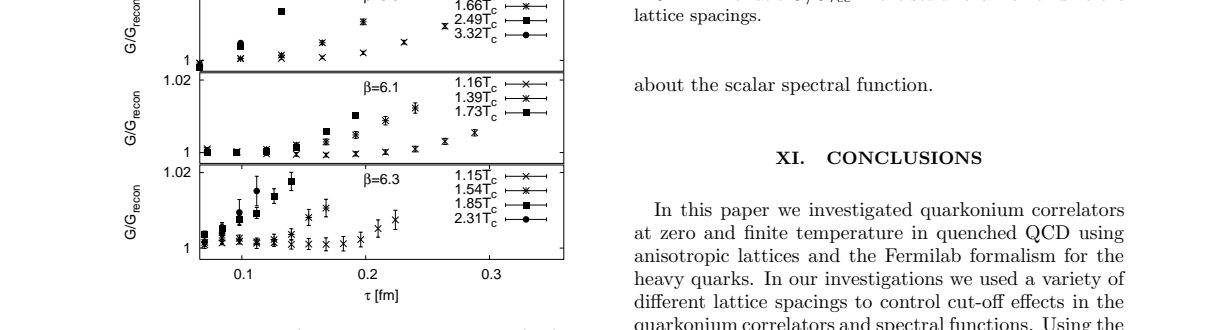
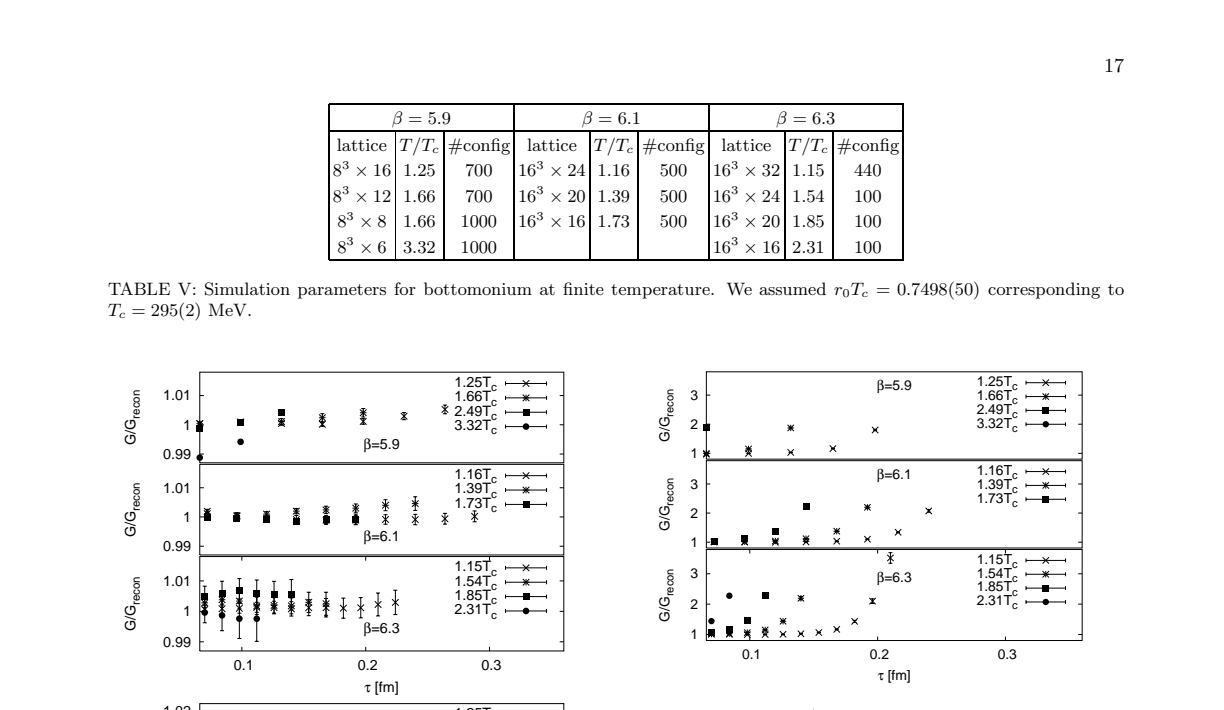
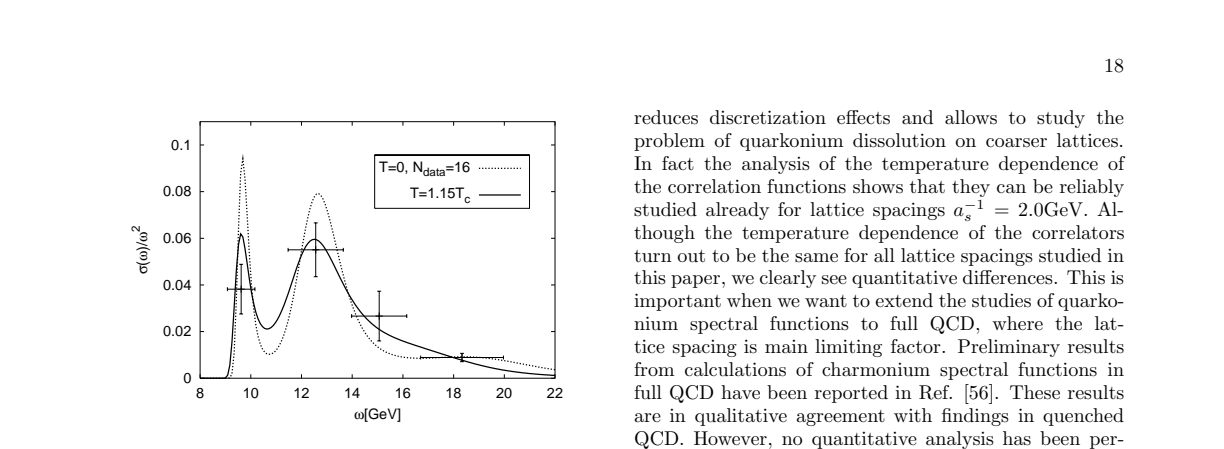
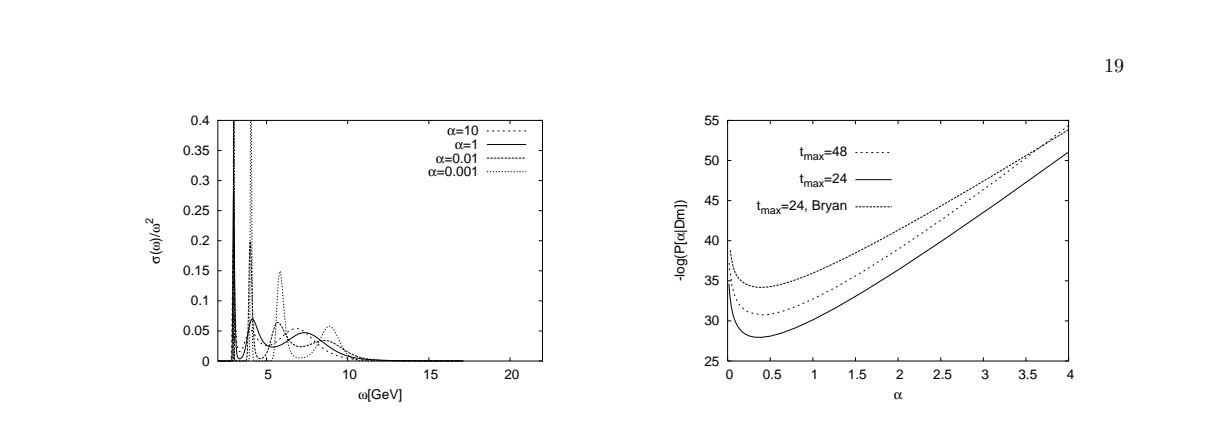
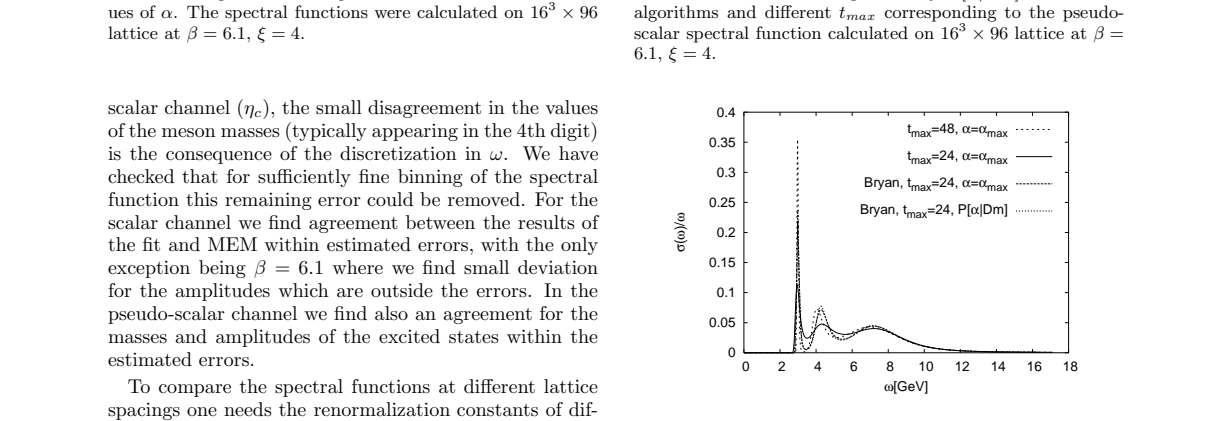
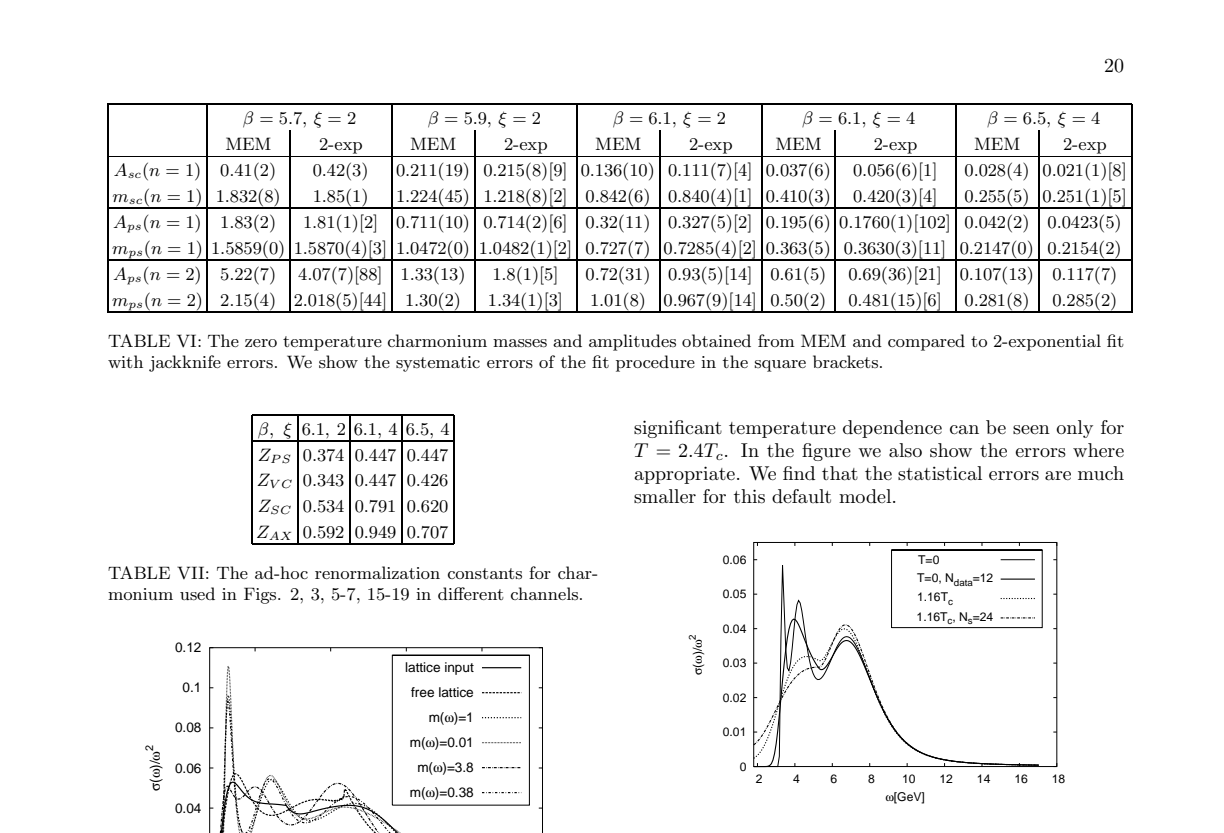

Showing 23 of the paper's 31 figures. Figures are the authors', reproduced from the paper.
References (57)
- [11] A. Mocsy and P. Petreczky, Phys. Rev. D 73, 074007 (2006) on Pith
- [1] T. Matsui and H. Satz, Phys. Lett. B 178, 416 (1986) on Pith
- [2] F. Karsch, M. T. Mehr and H. Satz, Z. Phys. C 37, 617 (1988) on Pith
- [3] G. R¨ opke, D. Blaschke, H. Schulz, Phys. Rev. D 38, 3589 (1988) on Pith
- [4] T. Hashimoto et al., Z. Phys. C 38, 251 (1988) on Pith
- [5] S. Digal, P. Petreczky and H. Satz, Phys. Lett. B 514, 57 (2001) on Pith
- [6] S. Digal, P. Petreczky and H. Satz, Phys. Rev. D 64, 094015 (2001) on Pith
- [7] E. V. Shuryak and I. Zahed, Phys. Rev. D 70, 054507 (2004) on Pith
- [8] C. Y. Wong, Phys. Rev. C 72, 034906 (2005) on Pith
- [9] C. Y. Wong and H. W. Crater, arXiv:hep-ph/0610440 on PithPith's reviewarXiv
- [10] A. Mocsy and P. Petreczky, Eur. Phys. J. C 43, 77 (2005) on Pith
- [12] At finite temperature two default models m(ω) = 0 .01 and m(ω) = 0.038ω2 have been used. fied compared to the zero temperature spectral function; its shape at small ω, however, strongly depends on the default model. We also analyzed the spectral function for these data with the ... on Pith
- [13] A. Mocsy, P. Petreczky and J. Casalderrey-Solana, arXiv:hep-ph/0609205; A. Mocsy and P. Petreczky, arXiv:hep-ph/0606053 on PithPith's reviewarXiv
- [14] W. M. Alberico, A. Beraudo, A. De Pace and A. Molinari, Phys. Rev. D 72, 114011 (2005) on Pith
- [15] D. Cabrera and R. Rapp, arXiv:hep-ph/0610254 on PithPith's reviewarXiv
- [16] T. Umeda, K. Nomura and H. Matsufuru, arXiv:hep-lat/0211003 on PithPith's reviewarXiv
- [17] M. Asakawa and T. Hatsuda, Phys. Rev. Lett. 92, 012001 (2004) on Pith
- [18] S. Datta, F. Karsch, P. Petreczky and I. Wetzorke, Phys. Rev. D 69, 094507 (2004) on Pith
- [19] K. Petrov, A. Jakov´ ac, P. Petreczky and A. Velytsky, PoS 21 0 0.01 0.02 0.03 0.04 0.05 0.06 0.07 0 2 4 6 8 10 12 14 16 18 σ(ω)/ω2 ω[GeV] T=0, Ndata=13 T=1.07Tc 0 0.01 0.02 0.03 0.04 0.05 0.06 0.07 0 2 4 6 8 10 12 14 16 18 σ(ω)/ω2 ω[GeV] T=0, Ndata=12 T=1.16Tc 0 0.01 0.02 0.0... on PithPith's reviewarXiv
- [20] P. Petreczky, K. Petrov, D. Teaney and A. Velytsky, PoS LAT2005, 185 (2005) [arXiv:hep-lat/0510021] on PithPith's reviewarXiv
show 37 more
- [21] A. Jakov´ ac, P. Petreczky, K. Petrov and A. Velytsky, arXiv:hep-lat/0603005 on PithPith's reviewarXiv
- [22] A. Velytsky, arXiv:hep-lat/0609013 on PithPith's reviewarXiv
- [23] M. Le Bellac, Thermal Field Theory , Cambridge Uni- versity Press ,1996 on Pith
- [24] E. Braaten, R. D. Pisarski and T. C. Yuan, Phys. Rev. Lett. 64, 2242 (1990) on Pith
- [25] F. Karsch, E. Laermann, P. Petreczky and S. Stickan, Phys. Rev. D 68, 014504 (2003) on Pith
- [26] G. Aarts and J. M. Martinez Resco, Nucl. Phys. B 726, 93 (2005) on Pith
- [27] M. Asakawa, T. Hatsuda and Y. Nakahara, Prog. Part. Nucl. Phys. 46, 459 (2001) [arXiv:hep-lat/0011040] on PithPith's reviewarXiv
- [28] G. P. Lepage, B. Clark, C. T. H. Davies, K. Horn- bostel, P. B. Mackenzie, C. Morningstar and H. Trot- tier, Nucl. Phys. Proc. Suppl. 106, 12 (2002) [arXiv:hep-lat/0110175] on PithPith's reviewarXiv
- [29] M. Jarrell and J.M. Gubernatis, Phys. Rep. 269 (1996) 133 on Pith
- [30] R. K. Bryan, Eur. Biophys J. 18, 165 (1990) on Pith
- [31] Y. Nakahara, M. Asakawa and T. Hatsuda, Phys. Rev. D 60, 091503 (1999) [arXiv:hep-lat/9905034] on PithPith's reviewarXiv
- [32] T. Yamazaki et al. [CP-PACS Collaboration], Phys. Rev. D 65, 014501 (2002) on Pith
- [33] F. Karsch, E. Laermann, P. Petreczky, S. Stickan and 22 I. Wetzorke, Phys. Lett. B 530, 147 (2002) on Pith
- [34] F. Karsch, S. Datta, E. Laermann, P. Petreczky, S. Stickan and I. Wetzorke, Nucl. Phys. A 715, 701 (2003) [arXiv:hep-ph/0209028] on PithPith's reviewarXiv
- [35] S. Datta, F. Karsch, P. Petreczky and I. Wet- zorke, Nucl. Phys. Proc. Suppl. 119, 487 (2003) [arXiv:hep-lat/0208012] on PithPith's reviewarXiv
- [36] M. Asakawa, T. Hatsuda and Y. Nakahara, Nucl. Phys. A 715, 863 (2003) [Nucl. Phys. Proc. Suppl. 119, 481 (2003)] [arXiv:hep-lat/0208059] on PithPith's reviewarXiv
- [37] T. Blum and P. Petreczky, arXiv:hep-lat/0408045 on PithPith's reviewarXiv
- [38] P. Petreczky, J. Phys. G 30, S431 (2004) on Pith
- [39] P. Petreczky, F. Karsch, E. Laermann, S. Stickan and I. Wetzorke, Nucl. Phys. Proc. Suppl. 106, 513 (2002) on Pith
- [40] C. R. Allton, J. E. Clowser, S. J. Hands, J. B. Kogut and C. G. Strouthos, Phys. Rev. D 66, 094511 (2002) on Pith
- [41] K. Langfeld, H. Reinhardt and J. Gattnar, Nucl. Phys. B 621, 131 (2002) on Pith
- [42] H. R. Fiebig, Phys. Rev. D 65, 094512 (2002) on Pith
- [43] K. Sasaki, S. Sasaki and T. Hatsuda, Phys. Lett. B 623, 208 (2005) on Pith
- [44] P. Chen, Phys. Rev. D 64, 034509 (2001) on Pith
- [45] T. R. Klassen, Nucl. Phys. B 533, 557 (1998) on Pith
- [46] R. Sommer, Nucl. Phys. B 411, 839 (1994) on Pith
- [47] R. G. Edwards, U. M. Heller, T. R. Klassen, unpublished on Pith
- [48] C. R. Allton, Nucl. Phys. Proc. Suppl. 53, 867 (1997) [arXiv:hep-lat/9610014]; hep-lat/9610016 on PithPith's reviewarXiv
- [49] M. Okamoto et al. [CP-PACS Collaboration], Phys. Rev. D 65, 094508 (2002) [arXiv:hep-lat/0112020] on PithPith's reviewarXiv
- [50] A. Gray et al, Phys. Rev. D 72, 094507 (2005) on Pith
- [51] S. Necco, Nucl. Phys. B 683, 137 (2004) [arXiv:hep-lat/0309017] on PithPith's reviewarXiv
- [52] X. Liao and T. Manke, Phys. Rev. D 65, 074508 (2002) [arXiv:hep-lat/0111049] on PithPith's reviewarXiv
- [53] P. Petreczky and D. Teaney, Phys. Rev. D 73, 014508 (2006) [arXiv:hep-ph/0507318] on PithPith's reviewarXiv
- [54] H. Iida, T. Doi, N. Ishii, H. Suganuma and K. Tsumura, arXiv:hep-lat/0602008 on PithPith's reviewarXiv
- [55] S. Datta, F. Karsch, S. Wissel, P. Petreczky and I. Wet- zorke, arXiv:hep-lat/0409147 on PithPith's reviewarXiv
- [56] C.T. Davies, et al, Phys. Rev. D 50, 6963 (1994) on Pith
- [57] G. Aarts, C. R. Allton, R. Morrin, A. P. O. Cais, M. B. Oktay, M. J. Peardon and J. I. Skullerud, arXiv:hep-lat/0610065 on PithPith's reviewarXiv
Cited by 32 Pith papers
Reviewed papers on Pith that cite this one. The full citation record
- In-medium bottomonium properties from lattice NRQCD calculations with extended meson operators hep-lat · Jan 2025
- Excited bottomonia in quark-gluon plasma from lattice QCD hep-lat · Oct 2019
- Thermal Broadening of Bottomonia: Lattice Non-Relativistic QCD with Extended Operators hep-lat · Aug 2019
- Quarkonium in-medium properties from realistic lattice NRQCD hep-lat · Aug 2018
- Lattice NRQCD study of S- and P-wave bottomonium states in a thermal medium with $N_f=2+1$ light flavors hep-lat · Sep 2014
- Charmonium properties in hot quenched lattice QCD hep-lat · Apr 2012
- Quarkonium states in an anisotropic QCD plasma hep-ph · Jan 2009
- Static quark-antiquark pairs at finite temperature hep-ph · Apr 2008
- Can quarkonia survive deconfinement ? hep-ph · May 2007
- Charmonium at high temperature in two-flavor QCD hep-lat · May 2007
- A resummed perturbative estimate for the quarkonium spectral function in hot QCD hep-ph · Apr 2007
- Quarkonium at finite temperature: Towards realistic phenomenology from first principles hep-ph · Sep 2015
- In-medium modifications of open and hidden strange-charm mesons from spatial correlation functions hep-lat · Nov 2014
- S wave bottomonium states moving in a quark-gluon plasma from lattice NRQCD hep-lat · Oct 2012
- Thermal Bottomonium Suppression at RHIC and LHC nucl-th · Dec 2011
- What happens to the Upsilon and eta_b in the quark-gluon plasma? Bottomonium spectral functions from lattice QCD hep-lat · Sep 2011
- Quarkonium dissociation in quark-gluon plasma via ionization in magnetic field hep-ph · Mar 2011
- Quarkonium above deconfinement as an open quantum system nucl-th · Jan 2010
- The heavy-quark potential in an anisotropic plasma hep-ph · Nov 2007
- Heavy quarkonium in any channel in resummed hot QCD hep-ph · Nov 2007
- Constant contribution in meson correlators at finite temperature hep-lat · Jan 2007
- Charmonium properties at high temperatures from lattice QCD hep-lat · May 2026
- Non-relativistic QCD Study of Excited Bottomonia at Finite Temperatures on a Fine Lattice hep-lat · Jan 2025
- Bottomonia suppression in 2.76 TeV Pb-Pb collisions hep-ph · Jul 2015
- The bottomonium spectrum at finite temperature from $N_f=2+1$ lattice QCD hep-lat · Feb 2014
- "QGP Signatures" Revisited hep-ph · Aug 2023
- Open Quantum Systems for Quarkonia hep-ph · Feb 2021
- Transport Properties of the Quark-Gluon Plasma -- A Lattice QCD Perspective hep-lat · Apr 2011
- Heavy Quarkonium in Extreme Conditions hep-ph · Dec 2019
- Thermodynamics of strong-interaction matter from Lattice QCD hep-lat · Apr 2015
- Quarkonia in the Quark Gluon Plasma hep-ph · Feb 2013
- Gauge/String Duality, Hot QCD and Heavy Ion Collisions hep-th · Jan 2011
How later papers used it
48 later papers cite it
1 paper by the same authors is listed below: 1 used its method or tool.
Uses its method or tool 1 of 2 papers with this label · 1 by the same authors
By the same authors
-
Used MEM and the algorithm described in this paper to calculate the spectral functions below Tc.
On temperature dependence of quarkonium correlators (2008) (same authors) · 1.00 · paraphrased: the licence does not allow quoting
How the literature uses it
42 arXiv papers cite this in 84 sentences
Papers whose main result relates to this one's
States a conflicting result 1 paper
-
We find that all quarkonium states, with the exception of the $1S$ bottomonium, dissolve in the deconfined phase at temperatures smaller than $1.5T_c$, in contradiction with the conclusions of recent studies.
Papers citing it · 52 sentences without a confident label
Contests it 1 paper
-
Thus, contrary to statements made in Refs. [ref] , the dissolution of the $1P$ quarkonium states does not lead to a large change in the correlation functions.
Can quarkonia survive deconfinement ? · Numerical results with $F_1(r,T)$ · contest 0.85
Uses its method or tool 2 papers
-
This has been done using MEM and the algorithm described in Ref. [ref] .
On temperature dependence of quarkonium correlators · Lattice calculations of quarkonium correlators · 1.00
-
In the following we will deploy an MEM implementation with extended search space [ref] (for technical background see e.g. [ref] ) in an attempt to reconstruct from $N_τ=32$ ideal imaginary time datapoints the most probable spectral function in the Bayesian sense.
A hard thermal loop benchmark for the extraction of the nonperturbative $Q\bar{Q}$ potential · MEM analysis of the perturbative Euclidean correlator · 0.93
Uses its data or values 1 paper
-
To understand the situation better, in Fig. [ref] we show our results with the lattice charmonium spectral function of Ref. [ref] (solid black curve).
Can quarkonia survive deconfinement ? · Numerical results with the potential $V(r,T)$ · 0.82
Compares with it 6 papers
-
The results are consistent with previous lattice studies of charmonium spectral functions [ref] , in which the spectral functions for the Ps and V channels in the deconfinement phase (but at not so high temperature) show a peak structure around the $η_c$ and $J/ψ$ masses like the result at zero temperature.
Study of constant mode in charmonium correlators at finite temperature · Finite temperature results · 0.87
-
We compare the calculated correlators to recent numerical results calculated from isotropic [ref] and anisotropic [ref] lattice formulations.
Can quarkonia survive deconfinement ? · Quarkonium correlators at zero temperature · 1.00
-
Using the criterion in [ref], the zero momentum dissociation temperature is found to be [equation] This is consistent with lattice measurements reported in Refs. [ref] that J/$ψ$ will survive up to $2 ∼2.4 T_c$ with $T_c=190$ MeV but is higher than the lattice results of Ref. [ref] that J/$ψ$ are found to dissociate already at $1.5 T_c$.
Charmonium moving through a strongly coupled QCD plasma: a holographic perspective · Momentum dependence of the dissociation temperature · 0.99
Cites it as support 1 paper
-
Thus �it is difficult to make any conclusive statement based on the shape of the spectral functions� [ref] .
Potential Models for Quarkonia · Potential Models $&$ Lattice QCD · 0.98
Cites it as background 17 papers
-
The temperature dependence of the charmonium and bottomonium correlators in pseudo-scalar channel has been studied in Refs. [ref] .
On temperature dependence of quarkonium correlators · The temperature dependence of the pseudo-scalar correlators · 0.96
-
The study of the properties of charmonia at finite temperature is one of the longstanding subjects on the lattice [ref] .
In-medium dispersion relations of charmonia studied by maximum entropy method · introduction · 0.96
-
Extensive efforts have been devoted to studying charmonium [ref] and bottomonium [ref] in lattice QCD.
Charmonium properties at high temperatures from lattice QCD · Introduction · 0.96
Challenges and discussion
Disagree with the review, or know something it missed? Leave a comment, or challenge this review formally: a challenge becomes a permanent entry in this paper's record, and its decision is published here.
Come back by email
A short list of the week's newly reviewed papers. Nothing is sent until you confirm from your inbox, and every email has a link that stops it. No account.
No comments yet.
Sign in to comment