Quantum Physics using Weighted Model Counting
Pith reviewed 2026-05-18 21:10 UTC · model grok-4.3
The pith
A framework converts Dirac notation into weighted model counting problems to solve quantum linear algebra tasks.
A machine-rendered reading of the paper's core claim, the machinery that carries it, and where it could break.
Core claim
The paper claims that linear algebraic problems in physics and quantum computing can be systematically expressed as weighted model counting instances through a framework that translates Dirac notation, built using a type system and denotational semantics.
What carries the argument
The Dirac notation to WMC conversion framework with its type system and denotational semantics that maps quantum states and operators to weighted counting problems.
If this is right
- Partition functions of the transverse-field Ising model can be calculated using WMC.
- Partition functions of the Potts model can be calculated using WMC.
- Automated reasoning heuristics can be applied systematically to quantum physics problems.
- A reusable general framework replaces per-instance approaches for quantum calculations.
Where Pith is reading between the lines
- This approach might scale to more complex quantum systems by using efficient WMC solvers.
- It could connect quantum mechanics computations with tools from constraint satisfaction and counting.
- Future work might extend the framework to handle time evolution or measurement in quantum circuits.
Load-bearing premise
The type system and denotational semantics correctly map Dirac notation and linear algebra onto weighted model counting without losing quantum features or adding errors.
What would settle it
Computing the partition function of the transverse-field Ising model with the framework and finding a numerical result that differs from the known exact or simulated value.
Figures





read the original abstract
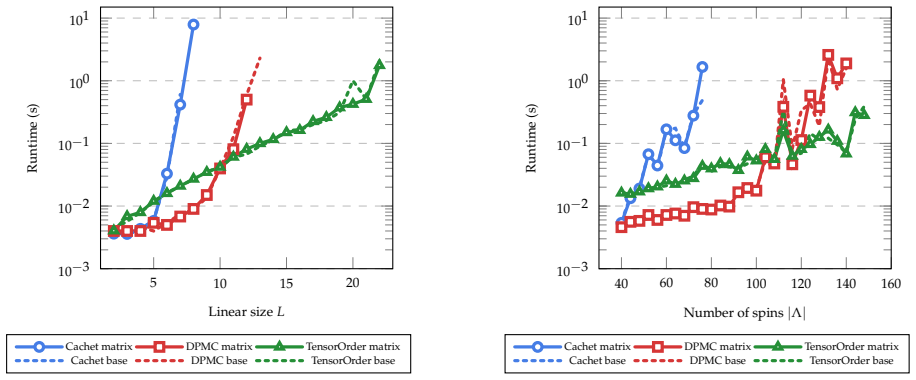
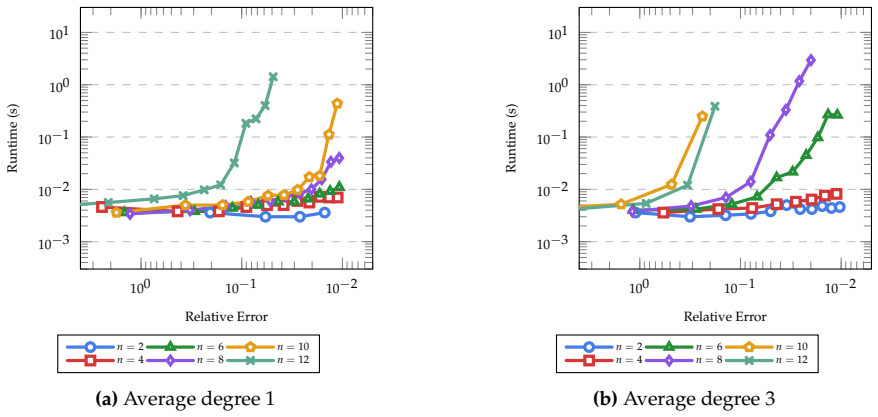
Weighted model counting (WMC) has proven effective at a range of tasks within computer science, physics, and beyond. However, existing approaches for using WMC in quantum physics only target specific problem instances, lacking a general framework for expressing problems using WMC. This limits the reusability of these approaches in other applications and risks a lack of mathematical rigor on a per-instance basis. We present an approach for expressing linear algebraic problems, specifically those present in physics and quantum computing, as WMC instances. We do this by introducing a framework that converts Dirac notation to WMC problems. We build up this framework theoretically, using a type system and denotational semantics, and provide an implementation in Python. We demonstrate the effectiveness of our framework in calculating the partition functions of several physical models: The transverse-field Ising model (quantum) and the Potts model (classical). The results suggest that heuristics developed in automated reasoning can be systematically applied to a wide class of problems in quantum physics through our framework.
Editorial analysis
A structured set of objections, weighed in public.
Referee Report
Summary. The manuscript presents a framework for expressing linear algebraic problems from quantum physics and computing as weighted model counting (WMC) instances. It converts Dirac notation to WMC problems via a type system and denotational semantics, includes a Python implementation, and demonstrates the approach by computing partition functions for the transverse-field Ising model and the Potts model.
Significance. If the central mapping holds without loss of quantum structure or introduction of approximation errors, the work would enable systematic reuse of automated reasoning heuristics and solvers across a broad class of quantum physics problems, increasing both applicability and rigor compared to ad-hoc per-instance encodings.
major comments (2)
- [§3] §3 (Theoretical Framework): The denotational semantics are constructed from first principles, but the manuscript provides no explicit theorem or inductive proof establishing that the mapping from arbitrary Dirac expressions (including superpositions and tensor products) to WMC instances is exact and structure-preserving for the full class of linear-algebraic operations claimed. This is load-bearing for the generality assertion.
- [§5] §5 (Demonstrations): The reported results for the transverse-field Ising model and Potts model lack baseline comparisons (e.g., to exact diagonalization or standard Monte Carlo) and error analysis, so it is not possible to quantify whether the WMC encoding introduces any overhead or deviation from known values.
minor comments (2)
- [§4] The Python implementation is referenced but not included as supplementary material or pseudocode; adding it would support reproducibility.
- [§3.1] Notation for the translation of inner products and normalization constants into WMC weights could be made more explicit with a small worked example early in the text.
Simulated Author's Rebuttal
We thank the referee for their constructive and detailed comments. We address each major comment below and describe the revisions that will be incorporated into the next version of the manuscript.
read point-by-point responses
-
Referee: [§3] §3 (Theoretical Framework): The denotational semantics are constructed from first principles, but the manuscript provides no explicit theorem or inductive proof establishing that the mapping from arbitrary Dirac expressions (including superpositions and tensor products) to WMC instances is exact and structure-preserving for the full class of linear-algebraic operations claimed. This is load-bearing for the generality assertion.
Authors: We thank the referee for this observation. The denotational semantics in Section 3 are defined inductively over the grammar of Dirac expressions, with each production (scalars, kets, bras, tensor products, linear combinations, and adjoints) mapped compositionally to the corresponding WMC operations. This construction ensures that the linear-algebraic structure is preserved exactly, with no approximation or loss of quantum features. Nevertheless, we agree that stating an explicit theorem and providing an inductive argument would strengthen the presentation. In the revised manuscript we will insert a formal theorem in Section 3 asserting that the semantics is faithful and structure-preserving, together with a concise inductive proof sketch. revision: yes
-
Referee: [§5] §5 (Demonstrations): The reported results for the transverse-field Ising model and Potts model lack baseline comparisons (e.g., to exact diagonalization or standard Monte Carlo) and error analysis, so it is not possible to quantify whether the WMC encoding introduces any overhead or deviation from known values.
Authors: We agree that empirical validation against established methods would improve the evaluation section. Although the framework is exact by construction, we will add direct comparisons for small lattices: exact diagonalization results for the transverse-field Ising model and exhaustive enumeration for the Potts model. These baselines will be reported alongside the WMC-derived partition functions, together with a discussion of numerical agreement (expected to be exact within floating-point precision) and the relative computational cost of the WMC encoding versus the baselines. The revised Section 5 will include these comparisons and an accompanying error analysis. revision: yes
Circularity Check
No significant circularity detected in framework construction
full rationale
The paper introduces a mapping from Dirac notation to weighted model counting via an explicitly defined type system and denotational semantics, which are built from first principles rather than derived from fitted data or prior self-referential results. Demonstrations compute partition functions for the transverse-field Ising model and Potts model using standard, externally known physical instances without post-hoc parameter adjustments or reductions that equate outputs to inputs by construction. The central contribution is a reusable framework with a Python implementation, and no load-bearing step relies on self-citation chains, uniqueness theorems from the same authors, or renaming of known results as novel derivations. This renders the derivation self-contained.
Axiom & Free-Parameter Ledger
axioms (1)
- domain assumption The denotational semantics correctly preserves the meaning of Dirac notation when mapped to weighted model counting.
Lean theorems connected to this paper
-
IndisputableMonolith/Foundation/RealityFromDistinction.leanreality_from_one_distinction unclear?
unclearRelation between the paper passage and the cited Recognition theorem.
We present an approach for expressing linear algebraic problems... by introducing a framework that converts Dirac notation to WMC problems. We build up this framework theoretically, using a type system and denotational semantics
-
IndisputableMonolith/Cost/FunctionalEquation.leanwashburn_uniqueness_aczel unclear?
unclearRelation between the paper passage and the cited Recognition theorem.
Jbra(i, q)Kr = [( x = i, W1, x, −, q)] ... JM2 · M1Kr = [( ϕ1 ∧ ϕ2 ∧ valy, W1 · W2, x, z, q)]
What do these tags mean?
- matches
- The paper's claim is directly supported by a theorem in the formal canon.
- supports
- The theorem supports part of the paper's argument, but the paper may add assumptions or extra steps.
- extends
- The paper goes beyond the formal theorem; the theorem is a base layer rather than the whole result.
- uses
- The paper appears to rely on the theorem as machinery.
- contradicts
- The paper's claim conflicts with a theorem or certificate in the canon.
- unclear
- Pith found a possible connection, but the passage is too broad, indirect, or ambiguous to say the theorem truly supports the claim.
Forward citations
Cited by 1 Pith paper
-
Quokka#: Quantum Computing with #SAT
Quokka# is a Python library that converts quantum circuit analysis tasks into #SAT problems, offering multiple encodings, approximate equivalence checking, and depth-optimal synthesis.
Reference graph
Works this paper leans on
-
[1]
Ignasi Ab´ıo and Peter J. Stuckey. Encoding linear constraints into sat. In Barry O’Sullivan, editor, Principles and Practice of Constraint Programming, pages 75–91, Cham, 2014. Springer International Publishing
work page 2014
-
[2]
Awad H. Al-Mohy and Nicholas J. Higham. A new scaling and squaring algorithm for the matrix exponential. SIAM Journal on Matrix Analysis and Applications, 31(3):970–989, 2010
work page 2010
-
[3]
History of the lenz-ising model
Stephen G Brush. History of the lenz-ising model. Reviews of modern physics, 39(4):883, 1967
work page 1967
-
[4]
On probabilistic inference by weighted model counting
Mark Chavira and Adnan Darwiche. On probabilistic inference by weighted model counting. Artificial Intelligence, 172(6):772–799, 2008
work page 2008
-
[5]
Interacting quantum observables: categorical algebra and diagram- matics
Bob Coecke and Ross Duncan. Interacting quantum observables: categorical algebra and diagram- matics. New Journal of Physics, 13(4):043016, 4 2011
work page 2011
- [6]
-
[7]
Pottics – the potts topic model for semantic image segmentation
Christoph Dann, Peter Gehler, Stefan Roth, and Sebastian Nowozin. Pottics – the potts topic model for semantic image segmentation. In Proceedings of 34th DAGM Symposium, Lecture Notes in Computer Science, pages 397–407. Springer, August 2012
work page 2012
-
[8]
Weighted model counting with conditional weights for bayesian networks
Paulius Dilkas and Vaishak Belle. Weighted model counting with conditional weights for bayesian networks. In Cassio de Campos and Marloes H. Maathuis, editors, Proceedings of the Thirty-Seventh Conference on Uncertainty in Artificial Intelligence , volume 161 of Proceedings of Machine Learning Research, pages 386–396. PMLR, 7 2021
work page 2021
- [9]
-
[10]
Jeffrey M. Dudek, Vu H. N. Phan, and Moshe Y. Vardi. Dpmc: Weighted model counting by dynamic programming on project-join trees. In Principles and Practice of Constraint Programming: 26th International Conference, CP 2020, Louvain-La-Neuve, Belgium, September 7–11, 2020, Proceedings, page 211–230, Berlin, Heidelberg, 2020. Springer-Verlag
work page 2020
-
[11]
Jeffrey M. Dudek, Vu H. N. Phan, and Moshe Y. Vardi. Procount: Weighted projected model counting with graded project-join trees. In Chu-Min Li and Felip Many`a, editors, Theory and Applications of Satisfiability Testing – SAT 2021, pages 152–170, Cham, 2021. Springer International Publishing
work page 2021
-
[12]
Jeffrey M. Dudek and Moshe Y. Vardi. Parallel weighted model counting with tensor networks, 2021
work page 2021
-
[13]
H. B. Hunt and R. E. Stearns. On the complexity of satisfiability problems for algebraic structures (preliminary report). In Teo Mora, editor, Applied Algebra, Algebraic Algorithms and Error-Correcting Codes, pages 250–258, Berlin, Heidelberg, 1989. Springer Berlin Heidelberg
work page 1989
-
[14]
Efficient cnf encoding for selecting 1 from n objects
William Klieber and Gihwon Kwon. Efficient cnf encoding for selecting 1 from n objects. 2007
work page 2007
-
[15]
Efficient inference in fully connected crfs with gaussian edge potentials
Philipp Kr¨ahenb ¨uhl and Vladlen Koltun. Efficient inference in fully connected crfs with gaussian edge potentials. In J. Shawe-Taylor, R. Zemel, P . Bartlett, F. Pereira, and K.Q. Weinberger, editors, Advances in Neural Information Processing Systems, volume 24. Curran Associates, Inc., 2011
work page 2011
-
[16]
Ronald M Levy, Allan Haldane, and William F Flynn. Potts hamiltonian models of protein co- variation, free energy landscapes, and evolutionary fitness.Curr Opin Struct Biol, 43:55–62, November 2016
work page 2016
-
[17]
Li, Mindren Lu, Israel Desta, Vikram Sundar, Gevorg Grigoryan, and Amy E
Alex J. Li, Mindren Lu, Israel Desta, Vikram Sundar, Gevorg Grigoryan, and Amy E. Keating. Neural network-derived potts models for structure-based protein design using backbone atomic coordinates and tertiary motifs. Protein Science, 32(2):e4554, 2023. 42
work page 2023
-
[18]
Quantum Neural Network Classifiers: A Tutorial
Weikang Li, Zhide Lu, and Dong-Ling Deng. Quantum Neural Network Classifiers: A Tutorial. SciPost Phys. Lect. Notes, page 61, 2022
work page 2022
-
[19]
Simulating quantum circuits by model counting
Jingyi Mei, Marcello Bonsangue, and Alfons Laarman. Simulating quantum circuits by model counting. In Arie Gurfinkel and Vijay Ganesh, editors, Computer Aided Verification, pages 555–578, Cham, 2024. Springer Nature Switzerland
work page 2024
-
[20]
Equivalence checking of quantum circuits by model counting
Jingyi Mei, Tim Coopmans, Marcello Bonsangue, and Alfons Laarman. Equivalence checking of quantum circuits by model counting. In Christoph Benzm ¨uller, Marijn J.H. Heule, and Renate A. Schmidt, editors, Automated Reasoning, pages 401–421, Cham, 2024. Springer Nature Switzerland
work page 2024
-
[21]
Disentangling the gap between quantum and #sat
Jingyi Mei, Jan Martens, and Alfons Laarman. Disentangling the gap between quantum and #sat. In Theoretical Aspects of Computing – ICTAC 2024: 21st International Colloquium, Bangkok, Thailand, November 25–29, 2024, Proceedings, page 17–40, Berlin, Heidelberg, 2024. Springer-Verlag
work page 2024
-
[22]
Dudek, Leonardo Due˜nas Osorio, and Moshe Y
Shaan Nagy, Roger Paredes, Jeffrey M. Dudek, Leonardo Due˜nas Osorio, and Moshe Y. Vardi. Ising model partition-function computation as a weighted counting problem. Phys. Rev. E, 109:055301, 5 2024
work page 2024
-
[23]
Empirical study on sat-encodings of the at-most-one constraint
Van-Hau Nguyen, Van-Quyet Nguyen, Kyungbaek Kim, and Pedro Barahona. Empirical study on sat-encodings of the at-most-one constraint. In The 9th International Conference on Smart Media and Applications, SMA 2020, page 470–475, New York, NY, USA, 2021. Association for Computing Machinery
work page 2020
-
[24]
Rom´an Or ´us. A practical introduction to tensor networks: Matrix product states and projected entangled pair states. Annals of Physics, 349:117–158, 2014
work page 2014
-
[25]
Feng Pan, Pengfei Zhou, Sujie Li, and Pan Zhang. Contracting arbitrary tensor networks: General approximate algorithm and applications in graphical models and quantum circuit simulations. Phys. Rev. Lett., 125:060503, 8 2020
work page 2020
-
[26]
A weighted model counting approach for critical infras- tructure reliability, 5 2019
Paredes, Due˜nas-Osorio, Meel, and Vardi. A weighted model counting approach for critical infras- tructure reliability, 5 2019
work page 2019
-
[27]
Nara M. Portela, George D.C. Cavalcanti, and Tsang Ing Ren. Contextual image segmentation based on the potts model. In 2013 IEEE 25th International Conference on Tools with Artificial Intelligence, pages 256–261, 2013
work page 2013
- [28]
-
[29]
Romero, Alejandro Gomez Cadavid, Pavle Nikaˇcevi´c, Enrique Solano, Narendra N
Sebasti´an V . Romero, Alejandro Gomez Cadavid, Pavle Nikaˇcevi´c, Enrique Solano, Narendra N. Hegade, Miguel Angel Lopez-Ruiz, Claudio Girotto, Masako Yamada, Panagiotis Kl. Barkoutsos, Ananth Kaushik, and Martin Roetteler. Protein folding with an all-to-all trapped-ion quantum computer, 2025
work page 2025
-
[30]
Towards Hamiltonian Simulation with Decision Diagrams
Aaron Sander, Lukas Burgholzer, and Robert Wille. Towards Hamiltonian Simulation with Decision Diagrams. In 2023 International Conference on Quantum Computing and Engineering, 5 2023
work page 2023
-
[31]
Tian Sang, Paul Beame, and Henry A. Kautz. Heuristics for fast exact model counting. InInternational Conference on Theory and Applications of Satisfiability Testing, 2005
work page 2005
-
[32]
The density-matrix renormalization group in the age of matrix product states
Ulrich Schollw”ock. The density-matrix renormalization group in the age of matrix product states. Annals of Physics, 326(1):96–192, 2011
work page 2011
-
[33]
Selinger.A Survey of Graphical Languages for Monoidal Categories, pages 289–355
P . Selinger.A Survey of Graphical Languages for Monoidal Categories, pages 289–355. Springer Berlin Heidelberg, Berlin, Heidelberg, 2011. 43
work page 2011
-
[34]
Ganak: A scalable probabilistic exact model counter
Shubham Sharma, Subhajit Roy, Mate Soos, and Kuldeep S Meel. Ganak: A scalable probabilistic exact model counter. In IJCAI, volume 19, pages 1169–1176, 2019
work page 2019
-
[35]
Masuo Suzuki. Relationship between d-dimensional quantal spin systems and (d+1)-dimensional ising systems: Equivalence, critical exponents and systematic approximants of the partition function and spin correlations. Progress of Theoretical Physics, 56(5):1454–1469, 11 1976
work page 1976
-
[36]
Proposal of a compact and efficient sat encoding using a numeral system of any base
Tomoya Tanjo, Naoyuki Tamura, and Mutsunori Banbara. Proposal of a compact and efficient sat encoding using a numeral system of any base. 2011
work page 2011
-
[37]
The complexity of computing the permanent
Leslie G Valiant. The complexity of computing the permanent. Theoretical computer science, 8(2):189– 201, 1979
work page 1979
-
[38]
Hybrid quantum optimization in the context of minimizing traffic congestion, 2025
Jedwin Villanueva, Gary J Mooney, Bhaskar Roy Bardhan, Joydip Ghosh, Charles D Hill, and Lloyd C L Hollenberg. Hybrid quantum optimization in the context of minimizing traffic congestion, 2025
work page 2025
-
[39]
Enriching diagrams with algebraic operations
Alejandro Villoria, Henning Basold, and Alfons Laarman. Enriching diagrams with algebraic operations. In International Conference on Foundations of Software Science and Computation Structures, pages 121–143. Springer, 2024
work page 2024
-
[40]
Automating equational proofs in dirac notation
Yingte Xu, Gilles Barthe, and Li Zhou. Automating equational proofs in dirac notation. Proc. ACM Program. Lang., 9(POPL), January 2025
work page 2025
-
[41]
D-hammer: Efficient equational reasoning for labelled dirac notation, 2025
Yingte Xu, Li Zhou, and Gilles Barthe. D-hammer: Efficient equational reasoning for labelled dirac notation, 2025
work page 2025
-
[42]
Reducing quantum circuit synthesis to #SAT
Dekel Zak, Jingyi Mei, Jean-Marie Lagniez, and Alfons Laarman. Reducing quantum circuit synthesis to #SAT. In 31th International Conference on Principles and Practice of Constraint Programming (CP 2025),
work page 2025
-
[43]
Accepted for publication. 44
discussion (0)
Sign in with ORCID, Apple, or X to comment. Anyone can read and Pith papers without signing in.