Giant field-free transverse Josephson diode effect in altermagnets
Pith reviewed 2026-05-18 15:59 UTC · model grok-4.3
The pith
Altermagnets with Rashba spin-orbit coupling produce a field-free transverse Josephson diode effect with efficiencies above 3000 percent in four-terminal junctions.
A machine-rendered reading of the paper's core claim, the machinery that carries it, and where it could break.
Core claim
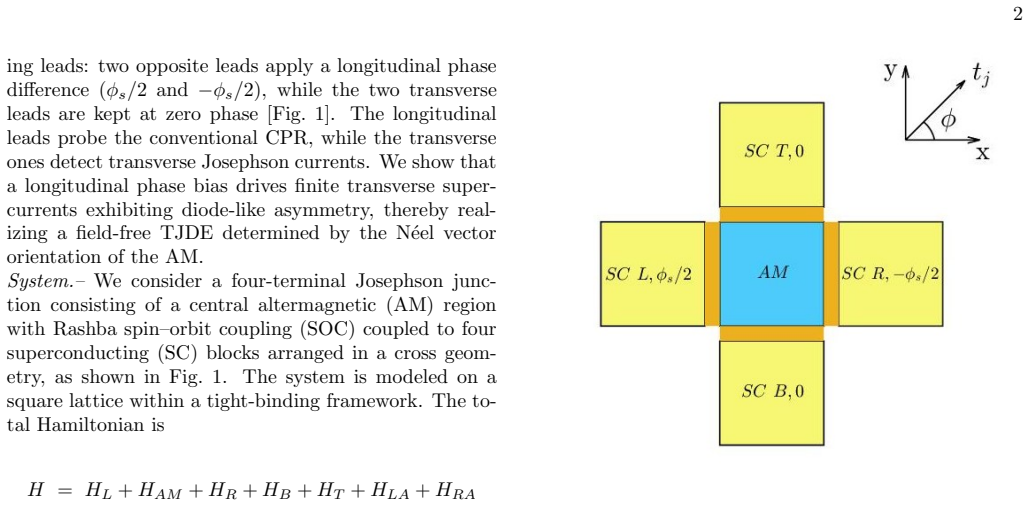
The authors predict that altermagnets with Rashba spin-orbit coupling in four-terminal Josephson junctions support a transverse Josephson diode effect that remains field-free, where a longitudinal phase bias generates nonreciprocal transverse supercurrents and a finite anomalous phase shift, while the longitudinal current itself shows a Josephson diode effect, with both responses tunable via the Néel vector orientation and diode efficiencies exceeding 3000 percent, and the effect robust against moderate disorder and imperfect interfaces.
What carries the argument
The four-terminal Josephson junction geometry that combines altermagnetic order with Rashba spin-orbit coupling, allowing nonreciprocal transverse supercurrents to emerge directly from the microscopic Hamiltonian and to be controlled by the Néel vector.
If this is right
- Unidirectional transverse supercurrents appear without external magnetic fields.
- Diode efficiencies reach values exceeding 3000 percent.
- Both transverse and longitudinal responses remain tunable by the Néel vector orientation.
- The nonreciprocity persists under moderate disorder and imperfect interfaces.
Where Pith is reading between the lines
- The combination could support field-free nonreciprocal elements in superconducting circuits for low-dissipation electronics.
- Similar transverse nonreciprocity may occur in other antiferromagnetic systems that also carry strong spin-orbit effects.
- Measuring the asymmetry in transverse current as a function of Néel vector angle in fabricated devices would directly test the prediction.
Load-bearing premise
Rashba spin-orbit coupling can be combined with altermagnetic order in the four-terminal Josephson geometry such that the transverse supercurrent nonreciprocity emerges robustly from the microscopic Hamiltonian without requiring fine-tuned parameters or external fields.
What would settle it
Fabricating a four-terminal Josephson junction on an altermagnet with Rashba spin-orbit coupling and measuring whether the transverse current-voltage curve shows nonreciprocity with efficiency above 3000 percent in the complete absence of magnetic fields.
Figures


read the original abstract
We predict a field-free transverse Josephson diode effect in altermagnets (AMs) with Rashba spin--orbit coupling, achieving diode efficiencies exceeding $3000\%$ and unidirectional transverse supercurrents in four-terminal junctions. In this geometry, a longitudinal phase bias generates transverse supercurrents that exhibit nonreciprocity and a finite anomalous phase shift, while the longitudinal current itself displays a Josephson diode effect. Both responses are tunable via the N\'eel vector orientation. We further show that the effect remains robust against moderate disorder and imperfect interfaces. These results establish AMs as a promising platform for nonreciprocal superconducting transport, with clear routes toward experimental realization.
Editorial analysis
A structured set of objections, weighed in public.
Referee Report
Summary. The manuscript presents a theoretical study of four-terminal Josephson junctions incorporating altermagnets with Rashba spin-orbit coupling. It predicts a field-free transverse Josephson diode effect featuring diode efficiencies exceeding 3000%, unidirectional transverse supercurrents, nonreciprocity accompanied by an anomalous phase shift, a conventional Josephson diode effect in the longitudinal channel, and tunability by Néel-vector orientation. The predictions are obtained from a microscopic Hamiltonian and are reported to remain robust under moderate disorder and imperfect interfaces.
Significance. If the central predictions hold, the work identifies altermagnets as a promising platform for field-free nonreciprocal superconducting transport with exceptionally high efficiencies. The explicit microscopic derivation, demonstration of Néel-vector tunability, and numerical checks of robustness to disorder constitute clear strengths that could guide experimental efforts in mesoscopic superconductivity and spintronics.
minor comments (3)
- [Results section] The precise definition of diode efficiency (e.g., the ratio of critical currents or the normalized form used to obtain values >3000%) should be stated explicitly in the main text or methods, together with the corresponding equation.
- [Figure 2 and Figure 3] Figure captions for the current-phase relations and efficiency plots would benefit from indicating the specific values of the Rashba strength, altermagnetic exchange, and junction lengths employed in the calculations.
- [Introduction] A brief comparison with existing literature on altermagnetic Josephson junctions or Rashba-based diodes would help situate the reported efficiencies and the transverse geometry.
Simulated Author's Rebuttal
We thank the referee for their positive and constructive report, which accurately summarizes our main results on the field-free transverse Josephson diode effect in altermagnets. We appreciate the recommendation for minor revision and the recognition of the microscopic derivation, Néel-vector tunability, and robustness checks as strengths. No specific major comments were raised in the report, so we outline our planned minor revisions below and confirm that all points can be addressed.
Circularity Check
No significant circularity; derivation self-contained from Hamiltonian
full rationale
The paper constructs a microscopic Bogoliubov-de Gennes Hamiltonian for a four-terminal Josephson junction incorporating altermagnetic exchange and Rashba SOC, then computes the transverse supercurrent and diode efficiency by direct numerical solution of the scattering problem or BdG equations. No parameters are fitted to the target observables; the reported >3000% efficiencies and field-free nonreciprocity follow from the model equations without self-definition or renaming of known results. Self-citations, if present, are not load-bearing for the central prediction. The derivation is therefore independent and falsifiable against external benchmarks.
Axiom & Free-Parameter Ledger
axioms (1)
- domain assumption Standard mean-field treatment of superconductivity in the presence of altermagnetic order and Rashba spin-orbit coupling
Lean theorems connected to this paper
-
IndisputableMonolith/Cost/FunctionalEquation.leanwashburn_uniqueness_aczel unclear?
unclearRelation between the paper passage and the cited Recognition theorem.
The central AM region with SOC is described in momentum space by Hk = ϵk σ0 + 2 tj (cos kx a − cos ky a) σϕ + α (σx sin ky a − σy sin kx a)
What do these tags mean?
- matches
- The paper's claim is directly supported by a theorem in the formal canon.
- supports
- The theorem supports part of the paper's argument, but the paper may add assumptions or extra steps.
- extends
- The paper goes beyond the formal theorem; the theorem is a base layer rather than the whole result.
- uses
- The paper appears to rely on the theorem as machinery.
- contradicts
- The paper's claim conflicts with a theorem or certificate in the canon.
- unclear
- Pith found a possible connection, but the passage is too broad, indirect, or ambiguous to say the theorem truly supports the claim.
Forward citations
Cited by 1 Pith paper
-
Geometry induced net spin polarization of $d$-wave altermagnets
Rectangular d-wave altermagnets acquire net spin polarization from geometry-induced imbalance in occupied spin states via anisotropic Fermi contours and finite-size k-space sampling, vanishing when Lx equals Ly or in ...
Reference graph
Works this paper leans on
-
[1]
Josephson, Possible new effects in superconductive tunnelling, Phys
B. Josephson, Possible new effects in superconductive tunnelling, Phys. Lett.1, 251 (1962)
work page 1962
-
[2]
A. Furusaki, Josephson current carried by andreev lev- els in superconducting quantum point contacts, Super- lattices Microstruct.25, 809 (1999)
work page 1999
-
[3]
F. Ando, Y. Miyasaka, T. Li, J. Ishizuka, T. Arakawa, Y. Shiota, T. Moriyama, and T. Ono, Observation of 5 superconducting diode effect, Nature584, 373 (2020)
work page 2020
-
[4]
C. Baumgartner, L. Fuchs, A. Costa, J. Pic´ o-Cort´ es, S. Reinhardt, S. Gronin, G. C. Gardner, T. Lindemann, M. J. Manfra, P. E. Faria Junior, D. Kochan, J. Fabian, N. Paradiso, and C. Strunk, Effect of rashba and dres- selhaus spin–orbit coupling on supercurrent rectification and magnetochiral anisotropy of ballistic Josephson junc- tions, J. Phys. : Co...
work page 2022
- [5]
- [6]
- [7]
-
[8]
B. Lu, S. Ikegaya, P. Burset, Y. Tanaka, and N. Nagaosa, Tunable josephson diode effect on the surface of topolog- ical insulators, Phys. Rev. Lett.131, 096001 (2023)
work page 2023
-
[9]
D. Margineda, J. S. Claydon, F. Qejvanaj, and C. Check- ley, Observation of anomalous josephson effect in nonequilibrium Andreev interferometers, Phys. Rev. B 107, L100502 (2023)
work page 2023
-
[10]
J. H. Correa and M. P. Nowak, Theory of universal diode effect in three-terminal Josephson junctions, Sci- Post Phys.17, 037 (2024)
work page 2024
-
[11]
S. Mondal, P.-H. Fu, and J. Cayao, Josephson diode effect with Andreev and Majorana bound states, arXiv:2503.08318 (2025)
-
[12]
L. ˇSmejkal, R. Gonz´ alez-Hern´ andez, T. Jungwirth, and J. Sinova, Crystal time-reversal symmetry breaking and spontaneous hall effect in collinear antiferromagnets, Sci. Adv.6, eaaz8809 (2020)
work page 2020
-
[13]
I. I. Mazin, K. Koepernik, M. D. Johannes, R. Gonz´ alez- Hern´ andez, and L.ˇSmejkal, Prediction of unconventional magnetism in doped FeSb2, Proc. Natl. Acad. Sci. U.S.A. 118, e2108924118 (2021)
work page 2021
- [14]
-
[15]
L. ˇSmejkal, J. Sinova, and T. Jungwirth, Emerging re- search landscape of altermagnetism, Phys. Rev. X12, 040501 (2022)
work page 2022
-
[16]
L. ˇSmejkal, A. B. Hellenes, R. Gonz´ alez-Hern´ andez, J. Sinova, and T. Jungwirth, Giant and tunneling mag- netoresistance in unconventional collinear antiferromag- nets with nonrelativistic spin-momentum coupling, Phys. Rev. X12, 011028 (2022)
work page 2022
-
[17]
L. Bai, W. Feng, S. Liu, L. ˇSmejkal, Y. Mokrousov, and Y. Yao, Altermagnetism: Exploring new frontiers in mag- netism and spintronics, Adv. Funct. Mater.34, 2409327 (2024)
work page 2024
- [18]
- [19]
-
[20]
C. Sun, A. Brataas, and J. Linder, Andreev reflection in altermagnets, Phys. Rev. B108, 054511 (2023)
work page 2023
-
[21]
Papaj, Andreev reflection at the altermagnet- superconductor interface, Phys
M. Papaj, Andreev reflection at the altermagnet- superconductor interface, Phys. Rev. B108, L060508 (2023)
work page 2023
- [22]
-
[23]
S.-B. Zhang, L.-H. Hu, and T. Neupert, Finite- momentum Cooper pairing in proximitized altermagnets, Nat. Commun.15, 1801 (2024)
work page 2024
-
[24]
J. A. Ouassou, A. Brataas, and J. Linder, dc Joseph- son effect in altermagnets, Phys. Rev. Lett.131, 076003 (2023)
work page 2023
-
[25]
C. W. J. Beenakker and T. Vakhtel, Phase-shifted An- dreev levels in an altermagnet Josephson junction, Phys. Rev. B108, 075425 (2023)
work page 2023
-
[26]
D. Chakraborty and A. M. Black-Schaffer, Zero-field finite-momentum and field-induced superconductivity in altermagnets, Phys. Rev. B110, L060508 (2024)
work page 2024
-
[27]
Q. Cheng and Q.-F. Sun, Orientation- dependent Josephson effect in spin-singlet superconductor/altermagnet/spin-triplet supercon- ductor junctions, Phys. Rev. B109, 024517 (2024)
work page 2024
-
[28]
B. Lu, K. Maeda, H. Ito, K. Yada, and Y. Tanaka,φ Josephson junction induced by altermagnetism, Phys. Rev. Lett.133, 226002 (2024)
work page 2024
-
[29]
S. Banerjee and M. S. Scheurer, Altermagnetic supercon- ducting diode effect, Phys. Rev. B110, 024503 (2024)
work page 2024
-
[30]
L. Sharma and M. Thakurathi, Tunable Josephson diode effect in singlet superconductor-altermagnet-triplet superconductor junctions, Phys. Rev. B112, 104506 (2025)
work page 2025
-
[31]
C. Goldberg and R. E. Davis, New galvanomagnetic ef- fect, Phys. Rev.94, 1121 (1954)
work page 1954
-
[32]
H. X. Tang, R. K. Kawakami, D. D. Awschalom, and M. L. Roukes, Giant planar Hall effect in epitaxial (Ga,Mn)As devices, Phys. Rev. Lett.90, 107201 (2003)
work page 2003
- [33]
-
[34]
A. Annadi, Z. Huang, K. Gopinadhan, X. R. Wang, A. Srivastava, Z. Q. Liu, H. H. Ma, T. P. Sarkar, T. Venkatesan, and Ariando, Fourfold oscillation in anisotropic magnetoresistance and planar Hall effect at the LaAlO 3/SrTiO3 heterointerfaces: Effect of carrier confinement and electric field on magnetic interactions, Phys. Rev. B87, 201102 (2013)
work page 2013
-
[35]
A. A. Taskin, H. F. Legg, F. Yang, S. Sasaki, Y. Kanai, K. Matsumoto, A. Rosch, and Y. Ando, Planar Hall effect from the surface of topological insulators, Nat. Commun. 8, 1340 (2017)
work page 2017
-
[36]
D. Suri and A. Soori, Finite transverse conductance in topological insulators under an applied in-plane magnetic field, J. Phys.: Condens. Matter33, 335301 (2021)
work page 2021
-
[37]
A. Soori, Finite transverse conductance and anisotropic magnetoconductance under an applied in-plane mag- netic field in two-dimensional electron gases with strong spin–orbit coupling, J. Phys.: Condens. Matter33, 335303 (2021)
work page 2021
-
[38]
B. K. Sahoo and A. Soori, Transverse currents in spin transistors, J. Phys.: Condens. Matter35, 365302 (2023)
work page 2023
- [39]
-
[40]
E. V. Bezuglyi, A. S. Rozhavsky, I. D. Vagner, and P. Wyder, Combined effect of Zeeman split- 6 ting and spin-orbit interaction on the Josephson cur- rent in a superconductor–two-dimensional electron gas– superconductor structure, Phys. Rev. B66, 052508 (2002)
work page 2002
-
[41]
A. Rasmussen, J. Danon, H. Suominen, F. Nichele, M. Kjaergaard, and K. Flensberg, Effects of spin-orbit coupling and spatial symmetries on the Josephson cur- rent in SNS junctions, Phys. Rev. B93, 155406 (2016)
work page 2016
-
[42]
O. Maistrenko, B. Scharf, D. Manske, and E. M. Han- kiewicz, Planar Josephson Hall effect in topological Josephson junctions, Phys. Rev. B103, 054508 (2021)
work page 2021
-
[43]
Zeng, Transverse josephson diode effect in tilted dirac systems, Phys
W. Zeng, Transverse josephson diode effect in tilted dirac systems, Phys. Rev. Lett.134, 176002 (2025)
work page 2025
-
[44]
B. K. Sahoo and A. Soori, Four-terminal josephson junc- tions: diode effects, anomalous currents and transverse currents, J. Phys.: Condens. Matter37, 305302 (2025)
work page 2025
-
[45]
N. Pankratova, H. Lee, R. Kuzmin, K. Wickramas- inghe, W. Mayer, J. Yuan, M. G. Vavilov, J. Shabani, and V. E. Manucharyan, Multiterminal Josephson effect, Phys. Rev. X10, 031051 (2020)
work page 2020
- [46]
- [47]
-
[48]
H. G. Le Duc, W. J. Kaiser, and J. A. Stern, Energy- gap spectroscopy of superconductors using a tunneling microscope, Appl. Phys. Lett.50, 1921 (1987)
work page 1921
-
[49]
G. S. Diniz and E. Vernek, Suppressed Kondo screen- ing in two-dimensional altermagnets, Phys. Rev. B109, 155127 (2024)
work page 2024
-
[50]
H.-R. Li, F. Lin, L. Li, D.-H. Xu, and J.-H. Sun, Kondo screening cloud ind-wave altermagnetic metal with cu- bic Rashba spin-orbit effect, Phys. Rev. B111, 245150 (2025)
work page 2025
-
[51]
W. Chen, L. Zeng, and W. Zhu, Helicity-controlled spin Hall angle in 2D altermagnets with Rashba spin-orbit coupling, Chin. Phys. Lett.42, 017201 (2025)
work page 2025
-
[52]
H. Reichlov´ a, R. L. Seeger, R. Gonz´ alez-Hern´ andez, I. Kounta, R. Schlitz, D. Kriegner, P. Ritzinger, M. Lammel, M. Leivisk¨ a, V. Petˇ r´ ıˇ cek, P. Doleˇ zal, E. Schmoranzerov´ a, A. Bad’ura, A. Thomas, V. Baltz, L. Michez, J. Sinova, S. T. B. Goennenwein, T. Jung- wirth, and L. ˇSmejkal, Macroscopic time reversal symme- try breaking by staggered s...
- [53]
-
[54]
G. Els, P. Lemmens, P. van Loosdrecht, G. G¨ untherodt, H. Lang, V. Thommen-Geiser, and H.-J. G¨ untherodt, De- termination of the superconducting energy gap ofRb 3C60 by electronic raman scattering, Physica C: Supercond. 307, 79 (1998)
work page 1998
- [55]
-
[56]
S. M. Frolov, D. J. Van Harlingen, V. A. Oboznov, V. V. Bolginov, and V. V. Ryazanov, Measure- ment of the current-phase relation of superconduc- tor/ferromagnet/superconductorπJosephson junctions, Phys. Rev. B70, 144505 (2004)
work page 2004
-
[57]
J. A. Glick, V. Aguilar, A. B. Gougam, B. M. Niedziel- ski, E. C. Gingrich, R. Loloee, W. P. Pratt, and N. O. Birge, Phase control in a spin-triplet squid, Sci. Adv.4, eaat9457 (2018). 7 Appendix A: Hamiltonian Different contributions to the Hamiltonian in eq. (1) are summarized below. HL = Lx s −1X nx=1 Ly saX ny=Ly s +1 h −t 0(Ψ† nx+1,ny τzΨnx,ny +h.c.)...
work page 2018
discussion (0)
Sign in with ORCID, Apple, or X to comment. Anyone can read and Pith papers without signing in.