Studying the thermoelectric properties of an anisotropic QGP medium
Pith reviewed 2026-05-18 00:34 UTC · model grok-4.3
The pith
Expansion-induced anisotropy increases the Seebeck coefficient in the quark-gluon plasma, producing a stronger induced electric field than in the isotropic case.
A machine-rendered reading of the paper's core claim, the machinery that carries it, and where it could break.
Core claim
In the presence of expansion-induced anisotropy, the magnitude of the Seebeck coefficient for each quark flavor and for the entire QGP medium increases, indicating a stronger induced electric field compared to the isotropic case.
What carries the argument
Solution of the relativistic Boltzmann transport equation in the relaxation time approximation, with partonic interactions included through effective thermal masses in the quasiparticle model for an anisotropic medium.
If this is right
- The induced electric field per unit temperature gradient is larger in the anisotropic medium than in the isotropic one.
- Charge asymmetries in particle distributions may become observable signatures of the anisotropy.
- Transport coefficients of the QGP receive modifications that affect its overall evolution.
- Phenomenological studies of QGP internal structure and phase properties gain new constraints from the anisotropic thermoelectric response.
Where Pith is reading between the lines
- The result suggests that early-stage hydrodynamic models should track thermoelectric fields when anisotropy is present, potentially altering predicted flow patterns.
- Lattice calculations of anisotropic media could be compared directly with the quasiparticle Seebeck values to test the effective-mass assumption.
- Experimental searches for charge-dependent particle correlations at RHIC or LHC energies might be reinterpreted in light of an enhanced Seebeck coefficient.
Load-bearing premise
The anisotropy is introduced by modeling the asymptotic expansion of matter in the initial stage and the interactions are captured by effective thermal masses inside the quasiparticle framework.
What would settle it
Observation of charge asymmetries or thermoelectric signals in heavy-ion collision data that remain unchanged or decrease when anisotropy parameters are varied would contradict the reported increase in the Seebeck coefficient.
Figures

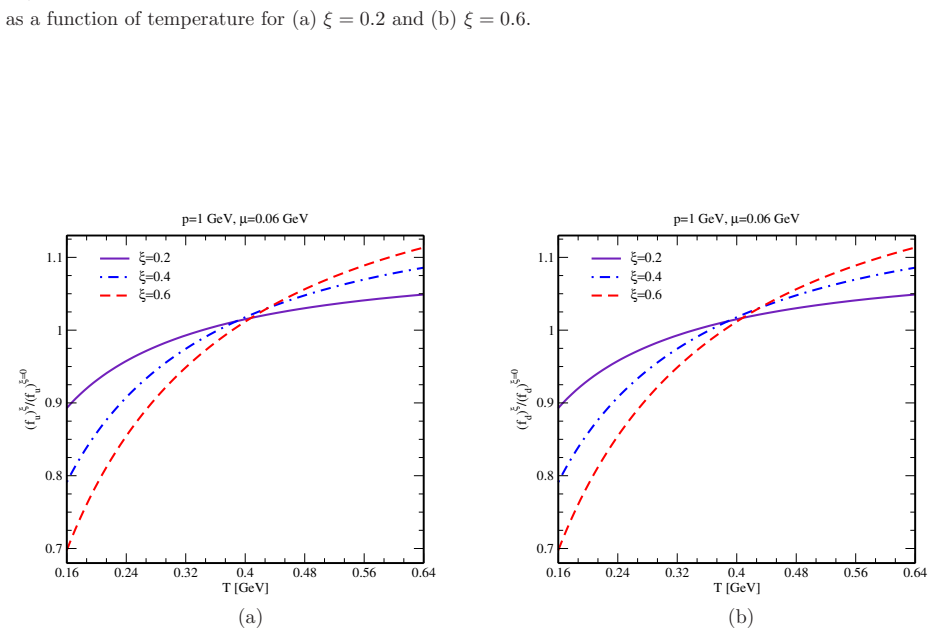


read the original abstract
We have studied how the thermoelectric properties of the quark-gluon plasma (QGP) are affected by a weak-momentum anisotropy arising from the asymptotic expansion of matter in the initial stages of ultrarelativistic heavy-ion collisions. The highly energetic medium produced in such collisions exhibits a notable temperature difference between its central and peripheral regions. This temperature gradient induces an electric field whose magnitude per unit temperature gradient, in the limit of vanishing electric current, defines the Seebeck coefficient of the medium. We have calculated the Seebeck coefficient for both individual quark flavors and the entire QGP medium in the presence of expansion-induced anisotropy by solving the relativistic Boltzmann transport equation in the relaxation time approximation within the kinetic theory framework. The partonic interactions are incorporated through their effective thermal masses within the quasiparticle model for an anisotropic QGP medium. We have observed that the magnitude of the Seebeck coefficient for each quark flavor as well as for the entire QGP medium increases in the presence of expansion-induced anisotropy, indicating a stronger induced electric field in the anisotropic medium compared to the isotropic case. Given that an increase in the Seebeck coefficient may lead to observable signatures such as charge asymmetries in particle distributions and to modifications in the transport behavior of the QGP, these results may provide useful input for future phenomenological studies investigating the internal structure and phase properties of the QGP in heavy-ion collisions.
Editorial analysis
A structured set of objections, weighed in public.
Referee Report
Summary. The paper calculates the Seebeck coefficient of a weakly momentum-anisotropic quark-gluon plasma by solving the relativistic Boltzmann equation in the relaxation-time approximation. Anisotropy is introduced via an expansion-induced parameter ξ in the background distribution, while partonic interactions enter through effective thermal masses in a quasiparticle model. The central claim is that the magnitude of the Seebeck coefficient (defined from the J=0 limit of the induced electric field per temperature gradient) increases for each quark flavor and for the full medium relative to the isotropic case.
Significance. If the result is robust, the work supplies a concrete prediction for how early-stage expansion anisotropy modifies thermoelectric transport in QGP, which could inform phenomenological searches for charge asymmetries or altered flow patterns in heavy-ion collisions. The calculation is grounded in standard kinetic theory and provides a falsifiable trend with the anisotropy strength.
major comments (1)
- [§2 and Boltzmann-equation section] §2 (quasiparticle model) and the subsequent Boltzmann-equation section: the effective thermal masses are stated to be those of the quasiparticle model for an anisotropic medium, yet the dispersion relation E(p,ξ) appears to retain the standard isotropic form m_q²(T) = g²T²/6 (or equivalent) while anisotropy enters only through the background distribution f₀(p,ξ). Because the Seebeck coefficient is obtained from integrals involving both the distribution deviation δf and the energy-momentum relation, an isotropic dispersion combined with an anisotropic f₀ risks an inconsistent thermoelectric response; this modeling choice is load-bearing for the claim that the coefficient increases with ξ.
minor comments (2)
- [Numerical results] The relaxation time is taken from the isotropic case; a brief discussion of its possible ξ dependence would clarify the robustness of the numerical results.
- [Introduction and definitions] Notation for the anisotropy parameter ξ and the direction of the temperature gradient should be made explicit in the definition of the Seebeck coefficient to avoid ambiguity when comparing to isotropic limits.
Simulated Author's Rebuttal
We thank the referee for the thorough review and valuable comments on our manuscript. We have carefully addressed the major concern regarding the consistency of the dispersion relation and background distribution in the quasiparticle model for the anisotropic QGP. Our point-by-point response follows, along with the revisions incorporated into the updated manuscript.
read point-by-point responses
-
Referee: [§2 and Boltzmann-equation section] §2 (quasiparticle model) and the subsequent Boltzmann-equation section: the effective thermal masses are stated to be those of the quasiparticle model for an anisotropic medium, yet the dispersion relation E(p,ξ) appears to retain the standard isotropic form m_q²(T) = g²T²/6 (or equivalent) while anisotropy enters only through the background distribution f₀(p,ξ). Because the Seebeck coefficient is obtained from integrals involving both the distribution deviation δf and the energy-momentum relation, an isotropic dispersion combined with an anisotropic f₀ risks an inconsistent thermoelectric response; this modeling choice is load-bearing for the claim that the coefficient increases with ξ.
Authors: We thank the referee for this insightful observation on the modeling consistency. In the quasiparticle model employed for the anisotropic QGP, the effective thermal mass m(T,ξ) is obtained self-consistently from the gap equation that integrates over the anisotropic distribution f₀(p,ξ), following the standard formulation used in the literature for weakly anisotropic media. The dispersion relation then takes the form E(p,ξ) = √(p² + m(T,ξ)²), so that anisotropy enters the energy-momentum relation through the ξ-dependent mass while the momentum dependence remains isotropic—an approximation justified for small ξ as in our expansion-induced anisotropy setup. This ensures that both δf (solved from the Boltzmann equation with anisotropic f₀) and the dispersion are treated within the same framework. To eliminate any ambiguity, we have revised §2 to explicitly derive the effective mass from the anisotropic integrals and added a paragraph clarifying the validity of this approach for weak anisotropy. The Seebeck coefficient integrals remain consistent, and the reported increase with ξ arises from the combined effects on the distribution, relaxation time, and mass. We believe this addresses the concern without changing the central results. revision: yes
Circularity Check
No significant circularity in the derivation chain
full rationale
The paper computes the Seebeck coefficient by solving the relativistic Boltzmann transport equation in the relaxation time approximation for an anisotropic QGP using the quasiparticle model. Anisotropy enters through the distribution function derived from asymptotic expansion, while effective thermal masses are incorporated per the model description. The reported increase in Seebeck coefficient magnitude follows from explicit evaluation of the current integrals in the J=0 limit and is not equivalent to the input parameters or definitions by construction. No load-bearing self-citations, fitted inputs renamed as predictions, or ansatz smuggling are present in the provided derivation outline; the result remains independently falsifiable via the transport solution and comparison to the isotropic case.
Axiom & Free-Parameter Ledger
free parameters (1)
- anisotropy strength parameter
axioms (2)
- domain assumption The relaxation time approximation is valid for solving the Boltzmann transport equation in this context.
- domain assumption Partonic interactions are captured by temperature-dependent effective thermal masses in the quasiparticle model.
Lean theorems connected to this paper
-
IndisputableMonolith/Cost/FunctionalEquation.leanwashburn_uniqueness_aczel unclear?
unclearRelation between the paper passage and the cited Recognition theorem.
We have calculated the Seebeck coefficient ... by solving the relativistic Boltzmann transport equation in the relaxation time approximation within the kinetic theory framework. The partonic interactions are incorporated through their effective thermal masses within the quasiparticle model for an anisotropic QGP medium.
-
IndisputableMonolith/Foundation/AlphaCoordinateFixation.leanJ_uniquely_calibrated_via_higher_derivative unclear?
unclearRelation between the paper passage and the cited Recognition theorem.
m_fT^ξ = m_fT + ξ g²/3π² ∫ dp p [fg + ½(ff + f̄f)] − ...
What do these tags mean?
- matches
- The paper's claim is directly supported by a theorem in the formal canon.
- supports
- The theorem supports part of the paper's argument, but the paper may add assumptions or extra steps.
- extends
- The paper goes beyond the formal theorem; the theorem is a base layer rather than the whole result.
- uses
- The paper appears to rely on the theorem as machinery.
- contradicts
- The paper's claim conflicts with a theorem or certificate in the canon.
- unclear
- Pith found a possible connection, but the passage is too broad, indirect, or ambiguous to say the theorem truly supports the claim.
Forward citations
Cited by 1 Pith paper
-
Electromagnetic response of a relativistic drifting plasma
Time-dependent electric fields in relativistic drifting plasma induce polarization drift that modifies the induced current structure, with quantitative estimates of Hall and polarization contributions provided for the...
Reference graph
Works this paper leans on
-
[1]
P. Braun-Munzinger and J. Stachel, Particle ratios, equilibration and the QCD phase boundary, J. Phys. G: Nucl. Part. Phys. 28, 1971 (2002)
work page 1971
-
[2]
Cleymans, Rapidity and energy dependence of thermal parameters , J
J. Cleymans, Rapidity and energy dependence of thermal parameters , J. Phys. G: Nucl. Part. Phys. 35, 044017 (2008)
work page 2008
-
[3]
A. Andronic et al. , Hadron production in ultra-relativistic nuclear collisio ns: Quarky- onic matter and a triple point in the phase diagram of QCD , Nucl. Phys. A 837, 65 (2010)
work page 2010
-
[4]
K. Fukushima and Y. Hidaka, Magnetic Shift of the Chemical Freeze-out and Electric Charge Fluctuations , Phys. Rev. Lett. 117, 102301 (2016)
work page 2016
-
[5]
S. Rath and B. K. Patra, Effect of magnetic field on the charge and thermal transport properties of hot and dense QCD matter , Eur. Phys. J. C 80, 747 (2020)
work page 2020
-
[6]
S. Rath and B. K. Patra, Viscous properties of hot and dense QCD matter in the presence of a magnetic field , Eur. Phys. J. C 81, 139 (2021)
work page 2021
-
[7]
S. Rath and S. Dash, Momentum transport properties of a hot and dense QCD matter in a weak magnetic field , Eur. Phys. J. C 82, 797 (2022)
work page 2022
-
[8]
S. Rath and S. Dash, Effects of weak magnetic field and finite chemical potential on the transport of charge and heat in hot QCD matter , Eur. Phys. J. A 59, 25 (2023)
work page 2023
-
[9]
A. Dumitru, Y. Guo and M. Strickland, The heavy-quark potential in an anisotropic plasma, Phys. Lett. B 662, 37 (2008)
work page 2008
-
[10]
A. Dumitru, Y. Guo, ´A. M´ ocsy and M. Strickland, Quarkonium states in an anisotropic QCD plasma , Phys. Rev. D 79, 054019 (2009)
work page 2009
-
[11]
M. Martinez and M. Strickland, Pre-equilibrium dilepton production from an anisotropic quark-gluon plasma , Phys. Rev. C 78, 034917 (2008)
work page 2008
- [12]
-
[13]
R. Ryblewski and M. Strickland, Dilepton production from the quark-gluon plasma using (3+1)-dimensional anisotropic dissipative hydrody namics, Phys. Rev. D 92, 025026 (2015)
work page 2015
-
[14]
A. Mukherjee, M. Mandal and P. Roy, Jet-dilepton conversion from an anisotropic quark-gluon plasma , Eur. Phys. J. A 53, 81 (2017). 19
work page 2017
-
[15]
S. Rath and B. K. Patra, Revisit to electrical and thermal conductivities, Lorenz a nd Knudsen numbers in thermal QCD in a strong magnetic field , Phys. Rev. D 100, 016009 (2019)
work page 2019
-
[16]
S. Rath and B. K. Patra, Momentum and its affiliated transport coefficients for hot QCD matter in a strong magnetic field , Phys. Rev. D 102, 036011 (2020)
work page 2020
-
[17]
S. Rath, Anisotropic modifications to the transport phenomena and ob servables in a hot QCD medium at finite baryon asymmetry , arXiv:2508.04934 [hep-ph]
-
[18]
T. Scheidemantel, C. Ambrosch-Draxl, T. Thonhauser, J. Bad ding and J. Sofo, Trans- port coefficients from first-principles calculations , Phys. Rev. B 68, 125210 (2003)
work page 2003
-
[19]
H. B. Callen, Thermodynamics and an introduction to thermostatistics , second edi- tion, chapter 14, John Wiley & sons, 1985
work page 1985
-
[20]
J. R. Bhatt, A. Das and H. Mishra, Thermoelectric effect and Seebeck coefficient for hot and dense hadronic matter , Phys. Rev. D 99, 014015 (2019)
work page 2019
-
[21]
A. Abhishek, A. Das, D. Kumar and H. Mishra, Thermoelectric transport coefficients of quark matter , Eur. Phys. J. C 82, 71 (2022)
work page 2022
- [22]
- [23]
-
[24]
M. Kurian, Thermoelectric behavior of hot collisional and magnetized QCD medium from an effective kinetic theory , Phys. Rev. D 103, 054024 (2021)
work page 2021
-
[25]
H. X. Zhang, J. W. Kang and B. W. Zhang, Thermoelectric properties of the (an- )isotropic QGP in magnetic fields , Eur. Phys. J. C 81, 623 (2021)
work page 2021
- [26]
-
[27]
S. A. Khan and B. K. Patra, Seebeck and Nernst coefficients of a magnetized hot QCD medium with a number conserving kernel , Phys. Rev. D 107, 074034 (2023)
work page 2023
- [28]
-
[29]
P. Romatschke and M. Strickland, Collective modes of an anisotropic quark-gluon plasma, Phys. Rev. D 68, 036004 (2003). 20
work page 2003
-
[30]
P. Romatschke and M. Strickland, Collective modes of an anisotropic quark-gluon plasma: II , Phys. Rev. D 70, 116006 (2004)
work page 2004
-
[31]
A. Hosoya and K. Kajantie, Transport coefficients of QCD matter , Nucl. Phys. B 250, 666 (1985)
work page 1985
-
[32]
V. Goloviznin and H. Satz, The refractive properties of the gluon plasma in SU(2) gauge theory, Z. Phys. C 57, 671 (1993)
work page 1993
-
[33]
A. Peshier, B. K¨ ampfer, O. P. Pavlenko and G. Soff, Massive quasiparticle model of the SU(3) gluon plasma , Phys. Rev. D 54, 2399 (1996)
work page 1996
-
[34]
A. Peshier, B. K¨ ampfer and G. Soff, From QCD lattice calculations to the equation of state of quark matter , Phys. Rev. D 66, 094003 (2002)
work page 2002
- [35]
- [36]
-
[37]
V. M. Bannur, Revisiting the quasi-particle model of the quark-gluon pla sma, Eur. Phys. J. C 50, 629 (2007)
work page 2007
-
[38]
V. M. Bannur, Quasi-particle model for QGP with nonzero densities , J. High Energy Phys. 0709, 046 (2007)
work page 2007
-
[39]
P. F. Kelly, Q. Liu, C. Lucchesi and C. Manuel, Classical transport theory and hard thermal loops in the quark-gluon plasma , Phys. Rev. D 50, 4209 (1994)
work page 1994
-
[40]
D. F. Litim and C. Manuel, Semi-classical transport theory for non-abelian plasmas , Phys. Rep. 364, 451 (2002)
work page 2002
-
[41]
E. Braaten and R. D. Pisarski, Simple effective Lagrangian for hard thermal loops , Phys. Rev. D 45, R1827 (1992)
work page 1992
-
[42]
J.-P. Blaizot, A. Ipp, A. Rebhan and U. Reinosa, Asymptotic thermal quark masses and the entropy of QCD in the large- Nf limit, Phys. Rev. D 72, 125005 (2005)
work page 2005
-
[43]
H. Berrehrah, E. Bratkovskaya, W. Cassing, P. B. Gossiaux, J. Aichelin and M. Bleicher, Collisional processes of on-shell and off-shell heavy quark s in vacuum and in the quark-gluon plasma , Phys. Rev. C 89, 054901 (2014)
work page 2014
-
[44]
J. I. Kapusta and C. Gale, Finite Temperature Field Theory Principles and Applica- tions, Cambridge University Press, 2006. 21
work page 2006
discussion (0)
Sign in with ORCID, Apple, or X to comment. Anyone can read and Pith papers without signing in.