REVIEW 3 major objections 5 minor 1 cited by
This paper claims that environment and policy co-design can scale with a critic-guided diffusion model, delivering gains up to 39% with 66% fewer samples.
Reviewed by Pith at T0; open to challenge. T0 means a machine referee read the full paper against a public rubric. the ladder, T0–T4 →
A diffusion-guided co-design framework (DiCoDe) outperforms prior environment-policy co-optimisation methods in warehouse, wind-farm, and navigation tasks, using fewer simulation samples.
T0 review reviewed 2026-08-03 challenge →
load-bearing objection DiCoDe is a plausible and well-ablated diffusion-based co-design method whose headline sample-efficiency number is misleading as framed, but the underlying contribution likely holds up after a comparison-protocol fix. the 3 major comments →
Scaling Multi-Agent Environment Co-Design with Diffusion Models
The pith
A machine-rendered reading of the paper's core claim, the machinery that carries it, and where it could break.
The reading
Core claim
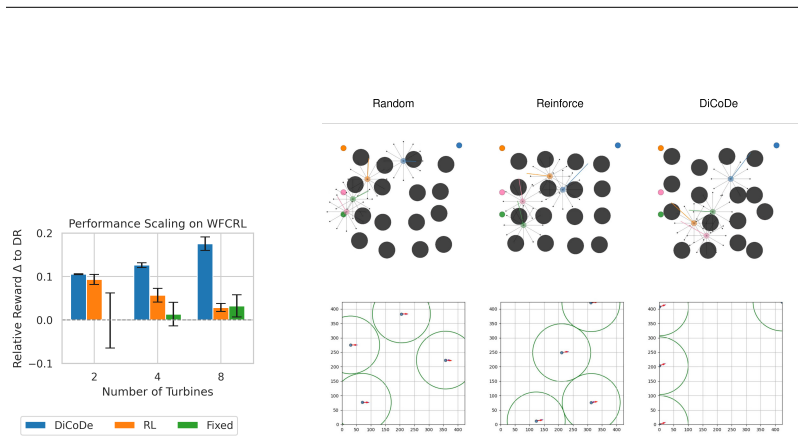
The central claim is that a pre-trained diffusion model can serve as a scalable environment generator for multi-agent co-design, provided the guidance signal is both dense and current. DiCoDe generates a distribution of reward-maximising environments by composing universal guidance with a projection operator (PUG), so every proposed layout satisfies hard constraints, and trains an environment critic by distilling the multi-agent reinforcement learning critic's value estimates onto clean environments, avoiding the noise and staleness of episode returns. The paper reports that this combination yields up to 39% higher rewards than the RL co-design baseline with 66% fewer simulation samples in a
What carries the argument
Three components carry the argument: (1) a diffusion model pre-trained on uniformly sampled valid environments, which supplies the score for plausible designs; (2) Projected Universal Guidance (PUG), a sampling procedure that steers the denoising trajectory towards high-return environments using a critic on clean predicted images and projects the predicted design back into the feasible set at each step, enforcing constraints such as obstacle separation; (3) critic distillation, which copies the agent value function's expected-return estimates for the initial state distribution into an environment critic, giving the generator a dense, low-variance, continually updated learning signal without
Load-bearing premise
The environment critic is assumed to inherit an unbiased estimate of the true expected return from the agent critic; if the agent value function is biased or stale, the guidance signal distills that bias into the environments, and the reward gains may not transfer to genuinely better environments.
What would settle it
Train DiCoDe exactly as described, then evaluate every generated environment with a fixed, independently trained reference policy (or a policy trained on uniform environments), and compare per-environment returns against the environment critic's predictions. If environments ranked high by the critic do not rank high under the reference policy, the distilled guidance is chasing a biased value estimate; a simpler variant is to compute the correlation between critic targets and true Monte-Carlo returns on a hold-out set of generated environments.
If this is right
- Co-design methods can be applied to high-dimensional environment spaces where Gaussian or evolutionary generators collapse.
- The same trajectory data can drive both agent improvement and environment improvement, removing the need to freeze one side while training the other.
- Hard physical constraints can be enforced throughout generation, so proposed designs are immediately usable in simulation or deployment.
- The method transfers across discrete mask-style layouts and continuous coordinate-style layouts, suggesting a general recipe.
- Sample complexity reductions of the reported size would make co-design feasible in real-world simulators where rollouts dominate cost.
Where Pith is reading between the lines
- The same PUG-plus-distillation recipe could be dropped into unsupervised environment design or any constrained generative design task, since neither component is specific to cooperative multi-agent reinforcement learning.
- A strong testable implication is that generated environments should also improve performance when evaluated with a frozen reference policy; if the gains only appear under the jointly trained policy, the environment critic may be overfitting to the current agent's value estimates.
- The reliance on a pre-trained uniform diffusion prior suggests that replacing the prior with a model trained on expert-designed or real-world layouts could further improve sample efficiency and realism.
- The claim that critic distillation filters rollout stochasticity could be quantified directly by comparing environment-critic targets against true returns over many seeds; the paper's own probe gives a partial version.
Editorial analysis
A structured set of objections, weighed in public.
Referee Report
Summary. The paper introduces DiCoDe, a framework for multi-agent environment co-design that combines a pre-trained diffusion model over a uniform environment prior with a novel guided-sampling procedure, Projected Universal Guidance (PUG), and a critic-distillation mechanism that transfers knowledge from the MARL critic into an environment critic. The diffusion sampler is intended to draw from a reward-maximising distribution of environments while enforcing hard constraints, and the distilled critic is meant to provide a dense and up-to-date signal that tracks policy shift. The method is evaluated on D-RWARE (warehouse automation), WFCRL (wind-farm control), and VMAS (multi-agent pathfinding), with ablations replacing PUG and the distillation target. The paper claims a 39% higher reward with 66% fewer simulation samples on the warehouse benchmark relative to a prior RL-based co-design method.
Significance. If the claims are borne out, DiCoDe is a meaningful step forward in scaling multi-agent co-design: it handles high-dimensional discrete and continuous design spaces, incorporates hard constraints through projection, and provides a dense learning signal via critic distillation. The paper explicitly ships code and evaluates on established benchmarks across multiple domains, which is a real strength. The ablation study, including DiCoDe-Descent/Sampling/ADD/MC, also helps isolate the contributions of PUG and distillation. The main risks are that the headline sample-efficiency claim is not supported by a controlled comparison, and that the theoretical derivation contains errors that need correction.
major comments (3)
- [§5, Table 1 and footnote] The 39%/66% claim is not supported by a controlled sample-complexity comparison. The Table 1 footnote states that RL* is normalised to a fixed number of policy updates and that RL requires 300% more samples per update for D-RWARE; Section 5 also states that the REINFORCE baseline 'may not have fully converged'. Thus the '66% fewer samples' conflates sample-per-update with sample complexity, and the comparison may be against an under-trained baseline. Please report learning curves against total simulator samples, or samples to reach a fixed reward threshold, and discuss baseline convergence.
- [§4.1, Eqs. (7)–(8)] The score equation is written incorrectly. Eq. (7) has ∇θt u_t(θt) rather than ∇θt log u_t(θt), and J_t(ϕ,θt)=J(ϕ,θ0) is not a function of the noised environment θt unless an expectation is taken. Eq. (8) then inserts the RHS of Eq. (7) into the reverse-time SDE with a nested gradient ∇x(∇θt u_t + ω∇θt V'), which is not the score and does not follow from Eq. (3). These appear to be notation typos, but as written the central derivation is not self-consistent; please rewrite the equations and clarify the conditioning on θt.
- [§4.3, Eq. (11)] The identity J(ϕ,θ)=E_{s0~Pθ}[Vψ(s0)] assumes the agent critic is unbiased. In MAPPO with neural function approximation and finite data this is an approximation, and if the critic is biased or stale the distilled environment critic propagates that bias into the diffusion guidance. Figure 3-right demonstrates variance reduction but does not establish unbiasedness. Please add either an explicit bias analysis or a caveat that the theoretical motivation holds only to the extent the critic is calibrated.
minor comments (5)
- [§5, figures] There are two figures numbered 'Figure 3' (the environment renderings and the critic-value/probe plots). This makes it hard to verify the PUG-vs-UG comparison; renumber figures and add captions.
- [§4.4] Typo: 'DiCode' should be 'DiCoDe'; also 'does notalternate' is missing a space.
- [§5, Table 1] The WFCRL2 row reports 490±0, i.e., zero variance over 9 seeds. Please verify this is not due to a reporting/rounding error.
- [§5, experimental setup] The phrase '20environment interactions' appears to be missing a unit (likely 20 million). Please clarify the total training budget for DiCoDe and the baselines.
- [Algorithm 1 / Appendix A.2] Algorithm 1 references Eqs. (17) and (19), which are defined only in the appendix. Cross-referencing is fine, but the main-text algorithm should be self-contained enough for a reader to understand the backward-guidance and recurrence steps.
Circularity Check
No circularity found: DiCoDe's derivation chains an explicit objective through learned surrogates, and its headline claims are empirical, not reductions to inputs.
full rationale
Section 4's derivation chain is non-circular: J is defined from rewards in Eq. 1; Eq. 6 defines the soft co-design distribution as a maximum-entropy objective; Eq. 7 gives the standard score of that objective; Eq. 8 plugs that score into the reverse diffusion SDE; PUG (Eqs. 9-10, Algorithm 1) is a sampling/projection method; and the environment critic is trained by distillation loss Eq. 12. At no point is the predicted quantity ('reward-maximising environments') defined as the output of the fitted module. The environment critic Vϑ is fitted to the agent critic Vψ (Eqs. 11-12), and final rewards are measured from the simulators, not from Vϑ. The Eq. 11 unbiased-critic assumption is a genuine correctness caveat—bias in Vψ can propagate into guidance—but an assumption is not a circular reduction. The '39% higher rewards / 66% fewer samples' headline rests on a policy-update-normalized comparison and Table 1's footnote that RL requires more samples per update at 300% for RWARE, and the paper itself concedes the Reinforce baseline 'may not have fully converged' (Section 5); these are evaluation/comparison artifacts, not circular reasoning. Self-citations (Gao & Prorok 2023; Bettini et al. 2022; Amir & Bruckstein 2025) are baselines, benchmarks, or background motivation, not load-bearing support for the derivation, and no uniqueness theorem from the authors' prior work is invoked. Section 6 explicitly disclaims theoretical guarantees. Therefore no specific circular step is present.
Axiom & Free-Parameter Ledger
free parameters (4)
- guidance weight ω =
200 (D-RWARE); 50→350 annealed (WFCRL); not stated (VMAS)
- distillation sample count Mdistill =
3
- number of recurrence steps m =
8 (RWARE); 4 (WFCRL); 8 (VMAS)
- backward guidance steps =
0 (RWARE); 16 (WFCRL); 6 (VMAS)
axioms (4)
- domain assumption Agent critic is an unbiased estimator of the value function (Eq 11).
- standard math The pretrained diffusion network approximates the score of the uniform environment distribution (Eq 7).
- domain assumption Projection PΘ maps any diffused sample to a valid environment while preserving enough gradient signal (Section 4.2).
- domain assumption The environment critic trained on clean environments can guide intermediate diffusive states via universal guidance (Section 4.2, A.2).
Cite this review
Pith. "Pith review of Scaling Multi-Agent Environment Co-Design with Diffusion Models." pith.science (2026). https://pith.science/paper/KV3XXDJE
@misc{pith2026251103100,
  author       = {Pith},
  title        = {Pith review of: Scaling Multi-Agent Environment Co-Design with Diffusion Models},
  year         = {2026},
  howpublished = {\url{https://pith.science/paper/KV3XXDJE}},
  note         = {Machine review of arXiv:2511.03100}
}
read the original abstract
The agent-environment co-design paradigm jointly optimises agent policies and environment configurations in search of improved system performance. With application domains ranging from warehouse logistics to windfarm management, co-design promises to fundamentally change how we deploy multi-agent systems. However, current co-design methods struggle to scale. They collapse under high-dimensional environment design spaces and suffer from sample inefficiency when addressing moving targets inherent to joint optimisation. We address these challenges by developing Diffusion Co-Design (DiCoDe), a scalable and sample-efficient co-design framework pushing co-design towards practically relevant settings. DiCoDe incorporates two core innovations. First, we introduce Projected Universal Guidance (PUG), a sampling technique that enables DiCoDe to explore a distribution of reward-maximising environments while satisfying hard constraints such as spatial separation between obstacles. Second, we devise a critic distillation mechanism to share knowledge from the reinforcement learning critic, ensuring that the guided diffusion model adapts to evolving agent policies using a dense and up-to-date learning signal. Together, these improvements lead to superior environment-policy pairs when validated on challenging multi-agent environment co-design benchmarks including warehouse automation, multi-agent pathfinding and wind farm optimisation. Our method consistently exceeds the state-of-the-art, achieving, for example, 39% higher rewards in the warehouse setting with 66% fewer simulation samples. This sets a new standard in agent-environment co-design, and is a stepping stone towards reaping the rewards of co-design in real world domains.
Figures




Forward citations
Cited by 1 Pith paper
-
Is Inter-Seed Cross-Play Enough? Evaluating the Robustness of Zero-Shot Coordination Algorithms to Implementation Details
For Other-Play in Yokai, agents trained with different implementation details coordinate across implementations about as well as across seeds, supporting inter-seed cross-play as a proxy for cross-implementation evaluation.
Reference graph
Works this paper leans on
-
[1]
write newline
" write newline "" before.all 'output.state := FUNCTION n.dashify 't := "" t empty not t #1 #1 substring "-" = t #1 #2 substring "--" = not "--" * t #2 global.max substring 't := t #1 #1 substring "-" = "-" * t #2 global.max substring 't := while if t #1 #1 substring * t #2 global.max substring 't := if while FUNCTION format.date year duplicate empty "emp...
-
[2]
@esa (Ref
\@ifxundefined[1] #1\@undefined \@firstoftwo \@secondoftwo \@ifnum[1] #1 \@firstoftwo \@secondoftwo \@ifx[1] #1 \@firstoftwo \@secondoftwo [2] @ #1 \@temptokena #2 #1 @ \@temptokena \@ifclassloaded agu2001 natbib The agu2001 class already includes natbib coding, so you should not add it explicitly Type <Return> for now, but then later remove the command n...
-
[3]
\@lbibitem[] @bibitem@first@sw\@secondoftwo \@lbibitem[#1]#2 \@extra@b@citeb \@ifundefined br@#2\@extra@b@citeb \@namedef br@#2 \@nameuse br@#2\@extra@b@citeb \@ifundefined b@#2\@extra@b@citeb @num @parse #2 @tmp #1 NAT@b@open@#2 NAT@b@shut@#2 \@ifnum @merge>\@ne @bibitem@first@sw \@firstoftwo \@ifundefined NAT@b*@#2 \@firstoftwo @num @NAT@ctr \@secondoft...
-
[4]
@open @close @open @close and [1] URL: #1 \@ifundefined chapter * \@mkboth \@ifxundefined @sectionbib * \@mkboth * \@mkboth\@gobbletwo \@ifclassloaded amsart * \@ifclassloaded amsbook * \@ifxundefined @heading @heading NAT@ctr thebibliography [1] @ \@biblabel @NAT@ctr \@bibsetup #1 @NAT@ctr @ @openbib .11em \@plus.33em \@minus.07em 4000 4000 `\.\@m @bibit...
This paper was first reviewed by deepseek-v4-flash on August 3, 2026.
discussion (0)
Sign in with ORCID, Apple, or X to comment. Anyone can read and Pith papers without signing in.