Recognition: 2 theorem links
· Lean TheoremProPhy: Progressive Physical Alignment for Dynamic World Simulation
Pith reviewed 2026-05-17 01:01 UTC · model grok-4.3
The pith
ProPhy produces more physically coherent videos by aligning generation progressively with semantic and token-level physical priors.
A machine-rendered reading of the paper's core claim, the machinery that carries it, and where it could break.
Core claim
The central claim is that ProPhy, via its two-stage Mixture-of-Physics-Experts mechanism for discriminative physical prior extraction and a physical alignment strategy that transfers capabilities from vision-language models, enables anisotropic generation that better reflects physical laws and outperforms prior methods in producing realistic dynamic videos.
What carries the argument
Two-stage Mixture-of-Physics-Experts mechanism for semantic physical principles and token-level dynamics, with VLM-based physical alignment strategy.
If this is right
- More realistic handling of large-scale and complex dynamics in generated videos.
- Fine-grained alignment to localized physical cues rather than isotropic responses.
- Video representations that more accurately reflect underlying physical laws.
- More accurate depiction of dynamic physical phenomena through transferred reasoning.
Where Pith is reading between the lines
- Such a model could improve the fidelity of simulated environments used in training autonomous systems.
- It might open paths to combining this with other sensory inputs for multimodal world models.
- Testing on out-of-distribution physical events could reveal the true depth of the learned priors.
Load-bearing premise
The two-stage experts and VLM transfer successfully isolate and apply genuine physical knowledge instead of relying on data correlations that mimic physics.
What would settle it
Generate videos from prompts with novel physical setups, such as objects interacting under unencountered gravity or friction conditions, and verify if the motion trajectories align with real physics calculations.
Figures


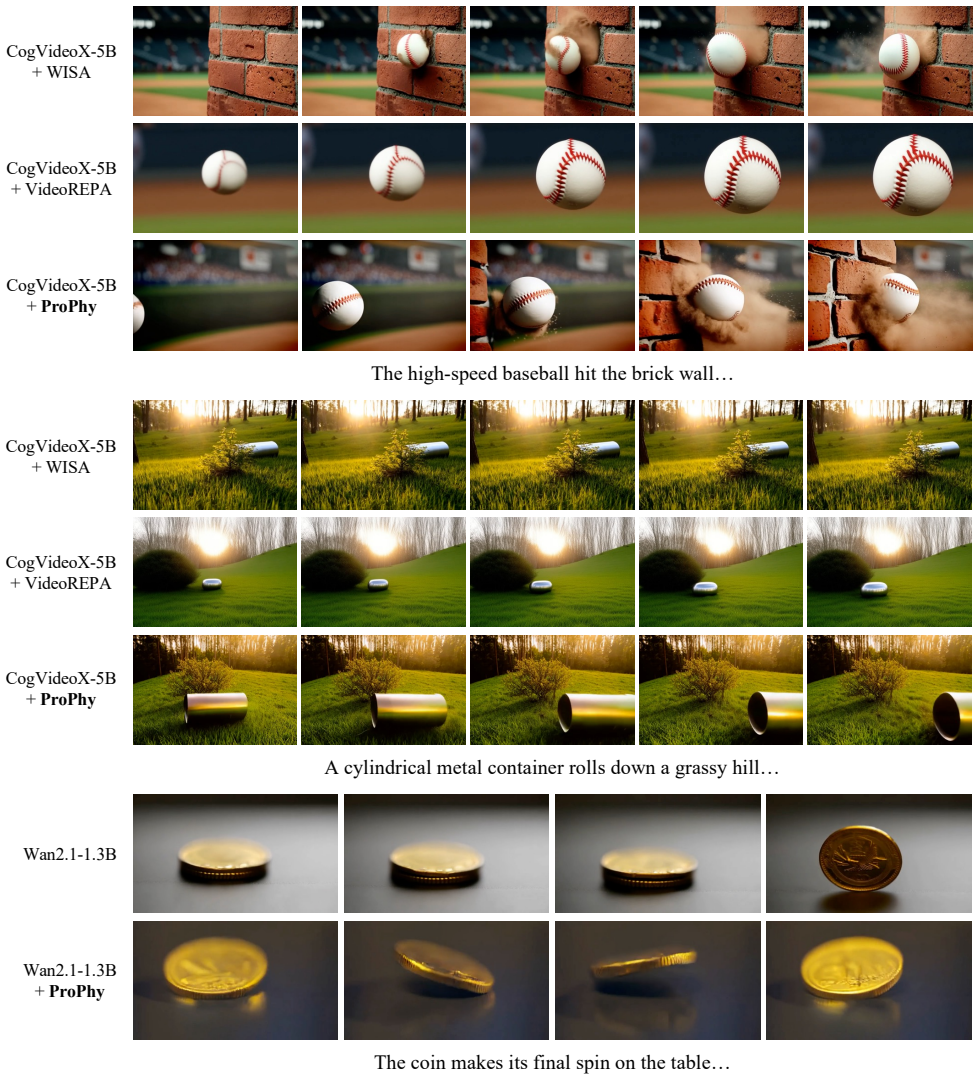

read the original abstract
Recent advances in video generation have shown remarkable potential for constructing world simulators. However, current models still struggle to produce physically consistent results, particularly when handling large-scale or complex dynamics. This limitation arises primarily because existing approaches respond isotropically to physical prompts and neglect the fine-grained alignment between generated content and localized physical cues. To address these challenges, we propose ProPhy, a Progressive Physical Alignment Framework that enables explicit physics-aware conditioning and anisotropic generation. ProPhy employs a two-stage Mixture-of-Physics-Experts mechanism for discriminative physical prior extraction, where Semantic Experts infer semantic-level physical principles from textual descriptions, and Refinement Experts capture token-level physical dynamics. This mechanism allows the model to learn fine-grained, physics-aware video representations that better reflect underlying physical laws. Furthermore, we introduce a physical alignment strategy that transfers the physical reasoning capabilities of vision-language models into the Refinement Experts, facilitating a more accurate representation of dynamic physical phenomena. Extensive experiments on physics-aware video generation benchmarks demonstrate that ProPhy produces more realistic, dynamic, and physically coherent results than existing state-of-the-art methods.
Editorial analysis
A structured set of objections, weighed in public.
Referee Report
Summary. The manuscript introduces ProPhy, a Progressive Physical Alignment Framework for physics-aware video generation and dynamic world simulation. It uses a two-stage Mixture-of-Physics-Experts (MoPE) architecture with Semantic Experts inferring physical principles from textual prompts and Refinement Experts modeling token-level dynamics, plus a VLM transfer strategy to inject physical reasoning. The central claim is that this produces more realistic, dynamic, and physically coherent outputs than existing SOTA methods on physics-aware video generation benchmarks.
Significance. If substantiated, the explicit separation of semantic-level and token-level physical modeling could advance video-based world simulators beyond purely statistical generation. The approach targets a recognized limitation in current models and, if the priors are genuinely physical rather than correlational, would be a useful contribution to controllable simulation.
major comments (2)
- [Experiments] The central claim that ProPhy yields physically coherent results depends on the MoPE + VLM transfer extracting and enforcing genuine physical laws. However, the experiments rely on standard video metrics (FVD, CLIP similarity, human preference) that can be satisfied by visually plausible but physically invalid outputs; no law-specific metrics (momentum conservation, energy balance, or gravity consistency across frames) are reported to isolate the mechanism from data correlations.
- [Method] The two-stage MoPE description (Semantic Experts for textual principles, Refinement Experts for token dynamics) is presented at a high level without derivation or ablation showing that the experts capture physical priors rather than learned statistical regularities. This is load-bearing for the claim of 'better reflect underlying physical laws.'
minor comments (2)
- [Method] Notation for the experts and alignment loss should be defined more explicitly with equations to allow reproduction.
- [Experiments] Figure captions and benchmark descriptions could clarify which physical properties are being tested.
Simulated Author's Rebuttal
We thank the referee for their constructive feedback. We address the major comments point by point below, making revisions to enhance the clarity and substantiation of our physical alignment claims.
read point-by-point responses
-
Referee: [Experiments] The central claim that ProPhy yields physically coherent results depends on the MoPE + VLM transfer extracting and enforcing genuine physical laws. However, the experiments rely on standard video metrics (FVD, CLIP similarity, human preference) that can be satisfied by visually plausible but physically invalid outputs; no law-specific metrics (momentum conservation, energy balance, or gravity consistency across frames) are reported to isolate the mechanism from data correlations.
Authors: We concur that relying solely on standard metrics leaves room for ambiguity regarding whether the improvements stem from genuine physical modeling or statistical correlations. To strengthen this aspect, we have incorporated law-specific evaluations in the revised manuscript. Specifically, we report metrics for gravity consistency by measuring vertical acceleration in falling objects and momentum conservation in collision scenarios across generated frames. These additions demonstrate that ProPhy better maintains physical invariants compared to baselines. revision: yes
-
Referee: [Method] The two-stage MoPE description (Semantic Experts for textual principles, Refinement Experts for token dynamics) is presented at a high level without derivation or ablation showing that the experts capture physical priors rather than learned statistical regularities. This is load-bearing for the claim of 'better reflect underlying physical laws.'
Authors: The two-stage design is derived from the observation that physical understanding operates at multiple scales, with semantic experts handling prompt-based rule inference and refinement experts focusing on per-token adjustments for dynamic consistency. We have expanded the method section with a more detailed derivation of the expert specialization losses and included comprehensive ablations in the experiments. These ablations compare full MoPE against ablated versions (e.g., semantic-only or refinement-only), showing superior performance in physical coherence tasks, which supports that the experts capture distinct physical priors beyond correlations. revision: yes
Circularity Check
No significant circularity; claims rest on empirical benchmarks rather than self-referential derivations
full rationale
The paper proposes ProPhy as an architectural framework consisting of a two-stage Mixture-of-Physics-Experts (Semantic Experts for textual principles and Refinement Experts for token dynamics) plus VLM transfer for physics-aware conditioning. No equations, derivations, or first-principles results are presented that reduce any claimed output to the inputs by construction, such as fitting a parameter and then relabeling a related quantity as a prediction. The central claims of more realistic and physically coherent video generation are justified by reference to external benchmarks and standard training procedures, which constitute independent empirical evaluation rather than circular reduction. This is the normal case for an applied ML architecture paper whose value is assessed against held-out data and baselines.
Axiom & Free-Parameter Ledger
Lean theorems connected to this paper
-
IndisputableMonolith/Cost/FunctionalEquation.leanwashburn_uniqueness_aczel unclear?
unclearRelation between the paper passage and the cited Recognition theorem.
two-stage Mixture-of-Physics-Experts mechanism for discriminative physical prior extraction, where Semantic Experts infer semantic-level physical principles... Refinement Experts capture token-level physical dynamics
-
IndisputableMonolith/Foundation/AbsoluteFloorClosure.leanabsolute_floor_iff_bare_distinguishability unclear?
unclearRelation between the paper passage and the cited Recognition theorem.
physical alignment strategy that transfers the physical reasoning capabilities of vision-language models into the Refinement Experts
What do these tags mean?
- matches
- The paper's claim is directly supported by a theorem in the formal canon.
- supports
- The theorem supports part of the paper's argument, but the paper may add assumptions or extra steps.
- extends
- The paper goes beyond the formal theorem; the theorem is a base layer rather than the whole result.
- uses
- The paper appears to rely on the theorem as machinery.
- contradicts
- The paper's claim conflicts with a theorem or certificate in the canon.
- unclear
- Pith found a possible connection, but the passage is too broad, indirect, or ambiguous to say the theorem truly supports the claim.
Forward citations
Cited by 1 Pith paper
-
ACWM-Phys: Investigating Generalized Physical Interaction in Action-Conditioned Video World Models
ACWM-Phys benchmark shows action-conditioned world models generalize on simple geometric interactions but drop sharply on deformable contacts, high-dimensional control, and complex articulated motion, indicating relia...
Reference graph
Works this paper leans on
-
[1]
Shuai Bai, Keqin Chen, Xuejing Liu, Jialin Wang, Wenbin Ge, Sibo Song, Kai Dang, Peng Wang, Shijie Wang, Jun Tang, et al. Qwen2. 5-vl technical report.arXiv preprint arXiv:2502.13923, 2025. 2, 6
work page internal anchor Pith review Pith/arXiv arXiv 2025
-
[2]
Hritik Bansal, Clark Peng, Yonatan Bitton, Roman Golden- berg, Aditya Grover, and Kai-Wei Chang. VideoPhy-2: A Challenging Action-Centric Physical Commonsense Evalua- tion in Video Generation.arXiv preprint arXiv:2503.06800,
-
[3]
Video generation models as world simulators.OpenAI Blog, 1(8):1, 2024
Tim Brooks, Bill Peebles, Connor Holmes, Will DePue, Yufei Guo, Li Jing, David Schnurr, Joe Taylor, Troy Luh- man, Eric Luhman, et al. Video generation models as world simulators.OpenAI Blog, 1(8):1, 2024. 2, 3
work page 2024
-
[4]
Jake Bruce, Michael D. Dennis, Ashley Edwards, Jack Parker-Holder, Yuge Shi, Edward Hughes, Matthew Lai, Aditi Mavalankar, Richie Steigerwald, Chris Apps, Yusuf Aytar, Sarah Maria Elisabeth Bechtle, Feryal Behbahani, Stephanie C. Y . Chan, Nicolas Heess, Lucy Gonzalez, Simon Osindero, Sherjil Ozair, Scott Reed, Jingwei Zhang, Konrad Zolna, Jeff Clune, Nan...
-
[5]
Scaling rectified flow transformers for high-resolution image synthesis
Patrick Esser, Sumith Kulal, Andreas Blattmann, Rahim Entezari, Jonas M ¨uller, Harry Saini, Yam Levi, Dominik Lorenz, Axel Sauer, Frederic Boesel, et al. Scaling rectified flow transformers for high-resolution image synthesis. 2024. 3
work page 2024
-
[6]
Denoising dif- fusion probabilistic models.NeurIPS, 33:6840–6851, 2020
Jonathan Ho, Ajay Jain, and Pieter Abbeel. Denoising dif- fusion probabilistic models.NeurIPS, 33:6840–6851, 2020. 3
work page 2020
-
[7]
Panwen Hu, Jin Jiang, Jianqi Chen, Mingfei Han, Shengcai Liao, Xiaojun Chang, and Xiaodan Liang. Storyagent: Cus- tomized storytelling video generation via multi-agent collab- oration.arXiv preprint arXiv:2411.04925, 2024. 2
-
[8]
VBench: Com- prehensive Benchmark Suite for Video Generative Models
Ziqi Huang, Yinan He, Jiashuo Yu, Fan Zhang, Chenyang Si, Yuming Jiang, Yuanhan Zhang, Tianxing Wu, Qingyang Jin, Nattapol Chanpaisit, Yaohui Wang, Xinyuan Chen, Limin Wang, Dahua Lin, Yu Qiao, and Ziwei Liu. VBench: Com- prehensive Benchmark Suite for Video Generative Models. InCVPR, pages 21807–21818, 2024. 6
work page 2024
-
[9]
Sihui Ji, Xi Chen, Xin Tao, Pengfei Wan, and Hengshuang Zhao. Physmaster: Mastering physical representation for video generation via reinforcement learning.arXiv preprint arXiv:2510.13809, 2025. 2, 3
-
[10]
VACE: All-in-One Video Creation and Editing
Zeyinzi Jiang, Zhen Han, Chaojie Mao, Jingfeng Zhang, Yulin Pan, and Yu Liu. V ACE: All-in-One Video Creation and Editing.arXiv preprint arXiv:2503.07598, 2025. 2
work page internal anchor Pith review Pith/arXiv arXiv 2025
-
[11]
How far is video generation from world model: A physical law perspective
Bingyi Kang, Yang Yue, Rui Lu, Zhijie Lin, Yang Zhao, Kaixin Wang, Gao Huang, and Jiashi Feng. How far is video generation from world model: A physical law perspective. arXiv preprint arXiv:2411.02385, 2024. 3
-
[12]
HunyuanVideo: A Systematic Framework For Large Video Generative Models
Weijie Kong, Qi Tian, Zijian Zhang, Rox Min, Zuozhuo Dai, Jin Zhou, Jiangfeng Xiong, Xin Li, Bo Wu, Jianwei Zhang, Kathrina Wu, Qin Lin, Junkun Yuan, Yanxin Long, Aladdin Wang, Andong Wang, Changlin Li, Duojun Huang, Fang Yang, Hao Tan, Hongmei Wang, Jacob Song, Jiawang Bai, Jianbing Wu, Jinbao Xue, Joey Wang, Kai Wang, Mengyang Liu, Pengyu Li, Shuai Li, ...
work page internal anchor Pith review Pith/arXiv arXiv 2025
-
[13]
Kling.https://klingai.kuaishou
Kuaishou. Kling.https://klingai.kuaishou. com/, 2024. 3
work page 2024
-
[14]
Flux.https://github.com/ black-forest-labs/flux, 2024
Black Forest Labs. Flux.https://github.com/ black-forest-labs/flux, 2024. 3
work page 2024
-
[15]
Yaron Lipman, Ricky T. Q. Chen, Heli Ben-Hamu, Maximil- ian Nickel, and Matthew Le. Flow Matching for Generative Modeling. InICLR, 2022. 3
work page 2022
-
[16]
Generative physical ai in vision: A survey.arXiv preprint arXiv:2501.10928, 2025
Daochang Liu, Junyu Zhang, Anh-Dung Dinh, Eunbyung Park, Shichao Zhang, Ajmal Mian, Mubarak Shah, and Chang Xu. Generative physical ai in vision: A survey.arXiv preprint arXiv:2501.10928, 2025. 3
-
[17]
Physgen: Rigid-body physics-grounded image- to-video generation
Shaowei Liu, Zhongzheng Ren, Saurabh Gupta, and Shen- long Wang. Physgen: Rigid-body physics-grounded image- to-video generation. InECCV, pages 360–378. Springer,
-
[18]
Xin Ma, Yaohui Wang, Xinyuan Chen, Gengyun Jia, Ziwei Liu, Yuan-Fang Li, Cunjian Chen, and Yu Qiao. Latte: La- tent Diffusion Transformer for Video Generation.Transac- tions on Machine Learning Research, 2025. 3
work page 2025
-
[19]
Motioncraft: Physics- based zero-shot video generation
Antonio Montanaro, Luca Savant Aira, Emanuele Aiello, Diego Valsesia, and Enrico Magli. Motioncraft: Physics- based zero-shot video generation. InNeurIPS, pages 123155–123181, 2024. 3
work page 2024
-
[20]
Do generative video models understand physical principles?arXiv preprint arXiv:2501.09038, 2025
Saman Motamed, Laura Culp, Kevin Swersky, Priyank Jaini, and Robert Geirhos. Do generative video models understand physical principles?arXiv preprint arXiv:2501.09038, 2025. 3
-
[21]
Cosmos World Foundation Model Platform for Physical AI
NVIDIA, Niket Agarwal, Arslan Ali, Maciej Bala, Yogesh Balaji, Erik Barker, Tiffany Cai, Prithvijit Chattopadhyay, Yongxin Chen, Yin Cui, Yifan Ding, Daniel Dworakowski, Jiaojiao Fan, Michele Fenzi, Francesco Ferroni, Sanja Fidler, Dieter Fox, Songwei Ge, Yunhao Ge, Jinwei Gu, Siddharth Gururani, Ethan He, Jiahui Huang, Jacob Huffman, Pooya Jannaty, Jingy...
work page internal anchor Pith review Pith/arXiv arXiv 2025
-
[22]
Scalable diffusion models with transformers
William Peebles and Saining Xie. Scalable diffusion models with transformers. InICCV, pages 4195–4205, 2023. 3
work page 2023
-
[23]
Zihan Qiu, Zeyu Huang, Bo Zheng, Kaiyue Wen, Zekun Wang, Rui Men, Ivan Titov, Dayiheng Liu, Jingren Zhou, and Junyang Lin. Demons in the Detail: On Implementing Load Balancing Loss for Training Specialized Mixture-of- Expert Models.arXiv preprint arXiv:2501.11873, 2025. 4
-
[24]
High-Resolution Image Synthesis With Latent Diffusion Models
Robin Rombach, Andreas Blattmann, Dominik Lorenz, Patrick Esser, and Bj ¨orn Ommer. High-Resolution Image Synthesis With Latent Diffusion Models. InCVPR, pages 10684–10695, 2022. 3
work page 2022
-
[25]
Scaling Vision with Sparse Mixture of Experts
Carlos Riquelme Ruiz, Joan Puigcerver, Basil Mustafa, Maxim Neumann, Rodolphe Jenatton, Andr ´e Susano Pinto, Daniel Keysers, and Neil Houlsby. Scaling Vision with Sparse Mixture of Experts. InNeurIPS, 2021. 4
work page 2021
-
[26]
Outrageously Large Neural Networks: The Sparsely-Gated Mixture-of-Experts Layer
Noam Shazeer, *Azalia Mirhoseini, *Krzysztof Maziarz, Andy Davis, Quoc Le, Geoffrey Hinton, and Jeff Dean. Outrageously Large Neural Networks: The Sparsely-Gated Mixture-of-Experts Layer. InICLR, 2017. 5
work page 2017
-
[27]
Denois- ing Diffusion Implicit Models
Jiaming Song, Chenlin Meng, and Stefano Ermon. Denois- ing Diffusion Implicit Models. InICLR, 2020. 3
work page 2020
-
[28]
A material point method for snow simulation.ACM TOG, 32(4):1–10, 2013
Alexey Stomakhin, Craig Schroeder, Lawrence Chai, Joseph Teran, and Andrew Selle. A material point method for snow simulation.ACM TOG, 32(4):1–10, 2013. 3
work page 2013
-
[29]
Physmotion: Physics- grounded dynamics from a single image.arXiv preprint arXiv:2411.17189, 2024
Xiyang Tan, Ying Jiang, Xuan Li, Zeshun Zong, Tianyi Xie, Yin Yang, and Chenfanfu Jiang. Physmotion: Physics- grounded dynamics from a single image.arXiv preprint arXiv:2411.17189, 2024. 3
-
[30]
Wan: Open and Advanced Large-Scale Video Generative Models
Team Wan, Ang Wang, Baole Ai, Bin Wen, Chaojie Mao, Chen-Wei Xie, Di Chen, Feiwu Yu, Haiming Zhao, Jianx- iao Yang, Jianyuan Zeng, Jiayu Wang, Jingfeng Zhang, Jin- gren Zhou, Jinkai Wang, Jixuan Chen, Kai Zhu, Kang Zhao, Keyu Yan, Lianghua Huang, Mengyang Feng, Ningyi Zhang, Pandeng Li, Pingyu Wu, Ruihang Chu, Ruili Feng, Shiwei Zhang, Siyang Sun, Tao Fan...
work page internal anchor Pith review Pith/arXiv arXiv 2025
-
[31]
Dreamvideo: High- fidelity image-to-video generation with image retention and text guidance
Cong Wang, Jiaxi Gu, Panwen Hu, Yuanfan Guo, Xiao Dong, Hang Xu, and Xiaodan Liang. Dreamvideo: High- fidelity image-to-video generation with image retention and text guidance. InICASSP, pages 1–5. IEEE, 2025. 2
work page 2025
-
[32]
WISA: World simulator assistant for physics-aware text-to-video genera- tion
Jing Wang, Ao Ma, Ke Cao, Jun Zheng, Jiasong Feng, Zhan- jie Zhang, Wanyuan Pang, and Xiaodan Liang. WISA: World simulator assistant for physics-aware text-to-video genera- tion. InNeurIPS, 2025. 2, 3, 5, 6, 7
work page 2025
-
[33]
Physanimator: Physics-guided generative cartoon animation
Tianyi Xie, Yiwei Zhao, Ying Jiang, and Chenfanfu Jiang. Physanimator: Physics-guided generative cartoon animation. InCVPR, pages 10793–10804, 2025. 3
work page 2025
-
[34]
Phyt2v: Llm-guided iterative self-refinement for physics- grounded text-to-video generation
Qiyao Xue, Xiangyu Yin, Boyuan Yang, and Wei Gao. Phyt2v: Llm-guided iterative self-refinement for physics- grounded text-to-video generation. InCVPR, pages 18826– 18836, 2025. 3
work page 2025
-
[35]
CogVideoX: Text-to-Video Diffusion Models with An Expert Transformer
Zhuoyi Yang, Jiayan Teng, Wendi Zheng, Ming Ding, Shiyu Huang, Jiazheng Xu, Yuanming Yang, Wenyi Hong, Xiao- han Zhang, Guanyu Feng, Da Yin, Yuxuan.Zhang, Weihan Wang, Yean Cheng, Bin Xu, Xiaotao Gu, Yuxiao Dong, and Jie Tang. CogVideoX: Text-to-Video Diffusion Models with An Expert Transformer. InICLR, 2024. 2, 3, 6, 7
work page 2024
-
[36]
Yu Yuan, Xijun Wang, Tharindu Wickremasinghe, Zeeshan Nadir, Bole Ma, and Stanley H Chan. Newtongen: Physics- consistent and controllable text-to-video generation via neu- ral newtonian dynamics.arXiv preprint arXiv:2509.21309,
-
[37]
Physdreamer: Physics-based interac- tion with 3d objects via video generation
Tianyuan Zhang, Hong-Xing Yu, Rundi Wu, Brandon Y Feng, Changxi Zheng, Noah Snavely, Jiajun Wu, and William T Freeman. Physdreamer: Physics-based interac- tion with 3d objects via video generation. InECCV, pages 388–406. Springer, 2024. 3
work page 2024
-
[38]
Xiangdong Zhang, Jiaqi Liao, Shaofeng Zhang, Fanqing Meng, Xiangpeng Wan, Junchi Yan, and Yu Cheng. Vide- oREPA: Learning Physics for Video Generation through Re- lational Alignment with Foundation Models. InNeurIPS,
-
[39]
RoboDreamer: Learning Compositional World Models for Robot Imagination
Siyuan Zhou, Yilun Du, Jiaben Chen, Yandong Li, Dit-Yan Yeung, and Chuang Gan. RoboDreamer: Learning Compo- sitional World Models for Robot Imagination.arXiv preprint arXiv:2404.12377, 2024. 2
work page internal anchor Pith review Pith/arXiv arXiv 2024
-
[40]
Zheng Zhu, Xiaofeng Wang, Wangbo Zhao, Chen Min, Ni- anchen Deng, Min Dou, Yuqi Wang, Botian Shi, Kai Wang, Chi Zhang, et al. Is sora a world simulator? a comprehensive survey on general world models and beyond.arXiv preprint arXiv:2405.03520, 2024. 2 10 A. Implementation Details A.1. Model Architecture and Settings We build our model on top of Wan2.1-T2V...
discussion (0)
Sign in with ORCID, Apple, or X to comment. Anyone can read and Pith papers without signing in.