Routes of Transport in the Path Integral Lindblad Dynamics through State-to-State Analysis
Pith reviewed 2026-05-16 23:43 UTC · model grok-4.3
The pith
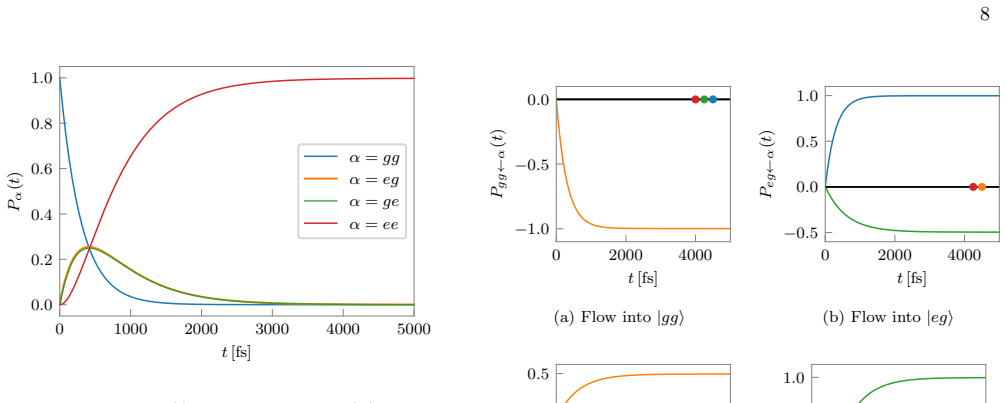
Extending state-to-state analysis to Lindblad dynamics reveals transport routes and steady-state currents in open quantum systems.
A machine-rendered reading of the paper's core claim, the machinery that carries it, and where it could break.
Core claim
By incorporating Lindblad jump operators into the path integral framework, the state-to-state analysis decomposes the dynamics to identify specific routes of transport. In examples of molecular aggregates with pumping and draining, this reveals the establishment of steady-state excitonic currents, providing a first-principles quantification.
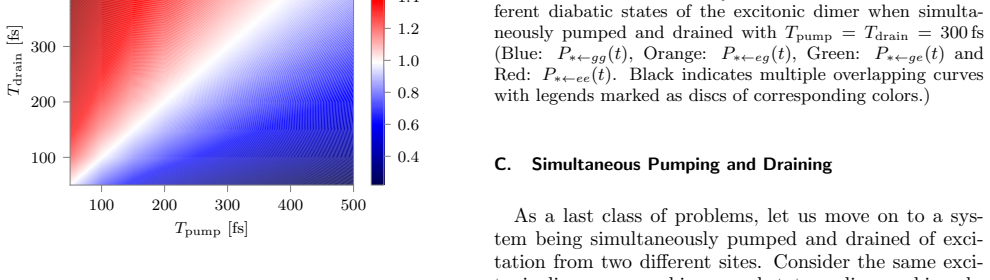
What carries the argument
The Lindblad state-to-state decomposition, which breaks down the time evolution under the combined thermal and Lindblad dynamics into contributions from individual state-to-state transitions.
If this is right
- Steady-state excitonic currents can be established and quantified in molecular aggregates under incoherent pumping and draining.
- Routes of transport become identifiable for systems with generic Lindblad processes coupled to thermal baths.
- Non-Hermitian approximations can be replaced by full Lindblad descriptions for more general empirical processes.
- The method provides a different first-principles approach to calculating currents in open quantum systems.
Where Pith is reading between the lines
- This formalism could be applied to design molecular systems for efficient energy transport in quantum technologies.
- Similar analysis might reveal control strategies for decoherence in quantum information processing.
- Testing the method on larger aggregates could show scalability for realistic photosynthetic models.
Load-bearing premise
The decomposition into state-to-state routes stays meaningful and accurate even after adding arbitrary Lindblad jump operators to the thermal bath dynamics.
What would settle it
A direct comparison showing that the predicted transport routes or current values from the Lindblad state-to-state method deviate significantly from those obtained by solving the full Lindblad master equation numerically for a test system.
Figures
read the original abstract
Analyzing routes of transport for open quantum systems with non-equilibrium initial conditions is extremely challenging. The state-to-state approach [A. Bose, and P.L. Walters, J. Chem. Theory Comput. 2023, 19, 15, 4828-4836] has proven to be a useful method for understanding transport mechanisms in quantum systems interacting with dissipative thermal baths, and has been recently extended to non-Hermitian systems to account for empirical loss. These non-Hermitian descriptions are, however, not capable of describing empirical processes of more general nature, including but not limited to a variety of pumping processes. We extend the state-to-state analysis to account for Lindbladian descriptions of generic dissipative, pumping and decohering processes acting on a system which is exchanging energy with a thermal bath. This Lindblad state-to-state method can elucidate routes of transport in systems coupled to a bath and additionally acted upon by Lindblad jump operators. The method is demonstrated using examples of excitonic aggregates subject to incoherent pumping and draining processes. Using this new state-to-state formalism, we demonstrate the establishment of steady-state excitonic currents across molecular aggregates, yielding a different first-principles approach to quantifying the same.
Editorial analysis
A structured set of objections, weighed in public.
Referee Report
Summary. The manuscript extends the state-to-state analysis technique to open quantum systems whose dynamics are generated by a thermal-bath path-integral propagator augmented by a general Lindblad super-operator that encodes incoherent pumping, draining, and decoherence. The authors apply the resulting Lindblad state-to-state formalism to excitonic aggregates and report the emergence of steady-state excitonic currents, presenting this as a first-principles route to quantifying non-equilibrium transport.
Significance. If the extension is rigorously derived and the numerical results are reproducible, the work would supply a useful addition to the toolkit for dissecting transport mechanisms in non-equilibrium open quantum systems. It generalizes an existing state-to-state decomposition beyond pure thermal or non-Hermitian cases, potentially enabling quantitative analysis of steady-state currents in molecular aggregates subject to arbitrary incoherent processes.
major comments (2)
- [Method / extension of the propagator] The central claim that the state-to-state projection continues to isolate well-defined, non-overlapping transport routes once arbitrary Lindblad jump operators are added to the thermal path-integral propagator is not supported by an explicit derivation. The manuscript inserts the Lindblad terms directly into the influence functional or stochastic unraveling without showing that the route labels remain invariant under the added super-operators; this is load-bearing for the interpretability of the reported currents.
- [Results / excitonic aggregate examples] The demonstration on excitonic aggregates reports steady-state currents but supplies neither the numerical implementation details of the combined propagator nor validation data (e.g., comparison against known limiting cases or convergence checks). Without these, it is impossible to confirm that the extracted currents are quantitatively accurate rather than artifacts of the discretization or fitting procedure.
minor comments (2)
- [Formalism] Notation for the combined influence functional that incorporates both the bath correlation functions and the Lindblad jump operators should be introduced more explicitly, including any additional stochastic terms.
- [Abstract / Introduction] The abstract and introduction would benefit from a concise statement of the precise class of Lindblad operators for which the route decomposition is claimed to remain unique.
Simulated Author's Rebuttal
We thank the referee for the constructive comments and for recognizing the potential utility of the Lindblad-extended state-to-state analysis. We address each major comment below and will revise the manuscript to incorporate the requested clarifications and additional material.
read point-by-point responses
-
Referee: [Method / extension of the propagator] The central claim that the state-to-state projection continues to isolate well-defined, non-overlapping transport routes once arbitrary Lindblad jump operators are added to the thermal path-integral propagator is not supported by an explicit derivation. The manuscript inserts the Lindblad terms directly into the influence functional or stochastic unraveling without showing that the route labels remain invariant under the added super-operators; this is load-bearing for the interpretability of the reported currents.
Authors: We agree that an explicit derivation of route-label invariance is essential for interpretability. In the revised manuscript we will insert a new subsection deriving the combined path-integral propagator. We will show that the state-to-state projectors remain orthogonal because the Lindblad jump operators act as local system operators that do not mix distinct route labels; the influence functional is augmented multiplicatively, preserving the decomposition of the propagator into non-overlapping route contributions. This establishes that the extracted currents continue to correspond to well-defined transport routes. revision: yes
-
Referee: [Results / excitonic aggregate examples] The demonstration on excitonic aggregates reports steady-state currents but supplies neither the numerical implementation details of the combined propagator nor validation data (e.g., comparison against known limiting cases or convergence checks). Without these, it is impossible to confirm that the extracted currents are quantitatively accurate rather than artifacts of the discretization or fitting procedure.
Authors: We accept that additional numerical details and validation are required for reproducibility. The revised manuscript will expand the Methods and Results sections to include: (i) the explicit algorithmic implementation of the Lindblad-augmented stochastic unraveling, (ii) direct comparisons to the pure-thermal limit (recovering the original state-to-state currents) and the pure-Lindblad limit, and (iii) convergence plots with respect to time-step size and number of trajectories. These data will be placed in the main text and supplementary material. revision: yes
Circularity Check
Minor self-citation to foundational state-to-state method; extension and demonstrations remain independent
full rationale
The paper extends the state-to-state route decomposition (cited to Bose & Walters 2023) to a combined thermal-bath plus general Lindblad generator. The central result—numerical demonstration of steady-state excitonic currents in molecular aggregates—is obtained by applying the extended formalism to concrete examples and is presented as a distinct first-principles quantification. No equation in the provided text reduces a reported current or route weight to a parameter fitted inside the same manuscript, nor does any uniqueness claim rest solely on an unverified self-citation chain. The self-citation supplies the base projector but does not substitute for the new Lindblad-compatible propagator or the numerical evidence. Hence only a low-level, non-load-bearing self-citation is present.
Axiom & Free-Parameter Ledger
axioms (1)
- domain assumption The dynamics of the open system are governed by the Lindblad master equation that includes both thermal-bath coupling and additional jump operators for pumping and decoherence.
Lean theorems connected to this paper
-
IndisputableMonolith/Cost/FunctionalEquation.leanwashburn_uniqueness_aczel unclear?
unclearRelation between the paper passage and the cited Recognition theorem.
We extend the state-to-state analysis to account for Lindbladian descriptions of generic dissipative, pumping and decohering processes... yielding a different first-principles approach to quantifying the same.
-
IndisputableMonolith/Foundation/RealityFromDistinction.leanreality_from_one_distinction unclear?
unclearRelation between the paper passage and the cited Recognition theorem.
The Lindblad state-to-state method can elucidate routes of transport in systems coupled to a bath and additionally acted upon by Lindblad jump operators.
What do these tags mean?
- matches
- The paper's claim is directly supported by a theorem in the formal canon.
- supports
- The theorem supports part of the paper's argument, but the paper may add assumptions or extra steps.
- extends
- The paper goes beyond the formal theorem; the theorem is a base layer rather than the whole result.
- uses
- The paper appears to rely on the theorem as machinery.
- contradicts
- The paper's claim conflicts with a theorem or certificate in the canon.
- unclear
- Pith found a possible connection, but the passage is too broad, indirect, or ambiguous to say the theorem truly supports the claim.
Reference graph
Works this paper leans on
-
[1]
Routes of Transport in the Path Integral Lindblad Dynamics through State-to-State Analysis
Routes of Transport in the Path Integral Lindblad Dynamics through State-to-State Analysis Devansh Sharma and Amartya Bose a) Department of Chemical Sciences, Tata Institute of Fundamental Research, Mumbai 400005, India Analyzing routes of transport for open quantum systems with non-equilibrium initial conditions is extremely challenging. The state-to-sta...
work page internal anchor Pith review Pith/arXiv arXiv 2023
-
[2]
We want to understand the flow of excitation into this system
is pumped incoherently with a particular time-scale,T pump. We want to understand the flow of excitation into this system. Unlike in our previous example, this system can no longer be described using the first excitation subspace. That is because the number of excitation keeps rising till we have two excitations (orN excitations for anN-mer in general). T...
work page 2000
-
[3]
The system starts from |gg⟩, but soon gains excitation
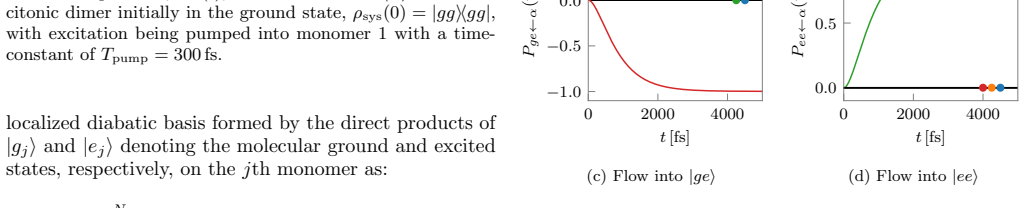
Conver- gence was reached at a time-step of ∆t= 4 fs and a memory time ofτ mem = 400 fs. The system starts from |gg⟩, but soon gains excitation. Because there are no ex- citonic drains, eventually all the population moves into the doubly excited state|ee⟩. The population of|eg⟩in- creases slightly before|ge⟩because it is the state that is getting pumped. ...
work page 2000
-
[4]
(Blue:P ∗←gg(t), Orange:P ∗←eg(t), Green: P∗←ge(t) and Red:P ∗←ee(t)
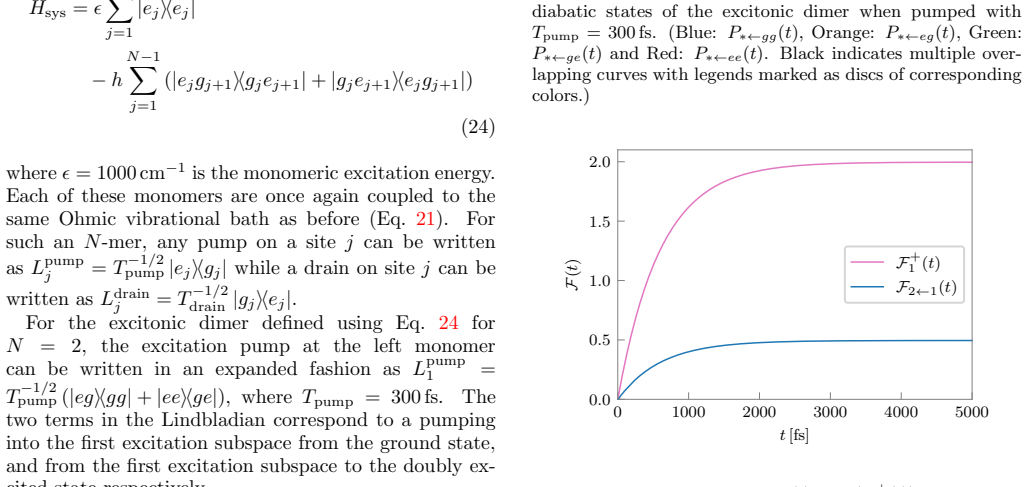
State-to-state analysis of excitation flows into the diabatic states of the excitonic dimer when pumped with Tpump = 300 fs. (Blue:P ∗←gg(t), Orange:P ∗←eg(t), Green: P∗←ge(t) and Red:P ∗←ee(t). Black indicates multiple over- lapping curves with legends marked as discs of corresponding colors.) 0 1000 2000 3000 4000 5000 t [fs] 0.0 0.5 1.0 1.5 2.0 F (t) F...
work page 2000
-
[5]
The|ge⟩state only receives population from the|eg⟩state
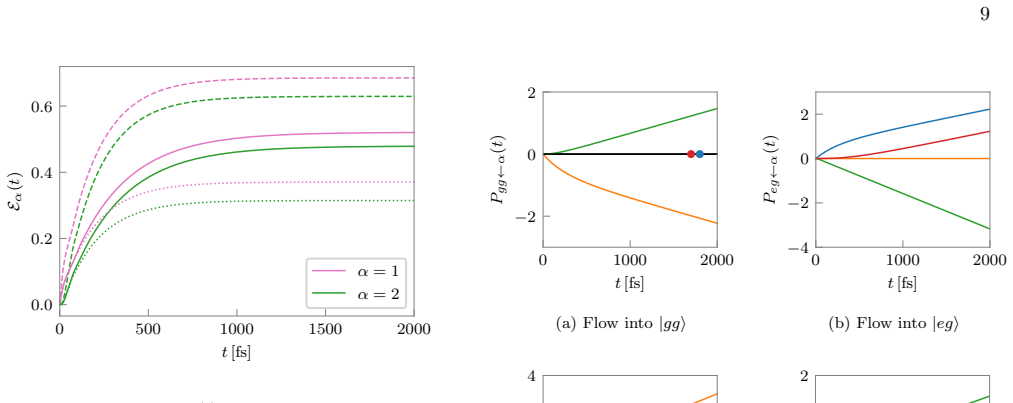
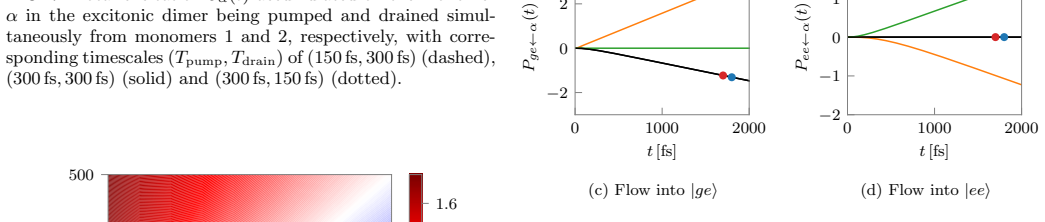
Consistent with the Lindblad jump operators, the pumping procedure takes the system from|gg⟩to|eg⟩. The|ge⟩state only receives population from the|eg⟩state. There is also only a sin- gle route of transport into|ee⟩, which is from|ge⟩and 9 0 500 1000 1500 2000 t [fs] 0.0 0.2 0.4 0.6 Eα (t) α = 1 α = 2 FIG
work page 2000
-
[6]
0 1000 2000 t [fs] −2 0 2 Pgg←α (t) (a) Flow into|gg⟩ 0 1000 2000 t [fs] −4 −2 0 2 Peg←α (t) (b) Flow into|eg⟩ 0 1000 2000 t [fs] −2 0 2 4 Pge←α (t) (c) Flow into|ge⟩ 0 1000 2000 t [fs] −2 −1 0 1 2 Pee←α (t) (d) Flow into|ee⟩ FIG
work page 2000
-
[7]
Black indicates multiple overlapping curves with legends marked as discs of corresponding colors.) C
State-to-state analysis of excitation flows into dif- ferent diabatic states of the excitonic dimer when simulta- neously pumped and drained withT pump =T drain = 300 fs (Blue:P ∗←gg(t), Orange:P ∗←eg(t), Green:P ∗←ge(t) and Red:P ∗←ee(t). Black indicates multiple overlapping curves with legends marked as discs of corresponding colors.) C. Simultaneous Pu...
work page 2000
-
[8]
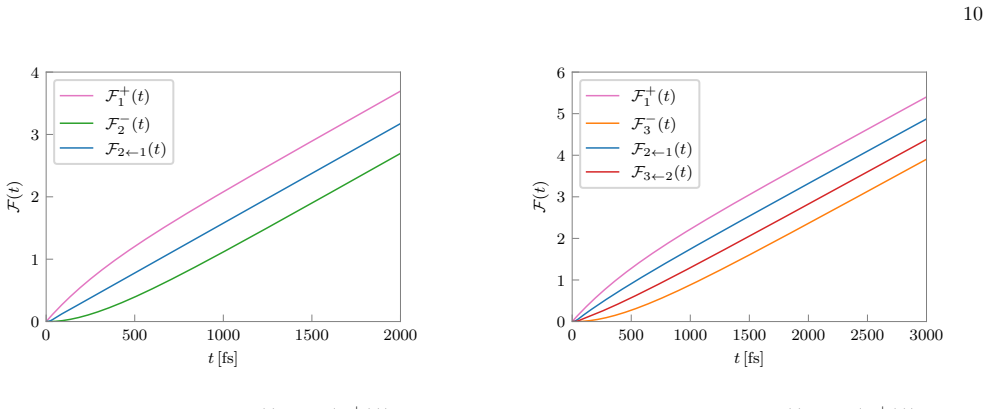
are directly measured, as mentioned pre- viously (in Sec. III B), the flow between the monomers 0 500 1000 1500 2000 2500 3000 t [fs] 0 1 2 3 4 5 6F (t) F + 1 (t) F− 3 (t) F2←1(t) F3←2(t) FIG
work page 2000
-
[9]
Photosynthetic Light- Harvesting Pigment-Protein Complexes: Toward Understanding How and Why,
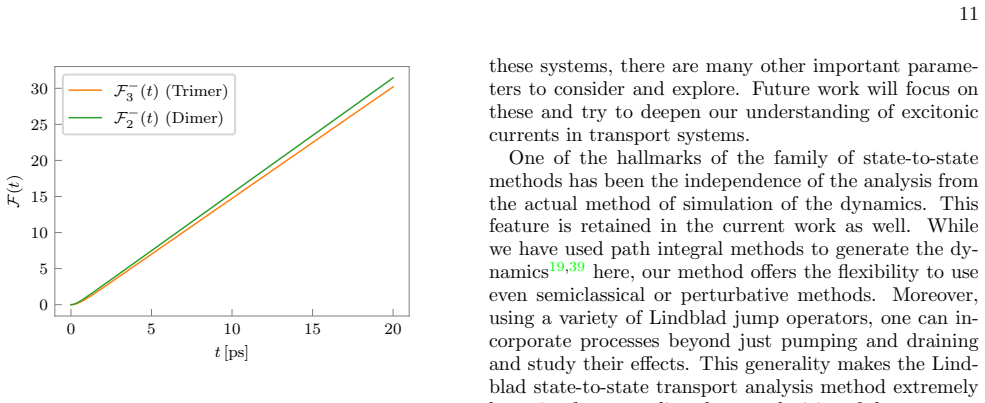
Excitation extraction as a function of time for the excitonic dimer and trimer withT pump =T drain = 300 fs. IV. CONCLUSIONS The state-to-state method 42,43 based on analysis of fluxes2,54,55 has proven to be quite capable of elucidat- ing dynamical routes of transport in aggregates, shed- ding light on the many-body effects of the environment as well. We...
discussion (0)
Sign in with ORCID, Apple, or X to comment. Anyone can read and Pith papers without signing in.