REVIEW 4 major objections 6 minor 4 cited by
Stable mass transfer in massive binaries leading to merging black holes
T0 review · 4 major / 6 minor · reviewed 2026-08-03 · deepseek-v4-flash
Pith's one-line read Stable mass transfer in close massive binaries can produce merging black holes that match observed gravitational-wave events.
desk verdict A solid, genuinely new detailed-evolution study of the stable mass transfer channel; the Case A→Case B shift from accretor structure is likely real, but the 'robust contributor' conclusion outruns the evidence—no rate calculation and a load-bearing efficiency assumption. read the letter →
The pith
A machine-rendered reading of the paper's core claim, the machinery that carries it, and where it could break.
The reading
What carries the argument
The load-bearing machinery is the fully resolved, continuously evolved binary model: both stars are followed simultaneously with internal differential rotation, tidal coupling, mass and angular momentum transfer, and a rotation-limited accretion efficiency of about 90 percent in the closest systems. Its crucial product is the chemical structure of the mass gainer, a helium-enriched envelope with an off-centre convective zone, which makes the accretor more compact than an equal-mass single star. That structural difference converts the reverse mass transfer from Case A to Case B, determines the final orbital period, and sets the black hole spins and mass ratio.
What would settle it
Measure the mass transfer efficiency in tight massive binaries, for example through the masses of black hole plus O-star systems or the growth of accretors in observed Algol-type binaries; if efficiencies are found to be 50 percent or lower, the shortest-merger-time systems would have merger times above the Hubble time and the channel would fail to explain observed events. Alternatively, a population synthesis with accretion efficiency reduced to 50 percent should eliminate the predicted merging black holes in the 10 to 25 solar-mass range.
Extended reading notes
Core claim
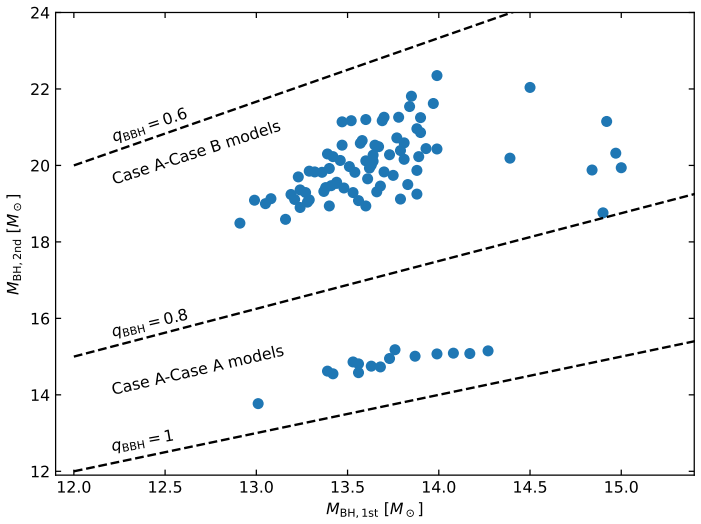
The paper's central claim is that continuity of the binary evolution matters: computing the full history, rather than restarting from a black hole plus a zero-age main-sequence companion, changes the outcome. Mass accretion onto the secondary during the first mass transfer adds helium-rich material and drives off-centre convection, leaving a rejuvenated star more compact during core hydrogen burning. Consequently, when this star later transfers mass to the newly formed black hole, it does so in Case B (shell-hydrogen burning) rather than Case A (core hydrogen burning). This opens a parameter space where merging binary black holes form with delay times down to about 1.5 billion years, mass ra
Load-bearing premise
The first mass transfer must be nearly conservative in the closest binaries: if the true accretion efficiency is significantly lower than the roughly 90 percent used here, the secondary never reaches the needed mass, the reverse mass transfer does not occur in tight orbits, and the predicted merging black hole population disappears.
Editorial extensions
If this is right
- The stable mass transfer channel is established as a viable isolated-binary route to merging black holes, alongside common-envelope and chemically homogeneous evolution.
- Predicted merging black holes have second-born components more massive than the first, mass ratios near 0.7, and effective spins 0.1 to 0.25, providing observable fingerprints for identifying this channel in gravitational-wave catalogs.
- Systems previously thought to merge during a Case A reverse mass transfer instead survive and merge within the Hubble time, expanding the predicted parameter space.
- Case A to Case A systems, with near-equal masses and effective spins near 0.6, are predicted to have merger times near the Hubble time, making them rare and consistent with the absence of such events in current data.
- Observed counterparts at every key stage, from massive Algol-type binaries to black hole plus Wolf-Rayet systems, support the reality of the channel.
Reading between the lines
- If this channel is a major contributor, the preference for mass ratios around 0.74 seen in observed merging black holes may be a direct fingerprint of stable mass transfer, and the merger rate of 10 to 25 solar-mass primary black holes may be largely set by this route.
- Because the effect depends on the accretor's helium-enriched envelope, rapid population-synthesis codes that approximate accretors as single stars likely mis-estimate both merger times and spins for this channel.
- A testable extension is to measure the masses and spins of observed black hole plus O-star binaries: the models predict a specific companion mass and orbital period at the time of first black hole formation, which could be checked against those systems.
- At higher metallicity, stronger winds would likely reduce the accretor mass and could close the channel, predicting that stable-mass-transfer mergers should be more common in low-metallicity environments.
Editorial analysis
A structured set of objections, weighed in public.
Referee Report
Summary. The paper presents a grid of 176 MESA binary evolution models that evolve both components simultaneously from the zero-age main sequence until the formation of the second black hole. The grid is fixed to a primary mass of 31.6 Msun, SMC-like metallicity, initial mass ratios qZAMS = 0.7–0.99, and initial orbital periods up to ~4.5 d. The key physical ingredient is the full treatment of the mass-accreting secondary during and after the first mass transfer, including accretion-induced mixing, rejuvenation, and helium enrichment. The authors find that most surviving systems undergo Case A first mass transfer followed by Case B second mass transfer, because the rejuvenated, helium-enriched donor remains compact during core hydrogen burning. These 'Case A–Case B' models produce merging BBHs with merger timescales ~0.09–0.34 of the Hubble time, mass ratios q ≈ 0.7, and effective spins χeff ≈ 0.1–0.25, which the authors compare favorably with GWTC-4 data for black holes in the 10–25 Msun primary mass range. They conclude that the stable mass transfer channel is a 'robust contributor' to the observed gravitational-wave population and that full evolution is essential to capture the reverse mass-transfer phase correctly.
Significance. If the central claims hold, this is a valuable step forward for the stable mass transfer channel. The paper is the first to follow both stars self-consistently through the entire pre-BBH evolution, including differential rotation, tides, and mass/angular-momentum exchange, without approximating the post-first-mass-transfer star as an unaccreted single star. Demonstrating that the accretor's helium-enriched, rejuvenated structure shifts the second mass transfer from Case A to Case B, opening a new parameter space of short-merger-time BBHs, is an important and physically credible result. The analytic mass-ratio estimate in Supplementary H is transparent and useful, and the paper is honest in listing uncertainties, including mass-transfer efficiency, wind angular-momentum loss, and mass ejection during collapse. However, the paper's conclusion goes beyond what the evidence supports: no rate calculation, population synthesis, or multi-primary-mass grid is presented, so the claim of being a 'robust contributor' to the observed GW population is not quantitatively established. The paper is also open about spin uncertainties that shift predicted values by 20–50% under alternative prescript
major comments (4)
- [Conclusion; Fig. 2] The central claim of a 'robust contributor to the observed gravitational wave events' is not supported by the evidence as presented. The grid is confined to a single primary mass (M1,ZAMS = 31.6 Msun), a single metallicity (SMC), and a narrow range of qZAMS and Porb. No binary population synthesis or rate calculation is provided, and the Conclusion itself notes that 'Our experiment needs to be repeated at different primary masses.' A grid of one primary mass cannot establish a population-level contribution. I would recommend either adding a rate/population assessment or substantially weakening the conclusion to a proof-of-channel statement.
- [Discussion, Model uncertainties; Supplementary H] The first mass-transfer efficiency is load-bearing. The example model has ~90% accretion efficiency, and the text states: 'A decrease of the mass transfer efficiency might raise their merger times to above the Hubble time.' Supplementary H (Eq. 12 and Fig. 19) shows how qBBH varies with ε, but it does not address the orbital widening and merger-time consequences of lower ε. Since efficiency is a subgrid model choice and observational constraints allow values well below 0.9, the claimed short merger times and the Case A–Case B parameter space in Fig. 2 are conditional on a near-conservative first mass transfer. Please add a sensitivity study in ε (including the resulting merger times) or an explicit empirical calibration for this mass/orbital-period range.
- [Supplementary C.1, C.2; Table 1] The spin predictions that underpin the comparison with GWTC-4 in Fig. 4 are not robust under the alternative prescriptions considered by the authors. Mass ejection during collapse reduces spins by 20–30% (Sup. C.1), and the 'new' wind angular-momentum-loss scheme reduces Case A–Case B spins by ~30% and the Case A–Case A second-born spin by ~50% (Sup. C.2, Table 1: aspin,2 drops from 0.80 to 0.42). These uncertainties are comparable to the difference between the model bands in Fig. 4. The statement that spins 'naturally fall into the observed regime' needs to be framed with these uncertainties explicitly propagated into the comparison.
- [Methods, Binary evolution; Supplementary D.2] The rotation-limited accretion model is a key subgrid prescription that produces the high efficiency in tight orbits. The paper does not provide a detailed budget showing how the 70–90% efficiency arises from the competition between accretion spin-up, tidal spin-down, and wind mass loss. Since a 20–30% change in this efficiency could remove the systems from the merging category, the paper would be substantially strengthened by showing the efficiency as a function of qZAMS and Porb across the grid, and by discussing which physical ingredients control it. This is not a fatal flaw, but it is required to support the robustness claim.
minor comments (6)
- [Eq. (6)] Typo: 'aapin,2nd' should be 'a_spin,2nd'.
- [Fig. 3] The axis label 'M=14Gyr' is unclear; please label explicitly as τ_M or t_merge = 14 Gyr, and similarly for the colorbar labels in Figs. 2–4 and 14.
- [Introduction, third paragraph] 'resolve each of the binary components by two grid points (a core, and an envelope)' should read 'two grid points per component' or 'two zones per star' for clarity.
- [Abstract/Introduction] Small grammar issues: 'The vast majority of massive binary systems in the universe is evidently unsuited' — 'systems are'; 'the phase of reverse mass transfer, that allows' — comma before 'that'.
- [References] References 10 and 19 are identical (Belczynski et al. 2016), as are 121 and 122 (Sukhbold et al. 2018). Please use unique citations.
- [Code and Data Availability] The statement that model data is 'available on request' and MESA inlists only upon acceptance is a reproducibility limitation; making the inlists and relevant model outputs public at submission would be preferable.
Circularity Check
No significant circularity: the derivation is self-contained and GWTC-4 is used as an external benchmark, not a fitting target.
full rationale
The paper's central claim is that detailed full-evolution MESA models, which include accretor structure and rotation, predict merging BBHs with mass ratios and effective spins overlapping GWTC-4 observations. The gravitational-wave catalog is not used to set any model parameter; the grid in q_ZAMS–P_orb,ZAMS and the physics choices are adopted from stellar/binary evolution literature, and the comparison in Fig. 4 is an external benchmark. The key modeling assumption—rotation-limited accretion efficiency yielding nearly conservative first mass transfer—is an input physics choice, not fitted to the GW data; the paper itself acknowledges the associated uncertainty ('A decrease of the mass transfer efficiency might raise their merger times to above the Hubble time'), which is a robustness caveat rather than a circular reduction. The only analytic estimate (Supplementary H) is an explicit compression of the simulation outputs using model-derived f_BH values and mass-transfer efficiencies; it is presented as an explanation of the grid results, not as an independent prediction, so no fitted input is relabeled as a prediction. Self-citations (e.g., refs. 61, 86) provide adopted physical prescriptions and prior model comparisons, but they are not used as the sole justification for the conclusion, nor do they import a uniqueness theorem or ansatz that already contains the claimed result. The conclusion therefore has independent content derived from the new full-evolution computations.
Assumptions & free parameters
free parameters (6)
- Initial primary mass M1,ZAMS =
31.6 Msun
- Convective overshooting alpha_OV =
0.335
- Mixing-length parameter alpha_MLT =
1.5
- Semiconvection efficiency alpha_SC =
1
- Turbulent viscosity/diffusion ratio f_C =
1/30
- Mass transfer efficiency (rotation-limited) =
~0.9 in example model
assumptions (6)
- domain assumption The entire pre-collapse star collapses directly to a BH at core helium depletion, with no mass ejection or natal kick.
- domain assumption BH accretion is Eddington-limited, with all non-accreted matter expelled from the binary.
- domain assumption Both stars are tidally locked at ZAMS; tides and spin-orbit coupling follow Hut (1981).
- domain assumption The first mass transfer is regulated by critical rotation of the accretor, with non-accreted mass ejected isotropically.
- domain assumption Low-metallicity SMC composition is representative of merging-BBH progenitors.
- standard math Peters (1964) / Mandel (2021) formulas describe BBH inspiral from the birth orbit.
Cite this review
Pith. "Pith review of Stable mass transfer in massive binaries leading to merging black holes." pith.science (2026). https://pith.science/paper/4WCGBFZZ
@misc{pith2026251220054,
  author       = {Pith},
  title        = {Pith review of: Stable mass transfer in massive binaries leading to merging black holes},
  year         = {2026},
  howpublished = {\url{https://pith.science/paper/4WCGBFZZ}},
  note         = {Machine review of arXiv:2512.20054}
}
abstract
The vast majority of massive binary systems in the universe is evidently unsuited to produce merging binary black holes. However, several narrow evolutionary paths of isolated massive binaries towards this goal have recently been identified. Due to the high degree of simplification and assumptions applied in previous modelling of these paths, conclusions remained vague so far. For one of these paths, the stable mass transfer channel, we now construct detailed binary evolution models which include internal differential rotation as well as mass and angular momentum transfer between the stars, all the way from the zero-age main sequence to the formation of the black holes, only skipping the rapid late burning stages. This allows us to follow the mass and chemical structure evolution of the mass accreting component, which turns out to have a key influence on the phase of reverse mass transfer, that allows the obtained black hole spins and mass ratios to naturally fall into the regime observed for the gravitational-wave source in the 10--25$M_\odot$ primary black hole mass range. As for this channel, also a large number of progenitor binaries are known, we conclude that it likely contributes to the observed population of gravitational wave sources.
Figures


Figures from the paper (17 more)





Forward citations
Cited by 4 Pith papers
-
Unravelling Mass Transfer in Algols from Surface Abundances. I. Z Vulpeculae
Z Vul's donor star shows a C/N ratio of 2.14, lacking the deep carbon depletion expected after mass stripping, and the fitted models favor nearly conservative Case A mass transfer.
-
Mass-Ratio Reversal as an Alternative to Hierarchical Mergers for GW241011
Mass-ratio reversal in isolated binaries offers a viable formation path for GW241011-like events under specific stellar-evolution and interaction conditions.
-
Targeting black holes from metal-poor progenitors with next-generation gravitational-wave detectors
Introduces a target redshift z_t to isolate metal-poor black hole progenitors and a statistical framework to test merger-rate variations against forecasts from Einstein Telescope and Cosmic Explorer.
-
Remnant recoil and host environments of GWTC-4.0 binary black-hole mergers
Five O4 gravitational-wave events prefer dynamical cluster formation; typical recoil kicks eject remnants from globular clusters but allow possible retention in nuclear star clusters, disfavoring efficient hierarchica...
Reference graph
Works this paper leans on
-
[1]
The LIGO Scientific Collaborationet al.GWTC-4.0: An Introduction to Version 4.0 of the Gravitational-Wave Transient Catalog.arXiv e-printsarXiv:2508.18080 (2025). 2508.18080. 20
arXiv 2025
-
[2]
The LIGO Scientific Collaborationet al.GWTC-4.0: Updating the Gravitational-Wave Transient Catalog with Observations from the First Part of the Fourth LIGO-Virgo- KAGRA Observing Run.arXiv e-printsarXiv:2508.18082 (2025).2508.18082
arXiv 2025
-
[3]
The LIGO Scientific Collaboration, the Virgo Collaboration & the KAGRA Collabora- tion. GWTC-4.0: Population Properties of Merging Compact Binaries.arXiv e-prints arXiv:2508.18083 (2025).2508.18083
arXiv 2025
-
[4]
M.et al.Clusters of Primordial Black Holes.European Physical Journal C 79, 246 (2019).1807.06590
Belotsky, K. M.et al.Clusters of Primordial Black Holes.European Physical Journal C 79, 246 (2019).1807.06590
arXiv 2019
-
[5]
Rodriguez, C. L.et al.Black holes: The next generation—repeated mergers in dense star clusters and their gravitational-wave properties.Phys. Rev. D100, 043027 (2019). 1906.10260
arXiv 2019
-
[6]
Samsing, J.et al.AGN as potential factories for eccentric black hole mergers.Nature 603, 237–240 (2022).2010.09765
arXiv 2022
- [7]
-
[8]
Vigna-G ´omez, A.et al.Massive Stellar Triples Leading to Sequential Binary Black Hole Mergers in the Field.Astrophys. J. Lett907, L19 (2021).2010.13669
arXiv 2021
Show all 169 references
-
[9]
& Lai, D
Liu, B. & Lai, D. Black Hole and Neutron Star Binary Mergers in Triple Systems: Merger Fraction and Spin-Orbit Misalignment.Astrophys. J.863, 68 (2018).1805.03202
2018 arXiv
-
[11]
Binary black hole mergers: formation and populations.Frontiers in Astron- omy and Space Sciences7, 38 (2020).2105.12455
Mapelli, M. Binary black hole mergers: formation and populations.Frontiers in Astron- omy and Space Sciences7, 38 (2020).2105.12455
2020 arXiv
-
[12]
& Broekgaarden, F
Mandel, I. & Broekgaarden, F. S. Rates of compact object coalescences.Living Reviews in Relativity25, 1 (2022).2107.14239
2022 arXiv
-
[13]
Sana, H.et al.Binary Interaction Dominates the Evolution of Massive Stars.Science337, 444 (2012).1207.6397
2012 arXiv
-
[14]
Gallegos-Garcia, M., Berry, C. P. L., Marchant, P. & Kalogera, V . Binary Black Hole Formation with Detailed Modeling: Stable Mass Transfer Leads to Lower Merger Rates. arXiv e-printsarXiv:2107.05702 (2021).2107.05702
2021 arXiv
-
[15]
& Spera, M
Mapelli, M., Giacobbo, N., Ripamonti, E. & Spera, M. The cosmic merger rate of stellar black hole binaries from the Illustris simulation.Mon. Not. R. Astron. Soc.472, 2422– 2435 (2017).1708.05722
2017 arXiv
-
[16]
U., Tauris, T
Kruckow, M. U., Tauris, T. M., Langer, N., Kramer, M. & Izzard, R. G. Progenitors of gravitational wave mergers: binary evolution with the stellar grid-based code COMBINE. Mon. Not. R. Astron. Soc.481, 1908–1949 (2018).1801.05433
1908 arXiv
-
[17]
& Li, X.-D
Shao, Y . & Li, X.-D. Population Synthesis of Black Hole Binaries with Compact Star Companions.Astrophys. J.920, 81 (2021).2107.03565
2021 arXiv
-
[18]
S.et al.The formation of merging black holes with masses beyond 30 M ⊙ at solar metallicity.Nature Astronomy7, 1090–1097 (2023).2212.10924
Bavera, S. S.et al.The formation of merging black holes with masses beyond 30 M ⊙ at solar metallicity.Nature Astronomy7, 1090–1097 (2023).2212.10924
2023 arXiv
-
[19]
E., Bulik, T
Belczynski, K., Holz, D. E., Bulik, T. & O’Shaughnessy, R. The first gravitational-wave source from the isolated evolution of two stars in the 40-100 solar mass range.Nature 534, 512–515 (2016).1602.04531. 22
2016 arXiv
-
[20]
& Bodensteiner, J
Marchant, P. & Bodensteiner, J. The Evolution of Massive Binary Stars.Annu. Rev. As- tron. Astrophys62, 21–61 (2024).2311.01865
2024 arXiv
-
[21]
Astrophys
Ivanova, N.et al.Common envelope evolution: where we stand and how we can move forward.Astron. Astrophys. Rev.21, 59 (2013).1209.4302
2013 arXiv
-
[22]
Ge, H., Webbink, R. F. & Han, Z. The Thermal Equilibrium Mass-loss Model and Its Applications in Binary Evolution.Astrophys. J. Supp.249, 9 (2020).2006.00774
2020 arXiv
-
[23]
Astrophys.650, A107 (2021).2103
Marchant, P.et al.The role of mass transfer and common envelope evolution in the formation of merging binary black holes.Astron. Astrophys.650, A107 (2021).2103. 09243
2021
-
[24]
R ¨opke, F. K. & De Marco, O. Simulations of common-envelope evolution in binary stellar systems: physical models and numerical techniques.Living Reviews in Computational Astrophysics9, 2 (2023).2212.07308
2023 arXiv
-
[25]
Lau, M. Y . M., Hirai, R., Price, D. J., Mandel, I. & Bate, M. R. Common envelopes in massive stars: III. The obstructive role of radiation transport in envelope ejection.As- tron. Astrophys.699, A274 (2025).2503.20506
2025 arXiv
-
[26]
Radiation pressure and equation of state are important in the envelope unbinding process in common envelope evolution.arXiv e-printsarXiv:2510.14173 (2025).2510
Chen, Z. Radiation pressure and equation of state are important in the envelope unbinding process in common envelope evolution.arXiv e-printsarXiv:2510.14173 (2025).2510. 14173
2025
-
[27]
Yoon, S. C. & Langer, N. Evolution of rapidly rotating metal-poor massive stars towards gamma-ray bursts.Astron. Astrophys.443, 643–648 (2005).astro-ph/0508242
2005 arXiv
-
[28]
Woosley, S. E. & Heger, A. The Progenitor Stars of Gamma-Ray Bursts.Astrophys. J. 637, 914–921 (2006).astro-ph/0508175. 23
2006 arXiv
-
[29]
Marchant, P., Langer, N., Podsiadlowski, P., Tauris, T. M. & Moriya, T. J. A new route towards merging massive black holes.Astron. Astrophys.588, A50 (2016).1601.03718
2016 arXiv
-
[30]
Eldridge, J. J. & Stanway, E. R. BPASS predictions for binary black hole mergers. Mon. Not. R. Astron. Soc.462, 3302–3313 (2016).1602.03790
2016 arXiv
-
[31]
& de Mink, S
Mandel, I. & de Mink, S. E. Merging binary black holes formed through chemically homogeneous evolution in short-period stellar binaries.Mon. Not. R. Astron. Soc.458, 2634–2647 (2016).1601.00007
2016 arXiv
-
[32]
& Koenigsberger, G
Hastings, B., Langer, N. & Koenigsberger, G. Internal circulation in tidally locked mas- sive binary stars: Consequences for double black hole formation.Astron. Astrophys.641, A86 (2020).2007.11299
2020 arXiv
-
[33]
Riley, J.et al.Rapid Stellar and Binary Population Synthesis with COMPAS.Astro- phys. J. Supp.258, 34 (2022).2109.10352
2022 arXiv
-
[34]
Popa, S. A. & de Mink, S. E. Very Massive, Rapidly Spinning Binary Black Hole Pro- genitors through Chemically Homogeneous Evolution – The Case of GW231123.arXiv e-printsarXiv:2509.00154 (2025).2509.00154
2025 arXiv
-
[35]
van Son, L. A. C.et al.No Peaks without Valleys: The Stable Mass Transfer Chan- nel for Gravitational-wave Sources in Light of the Neutron Star-Black Hole Mass Gap. Astrophys. J.940, 184 (2022).2209.13609
2022 arXiv
-
[36]
Astrophys.689, A305 (2024).2404.12426
Olejak, A.et al.Unequal-mass highly spinning binary black hole mergers in the stable mass transfer formation channel.Astron. Astrophys.689, A305 (2024).2404.12426
2024 arXiv
-
[37]
& Nelemans, G
Picco, A., Marchant, P., Sana, H. & Nelemans, G. Forming merging double compact objects with stable mass transfer.Astron. Astrophys.681, A31 (2024).2309.05736. 24
2024 arXiv
-
[38]
Klencki, J.et al.A fundamental limit to how close binary systems can get via sta- ble mass transfer shapes the properties of binary black hole mergers.arXiv e-prints arXiv:2505.08860 (2025).2505.08860
2025
-
[39]
R., Tout, C
Hurley, J. R., Tout, C. A. & Pols, O. R. Evolution of binary stars and the effect of tides on binary populations.Mon. Not. R. Astron. Soc.329, 897–928 (2002).astro-ph/0201220
2002 arXiv
-
[40]
Belczynski, K.et al.Compact Object Modeling with the StarTrack Population Synthesis Code.Astrophys. J. Supp.174, 223–260 (2008).astro-ph/0511811
2008 arXiv
-
[41]
S., Stevenson, S
Broekgaarden, F. S., Stevenson, S. & Thrane, E. Signatures of Mass Ratio Reversal in Gravitational Waves from Merging Binary Black Holes.Astrophys. J.938, 45 (2022). 2205.01693
2022 arXiv
-
[42]
Willcox, R.et al.Good things always come in 3s: trimodality in the binary black- hole chirp-mass distribution supports bimodal black-hole formation.arXiv e-prints arXiv:2510.07573 (2025).2510.07573
2025
-
[43]
J.898, 71 (2020).1911.00903
Breivik, K.et al.COSMIC Variance in Binary Population Synthesis.Astrophys. J.898, 71 (2020).1911.00903
2020 arXiv
-
[44]
& Li, X.-D
Shao, Y . & Li, X.-D. Stable Mass Transfer Can Explain Massive Binary Black Hole Mergers with a High-spin Component.Astrophys. J.930, 26 (2022).2203.14529
2022 arXiv
-
[45]
J.et al.Binary Population and Spectral Synthesis Version 2.1: Construction, Observational Verification, and New Results.Publ
Eldridge, J. J.et al.Binary Population and Spectral Synthesis Version 2.1: Construction, Observational Verification, and New Results.Publ. Astron. Soc. Aust.34, e058 (2017). 1710.02154. 25
2017 arXiv
-
[46]
M., Stevance, H
Briel, M. M., Stevance, H. F. & Eldridge, J. J. Understanding the high-mass binary black hole population from stable mass transfer and super-Eddington accretion in BPASS. Mon. Not. R. Astron. Soc.520, 5724–5745 (2023).2206.13842
2023 arXiv
-
[47]
Fragos, T.et al.POSYDON: A General-purpose Population Synthesis Code with Detailed Binary-evolution Simulations.Astrophys. J. Supp.264, 45 (2023).2202.05892
2023 arXiv
-
[48]
Paxton, B.et al.Modules for Experiments in Stellar Astrophysics (MESA).Astro- phys. J. Supp.192, 3 (2011).1009.1622
2011 arXiv
-
[49]
Paxton, B.et al.Modules for Experiments in Stellar Astrophysics (MESA): Planets, Oscillations, Rotation, and Massive Stars.Astrophys. J. Supp.208, 4 (2013).1301.0319
2013 arXiv
-
[50]
Paxton, B.et al.Modules for Experiments in Stellar Astrophysics (MESA): Binaries, Pulsations, and Explosions.Astrophys. J. Supp.220, 15 (2015).1506.03146
2015 arXiv
-
[51]
& Langer, N
Braun, H. & Langer, N. Effects of accretion onto massive main sequence stars.Astron. As- trophys.297, 483 (1995)
1995
-
[52]
& G ¨otberg, Y
Renzo, M. & G ¨otberg, Y . Evolution of Accretor Stars in Massive Binaries: Broader Implications from ModelingζOphiuchi.Astrophys. J.923, 277 (2021).2107.10933
2021 arXiv
-
[53]
Brott, I.et al.Rotating massive main-sequence stars. I. Grids of evolutionary models and isochrones.Astron. Astrophys.530, A115 (2011).1102.0530
2011 arXiv
-
[54]
& Weigert, A
Kippenhahn, R. & Weigert, A. Entwicklung in engen Doppelsternsystemen I. Masse- naustausch vor und nach Beendigung des zentralen Wasserstoff-Brennens.Zeitschrift f¨ ur Astrophysik65, 251 (1967)
1967
-
[55]
Astrophys.690, A282 (2024).2404.08612
Sch ¨urmann, C.et al.Analytic approximations for massive close post-mass transfer binary systems.Astron. Astrophys.690, A282 (2024).2404.08612. 26
2024 arXiv
-
[56]
S.et al.The impact of mass-transfer physics on the observable properties of field binary black hole populations.Astron
Bavera, S. S.et al.The impact of mass-transfer physics on the observable properties of field binary black hole populations.Astron. Astrophys.647, A153 (2021).2010.16333
2021 arXiv
-
[57]
& Belczynski, K
Olejak, A. & Belczynski, K. The Implications of High Black Hole Spins for the Origin of Binary Black Hole Mergers.Astrophys. J. Lett921, L2 (2021).2109.06872
2021 arXiv
-
[58]
& Kalogera, V
Sridhar, O., Ray, A. & Kalogera, V . Characterizing Binary Black Hole Subpopulations in GWTC-4 with Binned Gaussian Processes: On the Origins of the 35M ⊙ Peak.arXiv e-printsarXiv:2511.22093 (2025).2511.22093
2025 arXiv
-
[59]
Presupernova Evolution of Massive Single and Binary Stars.Annu
Langer, N. Presupernova Evolution of Massive Single and Binary Stars.Annu. Rev. As- tron. Astrophys50, 107–164 (2012).1206.5443
2012 arXiv
-
[60]
As- trophys.659, A98 (2022).2111.03329
Sen, K.et al.Detailed models of interacting short-period massive binary stars.Astron. As- trophys.659, A98 (2022).2111.03329
2022
-
[61]
T.et al.Populations of evolved massive binary stars in the Small Magellanic Cloud I: Predictions from detailed evolution models.arXiv e-printsarXiv:2503.23876 (2025)
Xu, X. T.et al.Populations of evolved massive binary stars in the Small Magellanic Cloud I: Predictions from detailed evolution models.arXiv e-printsarXiv:2503.23876 (2025). 2503.23876
2025
-
[62]
Sen, K.et al.Interacting binaries on the Main Sequence as in-situ tracers of mass transfer efficiency and stability.arXiv e-printsarXiv:2511.15347 (2025).2511.15347
2025
-
[63]
L.et al.Compact Remnant Mass Function: Dependence on the Explosion Mechanism and Metallicity.Astrophys
Fryer, C. L.et al.Compact Remnant Mass Function: Dependence on the Explosion Mechanism and Metallicity.Astrophys. J.749, 91 (2012).1110.1726
2012 arXiv
-
[64]
Natal kicks of stellar mass black holes by asymmetric mass ejection in fallback supernovae.Mon
Janka, H.-T. Natal kicks of stellar mass black holes by asymmetric mass ejection in fallback supernovae.Mon. Not. R. Astron. Soc.434, 1355–1361 (2013).1306.0007. 27
2013 arXiv
-
[65]
& Kalogera, V
Wong, T.-W., Valsecchi, F., Fragos, T. & Kalogera, V . Understanding Compact Object Formation and Natal Kicks. III. The Case of Cygnus X-1.Astrophys. J.747, 111 (2012). 1107.5585
2012 arXiv
-
[66]
Estimates of black hole natal kick velocities from observations of low-mass X-ray binaries.Mon
Mandel, I. Estimates of black hole natal kick velocities from observations of low-mass X-ray binaries.Mon. Not. R. Astron. Soc.456, 578–581 (2016).1510.03871
2016 arXiv
-
[67]
Vigna-G ´omez, A.et al.Constraints on Neutrino Natal Kicks from Black-Hole Binary VFTS 243.Phys. Rev. Lett.132, 191403 (2024).2310.01509
2024 arXiv
-
[68]
Astrophys.700, A59 (2025).2504.16669
Willcox, R.et al.Binarity at LOw Metallicity (BLOeM): Bayesian inference of natal kicks from inert black hole binaries.Astron. Astrophys.700, A59 (2025).2504.16669
2025 arXiv
-
[69]
Sana, H.et al.A high fraction of close massive binary stars at low metallicity.Nature Astronomy9, 1337–1346 (2025).2509.12488
2025
-
[70]
& Marchant, P
Dsilva, K., Shenar, T., Sana, H. & Marchant, P. A spectroscopic multiplicity survey of Galactic Wolf-Rayet stars. I. The northern WC sequence.Astron. Astrophys.641, A26 (2020).2006.13957
2020 arXiv
-
[71]
& Marchant, P
Dsilva, K., Shenar, T., Sana, H. & Marchant, P. A spectroscopic multiplicity survey of Galactic Wolf-Rayet stars. II. The northern WNE sequence.Astron. Astrophys.664, A93 (2022).2204.12518
2022 arXiv
-
[72]
& Marchant, P
Dsilva, K., Shenar, T., Sana, H. & Marchant, P. A spectroscopic multiplicity survey of Galactic Wolf-Rayet stars . III. The northern late-type nitrogen-rich sample.Astron. As- trophys.674, A88 (2023).2212.06927
2023 arXiv
-
[73]
Shenar, T.et al.Wolf-Rayet stars in the Small Magellanic Cloud. II. Analysis of the binaries.Astron. Astrophys.591, A22 (2016).1604.01022. 28
2016 arXiv
-
[74]
Spectral and orbital analysis of SMC AB 6.As- tron
Shenar, T.et al.The shortest-period Wolf-Rayet binary in the Small Magellanic Cloud: Part of a high-order multiple system. Spectral and orbital analysis of SMC AB 6.As- tron. Astrophys.616, A103 (2018).1805.00952
2018 arXiv
-
[75]
& Langer, N
Schootemeijer, A. & Langer, N. Wolf-Rayet stars in the Small Magellanic Cloud as testbed for massive star evolution.Astron. Astrophys.611, A75 (2018).1709.08727
2018 arXiv
-
[76]
Astrophys.673, A40 (2023)
Pauli, D.et al.Spectroscopic and evolutionary analyses of the binary system AzV 14 outline paths toward the WR stage at low metallicity.Astron. Astrophys.673, A40 (2023). 2303.03989
2023 arXiv
-
[77]
Miller-Jones, J. C. A.et al.Cygnus X-1 contains a 21-solar mass black hole—Implications for massive star winds.Science371, 1046–1049 (2021).2102.09091
2021
-
[78]
A.et al.A new dynamical model for the black hole binary lmc x-1*.The Astro- physical Journal697, 573 (2009)
Orosz, J. A.et al.A new dynamical model for the black hole binary lmc x-1*.The Astro- physical Journal697, 573 (2009). URLhttps://dx.doi.org/10.1088/0004-637X/ 697/1/573
2009 doi
-
[79]
Astrophys
Ramachandran, V .et al.Phase-resolved spectroscopic analysis of the eclipsing black hole X-ray binary M33 X-7: System properties, accretion, and evolution.Astron. Astrophys. 667, A77 (2022).2208.07773
2022 arXiv
-
[80]
A., Mikolajewska, J
Zdziarski, A. A., Mikolajewska, J. & Belczynski, K. Cyg X-3: a low-mass black hole or a neutron star.Mon. Not. R. Astron. Soc.429, L104–L108 (2013).1208.5455
2013 arXiv
-
[81]
A.et al.The wolf–rayet+black hole binary ngc 300 x-1: What is the mass of the black hole?The Astrophysical Journal910, 74 (2021)
Binder, B. A.et al.The wolf–rayet+black hole binary ngc 300 x-1: What is the mass of the black hole?The Astrophysical Journal910, 74 (2021). URLhttps://dx.doi. org/10.3847/1538-4357/abe6a9. 29
2021 doi
-
[82]
Laycock, S. G. T., Cappallo, R. C. & Moro, M. J. Chandra and XMM monitoring of the black hole X-ray binary IC 10 X-1.Mon. Not. R. Astron. Soc.446, 1399–1410 (2015). 1410.3417
2015 arXiv
-
[83]
Antonini, F.et al.Gravitational waves reveal the pair-instability mass gap and constrain nuclear burning in massive stars.arXiv e-printsarXiv:2509.04637 (2025).2509.04637
2025 arXiv
-
[84]
Tong, H.et al.A subpopulation of low-mass, spinning black holes: signatures of dynam- ical assembly.arXiv e-printsarXiv:2511.05316 (2025).2511.05316
2025
-
[85]
& Lasky, P
Banagiri, S., Thrane, E. & Lasky, P. D. Evidence for Three Subpopulations of Merging Binary Black Holes at Different Primary Masses.arXiv e-printsarXiv:2509.15646 (2025). 2509.15646
2025 arXiv
-
[86]
Wang, C.et al.Effects of Close Binary Evolution on the Main-sequence Morphology of Young Star Clusters.Astrophys. J. Lett888, L12 (2020).1912.07294
2020 arXiv
-
[87]
& Norman, C
Langer, N. & Norman, C. A. On the Collapsar Model of Long Gamma-Ray Bursts:Constraints from Cosmic Metallicity Evolution.Astrophys. J. Lett638, L63–L66 (2006).astro-ph/0512271
2006 arXiv
-
[88]
& Kobulnicky, H
Kewley, L. & Kobulnicky, H. A. Metallicity of star-forming galaxies. In De Grijs, R. & Gonz´alez Delgado, R. M. (eds.)Starbursts, 307–310 (Springer Netherlands, Dordrecht, 2005)
2005
-
[89]
Evolution of massive stars in the Large Magellanic Cloud : models with semiconvection.Astron
Langer, N. Evolution of massive stars in the Large Magellanic Cloud : models with semiconvection.Astron. Astrophys.252, 669–688 (1991)
1991
-
[90]
& Langer, N
Heger, A. & Langer, N. Presupernova Evolution of Rotating Massive Stars. II. Evolution of the Surface Properties.Astrophys. J.544, 1016–1035 (2000).astro-ph/0005110. 30
2000 arXiv
-
[91]
S.The Internal Constitution of the Stars( Cambridge University Press, 1926)
Eddington, A. S.The Internal Constitution of the Stars( Cambridge University Press, 1926)
1926
-
[92]
& Schubert, G
Goldreich, P. & Schubert, G. Differential Rotation in Stars.Astrophys. J.150, 571 (1967)
1967
-
[93]
Instabilit ¨at station¨arer Rotation in Sternen.Zeitschrift f¨ ur Astrophysik68, 317 (1968)
Fricke, K. Instabilit ¨at station¨arer Rotation in Sternen.Zeitschrift f¨ ur Astrophysik68, 317 (1968)
1968
-
[94]
Endal, A. S. & Sofia, S. The evolution of rotating stars. II. Calculations with time- dependent redistribution of angular momentum for 7 and 10 M sun stars.Astrophys. J. 220, 279–290 (1978)
1978
-
[95]
Stellar evolution with rotation
Maeder, A. Stellar evolution with rotation. II. A new approach for shear mixing.As- tron. Astrophys.321, 134–144 (1997)
1997
-
[96]
Spruit, H. C. Dynamo action by differential rotation in a stably stratified stellar interior. Astron. Astrophys.381, 923–932 (2002).astro-ph/0108207
2002 arXiv
-
[97]
S., de Koter, A
Vink, J. S., de Koter, A. & Lamers, H. J. G. L. M. New theoretical mass-loss rates of O and B stars.Astron. Astrophys.362, 295–309 (2000).astro-ph/0008183
2000 arXiv
-
[98]
S., de Koter, A
Vink, J. S., de Koter, A. & Lamers, H. J. G. L. M. Mass-loss predictions for O and B stars as a function of metallicity.Astron. Astrophys.369, 574–588 (2001).astro-ph/ 0101509
2001
-
[99]
S., de Koter, A
Vink, J. S., de Koter, A. & Lamers, H. J. G. L. M. On the nature of the bi-stability jump in the winds of early-type supergiants.Astron. Astrophys.350, 181–196 (1999). astro-ph/9908196. 31
1999 arXiv
-
[100]
R., Koesterke, L
Hamann, W. R., Koesterke, L. & Wessolowski, U. Spectral analyses of the Galactic Wolf- Rayet stars: hydrogen-helium abundances and improved stellar parameters for the WN class.Astron. Astrophys.299, 151 (1995)
1995
-
[101]
Friend, D. B. & Abbott, D. C. The Theory of Radiatively Driven Stellar Winds. III. Wind Models with Finite Disk Correction and Rotation.Astrophys. J.311, 701 (1986)
1986
-
[102]
The Eddington Limit in Rotating Massive Stars
Langer, N. The Eddington Limit in Rotating Massive Stars. In Nota, A. & Lamers, H. (eds.)Luminous Blue Variables: Massive Stars in Transition, vol. 120 ofAstronomical Society of the Pacific Conference Series, 83 (1997)
1997
-
[103]
Tidal evolution in close binary systems.Astron
Hut, P. Tidal evolution in close binary systems.Astron. Astrophys.99, 126–140 (1981)
1981
-
[104]
Eggleton, P. P. Approximations to the radii of Roche lobes.Astrophys. J.268, 368 (1983)
1983
-
[105]
Astrophys.638, A39 (2020).1912.09826
Langer, N.et al.Properties of OB star-black hole systems derived from detailed binary evolution models.Astron. Astrophys.638, A39 (2020).1912.09826
2020 arXiv
-
[106]
Henneco, J., Schneider, F. R. N. & Laplace, E. Contact tracing of binary stars: Pathways to stellar mergers.Astron. Astrophys.682, A169 (2024).2311.12124
2024 arXiv
-
[107]
& Han, Z
Podsiadlowski, P., Rappaport, S. & Han, Z. On the formation and evolution of black hole binaries.Mon. Not. R. Astron. Soc.341, 385–404 (2003).astro-ph/0207153
2003 arXiv
-
[108]
& Raine, D
Frank, J., King, A. & Raine, D. J.Accretion Power in Astrophysics: Third Edition(Cam- bridge University Press, 2002)
2002
-
[109]
Sen, K.et al.X-ray emission from BH+O star binaries expected to descend from the ob- served galactic WR+O binaries.arXiv e-printsarXiv:2106.01395 (2021).2106.01395. 32
2021
-
[110]
Astrophys.690, A256 (2024).2406.08596
Sen, K.et al.Whispering in the dark: Faint X-ray emission from black holes with OB star companions.Astron. Astrophys.690, A256 (2024).2406.08596
2024
-
[111]
& Mandel, I
Marchant, P., Podsiadlowski, P. & Mandel, I. An upper limit on the spins of merging binary black holes formed through isolated binary evolution.Astron. Astrophys.691, A339 (2024).2311.14041
2024 arXiv
-
[112]
Tauris, T. M. Tossing black hole spin axes.The Astrophysical Journal938, 66 (2022). URLhttps://dx.doi.org/10.3847/1538-4357/ac86c8
2022 doi
-
[113]
& Kalogera, V
Baibhav, V . & Kalogera, V . Revising the Spin and Kick Connection in Isolated Binary Black Holes.arXiv e-printsarXiv:2412.03461 (2024).2412.03461
2024 arXiv
-
[114]
C.et al.Analysis and simulations of binary black hole merger spins — the question of spin-axis tossing at black hole formation.New Astronomy 102459 (2025)
Larsen, H. C.et al.Analysis and simulations of binary black hole merger spins — the question of spin-axis tossing at black hole formation.New Astronomy 102459 (2025). URLhttps://www.sciencedirect.com/science/article/pii/ S1384107625001095
2025
-
[115]
Campanelli, M., Lousto, C. O. & Zlochower, Y . Spin-orbit interactions in black-hole binaries.Phys. Rev. D74, 084023 (2006).astro-ph/0608275
2006 arXiv
-
[116]
Peters, P. C. Gravitational radiation and the motion of two point masses.Phys. Rev.136, B1224–B1232 (1964). URLhttps://link.aps.org/doi/10.1103/PhysRev.136. B1224
1964 doi
-
[117]
An Accurate Analytical Fit to the Gravitational-wave Inspiral Duration for Eccentric Binaries.Research Notes of the American Astronomical Society5, 223 (2021)
Mandel, I. An Accurate Analytical Fit to the Gravitational-wave Inspiral Duration for Eccentric Binaries.Research Notes of the American Astronomical Society5, 223 (2021). 2110.09254. 33
2021 arXiv
-
[118]
Fryer, C. L. Mass Limits For Black Hole Formation.Astrophys. J.522, 413–418 (1999). astro-ph/9902315
1999 arXiv
-
[119]
E., Heger, A
Woosley, S. E., Heger, A. & Weaver, T. A. The evolution and explosion of massive stars. Reviews of Modern Physics74, 1015–1071 (2002)
2002
-
[120]
L., Woosley, S
Heger, A., Fryer, C. L., Woosley, S. E., Langer, N. & Hartmann, D. H. How Massive Single Stars End Their Life.Astrophys. J.591, 288–300 (2003).astro-ph/0212469
2003 arXiv
-
[122]
Sukhbold, T., Woosley, S. E. & Heger, A. A High-resolution Study of Presupernova Core Structure.Astrophys. J.860, 93 (2018).1710.03243
2018 arXiv
-
[123]
Schneider, F. R. N., Podsiadlowski, P. & M ¨uller, B. Pre-supernova evolution, compact- object masses, and explosion properties of stripped binary stars.Astron. Astrophys.645, A5 (2021).2008.08599
2021 arXiv
-
[124]
Schneider, F. R. N., Podsiadlowski, P. & Laplace, E. Bimodal Black Hole Mass Distribu- tion and Chirp Masses of Binary Black Hole Mergers.Astrophys. J. Lett950, L9 (2023). 2305.02380
2023 arXiv
-
[125]
Schneider, F. R. N., Podsiadlowski, P. & Laplace, E. Pre-supernova evolution and final fate of stellar mergers and accretors of binary mass transfer.Astron. Astrophys.686, A45 (2024).2403.03984
2024 arXiv
-
[126]
Laplace, E., Schneider, F. R. N. & Podsiadlowski, P. It’s written in the massive stars: The role of stellar physics in the formation of black holes.Astron. Astrophys.695, A71 (2025). 2409.02058. 34
2025 arXiv
-
[127]
Maltsev, K.et al.Explodability criteria for the neutrino-driven supernova mechanism. Astron. Astrophys.700, A20 (2025).2503.23856
2025 arXiv
-
[128]
Willcox, R.et al.New gravitational-wave data support a bimodal black-hole mass distri- bution.arXiv e-printsarXiv:2508.20787 (2025).2508.20787
2025 arXiv
-
[129]
Patton, R. A. & Sukhbold, T. Towards a realistic explosion landscape for binary population synthesis.Mon. Not. R. Astron. Soc.499, 2803–2816 (2020).2005.03055
2020 arXiv
-
[130]
E., Justham, S
Laplace, E., G ¨otberg, Y ., de Mink, S. E., Justham, S. & Farmer, R. The expansion of stripped-envelope stars: Consequences for supernovae and gravitational-wave progeni- tors.Astron. Astrophys.637, A6 (2020).2003.01120
2020 arXiv
-
[131]
On the spin-up of the mass accreting component in a close binary system
Packet, W. On the spin-up of the mass accreting component in a close binary system. Astron. Astrophys.102, 17–19 (1981)
1981
-
[132]
A.et al.To Be or Not To Be: The Role of Rotation in Modeling Galactic Be X-Ray Binaries.Astrophys
Rocha, K. A.et al.To Be or Not To Be: The Role of Rotation in Modeling Galactic Be X-Ray Binaries.Astrophys. J.971, 133 (2024).2403.07172
2024 arXiv
-
[133]
& van der Hucht, K
Petrovic, J., Langer, N. & van der Hucht, K. A. Constraining the mass transfer in massive binaries through progenitor evolution models of Wolf-Rayet+O binaries.Astron. Astro- phys.435, 1013–1030 (2005).astro-ph/0504242
2005 arXiv
-
[134]
& Li, X.-D
Shao, Y . & Li, X.-D. On the Formation of Be Stars through Binary Interaction.Astro- phys. J.796, 37 (2014).1410.0100
2014 arXiv
-
[135]
Sch ¨urmann, C.et al.Populations of evolved massive binary stars in the Small Magel- lanic Cloud II: Predictions from rapid binary evolution.arXiv e-printsarXiv:2503.23878 (2025).2503.23878. 35
2025
-
[136]
Lechien, T.et al.Binary stars take what they get: Evidence for Efficient Mass Transfer from Stripped Stars with Rapidly Rotating Companions.arXiv e-printsarXiv:2505.14780 (2025).2505.14780
2025 arXiv
-
[137]
& Han, Z
Bao, Y ., Li, Z., Ge, H., Chen, X. & Han, Z. Be star+He star binary as an indicator of binary mass transfer phase.arXiv e-printsarXiv:2506.02662 (2025).2506.02662
2025 arXiv
-
[138]
Zapartas, E.et al.The Demographics of Binary Companions to Stripped-Envelope Supernovae: Confronting Observations with Population Synthesis.arXiv e-prints arXiv:2508.12677 (2025).2508.12677
2025
-
[139]
Schneider, F. R. N.et al.Stellar mergers as the origin of magnetic massive stars.Nature 574, 211–214 (2019).1910.14058
2019 arXiv
-
[140]
& Braun, H
Wellstein, S., Langer, N. & Braun, H. Formation of contact in massive close binaries. Astron. Astrophys.369, 939–959 (2001).astro-ph/0102244
2001 arXiv
-
[141]
P., Grassitelli, L
Gr ¨afener, G., Owocki, S. P., Grassitelli, L. & Langer, N. On the optically thick winds of Wolf-Rayet stars.Astron. Astrophys.608, A34 (2017).1710.04543
2017 arXiv
-
[142]
Nathaniel, K.et al.Spindown of massive main sequence stars in the Milky Way.arXiv e-printsarXiv:2502.12107 (2025).2502.12107
2025
-
[143]
M., Chen, X
Chen, H.-L., Tauris, T. M., Chen, X. & Han, Z. Investigating the Stability of Mass Transfer in Neutron Star-helium White Dwarf Binaries.Astrophys. J.930, 134 (2022)
2022
-
[144]
Off-centre convective zones in mass accreting stellar models (2025)
Miszuda, A. Off-centre convective zones in mass accreting stellar models (2025). URL https://arxiv.org/abs/2508.14121.2508.14121
2025
-
[145]
Astrophys.672, A198 (2023).2302.04491
Sen, K.et al.Reverse Algols and hydrogen-rich Wolf-Rayet stars from very massive binaries.Astron. Astrophys.672, A198 (2023).2302.04491. 36
2023
-
[146]
& de Mink, S
Jin, H., Langer, N., Ercolino, A. & de Mink, S. E. A comprehensive grid of massive binary evolution models for the galaxy - surface properties of post-mass transfer stars. arXiv e-prints(2025). URLhttps://arxiv.org/abs/2510.19965.2510.19965
2025
-
[147]
E., Phinney, E
Soberman, G. E., Phinney, E. S. & van den Heuvel, E. P. J. Stability criteria for mass transfer in binary stellar evolution.Astron. Astrophys.327, 620–635 (1997).astro-ph/ 9703016
1997
-
[148]
Remillard, R. A. & McClintock, J. E. X-Ray Properties of Black-Hole Binaries. Annu. Rev. Astron. Astrophys44, 49–92 (2006).astro-ph/0606352
2006 arXiv
-
[149]
Reynolds, C. S. Observational Constraints on Black Hole Spin.Annu. Rev. Astron. Astro- phys59, 117–154 (2021).2011.08948
2021 arXiv
-
[150]
A.et al.Black Hole Spin Measurements in LMC X-1 and Cyg X-1 Are Highly Model Dependent.Astrophys
Zdziarski, A. A.et al.Black Hole Spin Measurements in LMC X-1 and Cyg X-1 Are Highly Model Dependent.Astrophys. J.962, 101 (2024).2308.06167
2024 arXiv
-
[151]
A.et al.What Is the Black Hole Spin in Cyg X-1?Astrophys
Zdziarski, A. A.et al.What Is the Black Hole Spin in Cyg X-1?Astrophys. J. Lett967, L9 (2024).2402.12325
2024 arXiv
-
[152]
& Kalogera, V
Qin, Y ., Marchant, P., Fragos, T., Meynet, G. & Kalogera, V . On the origin of black hole spin in high-mass x-ray binaries.The Astrophysical Journal870, L18 (2019). URL https://doi.org/10.3847/2041-8213/aaf97b
2019 doi
-
[153]
& Wang, Y .-Z
Qin, Y ., Shu, X., Yi, S. & Wang, Y .-Z. Hypercritical Accretion for Black Hole High Spin in Cygnus X-1.Research in Astronomy and Astrophysics22, 035023 (2022).2201.05611
2022 arXiv
-
[154]
Astrophys.693, A27 (2025)
Xing, Z.et al.Formation of wind-fed black hole high-mass X-ray binaries: The role of Roche-lobe-overflow post black hole formation.Astron. Astrophys.693, A27 (2025). 2407.00200. 37
2025 arXiv
-
[155]
J.910, 152 (2021).2011.10057
Zevin, M.et al.One Channel to Rule Them All? Constraining the Origins of Binary Black Holes Using Multiple Formation Pathways.Astrophys. J.910, 152 (2021).2011.10057
2021 arXiv
-
[156]
Astrophys.636, A104 (2020).1706.07053
Belczynski, K.et al.Evolutionary roads leading to low effective spins, high black hole masses, and O1/O2 rates for LIGO/Virgo binary black holes.Astron. Astrophys.636, A104 (2020).1706.07053
2020 arXiv
-
[157]
Qin, Y .et al.The spin of the second-born black hole in coalescing binary black holes. Astron. Astrophys.616, A28 (2018).1802.05738
2018 arXiv
-
[158]
S., Zevin, M
Bavera, S. S., Zevin, M. & Fragos, T. Approximations of the Spin of Close Black Hole- Wolf-Rayet Binaries.Research Notes of the American Astronomical Society5, 127 (2021). 2105.09077
2021 arXiv
-
[159]
Vinciguerra, S.et al.Be X-ray binaries in the SMC as indicators of mass-transfer effi- ciency.Mon. Not. R. Astron. Soc.498, 4705–4720 (2020).2003.00195
2020 arXiv
-
[160]
The LIGO Scientific Collaborationet al.GW231123: a Binary Black Hole Merger with Total Mass 190-265M⊙.arXiv e-printsarXiv:2507.08219 (2025).2507.08219
2025 arXiv
-
[161]
G.et al.GW241011 and GW241110: Exploring Binary Formation and Funda- mental Physics with Asymmetric, High-spin Black Hole Coalescences.Astrophys
Abac, A. G.et al.GW241011 and GW241110: Exploring Binary Formation and Funda- mental Physics with Asymmetric, High-spin Black Hole Coalescences.Astrophys. J. Lett 993, L21 (2025).2510.26931
2025
-
[162]
& Farmer, A
Mandel, I. & Farmer, A. Merging stellar-mass binary black holes.Physics Reports955, 1–24 (2022).1806.05820
2022 arXiv
-
[163]
S., Fishbach, M., Kremer, K
Ye, C. S., Fishbach, M., Kremer, K. & Reina-Campos, M. Mass Distribution of Bi- nary Black Hole Mergers from Young and Old Dense Star Clusters.arXiv e-prints arXiv:2507.07183 (2025).2507.07183. 38
2025 arXiv
-
[164]
Spin-orbit misalignment in close binaries with two compact objects.The Astrophysical Journal541, 319 (2000)
Kalogera, V . Spin-orbit misalignment in close binaries with two compact objects.The Astrophysical Journal541, 319 (2000). URLhttps://dx.doi.org/10.1086/309400
2000 doi
-
[165]
Fuller, J. & Ma, L. Most Black Holes Are Born Very Slowly Rotating.Astrophys. J. Lett 881, L1 (2019).1907.03714
2019 arXiv
-
[166]
Fuller, J. & Lu, W. The spins of compact objects born from helium stars in binary systems. Mon. Not. R. Astron. Soc.511, 3951–3964 (2022).2201.08407
2022 arXiv
-
[167]
S.et al.The origin of spin in binary black holes
Bavera, S. S.et al.The origin of spin in binary black holes. Predicting the distributions of the main observables of Advanced LIGO.Astron. Astrophys.635, A97 (2020).1906. 12257
2020
-
[168]
& Bavera, S
Zevin, M. & Bavera, S. S. Suspicious Siblings: The Distribution of Mass and Spin across Component Black Holes in Isolated Binary Evolution.Astrophys. J.933, 86 (2022). 2203.02515
2022 arXiv
-
[169]
& Mandel, I
Shikauchi, M., Hirai, R. & Mandel, I. Evolution of the Convective Core Mass during the Main Sequence.Astrophys. J.984, 149 (2025).2409.00460
2025 arXiv
-
[170]
& Lower, H
Br ˇcek, A., Hirai, R., Mandel, I. & Lower, H. Convective Core Evolution of Main- Sequence Stars in Rapid Population Synthesis I: Framework and Implementation.arXiv e-printsarXiv:2512.13838 (2025).2512.13838
2025 arXiv
-
[171]
1” and “2
Cook, H. E.et al.McFACTS II: Mass Ratio–Effective Spin Relationship of Black Hole Mergers in the AGN Channel.arXiv e-printsarXiv:2411.10590 (2024).2411.10590. 39 Supplementary Information A Uncertainties in black hole formation In our model grid, we have fixed the initial mass...
2024 arXiv
Reviewed August 3, 2026 · model on record in the stance chip above.
Discussion (0). Sign in to comment.