REVIEW 5 major objections 5 minor 2 cited by
This tutorial argues that differentiable programming turns first-order optimization algorithms into trainable, differentiable modules whose parameters can be learned end-to-end.
Reviewed by Pith at T0; open to challenge. T0 means a machine referee read the full paper against a public rubric. the ladder, T0–T4 →
T0 review · deepseek-v4-flash
2026-08-03 08:32 UTC pith:VPOGYORW
load-bearing objection A broad but shallow tutorial that rehashes standard material and overclaims 'learning' — the actual implementations are fixed first-order methods in PyTorch, and the one numerical validation is circular. the 5 major comments →
Learning to Optimize by Differentiable Programming
The pith
A machine-rendered reading of the paper's core claim, the machinery that carries it, and where it could break.
Core claim
The central claim is that a first-order optimization algorithm can be re-expressed as a differentiable program, and that enclosing it in an automatic-differentiation framework creates a mechanism for learning its design. The theoretical engine is duality: Fenchel–Rockafellar duality converts a convex constrained problem into a min-max saddle-point form whose iterates are proximal or gradient steps on primal and dual variables. Because each step is differentiable, reverse-mode automatic differentiation can propagate gradients backward through the entire iterative loop, allowing step sizes, penalty parameters, and dual variables to be adjusted by training. The authors establish this through de
What carries the argument
The central object is the primal–dual saddle-point reformulation of a convex cone program, typically obtained through Fenchel–Rockafellar duality. This reformulation turns the original constrained problem into an unconstrained min-max problem whose updates are proximal or gradient steps on primal and dual variables—ADMM, PDHG, or projected primal–dual gradient. Inside an automatic-differentiation framework, this iterative loop is a differentiable program: reverse-mode automatic differentiation propagates gradients backward through the iterates, so that free parameters such as step sizes, the ADMM penalty ρ, and the dual variables themselves can be learned or adjusted end-to-end. The Fenchel
Load-bearing premise
The Laplacian-regularized case study assumes that the scalar constant in the dual-to-primal recovery formula is uniquely fixed by primal feasibility and complementary slackness, but no derivation is given and the only numerical check fits that constant using the known answer.
What would settle it
Solve an LR-NNLS instance with a non-trivial active set, attempt to determine the scalar constant from complementary slackness and feasibility alone (without peeking at the primal solution), and compare the reconstructed x to a reference solver's output; if the constant is underdetermined, the reconstruction will fail.
If this is right
- The same solver code can double as a differentiable layer inside a neural network, so downstream learning objectives can directly tune optimization hyperparameters without manual gradient derivations.
- Duality provides a certificate of solution quality during training, enabling principled stopping criteria based on duality gap rather than iteration count.
- The framework supports parallel and GPU-accelerated execution of decomposed dual subproblems, as illustrated in the distributed nonnegative least-squares example, potentially scaling to very large cone programs.
- The recipe extends across problem families—LPs, QPs, SDP relaxations—meaning a single differentiable programming approach can replace bespoke solver wrappers in end-to-end pipelines.
- Training signals can flow through both primal and dual variables, allowing a dual solution to be refined iteratively until it is certified, which is useful when high-accuracy primal solutions are needed.
Where Pith is reading between the lines
- The paper's demonstrations implement standard algorithms (ADMM, PDHG, projected gradient) and do not yet train any of their parameters from data; the central 'learning to design' claim would be tested by experiments showing learned step sizes or penalties outperforming fixed ones on unseen problem instances.
- The dual-to-primal recovery formula in the Laplacian-regularized case study is validated by fitting the scalar constant to the known solution; a non-circular check would compute that constant from complementary slackness and active-set information alone.
- If the recovery formula is correct, a practical method could solve Laplacian-regularized problems entirely in the dual space, avoiding costly pseudoinverse factorizations; this is worth testing on large graphs where the pseudoinverse is infeasible.
- The tutorial's framework suggests that automatic differentiation through iterative solvers could serve as a generic mechanism for algorithm discovery, but supporting that broader claim will require evidence of learned algorithms, not just reimplementations of classical ones.
Editorial analysis
A structured set of objections, weighed in public.
Referee Report
Summary. This tutorial argues that differentiable programming frameworks (PyTorch, JAX, TensorFlow) can be used not only to execute first-order optimization algorithms but also to "learn how to design" them. It reviews automatic differentiation, cone programming, Lagrangian and Fenchel duality, ADMM, PDHG, and presents PyTorch implementations for NNLS and for case studies spanning the Stigler diet problem, neural network verification, optimal power flow, and Laplacian-regularized NNLS. The paper's stated thesis is that embedding first-order methods in automatic-differentiation frameworks allows end-to-end training that improves convergence and solution quality, and that the case studies demonstrate these gains. As submitted, however, the manuscript does not actually learn any algorithm: the only "learning" routine treats fixed Lagrangian variables as PyTorch parameters and runs Adam, while the case studies execute hand-specified iterations. In addition, a core Fenchel-conjugate derivation is mathematically incorrect, and the one numerical validation of a duality-based recovery formula is circular.
Significance. If the claims were established, this would be a useful tutorial bridging differentiable programming and convex optimization, with reproducible PyTorch code. The paper has genuine strengths: a broad survey of differentiable-programming frameworks and optimization packages, a correct Lagrangian derivation of the NNLS dual, and concrete ADMM/PDHG implementations with accompanying source code. However, the central claim about learning to design algorithms is not demonstrated, a key conjugate computation is invalid, and the only recovery validation is circular. The current value of the manuscript is therefore primarily expository rather than as evidence for the learning-to-optimize thesis.
major comments (5)
- [§3.3.2, Eq. (36)] The computation of the Fenchel conjugate g*(y) drops the term -1/2||Ax-(y+b)||^2 inside a supremum over x≥0. This is valid only if inf_{x≥0}||Ax-(y+b)||^2=0 for every y, i.e., y+b∈range(A) with attainment in the nonnegative orthant. No such range condition is stated. Consequently, the displayed dual max_y -g*(y) is not generally equal to the Lagrangian dual (NNLS-Lagrangian-Dual); the essential constraint A^T y≥0 is missing. This error propagates to the Fenchel saddle-point representation and to the PDHG update in Example 3.5. The conjugate computation and the resulting dual must be corrected.
- [§4.4, Eq. (92)] The representation x* = L†(μ* - A^T λ*) + c·1 is asserted, with c "uniquely determined by primal feasibility and complementary slackness," but no derivation is given. The numerical validation fits c from the known CVXPY solution x* as c=(1/n)1^T(x* - z); z is not even defined in this section. The reported reconstruction error of 10^-6 therefore only shows that x* - L†(μ* - A^T λ*) is nearly constant, not that c can be recovered from the KKT conditions alone. The uniqueness/recoverability claim needs a proof and a validation that does not use the true primal solution.
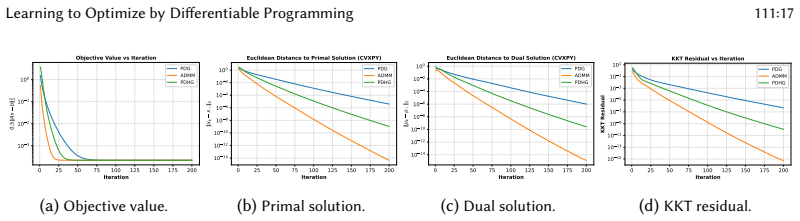
- [Abstract and §3.5–§4] The paper's central thesis is that differentiable programming can "learn how to design" optimization algorithms and that end-to-end training improves convergence and solution quality. The only training routine, learn_nnls_dual_by_backprop (§3.5), initializes λ, μ, z and runs Adam on the fixed Lagrangian of one NNLS instance; no update rule, step size, preconditioner, or proximal operator is learned. The Section 4 case studies run fixed ADMM/PDHG/projected-gradient iterations with hand-chosen parameters, e.g., Eqs. (83)–(86) in §4.3. There is no training set, no held-out evaluation, and no comparison against an untrained baseline. The stated thesis is therefore not demonstrated. The paper should either be reframed as a tutorial on implementing known algorithms or include genuine learned-algorithm experiments.
- [§3.4.1, Eq. (42)] In Example 3.3 the Lagrangian is ℒ = f(x) - μ^T x with μ≥0, so ∇_μ ℒ = -x. The dual problem is a maximization, so the projected dual update should be μ^{k+1} = Π(μ^k + σ x^{k+1}). Equation (42) instead uses μ^{k+1} = Π(μ^k - σ x^{k+1}), which is a descent step for the dual and is incorrect as written. This sign error affects the PDG algorithm described in the tutorial.
- [§4.1 and §4.2] The Stigler Diet and Neural Network Verification case studies contain only problem formulations and references to external tools; no differentiable-programming implementation, convergence plot, or numerical result is reported for either. Table 2 nevertheless claims that these case studies illustrate the benefits of the framework. At minimum, the authors should either provide actual experiments or state explicitly that these are purely illustrative formulations with no empirical evaluation.
minor comments (5)
- [Throughout] Fenchel–Rockafellar is consistently misspelled as "Fenchel–Rockafeller." Also, "computation graphs, also as known Kantorovich graphs" is ungrammatical.
- [§3.5 code block] The function recover_x_from_mu_active_set is called with parameters tau and max_refine that are not defined in the displayed code or the surrounding text. The reader cannot reproduce the primal recovery step without additional detail.
- [§4.4] In the validation sentence, z is used in c=(1/n)1^T(x* - z) but z is never defined. It should be z = L†(μ* - A^T λ*).
- [References] There are duplicate references for PyTorch ([96] and [136]) and for CVX ([77] and [78]). The reference list should be consolidated.
- [§3.3.2, Eq. (33)] The line inf_{x≥0}{y^T A x} is not well defined for general y: if any component of A^T y is negative, the infimum is -∞. This ambiguity is part of the problem that makes Eq. (36) invalid and should be clarified in the revision.
Circularity Check
Dual-to-primal recovery in §4.4 is validated with a constant fitted to the target solution; the rest of the tutorial's mathematics is standard and not circular.
specific steps
-
fitted input called prediction
[Section 4.4, after Eq. (92)]
"where μ⋆ and λ⋆ denote the optimal dual solutions, and the scalar c is uniquely determined by primal feasibility and the complementary slackness conditions. To numerically validate (92), we solve an LR-NNLS instance with(m, n) = (50, 30) using CVXPY and reconstruct x⋆ from the dual solutions via a least-squares estimate of c, namely c = 1/n 1⊤(x⋆ − z). The resulting reconstruction error is on the order of 10−6, confirming the theoretical consistency."
Eq. (92) claims x* = L†(μ*−Aᵀλ*) + c1 with c determined by KKT conditions. The numerical validation instead computes c = (1/n)1ᵀ(x*−z), i.e., c is fitted from the CVXPY solution x* that the formula is supposed to recover from dual variables alone. The 10⁻⁶ error therefore only shows that x*−L†(μ*−Aᵀλ*) is nearly constant; it does not test whether primal feasibility and complementary slackness determine c. The 'reconstruction' is a fit to the target, so the reported validation is forced by construction.
full rationale
The core tutorial mathematics—computation-graph backpropagation, Lagrangian/Fenchel duals of NNLS, ADMM and PDHG updates, and the OPF/NNV formulations—is standard textbook material with external grounding and is not circular. The only concrete circular step is the §4.4 validation: the constant c in the closed-form primal recovery is estimated from the true CVXPY solution, turning the claimed KKT-based recovery into a fitted reconstruction. Self-citations ([155], [156], [173]) are present but not load-bearing: they are cited as examples/background, and the paper's derivations do not rest on them. Separately, the headline claim that the paper 'learns how to design' optimization algorithms is not demonstrated—the only 'learning' routine (learn_nnls_dual_by_backprop) runs Adam on the Lagrangian of one fixed NNLS instance and no update rule or step-size policy is learned—but this is a claim-evidence gap, not a circular derivation, so it does not change the circularity score beyond the one fitted validation.
Axiom & Free-Parameter Ledger
free parameters (2)
- c (LR-NNLS null-space constant) =
c = (1/n) 1^T (x* - z), computed from the CVXPY solution
- ADMM/PDHG hyperparameters (ρ, ρ_c, τ, σ, θ, learning rate, iteration counts) =
ρ=1.0, ρ_c=1.0, lr=1e-2, iters=500–3000, etc.
axioms (5)
- domain assumption Slater's condition holds for NNLS and the cone programs considered, so strong duality holds and the primal optimum is recoverable from the dual.
- domain assumption The graph Laplacian L is connected, so its null space is span{1} and the solution form x* = -L† g + c1 is valid.
- domain assumption The dual of the nonconvex neural network verification problem provides valid certificates with no duality gap.
- ad hoc to paper The OPF case study is well modeled by the resistive-network surrogate with nodal power p_i(v) = v_i(Gv)_i and a quadratic loss v^T G v.
- ad hoc to paper In Example 3.2, inf_{x≥0} 1/2 ||Ax - (y+b)||² = 0 for every y, i.e., y+b ∈ range(A) is actually attained over the nonnegative orthant.
Cite this review
Pith. "Pith review of Learning to Optimize by Differentiable Programming." pith.science (2026). https://pith.science/paper/VPOGYORW
@misc{pith2026260116510,
  author       = {Pith},
  title        = {Pith review of: Learning to Optimize by Differentiable Programming},
  year         = {2026},
  howpublished = {\url{https://pith.science/paper/VPOGYORW}},
  note         = {Machine review of arXiv:2601.16510}
}
read the original abstract
Solving massive-scale optimization problems requires scalable first-order methods with low per-iteration cost. This tutorial highlights a shift in optimization: using differentiable programming not only to execute algorithms but to learn how to design them. Modern frameworks such as PyTorch, TensorFlow, and JAX enable this paradigm through efficient automatic differentiation. Embedding first-order methods within these systems allows end-to-end training that improves convergence and solution quality. Guided by Fenchel-Rockafellar duality, the tutorial demonstrates how duality-informed iterative schemes such as the alternating direction method of multipliers, and the primal-dual hybrid gradient can be learned and adapted through representative case studies.
Figures




Forward citations
Cited by 2 Pith papers
-
Controlled Periodic Synchronization for Efficient Data-Parallel Training
Periodic gradient+parameter synchronization with SlowMo beats DDP by 2.44 pp (K=4) on a WAN while cutting average wall-clock time by 13.8%, but only under a fixed LR=0.1 protocol.
-
Learning-Based Spectrum Cartography in Low Earth Orbit Satellite Networks: An Overview
The paper overviews attention-based learning methods for spectrum cartography in LEO satellite networks to enable adaptive fusion of heterogeneous measurements for inference and resource allocation.
Reference graph
Works this paper leans on
-
[1]
Martín Abadi, Paul Barham, Jianmin Chen, Zhifeng Chen, Andy Davis, Jeffrey Dean, Matthieu Devin, Sanjay Ghe- mawat, Geoffrey Irving, Michael Isard, et al. 2016. TensorFlow: A system for large-scale machine learning. In12th USENIX Symposium on Operating Systems Design and Implementation (OSDI 16). 265–283
2016
-
[2]
Martín Abadi and Gordon D Plotkin. 2019. A simple differentiable programming language.Proceedings of the ACM on Programming Languages4, POPL (2019), 1–28. 8Source code is available athttps://github.com/convexsoft/diffprog. J. ACM, Vol. 37, No. 4, Article 111. Publication date: August 2018. Learning to Optimize by Differentiable Programming 111:31
2019
-
[3]
Akshay Agrawal, Brandon Amos, Shane Barratt, Stephen Boyd, Steven Diamond, and J Zico Kolter. 2019. Differen- tiable convex optimization layers.Advances in Neural Information Processing Systems32 (2019)
2019
-
[4]
Akshay Agrawal and Stephen Boyd. 2020. Differentiating through log-log convex programs. arXiv preprint arXiv:2004.12553 (2020)
Pith/arXiv arXiv 2020
-
[5]
Akshay Agrawal, Stephen Boyd, Deepak Narayanan, Fiodar Kazhamiaka, and Matei Zaharia. 2022. Allocation of fungible resources via a fast, scalable price discovery method.Mathematical Programming Computation14, 3 (2022), 593–622
2022
-
[6]
Akshay Agrawal, Robin Verschueren, Steven Diamond, and Stephen Boyd. 2018. A rewriting system for convex optimization problems.Journal of Control and Decision5, 1 (2018), 42–60
2018
-
[7]
Ali AhmadiTeshnizi, Wenzhi Gao, and Madeleine Udell. 2023. Optimus: Optimization modeling using mip solvers and large language models.arXiv preprint arXiv:2310.06116(2023)
Pith/arXiv arXiv 2023
-
[8]
Aws Albarghouthi et al. 2021. Introduction to neural network verification.Foundations and Trends® in Programming Languages 7, 1–2 (2021), 1–157
2021
-
[9]
Rita Ammanouil, André Ferrari, and Cédric Richard. 2015. A graph Laplacian regularization for hyperspectral data unmixing.In 2015IEEEInternationalConferenceonAcoustics,SpeechandSignalProcessing(ICASSP) .IEEE,1637–1641
2015
-
[10]
Brandon Amos. 2019. Differentiable optimization-based modeling for machine learning. (2019)
2019
-
[11]
Brandon Amos, Ivan Jimenez, Jacob Sacks, Byron Boots, and J Zico Kolter. 2018. Differentiable mpc for end-to-end planning and control.Advances in Neural Information Processing Systems31 (2018)
2018
-
[12]
Brandon Amos and J Zico Kolter. 2017. Optnet: Differentiable optimization as a layer in neural networks. InInter- national Conference on Machine Learning. PMLR, 136–145
2017
-
[13]
Erling D Andersen and Knud D Andersen. 2000. The MOSEK interior point optimizer for linear programming: an implementation of the homogeneous algorithm. InHigh Performance Optimization. Springer, 197–232
2000
-
[14]
MarcinAndrychowicz,MishaDenil,SergioGomez,MatthewWHoffman,DavidPfau,TomSchaul,BrendanShilling- ford, and Nando De Freitas. 2016. Learning to learn by gradient descent by gradient descent.Advances in Neural Information Processing Systems29 (2016)
2016
-
[16]
David Applegate, Mateo Díaz, Oliver Hinder, Haihao Lu, Miles Lubin, Brendan O’Donoghue, and Warren Schudy
-
[17]
AnewinsightonaugmentedLagrangianmethodwithapplications in machine learning.Journal of Scientific Computing99, 2 (2024), 53
JianchaoBai,LinyuanJia,andZhengPeng.2024. AnewinsightonaugmentedLagrangianmethodwithapplications in machine learning.Journal of Scientific Computing99, 2 (2024), 53
2024
-
[18]
Shaojie Bai, J Zico Kolter, and Vladlen Koltun. 2019. Deep equilibrium models.Advances in Neural Information Processing Systems32 (2019)
2019
-
[19]
Friedrich L Bauer. 1974. Computational graphs and rounding error.SIAM J. Numer. Anal.11, 1 (1974), 87–96
1974
-
[20]
Atilim Gunes Baydin, Barak A Pearlmutter, Alexey Andreyevich Radul, and Jeffrey Mark Siskind. 2018. Automatic differentiation in machine learning: A survey.Journal of Machine Learning Research18, 153 (2018), 1–43
2018
-
[21]
2017.First-order methods in optimization
Amir Beck. 2017.First-order methods in optimization. SIAM
2017
-
[22]
Yoshua Bengio, Andrea Lodi, and Antoine Prouvost. 2021. Machine learning for combinatorial optimization: a methodological tour d’horizon.European Journal of Operational Research290, 2 (2021), 405–421
2021
-
[23]
Bentkamp, R
A. Bentkamp, R. Fernández Mir, and J. Avigad. 2023. Verified reductions for optimization. InTools and Algorithms for the Construction and Analysis of Systems, Vol. 13994. Springer, 74–92
2023
-
[24]
Quentin Bertrand, Quentin Klopfenstein, Mathurin Massias, Mathieu Blondel, Samuel Vaiter, Alexandre Gramfort, and Joseph Salmon. 2022. Implicit differentiation for fast hyperparameter selection in non-smooth convex learning. Journal of Machine Learning Research23, 149 (2022), 1–43
2022
-
[25]
2014.Constrained optimization and Lagrange multiplier methods
Dimitri P Bertsekas. 2014.Constrained optimization and Lagrange multiplier methods. Academic press
2014
-
[26]
Mathieu Blondel and Vincent Roulet. 2024. The elements of differentiable programming. arXiv preprint arXiv:2403.14606 (2024)
Pith/arXiv arXiv 2024
-
[27]
Mathieu Blondel, Olivier Teboul, Quentin Berthet, and Josip Djolonga. 2020. Fast differentiable sorting and ranking. In International Conference on Machine Learning. PMLR, 950–959
2020
-
[28]
Jonathan Borwein and Adrian Lewis. 2006. Convex Analysis and Nonlinear Optimization: Theoryand Examples. Springer
2006
-
[29]
Nacime Bouziani, David A Ham, and Ado Farsi. 2024. Differentiable programming across the PDE and machine learning barrier.arXiv preprint arXiv:2409.06085(2024)
Pith/arXiv arXiv 2024
-
[30]
Stephen Boyd, Neal Parikh, Eric Chu, Borja Peleato, Jonathan Eckstein, et al. 2011. Distributed optimization and statistical learning via the alternating direction method of multipliers.Foundations and Trends® in Machine learning 3, 1 (2011), 1–122. J. ACM, Vol. 37, No. 4, Article 111. Publication date: August 2018. 111:32 Tao, Tong and Tan
2011
-
[31]
2004.Convex optimization
Stephen P Boyd and Lieven Vandenberghe. 2004.Convex optimization. Cambridge university press
2004
-
[32]
James Bradbury, Roy Frostig, Peter Hawkins, Matthew James Johnson, Chris Leary, Dougal Maclaurin, George Necula, Adam Paszke, Jake VanderPlas, Skye Wanderman-Milne, et al. 2018. JAX: composable transformations of Python+ NumPy programs. (2018)
2018
-
[33]
Robin A Brown, Edward Schmerling, Navid Azizan, and Marco Pavone. 2022. A unified view of SDP-based neural network verification through completely positive programming. InInternational Conference on Artificial Intelligence and Statistics. PMLR, 9334–9355
2022
-
[34]
Deng Cai, Xiaofei He, Jiawei Han, and Thomas S Huang. 2010. Graph regularized nonnegative matrix factorization for data representation.IEEE Transactions on Pattern Analysis and Machine Intelligence33, 8 (2010), 1548–1560
2010
-
[35]
Raafi Careem, G Johar, and Ali Khatibi. 2024. Deep neural networks optimization for resource-constrained envi- ronments: Techniques and models.Indonesian Journal of Electrical Engineering and Computer Science33, 3 (2024), 1843–1854
2024
-
[36]
Antonin Chambolle and Thomas Pock. 2011. A first-order primal-dual algorithm for convex problems with applica- tions to imaging.Journal of Mathematical Imaging and Vision40, 1 (2011), 120–145
2011
-
[37]
Tsung-Hui Chang, Mingyi Hong, Wei-Cheng Liao, and Xiangfeng Wang. 2016. Asynchronous distributed ADMM for large-scale optimization—Part I: Algorithm and convergence analysis.IEEE Transactions on Signal Processing64, 12 (2016), 3118–3130
2016
-
[38]
Fei Chen, Gene Cheung, and Xue Zhang. 2024. Manifold graph signal restoration using gradient graph Laplacian regularizer. IEEE Transactions on Signal Processing72 (2024), 744–761
2024
-
[39]
Tianlong Chen, Xiaohan Chen, Wuyang Chen, Howard Heaton, Jialin Liu, Zhangyang Wang, and Wotao Yin. 2022. Learning to optimize: A primer and a benchmark.Journal of Machine Learning Research23, 189 (2022), 1–59
2022
-
[40]
Tianqi Chen, Thierry Moreau, Ziheng Jiang, Lianmin Zheng, Eddie Yan, Haichen Shen, Meghan Cowan, Leyuan Wang, Yuwei Hu, Luis Ceze, Carlos Guestrin, and Arvind Krishnamurthy. 2018. TVM: An automated end-to-end optimizing compiler for deep learning. In13th USENIX Symposium on Operating Systems Design and Implementation (OSDI 18). USENIX Association, Carlsba...
2018
-
[41]
Sharan Chetlur, Cliff Woolley, Philippe Vandermersch, Jonathan Cohen, John Tran, Bryan Catanzaro, and Evan Shelhamer. 2014. cuDNN: Efficient primitives for deep learning.arXiv preprint arXiv:1410.0759(2014)
Pith/arXiv arXiv 2014
-
[42]
Hong-Ming Chiu, Hao Chen, Huan Zhang, and Richard Y Zhang. 2025. SDP-CROWN: Efficient bound propagation for neural network verification with tightness of semidefinite programming.arXiv preprint arXiv:2506.06665(2025)
Pith/arXiv arXiv 2025
-
[43]
Ontheconvergenceanalysisofthedecentralizedprojectedgradientdescent method
WoocheolChoiandJimyeongKim.2025. Ontheconvergenceanalysisofthedecentralizedprojectedgradientdescent method. SIAM Journal on Optimization35, 3 (2025), 1673–1702
2025
-
[44]
1990.Optimization and nonsmooth analysis
Frank H Clarke. 1990.Optimization and nonsmooth analysis. SIAM
1990
-
[45]
Gonzalo E Constante-Flores, Hao Chen, and Can Li. 2025. Enforcing hard linear constraints in deep learning models with decision rules.arXiv preprint arXiv:2505.13858(2025)
arXiv 2025
-
[46]
Matthieu Courbariaux, Itay Hubara, Daniel Soudry, Ran El-Yaniv, and Yoshua Bengio. 2016. Binarized neural networks: Training deep neural networks with weights and activations constrained to+ 1 or-1. arXiv preprint arXiv:1602.02830 (2016)
Pith/arXiv arXiv 2016
-
[47]
Ron S Dembo, Stanley C Eisenstat, and Trond Steihaug. 1982. Inexact newton methods.SIAM J. Numer. Anal.19, 2 (1982), 400–408
1982
-
[48]
Jelena Diakonikolas, Chenghui Li, Swati Padmanabhan, and Chaobing Song. 2022. A fast scale-invariant algorithm for non-negative least squares with non-negative data.Advances in Neural Information Processing Systems35 (2022), 6264–6277
2022
-
[49]
Steven Diamond and Stephen Boyd. 2016. CVXPY: A Python-embedded modeling language for convex optimization. Journal of Machine Learning Research17, 83 (2016), 1–5
2016
-
[50]
Jean C Digitale, Jeffrey N Martin, and Medellena Maria Glymour. 2022. Tutorial on directed acyclic graphs.Journal of Clinical Epidemiology142 (2022), 264–267
2022
-
[51]
Joshua V Dillon, Ian Langmore, Dustin Tran, Eugene Brevdo, Srinivas Vasudevan, Dave Moore, Brian Patton, Alex Alemi, Matt Hoffman, and Rif A Saurous. 2017. Tensorflow distributions.arXiv preprint arXiv:1711.10604(2017)
Pith/arXiv arXiv 2017
-
[52]
Alexander Domahidi, Eric Chu, and Stephen Boyd. 2013. ECOS: An SOCP solver for embedded systems. In2013 European control conference (ECC). IEEE, 3071–3076
2013
-
[53]
Hermann W Dommel and William F Tinney. 2007. Optimal power flow solutions. IEEE Transactions on Power Apparatus and Systems10 (2007), 1866–1876
2007
-
[54]
Simon S Du and Wei Hu. 2019. Linear convergence of the primal-dual gradient method for convex-concave saddle point problems without strong convexity. InThe 22nd International Conference on Artificial Intelligence and Statistics. PMLR, 196–205
2019
-
[55]
Mirjam Dür and Franz Rendl. 2021. Conic optimization: A survey with special focus on copositive optimization and binary quadratic problems. (2021). J. ACM, Vol. 37, No. 4, Article 111. Publication date: August 2018. Learning to Optimize by Differentiable Programming 111:33
2021
-
[56]
Krishnamurthy Dvijotham, Sven Gowal, Robert Stanforth, Relja Arandjelovic, Brendan O’Donoghue, Jonathan Ue- sato, and Pushmeet Kohli. 2018. Training verified learners with learned verifiers.arXiv preprint arXiv:1805.10265 (2018)
Pith/arXiv arXiv 2018
-
[57]
First-ordermethodsforconvexoptimization
PavelDvurechensky,ShimritShtern,andMathiasStaudigl.2021. First-ordermethodsforconvexoptimization. EURO Journal on Computational Optimization9 (2021), 100015
2021
-
[58]
Zeinab Ebrahimi, Gustavo Batista, and Mohammad Deghat. 2024. AA-DLADMM: An accelerated ADMM-based framework for training deep neural networks.arXiv preprint arXiv:2401.03619(2024)
Pith/arXiv arXiv 2024
-
[59]
DualitybetweenLagrangianandLegendrianinvariants
TobiasEkholmandYankıLekili.2023. DualitybetweenLagrangianandLegendrianinvariants. Geometry & Topology 27, 6 (2023), 2049–2179
2023
-
[60]
Ernie Esser, Yifei Lou, and Jack Xin. 2013. A method for finding structured sparse solutions to nonnegative least squares problems with applications.SIAM Journal on Imaging Sciences6, 4 (2013), 2010–2046
2013
-
[61]
Ernie Esser, Xiaoqun Zhang, and Tony F Chan. 2010. A general framework for a class of first order primal-dual algorithms for convex optimization in imaging science.SIAM Journal on Imaging Sciences3, 4 (2010), 1015–1046
2010
-
[62]
Werner Fenchel. 2013. On conjugate convex functions. InTraces and Emergence of Nonlinear Programming. Springer, 125–129
2013
-
[63]
FerdinandoFioretto,PascalVanHentenryck,TerrenceWKMak,CuongTran,FedericoBaldo,andMicheleLombardi
-
[64]
Robert Fourer, Chandrakant Maheshwari, Arnold Neumaier, Dominique Orban, and Hermann Schichl. 2010. Con- vexity and concavity detection in computational graphs: Tree walks for convexity assessment.INFORMS Journal on Computing 22, 1 (2010), 26–43
2010
-
[65]
Marguerite Frank, Philip Wolfe, et al. 1956. An algorithm for quadratic programming.Naval Research Logistics Quarterly 3, 1-2 (1956), 95–110
1956
-
[66]
Roy Frostig, Matthew James Johnson, and Chris Leary. 2019. Compiling machine learning programs via high-level tracing. InSysML Conference 2018. Stanford, United States
2019
-
[67]
Bin Gao, Tie-Yan Liu, Wei Wei, Taifeng Wang, and Hang Li. 2011. Semi-supervised ranking on very large graphs with rich metadata. InProceedings of the 17th ACM SIGKDD International Conference on Knowledge Discovery and Data Mining. 96–104
2011
-
[68]
Yuan Gao and Christian Kroer. 2020. First-order methods for large-scale market equilibrium computation.Advances in Neural Information Processing Systems33 (2020), 21738–21750
2020
-
[69]
Susan Garner Garille and Saul I Gass. 2001. Stigler’s diet problem revisited.Operations Research49, 1 (2001), 1–13
2001
-
[70]
Maximilian Gelbrecht, Alistair White, Sebastian Bathiany, and Niklas Boers. 2023. Differentiable programming for Earth system modeling.Geoscientific Model Development16, 11 (2023), 3123–3135
2023
-
[71]
Google. 2024. OR-Tools: Google optimization tools.https://github.com/google/or-tools.git
2024
-
[72]
Google. 2026. Google OR-Tools.https://developers.google.com/optimization
2026
-
[73]
Stephen Gould. 2025. Lecture notes on differentiable optimisation in deep learning
2025
-
[74]
Stephen Gould, Richard Hartley, and Dylan Campbell. 2019. Deep declarative networks: A new hope.arXiv e-prints (2019), arXiv–1909
2019
-
[75]
Deepdeclarativenetworks
StephenGould,RichardHartley,andDylanCampbell.2021. Deepdeclarativenetworks. IEEE Transactions on Pattern Analysis and Machine Intelligence44, 8 (2021), 3988–4004
2021
-
[76]
Graphimplementationsfornonsmoothconvexprograms
MichaelGrantandStephenBoyd.2008. Graphimplementationsfornonsmoothconvexprograms. In RecentAdvances in Learning and Control. Springer-Verlag Limited, 95–110
2008
-
[77]
Michael Grant and Stephen Boyd. 2020. CVX: Matlab software for disciplined vonvex programming, version 2.2. https://cvxr.com/cvx/
2020
-
[78]
Michael Grant, Stephen Boyd, and Yinyu Ye. 2008. CVX: Matlab software for disciplined convex programming
2008
-
[79]
Harshit Gupta, Kyong Hwan Jin, Ha Q Nguyen, Michael T McCann, and Michael Unser. 2018. CNN-based projected gradient descent for consistent CT image reconstruction.IEEE Transactions on Medical Imaging37, 6 (2018), 1440– 1453
2018
-
[80]
Mohamad Azrin Syafiq Halim and Yeak Su Hoe. 2024. Introduction to automatic differentiation and neural differen- tiation equation.Proceedings of the Scientific Mathematics Journal24 (2024), 81–89
2024
-
[81]
Nguyen TV Hang, Boris S Mordukhovich, and M Ebrahim Sarabi. 2020. Second-order variational analysis in second- order cone programming.Mathematical Programming180, 1 (2020), 75–116
2020
discussion (0)
Sign in with ORCID, Apple, or X to comment. Anyone can read and Pith papers without signing in.