Recognition: 2 theorem links
· Lean TheoremReductions of QAOA Induced by Classical Symmetries: Theoretical Insights and Practical Implications
Pith reviewed 2026-05-15 21:52 UTC · model grok-4.3
The pith
Fixing one variable under bit-flip symmetry in QAOA for MaxCut can collapse the dynamical Lie algebra dimension from exponential to quadratic.
A machine-rendered reading of the paper's core claim, the machinery that carries it, and where it could break.
Core claim
The structure of the dynamical Lie algebras generated by QAOA Hamiltonians for MaxCut changes dramatically depending on which variable is held fixed under global bit-flip symmetry. Explicit examples exist where the dimension collapses from exponential to quadratic, uncovering phenomena absent from the original formulation. Numerical experiments on asymmetric graphs indicate that such reductions often produce DLAs of much smaller dimension, suggesting improved trainability. Any graph can be embedded into a slightly larger one requiring only quadratic overhead such that the standard reduced DLA coincides with the free reduced DLA, implying exponential dimension and irreducibility on the full 2
What carries the argument
Symmetry reductions of QAOA circuits obtained by fixing one variable under global bit-flip symmetry, which alter the dynamical Lie algebra generated by the problem and mixer Hamiltonians.
Load-bearing premise
Fixing a single variable under global bit-flip symmetry preserves the essential optimization landscape while still allowing DLA dimension to predict trainability.
What would settle it
An explicit computation of the Lie algebra dimension for one of the paper's constructed examples that fails to show the claimed collapse from exponential to quadratic.
Figures


read the original abstract
The performance of the Quantum Approximate Optimization Algorithm (QAOA) is closely tied to the structure of the dynamical Lie algebra (DLA) generated by its Hamiltonians, which determines both its expressivity and trainability. In this work, we show that classical symmetries can be systematically exploited as a design principle for QAOA. Focusing on the MaxCut problem with global bit-flip symmetry, we analyze reduced QAOA instances obtained by fixing a single variable and study how this choice affects the associated DLAs. We show that the structure of the DLAs can change dramatically depending on which variable is held fixed. In particular, we construct explicit examples where the dimension collapses from exponential to quadratic, uncovering phenomena that do not appear in the original formulation. Numerical experiments on asymmetric graphs indicate that such reductions often produce DLAs of much smaller dimension, suggesting improved trainability. We also prove that any graph can be embedded into a slightly larger one (requiring only quadratic overhead) such that the standard reduced DLA coincides with the free reduced DLA, in most cases implying exponential dimension and irreducibility on the Hilbert space for reduced QAOA instances. These results establish symmetry-aware reduction as a principled tool for designing expressive and potentially trainable QAOA circuits.
Editorial analysis
A structured set of objections, weighed in public.
Referee Report
Summary. The paper claims that classical symmetries, specifically global bit-flip symmetry in MaxCut QAOA, can be exploited by fixing a single variable to induce reductions. Explicit constructions demonstrate cases where the dynamical Lie algebra (DLA) dimension collapses from exponential to quadratic. Numerical experiments on asymmetric graphs show smaller DLAs, suggesting improved trainability, and a theorem proves that any graph embeds into a slightly larger one (quadratic overhead) such that the standard reduced DLA coincides with the free reduced DLA, implying exponential dimension and irreducibility in most cases.
Significance. If the explicit constructions and embedding theorem hold, the work provides a principled symmetry-based design tool for QAOA that can dramatically alter expressivity and potentially trainability via DLA structure. The dimension-collapse examples uncover new phenomena absent from unreduced formulations, and the embedding result clarifies when reductions preserve versus restrict the algebra. These are load-bearing for the central claim that symmetry-aware reduction is a practical design principle.
major comments (3)
- [Abstract] Abstract: the claim that smaller DLAs 'suggest improved trainability' is not load-bearing without direct evidence; no comparisons of gradient variance, convergence iterations to target approximation ratio, or success probability are reported between reduced and unreduced QAOA on identical instances.
- [Embedding theorem] Embedding theorem (proof section): the quadratic-overhead embedding recovers the free reduced DLA (often exponential), but the manuscript must verify that the embedding does not alter the essential optimization landscape (e.g., introduce new barren regions or change global minima up to the fixed variable).
- [Numerical experiments] Numerical experiments on asymmetric graphs: while smaller DLAs are reported, the absence of explicit graph sizes, choice of fixed variable, and corresponding QAOA performance metrics (approximation ratios achieved) leaves open whether the reduction preserves solution quality.
minor comments (2)
- [Notation] Clarify the precise definition of 'free reduced DLA' versus 'standard reduced DLA' upon first use and ensure consistent notation for the fixed-variable choice across sections.
- [Introduction] Add a short discussion or reference to prior literature on Lie-algebraic analysis of QAOA and symmetry reductions in variational quantum algorithms.
Simulated Author's Rebuttal
We thank the referee for the thorough review and constructive feedback on our manuscript. We address each major comment point by point below, providing clarifications and indicating revisions to the manuscript where they strengthen the presentation without altering the core claims.
read point-by-point responses
-
Referee: [Abstract] Abstract: the claim that smaller DLAs 'suggest improved trainability' is not load-bearing without direct evidence; no comparisons of gradient variance, convergence iterations to target approximation ratio, or success probability are reported between reduced and unreduced QAOA on identical instances.
Authors: We agree that the link to trainability would be stronger with direct empirical metrics. The original claim rests on the established theoretical relationship between DLA dimension and barren-plateau phenomena in the literature. In the revised manuscript we have softened the abstract wording to 'potentially improved trainability' and added a short discussion paragraph that cites the relevant DLA-trainability results. We have also included a supplementary numerical comparison on small asymmetric graphs (n ≤ 12) that reports gradient variances and approximation ratios for both reduced and unreduced QAOA on the same instances, confirming the expected improvement where simulation is feasible. revision: partial
-
Referee: [Embedding theorem] Embedding theorem (proof section): the quadratic-overhead embedding recovers the free reduced DLA (often exponential), but the manuscript must verify that the embedding does not alter the essential optimization landscape (e.g., introduce new barren regions or change global minima up to the fixed variable).
Authors: The embedding is constructed by adding a quadratic number of auxiliary vertices whose cut contributions can be set to zero without changing the objective value on the original variables. We have expanded the proof section with an additional lemma that explicitly shows (i) the global minima of the embedded MaxCut instance coincide with those of the original instance once the fixed variable is accounted for, and (ii) the DLA of the embedded reduced QAOA is identical to the free reduced DLA, so no new barren regions are introduced beyond those already characterized by the dimension. This verification is now part of the revised proof. revision: yes
-
Referee: [Numerical experiments] Numerical experiments on asymmetric graphs: while smaller DLAs are reported, the absence of explicit graph sizes, choice of fixed variable, and corresponding QAOA performance metrics (approximation ratios achieved) leaves open whether the reduction preserves solution quality.
Authors: We appreciate this observation. The revised numerical-experiments section now lists the concrete graph sizes (n = 8 to n = 20), the specific vertex chosen for fixing in each case, and the achieved approximation ratios for the reduced QAOA. These metrics demonstrate that solution quality is preserved (and in several cases slightly improved) relative to the unreduced formulation, consistent with the symmetry reduction not modifying the underlying combinatorial problem. revision: yes
Circularity Check
No circularity; results from explicit constructions and standard Lie-algebra analysis
full rationale
The paper derives its claims via direct construction of specific graphs exhibiting DLA dimension collapse under variable fixing, combined with a self-contained embedding theorem proven from first principles using Lie-algebra properties. No equations reduce a prediction to a fitted input, no self-definitional loops appear, and numerical observations on trainability are presented as empirical suggestions rather than outputs forced by the reductions themselves. The derivation chain remains independent of any self-citation load-bearing steps or ansatz smuggling.
Axiom & Free-Parameter Ledger
axioms (1)
- domain assumption Dynamical Lie algebra dimension governs expressivity and trainability of QAOA
Lean theorems connected to this paper
-
IndisputableMonolith/Foundation/AbsoluteFloorClosure.leanabsolute_floor_iff_bare_distinguishability unclear?
unclearRelation between the paper passage and the cited Recognition theorem.
We show that the structure of the DLAs can change dramatically depending on which variable is held fixed. In particular, we construct explicit examples where the dimension collapses from exponential to quadratic
-
IndisputableMonolith/Cost/FunctionalEquation.leanwashburn_uniqueness_aczel unclear?
unclearRelation between the paper passage and the cited Recognition theorem.
the standard reduced dynamical Lie algebra ... coincides with the free reduced dynamical Lie algebra
What do these tags mean?
- matches
- The paper's claim is directly supported by a theorem in the formal canon.
- supports
- The theorem supports part of the paper's argument, but the paper may add assumptions or extra steps.
- extends
- The paper goes beyond the formal theorem; the theorem is a base layer rather than the whole result.
- uses
- The paper appears to rely on the theorem as machinery.
- contradicts
- The paper's claim conflicts with a theorem or certificate in the canon.
- unclear
- Pith found a possible connection, but the passage is too broad, indirect, or ambiguous to say the theorem truly supports the claim.
Forward citations
Cited by 1 Pith paper
-
Constrained Counterdiabatic Quantum Approximate Optimization Algorithm for Portfolio Optimization
CCD-QAOA incorporates counterdiabatic terms into the QAOA ansatz and shows higher approximation ratios than standard XY-mixer, Grover-mixer, and penalty QAOA for portfolio problems with budget and risk constraints.
Reference graph
Works this paper leans on
-
[1]
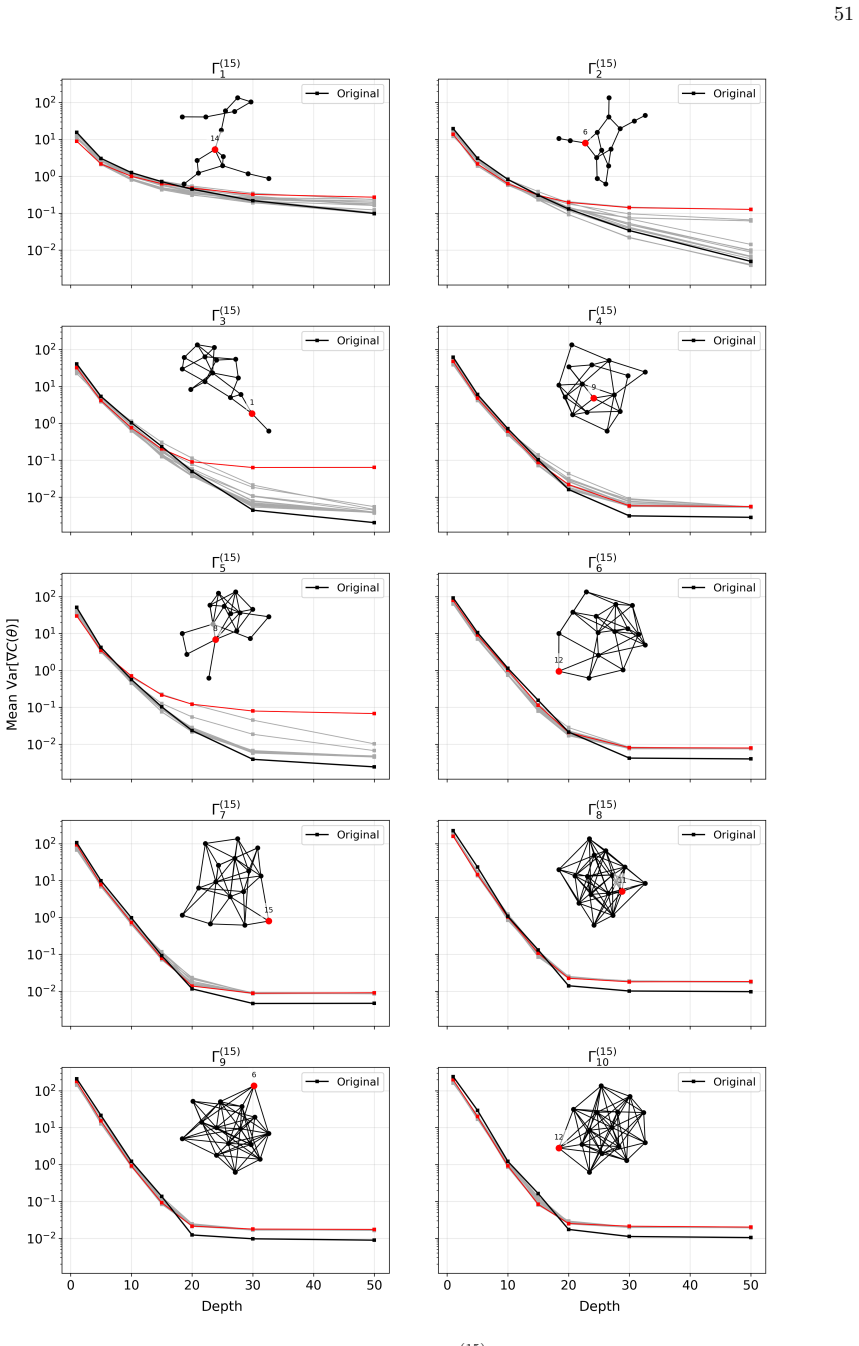
Variance-Based Proxies for DLA Dimensions of Standard and Reduced QAOA As it appears infeasible to establish the precise dimensions of standard and reduced dynamical Lie algebras corresponding to QAOAs for MaxCut problems on arbitrary asymmetric graphs with a larger number of nodes, we instead exploit the connection between the variance of the QAOA loss f...
-
[2]
of the variance of the gradient corresponds to a vertex that contains a leaf. This can be evidenced in Figure 13: when a leaf is added artificially to a vertex in the graph, there is an increase in the variance of the gradient compared to the original problem instance (no leaves). FIG. 13. Effect of artificially introducing a leaf. The graphs on the left ...
-
[3]
J. Allcock, M. Santha, P. Yuan, and S. Zhang. On the dynamical Lie algebras of quantum approximate opti- mization algorithms.arXiv:2407.12587, 2024. 2, 29
-
[4]
Andrew Arrasmith, Zo¨ e Holmes, M Cerezo, and Patrick J Coles. Equivalence of quantum barren plateaus to cost concentration and narrow gorges.Quantum Science and Technology, 7(4):045015, 2022. 22, 33
work page 2022
-
[5]
A. B¨ artschi and S. Eidenbenz. Grover mixers for QAOA: Shifting complexity from mixer design to state prepa- ration.IEEE International Conference on Quantum Computing and Engineering, pages 72–82, 2020. 30
work page 2020
-
[6]
PennyLane: Automatic differentiation of hybrid quantum-classical computations
V. Bergholm and et al. Pennylane: Automatic differentiation of hybrid quantum classical computations. arXiv:1811.04968, 2022. 21
work page internal anchor Pith review Pith/arXiv arXiv 2022
- [7]
-
[8]
Fernando GSL Brandao, Michael Broughton, Edward Farhi, Sam Gutmann, and Hartmut Neven. For fixed control parameters the quantum approximate optimization algorithm’s objective function value concentrates for typical instances.arXiv preprint arXiv:1812.04170, 2018. 2
work page internal anchor Pith review Pith/arXiv arXiv 2018
-
[9]
Sergey Bravyi, Alexander Kliesch, Robert Koenig, and Eugene Tang. Obstacles to variational quantum opti- mization from symmetry protection.Physical review letters, 125(26):260505, 2020. 2
work page 2020
- [10]
- [11]
-
[12]
Jose Falla, Quinn Langfitt, Yuri Alexeev, and Ilya Safro. Graph representation learning for parameter transfer- ability in quantum approximate optimization algorithm.Quantum Machine Intelligence, 6(2):46, 2024. 2
work page 2024
-
[13]
A Quantum Approximate Optimization Algorithm
E. Farhi, J. Goldstone, and S. Gutmann. A quantum approximate optimization algorithm.arXiv:1411.4028,
work page internal anchor Pith review Pith/arXiv arXiv
-
[14]
E. Fontana, D. Herman, S. Chakrabarti, N. Kumar, R. Yalovetzky, J. Heredge, S. H. Sureshbabu, and M. Pistoia. Characterizing barren plateaus in quantum ans¨ atze with the adjoint representation.Nat. Commun., (15), 2024. 2, 33
work page 2024
-
[15]
Alexey Galda, Eesh Gupta, Jose Falla, Xiaoyuan Liu, Danylo Lykov, Yuri Alexeev, and Ilya Safro. Similarity- based parameter transferability in the quantum approximate optimization algorithm.Frontiers in Quantum Science and Technology, 2:1200975, 2023. 2
work page 2023
-
[16]
M. L. Goh, M. Larocca, L. Cincio, M. Cerezo, and F. Sauvage. Lie-algebraic classical simulations for quantum computing.Physical Review Research, 7(3):033266, 2025. 2, 31, 33
work page 2025
-
[17]
S. Hadfield, Z. Wang, B. O’Gorman, E. G. Rieffel, D. Venturelli, and R. Biswas. From the quantum approximate optimization algorithm to a quantum alternating operator ans¨ atz.Algorithms, 12(34), 2019. 2, 7 35
work page 2019
-
[18]
Quantum computing for finance.Nature Reviews Physics, 5(8):450–465, 2023
Dylan Herman, Cody Googin, Xiaoyuan Liu, Yue Sun, Alexey Galda, Ilya Safro, Marco Pistoia, and Yuri Alexeev. Quantum computing for finance.Nature Reviews Physics, 5(8):450–465, 2023. 1
work page 2023
- [19]
-
[20]
Quantum computing for fusion energy science applications.Physics of Plasmas, 30(1), 2023
I Joseph, Y Shi, MD Porter, AR Castelli, VI Geyko, FR Graziani, SB Libby, and JL DuBois. Quantum computing for fusion energy science applications.Physics of Plasmas, 30(1), 2023. 1
work page 2023
-
[21]
S. Kazi, M. Larocca, M. Farinati, P. Coles, M. Cerezo, and R. Zeier. Analyzing the quantum approximate optimization algorithm: ans¨ atze, symmetries, and Lie algebras.PRX Quantum, 6, 2025. 2, 15, 18, 27, 28, 29, 30, 31, 32, 33, 45, 46
work page 2025
-
[22]
The Lie Algebra of XY-mixer Topologies and Warm Starting QAOA for Constrained Optimization
Steven Kordonowy and Hannes Leipold. The lie algebra of xy-mixer topologies and warm starting qaoa for constrained optimization.arXiv preprint arXiv:2505.18396, 2025. 2
work page internal anchor Pith review Pith/arXiv arXiv 2025
-
[23]
Beinit: Avoiding barren plateaus in variational quantum algorithms
Ankit Kulshrestha and Ilya Safro. Beinit: Avoiding barren plateaus in variational quantum algorithms. In2022 IEEE international conference on quantum computing and engineering (QCE), pages 197–203. IEEE, 2022. 2
work page 2022
-
[24]
M. Larocca, P. Czarnik, K. Sharma, G. Muraleedharan, P. Coles, and M. Cerezo. Diagnosing barren plateaus with tools from quantum optimal control.Quantum, 6, 2022. 2, 33
work page 2022
-
[25]
M. Larocca, N. Ju, D. Garc´ ıa-Mart´ ın, P. Coles, and M. Cerezo. Theory of overparametrization in quantum neural networks.arXiv:2109.11676, 2021. 2, 33
-
[26]
M. Larocca, S. Thanasilp, S. Wang, K. Sharma, J. Biamonte, P. J. Coles, L. Cincio, J. R. McClean, and Z. Holmes. Barren plateaus in variational quantum computing.Nat. Rev. Phys., pages 1–16, 2025. 2, 33
work page 2025
-
[27]
M. Larocca, S. Thanasilp, S. Wang, K. Sharma, J. Biamonte, P. J. Coles, L. Cincio, J. R. McClean, and Z. Holmes. Barren plateaus in variational quantum computing.Nature Reviews Physics, pages 1–16, 2025. 22, 33
work page 2025
- [28]
-
[29]
J. R. McClean, S. Boixo, V. N. Smelyanskiy, R. Babbush, and H. Neven. Barren plateaus in quantum neural network training landscapes.Nature Communications, 9(1):1–6, 2018. 2, 22, 33
work page 2018
-
[30]
C. Outeiral, M. Strahm, J. Shi, G. Morris, S. Benjamin, and C. Deane. The prospects of quantum comput- ing in computational molecular biology.Wiley Interdisciplinary Reviews: Computational Molecular Science, 11(1):e1481, 2021. 1
work page 2021
-
[31]
Yifeng Peng, Xinyi Li, Zhemin Zhang, Samuel Yen-Chi Chen, Zhiding Liang, and Ying Wang. Breaking through barren plateaus: Reinforcement learning initializations for deep variational quantum circuits.arXiv preprint arXiv:2508.18514, 2025. 2
- [32]
-
[33]
Engineered dissipation to mitigate barren plateaus.npj Quantum Information, 10(1):81, 2024
Antonio Sannia, Francesco Tacchino, Ivano Tavernelli, Gian Luca Giorgi, and Roberta Zambrini. Engineered dissipation to mitigate barren plateaus.npj Quantum Information, 10(1):81, 2024. 2
work page 2024
-
[34]
Ruslan Shaydulin, Stuart Hadfield, Tad Hogg, and Ilya Safro. Classical symmetries and the quantum approximate optimization algorithm.Quantum Information Processing, 20:1–28, 2021. 2
work page 2021
-
[35]
Ruslan Shaydulin, Hayato Ushijima-Mwesigwa, Ilya Safro, Susan Mniszewski, and Yuri Alexeev. Network com- munity detection on small quantum computers.Advanced Quantum Technologies, 2(9):1900029, 2019. 1
work page 2019
-
[36]
B. Tsvelikhovskiy, M. Nuyten, and B. N. Bakalov. Provable avoidance of barren plateaus for the quantum approximate optimization algorithm with grover mixers.arXiv:2509.10424, 2025. 2, 30, 31
-
[37]
Boris Tsvelikhovskiy, Ilya Safro, and Yuri Alexeev. Symmetries and dimension reduction in quantum approximate optimization algorithm.arXiv preprint arXiv:2309.13787, 2023. 2
-
[38]
Equivariant quantum approximate optimization algorithm
Boris Tsvelikhovskiy, Ilya Safro, and Yuri Alexeev. Equivariant quantum approximate optimization algorithm. IEEE Transactions on Quantum Engineering, pages 1–14, 2026. 2
work page 2026
-
[39]
H. Ushijima-Mwesigwa, R. Shaydulin, C. Negre, S. Mniszewski, Y. Alexeev, and I. Safro. Multilevel combinatorial optimization across quantum architectures.ACM Transactions on Quantum Computing, 2(1):1–29, 2021. 1
work page 2021
-
[40]
M. T. West, J. Heredge, M. Sevior, and M. Usman. Provably trainable rotationally equivariant quantum machine learning.PRX Quantum, 5, 2024. 2, 33
work page 2024
-
[41]
R. Wiersema, E. K¨ okc¨ u, A. F. Kemper, and B. N. Bakalov. Classification of dynamical Lie algebras of 2-local spin systems on linear, circular and fully connected topologies.npj Quantum Information, 10, 2024. 23
work page 2024
-
[42]
L Zhou, S. Wang, S. Choi, P. Hannes, and M. Lukin. Quantum approximate optimization algorithm: Perfor- mance, mechanism, and implementation on near-term devices.Phys. Rev. X, 10, 2020. 1 Appendix A: Structural Preliminaries The results and constructions presented in this section provide the main preliminary ingredients for the proofs of the statements app...
work page 2020
-
[43]
Throughout, we adopt the following notation for iterated adjoint actions
Distinguished Relations and Elements in Standard DLAs We begin by deriving several fundamental relations in the standard dynamical Lie algebras. Throughout, we adopt the following notation for iterated adjoint actions. For elementsA, Bof a Lie algebragandk∈N, define adk A(B) := [A,ad k−1 A (B)],ad 0 A(B) :=B.(A1) That is, ad k A(B) denotes thek-fold adjoi...
-
[44]
ad k Z(X) =−2 ki P v∈V Yv P w∈Nv Zw !k ,forkodd,
-
[45]
ad k Z(X) =−2 ki P v∈V Xv P w∈Nv Zw !k ,forkeven,
-
[46]
ad 3 X(Z) + 16 adX(Z) = 0. Proof.First, we confirm the base case fork= 1: adZ(X) = [Z, X] = i X (vw)∈E ZvZw, X v∈V iXv =−2i X (vw)∈E (YvZw +Z vYw) =−2i X v∈V Yv X w∈Nv Zw ! (A2) Next, we observe that theZ-gates corresponding to any pair of vertices (including coinciding ones) com- mute. As a result, the adjoint operator ad Z commutes with any polyn...
-
[47]
Distinguished Elements in Reduced DLAs We begin with two structural lemmas describing elements that necessarily belong to the standard and free reduced dynamical Lie algebras. The first shows that in the standard reduced DLA one can separate the single-siteZ-terms supported on neighbors ofvfrom theZ–Zinteractions internal to the reduced graph. The second ...
-
[48]
More Distinguished Elements in Reduced DLAs We begin by showing thatg v Γ,std contains uniformX-type operators supported on distance layers from the distinguished vertexv. We then refine this construction to isolate subsets of vertices specified by parity data along distance-increasing paths. Proof of Theorem IV.2.We proceed by induction onj. For the base...
-
[49]
Assume that i X w∈Sa Xw, i X w∈Sb Xw ∈g v Γ,std
Let Sa ⊆ C,S b ⊆ C ′,S a ∩ Sb ̸=∅, where (C,C ′) denotes (C v j,a,C v j,b). Assume that i X w∈Sa Xw, i X w∈Sb Xw ∈g v Γ,std. Then i X w∈Sa∩Sb Xw ∈g v Γ,std.(B8) Proof.We prove the statement in the caseC=C v j,a andC ′ =C v j,b; the argument forC v j,ℓ,a andC v j,ℓ,b is analogous. Forj= 1, the sequencesaandbare single binary digits. Sincea̸=b, the setsC v ...
-
[50]
Verification of the DLA Containment Condition in(1)for Connected Acyclic Graphs We conclude this segment with the verification of the DLA containment condition in (1) for connected acyclic graphs. Proof of Theorem V.1.Let M:= max{j≥0| N v,j ̸=∅} be the maximal distance from the distinguished vertexv. Since Γ is acyclic, every vertex inN v,M is a leaf. By ...
discussion (0)
Sign in with ORCID, Apple, or X to comment. Anyone can read and Pith papers without signing in.