REVIEW 4 major objections 5 minor 1 cited by
ARROW reduces catastrophic forgetting in continual RL by replaying experiences into a world model via dual short- and long-term buffers.
Reviewed by Pith at T0; open to challenge. T0 means a machine referee read the full paper against a public rubric. the ladder, T0–T4 →
ARROW, a DreamerV3-based continual RL method with dual distribution-matching replay buffers, reduces forgetting on sequential Atari while matching forward transfer on Procgen CoinRun variants.
T0 review reviewed 2026-07-14 challenge →
load-bearing objection Solid scoped methods paper: DreamerV3 plus dual short/long-term distribution-matching replay for continual RL, with useful but narrow empirical claims that still deserve a referee. the 4 major comments →
ARROW: Augmented Replay for RObust World models
The pith
A machine-rendered reading of the paper's core claim, the machinery that carries it, and where it could break.
The reading
Core claim
Compared with model-free and model-based baselines that use replay buffers of the same size, ARROW—an extension of DreamerV3 with a dual short-term and long-term distribution-matching buffer—exhibits substantially less forgetting on sequential tasks without shared structure (Atari) while maintaining comparable forward transfer on tasks with shared structure (Procgen CoinRun variants).
What carries the argument
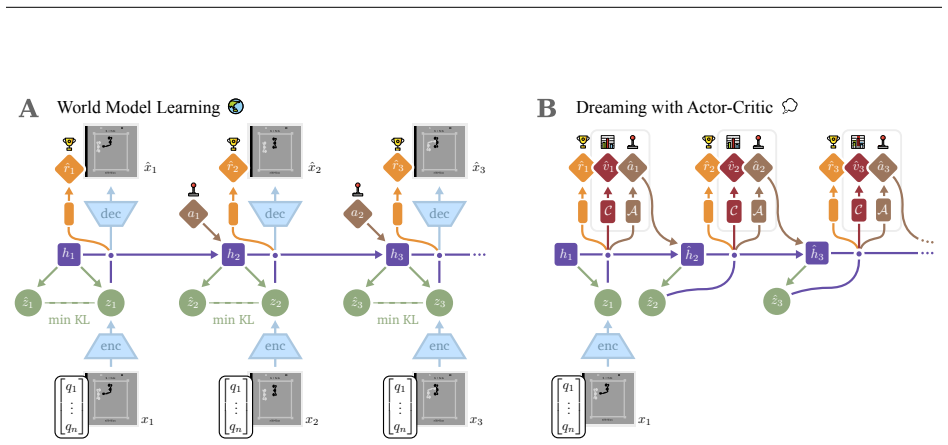
ARROW’s dual replay buffer: a short-term buffer holding recent experience and a long-term buffer that preserves task diversity by distribution-matching sampling rather than FIFO. Together they feed the world model so imagined rollouts remain accurate across task switches without expanding memory or requiring task labels.
Load-bearing premise
That a fixed-size long-term buffer, updated only by distribution-matching sampling without task labels or boundaries, will keep a representative mix of past tasks and not collapse to a non-representative subset.
What would settle it
On the same sequential Atari suite, swap ARROW’s long-term distribution-matching sampler for random or FIFO sampling of equal capacity and check whether average forgetting rises to the level of the equal-size DreamerV3 FIFO baseline.
If this is right
- Equal memory budgets can yield lower forgetting on disjoint sequential tasks when replay preserves diversity rather than recency alone.
- World-model training benefits more from diversity-preserving replay than policy-only training under the same capacity.
- Continual agents need not observe task boundaries if sampling tracks distribution shift well enough to stabilize the world model.
- Replay directed at a predictive model, rather than only at the policy, is a usable design lever for reducing interference.
- Compact dual buffers make further scaling of model-based continual RL more practical than large undifferentiated FIFO stores.
Where Pith is reading between the lines
- The same dual-buffer pattern could transfer to other generative world-model architectures beyond Dreamer-style agents.
- If long-term sampling collapses under much longer task sequences, adding surprise or coverage criteria would be a direct control experiment.
- Gains that are stronger on unstructured than structured tasks imply the method mainly shields against interference rather than amplifying transfer.
- The approach may also cut memory in offline-to-online continual settings where a single FIFO buffer already saturates.
Editorial analysis
A structured set of objections, weighed in public.
Referee Report
Summary. The paper proposes ARROW, a model-based continual RL method that extends DreamerV3 with a dual replay architecture: a short-term buffer for recent experience and a fixed-size long-term buffer whose contents are maintained by distribution-matching sampling intended to preserve task diversity without task labels or boundaries. Motivated by neuroscience-style replay into a world model rather than directly into the policy, ARROW is evaluated in two sequential settings—Atari games (little shared structure) and Procgen CoinRun variants (shared structure allowing transfer)—and is claimed to exhibit substantially less forgetting than model-free and model-based baselines with the same total replay capacity, while maintaining comparable forward transfer on the structured setting.
Significance. If the dual-buffer, unlabeled distribution-matching design is shown to be the causal driver of reduced forgetting at matched memory budgets, the work would be a useful contribution to continual model-based RL: it targets the practical memory bottleneck of replay, couples replay to a world model in a bio-inspired way, and reports gains on both non-transfer and transfer continual settings. Strengths include an explicit same-capacity comparison axis against FIFO DreamerV3 and model-free baselines, and a clear problem framing (scalability of replay under sequential tasks). The significance is currently limited by narrow environment coverage (Atari subset + CoinRun variants), dependence on the DreamerV3 stack, and incomplete isolation of the claimed diversity-preserving sampling rule from capacity allocation and other free parameters.
major comments (4)
- [Method / dual-buffer design] The central empirical claim (less forgetting at matched total buffer size) is defined relative to FIFO DreamerV3 by the long-term distribution-matching buffer. The manuscript does not make the sampling criterion, distance/feature space, insertion/eviction rule, and short-vs-long sampling ratio fully auditable as a reproducible algorithm. Without a precise statement of this procedure (and any dependence on latent features of the world model), it is not possible to verify that the buffer tracks task diversity rather than collapsing to a non-representative subset—the load-bearing premise of ARROW versus plain dual capacity.
- [Experiments / ablations] There is no ablation that isolates distribution-matching sampling from (i) simply splitting capacity into two FIFO buffers and (ii) alternative long-term selection rules (e.g., reservoir, random, surprise-based). Same total capacity is treated as the primary fair axis, but short-term capacity, long-term capacity, and the sampling ratio are free parameters. Without these controls, reported gains on Atari forgetting may be attributable to capacity allocation or hyperparameter search rather than the claimed diversity-preserving mechanism.
- [Experiments / evaluation settings] Evaluation is restricted to an Atari subset (tasks without shared structure) and Procgen CoinRun variants (shared structure). Continual RL conclusions about forgetting vs. forward transfer are sensitive to task order, number of tasks, and domain diversity. The manuscript should either expand the suite (more Atari games, additional Procgen games, or a standard continual RL benchmark with reported task sequences) or substantially qualify the scope of the claim that ARROW is robust across the two continual regimes.
- [Results / metrics] Metrics for forgetting and forward transfer must be defined explicitly (e.g., average performance drop after subsequent tasks; normalized transfer relative to single-task or from-scratch baselines) and reported with variance over seeds and, where applicable, task orders. The abstract’s “substantially less forgetting” / “comparable forward transfer” language needs corresponding tables with effect sizes and statistical support; otherwise the strongest claim remains only directionally supported.
minor comments (5)
- [Introduction] Neuroscience inspiration is motivational; keep it clearly separated from algorithmic claims so readers do not treat hippocampal replay as evidence for the specific dual-buffer rule.
- [Method / experimental setup] List all free parameters (buffer capacities, sampling ratio, DreamerV3 hyperparameters held fixed vs. tuned) in one place, and state the total memory budget in comparable units (transitions / bytes) across ARROW and baselines.
- [Experiments] Clarify whether task boundaries or labels are ever used at train or eval time; the abstract stresses unlabeled operation, which should be restated in the experimental protocol.
- [Related work] Related work should more sharply position ARROW against other continual model-based RL and replay-selection methods (reservoir, generative replay, prioritization) so the novelty of unlabeled distribution matching for world-model replay is clear.
- [Presentation] The provided manuscript extract is heavily corrupted (garbled characters, broken equations). Ensure the camera-ready source is clean, with numbered equations for the sampling objective and readable figures for learning curves and forgetting metrics.
Circularity Check
No significant circularity: empirical dual-buffer algorithm evaluated against external baselines; neuroscience is motivational only.
full rationale
ARROW is a methods paper that proposes a dual short/long-term replay buffer with distribution-matching sampling as an extension of DreamerV3, then measures forgetting and forward transfer on sequential Atari and Procgen CoinRun task sequences against same-size FIFO and model-free baselines. The dual-buffer design and sampling rule are design choices, not quantities derived from fitted parameters that are later re-presented as predictions. Neuroscience inspiration (replay to a world model) is cited only as motivation and does not enter any load-bearing equation or uniqueness claim. There is no self-definitional loop, no fitted constant renamed as a first-principles result, no uniqueness theorem imported from the same authors, and no ansatz smuggled via self-citation that forces the central claim. Empirical gains are defined relative to external held-out task sequences and matched-capacity baselines; residual risks (hyperparameter tuning, recoverability of the exact sampling metric from the corrupted extract) are reproducibility/correctness issues, not circularity of derivation. Score 0 is therefore the honest finding.
Axiom & Free-Parameter Ledger
free parameters (5)
- short_term_buffer_capacity
- long_term_buffer_capacity
- short_vs_long_sampling_ratio
- distribution_matching_sampling_criterion
- DreamerV3_hyperparameters
axioms (4)
- domain assumption Catastrophic forgetting in sequential RL is substantially mitigated by replaying a sufficiently diverse set of past transitions into a learned world model rather than only into the policy.
- ad hoc to paper A fixed-size long-term buffer maintained by distribution matching can stand in for task-aware or unbounded replay without explicit task boundaries.
- domain assumption DreamerV3’s RSSM-style world model, actor-critic, and imagination training remain a valid base learner under non-stationary multi-task streams.
- ad hoc to paper Same total replay capacity is a fair primary comparison axis between ARROW and FIFO / model-free baselines.
invented entities (2)
-
ARROW dual-buffer architecture (short-term + long-term distribution-matching replay)
no independent evidence
-
Long-term distribution-matching sampling rule for continual world-model replay
no independent evidence
Cite this review
Pith. "Pith review of ARROW: Augmented Replay for RObust World models." pith.science (2026). https://pith.science/paper/B4LNMOKD
@misc{pith2026260311395,
  author       = {Pith},
  title        = {Pith review of: ARROW: Augmented Replay for RObust World models},
  year         = {2026},
  howpublished = {\url{https://pith.science/paper/B4LNMOKD}},
  note         = {Machine review of arXiv:2603.11395}
}
read the original abstract
Continual reinforcement learning challenges agents to acquire new skills while retaining previously learned ones with the goal of improving performance in both past and future tasks. Most existing approaches rely on model-free methods with replay buffers to mitigate catastrophic forgetting; however, these solutions often face significant scalability challenges due to large memory demands. Drawing inspiration from neuroscience, where the brain replays experiences to a predictive World Model rather than directly to the policy, we present ARROW (Augmented Replay for RObust World models), a model-based continual RL algorithm that extends DreamerV3 with a memory-efficient, distribution-matching replay buffer. Unlike standard fixed-size FIFO buffers, ARROW maintains two complementary buffers: a short-term buffer for recent experiences and a long-term buffer that preserves task diversity through intelligent sampling. We evaluate ARROW on two challenging continual RL settings: Tasks without shared structure (Atari), and tasks with shared structure, where knowledge transfer is possible (Procgen CoinRun variants). Compared to model-free and model-based baselines with replay buffers of the same-size, ARROW demonstrates substantially less forgetting on tasks without shared structure, while maintaining comparable forward transfer. Our findings highlight the potential of model-based RL and bio-inspired approaches for continual reinforcement learning, warranting further research.
Figures


Forward citations
Cited by 1 Pith paper
-
The World Model Remembers, the Actor Forgets: Dream Rehearsal for Continual Model-Based RL
Under replay, DreamerV3's world model remembers old tasks but its actor forgets; supervised self-imitation on graded dreams retains behavior where RL-in-imagination fails.
This paper was first reviewed by grok-4.5 on July 14, 2026.
discussion (0)
Sign in with ORCID, Apple, or X to comment. Anyone can read and Pith papers without signing in.