Recognition: 2 theorem links
· Lean TheoremHorizon Edge Partition Functions in Λ>0 Quantum Gravity
Pith reviewed 2026-05-15 06:41 UTC · model grok-4.3
The pith
Codimension-2 edge modes on de Sitter horizons exhibit universal shift symmetries that structure one-loop gravity partition functions.
A machine-rendered reading of the paper's core claim, the machinery that carries it, and where it could break.
Core claim
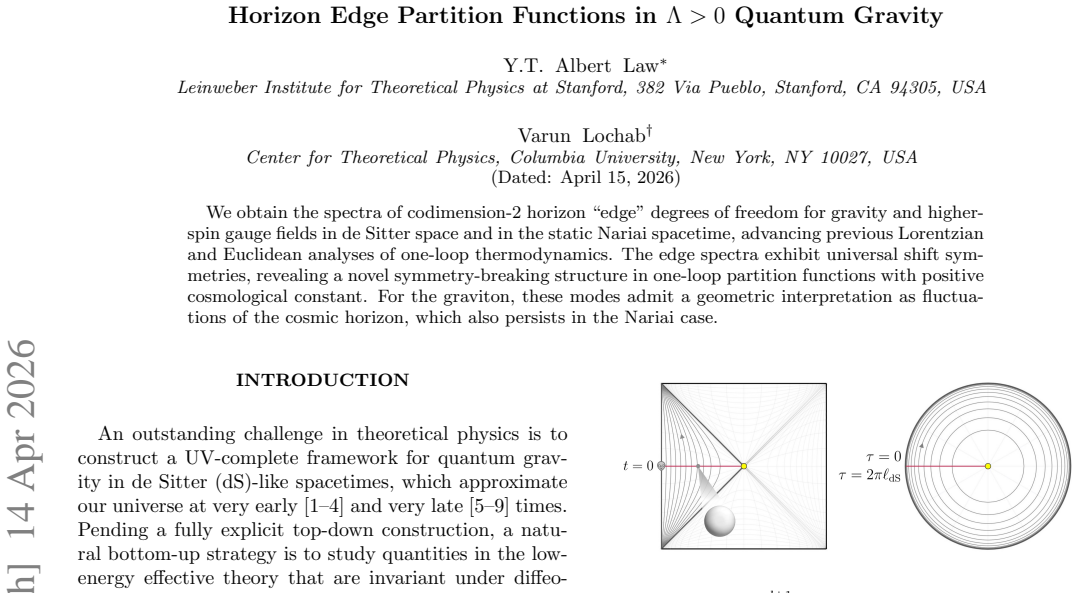
We obtain the spectra of codimension-2 horizon edge degrees of freedom for gravity and higher-spin gauge fields in de Sitter space and in the static Nariai spacetime, advancing previous Lorentzian and Euclidean analyses of one-loop thermodynamics. The edge spectra exhibit universal shift symmetries, revealing a novel symmetry-breaking structure in one-loop partition functions with positive cosmological constant. For the graviton, these modes admit a geometric interpretation as fluctuations of the cosmic horizon, which also persists in the Nariai case.
What carries the argument
Codimension-2 horizon edge degrees of freedom, which are localized modes on the horizon whose spectra display shift symmetries and contribute to the one-loop partition function.
If this is right
- The one-loop partition functions for de Sitter gravity and higher-spin fields acquire a characteristic symmetry-breaking pattern from the shift symmetries.
- Graviton edge modes correspond geometrically to fluctuations of the cosmic horizon in both de Sitter and Nariai spacetimes.
- The same edge-mode structure appears for higher-spin gauge fields, suggesting generality across field types.
- This extends earlier analyses of edge modes from Lorentzian and Euclidean settings to positive cosmological constant geometries.
Where Pith is reading between the lines
- If the shift symmetries persist at higher orders, they could impose strong constraints on the full non-perturbative path integral in de Sitter quantum gravity.
- These horizon fluctuations might offer a new route to understanding the entropy of de Sitter space beyond semiclassical approximations.
- Similar calculations in other cosmologies with positive Lambda could test whether the symmetry structure is universal or geometry-specific.
Load-bearing premise
The one-loop approximation and the precise definition of the codimension-2 horizon edge degrees of freedom continue to hold when applied to de Sitter and Nariai geometries.
What would settle it
An explicit computation of the edge-mode spectrum in de Sitter space that fails to display the reported universal shift symmetries would disprove the central claim.
Figures

read the original abstract
We obtain the spectra of codimension-2 horizon "edge" degrees of freedom for gravity and higher-spin gauge fields in de Sitter space and in the static Nariai spacetime, advancing previous Lorentzian and Euclidean analyses of one-loop thermodynamics. The edge spectra exhibit universal shift symmetries, revealing a novel symmetry-breaking structure in one-loop partition functions with positive cosmological constant. For the graviton, these modes admit a geometric interpretation as fluctuations of the cosmic horizon, which also persists in the Nariai case.
Editorial analysis
A structured set of objections, weighed in public.
Referee Report
Summary. The paper computes the spectra of codimension-2 horizon edge degrees of freedom for gravity and higher-spin gauge fields in de Sitter space and the static Nariai spacetime. These spectra exhibit universal shift symmetries that induce a novel symmetry-breaking structure in the one-loop partition functions for positive cosmological constant. The graviton edge modes receive a geometric interpretation as fluctuations of the cosmic horizon, which persists in the Nariai geometry.
Significance. If the spectra and shift symmetries are correctly derived, the work provides a concrete extension of prior one-loop thermodynamic analyses to positive cosmological constant backgrounds, offering potential new tools for understanding horizon thermodynamics and symmetry structures in de Sitter quantum gravity. The geometric interpretation for the graviton strengthens the link between edge modes and horizon physics.
major comments (2)
- [de Sitter edge spectra section] The de Sitter edge-mode analysis: the derivation of the shift symmetry relies on a specific choice of boundary conditions and mode separation that was previously validated in asymptotically flat or negative-Λ settings; the finite-area cosmological horizon and altered causal structure require an explicit check that no additional bulk-edge mixing occurs, as this is load-bearing for the claimed universality.
- [Nariai spacetime section] The Nariai geometry calculation: because the spacetime is a product with two horizons, the mode counting that produces the universal shift symmetry must demonstrate that contributions from the second horizon do not alter the degeneracy or the symmetry; without this, the extension of the geometric interpretation to Nariai is not fully supported.
minor comments (2)
- [Introduction] Notation for the edge-mode operators should be unified with the prior Lorentzian/Euclidean papers to facilitate direct comparison of the spectra.
- [higher-spin fields subsection] The abstract states the results for higher-spin fields but the main text should include at least one explicit spectrum table for a higher-spin example to illustrate the universality.
Simulated Author's Rebuttal
We thank the referee for their careful reading of our manuscript and for the constructive comments, which have helped us strengthen the presentation of our results. We address each major comment below and have revised the manuscript to incorporate the requested clarifications and explicit verifications.
read point-by-point responses
-
Referee: The de Sitter edge-mode analysis: the derivation of the shift symmetry relies on a specific choice of boundary conditions and mode separation that was previously validated in asymptotically flat or negative-Λ settings; the finite-area cosmological horizon and altered causal structure require an explicit check that no additional bulk-edge mixing occurs, as this is load-bearing for the claimed universality.
Authors: We agree that an explicit verification of the absence of bulk-edge mixing is necessary to confirm the universality of the shift symmetry in the de Sitter setting. In the revised manuscript, we have added a dedicated paragraph in the de Sitter edge spectra section. There we compute the relevant overlap integrals between bulk and edge modes using the chosen boundary conditions and demonstrate that mixing terms vanish identically, even accounting for the finite horizon area and modified causal structure. This explicit check supports the validity of the mode separation and the resulting shift symmetry. revision: yes
-
Referee: The Nariai geometry calculation: because the spacetime is a product with two horizons, the mode counting that produces the universal shift symmetry must demonstrate that contributions from the second horizon do not alter the degeneracy or the symmetry; without this, the extension of the geometric interpretation to Nariai is not fully supported.
Authors: We appreciate this point regarding the product structure of the Nariai geometry. In the revised manuscript, we have expanded the Nariai spacetime section with an explicit mode-counting argument. Because the geometry is a direct product, the quadratic action contains no cross terms between the two horizons. The modes on each horizon are identical by symmetry, and we show that the second horizon contributes an identical degeneracy without altering the shift symmetry or introducing additional mixing. This demonstration preserves the geometric interpretation of the graviton edge modes as horizon fluctuations. revision: yes
Circularity Check
Minor self-citation in extension of prior analyses; derivation remains independent
full rationale
The paper advances prior Lorentzian and Euclidean one-loop analyses to obtain edge spectra and shift symmetries in de Sitter and Nariai geometries. No equation or claim in the abstract or described chain reduces the spectra, symmetries, or geometric interpretation to a fitted parameter, self-definition, or load-bearing self-citation by construction. The central results are presented as outputs of the extension rather than presupposed inputs, leaving the derivation self-contained against external benchmarks with only minor potential self-citation.
Axiom & Free-Parameter Ledger
Lean theorems connected to this paper
-
IndisputableMonolith/Cost/FunctionalEquation.leanwashburn_uniqueness_aczel unclear?
unclearRelation between the paper passage and the cited Recognition theorem.
Z_{1-loop}^{PI}[S^{d+1}] = Z_{bulk}(β=β_{dS}) Z_{edge} ... edge spectra exhibit universal shift symmetries
-
IndisputableMonolith/Foundation/AlexanderDuality.leanalexander_duality_circle_linking unclear?
unclearRelation between the paper passage and the cited Recognition theorem.
branching rule so(d+2)→u(1)⊕so(d) ... nonlinear realization of SO(d+2)
What do these tags mean?
- matches
- The paper's claim is directly supported by a theorem in the formal canon.
- supports
- The theorem supports part of the paper's argument, but the paper may add assumptions or extra steps.
- extends
- The paper goes beyond the formal theorem; the theorem is a base layer rather than the whole result.
- uses
- The paper appears to rely on the theorem as machinery.
- contradicts
- The paper's claim conflicts with a theorem or certificate in the canon.
- unclear
- Pith found a possible connection, but the passage is too broad, indirect, or ambiguous to say the theorem truly supports the claim.
Forward citations
Cited by 2 Pith papers
-
de Sitter Vacua & pUniverses
The p-Schwinger model on de Sitter space supports p distinct de Sitter-invariant vacua that are Hadamard, and coupling a multi-flavor version to gravity yields a semiclassical de Sitter saddle at large N_f.
-
The yes boundaries wavefunctions of the universe
Using two timelike boundaries and a nearly maximally entangled thermofield double state from dressed de Sitter Hamiltonian theories, the authors construct wavefunctions for extended cosmological spacetimes that includ...
Reference graph
Works this paper leans on
-
[1]
to (6), Z1-loop PI Sd+1 ∼ Y u(1)⊕so(d) irreps ,(7) which makes theso(d) content explicit. Carrying out this analysis, explained in detail in the companion work [29], we obtain a refined form of (5), valid for anyd≥3: Zedge ∝det ′ −∇2 0 − d−1 ℓ2 dS ×det ′ −1 −∇2 1 − d−2 ℓ2 dS 1 2 ×det ′ −∇2 0 1 2 . (8) Here−∇ 2 0 and−∇ 2 1 denote the scalar and transverse-...
-
[2]
with topologyCP 2#CP 2 and its higher-dimensional generalizations [134], corresponding to Euclidean contin- uations of rotating Nariai black holes with special com- plexified parameters. For oddd+ 1, further saddles arise as smooth quotients of the roundS d+1. A canonical case is the Lens spacesL(p, q), theZ p quotients ofS 3, inter- pretable as grand can...
-
[3]
A. A. Starobinsky, Spectrum of relict gravitational ra- diation and the early state of the universe, JETP Lett. 30, 682 (1979)
work page 1979
-
[4]
A. H. Guth, The Inflationary Universe: A Possible Solu- tion to the Horizon and Flatness Problems, Phys. Rev. D23, 347 (1981)
work page 1981
-
[5]
A. D. Linde, A New Inflationary Universe Scenario: A Possible Solution of the Horizon, Flatness, Homogene- ity, Isotropy and Primordial Monopole Problems, Phys. Lett. B108, 389 (1982)
work page 1982
-
[6]
A. Albrecht and P. J. Steinhardt, Cosmology for Grand Unified Theories with Radiatively Induced Symmetry Breaking, Phys. Rev. Lett.48, 1220 (1982)
work page 1982
-
[7]
S. Perlmutteret al.(Supernova Cosmology Project), Measurements of the cosmological parameters Omega and Lambda from the first 7 supernovae at z>=0.35, Astrophys. J.483, 565 (1997), arXiv:astro-ph/9608192
work page internal anchor Pith review Pith/arXiv arXiv 1997
-
[8]
A. G. Riesset al.(Supernova Search Team), Observa- tional evidence from supernovae for an accelerating uni- verse and a cosmological constant, Astron. J.116, 1009 (1998), arXiv:astro-ph/9805201
work page internal anchor Pith review Pith/arXiv arXiv 1998
-
[9]
Improved Cosmological Constraints from New, Old and Combined Supernova Datasets
M. Kowalskiet al.(Supernova Cosmology Project), Im- proved Cosmological Constraints from New, Old and Combined Supernova Datasets, Astrophys. J.686, 749 (2008), arXiv:0804.4142 [astro-ph]
work page internal anchor Pith review Pith/arXiv arXiv 2008
-
[10]
Loeb, The Long - term future of extragalactic as- tronomy, Phys
A. Loeb, The Long - term future of extragalactic as- tronomy, Phys. Rev. D65, 047301 (2002), arXiv:astro- ph/0107568
-
[11]
L. M. Krauss and R. J. Scherrer, The Return of a Static Universe and the End of Cosmology, Gen. Rel. Grav. 39, 1545 (2007), arXiv:0704.0221 [astro-ph]
work page internal anchor Pith review Pith/arXiv arXiv 2007
-
[12]
G. W. Gibbons and S. W. Hawking, Action Integrals and Partition Functions in Quantum Gravity, Phys. Rev. D15, 2752 (1977)
work page 1977
-
[13]
Banks, Cosmological breaking of supersymmetry?, Int
T. Banks, Cosmological breaking of supersymmetry?, Int. J. Mod. Phys. A16, 910 (2001), arXiv:hep- th/0007146
-
[14]
Some Thoughts on the Quantum Theory of de Sitter Space
T. Banks, Some thoughts on the quantum theory of de sitter space, inThe Davis Meeting on Cosmic Inflation (2003) arXiv:astro-ph/0305037
work page internal anchor Pith review Pith/arXiv arXiv 2003
-
[15]
Quantum Gravity In De Sitter Space
E. Witten, Quantum gravity in de Sitter space, inStrings 2001: International Conference(2001) arXiv:hep-th/0106109
work page internal anchor Pith review Pith/arXiv arXiv 2001
-
[16]
D. Anninos, T. Bautista, and B. M¨ uhlmann, The two- sphere partition function in two-dimensional quantum gravity, JHEP09, 116, arXiv:2106.01665 [hep-th]
-
[17]
E. Coleman, E. A. Mazenc, V. Shyam, E. Silverstein, R. M. Soni, G. Torroba, and S. Yang, De Sitter mi- crostates from T T+ Λ 2 and the Hawking-Page transi- tion, JHEP07, 140, arXiv:2110.14670 [hep-th]
-
[18]
D. Anninos and B. M¨ uhlmann, The semiclassical grav- itational path integral and random matrices (toward a microscopic picture of a dS 2 universe), JHEP12, 206, arXiv:2111.05344 [hep-th]
-
[19]
D. Anninos, D. A. Galante, and B. M¨ uhlmann, Finite features of quantum de Sitter space, Class. Quant. Grav. 40, 025009 (2023), arXiv:2206.14146 [hep-th]
- [20]
-
[21]
S. Collier, L. Eberhardt, and B. M¨ uhlmann, A micro- scopic realization of dS 3, SciPost Phys.18, 131 (2025), arXiv:2501.01486 [hep-th]
- [22]
-
[23]
G. W. Gibbons and S. W. Hawking, Cosmological event horizons, thermodynamics, and particle creation, Phys. Rev. D15, 2738 (1977)
work page 1977
-
[24]
G. W. Gibbons and S. W. Hawking, Classification of Gravitational Instanton Symmetries, Commun. Math. Phys.66, 291 (1979)
work page 1979
-
[25]
D. Anninos, F. Denef, Y. T. A. Law, and Z. Sun, Quan- tum de Sitter horizon entropy from quasicanonical bulk, edge, sphere and topological string partition functions, JHEP01, 088, arXiv:2009.12464 [hep-th]
-
[26]
Our convention forZ edge differs from [23] by inver- sion. We adopt the present notation because recent Lorentzian analyses naturally interpretZ edge itself as a partition function, at least forp-form gauge theories [28, 31]
-
[27]
Sun, Higher spin de Sitter quasinormal modes, JHEP 11, 025, arXiv:2010.09684 [hep-th]
Z. Sun, Higher spin de Sitter quasinormal modes, JHEP 11, 025, arXiv:2010.09684 [hep-th]
-
[28]
M. Grewal and Y. T. A. Law, Real-time observ- ables in de Sitter thermodynamics, JHEP10, 052, arXiv:2403.06006 [hep-th]
-
[29]
A. Rios Fukelman, M. Semp´ e, and G. A. Silva, Notes on gauge fields and discrete series representations in de Sit- ter spacetimes, JHEP01, 011, arXiv:2310.14955 [hep- th]
- [30]
-
[31]
Y. T. A. Law, de Sitter horizon edge partition functions, Phys. Rev. D113, 086005 (2026), arXiv:2501.17912 [hep-th]
work page internal anchor Pith review Pith/arXiv arXiv 2026
-
[32]
J. Mukherjee, Entanglement entropy and the boundary action of edge modes, JHEP06, 113, arXiv:2310.14690 [hep-th]
-
[33]
A. Ball and Y. T. A. Law, Dynamical edge modes in p-form gauge theories, JHEP02, 182, arXiv:2411.02555 [hep-th]
- [34]
-
[35]
J. S. Dowker, Entanglement entropy for even spheres, arXiv preprint (2010), arXiv:1009.3854 [hep-th]
work page internal anchor Pith review Pith/arXiv arXiv 2010
-
[36]
Entanglement and Thermal Entropy of Gauge Fields
C. Eling, Y. Oz, and S. Theisen, Entanglement and Thermal Entropy of Gauge Fields, JHEP11, 019, arXiv:1308.4964 [hep-th]
work page internal anchor Pith review Pith/arXiv arXiv
-
[37]
S. N. Solodukhin, Entanglement entropy, conformal in- variance and extrinsic geometry, Phys. Lett. B665, 305 (2008), arXiv:0802.3117 [hep-th]
work page internal anchor Pith review Pith/arXiv arXiv 2008
-
[38]
Towards a derivation of holographic entanglement entropy
H. Casini, M. Huerta, and R. C. Myers, Towards a derivation of holographic entanglement entropy, JHEP 05, 036, arXiv:1102.0440 [hep-th]
work page internal anchor Pith review Pith/arXiv arXiv
-
[39]
Decomposition of entanglement entropy in lattice gauge theory
W. Donnelly, Decomposition of entanglement entropy in lattice gauge theory, Phys. Rev. D85, 085004 (2012), arXiv:1109.0036 [hep-th]
work page internal anchor Pith review Pith/arXiv arXiv 2012
-
[40]
Do gauge fields really contribute negatively to black hole entropy?
W. Donnelly and A. C. Wall, Do gauge fields really con- tribute negatively to black hole entropy?, Phys. Rev. D 86, 064042 (2012), arXiv:1206.5831 [hep-th]
work page internal anchor Pith review Pith/arXiv arXiv 2012
-
[41]
Notes on Entanglement in Abelian Gauge Theories
D. Radicevic, Notes on Entanglement in Abelian Gauge Theories, arXiv preprint (2014), arXiv:1404.1391 [hep- th]
work page internal anchor Pith review Pith/arXiv arXiv 2014
-
[42]
Entanglement entropy and nonabelian gauge symmetry
W. Donnelly, Entanglement entropy and nonabelian gauge symmetry, Class. Quant. Grav.31, 214003 (2014), arXiv:1406.7304 [hep-th]
work page internal anchor Pith review Pith/arXiv arXiv 2014
-
[43]
Entanglement entropy of electromagnetic edge modes
W. Donnelly and A. C. Wall, Entanglement entropy of electromagnetic edge modes, Phys. Rev. Lett.114, 111603 (2015), arXiv:1412.1895 [hep-th]
work page internal anchor Pith review Pith/arXiv arXiv 2015
-
[44]
Central Charge and Entangled Gauge Fields
K.-W. Huang, Central Charge and Entangled Gauge Fields, Phys. Rev. D92, 025010 (2015), arXiv:1412.2730 [hep-th]
work page internal anchor Pith review Pith/arXiv arXiv 2015
-
[45]
On The Entanglement Entropy For Gauge Theories
S. Ghosh, R. M. Soni, and S. P. Trivedi, On The Entan- glement Entropy For Gauge Theories, JHEP09, 069, arXiv:1501.02593 [hep-th]
work page internal anchor Pith review Pith/arXiv arXiv
-
[46]
Revisiting Entanglement Entropy of Lattice Gauge Theories
L.-Y. Hung and Y. Wan, Revisiting Entanglement Entropy of Lattice Gauge Theories, JHEP04, 122, arXiv:1501.04389 [hep-th]
work page internal anchor Pith review Pith/arXiv arXiv
-
[47]
S. Aoki, T. Iritani, M. Nozaki, T. Numasawa, N. Shiba, and H. Tasaki, On the definition of entanglement entropy in lattice gauge theories, JHEP06, 187, arXiv:1502.04267 [hep-th]
work page internal anchor Pith review Pith/arXiv arXiv
-
[48]
Geometric entropy and edge modes of the electromagnetic field
W. Donnelly and A. C. Wall, Geometric entropy and edge modes of the electromagnetic field, Phys. Rev. D 94, 104053 (2016), arXiv:1506.05792 [hep-th]
work page internal anchor Pith review Pith/arXiv arXiv 2016
-
[49]
Entanglement in Weakly Coupled Lattice Gauge Theories
D. Radiˇ cevi´ c, Entanglement in Weakly Coupled Lattice Gauge Theories, JHEP04, 163, arXiv:1509.08478 [hep- th]
work page internal anchor Pith review Pith/arXiv arXiv
-
[50]
Entanglement Entropy of U(1) Quantum Spin Liquids
M. Pretko and T. Senthil, Entanglement entropy ofU(1) quantum spin liquids, Phys. Rev. B94, 125112 (2016), arXiv:1510.03863 [cond-mat.str-el]
work page internal anchor Pith review Pith/arXiv arXiv 2016
-
[51]
R. M. Soni and S. P. Trivedi, Aspects of Entangle- ment Entropy for Gauge Theories, JHEP01, 136, arXiv:1510.07455 [hep-th]
work page internal anchor Pith review Pith/arXiv arXiv
-
[52]
A note on electromagnetic edge modes
F. Zuo, A note on electromagnetic edge modes, arXiv preprint (2016), arXiv:1601.06910 [hep-th]
work page internal anchor Pith review Pith/arXiv arXiv 2016
-
[53]
R. M. Soni and S. P. Trivedi, Entanglement entropy in (3 + 1)-d free U(1) gauge theory, JHEP02, 101, arXiv:1608.00353 [hep-th]
work page internal anchor Pith review Pith/arXiv arXiv
-
[54]
On entanglement entropy in non-Abelian lattice gauge theory and 3D quantum gravity
C. Delcamp, B. Dittrich, and A. Riello, On entangle- ment entropy in non-Abelian lattice gauge theory and 3D quantum gravity, JHEP11, 102, arXiv:1609.04806 [hep-th]
work page internal anchor Pith review Pith/arXiv arXiv
-
[55]
Gauge-invariant Variables and Entanglement Entropy
A. Agarwal, D. Karabali, and V. P. Nair, Gauge- invariant Variables and Entanglement Entropy, Phys. Rev. D96, 125008 (2017), arXiv:1701.00014 [hep-th]
work page internal anchor Pith review Pith/arXiv arXiv 2017
-
[56]
Edge State Quantization: Vector Fields in Rindler
A. Blommaert, T. G. Mertens, H. Verschelde, and V. I. Zakharov, Edge State Quantization: Vector Fields in Rindler, JHEP08, 196, arXiv:1801.09910 [hep-th]
work page internal anchor Pith review Pith/arXiv arXiv
-
[57]
Edge Dynamics from the Path Integral: Maxwell and Yang-Mills
A. Blommaert, T. G. Mertens, and H. Verschelde, Edge dynamics from the path integral — Maxwell and Yang- Mills, JHEP11, 080, arXiv:1804.07585 [hep-th]
work page internal anchor Pith review Pith/arXiv arXiv
-
[58]
Electromagnetic duality and central charge
L. Freidel and D. Pranzetti, Electromagnetic duality and central charge, Phys. Rev. D98, 116008 (2018), arXiv:1806.03161 [hep-th]
work page internal anchor Pith review Pith/arXiv arXiv 2018
-
[59]
Local subsystems in gauge theory and gravity
W. Donnelly and L. Freidel, Local subsystems in gauge theory and gravity, JHEP09, 102, arXiv:1601.04744 [hep-th]
work page internal anchor Pith review Pith/arXiv arXiv
-
[60]
Edge modes and corner ambiguities in 3d Chern-Simons theory and gravity
M. Geiller, Edge modes and corner ambiguities in 3d Chern–Simons theory and gravity, Nucl. Phys. B924, 312 (2017), arXiv:1703.04748 [gr-qc]
work page internal anchor Pith review Pith/arXiv arXiv 2017
-
[61]
A. J. Speranza, Local phase space and edge modes for diffeomorphism-invariant theories, JHEP02, 021, 9 arXiv:1706.05061 [hep-th]
work page internal anchor Pith review Pith/arXiv arXiv
-
[62]
Lorentz-diffeomorphism edge modes in 3d gravity
M. Geiller, Lorentz-diffeomorphism edge modes in 3d gravity, JHEP02, 029, arXiv:1712.05269 [gr-qc]
work page internal anchor Pith review Pith/arXiv arXiv
-
[63]
L. Freidel, E. R. Livine, and D. Pranzetti, Gravi- tational edge modes: from Kac–Moody charges to Poincar´ e networks, Class. Quant. Grav.36, 195014 (2019), arXiv:1906.07876 [hep-th]
-
[64]
V. Benedetti and H. Casini, Entanglement entropy of linearized gravitons in a sphere, Phys. Rev. D101, 045004 (2020), arXiv:1908.01800 [hep-th]
-
[65]
T. Takayanagi and K. Tamaoka, Gravity Edges Modes and Hayward Term, JHEP02, 167, arXiv:1912.01636 [hep-th]
-
[66]
L. Freidel, M. Geiller, and D. Pranzetti, Edge modes of gravity. Part I. Corner potentials and charges, JHEP 11, 026, arXiv:2006.12527 [hep-th]
-
[67]
L. Freidel, M. Geiller, and D. Pranzetti, Edge modes of gravity. Part II. Corner metric and Lorentz charges, JHEP11, 027, arXiv:2007.03563 [hep-th]
-
[68]
L. Freidel, M. Geiller, and D. Pranzetti, Edge modes of gravity. Part III. Corner simplicity constraints, JHEP 01, 100, arXiv:2007.12635 [hep-th]
-
[69]
W. Donnelly, L. Freidel, S. F. Moosavian, and A. J. Speranza, Gravitational edge modes, coadjoint orbits, and hydrodynamics, JHEP09, 008, arXiv:2012.10367 [hep-th]
-
[70]
L. Ciambelli and R. G. Leigh, Isolated surfaces and sym- metries of gravity, Phys. Rev. D104, 046005 (2021), arXiv:2104.07643 [hep-th]
-
[71]
S. Carrozza and P. A. Hoehn, Edge modes as reference frames and boundary actions from post-selection, JHEP 02, 172, arXiv:2109.06184 [hep-th]
-
[72]
L. Ciambelli, R. G. Leigh, and P.-C. Pai, Embeddings and Integrable Charges for Extended Corner Symmetry, Phys. Rev. Lett.128, 10.1103/PhysRevLett.128.171302 (2022), arXiv:2111.13181 [hep-th]
- [73]
-
[74]
S. Carrozza, S. Eccles, and P. A. Hoehn, Edge modes as dynamical frames: charges from post-selection in gen- erally covariant theories, SciPost Phys.17, 048 (2024), arXiv:2205.00913 [hep-th]
-
[75]
L. Ciambelli and R. G. Leigh, Universal corner symme- try and the orbit method for gravity, Nucl. Phys. B986, 116053 (2023), arXiv:2207.06441 [hep-th]
- [76]
-
[77]
G. Wong, A note on the bulk interpretation of the quantum extremal surface formula, JHEP04, 024, arXiv:2212.03193 [hep-th]
-
[78]
W. Donnelly, L. Freidel, S. F. Moosavian, and A. J. Speranza, Matrix Quantization of Gravitational Edge Modes, JHEP05, 163, arXiv:2212.09120 [hep-th]
-
[79]
L. Ciambelli, From Asymptotic Symmetries to the Corner Proposal, PoSModave2022, 002 (2023), arXiv:2212.13644 [hep-th]
-
[80]
V. Balasubramanian and C. Cummings, The entropy of finite gravitating regions, arXiv preprint (2023), arXiv:2312.08434 [hep-th]
discussion (0)
Sign in with ORCID, Apple, or X to comment. Anyone can read and Pith papers without signing in.