Data-Driven Synthesis of Robust Positively Invariant Sets from Noisy Data
Pith reviewed 2026-05-15 00:10 UTC · model grok-4.3
The pith
Finite noisy data of an unknown linear system suffices to construct certifiable robust positively invariant tubes.
A machine-rendered reading of the paper's core claim, the machinery that carries it, and where it could break.
Core claim
Based on data-consistency uncertainty sets constructed from noisy data, the method certifies a robustly stabilizing state-feedback gain via a common quadratic contraction. This contraction property directly enables constructive computation of polyhedral and ellipsoidal robust positively invariant tubes from the data.
What carries the argument
Data-consistency uncertainty sets that bound possible system matrices, combined with common quadratic contraction certification to compute RPI tubes.
If this is right
- The RPI tubes can be directly used in tube-based robust data-driven predictive control.
- Numerical examples show how noise and the certification step introduce quantifiable conservatism.
- A deterministic data-consistent procedure certifies the induced residual bound in the measurement-noise case.
- The approach works for both polytopic and ellipsoidal noise bounds.
Where Pith is reading between the lines
- This could allow control design without separate system identification steps.
- The tubes could support robustness verification in learned controllers from data.
- Online data collection might enable adaptive versions of the tube computation.
Load-bearing premise
The system is linear and time-invariant, and the noise is bounded by known sets consistent with the observed finite data.
What would settle it
A counterexample where the actual closed-loop trajectories under the computed feedback exit the synthesized RPI tube, or where no quadratic Lyapunov function contracts for all matrices in the data-consistent set.
Figures

read the original abstract
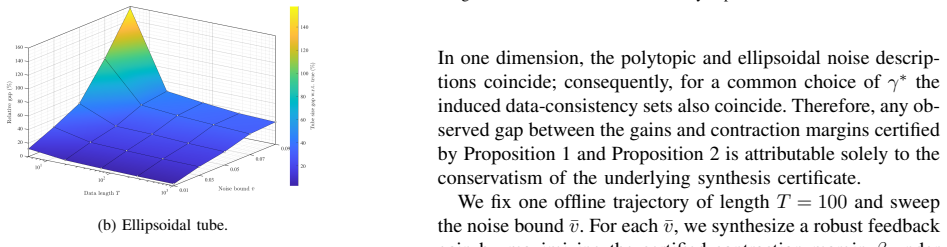
This paper develops a method to construct robust positively invariant (RPI) tube sets from finite noisy input-state data of an unknown linear time-invariant (LTI) system, yielding tubes that can be directly embedded in tube-based robust data-driven predictive control. Data-consistency uncertainty sets are constructed under process/measurement noise with polytopic/ellipsoidal bounds. In the measurement-noise case, we provide a deterministic and data-consistent procedure to certify the induced residual bound from data. Based on these sets, a robustly stabilizing state-feedback gain is certified via a common quadratic contraction, which in turn enables constructive polyhedral/ellipsoidal RPI tube computation. Numerical examples quantify the conservatism induced by noisy data and the employed certification step.
Editorial analysis
A structured set of objections, weighed in public.
Referee Report
Summary. The paper develops a data-driven method to construct robust positively invariant (RPI) tube sets from finite noisy input-state data of an unknown LTI system. It constructs data-consistency uncertainty sets under polytopic or ellipsoidal process/measurement noise bounds, supplies a deterministic procedure to certify the induced residual bound from data in the measurement-noise case, certifies a robustly stabilizing state-feedback gain via a common quadratic contraction, and computes explicit polyhedral or ellipsoidal RPI tubes that can be embedded in tube-based robust data-driven predictive control. Numerical examples illustrate the conservatism induced by noisy data and the certification step.
Significance. If the derivations and bounds hold, the contribution lies in providing a fully constructive, deterministic pipeline from raw noisy data to certifiable RPI tubes without an intermediate identified model. The explicit handling of measurement-noise residuals via data consistency and the dual polyhedral/ellipsoidal options are practical strengths for embedding in robust MPC. The approach rests on standard Lyapunov and set-invariance arguments once the uncertainty set is obtained, which is a strength when the data-consistency construction is tight.
major comments (1)
- [§4] §4 (robust stabilization): the common quadratic contraction is asserted to certify robust stabilization over the data-consistency set, but the manuscript must explicitly display the LMI/SDP conditions (including how the polytopic vertices or ellipsoidal matrix enter the Lyapunov inequality) and verify that the resulting gain remains feasible for the full range of consistent systems; without this, the link from data to certified contraction cannot be checked.
minor comments (2)
- [Numerical examples] The numerical examples section should report the exact data length N, noise-bound radii, and the resulting RPI volume ratios relative to the noise-free case so that the quantified conservatism can be reproduced.
- [§3] Notation for the residual bound in the measurement-noise case (e.g., the symbol used for the certified radius) should be introduced once in §3 and used consistently thereafter to avoid ambiguity when the same quantity appears in the RPI computation.
Simulated Author's Rebuttal
We thank the referee for the positive assessment and the recommendation of minor revision. The single major comment is addressed below; we will incorporate the requested clarifications.
read point-by-point responses
-
Referee: [§4] §4 (robust stabilization): the common quadratic contraction is asserted to certify robust stabilization over the data-consistency set, but the manuscript must explicitly display the LMI/SDP conditions (including how the polytopic vertices or ellipsoidal matrix enter the Lyapunov inequality) and verify that the resulting gain remains feasible for the full range of consistent systems; without this, the link from data to certified contraction cannot be checked.
Authors: We agree that the explicit SDP formulation is required for independent verification. In the revised manuscript we will insert the complete LMI/SDP conditions for the common quadratic Lyapunov function, explicitly showing the substitution of the polytopic vertices (or the ellipsoidal matrix bound) into the Lyapunov inequality. We will also add a short verification paragraph confirming that the computed gain yields a uniform contraction rate over the entire data-consistency set. revision: yes
Circularity Check
No significant circularity detected in derivation chain
full rationale
The paper constructs data-consistency uncertainty sets (polytopic or ellipsoidal) from finite noisy input-state data of an unknown LTI system, certifies a robustly stabilizing state-feedback gain via a common quadratic contraction, and then computes explicit polyhedral or ellipsoidal RPI tubes for embedding in tube-based predictive control. This chain follows standard Lyapunov and set-invariance arguments applied to the given uncertainty sets, with a deterministic procedure for residual bounds in the measurement-noise case. No self-definitional reductions, fitted parameters renamed as predictions, or load-bearing self-citations appear; the central claims remain independent of the inputs once the consistency sets are formed from data.
Axiom & Free-Parameter Ledger
free parameters (1)
- noise bound parameters
axioms (1)
- domain assumption The plant is linear time-invariant.
Forward citations
Cited by 1 Pith paper
-
Tube-Based Robust Data-Driven Predictive Control
A new tractable tube-based robust data-driven MPC for unknown discrete-time LTI systems using one noisy trajectory, simplex-constrained Hankel coefficients, and certified RPI sets to ensure recursive feasibility and p...
Reference graph
Works this paper leans on
-
[1]
F. Blanchini, “Set invariance in control,”Automatica, vol. 35, no. 11, pp. 1747–1767, 1999
work page 1999
-
[2]
Invariant approximations of the minimal robust positively invariant set,
S. V . Rakovi ´c, E. C. Kerrigan, K. I. Kouramas, and D. Q. Mayne, “Invariant approximations of the minimal robust positively invariant set,” IEEE Trans. Autom. Control, vol. 50, no. 3, pp. 406–410, 2005
work page 2005
-
[3]
A one-step approach to computing a polytopic robust positively invariant set,
P. Trodden, “A one-step approach to computing a polytopic robust positively invariant set,”IEEE Trans. Autom. Control, vol. 61, no. 12, pp. 4100–4105, 2016
work page 2016
-
[4]
Theory and computation of distur- bance invariant sets for discrete-time linear systems,
I. Kolmanovsky and E. G. Gilbert, “Theory and computation of distur- bance invariant sets for discrete-time linear systems,”Math. Probl. Eng., vol. 4, no. 4, pp. 317–367, 1998
work page 1998
-
[5]
E. G. Gilbert and K. T. Tan, “Linear systems with state and control constraints: The theory and application of maximal output admissible sets,”IEEE Trans. Autom. Control, vol. 36, no. 9, pp. 1008–1020, 1991
work page 1991
-
[6]
Robust model predictive control using tubes,
W. Langson, I. Chryssochoos, S. V . Rakovi´c, and D. Q. Mayne, “Robust model predictive control using tubes,”Automatica, vol. 40, no. 1, pp. 125–133, 2004
work page 2004
-
[7]
Robust model predic- tive control of constrained linear systems with bounded disturbances,
D. Q. Mayne, M. M. Seron, and S. V . Rakovi ´c, “Robust model predic- tive control of constrained linear systems with bounded disturbances,” Automatica, vol. 41, no. 2, pp. 219–224, 2005
work page 2005
-
[8]
J. B. Rawlings, D. Q. Mayne, and M. Diehl,Model Predictive Control: Theory, Computation, and Design, 2nd ed. Nob Hill Publishing, 2017
work page 2017
-
[9]
A note on persistency of excitation,
J. C. Willems, P. Rapisarda, I. Markovsky, and B. L. R. De Moor, “A note on persistency of excitation,”Syst. Control Lett., vol. 54, no. 4, pp. 325–329, 2005
work page 2005
-
[10]
Formulas for data-driven control: Stabilization, optimality, and robustness,
C. De Persis and P. Tesi, “Formulas for data-driven control: Stabilization, optimality, and robustness,”IEEE Trans. Autom. Control, vol. 65, no. 3, pp. 909–924, 2020
work page 2020
-
[11]
Robust data- driven state-feedback design,
J. Berberich, A. Koch, C. W. Scherer, and F. Allg ¨ower, “Robust data- driven state-feedback design,” inProc. Amer. Control Conf. (ACC), 2020, pp. 1532–1538
work page 2020
-
[12]
Trade-offs in learning controllers from noisy data,
A. Bisoffi, C. De Persis, and P. Tesi, “Trade-offs in learning controllers from noisy data,”Syst. Control Lett., vol. 154, Art. no. 104985, 2021
work page 2021
-
[13]
Data-enabled predictive control: In the shallows of the DeePC,
J. Coulson, J. Lygeros, and F. D ¨orfler, “Data-enabled predictive control: In the shallows of the DeePC,” inProc. 18th European Control Conf. (ECC), 2019, pp. 307–312
work page 2019
-
[14]
Data-enabled predic- tive control for grid-connected power converters,
L. Huang, J. Coulson, J. Lygeros, and F. D ¨orfler, “Data-enabled predic- tive control for grid-connected power converters,” inProc. IEEE Conf. Decis. Control (CDC), 2019, pp. 8130–8135
work page 2019
-
[15]
Robust constraint satisfaction in data-driven MPC,
J. Berberich, J. K ¨ohler, M. A. M ¨uller, and F. Allg ¨ower, “Robust constraint satisfaction in data-driven MPC,” inProc. IEEE Conf. Decis. Control (CDC), 2020, pp. 1260–1267
work page 2020
-
[16]
Data-driven model predictive control with stability and robustness guarantees,
J. Berberich, J. K ¨ohler, M. A. M ¨uller, and F. Allg ¨ower, “Data-driven model predictive control with stability and robustness guarantees,”IEEE Trans. Autom. Control, vol. 66, no. 4, pp. 1702–1717, 2021
work page 2021
-
[17]
Data-driven min–max MPC for linear systems: Robustness and adaptation,
Y . Xie, J. Berberich, and F. Allg ¨ower, “Data-driven min–max MPC for linear systems: Robustness and adaptation,”Automatica, vol. 183, Art. no. 112612, 2026
work page 2026
-
[18]
Robust data-driven predictive control for unknown linear systems with bounded disturbances,
K. Hu and T. Liu, “Robust data-driven predictive control for unknown linear systems with bounded disturbances,”IEEE Trans. Autom. Control, vol. 70, no. 10, pp. 6529–6544, 2025
work page 2025
-
[19]
Data-based guarantees of set invariance properties,
A. Bisoffi, C. De Persis, and P. Tesi, “Data-based guarantees of set invariance properties,”IFAC-PapersOnLine, vol. 53, no. 2, pp. 3953– 3958, 2020
work page 2020
-
[20]
Controller design for robust invariance from noisy data,
A. Bisoffi, C. De Persis, and P. Tesi, “Controller design for robust invariance from noisy data,”IEEE Trans. Autom. Control, vol. 68, no. 1, pp. 636–643, 2023
work page 2023
-
[21]
Data-driven synthesis of robust invariant sets and controllers,
S. K. Mulagaleti, A. Bemporad, and M. Zanon, “Data-driven synthesis of robust invariant sets and controllers,”IEEE Control Syst. Lett., vol. 6, pp. 1676–1681, 2022
work page 2022
-
[22]
On the minimal robust positively invariant set for linear difference inclusions,
K. I. Kouramas, S. V . Rakovi ´c, E. C. Kerrigan, J. C. Allwright, and D. Q. Mayne, “On the minimal robust positively invariant set for linear difference inclusions,” inProc. 44th IEEE Conf. Decision and Control (CDC), 2005, pp. 2296–2301
work page 2005
-
[23]
A quasi-infinite horizon nonlinear model predictive control scheme with guaranteed stability,
H. Chen and F. Allg ¨ower, “A quasi-infinite horizon nonlinear model predictive control scheme with guaranteed stability,”Automatica, vol. 34, no. 10, pp. 1205–1217, 1998
work page 1998
-
[24]
S. Boyd, L. El Ghaoui, E. Feron, and V . Balakrishnan,Linear Matrix Inequalities in System and Control Theory. Philadelphia, PA, USA: SIAM, 1994
work page 1994
-
[25]
Tube-Based Robust Data-Driven Predictive Control
C. Wang and D. Angeli, “Tube-Based Robust Data-Driven Predictive Control,” arXiv preprint arXiv:2604.15252, 2026. APPENDIXA DATA-CONSISTENT INDUCED GAIN BOUNDS A. Data-driven certification ofγ ∗ P This appendix provides a data-consistent procedure to com- puteγ ∗ P used in (18). Define the worst-case induced gain over the data-consistency setI VP(γ)as fP(...
work page internal anchor Pith review Pith/arXiv arXiv 2026
discussion (0)
Sign in with ORCID, Apple, or X to comment. Anyone can read and Pith papers without signing in.