REVIEW 4 major objections 4 minor 2 cited by
The slow growth of number entropy in many-body localized systems is caused by many-body quantum beats—interaction-modulated single-particle Rabi oscillations—and is compatible with the stability of MBL.
Reviewed by Pith at T0; open to challenge. T0 means a machine referee read the full paper against a public rubric. the ladder, T0–T4 →
2026-08-02 17:05 UTC pith:2GA4JQK2
load-bearing objection Fresh many-body quantum-beat mechanism for slow number entropy growth in QP MBL chains, likely right in essence but with a fitted coupling and an untested frozen-environment reduction; deserves a serious referee. the 4 major comments →
Quantum Beats in Many-Body Localized Systems
The pith
A machine-rendered reading of the paper's core claim, the machinery that carries it, and where it could break.
Core claim
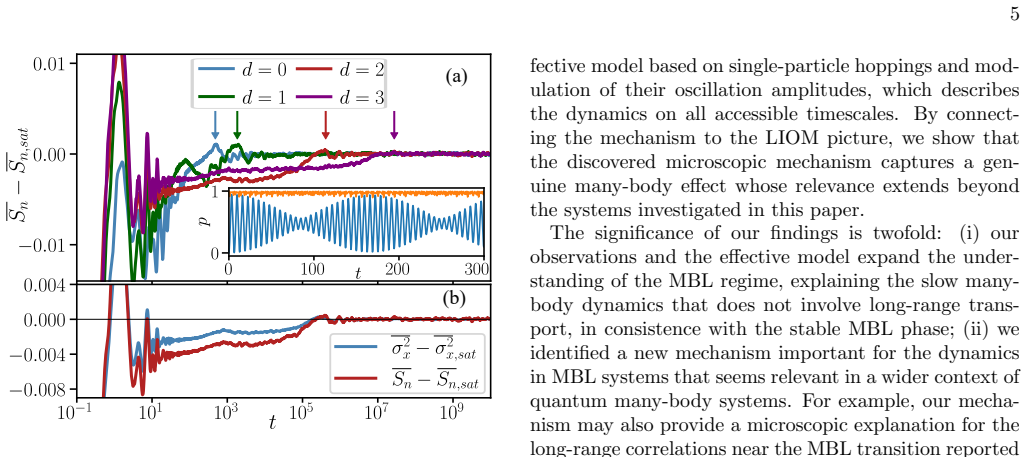
Deep in the MBL regime of the quasiperiodic XXZ chain, number entropy Sn(t) keeps growing long after single-particle dynamics saturates, in step-like increases that plateau only at t~10^5. The origin is amplitude modulation: hopping on one near-resonant pair is modulated by a second, distant near-resonant pair through interaction, giving Eq. (3), p(0,t)=1/2[1+cos(epsilon t/2)cos((1+epsilon/2)t)], with epsilon=4J_ab,cd, the LIOM coupling decaying as Jz e^{-d/xi}. Because the effective hoppings in H_AM do not depend on distance d between pairs, the beats survive at arbitrarily large separation and are generic to interacting systems. The same mechanism explains quasiparticle-width growth and th
What carries the argument
The central object is the four-site effective Hamiltonian H_AM (Eq. (2)) describing two near-resonant single-particle hoppings on pairs (a,b) and (c,d). Its eigenvalues form pairs E1=-E4, E2=-E3, and the interaction-induced correction epsilon=4J_ab,cd produces the beat formula Eq. (3), p(0,t)=1/2[1+cos(epsilon t/2)cos((1+epsilon/2)t)]. Single-particle resonances at all ranges are handled by Eq. (6) with effective tunnelling jeff(k)~W^{-k+1}. The mechanism is tied to LIOMs: the two hoppings are two local integrals of motion with coupling J_ab,cd ∝ Jz e^{-d/xi}.
Load-bearing premise
The entire four-site beat picture treats every particle outside a,b,c,d as frozen and only a static energy mediator, and it assumes any large quasiperiodic chain contains a near-resonant nearest-neighbour hopping pair at every distance d; if the environment dephases or absorbs beats, or if such pairs are rare, the conclusions would need revision.
What would settle it
In a quasiperiodic MBL chain with two implanted near-resonant pairs at controlled distance d, the local density difference across one pair should show collapse-and-revival at t≈π/epsilon with epsilon ∝ Jz e^{-d/xi}; absence of this beat, or a different d-scaling, falsifies the mechanism. A second test: unfreeze the environment in exact diagonalization; if the slow Sn growth persists when the four sites are decoupled from all mobile particles, the beat explanation fails.
If this is right
- The slow growth of Sn deep in MBL is a local, bounded effect (Sn≤ln2) driven by beats, not by long-range particle transport, so it does not by itself imply MBL instability.
- The structured, step-like Sn(t) in quasiperiodic systems and the featureless growth in random systems both follow from the same mechanism, with the difference set by the narrow vs wide distribution of the beat timescale 1/epsilon.
- The effective model quantitatively reproduces exact diagonalization for N up to 16 and time up to 10^9, including quasiparticle width, so the mechanism accounts for both number entropy and particle spreading.
- Since epsilon ∝ Jz e^{-d/xi}, the saturation time is controlled by interaction strength Jz and pair distance d; this gives a direct experimental dial for testing the mechanism.
- The proposed cold-atom signature—collapse and revival of Rabi oscillations on implanted near-resonant pairs at d=1 with |Jz|=3—lies within current experimental reach (timescales ~10^2 tunnelling times).
Where Pith is reading between the lines
- The frozen-environment approximation is the main vulnerability: if the rest of the chain is not a static mediator but dephases or resonantly absorbs the beat, the local-bounded picture and the stability conclusion would need revision.
- The assertion that every sufficiently large quasiperiodic chain contains a near-resonant hopping pair at every required distance d is plausibly correct but not proven; a counting argument or large-scale numerical statistics would put the 'generic to many-body systems' claim on firmer ground.
- The same beat mechanism might explain the long-range correlations and cat states reported near the MBL transition; a direct test would be to measure the LIOM-LIOM coupling J_ab,cd spectroscopically in a cold-atom chain.
- By analogy, quantum beats should appear in any interacting system with two weakly coupled two-level subsystems, so similar slow dynamics should be observable in trapped-ion or Rydberg arrays with engineered disorder and interactions.
Editorial analysis
A structured set of objections, weighed in public.
Referee Report
Summary. The paper studies the slow growth of the number entropy S_n and the central quasiparticle width in one-dimensional quasiperiodic (Aubry-André) XXZ chains deep in the many-body localized (MBL) regime. It identifies a microscopic mechanism: many-body quantum beats arising from the interaction between two nearly resonant single-particle hopping processes. The mechanism is modeled by a four-site effective Hamiltonian H_AM, leading to Eq. (3), p(0,t)=1/2[1+cos(ε t/2) cos((1+ε/2)t)], where ε is an interaction-induced energy correction. The authors combine this amplitude-modulation (AM) model with a single-particle resonance model [Eqs. (4)-(6)] and compare the resulting effective model with exact diagonalization (ED), reporting excellent agreement. They argue that AM is local, does not require narrow resonances, survives at arbitrarily large distances between LIOM pairs, and is consistent with MBL stability in the thermodynamic limit. They also propose experimental signatures of AM in cold-atom setups.
Significance. If the proposed mechanism is correct, it provides a concrete and generic microscopic origin for the long-timescale growth of S_n in the MBL regime, addressing an ongoing debate about whether such growth implies a destabilization of MBL. The paper connects the mechanism to the LIOM picture, explains quantitative differences between quasiperiodic and random potentials, and makes falsifiable predictions. The strength of the manuscript lies in its transparent analytical model, the use of ED for direct comparison, and the scaling checks in Appendix C (ε with distance d and interaction J_z). The experimental proposal for observing collapse and revival of Rabi oscillations is a valuable addition. However, the quantitative validation is weakened because the key parameter ε is not computed from the microscopic Hamiltonian but read off from the same eigenvalues used in the comparison, or treated as a free parameter in the averaged model.
major comments (4)
- [Mechanism, Eq. (3) and Fig. 2(a)] The central comparison in Fig. 2(a) is not a free prediction: for the single configuration, ε is taken directly from the exact eigenvalues as ε = E1+E4−E2−E3. The agreement therefore shows consistency between the four-site ansatz and the eigenenergies, but it does not independently verify the microscopic claim that ε = 4J_ab,cd ∝ J_z e^{−d/ξ}. In the averaged combined model (SM S.3), ε is explicitly described as 'the only free parameter', chosen to reproduce the AM timescale of a single phase. To make the test load-bearing, ε should be computed from the microscopic Hamiltonian or from LIOM perturbation theory, and then compared with the values needed to fit the ED curves, including the dependence on d and J_z shown in Appendix C.
- [Mechanism, 'frozen' environment] The four-site reduction assumes that all other particles are frozen: 'we treat other particles in the chain as being frozen and therefore having no effect on the dynamics of two particles on sites a,b,c,d.' This is a strong assumption. In the full XXZ chain the 'frozen' particles can hop and interact, causing energy shifts, dephasing, or absorption that could modify the beat envelope on the same timescales as 1/ε. No quantitative estimate is given for the validity of this reduction, and the agreement in Fig. 2 is weakened by the fitted ε. Please provide a bound on the influence of the environment, for example by comparing the full chain with a chain in which all sites outside the four-site subspace are pinned (infinite field), and assessing how the beat amplitude and timescale change.
- [Mechanism, 'every single-particle hopping process will eventually find its pair'] The genericity claim that in a sufficiently large system every hopping process finds a near-resonant partner at distance d is asserted without counting or phase-space reasoning. The AM mechanism requires two conditions: a near-resonant pair of single-particle hoppings, and a distance d such that 1/ε falls within the accessible time window. No estimate is provided for the density of such two-pair configurations as a function of d, W, and chain length, nor for the distribution of ε. Without this, it is unclear whether the observed S_n growth is generically due to AM or dominated by other, rarer processes. A statistical estimate or a finite-size scaling analysis of the number of near-resonant two-pair configurations would directly address this.
- [Appendix C, 'factor of order W smaller'] The statement that AM contributions from range k>1 hopping pairs are small 'by a factor of order W' is used to justify neglecting them in the effective model, which is central to the claim that the model captures all timescales. No derivation or numerical check is given. Please provide the explicit scaling argument or a numerical test showing that such contributions are indeed suppressed relative to the nearest-neighbour-pair AM.
minor comments (4)
- [Title mismatch] The header of the arXiv listing reads 'Quantum Beats in Many-Body Localized Systems', while the full-text title is 'Uncovering the Microscopic Mechanism of Slow Dynamics in Quasiperiodic Many-Body Localized Systems'. Please harmonize.
- [SM S.3, averaging interval] The choice of the interval [10^2, 5×10^3] over which the single-particle baseline is averaged is, as the authors note, 'somewhat arbitrary'. Some sensitivity analysis of the final combined-model prediction to this choice would strengthen the quantitative comparison.
- [Fig. C1(b)] The linear scaling of the AM timescale with J_z is demonstrated by fitting the J_z = −0.01 case and then scaling. This is a reasonable consistency check, but the proportionality constant remains an adjustable parameter. This should be stated explicitly in the main text.
- [Eq. (5)] The combinatorial factor f is introduced without a forward reference in the main text; the reader only learns its definition in SM S.2. Please add a brief parenthetical or footnote.
Circularity Check
The beat timescale in the paper's central comparison is set by a parameter extracted from the exact dynamics of the same system, so the quantitative agreement of Eq. (3) with ED is partly a consistency check rather than an independent prediction of the beat mechanism.
specific steps
-
fitted input called prediction
[Mechanism section, after Eq. (3) and Fig. 2(a); SM S.3]
"From Fig. 2(a), we observe excellent agreement of Sn obtained from our effective model with the exact numerical calculation for N=12 and a particular phase ϕ. The parameter ϵ is taken from numerical eigenvalues as ϵ=E1+E4−E2−E3... The value of ϵ is therefore the only free parameter in our model and it is chosen so that the same AM timescale as the one obtained for a single phase ϕPR of point reflection symmetry is recovered."
The claimed microscopic explanation identifies the slow growth with quantum beats whose timescale is set by 1/ϵ. But ϵ is not computed from the microscopic Hamiltonian; it is read off from the exact eigenvalues of the very same system whose time evolution the model is supposed to explain (Fig. 2a). In the averaged combined model (SM S.3), ϵ is the only free parameter and is fixed by matching the AM timescale of one chosen phase. Therefore the long-time beat/envelope timescale is an input to the model, not a prediction emerging from the four-site mechanism. The agreement in Fig. 2 tests the functional form of Eq. (3), but it does not independently confirm that interactions between two single-particle hoppings set the timescale of the observed slow growth.
full rationale
The central quantitative support for the many-body quantum beats mechanism is the agreement of the effective model, Eq. (3), with exact ED. That agreement is partly circular: ϵ sets the beat frequency, and ϵ is extracted from the exact eigenvalues of the same full system in Fig. 2(a) and, in the averaged model, is the only free parameter tuned to reproduce the AM timescale of a single phase (SM S.3). Thus the long-time growth timescale is fitted/read-off rather than independently predicted. Still, the claim does not reduce entirely to its inputs: Eq. (3) provides a nontrivial beat envelope, Fig. 3(a) shows the expected d-dependence of saturation times, and Appendix C checks exponential-in-d and linear-in-Jz scalings. These give the mechanism independent content, so a partial circularity score of 6 is appropriate. The frozen-environment assumption is a strong approximation but not itself circular; it is a correctness/robustness concern. Self-citations in Refs. [20,24,36] are not load-bearing: the mirror-symmetry resonance property in Appendix A is supported by a Taylor-expansion argument, and Ref. [24] is only a forward pointer to future work on random systems.
Axiom & Free-Parameter Ledger
free parameters (3)
- ε (AM coupling/timescale) =
extracted from exact eigenvalues for a single phase; in averaged model chosen to match φ_PR timescale (SM S.3)
- proportionality constant in J_z scaling =
fitted to J_z=−0.01 data
- moving-average window for splicing models =
10^2 to 5×10^3 tunnelling times
axioms (6)
- domain assumption Other particles in the chain are frozen and do not affect the four-site dynamics
- domain assumption LIOM description with H_LIOM = h̃_ab τ^z_ab + h̃_cd τ^z_cd + J_ab,cd τ^z_ab τ^z_cd to lowest order, with J_ab,cd ∝ J_z e^{-d/ξ}
- domain assumption Every sufficiently large QP chain contains pairs of near-resonant nearest-neighbor hoppings at every needed distance d
- ad hoc to paper Neglect of AM from range k>1 hopping pairs; their contribution to S_n is 'by a factor of order W smaller'
- domain assumption Small diagonal-difference condition |E_i^0−E_j^0|≲J for the approximate eigenvalues/vectors of H_AM
- domain assumption The W≥6 QP Heisenberg chain is in a deeply localized MBL phase with local integrals of motion
Cite this review
Pith. "Pith review of Quantum Beats in Many-Body Localized Systems." pith.science (2026). https://pith.science/paper/2GA4JQK2
@misc{pith2026260328721,
  author       = {Pith},
  title        = {Pith review of: Quantum Beats in Many-Body Localized Systems},
  year         = {2026},
  howpublished = {\url{https://pith.science/paper/2GA4JQK2}},
  note         = {Machine review of arXiv:2603.28721}
}
read the original abstract
Slow particle dynamics observed numerically even deep inside the many-body localized (MBL) regime has called the stability of MBL in the thermodynamic limit into question, and its microscopic origin remains unknown. Here, we show that this slow dynamics originates from many-body quantum beats that arise from the interaction-induced modulation of oscillations associated with single-particle hopping processes. We relate this mechanism to local integrals of motion (LIOMs) and show that it survives at arbitrarily large distances between LIOMs, is consistent with the stability of MBL in the thermodynamic limit, and is generic to many-body systems. We present new numerical results for quasiperiodic potentials and, based on the quantum beats mechanism, develop an analytical model that explains number entropy growth and quasiparticle spreading, as well as clarifies the distinct MBL phenomenology observed in quasiperiodic and random potentials. Lastly, we propose concrete signatures for observing many-body quantum beats in existing experimental platforms.
Figures


Forward citations
Cited by 2 Pith papers
-
An asymptotically solvable model of many-body critical phases: mobility edges, scars, and inverted scars
A solvable spin-chain model with hierarchical mirror structure exhibits two many-body critical phases — one ETH-like, one MBL-like — separated by a finite-temperature transition.
-
Thermal avalanches in a quasiperiodic XXZ model
Two-point correlations fail to detect thermal avalanches in a quasiperiodic XXZ chain while particle-number entropy reveals them, challenging correlation-only avalanche diagnostics.
Reference graph
Works this paper leans on
-
[1]
P. W. Anderson, Absence of diffusion in certain random lattices, Phys. Rev.109, 1492 (1958)
1958
-
[2]
Implementa- tion of cutting-edge research and its application as part of the Scientific Center of Excellence for Quantum and Complex Systems, and Representations of Lie Algebras
Arrows mark saturation times for differentd. Note that the choice of a rationalβ=p/qis numerically indistinguishable from the irrational case forq > N. (·) sat denotes the saturation value calculated numerically as the average of a given quantity for t >10 8. The inset shows AM on a timescale shorter than 102 tunnelling times for a particular configuratio...
2021
-
[3]
I. V. Gornyi, A. D. Mirlin, and D. G. Polyakov, Interact- ing electrons in disordered wires: Anderson localization and low-Ttransport, Phys. Rev. Lett.95, 206603 (2005)
2005
-
[4]
Abrahams, P
E. Abrahams, P. W. Anderson, D. C. Licciardello, and T. V. Ramakrishnan, Scaling theory of localization: Ab- sence of quantum diffusion in two dimensions, Phys. Rev. Lett.42, 673 (1979)
1979
-
[5]
Imbrie, On many-body localization for quantum spin chains, Journal of Statistical Physics163(2016)
J. Imbrie, On many-body localization for quantum spin chains, Journal of Statistical Physics163(2016)
2016
-
[6]
Basko, I
D. Basko, I. Aleiner, and B. Altshuler, Metal–insulator transition in a weakly interacting many-electron system with localized single-particle states, Annals of Physics 321, 1126 (2006)
2006
-
[7]
Sierant, M
P. Sierant, M. Lewenstein, A. Scardicchio, L. Vidmar, and J. Zakrzewski, Many-body localization in the age of classical computing, Reports on Progress in Physics88 (2025)
2025
-
[8]
D. A. Abanin, E. Altman, I. Bloch, and M. Serbyn, Col- loquium: Many-body localization, thermalization, and entanglement, Rev. Mod. Phys.91, 021001 (2019)
2019
-
[9]
J. H. Bardarson, F. Pollmann, and J. E. Moore, Un- bounded growth of entanglement in models of many-body localization, Phys. Rev. Lett.109, 017202 (2012)
2012
-
[10]
Lukin, M
A. Lukin, M. Rispoli, R. Schittko, M. E. Tai, A. M. Kauf- man, S. Choi, V. Khemani, J. L´ eonard, and M. Greiner, Probing entanglement in a many-body–localized system, Science364, 256 (2019)
2019
-
[11]
D. J. Luitz and Y. B. Lev, Absence of slow particle trans- port in the many-body localized phase, Phys. Rev. B102, 100202 (2020)
2020
-
[12]
Singh, J
R. Singh, J. H. Bardarson, and F. Pollmann, Signatures of the many-body localization transition in the dynamics of entanglement and bipartite fluctuations, New Journal of Physics18, 023046 (2016)
2016
-
[13]
Kiefer-Emmanouilidis, R
M. Kiefer-Emmanouilidis, R. Unanyan, M. Fleischhauer, and J. Sirker, Slow delocalization of particles in many- body localized phases, Phys. Rev. B103, 024203 (2021)
2021
-
[14]
Kiefer-Emmanouilidis, R
M. Kiefer-Emmanouilidis, R. Unanyan, M. Fleischhauer, and J. Sirker, Evidence for unbounded growth of the number entropy in many-body localized phases, Phys. Rev. Lett.124, 243601 (2020)
2020
-
[15]
Kiefer-Emmanouilidis, R
M. Kiefer-Emmanouilidis, R. Unanyan, M. Fleischhauer, and J. Sirker, Particle fluctuations and the failure of sim- ple effective models for many-body localized phases, Sci- Post Phys.12, 034 (2022)
2022
-
[16]
Kiefer-Emmanouilidis, R
M. Kiefer-Emmanouilidis, R. Unanyan, M. Fleischhauer, and J. Sirker, Unlimited growth of particle fluctuations in many-body localized phases, Annals of Physics435, 168481 (2021), special Issue on Localisation 2020
2021
-
[17]
Ghosh and M
R. Ghosh and M. ˇZnidariˇ c, Resonance-induced growth of number entropy in strongly disordered systems, Phys. Rev. B105, 144203 (2022)
2022
-
[18]
M. Kiefer-Emmanouilidis, R. Unanyan, M. Fleis- chhauer, and J. Sirker, Comment on ”resonance-induced growth of number entropy in strongly disordered systems”, arXiv:2203.06689 (2022), arXiv:2203.06689 [cond-mat.dis-nn]
Pith/arXiv arXiv 2022
-
[19]
Aceituno Ch´ avez, C
D. Aceituno Ch´ avez, C. Artiaco, T. Klein Kvorning, L. Herviou, and J. H. Bardarson, Ultraslow growth of number entropy in anℓ-bit model of many-body local- ization, Phys. Rev. Lett.133, 126502 (2024)
2024
-
[20]
R. Ghosh and M. ˇZnidariˇ c, Response to ‘comment on the- ory of growth of number entropy in disordered systems’, arXiv:2205.05768 (2022)
Pith/arXiv arXiv 2022
-
[21]
Sierant and J
P. Sierant and J. Zakrzewski, Challenges to observation of many-body localization, Phys. Rev. B105, 224203 (2022)
2022
-
[22]
ˇStrkalj, E
A. ˇStrkalj, E. V. H. Doggen, I. V. Gornyi, and O. Zilber- berg, Many-body localization in the interpolating Aubry- Andr´ e-Fibonacci model, Phys. Rev. Res.3, 033257 (2021)
2021
-
[23]
P. R. N. Falc˜ ao, A. S. Aramthottil, P. Sierant, and J. Za- krzewski, Many-body localization crossover is sharper in a quasiperiodic potential, Phys. Rev. B110, 184209 (2024)
2024
-
[24]
ˇStrkalj, E
A. ˇStrkalj, E. V. H. Doggen, and C. Castelnovo, Coexis- tence of localization and transport in many-body two- dimensional Aubry-Andr´ e models, Phys. Rev. B106, 184209 (2022)
2022
-
[25]
Aubry and G
S. Aubry and G. Andr´ e, Analyticity breaking and An- derson localization in incommensurate lattices, Annals of the Israel Physical Society3(1980)
1980
-
[26]
Faulend, H
B. Faulend, H. Buljan, and A. ˇStrkalj, (unpublished)
-
[27]
S. Iyer, V. Oganesyan, G. Refael, and D. A. Huse, Many- body localization in a quasiperiodic system, Phys. Rev. B87, 134202 (2013)
2013
-
[28]
Jordan and E
P. Jordan and E. Wigner, ¨Uber das paulische ¨ aquivalenzverbot, Zeitschrift f¨ ur Physik47, 631 (1928)
1928
-
[29]
Singh, B
H. Singh, B. Ware, R. Vasseur, and S. Gopalakrishnan, Local integrals of motion and the quasiperiodic many- body localization transition, Phys. Rev. B103, L220201 (2021)
2021
-
[30]
E. V. H. Doggen and A. D. Mirlin, Many-body delocaliza- tion dynamics in long Aubry-Andr´ e quasiperiodic chains, Phys. Rev. B100, 104203 (2019)
2019
-
[31]
D. A. Huse, R. Nandkishore, and V. Oganesyan, Phe- nomenology of fully many-body-localized systems, Phys. Rev. B90, 174202 (2014)
2014
-
[32]
Serbyn, Z
M. Serbyn, Z. Papi´ c, and D. A. Abanin, Local conserva- tion laws and the structure of the many-body localized states, Phys. Rev. Lett.111, 127201 (2013)
2013
-
[33]
Laflorencie, J
N. Laflorencie, J. Colbois, and F. Alet, Cat states car- rying long-range correlations in the many-body localized phase, Phys. Rev. B112, 224207 (2025)
2025
-
[34]
Chandran, I
A. Chandran, I. H. Kim, G. Vidal, and D. A. Abanin, Constructing local integrals of motion in the many-body localized phase, Phys. Rev. B91, 085425 (2015)
2015
-
[35]
L´ eonard, S
J. L´ eonard, S. Kim, M. Rispoli, A. Lukin, R. Schittko, J. Kwan, E. Demler, D. Sels, and M. Greiner, Probing the onset of quantum avalanches in a many-body localized system, Nature Physics19, 481 (2023)
2023
-
[36]
A. Padhan, J. Colbois, F. Alet, and N. Laflorencie, Long- range resonances in quasiperiodic many-body localiza- tion (2026), arXiv:2510.24704 [cond-mat.dis-nn]
Pith/arXiv arXiv 2026
-
[37]
UNCOVERING THE MICROSCOPIC MECHANISM OF SLOW DYNAMICS IN QUASIPERIODIC MANY-BODY LOCALIZED SYSTEMS
P. Weinberg and M. Bukov, QuSpin: a Python package for dynamics and exact diagonalisation of quantum many body systems part I: spin chains, SciPost Phys.2, 003 (2017). SUPPLEMENT AL MA TERIAL FOR “UNCOVERING THE MICROSCOPIC MECHANISM OF SLOW DYNAMICS IN QUASIPERIODIC MANY-BODY LOCALIZED SYSTEMS” 3.6 4.0 4.4 combined model10-2 N = 16 10 1 10 3 10 5 10 7 (b...
2017
-
[38]
Tabanelli, C
H. Tabanelli, C. Castelnovo, and A. ˇStrkalj, Reentrant localization transitions and anomalous spectral proper- ties in off-diagonal quasiperiodic systems, Phys. Rev. B 9 110, 184208 (2024)
2024
-
[2027]
6 Appendix Appendix A: Structured behaviour of single-particle dynamics in quasiperiodic chains FIG
All data that support the plots within this paper are available upon request. 6 Appendix Appendix A: Structured behaviour of single-particle dynamics in quasiperiodic chains FIG. A1. Sn(t) moving time average forW= 6 and N´ eel initial state. Let us now explain the structured behaviour in Sn(t) observed at short- and medium-timescales, i.e. fort < 103 in ...
This paper was first reviewed by deepseek-v4-flash on August 2, 2026.
discussion (0)
Sign in with ORCID, Apple, or X to comment. Anyone can read and Pith papers without signing in.