REVIEW 2 major objections 5 minor 115 references
This paper constructs an asymptotically solvable interacting spin chain whose hierarchical mirror structure produces a hierarchy of mirror-like many-body resonances, and shows that the system exhibits two distinct thermodynamic phases—one E
Reviewed by Pith at T0; open to challenge. T0 means a machine referee read the full paper against a public rubric. the ladder, T0–T4 →
2026-08-04 01:07 UTC pith:FQZ2WRCI
load-bearing objection A novel and carefully constructed solvable model of many-body critical phases, but the headline finite-temperature mobility edge rests on an ensemble equivalence the authors explicitly leave unproven. the 2 major comments →
An asymptotically solvable model of many-body critical phases: mobility edges, scars, and inverted scars
The pith
A machine-rendered reading of the paper's core claim, the machinery that carries it, and where it could break.
Core claim
Within the constructed mixed-field Ising chain with hierarchical mirror structure, every many-body eigenstate can be written down explicitly up to a controllable error, and the diagonal-matrix-element variance of any local observable evolves by Var_{n+1}(O) = (1 - p_n/2) Var_n(O) + δ_n, where p_n is the probability that the nth mirror level is resonant, equal to the Rényi-2 entropy factor e^{-S_2(T)} of the non-resonant block. From this recursion, the paper proves that a diverging sum Σ p_n forces Var_n(O)→0 for all local observables (weak ETH holds), giving the many-body critically extended (MBC-E) phase, while a converging sum leaves a finite variance for an extensive set of local observab
What carries the argument
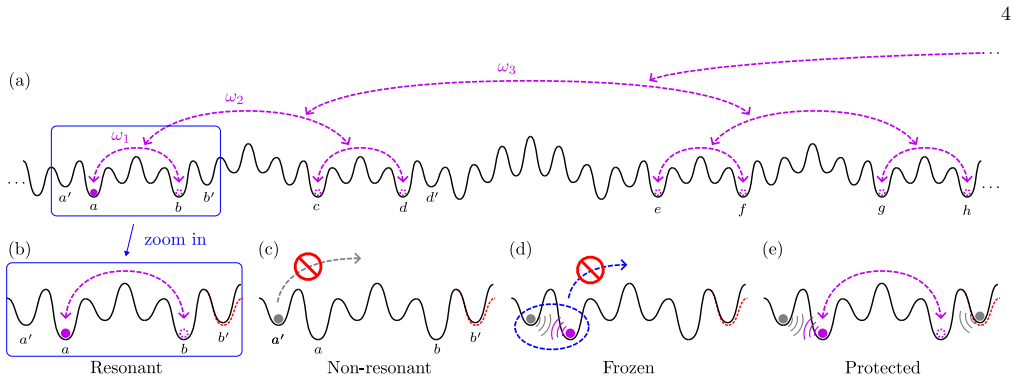
The hierarchical mirror structure (HMS): a recursive construction in which the Hamiltonian is built by mirror-copying resonant blocks, adding non-resonant blocks with symmetry-breaking terms, and coupling them with hierarchically weaker bonds, with scale separation 1 ≫ α ≫ β ≫ γ. This structure makes the resonance condition at each level depend only on whether the configurations of the non-resonant blocks are mirror-symmetric (protection) or not (freezing), allowing the eigenstates to be written down by repeated first-order degenerate perturbation theory within a controllable error bound. The recursion for the diagonal matrix element variance—Var_{n+1}(O) = (1 - p_n/2) Var_n(O) + δ_n, with p
Load-bearing premise
The entire finite-temperature phenomenology—including the mobility edge—rests on the unproven assumption that the canonical ensemble of the decoupled blocks at temperature T is locally equivalent to the microcanonical ensemble of the closed chain at the corresponding energy density, and that the thermodynamic limit can be taken before the circuit-depth limit; the paper states this explicitly as an expectation beyond its scope.
What would settle it
Numerically exact diagonalization of the finite approximants H_res^n for small n, with the prescribed hierarchical couplings, would settle the claim: compute the variance of a fixed local observable across eigenstates in a microcanonical energy window (rather than the canonical ensemble used in the proof) and compare with the predicted recursion Var_{n+1} = (1 - p_n/2) Var_n + δ. If Var_n fails to vanish when Σ p_n diverges, or if the temperature labeling derived from s(e) does not match the energy windows, the finite-temperature mobility edge is an artifact of the canonical assumption.
If this is right
- Weak ETH can hold even in a system that is far from thermal in other respects: thermalization timescales are hierarchical and there is no uniform thermalization time.
- An MBL-like critical phase can exist without true LIOMs: approximate LIOMs have non-decaying long-range Pauli weights that are 'inactive' except in rarer and rarer inverted-scar states, so the conventional LIOM-based picture of MBL does not apply.
- A thermodynamic many-body mobility edge is possible in a short-range interacting chain, provided the system's structure is hierarchical rather than uniformly random; the arguments against MBMEs based on local energy-density bubbles or single-particle mobility edges are bypassed.
- The Fibonacci quasicrystal, if the reasoning extends, is expected to lie deep in the MBC-L phase, explaining its mostly-MBL behavior with rare delocalized dynamics.
- The interacting Aubry-André model may contain structural rare regions that are delocalized at the eigenstate level even without low-disorder regions, potentially opening a route to avalanche instability in quasiperiodic MBL.
Where Pith is reading between the lines
- A testable distinction follows: in the MBC-E phase, the entanglement entropy of a finite system cut in half grows only as O(log L), so any finite-size numerical study would see an area law despite the infinite-system volume law; this finite-size signature could be searched for in existing quasiperiodic experiments.
- The same variance recursion could be adapted to other resonance mechanisms (repetition symmetries, multi-flat-band models) as a general criterion for many-body criticality, not just mirror symmetry.
- The assumed microcanonical-canonical equivalence could be tested directly by preparing finite approximants and comparing microcanonical eigenstate statistics to the canonical prediction; if the equivalence fails at accessible sizes, the energy-label of the mobility edge would shift, a falsifiable prediction.
Editorial analysis
A structured set of objections, weighed in public.
Referee Report
Summary. The paper constructs an asymptotically solvable model of a one-dimensional nearest-neighbor mixed-field Ising chain with a hierarchical mirror structure (HMS). The single-particle version is proved to have a purely singular continuous spectrum. The many-body version is analyzed through a sequence of decoupled-block approximants H∞_n; the authors derive a recursion for the variance of local-observable diagonal matrix elements in the canonical ensemble, with the level-n resonance probability p_n = e^{-S_2(T)}, where S_2 is the Rényi-2 entropy of the non-resonant blocks. Depending on whether Σ p_n diverges or converges, they identify two phases, MBC-E (weak ETH holds) and MBC-L (weak ETH fails), and construct rare scar and inverted-scar states. For L_n^nr = ⌈p ln n⌉, the convergence criterion becomes p s_2(T) > 1, yielding a finite-temperature transition that is interpreted as a thermodynamic many-body mobility edge. The paper also discusses implications for the Fibonacci quasicrystal, the EAAH model, and rare-region/avalanche effects in the interacting Aubry-André model.
Significance. If the central construction is accepted, the paper provides a rare analytic handle on many-body critical phases and a concrete counterexample to some no-thermodynamic-MBME arguments. The controlled-perturbation framework, explicit error bounds, and the recursion for Var_n[O] are coherent and nontrivial. The paper is also transparent about the point at which it invokes an assumption, which is commendable. However, the flagship finite-temperature MBME statement is conditional on an unproven equivalence between the canonical ensemble of decoupled blocks and the microcanonical ensemble of a closed chain, and on a specific limit order. The strength of the paper lies in the rigorous approximant-level results; its physical interpretation as a phase transition of a closed Hamiltonian is not established at the same level.
major comments (2)
- [Sec. IV C 1 and Sec. IV F 1, Eqs. (91) and abstract] The finite-temperature mobility edge is derived for the canonical ensemble ρ∞_n of the decoupled-block approximants, and the identification of T with a microcanonical energy density of the closed chain is explicitly assumed, not proved. The manuscript states: 'We expect (and assume) that the two limits can be taken together in some sense... beyond the scope of this paper' (Sec. IV C 1), and Sec. IV F 1 begins its MBME conclusion with 'Assuming the closed-system interpretation in Sec. IV C 1 holds.' Since the abstract claims a thermodynamic many-body mobility edge at p s_2(T_c)=1, this assumption is load-bearing. If the equivalence fails, T need not label an energy window of H∞, and the transition would be an artifact of the block ensemble rather than a mobility edge of the closed spin chain. Please either provide a controlled argument for the equivalence in this model or reformulate the
- [Sec. IV B, IV D, IV E] The phases are characterized by Var_n[O]→0 for eigenstates sampled from ρ∞_n, which are eigenstates of the cutoff Hamiltonians H∞_n, not of the infinite Hamiltonian H∞. In fact, the paper states that it does not try to define the limit '|S⟩∞' that would be the eigenstates of H∞. Thus the rigorous part establishes an RG-flow/approximant-level statement about the sequence H∞_n, not directly a phase of the thermodynamic-limit Hamiltonian H∞. The leap from Var_n[O]→0 to 'H∞ satisfies weak ETH' or 'H∞ is MBL-like' requires the same unproven limit-order and canonical-microcanonical equivalence. This should be clearly separated from the proven results, since it is a second load-bearing point for the paper's central physical claims.
minor comments (5)
- [Eq. (42) vs Eq. (43)] The non-resonant branch in Eq. (42) is written with 'B=C', while Eq. (43) and the degeneracy condition in Eq. (35) use 'B=\tilde{C}'. The two states coincide when B=\tilde{C}, so the 'B=C' in Eq. (42) appears to be a typo and should be corrected to B=\tilde{C}.
- [Abstract and Introduction] The finite-temperature MBME is presented unconditionally in the abstract and introduction, but Sec. IV F 1 states it is conditional on the closed-system interpretation. Add a caveat in the abstract so the reader is not misled about the status of the claim.
- [Sec. IV F 1] Consider qualifying the term 'phase transition': the change is in the convergence of Σ p_n and in Var_n[O], not in a conventional free-energy singularity or local order parameter. A term such as 'spectral transition' or 'eigenstate-phase transition' would be more precise and avoid overloading the thermodynamic term.
- [References] Reference [93] duplicates Ref. [80] (Iadecola and Schecter, Phys. Rev. B 98, 144204). Please consolidate or renumber.
- [Sec. IV F 2 and IV F 3] The block-swapping constructions for scar and inverted-scar states are central to the claim that rare opposite-phase eigenstates are dense in energy, but the energy-density preservation under infinite swaps is only sketched. A formal appendix with the precise conditions on L_n^nr and the swapped configurations would substantially strengthen this part.
Circularity Check
No significant circularity: MBC phases and the p·s2(Tc)=1 transition are proven in-paper from the constructed Hamiltonian; the finite-T MBME interpretation rests on an explicitly assumed (unproven) canonical-to-microcanonical equivalence, a flagged correctness risk rather than a circular step.
full rationale
The central derivation chain is self-contained. The model Hamiltonian is fully specified in Sec. IV A; the resonance probability p_n is computed, not fitted, as the collision probability of two independent canonical samples of the input non-resonant blocks, p_n = Tr[(e^{-H^{nr}_n/T}/Z)^2] = e^{-S^{nr}_{2,n}(T)} (Eq. 75). The freezing/protection mechanism is achieved in-paper via the 1>>alpha>>beta>>gamma scale hierarchy and Eqs. (36)-(42), and the variance recursion Var_{n+1}[O]=(1-p_n/2)Var_n[O]+delta_n (Eq. 80), the phase criterion (Sum p_n diverges/converges => MBC-E/MBC-L, Eqs. 86, 89), and the finite-T condition p·s^{nr}_{2,n}(T_c)=1 (Eqs. 90-91) are proven consequences, so the ETH-like/MBL-like verdicts are derived, not definitional equivalents. The block growth L^{nr}_n = ceil(p ln n) is transparently declared as the regime that yields a T-dependent series (Sec. IV F 1, 'We will show that this happens if L^{nr}_n is logarithmically divergent'), i.e., the model is engineered to exhibit the phenomena, which is legitimate model construction rather than a fitted input renamed as a prediction. Two flagged items are weighed but are not circularity: (i) the MBME interpretation requires an unproven closed-system equivalence, explicitly admitted in Sec. IV C 1: 'We expect (and assume) that the two limits can be taken together in some sense, but providing the exact procedure is beyond the scope of this paper' — a load-bearing assumption that is a correctness risk, not a circular reduction; (ii) self-citations, notably Ref. [32] (co-authored by all three present authors), support the freezing/protection intuition and the explicitly non-rigorous Sec. V speculation on Fibonacci/AA chains, but the central Sec. IV derivation does not rest on a self-citation chain.
Axiom & Free-Parameter Ledger
free parameters (5)
- p (non-resonant block growth exponent) =
tunable; finite-T transition requires p ln 2 > 1
- α_n, β_n, γ_n coupling scales at each hierarchy level =
no numerical values; chosen with 1 ≫ α ≫ β ≫ γ and 'small enough' error bounds
- δ_block (transverse-field coefficient in each initial building block) =
chosen small enough per block
- ϵ_n (per-level error bound) =
summable sequence; no explicit values
- Random J_j, h^z_j, h^x_j in initial blocks =
independent uniform in [-1,1]; no specific draws
axioms (5)
- standard math First-order degenerate perturbation theory with controlled error bounds is valid for the chosen parameters.
- domain assumption Initial building blocks satisfy regularity conditions: L_n^nr → ∞, entropy density s(e) exists and is strictly concave, Rényi-2 entropy density s_{2,n}(T) converges, and diagonal matrix-element variance has a uniform lower bound V(T)>0.
- ad hoc to paper Canonical ensemble of decoupled blocks is locally equivalent to the microcanonical ensemble of a closed system with energy density e and T=de/ds; L→∞ before n→∞ and the two limits commute in the relevant sense.
- domain assumption Generic random parameters avoid accidental degeneracies and vanishing matrix elements.
- domain assumption The infinite-system Hamiltonian H∞ is defined via an infinite binary embedding sequence, and local observable expectations have well-defined n→∞ limits.
Cite this review
Pith. "Pith review of An asymptotically solvable model of many-body critical phases: mobility edges, scars, and inverted scars." pith.science (2026). https://pith.science/paper/FQZ2WRCI
@misc{pith2026260800157,
  author       = {Pith},
  title        = {Pith review of: An asymptotically solvable model of many-body critical phases: mobility edges, scars, and inverted scars},
  year         = {2026},
  howpublished = {\url{https://pith.science/paper/FQZ2WRCI}},
  note         = {Machine review of arXiv:2608.00157}
}
read the original abstract
While the prethermal regime of random many-body localized (MBL) systems is dominated by accidental many-body resonances, another class of resonances, originating from the underlying potential structure, is expected in large-size deterministic systems. It is known that this class of resonances can lead to single-particle critical phases that are neither localized nor extended, but the consequences in interacting systems remain unclear. In this work, we construct an asymptotically solvable model of a one-dimensional nearest-neighbor interacting spin chain, whose spatial structure induces a hierarchy of mirror-like many-body resonances. We derive two phases in the thermodynamic limit, characterized by the satisfaction and violation of a version of the weak eigenstate thermalization hypothesis (ETH). While these two phases are similar to the usual MBL and ETH phases, there exist rare eigenstates that behave like the opposite phase, interpreted as many-body scars and inverted scars. Surprisingly, the two phases can be separated by a finite-temperature phase transition, corresponding to a thermodynamic many-body mobility edge, which was often believed to be impossible. Our results also suggest the existence of delocalized rare regions in an otherwise-localized interacting Aubry-Andr\'e model, even if there are no low-disorder regions like those in random systems. This challenges the common belief that there is no avalanche instability in quasiperiodic MBL.
Figures


Reference graph
Works this paper leans on
-
[1]
non-resonant regions
Origin of the HMS The HMS in the single-particle Fibonacci model is demonstrated in Fig. 7(a). Such mirror resonances origi- nate from the fact that the Fibonacci words contain long palindromes, which are substrings that are identical to their reversal. Indeed, one can show by an inductive ar- gument that everyC m, m≥3 with the last two letters removed is...
-
[2]
Without a clear non-resonant region, it cannot be estimated from some entropy of “Lnr n ” as in the constructed solvable model
Many-body consequence To study the many-body consequences, we need to es- timate the resonance probabilityp n. Without a clear non-resonant region, it cannot be estimated from some entropy of “Lnr n ” as in the constructed solvable model. In- stead, we note that since this model has no weak bonds, a better approximation is to treat the many-body the- ory ...
-
[3]
inactive
Many-body inverted scars The above argument regarding many-body scars in the MBC-E phase can be carried over to the MBC-L phase as well. That is, given a regular state|S⟩in MBC-L, we can construct a rare state|S ′⟩by constraining an infinite number of pairs of non-resonant blocks to have symmet- ric configurations to make it thermal-like. This condition s...
-
[4]
cut off” at the weak bonds close to both ends of the chain. For smaller levels (e.g., levels related tox 1, x2 andx 3), as the “weak bonds
Origin of the HMS In this subsection, we will give an intuitive argument on how the HMS emerges from the EAAH model. As we show in the constructed solvable model, the HMS gives rise to singular continuity (or critical phase) in the single- particle case. Assume that the HMS dominates the crit- ical phase of the EAAH model, and consider an extreme situatio...
-
[5]
non-resonant regions
Many-body consequence A major difference of the EAAH model in the criti- cal phase compared to our constructed solvable model is that we cannot assume the “non-resonant regions” of the EAAH model to be many-body localized in the interact- ing case. Instead, the EAAH model in the critical phase should be roughly viewed as a series of ergodic blocks linked ...
-
[6]
delocalization
Rare region due to a single mirror center Before we make the main argument about the rare re- gion due to HMS, we first discuss whether an avalanche may be initiated by a much simpler mechanism—due to a single approximate mirror center. If so, it would be meaningless to discuss the much more complicated rare region due to HMS. Ref. [32] shows that a singl...
-
[7]
error tolerance
Rare regions due to HMS Even if a thermal region is unlikely to emerge from a single mirror (or anti-mirror) center, having a hierarchy of mirror centers together changes the story. The original proof of the existence of a rare initial phase in the single-particle AA model in Ref. [35] is ex- actly based on the construction of what we call HMS (and is, to...
-
[8]
Note that in our context, whether there is a left boundary of the chain does not really matter, and we will keep our notation compatible with either
The model We start from a random-field XXZ chain with a bound- ary at the right H0 = 1 4 X j<c σx j σx j+1 +σ y j σy j+1 + ∆σz j σz j+1 + 1 2 X j≤c hjσz j , (A1) where the site indexjis an integer,cis the right-most site,σ x,y,z j are the Pauli operators at sitej, andh j are independent uniform random numbers in [−W, W]. Note that in our context, whether ...
-
[9]
[32] in the exactly symmetric (ϵ= 0) case
Exact mirror symmetry Here we briefly review the results of Ref. [32] in the exactly symmetric (ϵ= 0) case. In the weakly interact- ing limit (∆≪1), the LIOMsτ z j are approximately the occupation numbers of single-particle localized orbitals, from which the effective Hamiltonian of theηchain is derived: Heff = X ⟨ij⟩ J eff ij ηz i ηz j + X j heff j ηx j ...
-
[10]
Collective freezing Now we consider the effect of the symmetry-breaking Hϵ term. Since it leads to an energy difference ϵ 2 (h′ j −h ′ ej) between two spin configurations related by swapping a pair of active sitesj, ej, the most important contribution in theηchain is H eff ϵ = X j h′eff j ηz j , h ′eff j ≈ ϵ 2 (h′ j −h ′ ej),(A12) which turns theηchain in...
-
[11]
all resonant
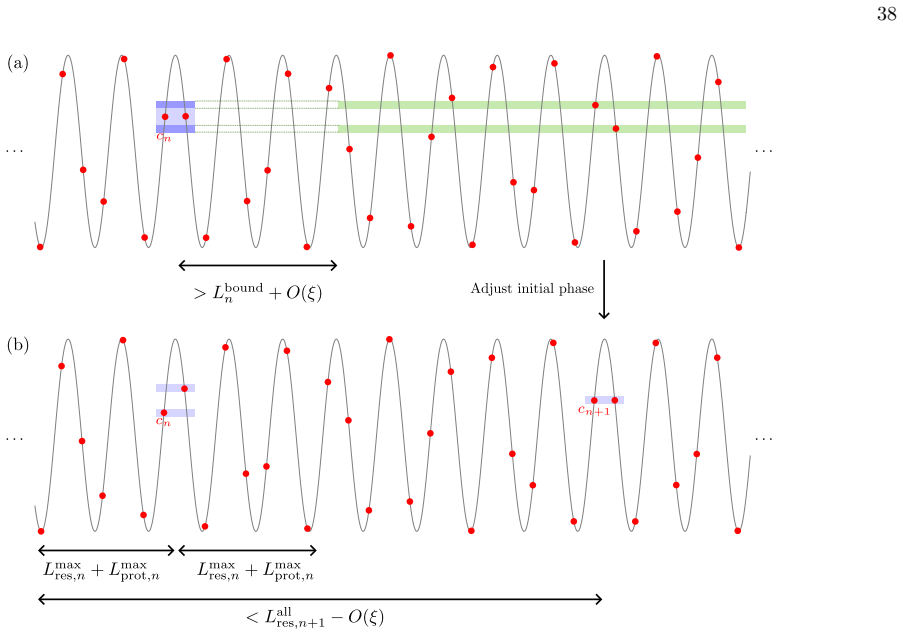
The protection layer From the results above, if we fixϵand the density of active sites, and moveb(the first active site) towards the left, eventually the synchronized oscillation will be- come frozen. To see this, note thatω sync decays at least exponentially inc−b, while|A|only grows linearly, so the crossover point (A14) will eventually be reached by in...
-
[12]
stretches out
Integrals of motion in the coupled segments Finally, we describe the structure of the integrals of motion of the final chain near the mirror center, depicted in Fig. 8(d). Note that if the total system size is large compared to any scales (e.g.,L max res +L max prot) that are in- fluenced by the mirror center, then we can still call them LIOMs. This is si...
-
[13]
Extension to HMS The results above have been for a single mirror center, that is, a single level of the HMS. A simple way to ex- tend to multiple levels is to assume that the LIOMs in theτchain are not entirely random, but themselves con- tain some stretched-out LIOMs resulting from the mirror resonances in the lower levels of the HMS. Intuitively, in- st...
-
[14]
rare initial phases become common
Generalizations Here, we consider the generalization beyond the random-field XXZ model symmetric around a bond with global independent symmetric breaking. To simplify the discussion (as a first approximation), we do not dis- tinguish between random models and the quasiperiodic model in the absence of distinctive features. In particu- lar, in Appendix B be...
-
[15]
P. W. Anderson, Phys. Rev.109, 1492 (1958)
1958
-
[16]
Nandkishore and D
R. Nandkishore and D. A. Huse, Annu. Rev. Condens. Matter Phys.6, 15 (2015)
2015
-
[17]
D. A. Abanin, E. Altman, I. Bloch, and M. Serbyn, Rev. Mod. Phys.91, 021001 (2019)
2019
-
[18]
Sierant, M
P. Sierant, M. Lewenstein, A. Scardicchio, L. Vidmar, and J. Zakrzewski, Reports on Progress in Physics88, 026502 (2025)
2025
-
[19]
D. A. Huse, R. Nandkishore, and V. Oganesyan, Phys. Rev. B90, 174202 (2014)
2014
-
[20]
J. Z. Imbrie, V. Ros, and A. Scardicchio, Annalen der Physik529, 1600278 (2017)
2017
-
[21]
D. M. Basko, I. L. Aleiner, and B. L. Altshuler, Annals of physics321, 1126 (2006)
2006
-
[22]
Oganesyan and D
V. Oganesyan and D. A. Huse, Phys. Rev. B75, 155111 (2007)
2007
-
[23]
ˇZnidariˇ c, T
M. ˇZnidariˇ c, T. Prosen, and P. Prelovˇ sek, Phys. Rev. B77, 064426 (2008)
2008
-
[24]
Pal and D
A. Pal and D. A. Huse, Phys. Rev. B82, 174411 (2010)
2010
-
[25]
Devakul and R
T. Devakul and R. R. P. P. Singh, Phys. Rev. Lett.115, 187201 (2015)
2015
-
[26]
J. Z. Imbrie, Journal of Statistical Physics163, 998 (2016)
2016
-
[27]
J. Z. Imbrie, Phys. Rev. Lett.117, 027201 (2016)
2016
-
[28]
Vidal, D
J. Vidal, D. Mouhanna, and T. Giamarchi, Phys. Rev. B - Condens. Matter Mater. Phys.65, 142011 (2002)
2002
-
[29]
S. Iyer, V. Oganesyan, G. Refael, and D. A. Huse, Phys. Rev. B - Condens. Matter Mater. Phys.87, 134202 (2013), 1212.4159
Pith/arXiv arXiv 2013
-
[30]
Mastropietro, Phys
V. Mastropietro, Phys. Rev. Lett.115, 180401 (2015)
2015
-
[31]
Khemani, D
V. Khemani, D. N. Sheng, and D. A. Huse, Phys. Rev. Lett.119, 075702 (2017)
2017
-
[32]
S. Xu, X. Li, Y.-T. Hsu, B. Swingle, and S. Das Sarma, Phys. Rev. Research1, 032039 (2019)
2019
-
[33]
D. Vu, K. Huang, X. Li, and S. Das Sarma, Phys. Rev. Lett.128, 146601 (2022)
2022
-
[34]
D. M. Long, P. J. D. Crowley, V. Khemani, and A. Chandran, Phys. Rev. Lett.131, 106301 (2023)
2023
-
[35]
D. M. Long, D. Hahn, M. Bukov, and A. Chandran, SciPost Phys.15, 251 (2023)
2023
-
[36]
Y.-T. Tu, D. M. Long, and S. Das Sarma, Phys. Rev. B109, 214309 (2024)
2024
-
[37]
Colbois, F
J. Colbois, F. Alet, and N. Laflorencie, Phys. Rev. B 110, 214210 (2024)
2024
-
[38]
Predicting dynamics from flows of the eigenstate thermalization hypothesis,
D. Hahn, D. M. Long, M. Bukov, and A. Chan- dran, “Predicting dynamics from flows of the eigenstate thermalization hypothesis,” (2025), arXiv:2504.01073 [quant-ph]
arXiv 2025
-
[39]
Resonance proliferation across localization transitions,
C. Vanoni, D. M. Long, and A. Chandran, “Resonance proliferation across localization transitions,” (2026), arXiv:2605.05445 [cond-mat.dis-nn]
Pith/arXiv arXiv 2026
-
[40]
Padhan, J
A. Padhan, J. Colbois, F. Alet, and N. Laflorencie, Phys. Rev. Lett.136, 197101 (2026)
2026
-
[41]
B. Faulend, H. Buljan, and A. ˇStrkalj, “Uncover- ing the microscopic mechanism of slow dynamics in quasiperiodic many-body localized systems,” (2026), arXiv:2603.28721 [cond-mat.dis-nn]
Pith/arXiv arXiv 2026
-
[42]
Gopalakrishnan, M
S. Gopalakrishnan, M. M¨ uller, V. Khemani, M. Knap, E. Demler, and D. A. Huse, Phys. Rev. B92, 104202 (2015)
2015
-
[43]
Khemani, S
V. Khemani, S. P. Lim, D. N. Sheng, and D. A. Huse, Phys. Rev. X7, 021013 (2017)
2017
-
[44]
S. J. Garratt, S. Roy, and J. T. Chalker, Phys. Rev. B 104, 184203 (2021)
2021
-
[45]
Crowley and A
P. Crowley and A. Chandran, SciPost Phys.12, 201 (2022)
2022
-
[46]
Li, Y.-T
Z.-J. Li, Y.-T. Tu, and S. Das Sarma, Phys. Rev. B 113, L180204 (2026)
2026
-
[47]
A. Y. Gordon, Uspekhi Matematicheskikh Nauk31, 257 (1976)
1976
-
[48]
J. E. Avron and B. Simon, Bulletin of the American Mathematical Society6, 81 (1982)
1982
-
[49]
Jitomirskaya and B
S. Jitomirskaya and B. Simon, Communications in Mathematical Physics165, 201 (1994)
1994
-
[50]
A. Hof, O. Knill, and B. Simon, Communications in mathematical physics174, 149 (1995)
1995
-
[51]
D. A. Koslover, Letters in Mathematical Physics71, 123 (2005)
2005
-
[52]
Jitomirskaya, Current developments in mathematics 2019, 1 (2019)
S. Jitomirskaya, Current developments in mathematics 2019, 1 (2019)
2019
-
[53]
Jitomirskaya and S
S. Jitomirskaya and S. Zhang, Journal of the European Mathematical Society24, 1723 (2021)
2021
-
[54]
Kohmoto, L
M. Kohmoto, L. P. Kadanoff, and C. Tang, Phys. Rev. Lett.50, 1870 (1983)
1983
-
[55]
S¨ ut˝ o, Communications in Mathematical Physics111, 409 (1987)
A. S¨ ut˝ o, Communications in Mathematical Physics111, 409 (1987)
1987
-
[56]
S¨ ut˝ o, Journal of statistical physics56, 525 (1989)
A. S¨ ut˝ o, Journal of statistical physics56, 525 (1989)
1989
-
[57]
Damanik, A
D. Damanik, A. Gorodetski, and W. Yessen, Inven- tiones mathematicae206, 629 (2016)
2016
-
[58]
Jagannathan, Rev
A. Jagannathan, Rev. Mod. Phys.93, 045001 (2021)
2021
-
[59]
Hatsugai and M
Y. Hatsugai and M. Kohmoto, Phys. Rev. B42, 8282 (1990)
1990
-
[60]
J. H. Han, D. J. Thouless, H. Hiramoto, and M. Kohmoto, Phys. Rev. B50, 11365 (1994)
1994
-
[61]
Takada, K
Y. Takada, K. Ino, and M. Yamanaka, Phys. Rev. E 70, 066203 (2004)
2004
-
[62]
F. Liu, S. Ghosh, and Y. D. Chong, Phys. Rev. B91, 014108 (2015)
2015
-
[63]
Avila, S
A. Avila, S. Jitomirskaya, and C. A. Marx, Inventiones mathematicae210, 283 (2017)
2017
-
[64]
In- applicability of avila’s theory in the diamond chain with quasiperiodic disorder,
M. Kumar, I. M. Khaymovich, and A. Sharma, “In- applicability of avila’s theory in the diamond chain with quasiperiodic disorder,” (2026), arXiv:2603.12362 [cond-mat.str-el]. 40
Pith/arXiv arXiv 2026
-
[65]
Aubry and G
S. Aubry and G. Andr´ e, Ann. Israel Phys. Soc3, 18 (1980)
1980
-
[66]
P. G. Harper, Proceedings of the Physical Society. Sec- tion A68, 874 (1955)
1955
-
[67]
Hiramoto, Journal of the Physical Society of Japan 59, 811 (1990)
H. Hiramoto, Journal of the Physical Society of Japan 59, 811 (1990)
1990
-
[68]
Hiramoto and M
H. Hiramoto and M. Kohmoto, International Journal of Modern Physics B6, 281 (1992)
1992
-
[69]
Settino, N
J. Settino, N. W. Talarico, F. Cosco, F. Plastina, S. Maniscalco, and N. Lo Gullo, Phys. Rev. B101, 144303 (2020)
2020
-
[70]
Mac´ e, N
N. Mac´ e, N. Laflorencie, and F. Alet, SciPost Phys.6, 050 (2019)
2019
-
[71]
V. K. Varma and M. ˇZnidariˇ c, Phys. Rev. B100, 085105 (2019)
2019
-
[72]
Y. Wang, C. Cheng, X.-J. Liu, and D. Yu, Phys. Rev. Lett.126, 080602 (2021)
2021
-
[73]
J. M. Deutsch, Phys. Rev. A43, 2046 (1991)
2046
-
[74]
Srednicki, Phys
M. Srednicki, Phys. Rev. E50, 888 (1994)
1994
-
[75]
T. Mori, T. N. Ikeda, E. Kaminishi, and M. Ueda, Journal of Physics B: Atomic, Molecular and Optical Physics51, 112001 (2018)
2018
-
[76]
J. M. Deutsch, Reports on Progress in Physics81, 082001 (2018)
2018
-
[77]
Bernien, S
H. Bernien, S. Schwartz, A. Keesling, H. Levine, A. Om- ran, H. Pichler, S. Choi, A. S. Zibrov, M. Endres, M. Greiner, V. Vuleti´ c, and M. D. Lukin, Nature551, 579 (2017)
2017
-
[78]
Shiraishi and T
N. Shiraishi and T. Mori, Phys. Rev. Lett.119, 030601 (2017)
2017
-
[79]
Serbyn, D
M. Serbyn, D. A. Abanin, and Z. Papi´ c, Nature Physics 17, 675 (2021)
2021
-
[80]
Chandran, T
A. Chandran, T. Iadecola, V. Khemani, and R. Moess- ner, Annual Review of Condensed Matter Physics14, 443 (2023)
2023
This paper was first reviewed by deepseek-v4-flash on August 4, 2026.
discussion (0)
Sign in with ORCID, Apple, or X to comment. Anyone can read and Pith papers without signing in.