Recognition: 2 theorem links
· Lean TheoremLearning and Generating Mixed States Prepared by Shallow Channel Circuits
Pith reviewed 2026-05-14 22:24 UTC · model grok-4.3
The pith
Any mixed state in the trivial phase can be learned and approximately generated by a shallow local channel circuit from measurements alone.
A machine-rendered reading of the paper's core claim, the machinery that carries it, and where it could break.
Core claim
Any mixed state in the trivial phase, defined by the existence of a shallow preparation channel circuit that preserves local reversibility throughout, can be learned from measurement data alone. Given copies of an unknown state from this class, the algorithm outputs a shallow local channel circuit that generates an approximation to the state in trace distance, with sample complexity and runtime polynomial or quasi-polynomial in the number of qubits for constant or polylogarithmic depth and gate locality.
What carries the argument
The trivial phase of mixed states, defined by the existence of a shallow preparation channel circuit that preserves local reversibility at every step.
Load-bearing premise
The unknown mixed state belongs to the trivial phase, so a shallow preparation channel circuit preserving local reversibility exists.
What would settle it
A concrete mixed state that admits a shallow reversible channel-circuit preparation but for which the algorithm returns no circuit whose generated state lies within the claimed trace-distance bound.
Figures




read the original abstract
Learning quantum states from measurement data is a central problem in quantum information and computational complexity. In this work, we study the problem of learning to generate mixed states on a finite-dimensional lattice. Motivated by recent developments in mixed state phases of matter, we focus on arbitrary states in the trivial phase. A state belongs to the trivial phase if there exists a shallow preparation channel circuit under which local reversibility is preserved throughout the preparation. We prove that any mixed state in this class can be efficiently learned from measurement access alone. Specifically, given copies of an unknown trivial phase mixed state, our algorithm outputs a shallow local channel circuit that approximately generates this state in trace distance. The sample complexity and runtime are polynomial (or quasi-polynomial) in the number of qubits, assuming constant (or polylogarithmic) circuit depth and gate locality. Importantly, the learner is not given the original preparation circuit and relies only on its existence. Our results provide a structural foundation for quantum generative models based on shallow channel circuits. In the classical limit, our framework also inspires an efficient algorithm for classical diffusion models using only a polynomial overhead of training and generation.
Editorial analysis
A structured set of objections, weighed in public.
Referee Report
Summary. The paper claims that any mixed state in the trivial phase—defined as one for which there exists a shallow preparation channel circuit preserving local reversibility throughout—can be efficiently learned from measurement access to copies alone. The algorithm outputs a shallow local channel circuit that approximates the unknown state to trace distance, with sample complexity and runtime polynomial (or quasi-polynomial) in system size for constant (or polylog) depth and gate locality. The learner does not receive the original circuit and the result is conditional on membership in this class; a classical limit for diffusion models is also sketched.
Significance. If the central learning theorem holds, the work supplies a constructive structural result linking mixed-state phases of matter to efficient generative modeling via shallow channel circuits. It gives an explicit measurement-based learner with controlled complexity and suggests a polynomial-overhead classical analogue, which could inform both quantum state tomography and classical generative modeling literature.
minor comments (3)
- [Abstract] The abstract and introduction should state the precise dependence of the sample complexity on depth d and locality k (e.g., whether the bound is poly(n,2^d) or involves additional factors) rather than the current high-level “polynomial or quasi-polynomial” phrasing.
- [§2] Clarify the precise notion of “local reversibility preserved throughout the preparation” when the circuit is applied to a mixed state; a short paragraph or diagram in §2 would help readers verify that the definition matches the learner’s assumptions.
- [Discussion] The classical diffusion-model corollary is stated only in the abstract; a brief self-contained paragraph in the discussion section would make the claimed polynomial overhead explicit and allow direct comparison with existing classical results.
Simulated Author's Rebuttal
We thank the referee for their positive summary of our work and for recommending minor revision. The provided report contains no enumerated major comments, so we have no specific points requiring point-by-point rebuttal. We will incorporate any minor editorial suggestions in the revised manuscript.
Circularity Check
No significant circularity; derivation self-contained
full rationale
The paper defines the trivial phase by the existence of a shallow preparation channel circuit preserving local reversibility, then proves that states in this class admit an efficient measurement-based learner outputting an approximating circuit. This is a standard conditional result: the class membership is an external assumption on the unknown state, and the algorithm constructs the circuit from data without reducing to fitted parameters, self-referential equations, or load-bearing self-citations. The abstract and claims exhibit no self-definitional steps, fitted-input predictions, or ansatz smuggling. The result is independent of the specific circuit and relies on measurement access alone.
Axiom & Free-Parameter Ledger
axioms (1)
- domain assumption Existence of a shallow preparation channel circuit preserving local reversibility for states in the trivial phase
Lean theorems connected to this paper
-
IndisputableMonolith/Foundation/ArithmeticFromLogic.lean; IndisputableMonolith/Cost/FunctionalEquation.leanreality_from_one_distinction; washburn_uniqueness_aczel unclear?
unclearRelation between the paper passage and the cited Recognition theorem.
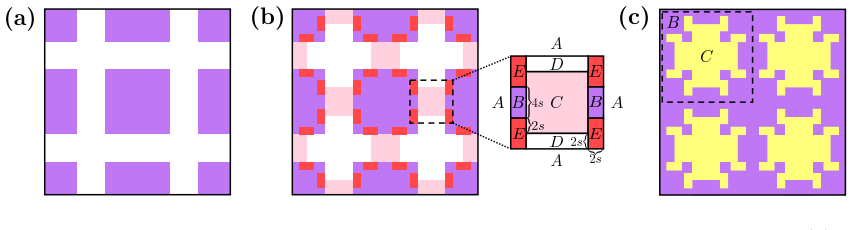
A state belongs to the trivial phase if there exists a shallow preparation channel circuit under which local reversibility is preserved throughout the preparation... local recovery map Ψ_{B→BC}... local extension map Φ_{BE→BC}
-
IndisputableMonolith/Foundation/DimensionForcing.lean; IndisputableMonolith/Foundation/AlexanderDuality.leanalexander_duality_circle_linking; D3_admits_circle_linking unclear?
unclearRelation between the paper passage and the cited Recognition theorem.
We prove that any mixed state in this class can be efficiently learned... (k+1)-layer channel circuit W
What do these tags mean?
- matches
- The paper's claim is directly supported by a theorem in the formal canon.
- supports
- The theorem supports part of the paper's argument, but the paper may add assumptions or extra steps.
- extends
- The paper goes beyond the formal theorem; the theorem is a base layer rather than the whole result.
- uses
- The paper appears to rely on the theorem as machinery.
- contradicts
- The paper's claim conflicts with a theorem or certificate in the canon.
- unclear
- Pith found a possible connection, but the passage is too broad, indirect, or ambiguous to say the theorem truly supports the claim.
Forward citations
Cited by 1 Pith paper
-
Concurrence of Symmetry Breaking and Nonlocality Phase Transitions in Diffusion Models
Symmetry breaking and nonlocality phase transitions occur nearly simultaneously during diffusion model generation in modern transformers.
Reference graph
Works this paper leans on
-
[1]
Anderson.Reverse-time diffusion equation models
[And82] Brian D.O. Anderson.Reverse-time diffusion equation models. In:Stochastic Processes and their Applications12.3 (1982), pp. 313–326. [Bak+25] Ainesh Bakshi, John Bostanci, William Kretschmer, Zeph Landau, Jerry Li, Allen Liu, Ryan O’Donnell, and Ewin Tang.Learning the closest product state. In:Proceedings of the 57th Annual ACM Symposium on Theory ...
-
[2]
In: arXiv:2504.02208 [quant-ph](2025)
[CR25] Chi-Fang Chen and Cambyse Rouz´ e.Quantum Gibbs states are locally Markovian. In: arXiv:2504.02208 [quant-ph](2025). [Fef+25] Bill Fefferman, Soumik Ghosh, Makrand Sinha, and Henry Yuen.The hardness of learning quantum circuits and its cryptographic applications. In:arXiv:2504.15343 [quant-ph](2025). [FR15] Omar Fawzi and Renato Renner.Quantum Cond...
-
[3]
Duan.Quantum Supremacy for Simulating a Translation-Invariant Ising Spin Model
[GWD17] Xun Gao, Sheng-Tao Wang, and L.-M. Duan.Quantum Supremacy for Simulating a Translation-Invariant Ising Spin Model. In:Physical Review Letters118.4 (2017), p. 040502. [Haa11] Jeongwan Haah.Local stabilizer codes in three dimensions without string logical oper- ators. In:Physical Review A83.4 (2011), p. 042330. [Haa16] Jeongwan Haah.An Invariant of ...
work page 2017
-
[4]
Local Diffusion Models and Phases of Data Distributions
[HKP20] Hsin-Yuan Huang, Richard Kueng, and John Preskill.Predicting many properties of a quantum system from very few measurements. In:Nature Physics16.10 (2020), pp. 1050–1057. 33 [Hu+25] Fangjun Hu, Guangkuo Liu, Yifan Zhang, and Xun Gao.Local Diffusion Models and Phases of Data Distributions. In:arXiv:2508.06614 [cs.LG](2025). [Hua+24] Hsin-Yuan Huang...
work page internal anchor Pith review Pith/arXiv arXiv 2020
-
[5]
In:arXiv:2509.15204 [quant-ph](2025)
[MKS25] Ruochen Ma, Vedika Khemani, and Shengqi Sang.Circuit-based characterization of finite-temperature quantum phases and self-correcting quantum memory. In:arXiv:2509.15204 [quant-ph](2025). [MT25] Ruochen Ma and Alex Turzillo.Symmetry-Protected Topological Phases of Mixed States in the Doubled Space. In:PRX Quantum6.1 (2025), p. 010348. [MW23] Ruoche...
-
[6]
In:arXiv:2511.15806 [quant-ph](2025)
[Pel+25] Angelos Pelecanos, Jack Spilecki, Ewin Tang, and John Wright.Mixed state tomography reduces to pure state tomography. In:arXiv:2511.15806 [quant-ph](2025). [San+25] Shengqi Sang, Leonardo A. Lessa, Roger S. K. Mong, Tarun Grover, Chong Wang, and Timothy H. Hsieh.Mixed-state phases from local reversibility. In:arXiv:2507.02292 [quant-ph](2025). [S...
-
[7]
Yao, and Hsin-Yuan Huang.Hardness of recognizing phases of matter
[Sch+25] Thomas Schuster, Dominik Kufel, Norman Y. Yao, and Hsin-Yuan Huang.Hardness of recognizing phases of matter. In:arXiv:2510.08503 [quant-ph](2025). [SE19] Yang Song and Stefano Ermon.Generative Modeling by Estimating Gradients of the Data Distribution. In:Proceedings of the 33rd International Conference on Neural In- formation Processing Systems. ...
-
[8]
Hsieh.Mixed-State Quantum Phases: Renormalization and Quantum Error Correction
[SZH24] Shengqi Sang, Yijian Zou, and Timothy H. Hsieh.Mixed-State Quantum Phases: Renormalization and Quantum Error Correction. In:Physical Review X14.3 (2024), p. 031044. [Vot+25] Matteo Votto, Marko Ljubotina, C´ ecilia Lancien, J. Ignacio Cirac, Peter Zoller, Maksym Serbyn, Lorenzo Piroli, and Benoˆ ıt Vermersch.Learning mixed quantum states in large-...
-
[9]
Wen.Vacuum degeneracy of chiral spin states in compactified space
[Wen89] X.-G. Wen.Vacuum degeneracy of chiral spin states in compactified space. In:Physical Review B40.10 (1989), pp. 7387–7390. [Wen90] X.-G. Wen.Topological Orders in Rigid States. In:International Journal of Modern Physics B04.02 (1990), pp. 239–271. [YSL25] Tai-Hsuan Yang, Bowen Shi, and Jong Yeon Lee.Topological Mixed States: Phases of Matter from A...
-
[10]
In:Physical Review Letters132.10 (2024), p
[Zha+24] Bingzhi Zhang, Peng Xu, Xiaohui Chen, and Quntao Zhuang.Generative Quantum Machine Learning via Denoising Diffusion Probabilistic Models. In:Physical Review Letters132.10 (2024), p. 100602. A Proofs of Backward Lightcone Decompositions In this appendix, we provide the proof of backward lightcone decompositions (Fact 3 and Fact
work page 2024
discussion (0)
Sign in with ORCID, Apple, or X to comment. Anyone can read and Pith papers without signing in.