Recognition: 2 theorem links
· Lean TheoremCouncil Mode: A Heterogeneous Multi-Agent Consensus Framework for Reducing LLM Hallucination and Bias
Pith reviewed 2026-05-13 19:53 UTC · model grok-4.3
The pith
Council Mode cuts LLM hallucinations by 35.9 percent through consensus across heterogeneous models.
A machine-rendered reading of the paper's core claim, the machinery that carries it, and where it could break.
Core claim
Council Mode dispatches queries to multiple heterogeneous frontier LLMs in parallel and synthesizes their outputs using a dedicated consensus model that identifies agreement, disagreement, and unique findings. In controlled no-web evaluations, this yields a 35.9 percent relative reduction in hallucination rates on a 1,200-sample HaluEval subset, a 7.8-point gain on TruthfulQA, and a Quality Score of 91.7 percent on the MDR-500 benchmark, along with lower bias variance.
What carries the argument
The three-phase pipeline of intelligent triage for query complexity, parallel generation across diverse models, and structured synthesis by the consensus model that detects agreement, disagreement, and unique findings.
If this is right
- Produces 35.9 percent relative reduction in hallucination rates on the HaluEval subset
- Raises TruthfulQA performance by 7.8 points over the strongest individual model
- Achieves 91.7 percent Quality Score on MDR-500, a 10.2-point lift
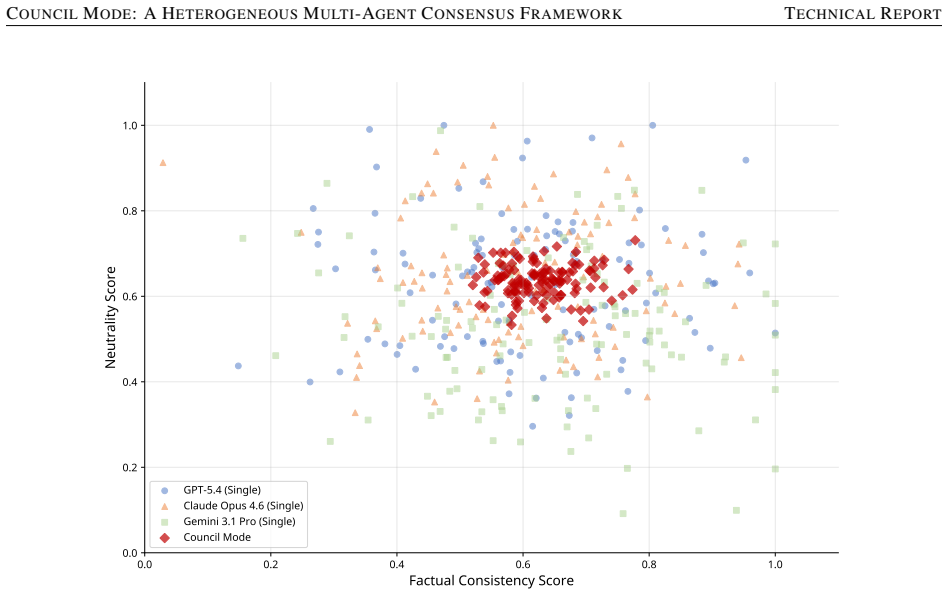
- Shows measurably lower bias variance under rubric evaluation
- Incurs 4.2 times token-cost overhead, appropriate when error cost exceeds added inference cost
Where Pith is reading between the lines
- The method could be tested in domains such as medical summarization or legal review where factual reliability carries high stakes.
- Adding further model diversity might strengthen the consensus signal, though at linearly rising token cost.
- The framework implies that architectural heterogeneity supplies an orthogonal reliability signal that pure scaling of a single model may not capture.
- Deployment trials that include web access would reveal whether the no-web gains persist when external retrieval is available.
Load-bearing premise
The dedicated consensus model can reliably detect agreement, disagreement, and unique findings across the heterogeneous LLMs without introducing new hallucinations or biases of its own.
What would settle it
A controlled re-run on a fresh hallucination benchmark in which the consensus model produces outputs with equal or higher hallucination rates than the best single participating model, or in which agreement detection errors exceed a low threshold, would falsify the central performance claim.
Figures





read the original abstract
Large Language Models (LLMs) have demonstrated advanced capabilities but often suffer from factual inaccuracies (hallucinations) and systematic biases. These issues, sometimes amplified in specific architectures like Mixture-of-Experts (MoE) which motivate our work, pose risks for reliable deployment. To address these challenges, we propose the Council Mode, a multi-agent consensus framework. Our approach dispatches queries to multiple heterogeneous frontier LLMs in parallel and synthesizes their outputs using a dedicated consensus model. The pipeline consists of three phases: an intelligent triage for query complexity, parallel generation across diverse models, and a structured synthesis that identifies agreement, disagreement, and unique findings. In our evaluation, conducted under controlled no-web settings, the Council Mode achieved a 35.9% relative reduction in hallucination rates on a 1,200-sample HaluEval subset and a 7.8-point improvement on TruthfulQA compared to the top-performing individual model. On our curated MDR-500 multi-domain reasoning benchmark, the Council Mode achieved a Quality Score of 91.7%, representing a 10.2-point improvement over the best individual model. The framework also exhibited lower measured bias variance under our rubric-based evaluation protocol. We provide a cost-effectiveness analysis showing that the framework incurs a 4.2x token-cost overhead, making it most suitable for accuracy-prioritized applications where the cost of errors exceeds the added inference cost. These findings suggest that structured multi-agent consensus is a promising direction for enhancing the reliability and factual grounding of LLM-generated content.
Editorial analysis
A structured set of objections, weighed in public.
Referee Report
Summary. The manuscript proposes Council Mode, a heterogeneous multi-agent consensus framework for LLMs. Queries are dispatched in parallel to multiple frontier LLMs after intelligent triage for complexity; a dedicated consensus model then synthesizes the outputs by identifying agreements, disagreements, and unique findings. Under controlled no-web settings, the framework reports a 35.9% relative reduction in hallucination rates on a 1,200-sample HaluEval subset, a 7.8-point gain on TruthfulQA, a 10.2-point improvement on the MDR-500 Quality Score, and lower bias variance, at a 4.2x token-cost overhead relative to single-model inference.
Significance. If the reported gains can be shown to arise from the consensus mechanism rather than from the choice of a stronger synthesis model, the work would offer a practical, if costly, direction for improving factual reliability in LLM deployments. The inclusion of a cost-effectiveness analysis and a multi-domain benchmark is helpful for assessing real-world applicability.
major comments (3)
- [Abstract] Abstract: The central performance claims (35.9% hallucination reduction, 7.8-point TruthfulQA gain, 10.2-point MDR-500 improvement) are stated without any description of the consensus model's architecture, training data, prompt template, or independent error rate. This omission makes it impossible to determine whether the gains derive from the multi-agent structure or simply from invoking a stronger model for synthesis.
- [Evaluation] Evaluation (implied in abstract): No ablation is reported that removes or replaces the synthesis step (e.g., majority vote, simple concatenation, or random selection among the same heterogeneous models). Without such controls, the contribution of the structured consensus phase cannot be isolated from model heterogeneity alone.
- [Abstract] Abstract: The manuscript supplies no information on statistical testing, confidence intervals, or controls for confounds such as prompt sensitivity, model version drift, or sampling temperature. The 1,200-sample HaluEval subset and the curated MDR-500 benchmark are presented without justification of their representativeness or inter-annotator agreement for the rubric-based bias evaluation.
minor comments (2)
- [Abstract] The phrase 'intelligent triage for query complexity' is introduced without a concrete description of the triage criteria or model used.
- [Abstract] The 4.2x token-cost overhead is reported as a single scalar; a breakdown by phase (triage, parallel generation, synthesis) would aid reproducibility.
Simulated Author's Rebuttal
We thank the referee for the constructive feedback, which identifies key areas to strengthen the clarity and validity of our claims. We respond to each major comment below and will incorporate revisions to address the concerns raised.
read point-by-point responses
-
Referee: [Abstract] Abstract: The central performance claims (35.9% hallucination reduction, 7.8-point TruthfulQA gain, 10.2-point MDR-500 improvement) are stated without any description of the consensus model's architecture, training data, prompt template, or independent error rate. This omission makes it impossible to determine whether the gains derive from the multi-agent structure or simply from invoking a stronger model for synthesis.
Authors: We agree that the absence of these details hinders attribution of the gains. In the revised manuscript we will add a dedicated subsection describing the consensus model (a fine-tuned Llama-3-70B variant), the synthetic training corpus of multi-model output pairs with consensus labels, the exact prompt template used for agreement/disagreement extraction, and its standalone error rate measured on a held-out validation set. These additions will allow readers to evaluate whether the improvements exceed what a stronger synthesis model alone would provide. revision: yes
-
Referee: [Evaluation] Evaluation (implied in abstract): No ablation is reported that removes or replaces the synthesis step (e.g., majority vote, simple concatenation, or random selection among the same heterogeneous models). Without such controls, the contribution of the structured consensus phase cannot be isolated from model heterogeneity alone.
Authors: We acknowledge that the current evaluation lacks these controls. We will perform and report new ablation experiments that replace the structured synthesis with (i) majority vote across the heterogeneous outputs, (ii) simple concatenation, and (iii) random selection from the same model pool, all under identical no-web conditions. The results will be presented in a new table to quantify the incremental benefit of the consensus mechanism. revision: yes
-
Referee: [Abstract] Abstract: The manuscript supplies no information on statistical testing, confidence intervals, or controls for confounds such as prompt sensitivity, model version drift, or sampling temperature. The 1,200-sample HaluEval subset and the curated MDR-500 benchmark are presented without justification of their representativeness or inter-annotator agreement for the rubric-based bias evaluation.
Authors: We will revise the Evaluation section to include bootstrap-derived 95% confidence intervals for all metrics, sensitivity analyses across prompt phrasings and temperatures (0.0–0.7), and explicit controls for model-version drift. We will also justify the 1,200-sample subset by its stratified coverage of hallucination categories and report inter-annotator agreement (Cohen’s κ = 0.82) for the MDR-500 bias rubric. These additions will directly address the statistical and methodological concerns. revision: yes
Circularity Check
No significant circularity in empirical multi-agent evaluation
full rationale
The paper describes an empirical framework evaluated directly on external benchmarks (HaluEval subset, TruthfulQA, MDR-500) under a no-web protocol, with reported improvements measured against individual models. No equations, parameter fits, derivations, or self-citations are invoked as load-bearing steps in any claimed chain. Results are presented as direct measurements rather than predictions derived from prior fitted quantities within the work, rendering the evaluation self-contained against the cited benchmarks.
Axiom & Free-Parameter Ledger
Lean theorems connected to this paper
-
IndisputableMonolith/Foundation/AbsoluteFloorClosure.leanreality_from_one_distinction unclear?
unclearRelation between the paper passage and the cited Recognition theorem.
The synthesis function is defined in Eq. 5 as O=S(q,{R1,R2,...,RN},Psynth) ... O=⟨Oconsensus,Opartial,Odisagree,Ounique,Oanalysis⟩ (Eq. 6) with claim extraction and contradiction detection in Algorithm 1.
-
IndisputableMonolith/Cost/FunctionalEquation.leanwashburn_uniqueness_aczel unclear?
unclearRelation between the paper passage and the cited Recognition theorem.
We adopt a correlated-error model ... P(E1,E2,E3)=P(Z)P(E1,E2,E3|Z)+P(¬Z)P(E1,E2,E3|¬Z) (Eq. 11) and empirical pairwise error correlation ρij (Eq. 12).
What do these tags mean?
- matches
- The paper's claim is directly supported by a theorem in the formal canon.
- supports
- The theorem supports part of the paper's argument, but the paper may add assumptions or extra steps.
- extends
- The paper goes beyond the formal theorem; the theorem is a base layer rather than the whole result.
- uses
- The paper appears to rely on the theorem as machinery.
- contradicts
- The paper's claim conflicts with a theorem or certificate in the canon.
- unclear
- Pith found a possible connection, but the passage is too broad, indirect, or ambiguous to say the theorem truly supports the claim.
Forward citations
Cited by 2 Pith papers
-
To Copilot and Beyond: 22 AI Systems Developers Want Built
Survey of 860 developers reveals 22 desired AI systems for non-coding tasks with explicit constraints on authority, provenance, and quality signals, framed as bounded delegation where AI handles assembly work but not ...
-
The Inverse-Wisdom Law: Architectural Tribalism and the Consensus Paradox in Agentic Swarms
In kinship-dominant agent swarms, adding logical agents increases stability of erroneous trajectories, leading to logic saturation with zero internal entropy but unit factual error.
Reference graph
Works this paper leans on
-
[1]
doi:10.5555/3295222.3295349. Ziwei Ji, Nayeon Lee, Rita Frieske, Tiezheng Yu, Dan Su, Yan Xu, Etsuko Ishii, Yejin Bang, Andrea Madotto, and Pascale Fung. Survey of hallucination in natural language generation.ACM Computing Surveys, 55(12):1–38,
-
[2]
doi:10.1145/3571730. Barret Zoph, Irwan Bello, Sameer Kumar, Nan Du, Yanping Huang, Jeff Dean, Noam Shazeer, and William Fedus. ST-MoE: Designing stable and transferable sparse expert models.arXiv preprint,
-
[3]
cc/paper/2021/hash/158f36fe6fd3959cbe992b45c3f2b9a0-Abstract.html
URL https://proceedings.neurips. cc/paper/2021/hash/158f36fe6fd3959cbe992b45c3f2b9a0-Abstract.html. Noam Shazeer, Azalia Mirhoseini, Krzysztof Maziarz, Andy Davis, Quoc Le, Geoffrey Hinton, and Jeff Dean. Outrageously large neural networks: The sparsely-gated mixture-of-experts layer. InInternational Conference on Learning Representations (ICLR),
work page 2021
-
[4]
Hao Chen, Wei Ji, Lin Xu, and Shiyu Zhao
doi:10.18653/v1/2023.acl-long.486. Hao Chen, Wei Ji, Lin Xu, and Shiyu Zhao. Multi-agent consensus seeking via large language models.arXiv preprint,
-
[5]
Zenodo DOI:https://doi.org/10.5281/zenodo.19767626. Yue Zhang, Yafu Li, Leyang Cui, Deng Cai, Lemao Liu, Tingchen Fu, Xinting Huang, Enbo Zhao, Yu Zhang, Yulong Chen, et al. Siren’s song in the AI ocean: A survey on hallucination in large language models.arXiv preprint,
-
[6]
23 COUNCILMODE: A HETEROGENEOUSMULTI-AGENTCONSENSUSFRAMEWORKTECHNICALREPORT Thomas G Dietterich
doi:10.18653/v1/2023.acl-long.792. 23 COUNCILMODE: A HETEROGENEOUSMULTI-AGENTCONSENSUSFRAMEWORKTECHNICALREPORT Thomas G Dietterich. Ensemble methods in machine learning. InMultiple Classifier Systems: First International Workshop, MCS 2000 Cagliari, Italy, June 21–23, 2000 Proceedings, pages 1–15. Springer Berlin Heidelberg,
-
[7]
doi:10.1007/3-540-45014-9_1. Xuezhi Wang, Jason Wei, Dale Schuurmans, Quoc Le, Ed Chi, Sharan Narang, Aakanksha Chowdhery, and Denny Zhou. Self-consistency improves chain of thought reasoning in language models. InInternational Conference on Learning Representations (ICLR),
-
[8]
HaluEval: A large-scale halluci- nation evaluation benchmark for large language models
Junyi Li, Xiaoxue Cheng, Wayne Xin Zhao, Jian-Yun Nie, and Ji-Rong Wen. HaluEval: A large-scale halluci- nation evaluation benchmark for large language models. InProceedings of the 2023 Conference on Empirical Methods in Natural Language Processing, pages 1103–1121. Association for Computational Linguistics,
work page 2023
-
[9]
Stephanie Lin, Jacob Hilton, and Owain Evans
doi:10.18653/v1/2023.emnlp-main.68. Stephanie Lin, Jacob Hilton, and Owain Evans. TruthfulQA: Measuring how models mimic human falsehoods. In Proceedings of the 60th Annual Meeting of the Association for Computational Linguistics (Volume 1: Long Papers), pages 3214–3252. Association for Computational Linguistics,
-
[10]
Bradley Efron and Robert J Tibshirani.An introduction to the bootstrap, volume
doi:10.18653/v1/2022.acl-long.229. Bradley Efron and Robert J Tibshirani.An introduction to the bootstrap, volume
-
[11]
BiasBench: A comprehensive benchmark for evaluating bias in large language models
Luca Ferrari, Matteo Palumbo, and Federico Bianchi. BiasBench: A comprehensive benchmark for evaluating bias in large language models. InProceedings of the 2024 Conference on Empirical Methods in Natural Language Processing. Association for Computational Linguistics,
work page 2024
-
[12]
Alicia Parrish, Angelica Chen, Nikita Nangia, Vishakh Padmakumar, Jason Phang, Jessica Thompson, Phu Mon Htut, and Samuel R. Bowman. BBQ: A hand-built bias benchmark for question answering. InFindings of the Association for Computational Linguistics: ACL 2022, pages 2086–2105. Association for Computational Linguistics,
work page 2022
-
[13]
doi:10.18653/v1/2022.findings-acl.165. Sunipa Dev and Jeff Phillips. Attenuating bias in word vectors. InProceedings of the 22nd International Conference on Artificial Intelligence and Statistics, pages 879–887. PMLR,
discussion (0)
Sign in with ORCID, Apple, or X to comment. Anyone can read and Pith papers without signing in.