opt-DDAP: Optimisable density-derived atomic point charges via automatic differentiation
Pith reviewed 2026-05-10 15:51 UTC · model grok-4.3
The pith
Reformulating the DDAP method as a differentiable graph allows automatic optimization of Gaussian parameters for stable atom-centered charges.
A machine-rendered reading of the paper's core claim, the machinery that carries it, and where it could break.
Core claim
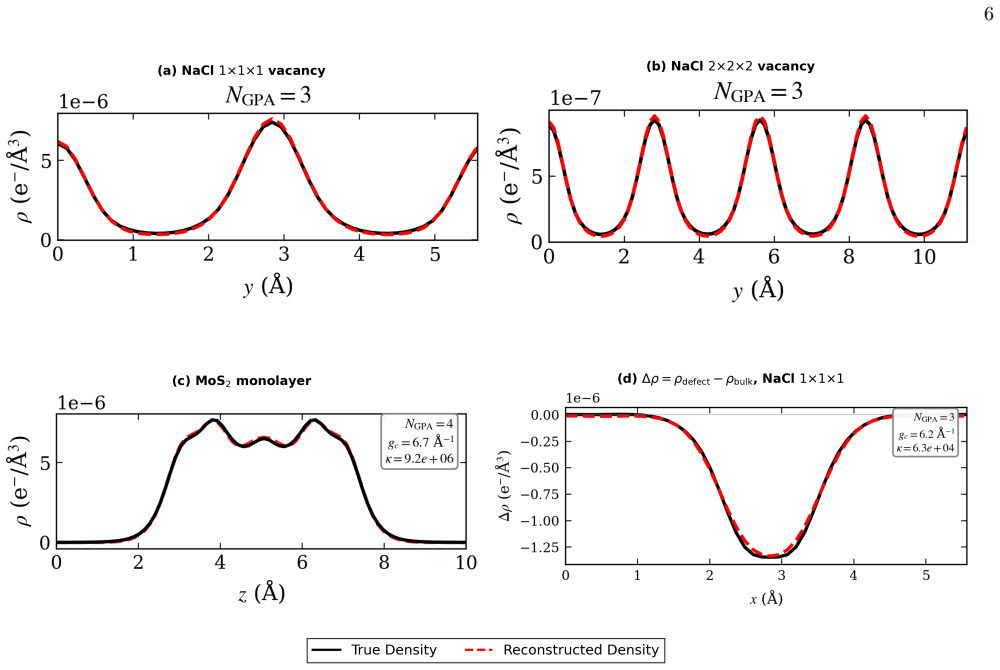
The central claim is that by expressing the DDAP charge assignment procedure as a differentiable computational graph, the Gaussian basis parameters and reciprocal-space cutoff become optimizable via automatic differentiation, and the replacement of the Lagrange-multiplier constraint with a pseudo-inverse solution followed by charge renormalization maintains numerical robustness without sacrificing the preservation of multipole moments needed for long-range electrostatics, as shown through faithful density reconstruction on NaCl vacancy cells and MoS2.
What carries the argument
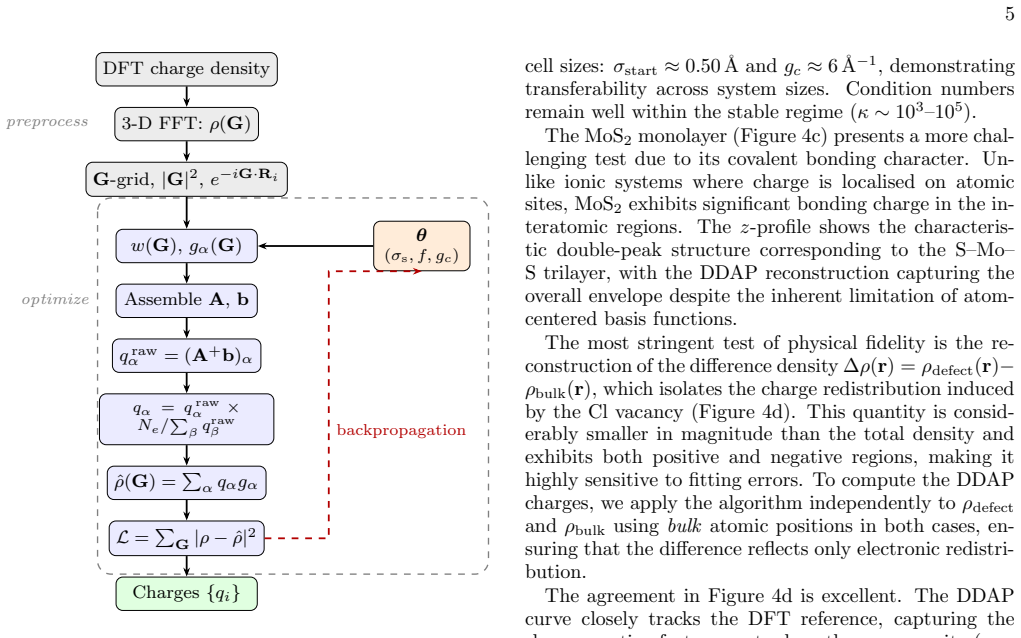
The differentiable computational graph representation of the Gaussian fitting and multipole preservation process, which permits gradient-based optimization of previously heuristic parameters.
If this is right
- The optimised charges serve as direct inputs to machine-learning and empirical interatomic potentials that include long-range electrostatic interactions.
- Stable performance holds for systems with vacancies and layered structures where the original solver fails.
- Reconstruction of both absolute and difference charge densities remains accurate after optimization.
- Parameter optimization reduces reliance on fixed heuristics for each new material.
Where Pith is reading between the lines
- This optimization strategy could be extended to other charge-partitioning schemes that currently use constrained linear algebra.
- Further tests on highly covalent networks might show how much the adaptive parameters improve transferability across chemical environments.
- The automatic tuning opens a path to embedding charge fitting inside larger end-to-end differentiable models for materials simulation.
Load-bearing premise
The pseudo-inverse solution followed by charge renormalisation preserves the multipole moments that govern long-range electrostatics to the same accuracy as the Lagrange-multiplier approach, even when the matrix is ill-conditioned.
What would settle it
Compute the difference in electrostatic energies or dipole and quadrupole moments between opt-DDAP and standard DDAP charges for a covalent system that produces an ill-conditioned fitting matrix and check whether the deviation stays below the threshold required for the target application.
Figures
read the original abstract
Interatomic potentials which accurately describe long-range electrostatics require atom-centred charges. One such method to determine these atom-centred charges from density functional theory (DFT) calculations is the density-derived atomic point (DDAP) charge method. DDAP fits atom-centred Gaussians to the ground-state DFT charge density and preserves the multipole moments that govern long-range electrostatics. While these charges accurately predict long-range behaviour, in practice, they are limited by their reliance on fixed, heuristic parameters and a constrained solver that becomes numerically unstable for complex or covalent systems. In this work, we present opt-DDAP, which solves this limitation by reformulating the algorithm as a differentiable computational graph. This reformulation allows for the optimisation of Gaussian basis parameters and the reciprocal-space cutoff using automatic differentiation. To ensure numerical robustness through this automatic differentiation process, we replace the conventional Lagrange-multiplier approach with a pseudo-inverse solution followed by charge renormalisation, maintaining stability even in the presence of ill-conditioned matrices. We validate the framework on NaCl vacancy supercells and on MoS$_2$, demonstrating faithful reconstruction of both absolute and difference charge densities. The optimised charges are intended to serve as inputs to effective electrostatic models in machine-learning and empirical interatomic potentials that incorporate long-range interactions.
Editorial analysis
A structured set of objections, weighed in public.
Referee Report
Summary. The manuscript introduces opt-DDAP, an extension of the density-derived atomic point (DDAP) charge fitting method. By reformulating the DDAP algorithm as a differentiable computational graph, the authors enable the use of automatic differentiation to optimize the Gaussian basis parameters and the reciprocal-space cutoff. To maintain numerical stability during this optimization, particularly for ill-conditioned matrices, the conventional Lagrange-multiplier constrained solver is replaced with a pseudo-inverse solution followed by post-hoc charge renormalization. The approach is demonstrated on NaCl vacancy supercells and MoS2 systems, where it achieves faithful reconstruction of both absolute and difference charge densities. The resulting charges are positioned as improved inputs for long-range electrostatics in machine learning and empirical interatomic potentials.
Significance. If the central claim holds, this work could significantly advance the derivation of atom-centered charges for interatomic potentials by removing the reliance on fixed heuristic parameters and providing a stable optimization pathway. The differentiable reformulation opens the door to systematic improvement of charge fitting for complex covalent systems where standard DDAP struggles. Credit is due for the clear motivation and the practical validation on relevant materials like NaCl and MoS2. However, the significance is tempered by the lack of explicit verification that the new solver preserves the key multipole properties to the same degree as the original method.
major comments (3)
- [Abstract] Abstract: The central assertion that the pseudo-inverse solution followed by charge renormalisation maintains the multipole moments that govern long-range electrostatics (while ensuring stability for ill-conditioned matrices) is not supported by any quantitative comparison of multipole moments, electrostatic potentials, or long-range errors to the original Lagrange-multiplier DDAP solver. This equivalence is load-bearing for the claim that opt-DDAP retains DDAP's long-range fidelity.
- [Validation] Validation section (NaCl vacancy supercells and MoS2): No quantitative error metrics (e.g., RMSE or MAE for absolute/difference density reconstruction, multipole moment deviations) or baseline comparisons to standard DDAP are reported, nor is there discussion of how the renormalisation step affects accuracy. This leaves the performance claims unquantified and the improvement over heuristic DDAP unassessed.
- [Method] Method (pseudo-inverse + renormalisation replacement): The manuscript states that this substitution 'maintains stability even in the presence of ill-conditioned matrices' but provides no analysis of the null-space projection or conditions under which renormalisation alters the fitted charges' multipole content relative to the constrained Lagrange solve. Without this, the retention of long-range electrostatic properties remains unproven.
minor comments (2)
- [Abstract] Abstract: The phrase 'faithful reconstruction' is used without specifying the quantitative criteria or error thresholds employed to judge faithfulness.
- [Method] The manuscript would benefit from explicit statements of the loss function used in the automatic differentiation optimization and the convergence criteria for the parameter search.
Simulated Author's Rebuttal
We thank the referee for their constructive and detailed review of our manuscript. We address each major comment point-by-point below, providing clarifications and committing to revisions that will strengthen the evidence for our claims.
read point-by-point responses
-
Referee: [Abstract] Abstract: The central assertion that the pseudo-inverse solution followed by charge renormalisation maintains the multipole moments that govern long-range electrostatics (while ensuring stability for ill-conditioned matrices) is not supported by any quantitative comparison of multipole moments, electrostatic potentials, or long-range errors to the original Lagrange-multiplier DDAP solver. This equivalence is load-bearing for the claim that opt-DDAP retains DDAP's long-range fidelity.
Authors: We acknowledge that the manuscript lacks explicit quantitative comparisons demonstrating equivalence of multipole moments and long-range electrostatic properties. The pseudo-inverse yields the minimum-norm solution to the least-squares problem, which coincides with the Lagrange-multiplier result for well-conditioned cases; renormalization then enforces the total-charge constraint by a uniform additive shift that affects only the monopole moment. Higher multipoles are unaffected provided the basis functions are atom-centered. To directly address the concern, the revised manuscript will include side-by-side numerical comparisons of multipole moments, electrostatic potentials, and long-range interaction errors between the original DDAP solver and opt-DDAP on the NaCl and MoS2 systems. revision: yes
-
Referee: [Validation] Validation section (NaCl vacancy supercells and MoS2): No quantitative error metrics (e.g., RMSE or MAE for absolute/difference density reconstruction, multipole moment deviations) or baseline comparisons to standard DDAP are reported, nor is there discussion of how the renormalisation step affects accuracy. This leaves the performance claims unquantified and the improvement over heuristic DDAP unassessed.
Authors: We agree that quantitative error metrics and baseline comparisons are necessary to substantiate the performance claims. The present manuscript emphasizes qualitative visual agreement in charge-density reconstruction. In the revised version we will report RMSE and MAE values for both absolute and difference densities, multipole-moment deviations, and direct numerical comparisons against the standard Lagrange-multiplier DDAP implementation on the same NaCl vacancy and MoS2 supercells. We will also add a short discussion of the renormalization step's effect on accuracy. revision: yes
-
Referee: [Method] Method (pseudo-inverse + renormalisation replacement): The manuscript states that this substitution 'maintains stability even in the presence of ill-conditioned matrices' but provides no analysis of the null-space projection or conditions under which renormalisation alters the fitted charges' multipole content relative to the constrained Lagrange solve. Without this, the retention of long-range electrostatic properties remains unproven.
Authors: The substitution is introduced to avoid numerical instability when the overlap matrix becomes ill-conditioned or rank-deficient. The pseudo-inverse projects onto the column space, discarding the null-space component that would otherwise cause divergence in the Lagrange approach. Renormalization then restores the exact total charge without modifying relative atomic contributions that determine higher multipoles. The revised methods section will contain a concise mathematical derivation of the null-space projection together with numerical tests that quantify any residual multipole differences under controlled ill-conditioning. revision: yes
Circularity Check
No significant circularity; derivation remains grounded in external DFT data
full rationale
The opt-DDAP reformulation introduces automatic differentiation to optimize Gaussian basis parameters and reciprocal-space cutoff, with the pseudo-inverse plus renormalization step serving as a numerical stabilization technique rather than a definitional reduction. No equation in the provided text equates the final charges or multipole preservation to quantities defined solely by the fitted parameters themselves. Validation targets independent DFT charge densities on NaCl and MoS2, and the central claim of faithful density reconstruction does not collapse into a self-referential fit. The method therefore retains independent content from external benchmarks.
Axiom & Free-Parameter Ledger
free parameters (2)
- Gaussian basis parameters
- reciprocal-space cutoff
axioms (1)
- domain assumption The pseudo-inverse solution plus charge renormalisation preserves the multipole moments that govern long-range electrostatics to sufficient accuracy.
Reference graph
Works this paper leans on
-
[1]
opt-DDAP: Optimisable density-derived atomic point charges via automatic differentiation
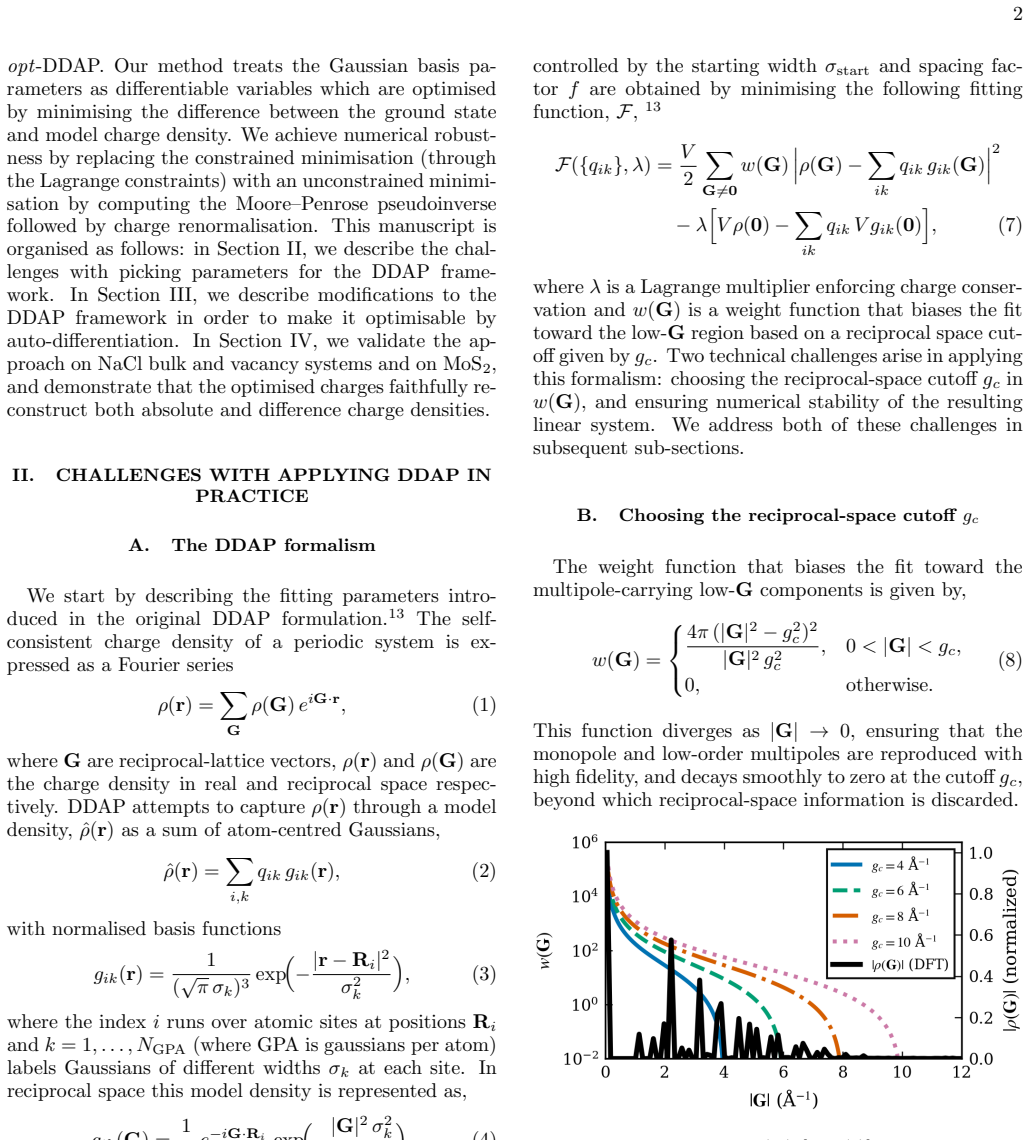
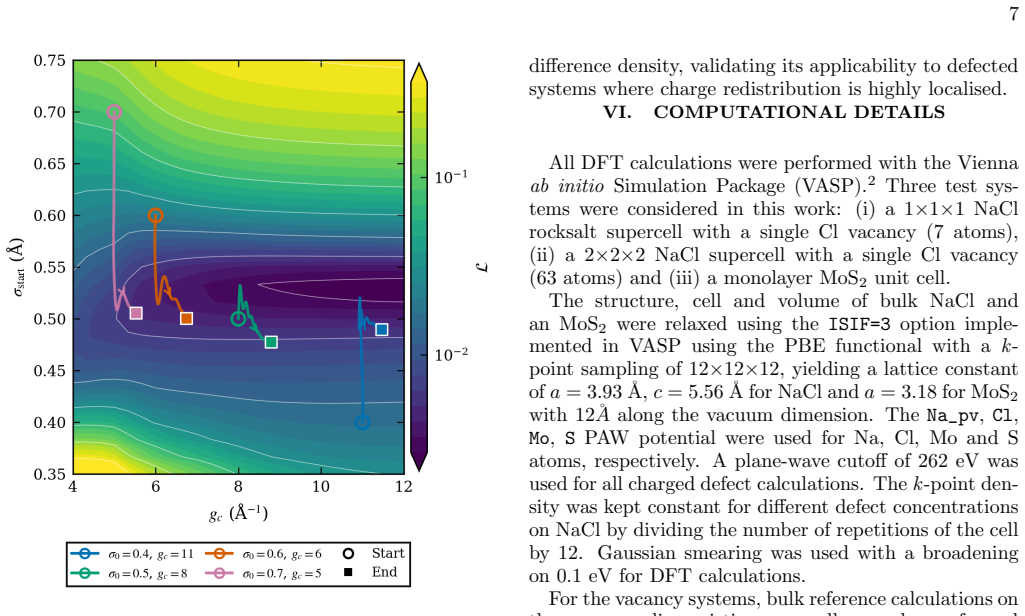
Furthermore, the Gaussian basis parameters, i.e., number of Gaussians per atom, their decay lengthsσ, and the reciprocal-space cut- offg c, are typically chosen heuristically and held fixed. Default values may not transfer across chemically distinct systems (ionic vs. covalent), different supercell sizes, or defected structures. In this work, we solve thi...
work page internal anchor Pith review Pith/arXiv arXiv 2026
-
[2]
Adam: A Method for Stochastic Optimization
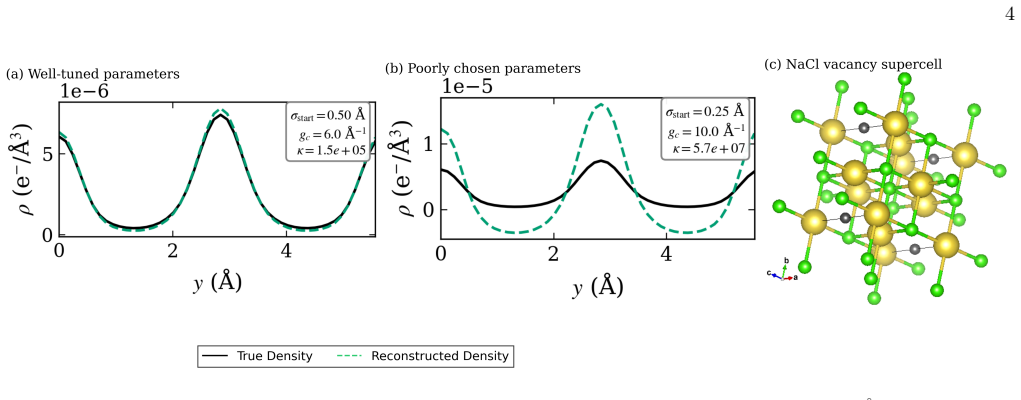
Gaussian smearing was used with a broadening on 0.1 eV for DFT calculations. For the vacancy systems, bulk reference calculations on the corresponding pristine supercell were also performed to construct the difference density ∆ρ=ρ defect −ρ bulk. The DDAP optimization usedN GPA = 3, with initial σstart = 0.5 ˚A,f= 1.25, andg c = 6.0 ˚A−1. Adam was run wit...
work page internal anchor Pith review Pith/arXiv arXiv doi:10.1038/s41524-025-01577-7 2025
-
[3]
Dense periodic solids violate this assumption
In that limit, even the widest Gaussian σmax =σ start ·f NGP A−1 contributes negligible electron density at neighbouring sites. Dense periodic solids violate this assumption. For the NaCl system, the nearest-neighbour Na–Cl distance isd≈2.77 ˚A. WithN GPA = 3 andσ start = 0.5 ˚A, Bl¨ ochl’s default gives σmax = 0.5×1.5 2 = 1.125 ˚A, which is∼40% of the bo...
work page 1995
discussion (0)
Sign in with ORCID, Apple, or X to comment. Anyone can read and Pith papers without signing in.