Noise-Induced Resurrection of Dynamical Skin Effects in Quasiperiodic Non-Hermitian Systems
Pith reviewed 2026-05-10 16:23 UTC · model grok-4.3
The pith
Noise maps non-Hermitian dynamics to a non-reciprocal master equation whose spectrum develops a point gap that restores the dynamical skin effect.
A machine-rendered reading of the paper's core claim, the machinery that carries it, and where it could break.
Core claim
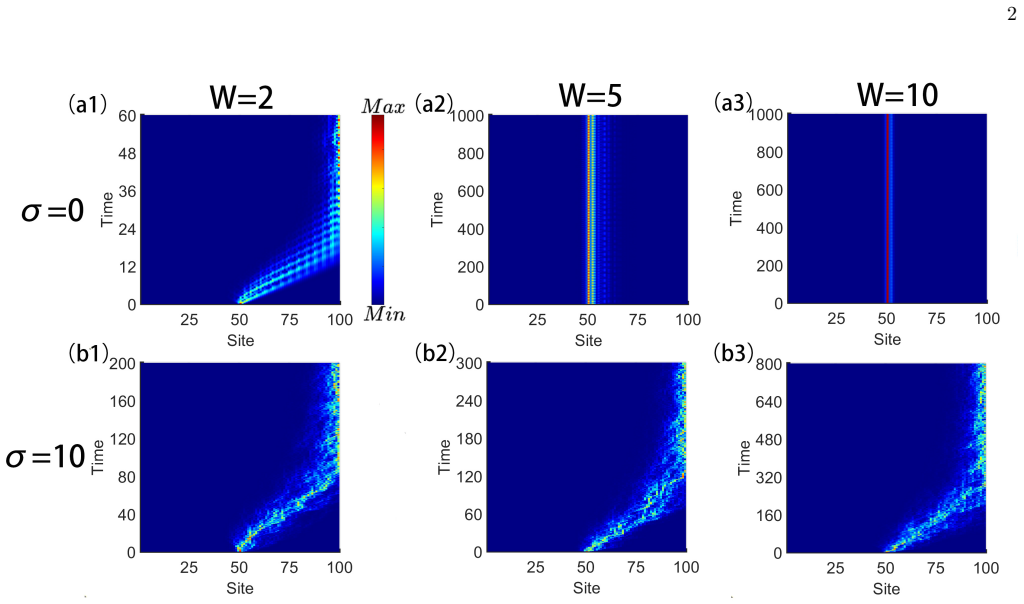
Using perturbative analysis, we demonstrate that noise effectively maps the non-Hermitian Schrödinger dynamics onto a non-reciprocal master equation, whose complex spectrum develops a noise-induced point gap. This mechanism enables delocalization, reinstates directional transport, and revives the DSE even in regimes where the static NHSE is absent. Moreover, the relaxation dynamics exhibit a non-monotonic dependence on noise strength, reflecting a competition between noise-assisted delocalization and noise-induced decoherence.
What carries the argument
Perturbative mapping of the non-Hermitian Schrödinger equation onto a non-reciprocal master equation that generates a noise-induced point gap in the complex spectrum.
If this is right
- Wave packets regain the ability to drift and accumulate at boundaries despite strong quasiperiodic localization.
- Directional transport is reinstated in parameter regimes that lack the static non-Hermitian skin effect.
- Relaxation dynamics become non-monotonic in noise amplitude because delocalization assistance competes with decoherence.
- Transport control becomes possible in quasiperiodic open systems by tuning noise strength alone.
Where Pith is reading between the lines
- The same noise-induced point-gap mechanism may operate in other non-Hermitian lattices once their effective master equations are derived.
- Experimental platforms could test resurrection by measuring boundary accumulation as a function of controlled noise intensity.
- If the mapping generalizes beyond perturbation theory, noise could serve as a generic tool for engineering skin-effect transport in disordered open systems.
Load-bearing premise
The perturbative treatment of the Ornstein-Uhlenbeck noise remains accurate at the strengths where the dynamical skin effect reappears, and higher-order corrections do not close the point gap or eliminate directional transport.
What would settle it
Numerical or experimental observation that the point gap in the effective master-equation spectrum closes or that net directional drift vanishes at intermediate noise strengths where the paper predicts resurrection would falsify the central claim.
Figures


read the original abstract
The non-Hermitian skin effect (NHSE) refers to the accumulation of an extensive number of eigenstates at system boundaries under open boundary conditions (OBCs). As a dynamical consequence, wave packets in such systems drift and ultimately accumulate at a boundary, giving rise to the dynamical skin effect (DSE). While strong quasiperiodic potentials are known to suppress the DSE by inducing localization, we show that the introduction of Ornstein-Uhlenbeck (OU) noise unexpectedly restores it. Using perturbative analysis, we demonstrate that noise effectively maps the non-Hermitian Schr\"{o}dinger dynamics onto a non-reciprocal master equation, whose complex spectrum develops a noise-induced point gap. This mechanism enables delocalization, reinstates directional transport, and revives the DSE even in regimes where the static NHSE is absent. Moreover, the relaxation dynamics exhibit a non-monotonic dependence on noise strength, reflecting a competition between noise-assisted delocalization and noise-induced decoherence. Our results uncover a noise-enabled mechanism for resurrecting the DSE and suggest a new route for controlling transport in quasiperiodic, open quantum systems.
Editorial analysis
A structured set of objections, weighed in public.
Referee Report
Summary. The paper claims that Ornstein-Uhlenbeck noise resurrects the dynamical skin effect (DSE) in quasiperiodic non-Hermitian systems where strong quasiperiodic potentials suppress the static non-Hermitian skin effect (NHSE). Using perturbative analysis, the non-Hermitian Schrödinger dynamics is mapped onto a non-reciprocal master equation whose complex spectrum acquires a noise-induced point gap; this gap is said to drive delocalization, restore directional transport, and revive the DSE. The relaxation dynamics are reported to depend non-monotonically on noise strength due to competition between noise-assisted delocalization and decoherence.
Significance. If the perturbative mapping and resulting point gap hold in the relevant regime, the result would identify a concrete noise-enabled mechanism for controlling localization and transport in open non-Hermitian systems, extending the understanding of dynamical skin effects beyond static Hamiltonians.
major comments (2)
- [Abstract and perturbative analysis] The central claim rests on a first-order perturbative mapping of the stochastic non-Hermitian Schrödinger equation to an effective non-reciprocal master equation (abstract and the section presenting the perturbative analysis). No radius of convergence, error estimate, or direct comparison of the perturbative Liouvillian spectrum against the exact stochastic unraveling is provided to establish that the noise-induced point gap survives at the intermediate noise strengths where DSE resurrection and non-monotonic relaxation are reported.
- [Numerical results on DSE revival] The reported revival of directional transport and delocalization is attributed to the point gap, yet the numerical demonstrations of wave-packet dynamics lack quantitative checks (e.g., spectral comparison or gap-size scaling) against the perturbative master equation at the noise values used.
minor comments (1)
- [Abstract] The abstract refers to 'perturbative analysis' without specifying the small parameter (noise amplitude or correlation time) or the order retained.
Simulated Author's Rebuttal
We thank the referee for the careful reading and constructive comments on our manuscript. We address each major comment below and have revised the manuscript accordingly to strengthen the validation of the perturbative mapping and its connection to the numerical results.
read point-by-point responses
-
Referee: [Abstract and perturbative analysis] The central claim rests on a first-order perturbative mapping of the stochastic non-Hermitian Schrödinger equation to an effective non-reciprocal master equation (abstract and the section presenting the perturbative analysis). No radius of convergence, error estimate, or direct comparison of the perturbative Liouvillian spectrum against the exact stochastic unraveling is provided to establish that the noise-induced point gap survives at the intermediate noise strengths where DSE resurrection and non-monotonic relaxation are reported.
Authors: We appreciate the referee's point regarding the need for validation of the perturbative mapping. The first-order expansion in noise strength is controlled by the finite correlation time of the Ornstein-Uhlenbeck process, which suppresses higher-order contributions in the relevant regime. While an analytic radius of convergence was not derived, we have now performed direct numerical comparisons in the revised manuscript: the spectrum of the effective non-reciprocal Liouvillian is compared against ensemble-averaged eigenvalues extracted from stochastic unravelings of the original Schrödinger equation. These comparisons show that the noise-induced point gap remains quantitatively accurate for the intermediate noise strengths at which DSE revival and non-monotonic relaxation are observed, thereby confirming the mapping's applicability. revision: yes
-
Referee: [Numerical results on DSE revival] The reported revival of directional transport and delocalization is attributed to the point gap, yet the numerical demonstrations of wave-packet dynamics lack quantitative checks (e.g., spectral comparison or gap-size scaling) against the perturbative master equation at the noise values used.
Authors: We agree that stronger quantitative linkage between the wave-packet numerics and the perturbative spectrum would improve the presentation. In the revised manuscript we have added (i) plots of the point-gap size versus noise strength extracted from both the effective master equation and the stochastic simulations, and (ii) direct comparisons of transport velocities and inverse participation ratios between the full stochastic dynamics and the predictions of the non-reciprocal master equation at the same noise values. These checks demonstrate that the observed directional transport and delocalization scale consistently with the gap size, supporting the attribution of DSE resurrection to the noise-induced point gap. revision: yes
Circularity Check
No circularity: perturbative mapping derives point gap independently
full rationale
The paper's central derivation uses perturbative analysis on Ornstein-Uhlenbeck noise to map the non-Hermitian Schrödinger equation to an effective non-reciprocal master equation, from which a noise-induced point gap in the Liouvillian spectrum is obtained. This gap then explains the resurrection of directional transport and DSE. No equations or claims in the abstract reduce the gap or DSE revival to a fitted parameter, self-defined quantity, or load-bearing self-citation; the result is presented as an output of the stochastic expansion rather than an input. The derivation chain remains self-contained against external benchmarks such as direct stochastic unraveling or exact diagonalization, with no evidence of the enumerated circularity patterns.
Axiom & Free-Parameter Ledger
axioms (1)
- domain assumption Perturbative analysis in noise strength is sufficient to capture the leading effect on the spectrum and transport
Forward citations
Cited by 1 Pith paper
-
Noise-Enhanced Self-Healing Dynamics in Non-Hermitian Systems
Stochastic noise constructively enhances edge self-healing in non-Hermitian systems: weak noise aligns finite-time Lyapunov exponents to prolong healing, while strong noise induces effective non-unitary drift-diffusio...
Reference graph
Works this paper leans on
-
[1]
E. J. Bergholtz, J. C. Budich, and F. K. Kunst, Ex- ceptional topology of non-hermitian systems, Rev. Mod. Phys.93, 015005 (2021)
work page 2021
-
[2]
Z. G. Yuto Ashida and M. Ueda, Non-hermitian physics, Adv. Phys.69, 249 (2020)
work page 2020
-
[3]
E. Persson, I. Rotter, H.-J. St¨ ockmann, and M. Barth, Observation of resonance trapping in an open microwave cavity, Phys. Rev. Lett.85, 2478 (2000)
work page 2000
-
[4]
A. Volya and V. Zelevinsky, Non-hermitian effective hamiltonian and continuum shell model, Phys. Rev. C 67, 054322 (2003)
work page 2003
-
[5]
Rotter, A non-hermitian hamilton operator and the physics of open quantum systems, J
I. Rotter, A non-hermitian hamilton operator and the physics of open quantum systems, J. Phys. A Math. Theor.42, 153001 (2009)
work page 2009
-
[6]
F. Reiter and A. S. Sørensen, Effective operator formal- ism for open quantum systems, Phys. Rev. A85, 032111 (2012)
work page 2012
-
[7]
I. Rotter and J. P. Bird, A review of progress in the physics of open quantum systems: theory and experi- ment, Rep. Prog. Phys.78, 114001 (2015)
work page 2015
- [8]
-
[9]
L. Feng, R. El-Ganainy, and L. Ge, Non-hermitian pho- tonics based on parity–time symmetry, Nat. Photon.11, 752 (2017)
work page 2017
-
[10]
M.-A. M. G. O. D. N. C. A. Regensburger, C. Bersch and U. Peschel, Parity–time synthetic photonic lattices, Nature488, 167 (2012)
work page 2012
-
[11]
L. Feng, Z. J. Wong, R.-M. Ma, Y. Wang, and X. Zhang, Single-mode laser by parity-time symmetry breaking, Sci- ence346, 972 (2014)
work page 2014
-
[12]
B. Zhen, C. W. Hsu, Y. Igarashi, L. Lu, I. Kaminer, A. Pick, S. L. Chua, J. D. Joannopoulos, and M. Soljai, Spawning rings of exceptional points out of dirac cones, 7 Nature525, 354 (2015)
work page 2015
-
[13]
H. Zhou, C. Peng, Y. Yoon, C. W. Hsu, K. A. Nelson, L. Fu, J. D. Joannopoulos, M. Soljaˇ ci´ c, and B. Zhen, Observation of bulk fermi arc and polarization half charge from paired exceptional points, Science359, 1009 (2018)
work page 2018
-
[14]
M. A. Bandres, S. Wittek, G. Harari, M. Parto, J. Ren, M. Segev, D. N. Christodoulides, and M. Khajavikhan, Topological insulator laser: Experiments, Science359, eaar4005 (2018)
work page 2018
- [15]
-
[16]
K. Wang, T. Li, L. Xiao, Y. Han, W. Yi, and P. Xue, Detecting non-bloch topological invariants in quantum dynamics, Phys. Rev. Lett.127, 270602 (2021)
work page 2021
-
[17]
K. Ding, G. Ma, M. Xiao, Z. Q. Zhang, and C. T. Chan, Emergence, coalescence, and topological properties of multiple exceptional points and their experimental re- alization, Phys. Rev. X6, 021007 (2016)
work page 2016
-
[18]
W. Tang, X. Jiang, K. Ding, Y.-X. Xiao, Z.-Q. Zhang, C. T. Chan, and G. Ma, Exceptional nexus with a hybrid topological invariant, Science370, 1077 (2020)
work page 2020
-
[19]
K. Ding, G. Ma, Z. Q. Zhang, and C. T. Chan, Ex- perimental demonstration of an anisotropic exceptional point, Phys. Rev. Lett.121, 085702 (2018)
work page 2018
-
[20]
W. Tang, K. Ding, and G. Ma, Direct measurement of topological properties of an exceptional parabola, Phys. Rev. Lett.127, 034301 (2021)
work page 2021
-
[21]
Y. Aur´ egan and V. Pagneux,PT-symmetric scattering in flow duct acoustics, Phys. Rev. Lett.118, 174301 (2017)
work page 2017
-
[22]
S. Puri, J. Ferdous, A. Shakeri, A. Basiri, M. Dubois, and H. Ramezani, Tunable non-hermitian acoustic filter, Phys. Rev. Appl.16, 014012 (2021)
work page 2021
- [23]
-
[24]
D. Zou, T. Chen, W. He, J. Bao, and X. Zhang, Ob- servation of hybrid higher-order skin-topological effect in non-hermitian topolectrical circuits, Nat. Commun.12, 7201 (2021)
work page 2021
- [25]
-
[26]
H. Yuan, W. Zhang, Z. Zhou, W. Wang, N. Pan, Y. Feng, H. Sun, and X. Zhang, Non-hermitian topolectrical cir- cuit sensor with high sensitivity, Adv. Sci.10, 2301128 (2023)
work page 2023
- [27]
- [28]
- [29]
-
[30]
Longhi, Self-healing of non-hermitian topological skin modes, Phys
S. Longhi, Self-healing of non-hermitian topological skin modes, Phys. Rev. Lett.128, 157601 (2022)
work page 2022
- [31]
-
[32]
H. P. L¨ uschen, S. Scherg, T. Kohlert, M. Schreiber, P. Bordia, X. Li, S. Das Sarma, and I. Bloch, Single- particle mobility edge in a one-dimensional quasiperiodic optical lattice, Phys. Rev. Lett.120, 160404 (2018)
work page 2018
- [33]
-
[34]
Y. E. Kraus, Y. Lahini, Z. Ringel, M. Verbin, and O. Zil- berberg, Topological states and adiabatic pumping in quasicrystals, Phys. Rev. Lett.109, 106402 (2012)
work page 2012
-
[35]
P. Wang, Y. Zheng, X. Chen, C. Huang, Y. V. Kartashov, L. Torner, V. V. Konotop, and F. Ye, Localization and delocalization of light in photonic moire lattices, Nature 577, 42 (2020)
work page 2020
-
[36]
X. Ni, K. Chen, M. Weiner, D. J. Apigo, C. Prodan, A. Al` u, E. Prodan, and A. B. Khanikaev, Observation of hofstadter butterfly and topological edge states in re- configurable quasi-periodic acoustic crystals, Commun. Phys.2, 55 (2019)
work page 2019
-
[37]
Kohmoto, Metal-insulator transition and scaling for incommensurate systems, Phys
M. Kohmoto, Metal-insulator transition and scaling for incommensurate systems, Phys. Rev. Lett.51, 1198 (1983)
work page 1983
-
[38]
D. J. Thouless, Bandwidths for a quasiperiodic tight- binding model, Phys. Rev. B28, 4272 (1983)
work page 1983
- [39]
- [40]
- [41]
-
[42]
I. Guarneri and G. Mantica, Multifractal energy spectra and their dynamical implications, Phys. Rev. Lett.73, 3379 (1994)
work page 1994
-
[43]
Pi´ echon, Anomalous diffusion properties of wave pack- ets on quasiperiodic chains, Phys
F. Pi´ echon, Anomalous diffusion properties of wave pack- ets on quasiperiodic chains, Phys. Rev. Lett.76, 4372 (1996)
work page 1996
-
[44]
M. Wilkinson and E. J. Austin, Spectral dimension and dynamics for harper’s equation, Phys. Rev. B50, 1420 (1994)
work page 1994
-
[45]
F. A. B. F. de Moura and M. L. Lyra, Delocalization in the 1d anderson model with long-range correlated disor- der, Phys. Rev. Lett.81, 3735 (1998)
work page 1998
-
[46]
Longhi, Phase transitions in a non-hermitian aubry- andr´ e-harper model, Phys
S. Longhi, Phase transitions in a non-hermitian aubry- andr´ e-harper model, Phys. Rev. B103, 054203 (2021)
work page 2021
-
[47]
S. Gopalakrishnan, K. R. Islam, and M. Knap, Noise- induced subdiffusion in strongly localized quantum sys- tems, Phys. Rev. Lett.119, 046601 (2017)
work page 2017
-
[48]
See Supplemental Material athttp://link.aps.org/ supplemental/xxxfor comprehensive details, including a pedagogical introduction to the Ornstein-Uhlenbeck pro- cess, full perturbative derivations of the effective master equations, and continuous-limit dynamic scaling analysis. Crucially, the SM provides extensive quantitative evalua- tions of the relaxati...
-
[49]
Y. Liu, Q. Zhou, and S. Chen, Localization transi- tion, spectrum structure, and winding numbers for one- dimensional non-hermitian quasicrystals, Phys. Rev. B 104, 024201 (2021)
work page 2021
-
[50]
S. Longhi, D. Gatti, and G. Della Valle, Robust light transport in non-hermitian photonic lattices, Sci. Rep. 5, 10.1038/srep13376 (2015). 8
-
[51]
L. Jin, P. Wang, and Z. Song, One-way light transport controlled by synthetic magnetic fluxes and -symmetric resonators, New J. Phys.19, 015010 (2017)
work page 2017
-
[52]
Notably, in the regime of strong quasiperiodicity with relatively weak noise (e.g.,W= 10 andσ= 2), Σ(t) exhibits subdiffusive scaling behavior. Simultaneously, ∆X(t) is characterized by a scaling exponent slightly smaller than that of the standard linear drift regime, i.e., ∆X(t)∼t α withα≲1
- [53]
- [54]
-
[55]
B. Raftari, N. V. Budko, and C. Vuik, Self-consistent drift-diffusion-reaction model for the electron beam in- teraction with dielectric samples, J. Appl. Phys.118, 204101 (2015)
work page 2015
-
[56]
P. A. Markowich, C. A. Ringhofer, and C. Schmeiser, Semiconductor equations(Springer Science & Business Media, 2012)
work page 2012
-
[57]
C. Z. T. J. Z. W. Z. W. Shuqiao Li, Linyuan Dou and X. Cheng, Hybrid skin-topological-anderson effect in sys- tems with gain and loss, Communications Physics8, https://doi.org/10.1038/s42005-025-02327-3 (2025)
-
[58]
A. Shi, L. Bao, P. Peng, J. Ning, Z. Wang, and J. Liu, Non-hermitian floquet higher-order topological states in two-dimensional quasicrystals, Phys. Rev. B111, 094109 (2025)
work page 2025
-
[59]
D. N. Maksimov and A. A. Bogdanov, Quantum noise suppression in non-hermitian resonators at an excep- tional point, Phys. Rev. B112, L041302 (2025)
work page 2025
-
[60]
P. Martinez-Azcona, A. Kundu, A. Saxena, A. del Campo, and A. Chenu, Quantum dynamics with stochas- tic non-hermitian hamiltonians, Phys. Rev. Lett.135, 010402 (2025)
work page 2025
-
[61]
Longhi, Erratic non-hermitian skin localization, Phys
S. Longhi, Erratic non-hermitian skin localization, Phys. Rev. Lett.134, 196302 (2025)
work page 2025
-
[62]
N. Hatano and D. R. Nelson, Vortex pinning and non- hermitian quantum mechanics, Phys. Rev. B56, 8651 (1997)
work page 1997
-
[63]
N. Hatano and D. R. Nelson, Localization transitions in non-hermitian quantum mechanics, Phys. Rev. Lett.77, 570 (1996)
work page 1996
- [66]
-
[68]
S. Weidemann, M. Kremer, S. Longhi, and A. Szameit, Coexistence of dynamical delocalization and spectral lo- calization through stochastic dissipation, Nature Photon- ics15, 576 (2021). Supplementary Material for ”Noise-Induced Resurrection of Dynamical Skin Effects in Quasiperiodic Non-Hermitian Systems” Wuping Yang1 and H. Huang 1, 2, 3,∗ 1School of Phy...
work page 2021
-
[69]
N. Hatano and D. R. Nelson, Vortex pinning and non-hermitian quantum mechanics, Phys. Rev. B56, 8651 (1997)
work page 1997
-
[70]
N. Hatano and D. R. Nelson, Localization transitions in non-hermitian quantum mechanics, Phys. Rev. Lett.77, 570 (1996). 18 Figure S8. (a1) (a2) The first-order non-Hermitian Bott index for the model (S88) under differentW. (b1) (b2) Energy spectra under OBC (colored dots) and PBC (black dots) for variousW. The color scale representsw (2) CW(Ea) of the ei...
work page 1996
-
[71]
A. Amir, Y. Lahini, and H. B. Perets, Classical diffusion of a quantum particle in a noisy environment, Phys. Rev. E79, 050105 (2009)
work page 2009
-
[72]
The sum of two independent Gaussian random variables also follows a Gaussian distribution
-
[73]
W. Yang and H. Huang, Unified multipole bott indices for non-hermitian skin effect in different orders, Phys. Rev. B111, 155121 (2025)
work page 2025
-
[74]
To be precise, the L´ evy noise at each site is generated from the distributionξ∼S(1.5,0,10,0)
-
[75]
J. M. Chambers, C. L. Mallows, and B. Stuck, A method for simulating stable random variables, Journal of the american statistical association71, 340 (1976)
work page 1976
-
[76]
P. Pogorzelec and B. Dybiec, Resetting induced multimodality, Chaos: An Interdisciplinary Journal of Nonlinear Science 33(2023)
work page 2023
- [77]
-
[78]
B. Li, C. Chen, and Z. Wang, Universal non-hermitian transport in disordered systems, Phys. Rev. Lett.135, 033802 (2025)
work page 2025
-
[79]
S. Weidemann, M. Kremer, S. Longhi, and A. Szameit, Coexistence of dynamical delocalization and spectral localization through stochastic dissipation, Nature Photonics15, 576 (2021)
work page 2021
discussion (0)
Sign in with ORCID, Apple, or X to comment. Anyone can read and Pith papers without signing in.