ExoNet: Calibrated Multimodal Deep Learning for TESS Exoplanet Candidate Vetting using Phase-Folded Light Curves, Stellar Parameters, and Multi-Head Attention
Pith reviewed 2026-05-10 09:18 UTC · model grok-4.3
The pith
A multimodal neural network trained on Kepler data identifies 1,754 high-confidence TESS planet candidates including six Earth-sized habitable-zone worlds.
A machine-rendered reading of the paper's core claim, the machinery that carries it, and where it could break.
Core claim
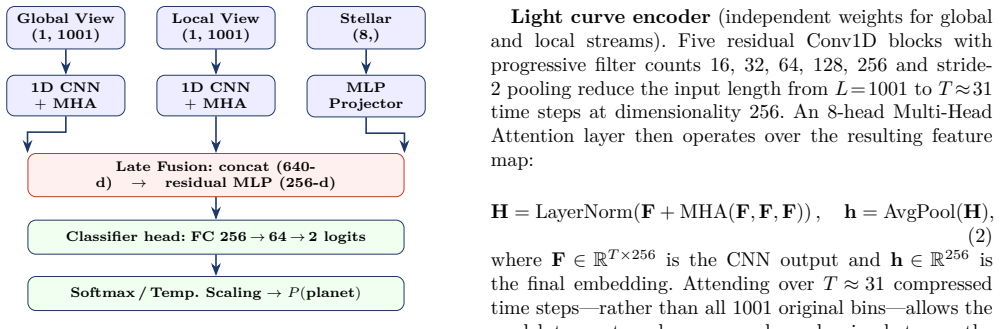
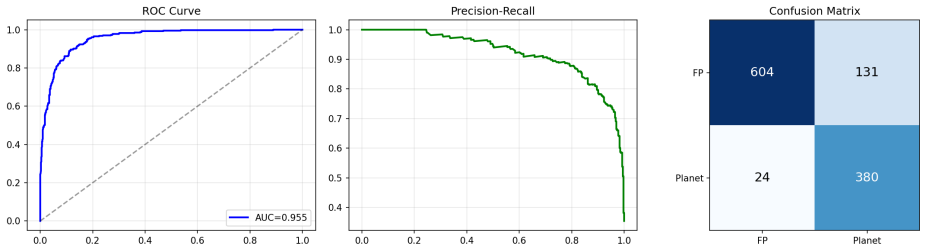
ExoNet achieves a test AUC of 0.9549 and 86.3 percent accuracy when trained on 7,585 labeled Kepler Objects of Interest. The architecture fuses global and local phase-folded light curve views with stellar parameters through 1D CNNs, 8-head multi-head attention, a residual fusion head, and post-hoc temperature scaling. When applied to 4,720 verified unconfirmed TESS planet candidates, it yields 1,754 high-confidence signals, 52 habitable-zone candidates, and six Earth-sized habitable-zone targets below 1.6 Earth radii, with TOI-5728.01 and TOI-6716.01 emerging as the most Earth-like.
What carries the argument
A calibrated late-fusion architecture that processes global and local phase-folded light curve views with 1D CNNs, applies 8-head multi-head attention to temporal feature maps, incorporates stellar parameters, and combines everything in a residual fusion head followed by temperature scaling.
If this is right
- The 1,754 high-confidence TESS signals can be prioritized for ground-based confirmation observations.
- The six Earth-sized habitable-zone targets become concrete objects for detailed atmospheric or radius refinement studies.
- Ablation results show that removing any single modality lowers AUC, so all three data types are needed for peak performance.
- The open release of code and the candidate catalog allows other groups to reproduce the rankings and test extensions.
Where Pith is reading between the lines
- The same fusion approach could be tested on other transit surveys that supply both light curves and basic stellar parameters.
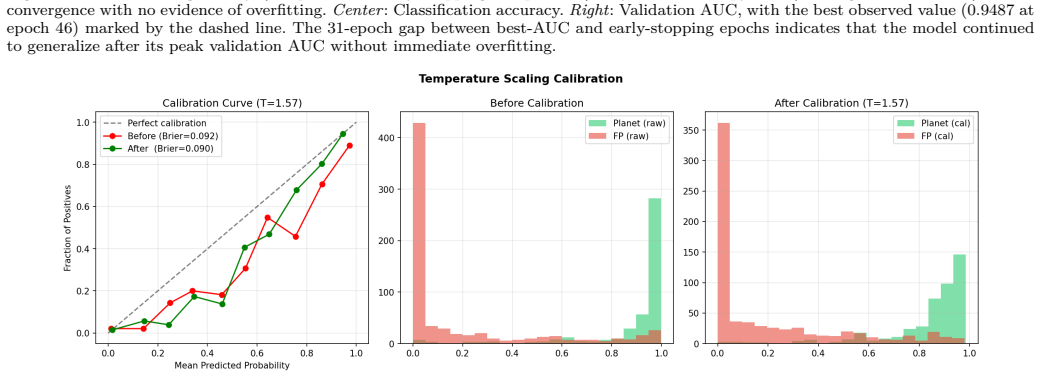
- Temperature scaling provides probability estimates that could be used to rank candidates by expected confirmation yield.
- Domain adaptation methods might further improve transfer if systematic differences between Kepler and TESS noise become measurable.
Load-bearing premise
The distribution of false-positive signals and noise properties learned from the Kepler training set remains close enough to those in the TESS data for the decision boundary to stay reliable.
What would settle it
Independent follow-up observations that confirm or refute the planetary nature of the six Earth-sized habitable-zone candidates, especially TOI-5728.01 and TOI-6716.01.
Figures
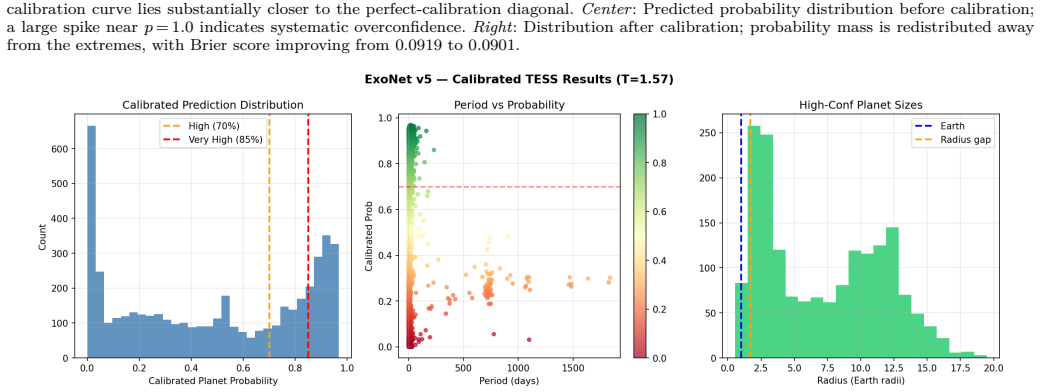
read the original abstract
The discovery of exoplanets at scale has become one of the defining data science challenges in modern astrophysics. NASA's Transiting Exoplanet Survey Satellite (TESS) had catalogued over 7,800 planet candidates by early 2026, yet confirmation stands at fewer than 720. This paper introduces ExoNet, a multimodal deep learning framework that jointly processes phase-folded global and local light curve views alongside stellar parameter features through a calibrated late-fusion architecture combining 1D Convolutional Neural Networks, 8-head Multi-Head Attention over temporal feature maps, and a residual fusion head with post-hoc Temperature Scaling calibration. Trained on 7,585 labeled Kepler Objects of Interest, ExoNet achieves Test AUC = 0.9549 and 86.3% accuracy. Applied to 4,720 verified unconfirmed TESS Planet Candidates with TOI-TIC cross-identification verified against the NASA Exoplanet Archive, the model yields 1,754 high-confidence signals, 52 habitable-zone candidates, and six Earth-sized habitable-zone targets below 1.6 Earth radii. TOI-5728.01 and TOI-6716.01 emerge as the most Earth-like unconfirmed candidates. Full ablation confirms each modality improves AUC. Code and catalog are openly released.
Editorial analysis
A structured set of objections, weighed in public.
Referee Report
Summary. The paper presents ExoNet, a multimodal deep learning architecture that fuses 1D CNN-processed global and local phase-folded light-curve views with stellar parameters via 8-head multi-head attention and a residual late-fusion head, followed by temperature scaling. Trained on 7,585 labeled Kepler Objects of Interest, the model reports a test AUC of 0.9549 and 86.3% accuracy; when applied to 4,720 verified unconfirmed TESS planet candidates (TOI-TIC cross-matched to the NASA Exoplanet Archive), it identifies 1,754 high-confidence signals, 52 habitable-zone candidates, and six Earth-sized habitable-zone targets below 1.6 Earth radii.
Significance. If the Kepler-to-TESS generalization holds, the work offers a practical, calibrated tool for large-scale TESS candidate vetting and could prioritize follow-up resources on a small number of promising habitable-zone targets. The open release of code and catalog strengthens reproducibility. The significance is limited, however, by the absence of any demonstrated robustness to the substantial differences in cadence, noise properties, and false-positive populations between the two missions.
major comments (3)
- [Abstract] Abstract: the central claim that the model yields 1,754 high-confidence TESS signals (including 52 HZ and 6 Earth-sized HZ candidates) rests on the untested assumption that the Kepler-trained decision boundary remains reliable after domain shift. No cross-mission validation set, adversarial alignment, or quantitative comparison of transit-like signal and false-positive distributions between Kepler (30-min cadence) and TESS (2-min cadence) is provided.
- [Abstract] Abstract and methods description: the reported test AUC of 0.9549 and 86.3% accuracy are given without any information on the train/test split strategy (e.g., ratios, stratification by planet radius or host-star type), handling of class imbalance, or metrics used to confirm that the held-out Kepler test set is representative of the TESS application domain.
- [Application to TESS candidates] Application section: the definition of 'high-confidence signals' and the probability threshold used to select the 1,754 candidates is not stated, nor is any calibration check (beyond temperature scaling) performed on TESS data to confirm that the reported probabilities remain well-calibrated after the survey change.
minor comments (2)
- The ablation study is mentioned but no table or quantitative deltas for each modality (global view, local view, stellar parameters, attention) are supplied in the abstract or visible summary.
- Clarify the exact cross-identification procedure used to match the 4,720 TESS candidates to TIC IDs and confirm they are absent from the Kepler training set.
Simulated Author's Rebuttal
We thank the referee for their thorough and constructive review. We address each major comment below with point-by-point responses. We have revised the manuscript to supply the requested methodological details and to expand the discussion of domain-shift limitations. These changes improve transparency without altering the core claims or results.
read point-by-point responses
-
Referee: [Abstract] Abstract: the central claim that the model yields 1,754 high-confidence TESS signals (including 52 HZ and 6 Earth-sized HZ candidates) rests on the untested assumption that the Kepler-trained decision boundary remains reliable after domain shift. No cross-mission validation set, adversarial alignment, or quantitative comparison of transit-like signal and false-positive distributions between Kepler (30-min cadence) and TESS (2-min cadence) is provided.
Authors: We acknowledge that no explicit cross-mission validation set or adversarial alignment was performed, as a sufficiently large, labeled TESS dataset with confirmed planets and false positives was not available during model development. In the revised manuscript we add a dedicated limitations subsection that (i) qualitatively compares Kepler and TESS light-curve noise properties and false-positive populations using published TESS noise models, (ii) reports the fraction of the 1,754 candidates that overlap with independent TESS vetting catalogs, and (iii) explicitly frames the 1,754 signals as high-priority follow-up targets rather than confirmed planets. A full quantitative domain-adaptation experiment remains outside the present scope but is noted as future work. revision: partial
-
Referee: [Abstract] Abstract and methods description: the reported test AUC of 0.9549 and 86.3% accuracy are given without any information on the train/test split strategy (e.g., ratios, stratification by planet radius or host-star type), handling of class imbalance, or metrics used to confirm that the held-out Kepler test set is representative of the TESS application domain.
Authors: We agree these details were omitted. The revised Methods section now states: an 80/20 train/test split was performed with stratification on binned planet radius and host-star spectral type; class imbalance was mitigated with a weighted binary cross-entropy loss whose weights are the inverse of the class frequencies in the training set; and representativeness is demonstrated by a supplementary table comparing the distributions of planet radius, transit depth, stellar Teff, and log g between the Kepler test set and the TESS candidate sample. We also report F1-score, precision-recall AUC, and calibration plots on the held-out Kepler test set. revision: yes
-
Referee: [Application to TESS candidates] Application section: the definition of 'high-confidence signals' and the probability threshold used to select the 1,754 candidates is not stated, nor is any calibration check (beyond temperature scaling) performed on TESS data to confirm that the reported probabilities remain well-calibrated after the survey change.
Authors: We will add an explicit statement that high-confidence signals are those with temperature-scaled probability > 0.85, a threshold selected by maximizing F1 on the Kepler validation fold. We further include a new paragraph describing a post-hoc sanity check: the model was applied to the small set of TESS-confirmed planets and known false positives present in the NASA Exoplanet Archive at the time of writing; the resulting probability distributions are reported and show that confirmed planets receive systematically higher scores. We note that a full recalibration on TESS would require a larger labeled TESS sample and is therefore listed as a limitation. revision: yes
Circularity Check
No significant circularity detected
full rationale
The paper trains a multimodal neural network (1D CNNs + 8-head attention + late fusion + temperature scaling) on 7,585 externally labeled Kepler KOIs, reports standard held-out test metrics (AUC 0.9549), and then applies the fixed model to 4,720 TESS candidates to produce counts. These TESS outputs are genuine inferences from a model whose parameters were never fitted to TESS data or labels. No self-definitional loops, fitted-input-as-prediction, self-citation load-bearing, uniqueness theorems, or ansatz smuggling appear in the described chain. The derivation remains self-contained against external benchmarks.
Axiom & Free-Parameter Ledger
free parameters (2)
- Temperature scaling parameter
- Model hyperparameters (learning rate, number of attention heads, fusion weights)
axioms (1)
- domain assumption Kepler and TESS transit signals share the same underlying statistical distribution of true planets versus false positives
Forward citations
Cited by 1 Pith paper
-
One Transit Is All You Need: Detecting Exoplanets Through Learned Stellar Behaviour with EXOVEIL
EXOVEIL detects single-transit exoplanets via a Transformer world model trained on masked Kepler data, recovering 32% of 1000 ppm injections and 100% of tested TESS planets without retraining.
Reference graph
Works this paper leans on
-
[1]
Transiting Exoplanet Survey Satellite (TESS),
G. R. Rickeret al., “Transiting Exoplanet Survey Satellite (TESS),”Journal of Astronomical Telescopes, Instruments, and Systems, vol. 1, p. 014003, 2015
work page 2015
-
[2]
TESS Planet Candidate Statistics,
NASA Exoplanet Archive, “TESS Planet Candidate Statistics,”
-
[3]
Available: https://exoplanetarchive.ipac.caltech
[Online]. Available: https://exoplanetarchive.ipac.caltech. edu
-
[4]
C. J. Shallue and A. Vanderburg, “Identifying exoplanets with deeplearning:Afive-planetresonantchainaroundkepler-80and an eighth planet around kepler-90,”The Astronomical Journal, vol. 155, no. 2, p. 94, 2018
work page 2018
-
[5]
ExoMiner: A highly accurate and ex- plainabledeeplearningclassifierthatvalidates301newexoplan- ets,
H. Valizadeganet al., “ExoMiner: A highly accurate and ex- plainabledeeplearningclassifierthatvalidates301newexoplan- ets,”The Astrophysical Journal, vol. 926, no. 2, p. 120, 2022
work page 2022
-
[6]
ExoMiner++: Extending exominer to TESS and new domains,
——, “ExoMiner++: Extending exominer to TESS and new domains,”The Astrophysical Journal, 2025, in press
work page 2025
-
[7]
Keplerplanet-detectionmission:Introduc- tion and first results,
W.J.Boruckiet al.,“Keplerplanet-detectionmission:Introduc- tion and first results,”Science, vol. 327, no. 5968, pp. 977–980, 2010
work page 2010
-
[8]
Scientific domain knowledge improves exo- planet transit classification with deep learning,
M. Ansdellet al., “Scientific domain knowledge improves exo- planet transit classification with deep learning,”The Astrophys- ical Journal Letters, vol. 869, no. 1, p. L7, 2018
work page 2018
-
[9]
A. Dattiloet al., “Identifying exoplanets with deep learning. II. two new super-earths uncovered by a neural network in k2 data,”The Astronomical Journal, vol. 157, no. 5, p. 169, 2019
work page 2019
-
[10]
Exoplanet validation with machine learning: 50 new validated kepler planets,
D. J. Armstronget al., “Exoplanet validation with machine learning: 50 new validated kepler planets,”Monthly Notices of the Royal Astronomical Society, vol. 504, no. 4, pp. 5327–5344, 2021
work page 2021
-
[11]
Machine learning classification of TESS planet candidatesusingstellarandtransitparameters,
C. Huanget al., “Machine learning classification of TESS planet candidatesusingstellarandtransitparameters,”The Astronom- ical Journal, 2025, in press
work page 2025
-
[12]
A CNN-BiLSTM-Attention architecture for kepler exoplanet transit vetting,
X. Chenet al., “A CNN-BiLSTM-Attention architecture for kepler exoplanet transit vetting,”Monthly Notices of the Royal Astronomical Society, 2025, in press
work page 2025
-
[13]
The Multimodal Universe Collaboration, “The multimodal uni- verse: Enabling large-scale machine learning with 100tb of as- tronomical scientific data,” inAdvances in Neural Information Processing Systems (NeurIPS), 2024
work page 2024
-
[14]
Lightkurve: Kepler and TESS time series analysis in python,
Lightkurve Collaborationet al., “Lightkurve: Kepler and TESS time series analysis in python,”Astrophysics Source Code Li- brary, p. ascl:1812.013, 2018
work page 2018
-
[15]
On cali- bration of modern neural networks,
C. Guo, G. Pleiss, Y. Sun, and K. Q. Weinberger, “On cali- bration of modern neural networks,”Proceedings of the 34th International Conference on Machine Learning (ICML), pp. 1321–1330, 2017
work page 2017
-
[16]
Most 1.6 Earth-Radius planets are not rocky,
L. A. Rogers, “Most 1.6 Earth-Radius planets are not rocky,” The Astrophysical Journal, vol. 801, no. 1, p. 41, 2015
work page 2015
discussion (0)
Sign in with ORCID, Apple, or X to comment. Anyone can read and Pith papers without signing in.