REVIEW 1 major objections 3 minor 1 cited by
The millihertz X-ray QPO in 1ES 1927+654 has plateaued at a constant frequency of 2.5 mHz.
Reviewed by Pith at T0; open to challenge. T0 means a machine referee read the full paper against a public rubric. the ladder, T0–T4 →
T0 review · grok-4.3
2026-05-10 07:02 UTC
load-bearing objection New 1.5-year monitoring shows the mHz QPO in 1ES 1927+654 has plateaued at ~2.5 mHz with stable lags and flux pattern, plus the first NuSTAR AGN QPO detection. the 1 major comments →
Persistence of the Millihertz X-ray Quasi-Periodic Oscillation in the Active Galactic Nucleus 1ES 1927+654
The pith
A machine-rendered reading of the paper's core claim, the machinery that carries it, and where it could break.
Core claim
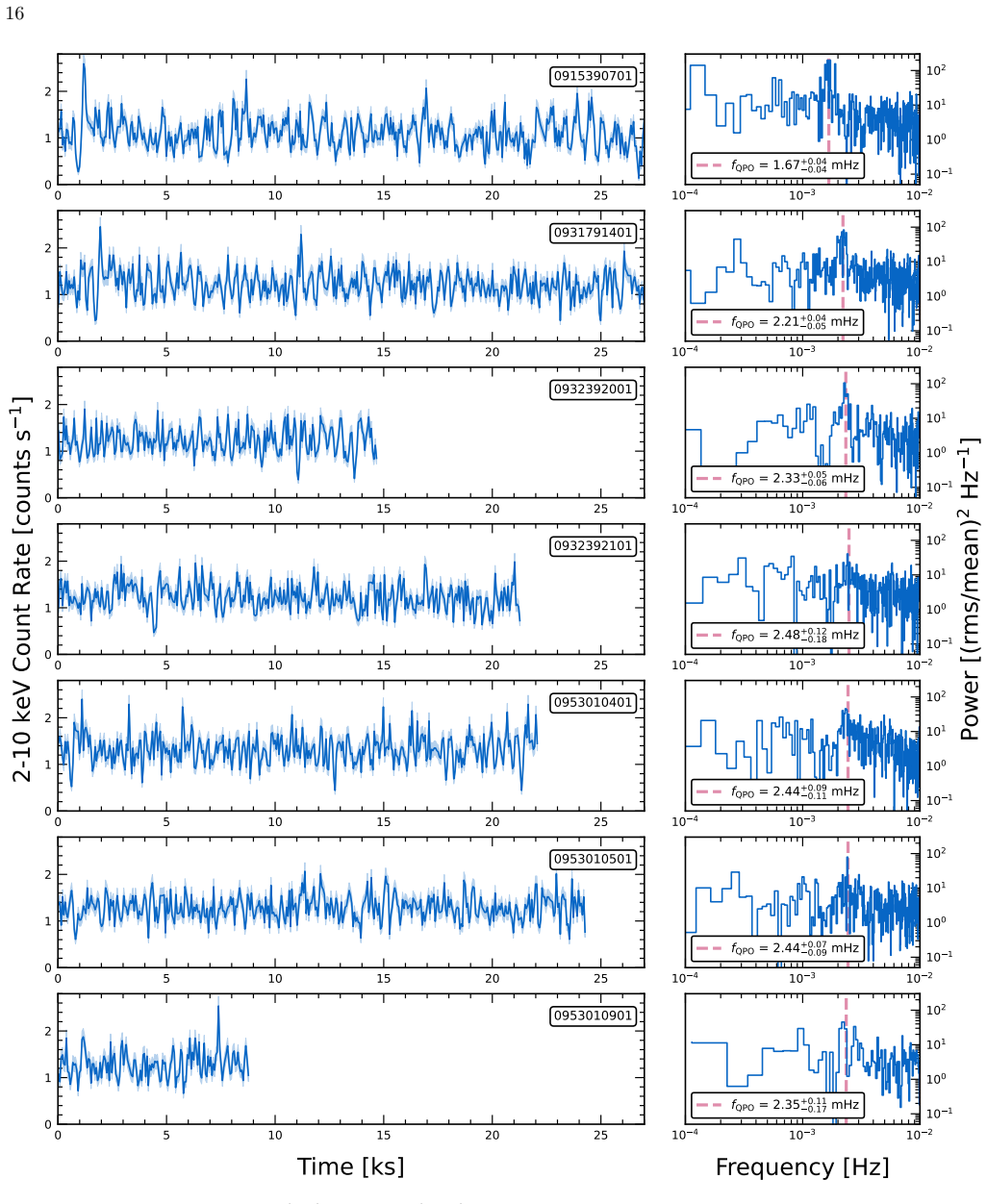
In 1ES 1927+654 the X-ray QPO persists with its frequency now fixed near 2.5 mHz. The stacked power spectra lack a significant second harmonic. A soft lag is present at all frequencies and stays stable while the QPO frequency changed earlier. Extreme X-ray jumps reaching 80 percent of baseline flux continue with a fixed dip-rise-fall pattern. The QPO is detected for the first time in NuSTAR data at frequencies matching the XMM-Newton results.
What carries the argument
Stacked XMM-Newton power spectra combined with spectral-timing analysis of the QPO signal across epochs, which isolate the frequency plateau, absence of harmonics, and stability of the lag and flux pattern.
Load-bearing premise
The periodic signals seen in XMM-Newton and NuSTAR data across years represent continuation of the same physical QPO rather than separate or coincidental variability.
What would settle it
A future observation in which the QPO frequency shifts away from 2.5 mHz or the periodic signal disappears would show that the plateau is temporary.
Editorial analysis
A structured set of objections, weighed in public.
Referee Report
Summary. The manuscript reports continued monitoring of the millihertz X-ray QPO in the AGN 1ES 1927+654. After frequency evolution from 0.9-2.4 mHz (2022-2024), the QPO has persisted and plateaued at ~2.5 mHz over the subsequent 1.5 years. This is based on 250 ks XMM-Newton data (>900 cycles) plus NuSTAR observations, with stacked power spectra showing no significant second harmonic, a stable soft reverberation-like lag at all frequencies, persistent extreme (~80% baseline) dip-rise-fall flux jumps on the QPO period, and the first NuSTAR detection of an AGN QPO at consistent frequencies. Models for eclipses or coupled disk-corona behavior are explored but described as strained by the new observations.
Significance. If the observational results hold, this constitutes the longest temporal baseline and highest cycle count (>900) for any AGN QPO, providing a unique dataset for testing QPO mechanisms. Strengths include the large exposure, consistent multi-instrument detection across XMM-Newton and NuSTAR, explicit statements on the absence of a second harmonic, and the remarkable stability of the soft lag even through prior frequency evolution. These features offer direct constraints on accretion flow models and reverberation in AGN, with the plateau and persistent pattern challenging simple evolutionary or eclipse scenarios.
major comments (1)
- The central claim of persistence and a true frequency plateau at 2.5 mHz rests on cross-epoch identification of the signal as the continuation of the 2022-2024 feature. While frequencies are consistent and the lag/pattern stability provides supporting evidence, the manuscript would benefit from an explicit statistical test (e.g., a stationarity analysis or drift-rate upper limit with uncertainties) in the power-spectrum section to rule out the possibility of unrelated variability near 2.5 mHz or an undetected slow residual evolution.
minor comments (3)
- The abstract and results sections state the QPO 'persists but has plateaued'; a dedicated paragraph summarizing the frequency measurements and their uncertainties for each epoch (2022-2024 vs. 2024-2026) would improve clarity on the plateau claim.
- Figure captions and the NuSTAR detection section should explicitly note the energy bands used for the power spectra and lag analysis to allow direct comparison with prior XMM-Newton results.
- The model exploration (eclipses and disk-corona coupling) is presented as strained; adding a short table comparing predicted vs. observed lag amplitudes or harmonic content would make this assessment more quantitative without altering the observational focus.
Simulated Author's Rebuttal
We thank the referee for their positive assessment of the manuscript and for the constructive suggestion. We address the major comment below.
read point-by-point responses
-
Referee: The central claim of persistence and a true frequency plateau at 2.5 mHz rests on cross-epoch identification of the signal as the continuation of the 2022-2024 feature. While frequencies are consistent and the lag/pattern stability provides supporting evidence, the manuscript would benefit from an explicit statistical test (e.g., a stationarity analysis or drift-rate upper limit with uncertainties) in the power-spectrum section to rule out the possibility of unrelated variability near 2.5 mHz or an undetected slow residual evolution.
Authors: We agree that an explicit statistical test would strengthen the central claim. In the revised manuscript we will add a stationarity analysis of the power spectra across the full 2022–2026 baseline in the power-spectrum section. This will include a quantitative upper limit on any residual frequency drift (with uncertainties) derived from the multi-epoch data, thereby directly addressing the possibility of unrelated variability near 2.5 mHz or undetected slow evolution. The existing lag and flux-pattern stability will be retained as supporting evidence but will no longer be the sole basis for the plateau interpretation. revision: yes
Circularity Check
No circularity: purely observational report of measured frequencies, lags, and flux patterns from telescope data
full rationale
The paper's central claims rest on direct measurements of QPO frequency (~2.5 mHz plateau), absence of second harmonic in stacked power spectra, stable soft lags, and persistent dip-rise-fall flux patterns extracted from 250 ks XMM-Newton and NuSTAR observations spanning 2023-2026. These quantities are obtained via standard periodogram and lag analysis on public data without any fitted parameters that are then renamed as predictions. Model explorations for eclipses or disk-corona coupling are explicitly described as strained and not used to derive the reported frequencies or stability. No self-citations serve as load-bearing uniqueness theorems, and no ansatz or renaming of known results occurs. The analysis is self-contained against external data benchmarks with >900 cycles providing independent verification.
Axiom & Free-Parameter Ledger
axioms (2)
- standard math Standard assumptions of Fourier-based power spectrum and cross-spectrum analysis for detecting quasi-periodic signals in X-ray light curves
- domain assumption The observed soft lags are reverberation-like and can be compared across epochs without additional geometric modeling
read the original abstract
1ES 1927+654 is an extreme active galactic nucleus (AGN) that has defied our canonical expectations for how AGN appear across the electromagnetic spectrum and how they vary on short timescales. In 2022, this source began showing a X-ray quasi-periodic oscillation (QPO) at mHz frequencies, along with a newly launched radio jet. Unlike the handful of other known AGN QPOs, the QPO in 1ES 1927+654 showed a significant frequency evolution, spanning from 0.9-2.4 mHz from 2022-2024. In this work, we present the last 1.5 years of monitoring with XMM-Newton (250 ks) up to January 2026, which reveals that the QPO persists but has plateaued at a constant frequency of approximately 2.5 mHz. We perform detailed spectral-timing analyses on this exquisite dataset, consisting of over 900 QPO cycles, more than any AGN QPO to date. Our main findings are: (1) the stacked XMM-Newton power spectra shows no significant second harmonic, (2) a soft (reverberation-like) lag is observed at all frequencies and remains remarkably stable even as the QPO frequency evolved from 2022-2024, and (3) extreme X-ray jumps on the QPO period (up to ~80% baseline flux) persist to present day with a remarkably stable dip-rise-fall pattern. Finally, we also detect the first AGN QPO in NuSTAR observations, which is present from 2023 to 2026 at frequencies consistent with the XMM-Newton detections. While we explore models for eclipses and coupled disk-corona behavior to simultaneously explain the lags, dips, and QPO, these new observations strain such models.
Figures




Forward citations
Cited by 1 Pith paper
-
Gaussian-process evidence for a stochastic-variability transition in the recovering corona of 1ES 1927+654
In the 2019 May 5 XMM-Newton exposure of 1ES 1927+654 the preferred X-ray covariance changes from Matérn-3/2-like to DRW-like, sharply at ~23.5 ks in the hard band, after corona reappearance but before later hardening.
Reference graph
Works this paper leans on
-
[1]
Abramowicz, M. A., & Klu´ zniak, W. 2001, A&A, 374, L19, doi: 10.1051/0004-6361:20010791
-
[2]
Akaike, H. 1974, IEEE Transactions on Automatic Control, 19, 716, doi: 10.1109/TAC.1974.1100705
-
[3]
N., Markeviciute J., Kara E., Fabian A
Middleton, M. 2014, MNRAS, 445, L16, doi: 10.1093/mnrasl/slu127
-
[4]
Alston, W. N., Fabian, A. C., Buisson, D. J. K., et al. 2019, MNRAS, 482, 2088, doi: 10.1093/mnras/sty2527
-
[5]
doi:10.1093/mnras/stab1473 , eprint =
Alston, W. N., Pinto, C., Barret, D., et al. 2021, MNRAS, 505, 3722, doi: 10.1093/mnras/stab1473
-
[6]
Arcodia, R., Merloni, A., Nandra, K., et al. 2021, Nature, 592, 704, doi: 10.1038/s41586-021-03394-6 Ar´ evalo, P., & Uttley, P. 2006, MNRAS, 367, 801, doi: 10.1111/j.1365-2966.2006.09989.x
-
[7]
Ashton, D. I., & Middleton, M. J. 2021, MNRAS, 501, 5478, doi: 10.1093/mnras/staa4024
-
[8]
Ashton, D. I., & Middleton, M. J. 2022, MNRAS, 513, 5245, doi: 10.1093/mnras/stac1122 Astropy Collaboration, Robitaille, T. P., Tollerud, E. J., et al. 2013, A&A, 558, A33, doi: 10.1051/0004-6361/201322068 Astropy Collaboration, Price-Whelan, A. M., Sip˝ ocz, B. M., et al. 2018, AJ, 156, 123, doi: 10.3847/1538-3881/aabc4f Astropy Collaboration, Price-Whel...
-
[9]
A., Cook, R., et al.\ 2015, , 800, 109
Bachetti, M., Harrison, F. A., Cook, R., et al. 2015, ApJ, 800, 109, doi: 10.1088/0004-637X/800/2/109
-
[10]
Barros, S. C. C., Marsh, T. R., Dhillon, V. S., et al. 2007, MNRAS, 374, 1334, doi: 10.1111/j.1365-2966.2006.11244.x
-
[11]
Bellavita, C., Garc´ ıa, F., M´ endez, M., & Karpouzas, K. 2022, MNRAS, 515, 2099, doi: 10.1093/mnras/stac1922
-
[12]
2002b, ApJ, 572, 392, doi: 10.1086/340290
Belloni, T., Psaltis, D., & van der Klis, M. 2002, ApJ, 572, 392, doi: 10.1086/340290
-
[13]
Belloni, T. M., Sanna, A., & M´ endez, M. 2012, MNRAS, 426, 1701, doi: 10.1111/j.1365-2966.2012.21634.x
-
[14]
Cackett, E. M., Bentz, M. C., & Kara, E. 2021, iScience, 24, 102557, doi: 10.1016/j.isci.2021.102557
-
[15]
2023, MNRAS, 526, 2331, doi: 10.1093/mnras/stad2877
Cao, X., You, B., & Wei, X. 2023, MNRAS, 526, 2331, doi: 10.1093/mnras/stad2877
-
[16]
Chakraborty, J., Kara, E., Masterson, M., et al. 2021, ApJL, 921, L40, doi: 10.3847/2041-8213/ac313b
-
[17]
Chakraborty, J., Arcodia, R., Kara, E., et al. 2024, ApJ, 965, 12, doi: 10.3847/1538-4357/ad2941
-
[18]
2016, MNRAS, 459, 3963, doi: 10.1093/mnras/stw878
Emmanoulopoulos, D. 2016, MNRAS, 459, 3963, doi: 10.1093/mnras/stw878
-
[19]
Corcoran, M. F. 2005, AJ, 129, 2018, doi: 10.1086/428756
-
[20]
Crummy, J., Fabian, A. C., Gallo, L., & Ross, R. R. 2006, MNRAS, 365, 1067, doi: 10.1111/j.1365-2966.2005.09844.x
-
[21]
2022, PhRvD, 105, 103010, doi: 10.1103/PhysRevD.105.103010 De Marco, B., Ponti, G., Cappi, M., et al
Davelaar, J., & Haiman, Z. 2022, PhRvD, 105, 103010, doi: 10.1103/PhysRevD.105.103010 De Marco, B., Ponti, G., Cappi, M., et al. 2013, MNRAS, 431, 2441, doi: 10.1093/mnras/stt339 D´ ıaz Trigo, M., Parmar, A. N., Boirin, L., M´ endez, M., &
-
[22]
Kaastra, J. S. 2006, A&A, 445, 179, doi: 10.1051/0004-6361:20053586
-
[23]
C., Lohfink A., Kara E., Parker M
Fabian, A. C., Lohfink, A., Kara, E., et al. 2015, MNRAS, 451, 4375, doi: 10.1093/mnras/stv1218
-
[24]
, year = 2009, month = may, volume =
Fabian, A. C., Zoghbi, A., Ross, R. R., et al. 2009, Nature, 459, 540, doi: 10.1038/nature08007
-
[25]
Franchini, A., Bonetti, M., Lupi, A., et al. 2023, A&A, 675, A100, doi: 10.1051/0004-6361/202346565
-
[26]
C., MacMackin, C., Vasudevan, R., et al
Gallo, L. C., MacMackin, C., Vasudevan, R., et al. 2013, MNRAS, 433, 421, doi: 10.1093/mnras/stt735
-
[27]
Ghosh, R., Laha, S., Meyer, E., et al. 2023, ApJ, 955, 3, doi: 10.3847/1538-4357/aced92 Gierli´ nski, M., Middleton, M., Ward, M., & Done, C. 2008, Nature, 455, 369, doi: 10.1038/nature07277
-
[28]
Giustini, M., Miniutti, G., & Saxton, R. D. 2020, A&A, 636, L2, doi: 10.1051/0004-6361/202037610 Gonz´ alez-Mart´ ın, O., & Vaughan, S. 2012, A&A, 544, A80, doi: 10.1051/0004-6361/201219008
-
[29]
Hamaguchi, K., Corcoran, M. F., Russell, C. M. P., et al. 2014, ApJ, 784, 125, doi: 10.1088/0004-637X/784/2/125
-
[30]
doi:10.1111/j.1745-3933.2010.00930.x , journal=
Heil, L. M., & Vaughan, S. 2010, MNRAS, 405, L86, doi: 10.1111/j.1745-3933.2010.00864.x
-
[31]
2025, ApJ, 993, 186, doi: 10.3847/1538-4357/ae07ca
Huang, X., Linial, I., & Jiang, Y.-F. 2025, ApJ, 993, 186, doi: 10.3847/1538-4357/ae07ca
-
[32]
E., Aigrain, S., & Karastergiou, A
Ingram, A., Motta, S. E., Aigrain, S., & Karastergiou, A. 2021, MNRAS, 503, 1703, doi: 10.1093/mnras/stab609
-
[33]
Ingram, A., Bollemeijer, N., Veledina, A., et al. 2024, ApJ, 968, 76, doi: 10.3847/1538-4357/ad3faf
-
[34]
Ingram, A. R., & Motta, S. E. 2019, NewAR, 85, 101524, doi: 10.1016/j.newar.2020.101524
-
[35]
Kaaret, P., Feng, H., & Roberts, T. P. 2017, ARA&A, 55, 303, doi: 10.1146/annurev-astro-091916-055259
-
[36]
Kara, E., Alston, W. N., Fabian, A. C., et al. 2016, MNRAS, 462, 511, doi: 10.1093/mnras/stw1695
-
[37]
Kara, E., Steiner, J. F., Fabian, A. C., et al. 2019, Nature, 565, 198, doi: 10.1038/s41586-018-0803-x
-
[38]
Kara, E., Pinto, C., Walton, D. J., et al. 2020, MNRAS, 491, 5172, doi: 10.1093/mnras/stz3318
-
[39]
Kotov, O., Churazov, E., & Gilfanov, M. 2001, MNRAS, 327, 799, doi: 10.1046/j.1365-8711.2001.04769.x
-
[40]
M., Davelaar, J., Haiman, Z., et al
Krauth, L. M., Davelaar, J., Haiman, Z., et al. 2024, PhRvD, 109, 103014, doi: 10.1103/PhysRevD.109.103014
-
[41]
1998, ApJ, 494, 753, doi: 10.1086/305248
Kuulkers, E., Wijnands, R., Belloni, T., et al. 1998, ApJ, 494, 753, doi: 10.1086/305248
-
[42]
Laha, S., Meyer, E., Roychowdhury, A., et al. 2022, ApJ, 931, 5, doi: 10.3847/1538-4357/ac63aa
-
[43]
Laha, S., Meyer, E. T., Sadaula, D. R., et al. 2025, ApJ, 981, 125, doi: 10.3847/1538-4357/adaea0
-
[44]
Lewin, C. 2025, STELA: Sampling Time for Even Lightcurve Analysis Toolkit,, Astrophysics Source Code Library, record ascl:2509.001 http://ascl.net/2509.001
work page 2025
-
[45]
Li, R., Ho, L. C., Ricci, C., et al. 2022, ApJ, 933, 70, doi: 10.3847/1538-4357/ac714a
-
[46]
Linial, I., & Metzger, B. D. 2023, ApJ, 957, 34, doi: 10.3847/1538-4357/acf65b L´ opez-Barquero, V., Jenkins, A., Reynolds, C. S., &
-
[47]
2025, arXiv e-prints, arXiv:2512.09026, doi: 10.48550/arXiv.2512.09026
Fabian, A. 2025, arXiv e-prints, arXiv:2512.09026, doi: 10.48550/arXiv.2512.09026
work page internal anchor Pith review doi:10.48550/arxiv.2512.09026 2025
-
[48]
Lyubarskii, Y. E. 1997, MNRAS, 292, 679, doi: 10.1093/mnras/292.3.679
-
[49]
2003, ApJ, 598, 935, doi: 10.1086/379103
Markowitz, A., Edelson, R., & Vaughan, S. 2003, ApJ, 598, 935, doi: 10.1086/379103
-
[50]
Marsh, T. R., & Steeghs, D. 2002, MNRAS, 331, L7, doi: 10.1046/j.1365-8711.2002.05346.x
-
[51]
Masterson, M., Kara, E., Ricci, C., et al. 2022, ApJ, 934, 35, doi: 10.3847/1538-4357/ac76c0
-
[52]
2025, Nature, 638, 370, doi: 10.1038/s41586-024-08385-x The Millihertz X-ray QPO in 1ES 1927+65421
Masterson, M., Kara, E., Panagiotou, C., et al. 2025, Nature, 638, 370, doi: 10.1038/s41586-024-08385-x The Millihertz X-ray QPO in 1ES 1927+65421
-
[53]
Fender, R. P. 2006, Nature, 444, 730, doi: 10.1038/nature05389
-
[54]
Mason, K. O. 2004, MNRAS, 348, 783, doi: 10.1111/j.1365-2966.2004.07376.x
-
[55]
Meyer, E. T., Laha, S., Shuvo, O. I., et al. 2025, ApJL, 979, L2, doi: 10.3847/2041-8213/ad8651
-
[56]
Schurch, N. 2009, MNRAS, 394, 250, doi: 10.1111/j.1365-2966.2008.14255.x
-
[57]
doi:10.1038/s41586-019-1556-x , journal=
Miniutti, G., Saxton, R. D., Giustini, M., et al. 2019, Nature, 573, 381, doi: 10.1038/s41586-019-1556-x
-
[58]
Morgan, E. H., Remillard, R. A., & Greiner, J. 1997, ApJ, 482, 993, doi: 10.1086/304191
-
[59]
Motta, S. E., Belloni, T. M., Stella, L., Mu˜ noz-Darias, T., & Fender, R. 2014a, MNRAS, 437, 2554, doi: 10.1093/mnras/stt2068
-
[60]
Motta, S. E., Munoz-Darias, T., Sanna, A., et al. 2014b, MNRAS, 439, L65, doi: 10.1093/mnrasl/slt181
-
[61]
Tearing up the Disk: How Black Holes Accrete , volume =
Nixon, C., King, A., Price, D., & Frank, J. 2012, ApJL, 757, L24, doi: 10.1088/2041-8205/757/2/L24
-
[62]
Nowak, M. A. 2000, MNRAS, 318, 361, doi: 10.1046/j.1365-8711.2000.03668.x
-
[63]
2018, A&A, 610, A37, doi: 10.1051/0004-6361/201731841
Panagiotou, C., & Walter, R. 2018, A&A, 610, A37, doi: 10.1051/0004-6361/201731841
-
[64]
Pasham, D. R., Remillard, R. A., Fragile, P. C., et al. 2019, Science, 363, 531, doi: 10.1126/science.aar7480
-
[65]
2017, MNRAS, 468, 2865, doi: 10.1093/mnras/stx641
Pinto, C., Alston, W., Soria, R., et al. 2017, MNRAS, 468, 2865, doi: 10.1093/mnras/stx641
-
[66]
Pinto, C., Soria, R., Walton, D. J., et al. 2021, MNRAS, 505, 5058, doi: 10.1093/mnras/stab1648
-
[67]
Pittard, J. M., & Corcoran, M. F. 2002, A&A, 383, 636, doi: 10.1051/0004-6361:20020025
-
[68]
Raj, A., & Nixon, C. J. 2021, ApJ, 909, 82, doi: 10.3847/1538-4357/abdc25
-
[69]
Remillard, R. A., Morgan, E. H., McClintock, J. E., Bailyn, C. D., & Orosz, J. A. 1999, ApJ, 522, 397, doi: 10.1086/307606
-
[70]
Remillard, R. A., Muno, M. P., McClintock, J. E., & Orosz, J. A. 2002, ApJ, 580, 1030, doi: 10.1086/343791
-
[71]
Ricci, C., Kara, E., Loewenstein, M., et al. 2020, ApJL, 898, L1, doi: 10.3847/2041-8213/ab91a1
-
[72]
Ricci, C., Loewenstein, M., Kara, E., et al. 2021, ApJS, 255, 7, doi: 10.3847/1538-4365/abe94b
-
[73]
Scepi, N., Begelman, M. C., & Dexter, J. 2021, MNRAS, 502, L50, doi: 10.1093/mnrasl/slab002
-
[74]
2025, ApJL, 995, L30, doi: 10.3847/2041-8213/ae2464
Shui, Q.-C., Zhang, S., Zhang, S.-N., et al. 2025, ApJL, 995, L30, doi: 10.3847/2041-8213/ae2464
-
[75]
2009, title Clustering of luminous red galaxies - III
Sobolewska, M. A., & Papadakis, I. E. 2009, MNRAS, 399, 1597, doi: 10.1111/j.1365-2966.2009.15382.x
-
[76]
Taylor, C. S., Wilkins, D. R., & Allen, S. W. 2025, ApJ, 987, 135, doi: 10.3847/1538-4357/ade23d
-
[77]
Trakhtenbrot, B., Arcavi, I., MacLeod, C. L., et al. 2019, ApJ, 883, 94, doi: 10.3847/1538-4357/ab39e4
-
[78]
Wilkins, D. R. 2014, A&A Rv, 22, 72, doi: 10.1007/s00159-014-0072-0
-
[79]
Uttley, P., & McHardy, I. M. 2001, MNRAS, 323, L26, doi: 10.1046/j.1365-8711.2001.04496.x
-
[80]
Uttley, P., McHardy, I. M., & Vaughan, S. 2005, MNRAS, 359, 345, doi: 10.1111/j.1365-2966.2005.08886.x
discussion (0)
Sign in with ORCID, Apple, or X to comment. Anyone can read and Pith papers without signing in.