REVIEW 3 major objections 5 minor 1 cited by
Tool-call safety moves into the OS kernel so a 10-line userspace script cannot bypass it.
Reviewed by Pith at T0; open to challenge. T0 means a machine referee read the full paper against a public rubric. the ladder, T0–T4 →
T0 review · grok-4.5
2026-07-12 19:12 UTC pith:UVDUHUI5
load-bearing objection Kernel MCP governance with a logit gate is a real systems idea, but the structural-impossibility claim is overstated while ring-3 syscalls stay open. the 3 major comments →
Governed MCP: Kernel-Level Tool Governance for AI Agents via Logit-Based Safety Primitives
The pith
A machine-rendered reading of the paper's core claim, the machinery that carries it, and where it could break.
Core claim
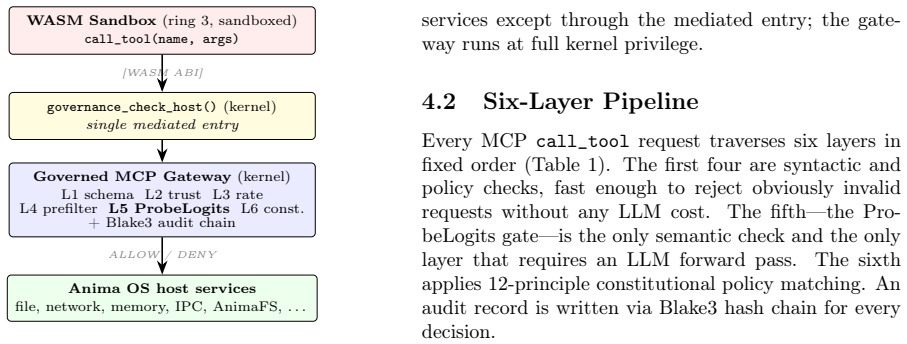
Tool-call governance is feasible as an OS primitive: a kernel-resident Governed MCP gateway can mediate every registered MCP tool and every WASM host function via a six-layer pipeline whose load-bearing semantic check is ProbeLogits, rendering the 10-line userspace bypass that defeats existing guardrail libraries structurally impossible (aside from a disclosed set of still-ungated ring-3 syscall paths).
What carries the argument
ProbeLogits, a logit-based safety primitive that performs one probe-prompt prefill and a single logit read, acts as the load-bearing semantic gate inside a six-layer kernel pipeline (schema validation, trust tier, rate limit, adversarial pre-filter, ProbeLogits, constitutional policy match) plus a Blake3-hashed audit chain.
Load-bearing premise
Mediating registered MCP tools and WASM host functions is enough to claim structural impossibility of bypass while a disclosed set of ring-3 syscall paths stays ungated, and a single probe-prompt plus one logit read is a reliable semantic safety gate across models.
What would settle it
A working userspace agent that issues a harmful MCP tool call or WASM host-function invocation without ever entering the kernel gateway, or a silicon re-measurement on the same hardware and models that fails to recover the reported F1 collapse of 0.432 when ProbeLogits is removed.
Editorial analysis
A structured set of objections, weighed in public.
Referee Report
Summary. The manuscript proposes Governed MCP: a kernel-resident gateway that interposes on every registered MCP tool call and every WASM-to-system host function via a six-layer pipeline (schema validation, trust tier, rate limit, adversarial pre-filter, ProbeLogits semantic gate, constitutional policy match) plus a Blake3 audit chain. The load-bearing check is ProbeLogits—one probe-prompt prefill and a single logit read. The system is implemented in Anima OS (~286k LOC bare-metal Rust). Reported costs are 11.3 µs for the non-inference path and 332–556 ms for ProbeLogits across three 7–8B models (2.4–3.4× faster than Llama Guard 3 on the same hardware). An ablation claims F1 falls from 0.789 to 0.357 without ProbeLogits. Multi-benchmark numbers (HarmBench, XSTest, ToxicChat) are reported as architecture-agnostic. The central claim is that mediating the MCP/WASM surface makes the classic 10-line userspace guardrail bypass structurally impossible, with a disclosed residual set of ungated ring-3 syscall paths left for future work.
Significance. If the result holds at the claimed scope, the paper would be a concrete demonstration that agent tool-call governance can be lifted from userspace libraries into an OS mediation surface, with a measured ablation showing that hand rules alone are insufficient and with multi-model evidence that a logit-read primitive is architecture-agnostic. The combination of a bare-metal Rust kernel implementation, silicon-measured latency, Blake3 audit chaining, and an explicit ablation is a genuine systems contribution relative to pure application-layer guardrails. The significance is bounded by the residual ungated ring-3 ABI: the work is strongest as “kernel mediation of the MCP/WASM tool surface,” weaker as a full OS-primitive claim that tool side effects cannot be reached without governance.
major comments (3)
- The abstract’s structural-impossibility claim (“the 10-line userspace bypass … is structurally impossible”) is load-bearing for the “OS primitive” framing, yet is immediately qualified by “a disclosed set of ring-3 syscall paths remains ungated.” Ordinary ring-3 ABI paths (open/write/connect/execve and equivalents) can realize the same file, network, and process side effects that MCP tools expose. Mediating registered MCP tools and WASM host functions therefore shows that the MCP/WASM surface is gated; it does not show that tool-call side effects themselves are gated. Either (a) inventory the remaining open ring-3 paths and argue they cannot produce equivalent effects under the Anima threat model, or (b) restate the claim as surface-scoped mediation rather than structural impossibility of bypass. Without one of those, the strongest claim does not hold.
- ProbeLogits is presented as the load-bearing semantic gate (ablation ΔF1 = −0.432). A single probe-prompt prefill plus one logit read is a free-parameter construction (probe text, decision threshold, model choice). The abstract does not state how the threshold was fixed, whether it was tuned on the evaluation suites, or how sensitive F1 is to prompt/threshold choice across Qwen2.5-7B, Llama-3-8B, and Mistral-7B. For the ablation and multi-benchmark claims to support “architecture-agnostic” reliability, the manuscript needs a fixed decision rule, sensitivity analysis, and an explicit statement that thresholds were not fit to the reported test sets.
- Evaluation claims (HarmBench 98–99% non-copyright block, XSTest 98.5–100% unsafe recall, ToxicChat parity with Llama Guard 3, F1 0.789) are central but, on the abstract alone, lack dataset construction details, decision thresholds, error bars, and the exact Llama Guard 3 baseline protocol (same hardware, same prompts, same allow/deny mapping). These are required for the multi-model and ablation results to be assessable; without them the quantitative support for the load-bearing role of ProbeLogits cannot be verified.
minor comments (5)
- Clarify the threat model early: who controls the agent process, whether the adversary can issue raw syscalls, and what “structurally impossible” means under that model.
- Define “silicon-measured” and the measurement methodology for the 11.3 µs and 332–556 ms figures (timer source, warm/cold cache, batching, hardware).
- Name the exact constitutional policy match rules and trust-tier parameters so the free parameters of the six-layer pipeline are enumerable.
- Resolve the scope of “every registered MCP tool” vs. dynamic tool registration: can a userspace agent register a new tool that bypasses the gateway?
- The abstract-only form leaves notation for ProbeLogits (which logit, how the probe prompt is constructed) underspecified; a short formal definition would help.
Circularity Check
No significant circularity: external benchmarks and ablation ground the claims; residual is ordinary systems self-measurement of the author's own kernel.
full rationale
This is an abstract-only systems paper whose load-bearing empirical claims are evaluated against external suites (HarmBench, XSTest, ToxicChat) and a third-party baseline (Llama Guard 3), with an internal ablation (rules-only vs rules+ProbeLogits) that is a genuine control rather than a tautology. Latency and F1 numbers are silicon-measured outcomes, not fitted parameters renamed as predictions. There is no uniqueness theorem, no self-citation chain justifying the central premise, no ansatz smuggled via prior author work, and no self-definitional loop (ProbeLogits is a method whose reliability is tested, not assumed by construction). The structural-impossibility claim is qualified by the paper itself (ungated ring-3 paths), which is a completeness/correctness issue, not circularity. Residual risk is the ordinary fact that the kernel, gateway, and probe prompts are the author's own artifacts without third-party reimplementation—normal for OS papers and not a derivation that reduces to its inputs. Score 1 for that residual self-measurement; steps empty because no enumerated circular pattern is present.
Axiom & Free-Parameter Ledger
free parameters (3)
- ProbeLogits decision threshold / probe prompt
- Trust-tier and rate-limit parameters
- Constitutional policy match rules
axioms (4)
- domain assumption MCP tool calls are the right mediation surface for agent side effects (analogous to syscalls).
- ad hoc to paper A single probe-prompt prefill and one logit read is a sufficient semantic safety signal for tool-call allow/deny.
- domain assumption Kernel interposition on registered MCP tools and WASM host functions is the correct completeness boundary for 'structurally impossible' userspace bypass.
- standard math Standard systems measurement and classification metrics (latency, F1, recall on named benchmarks) are valid for the safety claim.
invented entities (3)
-
ProbeLogits
independent evidence
-
Governed MCP gateway (6-layer kernel pipeline + Blake3 audit chain)
no independent evidence
-
Anima OS
no independent evidence
Cite this review
Pith. "Pith review of Governed MCP: Kernel-Level Tool Governance for AI Agents via Logit-Based Safety Primitives." pith.science (2026). https://pith.science/paper/UVDUHUI5
@misc{pith2026260416870,
  author       = {Pith},
  title        = {Pith review of: Governed MCP: Kernel-Level Tool Governance for AI Agents via Logit-Based Safety Primitives},
  year         = {2026},
  howpublished = {\url{https://pith.science/paper/UVDUHUI5}},
  note         = {Machine review of arXiv:2604.16870}
}
read the original abstract
AI agents increasingly call external tools (file system, network, APIs) through the Model Context Protocol (MCP). These tool calls are the agent's syscalls: privileged operations with side effects on shared state, yet today's safety enforcement lives entirely in userspace, where a 10-line script can bypass it. I propose Governed MCP, a kernel-resident tool governance gateway built on a logit-based safety primitive (ProbeLogits). The gateway interposes on every MCP tool call in a 6-layer pipeline: schema validation, trust tier, rate limit, adversarial pre-filter, a ProbeLogits semantic gate (the load-bearing check), and constitutional policy match, with a Blake3-hashed audit chain. I implement Governed MCP in Anima OS, a bare-metal x86-64 kernel in ~286,000 lines of Rust. The five non-inference layers plus the audit append cost a measured 11.3 us per call; the ProbeLogits gate (one probe-prompt prefill plus a single logit read) costs 332-556 ms per classification across Qwen2.5-7B, Llama-3-8B, and Mistral-7B, 2.4-3.4x faster than a Llama Guard 3 pass on the same hardware. A silicon-measured ablation shows that removing the ProbeLogits layer collapses F1 from 0.789 to 0.357 (delta-F1 = -0.432): hand-rule firewalling alone is insufficient. Every WASM-to-system host function and every registered MCP tool is mediated by the kernel gateway, so the 10-line userspace bypass that defeats existing guardrail libraries is structurally impossible; a disclosed set of ring-3 syscall paths remains ungated pending future work. Multi-model validation across three architectures (HarmBench 98-99% non-copyright block, XSTest 98.5-100% unsafe recall, ToxicChat parity with Llama Guard 3) shows the underlying primitive is architecture-agnostic. Governed MCP demonstrates that tool-call governance is feasible as an OS primitive, not just an application-layer concern.
Figures
Forward citations
Cited by 1 Pith paper
-
Elastic Gang: Per-Token Membership Change for a Hard-Barriered LLM Inference Gang Co-Scheduled with OS Processes
An ACK-latched epoch protocol lets a hard-barriered CPU LLM inference gang change membership per token bit-exactly and Pareto-dominate static core partitions on general throughput.
discussion (0)
Sign in with ORCID, Apple, or X to comment. Anyone can read and Pith papers without signing in.