REVIEW 4 major objections 3 minor 2 cited by
Splitting robot actions into coarse anchors plus fine residuals boosts precision.
Reviewed by Pith at T0; open to challenge. T0 means a machine referee read the full paper against a public rubric. the ladder, T0–T4 →
T0 review · deepseek-v4-flash
2026-08-02 15:52 UTC pith:O65NSA5T
load-bearing objection Clean incremental VLA refinement paper whose main empirical claim is likely overstated because the GR-1 baseline is a modified chunk-predicting reimplementation, and no variance is reported. the 4 major comments →
AnchorRefine: Synergy-Manipulation Based on Trajectory Anchor and Residual Refinement for Vision-Language-Action Models
The pith
A machine-rendered reading of the paper's core claim, the machinery that carries it, and where it could break.
Core claim
The paper's central claim is that explicit decomposition of action modeling into global trajectory anchoring and local residual refinement is an effective principle for precision-critical robotic manipulation. Concretely, AnchorRefine trains a trajectory anchor planner in the original action space, then freezes it and trains a residual refinement module in the space of anchor-relative residuals (computed with a stop-gradient), so that the composed arm action is anchor plus residual. For gripper control, it introduces a decision-aware correction that pushes the anchor-phase gripper probability across the open/closed threshold by a margin proportional to the anchor's own confidence. The paper
What carries the argument
Anchor-induced residualization: the refinement target is defined as the ground-truth action minus the detached (stop-gradient) anchor prediction, so the residual is always measured relative to the anchor's current output. Combined with a frozen anchor in phase two and a decision-aware gripper correction that uses the anchor's sigmoid probability and a boundary-crossing margin, this turns full action prediction into a compact residual-correction problem, reducing the norm and covariance of the learning target.
Load-bearing premise
The reported gains over the regression backbone are measured against a reproduction of that backbone rather than its official published results; if the reproduction is weaker, the gains are inflated.
What would settle it
Re-run the same evaluation against the regression backbone's officially published numbers on the same benchmark. If AnchorRefine's success rate no longer exceeds the official figure, or the difference falls within evaluation noise, the central claim of consistent improvement is not supported.
If this is right
- If the central claim holds, any VLA policy that currently regresses or denoises full action chunks can likely be improved by splitting training into an anchor phase and a residual-refinement phase.
- The larger gains on the weaker regression backbone suggest the method is especially valuable when the base policy has room for improvement, while the consistent gains on the stronger diffusion backbone indicate the refinement remains complementary even for strong monolithic policies.
- The decision-aware gripper formulation implies that discrete action dimensions should not be trained as ordinary regression residuals, but as boundary-crossing corrections with direction and magnitude.
- The error-transition analysis (refinement converts failures into successes more often than the reverse, and gripper-related errors drop by roughly a quarter) supports the view that local correction near contact, not global replanning, is the decisive bottleneck in precision tasks.
- The two-phase design with a frozen anchor prevents the refinement branch from collapsing into a redundant reparameterization of the full action space, offering a template for hierarchical action generation within a single prediction horizon.
Where Pith is reading between the lines
- The same anchor–residual decomposition could transfer to other heterogeneous action spaces, such as whole-body control or multi-robot coordination, where macro and micro scales differ and small corrections are decisive.
- The decision-aware correction is a general recipe for any discrete action dimension (e.g., tool switching, mode selection) where decisions are boundary-sensitive rather than smoothly regressed.
- A testable prediction from the compact-residual claim is that the refinement phase should be more sample-efficient than monolithic training; measuring success rate versus number of refinement demonstrations would directly test this.
- The paper's stated limitation of a non-adaptive refinement formulation points to a natural extension: make the correction strength scale with the anchor's local uncertainty or instantaneous error, rather than a fixed additive residual.
Editorial analysis
A structured set of objections, weighed in public.
Referee Report
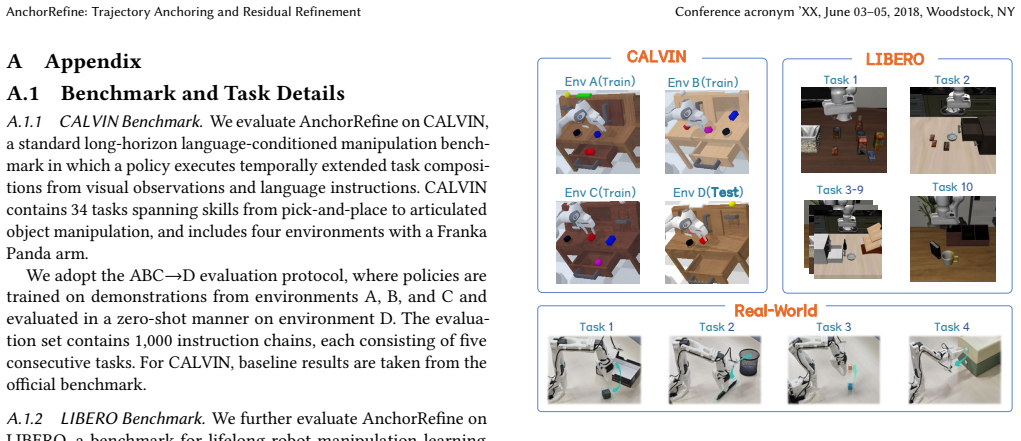
Summary. The paper proposes AnchorRefine, a two-phase factorization of VLA action prediction. A trajectory-anchor planner is trained first in the original action space; a residual-refinement branch is then trained to predict the difference between the ground-truth action and the detached anchor prediction, together with a decision-aware gripper correction that adjusts the anchor gripper probability near its decision boundary. The final arm action is the sum of anchor and residual, and the final gripper decision is obtained by adding the predicted correction to the anchor probability. The method is instantiated on GR-1 and X-VLA backbones and evaluated on LIBERO-Long, CALVIN ABC→D, and four real-robot tasks. The headline results are consistent improvements over the two matched baselines, with gains up to +7.8 success-rate points on LIBERO-Long and up to +18% on real-world tasks.
Significance. The factorization principle is plausible and the paper has several strengths: evaluation on external benchmarks, paired backbone comparisons, controlled ablations for capacity and target formulation, and a real-robot deployment. The paper is also honest about important caveats, explicitly disclosing that the residual loss is mathematically equivalent to supervising the composed action and that GR-1* is a reimplementation rather than the official model. If the reported improvements are reproducible and statistically robust, AnchorRefine would be a simple and general wrapper for improving VLA policies. However, the current manuscript does not yet provide the baseline calibration and uncertainty information needed to separate the method's contribution from reproduction effects and run-to-run variance.
major comments (4)
- [Table 1; Sec. 4.2] No seed counts, error bars, or confidence intervals are reported for any simulation result. Table 1 gives single point estimates; the primary claims of +7.8% over GR-1* and +1.6% over X-VLA* on LIBERO-Long are presented without variance, even though LIBERO and CALVIN evaluation is stochastic. The claim of 'consistent improvement' is therefore not yet statistically supported. Please report mean±std over at least three seeds, or per-task breakdowns, and where possible paired significance tests.
- [Sec. 4.1; App. A.2.1] As disclosed in A.2.1, the GR-1* baseline is not the original GR-1: it is a reimplementation that predicts an action chunk instead of a single next action step. Chunk prediction is a known architectural change that can materially affect performance. Since the paper does not provide the official GR-1 LIBERO number (or a same-protocol run of the released architecture as the anchor-only baseline), the +7.8% gain over GR-1* cannot be causally attributed to the anchor–refine decomposition. Please report official GR-1 results on LIBERO-Long, or compare AnchorRefine against a baseline that exactly matches the released GR-1 architecture.
- [Sec. 3.4, Eqs. (5)–(7)] The paper admits that, with the anchor frozen, L_refine in Eq. (7) is mathematically equivalent to supervising the composed action A_anc + R_hat against the ground truth, because R* = A − A_anc is a constant shift. This means the residual-space formulation is not a new objective but a reparameterization of the same final-action regression. The claimed benefit of a more compact target (Fig. 1b) is then only an optimization-side effect, and the training-dynamics comparison in Fig. 3b compares different loss functions. To substantiate the central 'residualization' claim, please show that the composed-action training loss or validation success improves relative to a monolithic baseline with the same total capacity and the same training budget.
- [Sec. 4.5, Fig. 4] The real-world results are based on 20 trials per task with no error bars or confidence intervals. With 20 trials, the 95% confidence interval is at least ±10 percentage points, so the 'up to 18%' real-world improvement is not statistically grounded. Please add confidence intervals, report raw counts, and ideally increase the number of trials or repeat the evaluation.
minor comments (3)
- [Eq. (9), Sec. 3.5] The margin ε in Eq. (9) is a free hyperparameter, but its value is not reported anywhere, nor is a sensitivity analysis provided. Please state the value and, if possible, include a small sweep.
- [Sec. 3.6; App. A.3] The choice λ=0.01 is attributed to reference [51], but the paper does not explain whether the same weight is appropriate for the gripper loss scale in these experiments. Please clarify how λ was selected and whether the result is sensitive to it.
- [Unspecified] The manuscript still contains template placeholders (conference acronym, ACM copyright line, DOI, '2018' year) and some references with implausible future dates (e.g., arXiv:2604.17787). These should be cleaned before any formal submission.
Circularity Check
No significant circularity: AnchorRefine's anchor–residual decomposition is trained end-to-end against ground-truth actions, and the residual reparameterization is transparently equivalent to direct action supervision.
full rationale
The paper's derivation chain is self-contained and does not reduce any prediction to a fitted input or to a self-citation. The central construction defines the residual target as the ground-truth action minus a detached anchor prediction (Eq. 5), trains the refinement branch in that residual space (Eq. 7), and forms the final action as anchor plus residual (Eq. 2). The paper explicitly acknowledges in Section 3.4 that, because the anchor is frozen, this residual-space loss is mathematically equivalent to supervising the composed action against the ground truth: 'When the anchor is frozen, this loss is mathematically equivalent to supervising the composed action Â_anc + R̂ against the ground truth A, since R* = A − Â_anc reduces to a constant shift.' This is a reparameterization, not circularity. The claimed compactness of residual targets (Fig. 1b, Section 4.3.3) is an empirical property of the trained anchor, not a definition that forces the reported success-rate outcomes. The gripper refinement target (Eqs. 8–10) uses ground-truth labels only to construct a training signal; at inference the correction is predicted from observations, so no fitted value is renamed as a prediction. The hyperparameter λ = 0.01 is taken from prior external work X-VLA [51], and there is no load-bearing self-citation chain or imported uniqueness theorem. All headline gains are validated on external benchmarks (LIBERO, CALVIN) and real-robot rollouts against matched baselines. The disclosed GR-1* reproduction (Appendix A.2.1) raises a baseline-calibration concern about whether +7.8% is fully attributable to the method, but that is an experimental validity issue, not a circularity of the derivation.
Axiom & Free-Parameter Ledger
free parameters (2)
- λ (phase-2 loss weight) =
0.01
- ε (margin in Eq. 9) =
not specified
axioms (5)
- domain assumption Human reaching follows a coarse-to-fine pattern that transfers to robot control.
- domain assumption Reconstruction-style training biases the anchor branch toward dominant motion structure.
- domain assumption Smaller-norm, lower-covariance residual targets are easier to learn.
- domain assumption Freezing the anchor in Phase 2 prevents collapse into a redundant reparameterization of the full action space.
- domain assumption The reproduced GR-1* baseline is a faithful proxy for official GR-1.
read the original abstract
Precision-critical manipulation requires both global trajectory organization and local execution correction, yet most vision-language-action (VLA) policies generate actions within a single unified space. This monolithic formulation forces macro-level transport and micro-level refinement to be optimized under the same objective, causing large motions to dominate learning while suppressing small but failure-critical corrective signals. In contrast, human manipulation is structured by global movement planning together with continuous local adjustment during execution. Motivated by this principle, we propose AnchorRefine, a hierarchical framework that factorizes VLA action modeling into trajectory anchor and residual refinement. The anchor planner predicts a coarse motion scaffold, while the refinement module corrects execution-level deviations to improve geometric and contact precision. We further introduce a decision-aware gripper refinement mechanism to better capture the discrete and boundary-sensitive nature of gripper control. Experiments on LIBERO, CALVIN, and real-robot tasks demonstrate that AnchorRefine consistently improves both regression-based and diffusion-based VLA backbones, yielding gains of up to 7.8% in simulation success rate and 18% in real-world success rate.
Figures




Forward citations
Cited by 2 Pith papers
-
EgoRecovery: Acquiring Failure Recovery Ability Through Human Recovery Demonstration
EgoRecovery co-trains robot recovery policies from egocentric human recovery videos by sharing a gated corrective-intent bottleneck, raising average closed-loop recovery success from 52.5% (robot-only) to 85% on four ...
-
Safe Embodied AI for Long-horizon Tasks: A Cross-layer Analysis of Robotic Manipulation
A structured literature survey of safety mechanisms in long-horizon robotic manipulation organized by intervention timing and strength of supporting evidence.
Reference graph
Works this paper leans on
-
[1]
Lars Ankile, Anthony Simeonov, Idan Shenfeld, Marcel Torne, and Pulkit Agrawal
-
[2]
Jinze Bai, Shuai Bai, Yunfei Chu, Zeyu Cui, Kai Dang, Xiaodong Deng, Yang Fan, Wenbin Ge, Yu Han, Fei Huang, et al. 2023. Qwen technical report.arXiv preprint arXiv:2309.16609(2023)
Pith/arXiv arXiv 2023
-
[3]
Lucas Beyer, Andreas Steiner, André Susano Pinto, Alexander Kolesnikov, Xiao Wang, Daniel Salz, Maxim Neumann, Ibrahim Alabdulmohsin, Michael Tschan- nen, Emanuele Bugliarello, et al. 2024. Paligemma: A versatile 3b vlm for transfer. arXiv preprint arXiv:2407.07726(2024)
Pith/arXiv arXiv 2024
-
[4]
Kevin Black, Noah Brown, Danny Driess, Adnan Esmail, Michael Equi, Chelsea Finn, Niccolo Fusai, Lachy Groom, Karol Hausman, Brian Ichter, et al. 2024.𝜋0: A Vision-Language-Action Flow Model for General Robot Control.arXiv preprint arXiv:2410.24164(2024)
Pith/arXiv arXiv 2024
-
[5]
Kevin Black, Mitsuhiko Nakamoto, Pranav Atreya, Homer Rich Walke, Chelsea Finn, Aviral Kumar, and Sergey Levine. [n. d.]. Zero-Shot Robotic Manipulation with Pre-Trained Image-Editing Diffusion Models. InThe Twelfth International Conference on Learning Representations
-
[6]
Anthony Brohan, Noah Brown, Justice Carbajal, Yevgen Chebotar, Xi Chen, Krzysztof Choromanski, Tianli Ding, Danny Driess, Avinava Dubey, Chelsea Finn, et al. 2023. Rt-2: Vision-language-action models transfer web knowledge to robotic control.7th Annual Conference on Robot Learning(2023)
2023
-
[7]
Qingwen Bu, Jisong Cai, Li Chen, Xiuqi Cui, Yan Ding, Siyuan Feng, Shenyuan Gao, Xindong He, Xuan Hu, Xu Huang, et al . 2025. Agibot world colosseo: A large-scale manipulation platform for scalable and intelligent embodied systems. arXiv preprint arXiv:2503.06669(2025)
Pith/arXiv arXiv 2025
-
[8]
Qingwen Bu, Yanting Yang, Jisong Cai, Shenyuan Gao, Guanghui Ren, Maoqing Yao, Ping Luo, and Hongyang Li. 2025. Univla: Learning to act anywhere with task-centric latent actions.arXiv preprint arXiv:2505.06111(2025)
Pith/arXiv arXiv 2025
-
[9]
Remi Cadene, Simon Aliberts, Francesco Capuano, Michel Aractingi, Adil Zoui- tine, Pepijn Kooijmans, Jade Choghari, Martino Russi, Caroline Pascal, Steven Palma, et al. 2026. Lerobot: An open-source library for end-to-end robot learning. arXiv preprint arXiv:2602.22818(2026)
arXiv 2026
-
[10]
Joao Carvalho, Dorothea Koert, Marek Daniv, and Jan Peters. 2022. Residual robot learning for object-centric probabilistic movement primitives.arXiv preprint arXiv:2203.03918(2022)
Pith/arXiv arXiv 2022
-
[11]
Cheng Chi, Zhenjia Xu, Siyuan Feng, Eric Cousineau, Yilun Du, Benjamin Burch- fiel, Russ Tedrake, and Shuran Song. 2025. Diffusion policy: Visuomotor policy learning via action diffusion.The International Journal of Robotics Research44, 10-11 (2025), 1684–1704
2025
-
[12]
Todor Davchev, Kevin Sebastian Luck, Michael Burke, Franziska Meier, Stefan Schaal, and Subramanian Ramamoorthy. 2022. Residual learning from demonstra- tion: Adapting dmps for contact-rich manipulation.IEEE Robotics and Automation Letters7, 2 (2022), 4488–4495
2022
-
[13]
Digby Elliott, Steve Hansen, Lawrence EM Grierson, James Lyons, Simon J Ben- nett, and Spencer J Hayes. 2010. Goal-directed aiming: two components but multiple processes.Psychological bulletin136, 6 (2010), 1023
2010
-
[14]
Digby Elliott, Werner F Helsen, and Romeo Chua. 2001. A century later: Wood- worth’s (1899) two-component model of goal-directed aiming.Psychological bulletin127, 3 (2001), 342
2001
-
[15]
Jiayuan Gu, Sean Kirmani, Paul Wohlhart, Yao Lu, Montserrat Gonzalez Arenas, Kanishka Rao, Wenhao Yu, Chuyuan Fu, Keerthana Gopalakrishnan, Zhuo Xu, et al. 2023. Robotic task generalization via hindsight trajectory sketches. InFirst Workshop on Out-of-Distribution Generalization in Robotics at CoRL 2023
2023
-
[16]
Siddhant Haldar, Zhuoran Peng, and Lerrel Pinto. 2024. Baku: An efficient transformer for multi-task policy learning.Advances in Neural Information Processing Systems37 (2024), 141208–141239
2024
-
[17]
Siddhant Haldar and Lerrel Pinto. [n. d.]. Point Policy: Unifying Observations and Actions with Key Points for Robot Manipulation. In9th Annual Conference on Robot Learning
-
[18]
Peng Hao, Tao Lu, Shaowei Cui, Junhang Wei, Yinghao Cai, and Shuo Wang
-
[19]
Kaiming He, Xiangyu Zhang, Shaoqing Ren, and Jian Sun. 2016. Deep residual learning for image recognition. InProceedings of the IEEE conference on computer vision and pattern recognition. 770–778
2016
-
[20]
Zhi Hou, Tianyi Zhang, Yuwen Xiong, Haonan Duan, Hengjun Pu, Ronglei Tong, Chengyang Zhao, Xizhou Zhu, Yu Qiao, Jifeng Dai, et al . 2025. Dita: Scaling diffusion transformer for generalist vision-language-action policy. InProceedings of the IEEE/CVF International Conference on Computer Vision. 7686–7697
2025
-
[21]
Yucheng Hu, Yanjiang Guo, Pengchao Wang, Xiaoyu Chen, Yen-Jen Wang, Jianke Zhang, Koushil Sreenath, Chaochao Lu, and Jianyu Chen. [n. d.]. Video Prediction Policy: A Generalist Robot Policy with Predictive Visual Representations. InForty- second International Conference on Machine Learning
-
[22]
Haifeng Huang, Xinyi Chen, Yilun Chen, Hao Li, Xiaoshen Han, Zehan Wang, Tai Wang, Jiangmiao Pang, and Zhou Zhao. 2025. Roboground: Robotic manipulation with grounded vision-language priors. InProceedings of the Computer Vision and Pattern Recognition Conference. 22540–22550
2025
-
[23]
Tobias Johannink, Shikhar Bahl, Ashvin Nair, Jianlan Luo, Avinash Kumar, Matthias Loskyll, Juan Aparicio Ojea, Eugen Solowjow, and Sergey Levine. 2019. Residual Reinforcement Learning for Robot Control. In2019 International Con- ference on Robotics and Automation (ICRA)
2019
-
[24]
Siddharth Karamcheti, Suraj Nair, Ashwin Balakrishna, Percy Liang, Thomas Kollar, and Dorsa Sadigh. 2024. Prismatic vlms: Investigating the design space of visually-conditioned language models. InForty-first International Conference on Machine Learning
2024
-
[25]
Moo Jin Kim, Karl Pertsch, Siddharth Karamcheti, Ted Xiao, Ashwin Balakr- ishna, Suraj Nair, Rafael Rafailov, Ethan P Foster, Pannag R Sanketi, Quan Vuong, Thomas Kollar, Benjamin Burchfiel, Russ Tedrake, Dorsa Sadigh, Sergey Levine, Percy Liang, and Chelsea Finn. 2024. OpenVLA: An Open-Source Vision- Language-Action Model. In8th Annual Conference on Robo...
2024
-
[26]
Michelle A Lee, Yuke Zhu, Krishnan Srinivasan, Parth Shah, Silvio Savarese, Li Fei-Fei, Animesh Garg, and Jeannette Bohg. 2019. Making sense of vision and touch: Self-supervised learning of multimodal representations for contact-rich tasks. In2019 International conference on robotics and automation (ICRA). IEEE, 8943–8950
2019
-
[27]
Yi Li, Yuquan Deng, Jesse Zhang, Joel Jang, Marius Memmel, Caelan Reed Garrett, Fabio Ramos, Dieter Fox, Anqi Li, Abhishek Gupta, et al. [n. d.]. HAMSTER: Hi- erarchical Action Models for Open-World Robot Manipulation. InThe Thirteenth International Conference on Learning Representations
-
[28]
Juyi Lin, Amir Taherin, Arash Akbari, Arman Akbari, Lei Lu, Guangyu Chen, Taskin Padir, Xiaomeng Yang, Weiwei Chen, Yiqian Li, et al. 2025. Vote: vision- language-action optimization with trajectory ensemble voting.arXiv preprint arXiv:2507.05116(2025). Conference acronym ’XX, June 03–05, 2018, Woodstock, NY Tingzheng Jia et al
Pith/arXiv arXiv 2025
-
[29]
Bo Liu, Yifeng Zhu, Chongkai Gao, Yihao Feng, Qiang Liu, Yuke Zhu, and Peter Stone. 2023. Libero: Benchmarking knowledge transfer for lifelong robot learning. Advances in Neural Information Processing Systems36 (2023), 44776–44791
2023
-
[30]
Songming Liu, Lingxuan Wu, Bangguo Li, Hengkai Tan, Huayu Chen, Zhengyi Wang, Ke Xu, Hang Su, and Jun Zhu. [n. d.]. RDT-1B: a Diffusion Foundation Model for Bimanual Manipulation. InThe Thirteenth International Conference on Learning Representations
-
[31]
Xiao Ma, Sumit Patidar, Iain Haughton, and Stephen James. 2024. Hierarchical diffusion policy for kinematics-aware multi-task robotic manipulation. InPro- ceedings of the IEEE/CVF Conference on Computer Vision and Pattern Recognition. 18081–18090
2024
-
[32]
Yueen Ma, Zixing Song, Yuzheng Zhuang, Jianye Hao, and Irwin King. 2024. A survey on vision-language-action models for embodied ai.arXiv preprint arXiv:2405.14093(2024)
Pith/arXiv arXiv 2024
-
[33]
Oier Mees, Dibya Ghosh, Karl Pertsch, Kevin Black, Homer Rich Walke, Sudeep Dasari, Joey Hejna, Tobias Kreiman, Charles Xu, Jianlan Luo, et al. 2024. Octo: An open-source generalist robot policy. InFirst Workshop on Vision-Language Models for Navigation and Manipulation at ICRA 2024
2024
-
[34]
Oier Mees, Lukas Hermann, Erick Rosete-Beas, and Wolfram Burgard. 2022. Calvin: A benchmark for language-conditioned policy learning for long-horizon robot manipulation tasks.IEEE Robotics and Automation Letters7, 3 (2022), 7327–7334
2022
-
[35]
Abby O’Neill, Abdul Rehman, Abhiram Maddukuri, Abhishek Gupta, Abhishek Padalkar, Abraham Lee, Acorn Pooley, Agrim Gupta, Ajay Mandlekar, Ajinkya Jain, et al. 2024. Open x-embodiment: Robotic learning datasets and rt-x models: Open x-embodiment collaboration 0. In2024 IEEE International Conference on Robotics and Automation (ICRA). IEEE, 6892–6903
2024
-
[36]
Y Paulignan, C MacKenzie, R Marteniuk, and Marc Jeannerod. 1991. Selective perturbation of visual input during prehension movements: 1. The effects of changing object position.Experimental brain research83, 3 (1991), 502–512
1991
-
[37]
Moritz Reuss, Hongyi Zhou, Marcel Rühle, Ömer Erdinç Yağmurlu, Fabian Otto, and Rudolf Lioutikov. [n. d.]. FLOWER: Democratizing Generalist Robot Policies with Efficient Vision-Language-Flow Models. In9th Annual Conference on Robot Learning
-
[38]
Tom Silver, Kelsey Allen, Josh Tenenbaum, and Leslie Kaelbling. 2018. Residual policy learning.arXiv preprint arXiv:1812.06298(2018)
Pith/arXiv arXiv 2018
-
[39]
Yang Tian, Sizhe Yang, Jia Zeng, Ping Wang, Dahua Lin, Hao Dong, and Jiangmiao Pang. [n. d.]. Predictive Inverse Dynamics Models are Scalable Learners for Robotic Manipulation. InThe Thirteenth International Conference on Learning Representations
-
[40]
Homer Rich Walke, Kevin Black, Tony Z Zhao, Quan Vuong, Chongyi Zheng, Philippe Hansen-Estruch, Andre Wang He, Vivek Myers, Moo Jin Kim, Max Du, et al. 2023. Bridgedata v2: A dataset for robot learning at scale. InConference on Robot Learning. PMLR, 1723–1736
2023
-
[41]
Junjie Wen, Yichen Zhu, Jinming Li, Zhibin Tang, Chaomin Shen, and Feifei Feng. [n. d.]. DexVLA: Vision-Language Model with Plug-In Diffusion Expert for General Robot Control. In9th Annual Conference on Robot Learning
-
[42]
Junjie Wen, Yichen Zhu, Jinming Li, Minjie Zhu, Zhibin Tang, Kun Wu, Zhiyuan Xu, Ning Liu, Ran Cheng, Chaomin Shen, et al. 2025. Tinyvla: Towards fast, data- efficient vision-language-action models for robotic manipulation.IEEE Robotics and Automation Letters(2025)
2025
-
[43]
Junjie Wen, Yichen Zhu, Minjie Zhu, Zhibin Tang, Jinming Li, Zhongyi Zhou, Xiaoyu Liu, Chaomin Shen, Yaxin Peng, and Feifei Feng. 2025. Diffusionvla: Scaling robot foundation models via unified diffusion and autoregression. In Forty-second International Conference on Machine Learning
2025
-
[44]
Hongtao Wu, Ya Jing, Chilam Cheang, Guangzeng Chen, Jiafeng Xu, Xinghang Li, Minghuan Liu, Hang Li, and Tao Kong. 2024. Unleashing Large-Scale Video Gen- erative Pre-training for Visual Robot Manipulation. InThe Twelfth International Conference on Learning Representations
2024
-
[45]
Zhou Xian, Nikolaos Gkanatsios, Theophile Gervet, Tsung-Wei Ke, and Katerina Fragkiadaki. 2023. Chaineddiffuser: Unifying trajectory diffusion and keypose prediction for robotic manipulation. In7th Annual Conference on Robot Learning
2023
-
[46]
Hewen Xiao, Youmin Gong, Jie Mei, Zihou Wu, Guangfu Ma, and Weiren Wu. 2026. Residual-learning-based landing control with gravity estimation for quadruped robot in low-gravity scenarios.Astrodynamics(2026), 1–14
2026
-
[47]
Likui Zhang, Tao Tang, Zhihao Zhan, Xiuwei Chen, Zisheng Chen, Jianhua Han, Jiangtong Zhu, Pei Xu, Hang Xu, Hefeng Wu, et al. 2026. AtomicVLA: Unlocking the Potential of Atomic Skill Learning in Robots. InProceedings of the IEEE/CVF Conference on Computer Vision and Pattern Recognition (CVPR)
2026
-
[48]
Wenbo Zhang, Tianrun Hu, Hanbo Zhang, Yanyuan Qiao, Yuchu Qin, Yang Li, Jiajun Liu, Tao Kong, Lingqiao Liu, and Xiao Ma. [n. d.]. Chain-of-Action: Trajectory Autoregressive Modeling for Robotic Manipulation. InThe Thirty- ninth Annual Conference on Neural Information Processing Systems
-
[49]
Qingqing Zhao, Yao Lu, Moo Jin Kim, Zipeng Fu, Zhuoyang Zhang, Yecheng Wu, Zhaoshuo Li, Qianli Ma, Song Han, Chelsea Finn, et al . 2025. Cot-vla: Visual chain-of-thought reasoning for vision-language-action models. InProceedings of the Computer Vision and Pattern Recognition Conference. 1702–1713
2025
-
[50]
Tony Z Zhao, Vikash Kumar, Sergey Levine, and Chelsea Finn. 2023. Learning fine-grained bimanual manipulation with low-cost hardware.arXiv preprint arXiv:2304.13705(2023)
Pith/arXiv arXiv 2023
-
[51]
Jinliang Zheng, Jianxiong Li, Zhihao Wang, Dongxiu Liu, Xirui Kang, Yuchun Feng, Yinan Zheng, Jiayin Zou, Yilun Chen, Jia Zeng, Tai Wang, Ya-Qin Zhang, Jingjing Liu, and Xianyuan Zhan. 2026. X-VLA: Soft-Prompted Transformer as Scalable Cross-Embodiment Vision-Language-Action Model. InThe Fourteenth International Conference on Learning Representations
2026
-
[52]
Ruijie Zheng, Yongyuan Liang, Shuaiyi Huang, Jianfeng Gao, Hal Daumé III, Andrey Kolobov, Furong Huang, and Jianwei Yang. [n. d.]. TraceVLA: Visual Trace Prompting Enhances Spatial-Temporal Awareness for Generalist Robotic Policies. InThe Thirteenth International Conference on Learning Representations
-
[53]
Dongxu Zhou, Ruiqing Jia, Haifeng Yao, and Mingzuo Xie. 2021. Robotic arm mo- tion planning based on residual reinforcement learning. In2021 13th International Conference on Computer and Automation Engineering (ICCAE). IEEE, 89–94. AnchorRefine: Trajectory Anchoring and Residual Refinement Conference acronym ’XX, June 03–05, 2018, Woodstock, NY A Appendix...
2021
-
[2022]
Meta-Residual Policy Learning: Zero-Trial Robot Skill Adaptation via Knowledge Fusion.IEEE Robotics and Automation Letters7, 2 (2022), 3656–3663. doi:10.1109/LRA.2022.3146916
arXiv 2022
-
[2025]
In2025 IEEE International Conference on Robotics and Automation (ICRA)
From imitation to refinement-residual rl for precise assembly. In2025 IEEE International Conference on Robotics and Automation (ICRA). IEEE
discussion (0)
Sign in with ORCID, Apple, or X to comment. Anyone can read and Pith papers without signing in.