REVIEW 1 major objections 3 minor 1 cited by
The double ratio of hypertriton to triton production stays constant at 0.4 across RHIC collision energies from 3 to 27 GeV.
Reviewed by Pith at T0; open to challenge. T0 means a machine referee read the full paper against a public rubric. the ladder, T0–T4 →
T0 review · grok-4.3
2026-05-10 03:26 UTC
load-bearing objection STAR has new hypertriton yields down to 3.2 GeV and a flat double ratio at 0.4, but the coalescence reading still needs work on whether source-size changes are really under control. the 1 major comments →
Collision Energy Dependence of Hypertriton Production in Au+Au Collisions at RHIC
The pith
A machine-rendered reading of the paper's core claim, the machinery that carries it, and where it could break.
Core claim
Measurements show that the pT-integrated hypertriton yields and the hypertriton-to-lambda ratio increase strongly with decreasing collision energy yet remain a factor of about two below thermal-model expectations. The mean transverse momentum of hypertritons lies below the value expected from a Blast-Wave fit to lighter hadrons. Most notably, the double ratio (³_ΛH/Λ) divided by (t/p) holds steady near 0.4 across the full energy range. Within the coalescence framework this flat value directly signals that the formation probability of the weakly bound hypertriton is suppressed relative to the triton because of the weaker hyperon-nucleon interaction compared with the nucleon-nucleon force.
What carries the argument
The double ratio ((³_ΛH/Λ)/(t/p)) inside the coalescence framework, which isolates the relative formation probability fixed by hyperon-nucleon versus nucleon-nucleon interaction strength.
Load-bearing premise
The coalescence framework cleanly extracts the formation probability from the double ratio without significant contamination from other production channels, final-state interactions, or energy-dependent changes in source size and density.
What would settle it
A measurement of the same double ratio at energies below 3 GeV or in a different collision system that deviates significantly from 0.4 would show that the constant value is not set solely by the fixed interaction strength.
If this is right
- Hypertriton formation probability is suppressed by a factor of roughly 0.4 relative to triton production at every energy studied.
- Thermal models assuming full chemical equilibrium overpredict hypertriton yields by a factor of two throughout the measured range.
- Hypertriton source conditions at chemical freeze-out differ from those of light hadrons, as shown by the lower mean transverse momentum.
- The suppression factor is independent of collision energy, indicating that binding properties dominate over evolving medium effects.
Where Pith is reading between the lines
- The same double-ratio method could be applied to other weakly bound hypernuclei to separate intrinsic interaction strength from formation dynamics.
- The constant suppression provides a direct experimental anchor for low-energy hyperon-nucleon potentials used in hypernuclear structure calculations.
- If the ratio remains flat at still lower energies, it would imply that hypertriton production near threshold is governed by the same interaction-limited coalescence probability.
Editorial analysis
A structured set of objections, weighed in public.
Referee Report
Summary. The STAR Collaboration reports measurements of hypertriton (³_ΛH) transverse momentum spectra and p_T-integrated yields at mid-rapidity (|y|<0.5) in Au+Au collisions at 11 energies from 3.2 to 27 GeV. The ³_ΛH yields and ³_ΛH/Λ ratio in central collisions increase strongly with decreasing energy and lie a factor of ~2 below thermal model predictions. The mean p_T of ³_ΛH is lower than Blast-Wave expectations based on light-hadron freeze-out parameters. The double ratio ((³_ΛH/Λ)/(t/p)) remains constant at ~0.4 across the energy range; within the coalescence framework this is interpreted as direct evidence for suppressed hypertriton formation probability arising from the weaker hyperon-nucleon interaction relative to nucleon-nucleon.
Significance. The work supplies new, direct experimental ratios for light hypernuclei production over a broad energy range from a major collaboration. The reported constancy of the double ratio, if robust against source-size variations, supplies a clean observable for testing coalescence models and constraining YN interaction strengths. The discrepancy with thermal models is also noted as a useful benchmark. These strengths are tempered by the need to demonstrate that energy-dependent freeze-out volume and density changes do not mimic or mask the claimed interaction effect.
major comments (1)
- [Abstract and Discussion] Abstract and Discussion: The claim that the constant ~0.4 value of ((³_ΛH/Λ)/(t/p)) directly isolates the suppressed formation probability due to weaker YN vs. NN interaction assumes coalescence probabilities are insensitive to all other factors. Because the hypertriton is weakly bound, its wave-function overlap is far more sensitive to source radius and density profile than the triton. Collision energy changes both the freeze-out volume and the density at which light nuclei form; the manuscript provides no quantitative estimate, hydrodynamic simulation, or coalescence-model scan showing that these effects remain sub-dominant or perfectly correlated across 3.2–27 GeV. This assumption is load-bearing for the interaction-strength interpretation.
minor comments (3)
- [Abstract] The double-ratio notation in the abstract would benefit from explicit parentheses or a short equation to prevent misreading.
- [Results] Tables or figures showing the double ratio should list both statistical and systematic uncertainties for each energy point.
- [Introduction] The introduction could usefully reference prior coalescence calculations for hypertriton in smaller systems to place the present energy-scan results in context.
Simulated Author's Rebuttal
We thank the referee for the careful and constructive review of our manuscript. We address the major comment below and have revised the manuscript to strengthen the discussion of the double-ratio interpretation.
read point-by-point responses
-
Referee: The claim that the constant ~0.4 value of ((³_ΛH/Λ)/(t/p)) directly isolates the suppressed formation probability due to weaker YN vs. NN interaction assumes coalescence probabilities are insensitive to all other factors. Because the hypertriton is weakly bound, its wave-function overlap is far more sensitive to source radius and density profile than the triton. Collision energy changes both the freeze-out volume and the density at which light nuclei form; the manuscript provides no quantitative estimate, hydrodynamic simulation, or coalescence-model scan showing that these effects remain sub-dominant or perfectly correlated across 3.2–27 GeV. This assumption is load-bearing for the interaction-strength interpretation.
Authors: We agree that the interpretation of the constant double ratio relies on the assumption that variations in source size and density do not dominate the observed behavior. The manuscript presents the constancy of ((³_ΛH/Λ)/(t/p)) ~ 0.4 across 3.2–27 GeV as evidence, within the coalescence framework, for a suppressed hypertriton formation probability driven by the weaker YN interaction relative to NN. The broad energy range corresponds to substantial changes in freeze-out volume (as established by HBT measurements in similar systems), yet the ratio remains flat; this provides supporting evidence that source-size effects are either sub-dominant or correlated between the hypertriton and triton channels. We acknowledge, however, that the manuscript does not contain a dedicated coalescence-model scan or hydrodynamic simulation quantifying the residual sensitivity. In the revised version we will (i) moderate the abstract language from “directly reflects” to “is consistent with” the suppressed formation probability, (ii) add a paragraph in the discussion section that references existing coalescence calculations for light nuclei and notes the expected source-size dependence, and (iii) explicitly state that a full quantitative assessment lies beyond the scope of the present experimental paper. These changes preserve the central observation while making the assumptions transparent. revision: partial
Circularity Check
No circularity: direct experimental ratios interpreted via standard external framework
full rationale
The paper reports measured hypertriton yields, pT spectra, and the double ratio ((³_ΛH/Λ)/(t/p)) as a function of collision energy from Au+Au data. The constancy of this ratio at ~0.4 is presented as an experimental result. The coalescence interpretation linking the ratio to suppressed formation probability from weaker YN vs NN interactions is an application of an established external model after the measurements, not a derivation that reduces by the paper's own equations or self-citations to its inputs. No load-bearing self-citation chains, fitted parameters renamed as predictions, or self-definitional steps are present. The central claims rest on direct data extraction and are self-contained.
Axiom & Free-Parameter Ledger
read the original abstract
The STAR Collaboration reports measurements of the collision energy dependence of hypertriton (${}^{3}_{\Lambda}$H) transverse momentum spectra and $p_{\rm T}$-integrated yields at mid-rapidity ($|y|<$0.5) in Au+Au collisions at 11 collision energies between 3.2 and 27\,GeV. The measured ${}^{3}_{\Lambda}$H yields and ${}^{3}_{\Lambda}$H/$\Lambda$ yields ratio in central collisions increase strongly with decreasing collision energy, and are a factor of $\sim$2 lower than thermal model predictions at this energy range. The mean $p_{\rm T}$ of ${}^{3}_{\Lambda}$H is lower than the Blast-Wave expectation using the freeze-out parameters from light hadrons. Furthermore, the observed double ratio $({}^{3}_{\Lambda}{\rm{H}}/\Lambda)/(t/p)$ maintains a constant value of $\sim$0.4 across the measured energy range. Within the coalescence framework, this ratio directly reflects the significantly suppressed formation probability of the weakly-bound hypertriton relative to the triton, which results from the weaker hyperon-nucleon interaction compared with the nucleon-nucleon interaction.
Figures


Forward citations
Cited by 1 Pith paper
-
Probing (Hyper)Nuclei Wave Functions and Production Mechanisms in $\sqrt{s_{\rm{NN}}}=200$ GeV Isobar Collisions at RHIC
Isobar collision yields of ³_ΛH and light nuclei favor coalescence with non-Gaussian hypertriton wave functions that carry enhanced short-distance d–Λ probability, inconsistent with a Gaussian ansatz tied to the measu...
Reference graph
Works this paper leans on
-
[1]
(GeV/c-πHe3M( 30 40 50 3 10×) 2 (/2MeV/c310×CountsCounts ) 2M (GeV/c2.97 2.98 2.99 3 3.01 3.02 )
-
[2]
(GeV/c-πHe3M( 0 0.05 0.1 0.15 0.2 3 10×) 2 (/1 MeV/c310×Counts = 19.6 GeV NNs|y|<0.5 <4 GeV/c T1.5<pCOL (b) 2.98 3 3.02 )
-
[3]
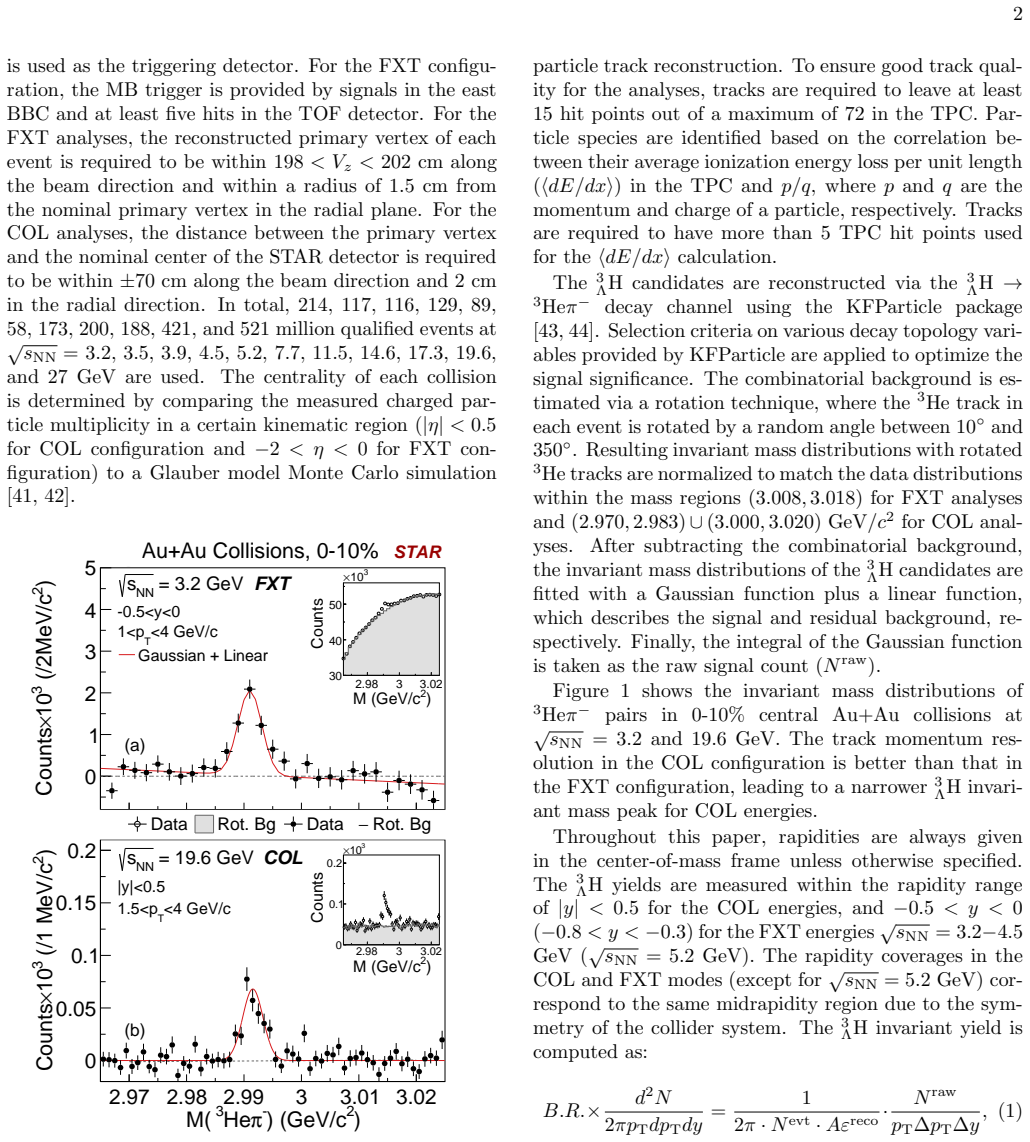
(GeV/c-πHe3M( 0 0.1 0.2 3 10×) 2 (/1 MeV/c310×CountsCounts ) 2M (GeV/cData Rot. Bg Rot. Bg −Data FIG. 1. Combinatorial background subtracted invariant mass distributions of 3 ΛH→ 3Heπ− candidates in 0-10% central Au+Au collisions at √sNN = 3.2 (top) and 19.6 GeV (bot- tom), with un-subtracted distributions inset. They are fitted with a Gaussian plus a lin...
-
[4]
A. Gal, E. V. Hungerford, and D. J. Millener, Rev. Mod. Phys.88, 035004 (2016), arXiv:1605.00557 [nucl-th]
work page Pith review arXiv 2016
-
[5]
L. Tolos and L. Fabbietti, Prog. Part. Nucl. Phys.112, 103770 (2020), arXiv:2002.09223 [nucl-ex]
- [6]
-
[7]
Hyperon Puzzle: Hints from Quantum Monte Carlo Calculations
D. Lonardoni, A. Lovato, S. Gandolfi, and F. Pederiva, Phys. Rev. Lett.114, 092301 (2015), arXiv:1407.4448 [nucl-th]
work page Pith review arXiv 2015
-
[8]
D. Gerstung, N. Kaiser, and W. Weise, Eur. Phys. J. A 56, 175 (2020), arXiv:2001.10563 [nucl-th]
-
[9]
Production of light nuclei, hypernuclei and their antiparticles in relativistic nuclear collisions
A. Andronicet al., Phys. Lett. B697, 203 (2011), arXiv:1010.2995 [nucl-th]
work page Pith review arXiv 2011
-
[10]
J. Steinheimer, K. Gudima, A. Botvina, I. Mishustin, M. Bleicher, and H. Stocker, Phys. Lett. B714, 85 (2012), arXiv:1203.2547 [nucl-th]
work page Pith review arXiv 2012
-
[11]
S. Gl¨ aßel, V. Kireyeu, V. Voronyuk, J. Aichelin, C. Blume, E. Bratkovskaya, G. Coci, V. Kolesnikov, and M. Winn, Phys. Rev. C105, 014908 (2022), arXiv:2106.14839 [nucl-th]
-
[13]
Particle Production in Heavy Ion Collisions
P. Braun-Munzinger, K. Redlich, and J. Stachel, Parti- cle production in heavy ion collisions, inQuark–Gluon Plasma 3(2003) pp. 491–599, arXiv:nucl-th/0304013
work page Pith review arXiv 2003
-
[14]
Decoding the phase structure of QCD via particle production at high energy
A. Andronic, P. Braun-Munzinger, K. Redlich, and J. Stachel, Nature561, 321 (2018), arXiv:1710.09425 [nucl-th]
work page Pith review arXiv 2018
- [17]
- [18]
-
[19]
S. Acharyaet al.(ALICE), Phys. Rev. Lett.131, 102302 (2023), arXiv:2209.07360 [nucl-ex]
-
[20]
M. Abdallahet al.(STAR), Phys. Rev. Lett.128, 202301 (2022), arXiv:2110.09513 [nucl-ex]
-
[21]
S. Acharyaet al.(ALICE), Phys. Lett. B797, 134905 (2019), arXiv:1907.06906 [nucl-ex]
-
[22]
Ji (STAR), EPJ Web Conf.276, 04003 (2023)
Y. Ji (STAR), EPJ Web Conf.276, 04003 (2023)
work page 2023
-
[23]
L. Adamczyket al.(STAR), Phys. Rev. C97, 054909 (2018), arXiv:1710.00436 [nucl-ex]
work page internal anchor Pith review arXiv 2018
-
[24]
Rappoldet al.(HypHI), Physics Letters B747, 129 (2015)
C. Rappoldet al.(HypHI), Physics Letters B747, 129 (2015)
work page 2015
-
[25]
B. I. Abelevet al.(STAR), Science328, 58 (2010), arXiv:1003.2030 [nucl-ex]
work page internal anchor Pith review arXiv 2010
-
[26]
Abdulhamidet al.(STAR), Nature632, 1026 (2024), arXiv:2310.12674 [nucl-ex]
M. Abdulhamidet al.(STAR), Nature632, 1026 (2024), arXiv:2310.12674 [nucl-ex]
-
[27]
J. Adamet al.(ALICE), Phys. Lett. B754, 360 (2016), arXiv:1506.08453 [nucl-ex]
work page Pith review arXiv 2016
-
[28]
S. Acharyaet al.(ALICE), Phys. Rev. Lett.128, 252003 (2022), arXiv:2107.10627 [nucl-ex]
-
[29]
Beam-Energy Dependence of Directed Flow of Protons, Antiprotons and Pions in Au+Au Collisions
L. Adamczyket al.(STAR), Phys. Rev. Lett.112, 162301 (2014), arXiv:1401.3043 [nucl-ex]
work page Pith review arXiv 2014
-
[30]
B. Aboonaet al.(STAR), Phys. Rev. Lett.130, 212301 (2023), arXiv:2211.16981 [nucl-ex]
-
[31]
Herrmann (CBM), EPJ Web Conf.259, 09001 (2022)
N. Herrmann (CBM), EPJ Web Conf.259, 09001 (2022)
work page 2022
-
[32]
Syresinet al.(NICA), in10th International Particle Accelerator Conference(2019) p
E. Syresinet al.(NICA), in10th International Particle Accelerator Conference(2019) p. MOPMP014
work page 2019
-
[33]
K. Aokiet al., Extension of the J-PARC Hadron Experimental Facility: Third White Paper (2021), arXiv:2110.04462 [nucl-ex]
- [34]
- [35]
- [36]
-
[37]
The STAR Time Projection Chamber: A Unique Tool for Studying High Multiplicity Events at RHIC
M. Andersonet al., Nucl. Instrum. Meth. A499, 659 (2003), arXiv:nucl-ex/0301015
work page Pith review arXiv 2003
-
[38]
X. Wang, F. Shen, S. Wang, C. Feng, C. Li, P. Lu, J. Thomas, Q. Xu, and C. Zhu, Nucl. Instrum. Meth. A859, 90 (2017)
work page 2017
-
[39]
E. G. Juddet al., Nucl. Instrum. Meth. A902, 228 (2018)
work page 2018
- [40]
-
[41]
W. J. Llopeet al., Nucl. Instrum. Meth. A759, 23 (2014), arXiv:1403.6855 [physics.ins-det]
work page Pith review arXiv 2014
-
[42]
C. A. Whitten (STAR), AIP Conf. Proc.980, 390 (2008)
work page 2008
- [43]
- [44]
-
[45]
B. I. Abelevet al.(STAR), Phys. Rev. C81, 024911 (2010), arXiv:0909.4131 [nucl-ex]
work page Pith review arXiv 2010
-
[46]
M. Zyzak,Online selection of short-lived particles on many-core computer architectures in the CBM experi- ment at F AIR, Ph.D. thesis, Frankfurt U. (2016)
work page 2016
- [47]
- [49]
- [50]
-
[52]
Barlow, inConference on Advanced Statistical Tech- niques in Particle Physics(2002) pp
R. Barlow, inConference on Advanced Statistical Tech- niques in Particle Physics(2002) pp. 134–144, arXiv:hep- ex/0207026
-
[54]
M. Abdulhamidet al.(STAR), Phys. Rev. Lett.130, 202301 (2023), arXiv:2209.08058 [nucl-ex]
-
[58]
Beam energy dependence of (anti-)deuteron production in Au+Au collisions at RHIC
J. Adamet al.(STAR), Phys. Rev. C99, 064905 (2019), arXiv:1903.11778 [nucl-ex]
work page Pith review arXiv 2019
-
[59]
S. Acharyaet al.(ALICE), Phys. Rev. C107, 064904 (2023), arXiv:2211.14015 [nucl-ex]
- [60]
-
[61]
S. A. Basset al., Prog. Part. Nucl. Phys.41, 255 (1998), arXiv:nucl-th/9803035
work page Pith review arXiv 1998
-
[62]
M. Bleicheret al., J. Phys. G25, 1859 (1999), arXiv:hep- ph/9909407
-
[63]
Z.-J. Dong, G. Chen, Q.-Y. Wang, Z.-L. She, Y.-L. Yan, F.-X. Liu, D.-M. Zhou, and B.-H. Sa, Eur. Phys. J. A 54, 144 (2018), arXiv:1803.01547 [nucl-th]
work page internal anchor Pith review arXiv 2018
- [64]
-
[65]
F. Bellini, K. Blum, A. P. Kalweit, and M. Puccio, Phys. Rev. C103, 014907 (2021), arXiv:2007.01750 [nucl-th]
-
[66]
M. Mahlein, B. Singh, M. Viviani, F. Bellini, L. Fabbietti, A. Kievsky, and L. E. Marcucci, ToMCCA-3: A realistic 3-body coalescence model (2025), arXiv:2504.02491 [hep- ph]. End Matter: Collision Energy Dependence of Hypertriton Production in Au+Au Collisions at RHIC The STAR Collaboration (Dated: April 21, 2026) CENTRALITY DEPENDENCE OF HYPER TRITON PRO...
-
[67]
Thermal-FIST: A package for heavy-ion collisions and hadronic equation of state
V. Vovchenko and H. Stoecker, Comput. Phys. Commun. 244, 295 (2019), arXiv:1901.05249 [nucl-th]
work page Pith review arXiv 2019
-
[68]
V. Vovchenko, V. V. Begun, and M. I. Gorenstein, Phys. Rev. C93, 064906 (2016), arXiv:1512.08025 [nucl-th]
work page internal anchor Pith review arXiv 2016
- [69]
-
[70]
T. Reichert, J. Steinheimer, V. Vovchenko, B. D¨ onigus, and M. Bleicher, Phys. Rev. C107, 014912 (2023), arXiv:2210.11876 [nucl-th]
-
[71]
L. Adamczyket al.(STAR), Phys. Rev. C96, 044904 (2017), arXiv:1701.07065 [nucl-ex]
work page Pith review arXiv 2017
-
[72]
M. Abdulhamidet al.(STAR), Phys. Rev. C110, 054911 (2024), arXiv:2311.11020 [nucl-ex]
-
[73]
J. Adamet al.(STAR), Phys. Rev. C102, 034909 (2020), arXiv:1906.03732 [nucl-ex]
-
[74]
Thermal phenomenology of hadrons from 200 AGeV S+S collisions
E. Schnedermann, J. Sollfrank, and U. W. Heinz, Phys. Rev. C48, 2462 (1993), arXiv:nucl-th/9307020
work page Pith review arXiv 1993
- [75]
- [76]
-
[77]
P. Eckertet al., Rev. Mex. Fis. Suppl.3, 0308069 (2022), arXiv:2201.02368 [physics.data-an]
- [78]
-
[79]
J. Golak, K. Miyagawa, H. Kamada, H. Witala, W. Gloeckle, A. Parreno, A. Ramos, and C. Bennhold, Phys. Rev. C55, 2196 (1997), [Erratum: Phys.Rev.C 56, 2892–2892 (1997)], arXiv:nucl-th/9612065
work page internal anchor Pith review arXiv 1997
-
[80]
V. Vovchenko, B. D¨ onigus, B. Kardan, M. Lorenz, and H. Stoecker, Phys. Lett.B, 135746 (2020), arXiv:2004.04411 [nucl-th]
discussion (0)
Sign in with ORCID, Apple, or X to comment. Anyone can read and Pith papers without signing in.