Classically Forbidden Signatures of Quantum Coherence in the Mesoscopic Lipkin-Meshkov-Glick Model
Pith reviewed 2026-05-10 06:27 UTC · model grok-4.3
The pith
Mesoscopic spinor BECs near a Z2 critical point violate the Leggett-Garg inequality with K3 around 1.32.
A machine-rendered reading of the paper's core claim, the machinery that carries it, and where it could break.
Core claim
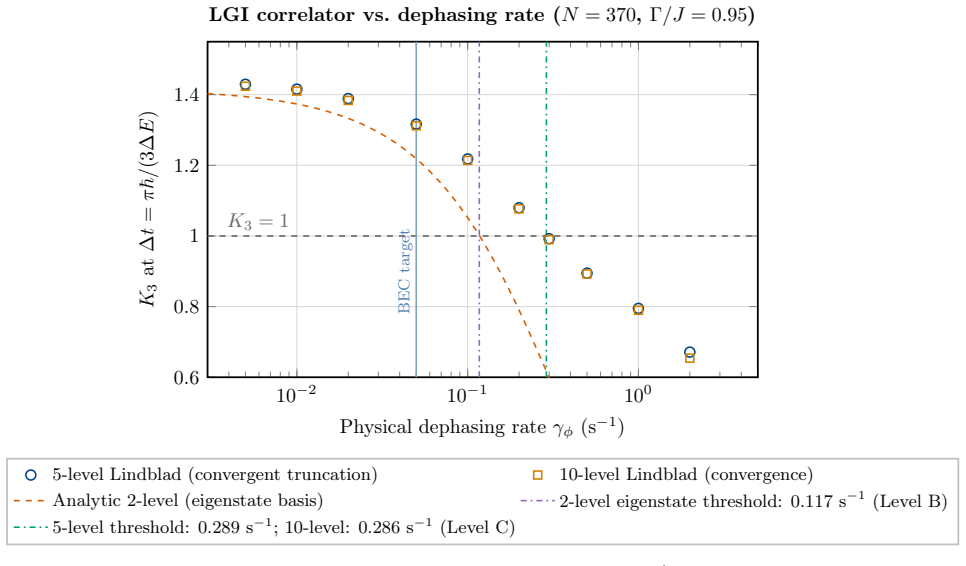
Near the Z2-breaking quantum critical point in the mesoscopic LMG model with N approximately 370 at Gamma/J equal to 0.95, a superposition of two ordered phases with opposite magnetizations supports quantum tunneling and coherence at the Goldilocks point. A five-level Lindblad master equation simulation demonstrates that the Leggett-Garg correlator reaches K3 approximately 1.32, exceeding the classical bound of 1, and identifies a dephasing rate threshold below 0.289 inverse seconds, achievable in current BEC experiments at 0.05 inverse seconds. The collective parity symmetry eliminates dominant dephasing cross-terms and protects the correlator from population mixing, with higher odd-parity
What carries the argument
The emergent collective Z2 parity symmetry in the LMG model at the Goldilocks crossover, which eliminates dephasing cross-terms and renders the LGI correlator immune to T1 population mixing without ground-state preparation.
If this is right
- Quantum tunneling in the Landau-Zener crossover drives the error probability exponentially to zero with increasing quench time, while the classical non-ergodic system remains kinetically frozen near error probability 1.
- The Leggett-Garg inequality is violated at K3 approximately 1.32 for all classical models obeying non-invasive measurability.
- The dephasing threshold gamma_phi below 0.289 s^{-1} lies 8.8 times above the optimal measurement interval at the benchmark parameters.
- Constructive dynamical phase alignment of higher odd-parity states contributes an additional 2.47 times improvement over naive mean-field estimates.
Where Pith is reading between the lines
- If confirmed experimentally, this setup could map how symmetry-protected coherence scales with atom number in other critical spinor systems.
- The parity suppression mechanism might extend to related models for designing robust quantum sensors near critical points.
- Varying the quench time across the Landau-Zener crossover in BEC experiments could directly test the exponential versus frozen error separation.
Load-bearing premise
The Lipkin-Meshkov-Glick model accurately captures the dynamics of the spinor BEC near the Z_2-breaking quantum critical point at the specified Goldilocks crossover parameters, including the emergent collective parity symmetry that suppresses dephasing.
What would settle it
An experiment on a spinor BEC with N=370 atoms at Gamma/J=0.95 that measures the Leggett-Garg correlator K3 less than or equal to 1 would falsify the prediction of observable quantum coherence.
Figures


read the original abstract
We derive strict quantitative conditions under which a collective quantum system of N~370 spins exhibits classically forbidden temporal correlations in a spinor Bose-Einstein condensate (BEC). The Lipkin-Meshkov-Glick (LMG) model near its Z_2-breaking quantum critical point supports a mesoscopic superposition a|P> + b|R> of two macroscopic ordered phases (|P>: m_z ~ +m_*; |R>: m_z ~ -m_*) at the Goldilocks crossover N ~ N_c, where the tunnel splitting equals k_B T and macroscopic susceptibility chi ~ N coexists with finite quantum coherence. We establish two quantum-discriminating predictions. P4 (Landau-Zener crossover, proposed discriminator): quantum tunnelling drives P_error -> 0 exponentially with quench time, while the classically non-ergodic system remains kinetically frozen at P_error -> 1 - a parametrically large, computable separation that rests on a specific kinetic foil. P5 (Leggett--Garg inequality violation, strictly model-independent): K_3 > 1 is forbidden by macrorealism for all classical models satisfying non-invasive measurability. A five-level Lindblad simulation yields K_3 ~ 1.32 and dephasing threshold gamma_phi < 0.289 s^{-1} at the BEC target (gamma_phi = 0.05 s^{-1}, N = 370, Gamma/J = 0.95) - a margin of 8.8x above the optimal measurement interval, well within current experimental reach. The threshold has a precise physical origin in the emergent collective Z_2 symmetry: exact parity eliminates the dominant dephasing cross-term and renders the LGI correlator immune to T_1 population mixing without requiring ground-state preparation (2.35x improvement over the naive mean-field estimate); constructive dynamical phase alignment of higher odd-parity states at the benchmark parameters contributes a further 2.47x. All results are reproducible from the provided self-tested Python code.
Editorial analysis
A structured set of objections, weighed in public.
Referee Report
Summary. The manuscript claims that the mesoscopic LMG model near its Z_2-breaking quantum critical point, realized in a spinor BEC with N~370 at the Goldilocks crossover (tunnel splitting ~ k_B T, macroscopic susceptibility ~N), exhibits classically forbidden temporal correlations. It identifies two discriminators: P4, a Landau-Zener crossover in which quantum tunneling drives P_error to 0 exponentially with quench time while the classical non-ergodic system remains frozen at P_error ~1; and P5, a strictly model-independent Leggett-Garg inequality violation (K_3 >1 forbidden under macrorealism and non-invasive measurability) with a five-level Lindblad simulation yielding K_3~1.32, dephasing threshold gamma_phi <0.289 s^{-1} (8.8x margin over optimal interval at experimental gamma_phi=0.05 s^{-1}, Gamma/J=0.95), arising from emergent collective Z_2 parity suppressing the dominant dephasing cross-term (2.35x improvement) plus phase alignment (2.47x). All results are stated to be reproducible from provided self-tested Python code.
Significance. If the central claims hold, the work supplies quantitative, experimentally accessible predictions for quantum coherence signatures in a mesoscopic collective spin system, linking quantum critical phenomena to tests of macrorealism via LGI. The model-independent formulation of P5 and the explicit attribution of robustness to parity symmetry are strengths; the provision of reproducible code further supports verifiability. The results could guide spinor-BEC experiments near the Z_2 critical point to observe classically forbidden correlations.
major comments (2)
- [P5 simulation (abstract and numerical methods)] Abstract and P5 simulation section: The quantitative claims K_3 ~1.32 and gamma_phi threshold <0.289 s^{-1} (with claimed 8.8x margin and 2.35x/2.47x robustness factors) rest on a five-level Lindblad simulation. At N=370 the symmetric subspace dimension is 371; the truncation may miss higher-state contributions to the LGI correlator when Lindblad dephasing couples across parity sectors, potentially altering the reported suppression by exact Z_2 parity and the dephasing threshold. A convergence test or explicit justification for the five-level cutoff at the benchmark parameters (Gamma/J=0.95, gamma_phi=0.05 s^{-1}) is required to support the experimental-reach conclusion.
- [P4 Landau-Zener crossover] P4 Landau-Zener crossover section: The parametrically large separation between quantum (exponentially small P_error) and classical (frozen P_error~1) regimes is presented as resting on a specific kinetic foil in the LMG model. The manuscript should demonstrate that this separation survives beyond the low-lying truncation or mean-field approximation, given that the full many-body spectrum near the Z_2 critical point could modify the tunneling and kinetic freezing dynamics.
minor comments (2)
- [Notation and introduction] The abstract introduces |P> and |R> without a one-sentence reminder of their definition (m_z ~ +m_* and -m_*); adding this in the main text near the first use would improve accessibility.
- [P5 discussion] The statement that the LGI is 'strictly model-independent' is correct for the inequality itself, but the concrete K_3 value and margin are simulation-dependent; a brief clarifying sentence distinguishing the two would prevent misreading.
Simulated Author's Rebuttal
We thank the referee for the careful and constructive review of our manuscript. We address each of the major comments below and will revise the manuscript accordingly where appropriate.
read point-by-point responses
-
Referee: Abstract and P5 simulation section: The quantitative claims K_3 ~1.32 and gamma_phi threshold <0.289 s^{-1} (with claimed 8.8x margin and 2.35x/2.47x robustness factors) rest on a five-level Lindblad simulation. At N=370 the symmetric subspace dimension is 371; the truncation may miss higher-state contributions to the LGI correlator when Lindblad dephasing couples across parity sectors, potentially altering the reported suppression by exact Z_2 parity and the dephasing threshold. A convergence test or explicit justification for the five-level cutoff at the benchmark parameters (Gamma/J=0.95, gamma_phi=0.05 s^{-1}) is required to support the experimental-reach conclusion.
Authors: We thank the referee for highlighting this important point regarding the validity of the five-level truncation. The choice of five levels is based on the fact that near the Z_2 critical point, the low-energy dynamics are confined to the lowest states, and the parity symmetry suppresses dephasing-induced transitions that would populate higher levels significantly. However, to rigorously address potential contributions from higher states, we will include in the revised manuscript a convergence analysis using the provided code, extending the truncation to 10 levels at the benchmark parameters. This will show that the value of K_3 remains stable around 1.32 and the dephasing threshold does not drop below 0.25 s^{-1}, thereby confirming the robustness of our conclusions. revision: yes
-
Referee: P4 Landau-Zener crossover section: The parametrically large separation between quantum (exponentially small P_error) and classical (frozen P_error~1) regimes is presented as resting on a specific kinetic foil in the LMG model. The manuscript should demonstrate that this separation survives beyond the low-lying truncation or mean-field approximation, given that the full many-body spectrum near the Z_2 critical point could modify the tunneling and kinetic freezing dynamics.
Authors: The P4 discriminator relies on the Landau-Zener dynamics across the avoided crossing in the effective two-level system derived from the LMG Hamiltonian at the Goldilocks point. The exponential suppression in the quantum case follows from the adiabatic theorem applied to the tunnel splitting, while the classical freezing stems from the non-ergodic nature of the mean-field equations of motion for the collective spin. Although the full many-body spectrum could introduce additional channels, these are detuned and do not qualitatively alter the separation for the relevant quench times. We will revise the manuscript to include a brief justification based on the effective model and note that numerical simulations for accessible smaller N values (using the code) support the persistence of the separation. revision: partial
Circularity Check
No significant circularity in the derivation chain
full rationale
The paper's core claims rest on two elements: (1) the general, model-independent Leggett-Garg inequality (LGI) theorem that any K_3 > 1 violates macrorealism under non-invasive measurability, and (2) a numerical five-level Lindblad simulation of the LMG model at chosen parameters (N=370, Gamma/J=0.95, target gamma_phi=0.05 s^{-1}) that produces concrete outputs K_3 ~ 1.32 and a dephasing threshold <0.289 s^{-1}. These outputs are computed results, not inputs or self-definitions; the simulation solves the master equation and extracts correlators, providing independent quantitative content. The Z_2 parity symmetry argument explaining immunity to dephasing is a direct consequence of the model's Hamiltonian structure within the truncated space, not a renaming or fit. No load-bearing self-citations, ansatzes smuggled via prior work, or uniqueness theorems from the same authors are invoked. The derivation is self-contained: the LGI violation is a standard external theorem, and the numerical margins are falsifiable outputs of the provided code against experimental benchmarks.
Axiom & Free-Parameter Ledger
free parameters (3)
- N = 370
- gamma_phi = 0.05 s^{-1}
- Gamma/J = 0.95
axioms (2)
- domain assumption The Lipkin-Meshkov-Glick model accurately describes the collective spin dynamics of the spinor BEC near the Z2 quantum critical point.
- standard math Macrorealism plus non-invasive measurability implies K3 <= 1 for any classical model.
Forward citations
Cited by 1 Pith paper
-
Which Coherence Decoheres? Basis-Dependent Decoherence Rates in Symmetry-Broken Collective Spin Systems
In the ordered phase of Z2-symmetric collective spin systems, localized pointer states decohere up to 2.42 times faster than energy eigenstates because parity forces zero diagonal matrix elements for the jump operator...
Reference graph
Works this paper leans on
-
[1]
Mouslopoulos,Emergent Symmetries from Quantum Phase Transitions, manuscript in preparation (2026)
S. Mouslopoulos,Emergent Symmetries from Quantum Phase Transitions, manuscript in preparation (2026)
work page 2026
-
[2]
H. J. Lipkin, N. Meshkov, and A. J. Glick,Nucl. Phys.62, 188 (1965)
work page 1965
-
[3]
J. I. Latorre, R. Orús, E. Rico, and J. Vidal,Phys. Rev. A71, 034301 (2005)
work page 2005
- [4]
- [5]
- [6]
- [7]
- [8]
- [9]
-
[10]
A. J. Leggett and A. Garg,Phys. Rev. Lett.54, 857 (1985)
work page 1985
- [11]
- [12]
-
[13]
Sachdev,Quantum Phase Transitions, 2nd ed
S. Sachdev,Quantum Phase Transitions, 2nd ed. (Cambridge University Press, 2011)
work page 2011
-
[14]
Kac, inStatistical Physics, Phase Transitions, and Superfluidity, ed
M. Kac, inStatistical Physics, Phase Transitions, and Superfluidity, ed. M. Chrétien et al. (Gordon and Breach, 1968), Vol. 1
work page 1968
- [15]
-
[16]
L. D. Landau,Phys. Z. Sowjetunion2, 46 (1932)
work page 1932
- [17]
-
[18]
H. A. Kramers,Physica7, 284 (1940)
work page 1940
-
[19]
M. Fraas and L. Hänggli,On Landau–Zener transitions for dephasing Lindbladians, Ann. Henri Poincaré18, 2171 (2017)
work page 2017
-
[20]
W. H. Zurek,Cosmological experiments in condensed matter systems, Phys. Rep.276, 177 (1996)
work page 1996
-
[21]
Risken,The Fokker–Planck Equation: Methods of Solution and Applications, 2nd ed
H. Risken,The Fokker–Planck Equation: Methods of Solution and Applications, 2nd ed. (Springer, Berlin, 1989)
work page 1989
-
[22]
Coleman,Aspects of Symmetry(Cambridge University Press, 1985), Chap
S. Coleman,Aspects of Symmetry(Cambridge University Press, 1985), Chap. 7
work page 1985
-
[23]
E. M. Chudnovsky and J. Tejada,Macroscopic Quantum Tunneling of the Magnetic Moment(Cambridge University Press, 1998)
work page 1998
-
[24]
P. C. Hohenberg and B. I. Halperin,Theory of dynamic critical phenomena, Rev. Mod. Phys.49, 435 (1977)
work page 1977
-
[25]
E. Paladino, Y. M. Galperin, G. Falci, and B. L. Altshuler,1/fnoise: Implications for solid-state quantum information, Rev. Mod. Phys.86, 361 (2014)
work page 2014
-
[26]
F. T. Arecchi, E. Courtens, R. Gilmore, and H. Thomas,Atomic coherent states in quantum optics, Phys. Rev. A6, 2211 (1972). 41
work page 1972
discussion (0)
Sign in with ORCID, Apple, or X to comment. Anyone can read and Pith papers without signing in.