Intrinsic Magnetoelectric Hall Effect from Layer-Orbital Quantum Geometry
Pith reviewed 2026-05-09 23:58 UTC · model grok-4.3
The pith
A mixed layer-orbital quantum geometry produces an intrinsic magnetoelectric Hall effect bilinear in electric and magnetic fields.
A machine-rendered reading of the paper's core claim, the machinery that carries it, and where it could break.
Core claim
The combined action of out-of-plane electric and magnetic fields couples to layer polarization and orbital moment, generating a mixed layer-orbital quantum geometry in field-dressed Bloch states. This geometry produces an intrinsic magnetoelectric Hall effect bilinear in the fields, which is scattering-time independent and can occur in nonmagnetic systems without spin-orbit coupling. The response originates from interband coherence and persists in the band gap, with the Hall coefficient being odd under gate reversal and tracking layer polarization. As shown in rhombohedral pentalayer graphene, the conductivity reaches order 0.05 e²/h.
What carries the argument
Mixed layer-orbital quantum geometry in field-dressed Bloch states, arising from the coupling of out-of-plane fields to layer polarization and orbital moment.
If this is right
- The magnetoelectric Hall conductivity is independent of scattering time.
- The effect appears in nonmagnetic materials lacking spin-orbit coupling.
- The Hall response remains finite and non-quantized within the band gap.
- The Hall coefficient reverses sign upon gate voltage reversal and follows the layer polarization.
- Certain symmetry classes of layered materials are predicted to exhibit this transport.
Where Pith is reading between the lines
- This mechanism could enable gate-tunable Hall measurements to detect layer polarization in 2D systems.
- Analogous bilinear responses may appear in other multilayer van der Waals materials with tunable interlayer coupling.
- The effect suggests device concepts for magnetoelectric sensing that require no net magnetization.
Load-bearing premise
The combined out-of-plane electric and magnetic fields can be treated as a perturbation that generates a well-defined mixed layer-orbital quantum geometry in the field-dressed Bloch states whose interband coherence yields a bilinear Hall response.
What would settle it
Observation of a Hall conductivity linear in both applied out-of-plane E and B fields inside the band gap of a nonmagnetic layered material without spin-orbit coupling, with the coefficient odd under gate reversal, would support the claim; its absence in rhombohedral pentalayer graphene would falsify it.
Figures
read the original abstract
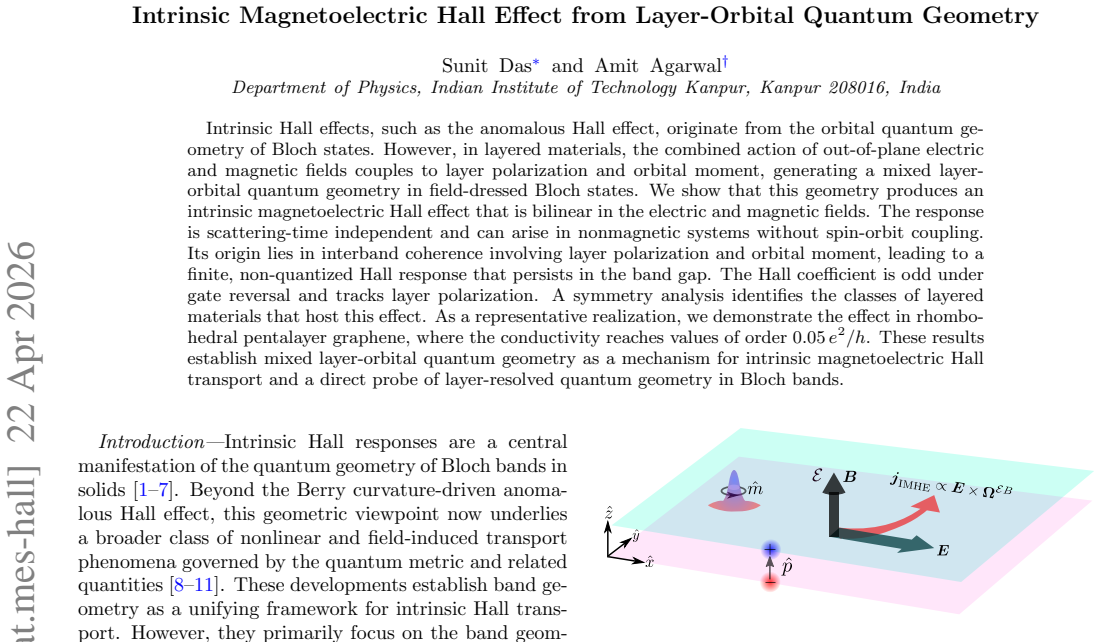
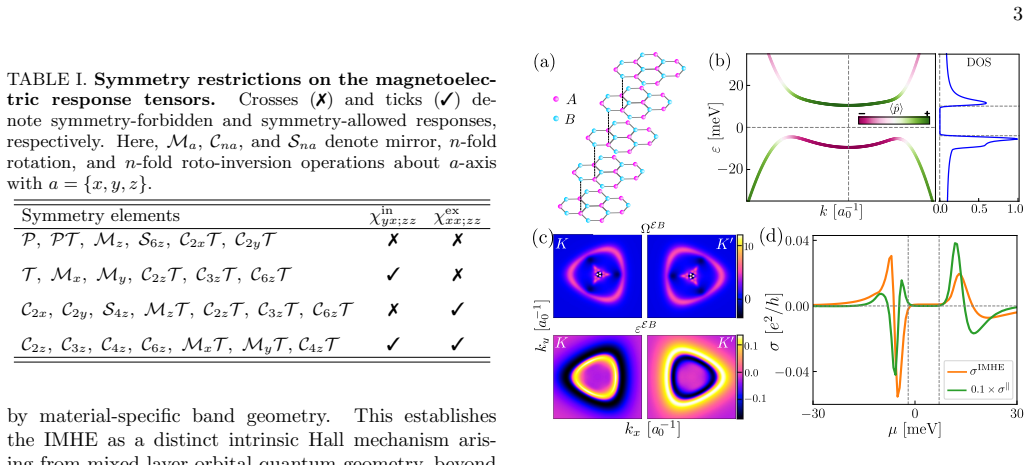
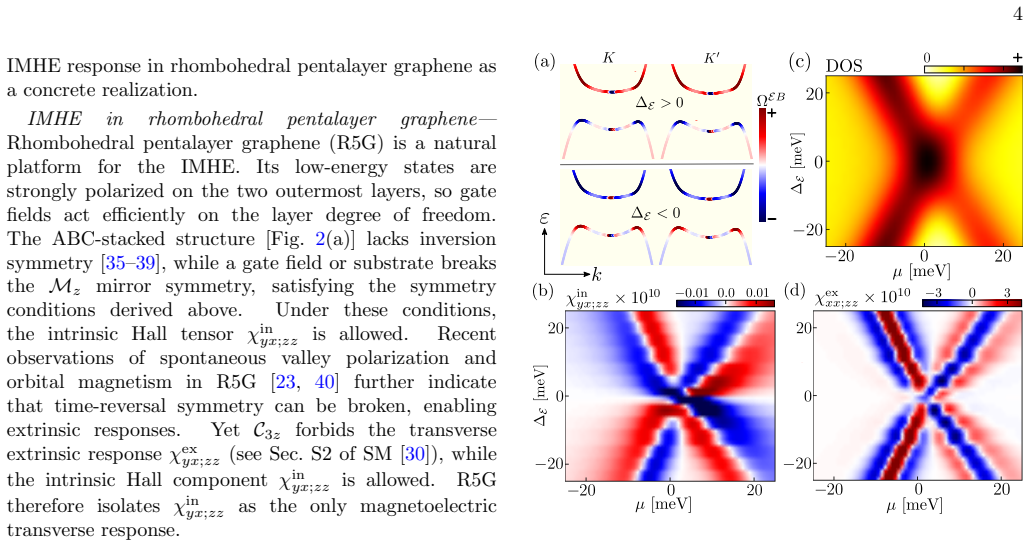
Intrinsic Hall effects, such as the anomalous Hall effect, originate from the orbital quantum geometry of Bloch states. However, in layered materials, the combined action of out-of-plane electric and magnetic fields couples to layer polarization and orbital moment, generating a mixed layer-orbital quantum geometry in field-dressed Bloch states. We show that this geometry produces an intrinsic magnetoelectric Hall effect that is bilinear in the electric and magnetic fields. The response is scattering-time independent and can arise in nonmagnetic systems without spin-orbit coupling. Its origin lies in interband coherence involving layer polarization and orbital moment, leading to a finite, non-quantized Hall response that persists in the band gap. The Hall coefficient is odd under gate reversal and tracks layer polarization. A symmetry analysis identifies the classes of layered materials that host this effect. As a representative realization, we demonstrate the effect in rhombohedral pentalayer graphene, where the conductivity reaches values of order $0.05\,e^2/h$. These results establish mixed layer-orbital quantum geometry as a mechanism for intrinsic magnetoelectric Hall transport and a direct probe of layer-resolved quantum geometry in Bloch bands.
Editorial analysis
A structured set of objections, weighed in public.
Referee Report
Summary. The manuscript derives an intrinsic magnetoelectric Hall effect that is bilinear in out-of-plane electric and magnetic fields, arising from mixed layer-orbital quantum geometry in field-dressed Bloch states of layered materials. The response is scattering-time independent, occurs without magnetism or spin-orbit coupling, persists inside the band gap, is odd under gate reversal, and tracks layer polarization. Symmetry analysis identifies allowed material classes, and a numerical demonstration in rhombohedral pentalayer graphene yields a Hall conductivity of order 0.05 e²/h.
Significance. If the central derivation holds, the work identifies a new geometric mechanism for intrinsic Hall transport that directly couples layer polarization and orbital moment, offering a probe of layer-resolved quantum geometry and a concrete, testable prediction for multilayer graphene. The scattering independence and persistence in the gap distinguish it from conventional extrinsic contributions and extend the scope of quantum-geometric Hall effects.
major comments (1)
- [field-dressed Bloch states derivation] The derivation of the bilinear response (abstract and the section introducing field-dressed Bloch states) relies on first-order perturbative dressing of zero-field Bloch states by both E_z and B_z to generate the mixed layer-orbital quantum geometry. However, a uniform B_z is introduced via a vector potential that explicitly breaks continuous translational symmetry, so the eigenstates are Landau levels (or magnetic Bloch states on a supercell) rather than ordinary crystal-momentum eigenstates. First-order perturbation around zero-B Bloch states therefore captures only the diagonal orbital-moment shift while omitting non-perturbative orbital mixing and cyclotron-orbit contributions that dominate Hall transport. Because the claimed response is asserted to be intrinsic and to persist inside the gap, this approximation directly undermines extraction of a clean bilinear geometric term.
minor comments (2)
- [numerical results] The numerical value is quoted only as 'order 0.05 e²/h' in the abstract; the main text should report the precise computed conductivity, the specific E and B values used, and any convergence checks with respect to k-point sampling or layer thickness.
- [theory section] Notation for the mixed quantum metric and Berry curvature terms should be defined explicitly with equation numbers when first introduced, to avoid ambiguity between layer-polarization and orbital-moment contributions.
Simulated Author's Rebuttal
We thank the referee for their careful reading and insightful comment on the derivation. We address the concern point by point below and will make a partial revision to clarify the weak-field regime.
read point-by-point responses
-
Referee: [field-dressed Bloch states derivation] The derivation of the bilinear response (abstract and the section introducing field-dressed Bloch states) relies on first-order perturbative dressing of zero-field Bloch states by both E_z and B_z to generate the mixed layer-orbital quantum geometry. However, a uniform B_z is introduced via a vector potential that explicitly breaks continuous translational symmetry, so the eigenstates are Landau levels (or magnetic Bloch states on a supercell) rather than ordinary crystal-momentum eigenstates. First-order perturbation around zero-B Bloch states therefore captures only the diagonal orbital-moment shift while omitting non-perturbative orbital mixing and cyclotron-orbit contributions that dominate Hall transport. Because the claimed response is asserted to be intrinsic and to persist inside the gap, this approximation directly undermines extraction of
Authors: We agree that a uniform B_z formally breaks continuous translational symmetry, requiring magnetic Bloch states or Landau levels for exact eigenstates. However, our derivation targets the weak-field limit (magnetic length much larger than lattice constant, cyclotron energy small compared to bandwidth), where the standard perturbative expansion in the vector potential around zero-field Bloch states is valid and routinely employed in the literature for intrinsic geometric responses (e.g., orbital magnetization, Berry-phase corrections to conductivity). This captures the leading bilinear term arising from mixed layer-orbital quantum geometry in the interband coherence, without requiring strong-field non-perturbative mixing. Cyclotron and Landau-level effects appear at higher order or in the quantized strong-B regime and do not contaminate the scattering-independent, gap-persistent bilinear geometric contribution we isolate. The persistence inside the gap follows directly from the density-matrix perturbation in the dressed basis, independent of scattering. We will add an explicit paragraph in the revised manuscript discussing the validity conditions of the weak-field approximation, its separation from strong-field physics, and supporting references. This is a partial revision for clarity; the central results remain unchanged. revision: partial
Circularity Check
No circularity: derivation follows from standard quantum geometry without reduction to inputs
full rationale
The paper derives the bilinear magnetoelectric Hall response from interband coherence in the mixed layer-orbital quantum geometry of perturbatively field-dressed Bloch states. No equation or step reduces by construction to a fitted parameter, self-definition, or load-bearing self-citation chain; the result is obtained from the geometric Berry-phase-like terms under combined E and B perturbations. The demonstration in rhombohedral pentalayer graphene is a concrete evaluation rather than a fit renamed as prediction. This matches the default expectation of a self-contained first-principles calculation.
Axiom & Free-Parameter Ledger
axioms (2)
- standard math Bloch theorem and band structure in periodic crystals
- domain assumption Perturbative treatment of weak electric and magnetic fields on Bloch states
Forward citations
Cited by 1 Pith paper
-
Orbital-Splitter Current in Altermagnets
Altermagnets host a purely intrinsic orbital-splitter current that is strongly anisotropic, exceeds the spin-splitter current by up to a factor of four in some directions, and generates damping-like torque to speed up...
Reference graph
Works this paper leans on
-
[1]
Berry phase effects on electronic properties,
Di Xiao, Ming-Che Chang, and Qian Niu, “Berry phase effects on electronic properties,” Rev. Mod. Phys.82, 1959–2007 (2010)
work page 1959
-
[2]
Quantum Geometry Phenomena in Condensed Matter Systems,
Anyuan Gao, Naoto Nagaosa, Ni Ni, and Su-Yang Xu, “Quantum geometry phenomena in condensed matter systems,” (2025), arXiv:2508.00469 [cond-mat.str-el]
-
[3]
Quantum geometry and the hidden scales in materials,
Nishchhal Verma, Philip J. W. Moll, Tobias Holder, and Raquel Queiroz, “Quantum geometry and the hidden scales in materials,” Nature Reviews Physics (2026)
work page 2026
-
[4]
Quantum geometry in quantum materials,
Jiabin Yu, B. Andrei Bernevig, Raquel Queiroz, Enrico Rossi, P¨ aivi T¨ orm¨ a, and Bohm-Jung Yang, “Quantum geometry in quantum materials,” npj Quantum Materials 10, 101 (2025)
work page 2025
-
[5]
Quantum geometry in condensed matter,
Tianyu Liu, Xiao-Bin Qiang, Hai-Zhou Lu, and X C Xie, “Quantum geometry in condensed matter,” National Science Review12, nwae334 (2024)
work page 2024
-
[6]
Tunable moir´ e materials for probing berry physics and topology,
Pratap Chandra Adak, Subhajit Sinha, Amit Agarwal, and Mandar M. Deshmukh, “Tunable moir´ e materials for probing berry physics and topology,” Nature Reviews Materials9, 481–498 (2024)
work page 2024
-
[7]
Rhonald Burgos Atencia, Amit Agarwal, and Dimitrie Culcer, “Orbital angular momentum of bloch electrons: equilibrium formulation, magneto-electric phenomena, and the orbital hall effect,” Advances in Physics: X9, 2371972 (2024)
work page 2024
-
[8]
Nonlinear hall effect with time-reversal symmetry: Theory and material realizations,
Carmine Ortix, “Nonlinear hall effect with time-reversal symmetry: Theory and material realizations,” Advanced Quantum Technologies4, 2100056 (2021)
work page 2021
-
[9]
Non-linear hall effects: Mechanisms and materials,
Arka Bandyopadhyay, Nesta Benno Joseph, and Awad- hesh Narayan, “Non-linear hall effects: Mechanisms and materials,” Materials Today Electronics8, 100101 (2024)
work page 2024
-
[10]
Reveal- ing quantum geometry in nonlinear quantum materials,
Yiyang Jiang, Tobias Holder, and Binghai Yan, “Reveal- ing quantum geometry in nonlinear quantum materials,” Reports on Progress in Physics88, 076502 (2025)
work page 2025
-
[11]
Non- linear transport in non-centrosymmetric systems,
Manuel Su´ arez-Rodr´ ıguez, Fernando de Juan, Ivo Souza, Marco Gobbi, F` elix Casanova, and Luis E. Hueso, “Non- linear transport in non-centrosymmetric systems,” Na- ture Materials24, 1005–1018 (2025)
work page 2025
-
[12]
Intrinsic gyrotropic magnetic current from zeeman quantum geometry,
Longjun Xiang, Jinxiong Jia, Fuming Xu, Zhenhua Qiao, and Jian Wang, “Intrinsic gyrotropic magnetic current from zeeman quantum geometry,” Phys. Rev. Lett.134, 116301 (2025)
work page 2025
-
[13]
Layer hall effect in a 2d topological axion antiferromagnet,
Anyuan Gao, Yu-Fei Liu, Chaowei Hu, Jian-Xiang Qiu, Christian Tzschaschel, Barun Ghosh, Sheng-Chin Ho, Damien B´ erub´ e, Rui Chen, Haipeng Sun, Zhaowei Zhang, Xin-Yue Zhang, Yu-Xuan Wang, Naizhou Wang, Zumeng Huang, Claudia Felser, Amit Agarwal, Thomas Ding, Hung-Ju Tien, Austin Akey, Jules Gardener, Ba- hadur Singh, Kenji Watanabe, Takashi Taniguchi, Ke...
work page 2021
-
[14]
Layer hall effect without external electric field,
Yulei Han, Yunpeng Guo, Zeyu Li, and Zhenhua Qiao, “Layer hall effect without external electric field,” Phys. Rev. Lett.134, 236206 (2025)
work page 2025
-
[15]
Layer hall effect in multiferroic two-dimensional materials,
Yangyang Feng, Ying Dai, Baibiao Huang, Liangzhi Kou, and Yandong Ma, “Layer hall effect in multiferroic two-dimensional materials,” Nano Letters23, 5367–5372 (2023)
work page 2023
-
[16]
Zhuo-Hua Chen, Hou-Jian Duan, Ming-Xun Deng, and Rui-Qiang Wang, “Nonlinear layer hall effect and detection of the hidden berry curvature dipole in PT-symmetric antiferromagnetic insulators,” (2025), arXiv:2510.23971 [cond-mat.mes-hall]
-
[17]
Gate-controllable quadri- layertronics in 2d multiferroic antiferromagnet,
Ting Zhang, Mingsheng Wang, Xilong Xu, Ying 6 Dai, and Yandong Ma, “Gate-controllable quadri- layertronics in 2d multiferroic antiferromagnet,” (2024), arXiv:2411.07016 [cond-mat.mtrl-sci]
-
[18]
Planar hall effect in quasi-two-dimensional materials,
Koushik Ghorai, Sunit Das, Harsh Varshney, and Amit Agarwal, “Planar hall effect in quasi-two-dimensional materials,” Phys. Rev. Lett.134, 026301 (2025)
work page 2025
-
[19]
Interlayer electric multipoles induced by in-plane field from quantum geometric origins,
Huiyuan Zheng, Dawei Zhai, Cong Xiao, and Wang Yao, “Interlayer electric multipoles induced by in-plane field from quantum geometric origins,” Nano Letters24, 8017–8023 (2024)
work page 2024
-
[20]
Time-reversal even charge hall effect from twisted in- terface coupling,
Dawei Zhai, Cong Chen, Cong Xiao, and Wang Yao, “Time-reversal even charge hall effect from twisted in- terface coupling,” Nature Communications14(2023)
work page 2023
-
[21]
Layer coherence origin of planar hall effect: From charge to multipole and valley,
Huiyuan Zheng, Dawei Zhai, Cong Xiao, and Wang Yao, “Layer coherence origin of planar hall effect: From charge to multipole and valley,” Nano Letters25, 10096–10101 (2025)
work page 2025
-
[22]
Crossed nonlinear dynamical hall effect in twisted bi- layers,
Cong Chen, Dawei Zhai, Cong Xiao, and Wang Yao, “Crossed nonlinear dynamical hall effect in twisted bi- layers,” Phys. Rev. Res.6, L012059 (2024)
work page 2024
-
[23]
Orbital multiferroicity in pentalayer rhombohedral graphene,
Tonghang Han, Zhengguang Lu, Giovanni Scuri, Jiho Sung, Jue Wang, Tianyi Han, Kenji Watanabe, Takashi Taniguchi, Liang Fu, Hongkun Park, and Long Ju, “Orbital multiferroicity in pentalayer rhombohedral graphene,” Nature623, 41–47 (2023)
work page 2023
-
[24]
Orbital longitudi- nal magnetoelectric coupling in rhombohedral multilayer graphene,
Jin-Xin Hu and Justin C. W. Song, “Orbital longitudi- nal magnetoelectric coupling in rhombohedral multilayer graphene,” Proceedings of the National Academy of Sci- ences123, e2506751123 (2026)
work page 2026
-
[25]
Jin-Xin Hu, “Orbital longitudinal magnetoelectricity in quasi-2d parity-violating antiferromagnets: Inter- play of berry phase and stacking order,” (2025), arXiv:2511.20517 [cond-mat.mes-hall]
-
[26]
Electric hall effect and quan- tum electric hall effect,
Chaoxi Cui, Run-Wu Zhang, Yuhui Qiu, Yilin Han, Zhi- Ming Yu, and Yugui Yao, “Electric hall effect and quan- tum electric hall effect,” Phys. Rev. Lett.135, 116301 (2025)
work page 2025
-
[27]
Layer hall counterflow as a model probe of magic-angle twisted bilayer graphene,
Jihang Zhu, Dawei Zhai, Cong Xiao, and Wang Yao, “Layer hall counterflow as a model probe of magic-angle twisted bilayer graphene,” Phys. Rev. B109, 155114 (2024)
work page 2024
-
[28]
Dissipationless layertronics in axion insulator mnbi2te4,
Shuai Li, Ming Gong, Shuguang Cheng, Hua Jiang, and X C Xie, “Dissipationless layertronics in axion insulator mnbi2te4,” National Science Review11, nwad262 (2023)
work page 2023
-
[29]
Orbital origin of the intrinsic pla- nar hall effect,
Hui Wang, Yue-Xin Huang, Huiying Liu, Xiaolong Feng, Jiaojiao Zhu, Weikang Wu, Cong Xiao, and Shengyuan A. Yang, “Orbital origin of the intrinsic pla- nar hall effect,” Phys. Rev. Lett.132, 056301 (2024)
work page 2024
-
[30]
See Supplemental Material at [link to be inserted by the publisher] for details on (S1) derivation of magne- toelectric current expressions, (S2) magnetic point group symmetry restriction, (S3) magnetoelectric transport re- sponse in R5G, and (S4) distinction of IMHE from other Hall mechanisms
-
[31]
John David Jackson,Classical electrodynamics(John Wi- ley & Sons, 2012)
work page 2012
-
[32]
Orbital magnetization as the origin of the nonlinear hall effect,
Zesheng Zhang, Xin-Zhi Li, and Wen-Yu He, “Orbital magnetization as the origin of the nonlinear hall effect,” Phys. Rev. Res.7, L042064 (2025)
work page 2025
-
[33]
Robert E Newnham,Properties of Materials: Anisotropy, Symmetry, Structure(Oxford University Press, New York, 2005)
work page 2005
-
[34]
Samuel V. Gallego, Jesus Etxebarria, Luis Elcoro, Emre S. Tasci, and J. Manuel Perez-Mato, “Automatic calculation of symmetry-adapted tensors in magnetic and non-magnetic materials: a new tool of the Bilbao Crys- tallographic Server,” Acta Crystallogr. Sect. A75, 438 (2019)
work page 2019
-
[35]
Trigonal warp- ing and berry’s phasenπin abc-stacked multilayer graphene,
Mikito Koshino and Edward McCann, “Trigonal warp- ing and berry’s phasenπin abc-stacked multilayer graphene,” Phys. Rev. B80, 165409 (2009)
work page 2009
-
[36]
Berry curvature of low-energy excitons in rhom- bohedral graphene,
Henry Davenport, Frank Schindler, and Johannes Knolle, “Berry curvature of low-energy excitons in rhom- bohedral graphene,” Phys. Rev. B113, 115102 (2026)
work page 2026
-
[37]
Junkai Dong, Taige Wang, Tianle Wang, Tomohiro Soe- jima, Michael P. Zaletel, Ashvin Vishwanath, and Daniel E. Parker, “Anomalous hall crystals in rhombo- hedral multilayer graphene. i. interaction-driven chern bands and fractional quantum hall states at zero mag- netic field,” Phys. Rev. Lett.133, 206503 (2024)
work page 2024
-
[38]
Theory of quantum anomalous hall phases in pentalayer rhombo- hedral graphene moir´ e structures,
Zhihuan Dong, Adarsh S. Patri, and T. Senthil, “Theory of quantum anomalous hall phases in pentalayer rhombo- hedral graphene moir´ e structures,” Phys. Rev. Lett.133, 206502 (2024)
work page 2024
-
[39]
Spon- taneous vortex-antivortex lattice and majorana fermions in rhombohedral graphene,
Filippo Gaggioli, Daniele Guerci, and Liang Fu, “Spon- taneous vortex-antivortex lattice and majorana fermions in rhombohedral graphene,” Phys. Rev. Lett.135, 116001 (2025)
work page 2025
-
[40]
Large quantum anomalous hall effect in spin-orbit prox- imitized rhombohedral graphene,
Tonghang Han, Zhengguang Lu, Yuxuan Yao, Jixi- ang Yang, Junseok Seo, Chiho Yoon, Kenji Watanabe, Takashi Taniguchi, Liang Fu, Fan Zhang, and Long Ju, “Large quantum anomalous hall effect in spin-orbit prox- imitized rhombohedral graphene,” Science384, 647–651 (2024)
work page 2024
-
[41]
In multilayer graphene, the interlayer potential drop is renormalized by electrostatic screening arising from layer charge redistribution. As a result, the effective potential difference can become a nonlinear function of the applied gate field and depends on carrier density [24]. For sim- plicity, we neglect these screening effects and treatϵ r phenomeno...
-
[42]
The ΩEB (εEB) isT-even (T-odd)
‘Predominantly’ because the small valley polarization used in the R5G model weakly breaks time-reversal sym- metry. The ΩEB (εEB) isT-even (T-odd). In the absence of valley polarization, consequently, they have the same (opposite) sign and amplitude in the two valleys. See also Sec. S2 of SM [30]
-
[43]
In-plane hall effect in two- dimensional helical electron systems,
Vladimir A. Zyuzin, “In-plane hall effect in two- dimensional helical electron systems,” Phys. Rev. B102, 241105 (2020)
work page 2020
-
[44]
James H. Cullen, Pankaj Bhalla, E. Marcellina, A. R. Hamilton, and Dimitrie Culcer, “Generating a topolog- ical anomalous hall effect in a nonmagnetic conductor: An in-plane magnetic field as a direct probe of the berry curvature,” Phys. Rev. Lett.126, 256601 (2021)
work page 2021
-
[45]
Anomalous planar hall effect in two-dimensional trigonal crystals,
Raffaele Battilomo, Niccol´ o Scopigno, and Carmine Or- tix, “Anomalous planar hall effect in two-dimensional trigonal crystals,” Phys. Rev. Res.3, L012006 (2021)
work page 2021
-
[46]
Anomalous hall effect in ZrTe5,
Tian Liang, Jingjing Lin, Quinn Gibson, Satya Kush- waha, Minhao Liu, Wudi Wang, Hongyu Xiong, Jonathan A. Sobota, Makoto Hashimoto, Patrick S. Kirchmann, Zhi-Xun Shen, R. J. Cava, and N. P. Ong, “Anomalous hall effect in ZrTe5,” Nat. Phys.14, 451 (2018)
work page 2018
-
[47]
Heterodimensional superlattice with in- plane anomalous hall effect,
Jiadong Zhou, Wenjie Zhang, Yung-Chang Lin, Jin Cao, Yao Zhou, Wei Jiang, Huifang Du, Bijun Tang, Jia Shi, Bingyan Jiang, Xun Cao, Bo Lin, Qundong Fu, Chao Zhu, Wei Guo, Yizhong Huang, Yuan Yao, Stuart S. P. 7 Parkin, Jianhui Zhou, Yanfeng Gao, Yeliang Wang, Yan- glong Hou, Yugui Yao, Kazu Suenaga, Xiaosong Wu, and Zheng Liu, “Heterodimensional superlatti...
work page 2022
-
[48]
Berry phase cor- rection to electron density of states in solids,
Di Xiao, Junren Shi, and Qian Niu, “Berry phase cor- rection to electron density of states in solids,” Phys. Rev. Lett.95, 137204 (2005). End Matter Appendix A: Field-induced quantum geometry and en- ergy correction—We consider a general Bloch Hamilto- nian ˆH0 for a layered material, ˆH0|unk⟩=ε n(k)|unk⟩, where|u nk⟩is the Bloch eigenstate with energyε n...
work page 2005
discussion (0)
Sign in with ORCID, Apple, or X to comment. Anyone can read and Pith papers without signing in.