Multi-photon schemes for mid-infrared detection
Pith reviewed 2026-05-08 07:38 UTC · model grok-4.3
The pith
Ge_{1-x}Sn_x alloys deliver substantially larger nonlinear response and three-color injected current than GaAs for certain pump energies and compositions in the mid-infrared.
A machine-rendered reading of the paper's core claim, the machinery that carries it, and where it could break.
Core claim
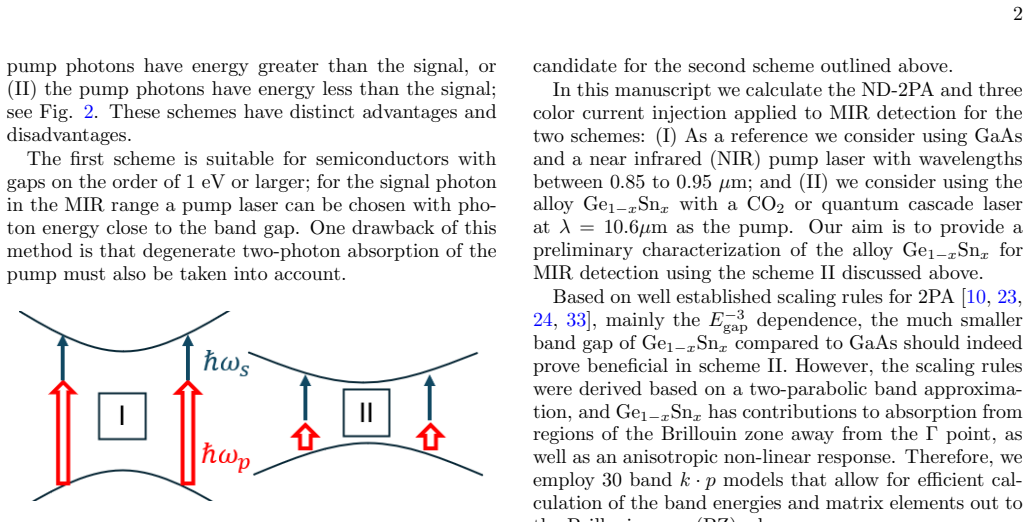
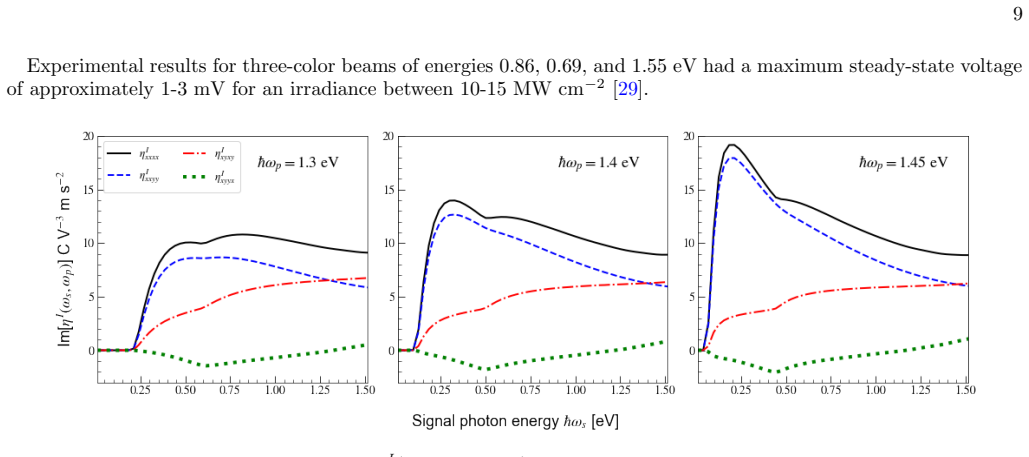
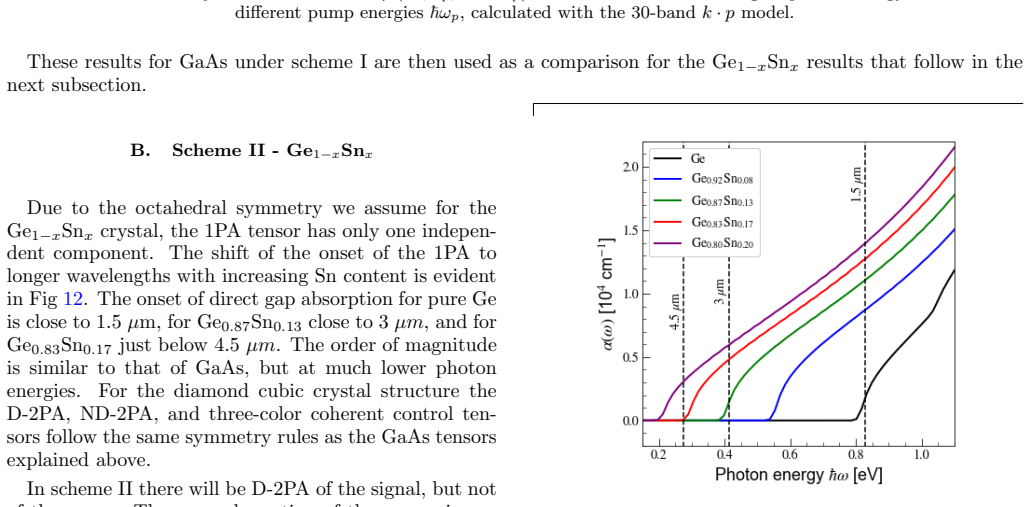
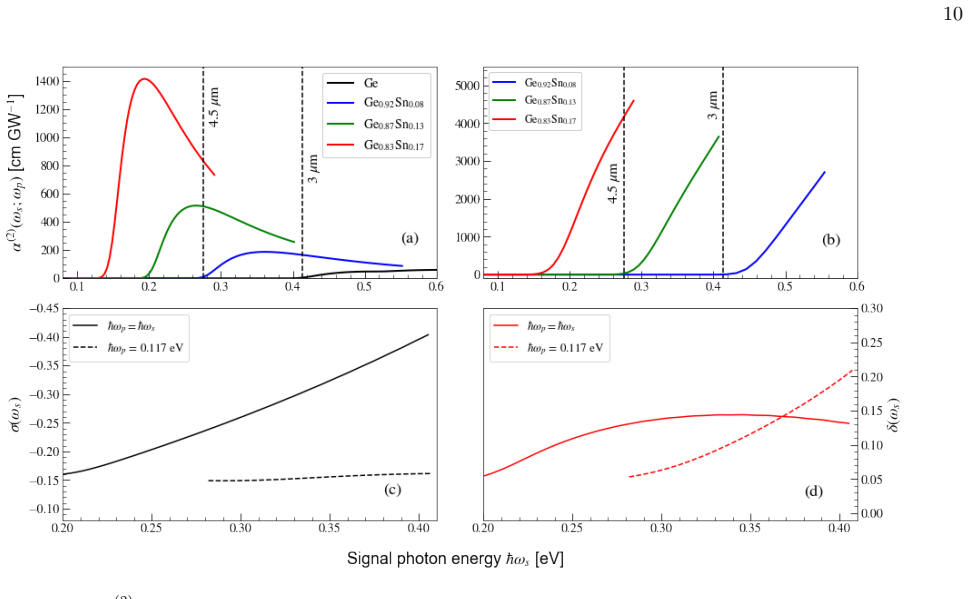
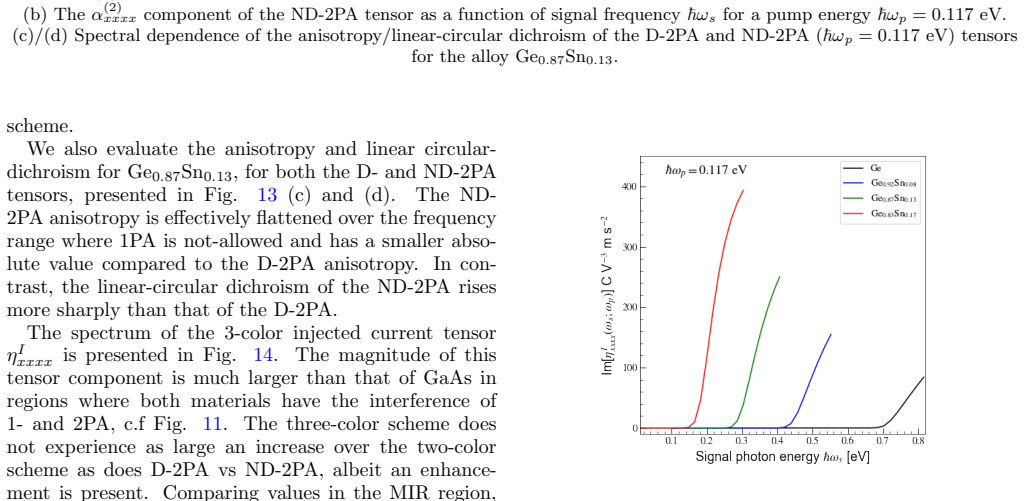
We calculate the theoretical non-degenerate two photon absorption and three color injected current response tensors for bulk GaAs and Ge_{1-x}Sn_x for a range of alloy compositions. In particular, by including a 'pump' beam we compare two 'schemes' that are sensitive to mid-infrared photons. In 'scheme I' we consider GaAs and a pump photon with energy greater than half the band gap, and in 'scheme II' we consider Ge_{1-x}Sn_x with a pump photon with energy less than half the band gap. We find that for certain pump and alloy concentrations Ge_{1-x}Sn_x has a substantially larger nonlinear response and three-color injected current than GaAs in the mid-infrared frequency window where both can b
What carries the argument
The non-degenerate two-photon absorption and three-color injected current response tensors, computed from band-structure models and perturbation theory for GaAs and Ge_{1-x}Sn_x under the two pumping schemes.
Load-bearing premise
The band-structure models and perturbation theory used to compute the response tensors accurately represent real bulk materials without significant higher-order effects, defects, or interface contributions.
What would settle it
Experimental measurement of the nonlinear response tensors or three-color injected current in fabricated Ge_{1-x}Sn_x samples at chosen compositions and mid-infrared frequencies with the specified pump, showing values that are not substantially larger than those measured in GaAs under equivalent conditions.
Figures
read the original abstract
We calculate the theoretical non-degenerate two photon absorption and three color injected current response tensors for bulk GaAs and Ge$_{1-x}$Sn$_x$ for a range of alloy compositions. In particular, by including a ''pump'' beam we compare two ''schemes'' that are sensitive to mid-infrared photons. In ''scheme I'' we consider GaAs and a pump photon with energy greater than half the band gap, and in ''scheme II'' we consider Ge$_{1-x}$Sn$_x$ with a pump photon with energy less than half the band gap. We find that for certain pump and alloy concentrations Ge$_{1-x}$Sn$_x$ has a substantially larger nonlinear response and three-color injected current than GaAs in the mid-infrared frequency window where both materials can absorb photons via non-degenerate two-photon absorption.
Editorial analysis
A structured set of objections, weighed in public.
Referee Report
Summary. The manuscript calculates the non-degenerate two-photon absorption and three-color injected current response tensors for bulk GaAs and Ge_{1-x}Sn_x alloys over a range of compositions using band-structure models and perturbation theory. It compares two multi-photon schemes for mid-infrared detection: Scheme I (GaAs with pump photon energy > E_g/2) and Scheme II (Ge_{1-x}Sn_x with pump photon energy < E_g/2). The central claim is that for certain pump energies and alloy concentrations, Ge_{1-x}Sn_x exhibits substantially larger nonlinear responses and injected currents than GaAs in the mid-IR window where both support non-degenerate TPA.
Significance. If the computed tensors accurately reflect real-material behavior, the work identifies GeSn alloys as potentially superior to GaAs for multi-photon mid-IR detection, with tunable composition offering enhanced sensitivity. This could guide material selection for mid-IR sensors, though the practical impact depends on experimental realizability of the proposed schemes.
major comments (1)
- [Section describing the computational approach and results for the response tensors] The central claim of substantially larger responses in Ge_{1-x}Sn_x rests on the fidelity of the chosen band-structure model and perturbation-theory truncation for the response tensors. The manuscript provides no benchmarks against measured non-degenerate TPA coefficients for GaAs or error estimates for the alloy model in the relevant frequency window, leaving the quantitative comparison vulnerable to higher-order corrections or defects.
minor comments (2)
- [Abstract] The abstract states the finding for 'certain pump and alloy concentrations' but does not indicate the specific ranges of x or pump energies examined; adding this would improve clarity.
- [Introduction or methods] Notation for the response tensors and the definition of the three-color injected current should be introduced with explicit equations early in the text to aid readers unfamiliar with the formalism.
Simulated Author's Rebuttal
We thank the referee for their thorough review and valuable comments on our manuscript. We address the major comment regarding the validation of our computational methods below.
read point-by-point responses
-
Referee: The central claim of substantially larger responses in Ge_{1-x}Sn_x rests on the fidelity of the chosen band-structure model and perturbation-theory truncation for the response tensors. The manuscript provides no benchmarks against measured non-degenerate TPA coefficients for GaAs or error estimates for the alloy model in the relevant frequency window, leaving the quantitative comparison vulnerable to higher-order corrections or defects.
Authors: We agree that including benchmarks and error estimates would strengthen the manuscript. Our calculations are based on the 8-band k·p model for GaAs and a composition-dependent parameterization for Ge_{1-x}Sn_x, using third-order time-dependent perturbation theory for the response tensors. While we did not include direct comparisons to experimental non-degenerate TPA data in the original submission, such data for GaAs in the mid-IR is available in the literature for related frequency ranges, and our degenerate TPA results align with established values. For the alloy, experimental nonlinear data is limited. In the revised version, we will add a new subsection discussing the model validation, including references to experimental TPA coefficients for GaAs and an analysis of the expected accuracy of the perturbation truncation by estimating the contribution of higher-order terms. We maintain that the relative comparison between the two schemes remains robust as both are treated within the same theoretical framework. revision: partial
Circularity Check
No circularity: calculations rest on standard perturbation theory and band models
full rationale
The paper computes non-degenerate TPA and three-color injected current tensors for GaAs and Ge1-xSnx using established k·p or effective-mass band structures plus low-order perturbation theory. No parameters are fitted to the target mid-IR response and then re-labeled as predictions; no self-citation chain supplies a uniqueness theorem or ansatz that forces the result; the comparison between materials follows directly from the computed tensors without reduction to inputs by construction. The derivation is therefore self-contained against external benchmarks.
Axiom & Free-Parameter Ledger
free parameters (2)
- alloy composition x in Ge1-xSnx
- pump photon energy relative to band gap
axioms (2)
- standard math Perturbation theory suffices to compute non-degenerate two-photon absorption and injected current tensors
- domain assumption Bulk crystal approximations apply without significant defect or surface effects
Reference graph
Works this paper leans on
-
[1]
Multi-photon schemes for mid-infrared detection
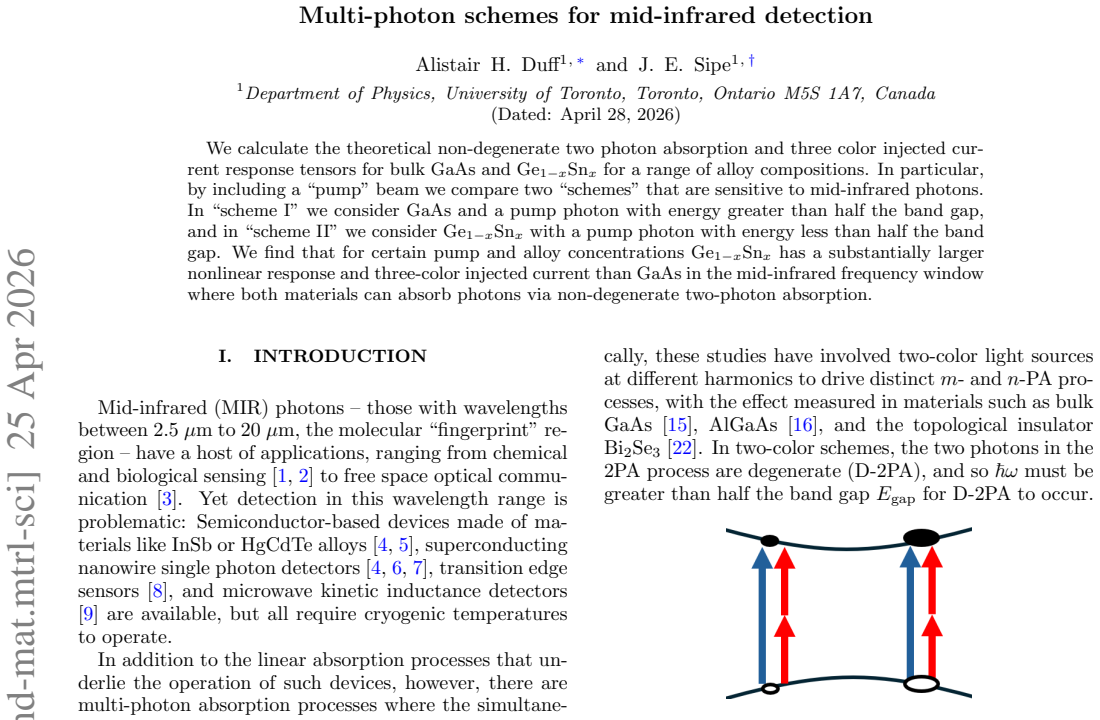
are available, but all require cryogenic temperatures to operate. In addition to the linear absorption processes that un- derlie the operation of such devices, however, there are multi-photon absorption processes where the simultane- ous absorption ofn-photons leads to a single electronic transition [10]. They could provide an alternate route to MIR detec...
work page internal anchor Pith review Pith/arXiv arXiv 2026
-
[2]
X′ c′ (v′) Γbc cvk(ω1, ω2) ∗ va cc′ (v′v) vd c′v (cv′) #
to represent the interaction Hamiltonian [39, 40], ˆHe-em(t) =−eA i(t)ˆvi(x), (1) wheree=−|e|is the electronic charge, ˆv i(x) is the velocity operator, andA(t) is the time-dependent vec- tor potential that describes the electric field,E(t) = −∂A(t)/∂t, with Ei(t) = X ω e−iωtEi(ω) +e iωtEi(−ω) .(2) A. 1- and 2-P A From first and second order time-dependen...
work page 2064
- [3]
-
[4]
L. M. Rosenfeld, D. A. Sulway, G. F. Sinclair, V. Anant, M. G. Thompson, J. G. Rarity, and J. W. Silverstone, Optics Express28, 37092 (2020)
work page 2020
-
[5]
P. Corrigan, R. Martini, E. A. Whittaker, and C. Bethea, Optics Express17, 4355 (2009)
work page 2009
-
[6]
J. A. Lau, V. B. Verma, D. Schwarzer, and A. M. Wodtke, Chem. Soc. Rev.52, 921 (2023)
work page 2023
-
[7]
Rogalski,Infrared Detectors, 2nd ed
A. Rogalski,Infrared Detectors, 2nd ed. (CRC Press, 2010)
work page 2010
-
[8]
L. Chen, D. Schwarzer, J. A. Lau, V. B. Verma, M. J. Stevens, F. Marsili, R. P. Mirin, S. W. Nam, and A. M. Wodtke, Optics Express26, 14859 (2018)
work page 2018
-
[9]
V. B. Verma, B. Korzh, A. B. Walter, A. E. Lita, R. M. Briggs, M. Colangelo, Y. Zhai, E. E. Wollman, A. D. Beyer, J. P. Allmaras, H. Vora, D. Zhu, E. Schmidt, A. G. Kozorezov, K. K. Berggren, R. P. Mirin, S. W. Nam, and M. D. Shaw, APL photonics6(2021), 10.1063/5.0048049
-
[10]
K. D. Irwin and G. C. Hilton, “Transition-edge sensors,” inCryogenic Particle Detection(Springer Berlin Heidel- berg, 2005) pp. 63–150
work page 2005
-
[11]
B. A. Mazin, B. Bumble, S. R. Meeker, K. O’Brien, S. McHugh, and E. Langman, Optics Express20, 1503 (2012)
work page 2012
-
[12]
B. S. Wherrett, J. Opt. Soc. Am. B1, 67 (1984)
work page 1984
-
[13]
R. W. Boyd,Nonlinear Optics, 3rd ed. (Elsevier, 2008)
work page 2008
-
[14]
R. Atanasov, A. Hach´ e, J. L. P. Hughes, H. M. van Driel, and J. E. Sipe, Phys. Rev. Lett.76, 1703 (1996)
work page 1996
- [15]
-
[16]
K. Wang, R. A. Muniz, J. E. Sipe, and S. T. Cundiff, Physical Review Letters123, 067402 (2019)
work page 2019
-
[17]
A. Hach´ e, Y. Kostoulas, R. Atanasov, J. L. P. Hughes, J. E. Sipe, and H. M. van Driel, Physical Review Letters 13 78, 306 (1997)
work page 1997
-
[18]
K. Wang, R. A. Muniz, J. E. Sipe, and S. T. Cundiff, Phys. Rev. Lett.123, 067402 (2019)
work page 2019
-
[19]
S. Sederberg, F. Kong, F. Hufnagel, C. Zhang, E. Karimi, and P. Corkum, Nature Photonics14, 1 (2020)
work page 2020
-
[20]
Directional pho- tocurrent generated by quantum interference control,
Y. Gong, K. Wang, and S. T. Cundiff, “Directional pho- tocurrent generated by quantum interference control,” (2025), arXiv:2511.05318 [cond-mat.other]
-
[21]
S. Sederberg and P. B. Corkum, Applied Physics Letters 120, 160504 (2022)
work page 2022
- [22]
-
[23]
H. M. van Driel, J. E. Sipe, A. Hach´ e, and R. Atanasov, physica status solidi (b)204, 3 (1997)
work page 1997
-
[24]
D. A. Bas, K. Vargas-Velez, S. Babakiray, T. A. Johnson, P. Borisov, T. D. Stanescu, D. Lederman, and A. D. Bristow, Applied Physics Letters106, 041109 (2015)
work page 2015
-
[25]
E. W. Van Stryland, M. A. Woodall, H. Vanherzeele, and M. J. Soileau, Optics Letters10, 490 (1985)
work page 1985
-
[26]
M. Shiek-Bahae, D. C. Hutchings, D. J. Hagan, and E. W. Van Stryland, IEEE Journal of Quantum Elec- tronics27, 1296 (1991)
work page 1991
-
[27]
M. Reichert, A. L. Smirl, G. Salamo, D. J. Hagan, and E. W. Van Stryland, Physical Review Letters117, 073602 (2016)
work page 2016
-
[28]
H. S. Pattanaik, M. Reichert, J. B. Khurgin, D. J. Ha- gan, and E. W. Van Stryland, IEEE Journal of Quantum Electronics52, 1 (2016)
work page 2016
-
[29]
D. A. Fishman, C. M. Cirloganu, S. Webster, L. A. Padilha, M. Monroe, D. J. Hagan, and E. W. Van Stry- land, Nature Photonics5, 561 (2011)
work page 2011
-
[30]
L. Krauss-Kodytek, C. Ruppert, and M. Betz, Optics Express29, 34522 (2021)
work page 2021
-
[31]
J. M. Fraser, A. Hach´ e, A. I. Shkrebtii, J. E. Sipe, and H. M. van Driel, Applied Physics Letters74, 2014 (1999)
work page 2014
- [32]
-
[33]
Z. Song, W. Fan, C. S. Tan, Q. Wang, D. Nam, D. H. Zhang, and G. Sun, New Journal of Physics21, 073037 (2019)
work page 2019
-
[34]
O. Moutanabbir, S. Assali, X. Gong, E. O’Reilly, C. A. Broderick, B. Marzban, J. Witzens, W. Du, S.-Q. Yu, A. Chelnokov, D. Buca, and D. Nam, Applied Physics Letters118, 110502 (2021)
work page 2021
-
[35]
M. Sheik-Bahae, D. J. Hagan, and E. W. Van Stryland, Physical Review Letters65, 96 (1990)
work page 1990
-
[36]
D. C. Hutchings and E. W. Van Stryland, J. Opt. Soc. Am. B9, 2065 (1992)
work page 2065
-
[37]
J. A. Bolger, A. K. Kar, B. S. Wherrett, R. Desalvo, D. C. Hutchings, and D. J. Hagan, Optics Communications97, 203 (1993)
work page 1993
-
[38]
M. L. Cohen and S. G. Louie,Fundamentals of Con- densed Matter Physics(Cambridge University Press, 2016)
work page 2016
-
[39]
J. D. Jackson,Classical Electrodynamics, 3rd ed. (John Wiley and Sons, 1999)
work page 1999
-
[40]
With the use of sum rules the results from a length gauge or velocity gauge are equivalent due to gauge invariance
-
[41]
G. B. Ventura, D. J. Passos, J. M. B. Lopes dos Santos, J. M. Viana Parente Lopes, and N. M. R. Peres, Physical Review B96, 035431 (2017)
work page 2017
-
[42]
D. J. Passos, G. B. Ventura, J. M. Viana Parente Lopes, J. M. B. Lopes dos Santos, and N. M. R. Peres, Physical Review B97, 235446 (2018)
work page 2018
-
[43]
Binder,Optical properties of graphene(World Scien- tific Publishing Co., 2017)
R. Binder,Optical properties of graphene(World Scien- tific Publishing Co., 2017)
work page 2017
- [44]
- [45]
-
[46]
K. Gawarecki, P. Scharoch, M. Wi´ sniewski, J. Ziembicki, H. S. M¸ aczko, M. G ladysiewicz, and R. Kudrawiec, Phys. Rev. B105, 045202 (2022)
work page 2022
-
[47]
X. Kong, L. Li, and F. M. Peeters, Applied Physics Letters112, 251601 (2018)
work page 2018
-
[48]
P. E. Bl¨ ochl, O. Jepsen, and K. Andersen, Phys. Rev. B 49, 16223 (1994)
work page 1994
-
[49]
Nalla, Asian Journal of Physics30(2021), 10.54955/AJP.30.6.2021.907-916
V. Nalla, Asian Journal of Physics30(2021), 10.54955/AJP.30.6.2021.907-916
-
[50]
D. C. Hutchings and B. S. Wherrett, Phys. Rev. B49, 2418 (1994)
work page 1994
-
[51]
D. C. Hutchings and B. S. Wherrett, Optical Materials 3, 53 (1994)
work page 1994
-
[52]
Hole spin in direct bandgap germanium-tin quantum dot,
N. Rotaru, P. D. Vecchio, and O. Moutanabbir, “Hole spin in direct bandgap germanium-tin quantum dot,” (2025), arXiv:2502.17659 [cond-mat.mes-hall]
discussion (0)
Sign in with ORCID, Apple, or X to comment. Anyone can read and Pith papers without signing in.