REVIEW 2 major objections 2 minor 2 cited by
Explicitly diagnosing missing evidence in retrieval sets enables better iterative query refinement for long-term conversational memory.
Reviewed by Pith at T0; open to challenge. T0 means a machine referee read the full paper against a public rubric. the ladder, T0–T4 →
T0 review · grok-4.3
2026-05-07 05:19 UTC
load-bearing objection EviMem adds explicit evidence-gap diagnosis via insufficiency signals and a layered memory hierarchy, with concrete accuracy and latency gains on LoCoMo, but the core sufficiency evaluator lacks independent validation. the 2 major comments →
EviMem: Evidence-Gap-Driven Iterative Retrieval for Long-Term Conversational Memory
The pith
A machine-rendered reading of the paper's core claim, the machinery that carries it, and where it could break.
Core claim
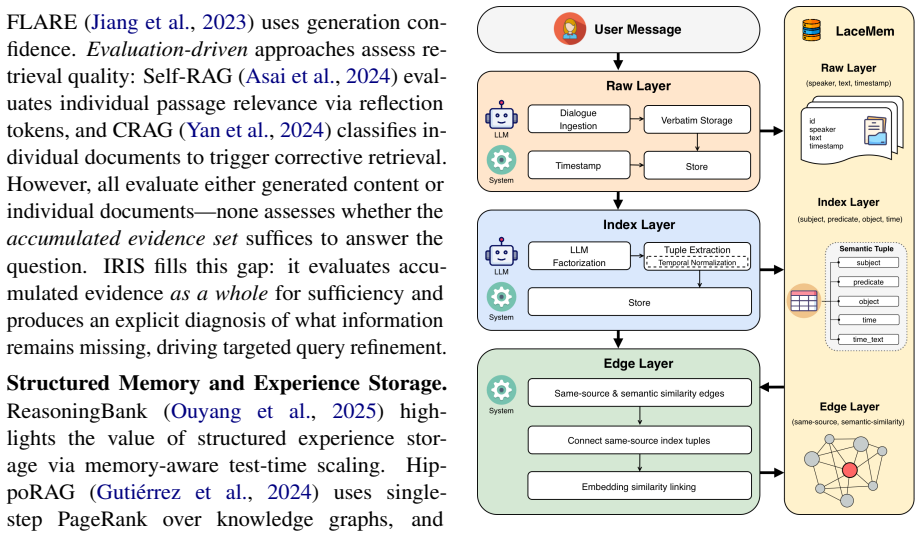
EviMem combines IRIS, a framework that uses sufficiency evaluation to detect evidence gaps and drive targeted query refinement in a closed loop, with LaceMem, a coarse-to-fine layered architecture for conversational evidence memory that supports precise gap identification, resulting in improved performance on temporal and multi-hop questions.
What carries the argument
IRIS (Iterative Retrieval via Insufficiency Signals), the closed-loop framework that detects evidence gaps through sufficiency evaluation to guide query refinement, enabled by LaceMem's coarse-to-fine memory hierarchy.
Load-bearing premise
The sufficiency evaluation can reliably identify missing evidence without introducing systematic false positives or negatives.
What would settle it
A dataset or test where the sufficiency evaluator consistently misidentifies what evidence is needed, resulting in no accuracy improvement or increased latency on temporal and multi-hop questions.
If this is right
- Accuracy on temporal questions rises from 73.3% to 81.6% compared to prior methods.
- Multi-hop question accuracy improves from 65.9% to 85.2%.
- The approach achieves these gains at 4.5 times lower latency.
- Retrieval becomes more targeted by focusing on diagnosed missing evidence rather than blind refinement.
Where Pith is reading between the lines
- This method highlights the value of explicit gap diagnosis, which could apply to other domains like document retrieval or knowledge base querying where evidence is scattered.
- Future systems might integrate similar sufficiency checks to make iterative retrieval more efficient across different modalities or longer contexts.
- The layered memory could inspire designs for other hierarchical storage in AI memory systems to facilitate better diagnostics.
Editorial analysis
A structured set of objections, weighed in public.
Referee Report
Summary. The paper claims to introduce EviMem, combining IRIS (a closed-loop iterative retrieval framework that detects evidence gaps via sufficiency evaluation, diagnoses missing information, and drives targeted query refinement) with LaceMem (a coarse-to-fine layered memory hierarchy). On the LoCoMo benchmark, EviMem is reported to improve Judge Accuracy over MIRIX from 73.3% to 81.6% on temporal questions and from 65.9% to 85.2% on multi-hop questions while achieving 4.5x lower latency.
Significance. If the core assumptions hold, this is a meaningful engineering advance for long-context conversational retrieval: explicit evidence-gap diagnosis offers a more directed alternative to prior iterative methods that rely on generated content or document-level signals. The magnitude of the accuracy gains on the hardest question categories, combined with the latency reduction and open-sourced code, would make the work practically relevant for memory-augmented dialogue systems.
major comments (2)
- [§3] §3 (IRIS framework): The sufficiency evaluator is the load-bearing component of the closed-loop design, yet the manuscript provides no independent validation (human agreement on diagnosed gaps, error analysis of false-positive/negative diagnoses, or ablation that removes the insufficiency signal while keeping iteration count fixed). Without this, the 8–19 point gains on temporal and multi-hop questions cannot be confidently attributed to targeted gap closure rather than simply performing more retrieval steps or using a stronger base retriever.
- [§5] §5 (Experiments): The reported LoCoMo results lack statistical significance tests, run-to-run variance, and full specification of the Judge Accuracy metric and baseline implementations (including MIRIX). The latency comparison (4.5x) also requires explicit definition of what is timed (per-query wall time, total tokens, etc.) to allow reproduction and fair assessment.
minor comments (2)
- [Abstract] Abstract and §1: 'Judge Accuracy' is used without a one-sentence definition or reference to its exact computation on LoCoMo; adding this would improve accessibility.
- [Figure 1] Figure 1 (architecture diagram): The flow from sufficiency evaluation to query refinement and LaceMem access could be labeled more explicitly to clarify how the coarse-to-fine hierarchy supplies the granularity needed for gap diagnosis.
Simulated Author's Rebuttal
We appreciate the referee's detailed and constructive feedback, which identifies key areas where additional validation and reporting would strengthen the manuscript. We address each major comment below and will revise the paper to incorporate the suggested improvements for better clarity and rigor.
read point-by-point responses
-
Referee: [§3] §3 (IRIS framework): The sufficiency evaluator is the load-bearing component of the closed-loop design, yet the manuscript provides no independent validation (human agreement on diagnosed gaps, error analysis of false-positive/negative diagnoses, or ablation that removes the insufficiency signal while keeping iteration count fixed). Without this, the 8–19 point gains on temporal and multi-hop questions cannot be confidently attributed to targeted gap closure rather than simply performing more retrieval steps or using a stronger base retriever.
Authors: We agree that the absence of targeted validation for the sufficiency evaluator leaves open the possibility that gains stem from iteration count or base retriever strength rather than gap diagnosis. In the revised manuscript, we will add an ablation that holds the number of retrieval iterations fixed while disabling the insufficiency signal (replacing it with generic or random query refinement) to isolate its contribution. We will also include a dedicated error analysis subsection with concrete examples of false-positive and false-negative sufficiency diagnoses, along with their impact on downstream retrieval. For human agreement, we will report inter-annotator agreement on a sampled subset of diagnosed evidence gaps evaluated by two independent annotators. revision: yes
-
Referee: [§5] §5 (Experiments): The reported LoCoMo results lack statistical significance tests, run-to-run variance, and full specification of the Judge Accuracy metric and baseline implementations (including MIRIX). The latency comparison (4.5x) also requires explicit definition of what is timed (per-query wall time, total tokens, etc.) to allow reproduction and fair assessment.
Authors: We acknowledge these reporting omissions. In the revision we will add (i) statistical significance testing (McNemar’s test for paired accuracy comparisons and bootstrap confidence intervals), (ii) standard deviations across five independent runs with different random seeds, and (iii) a complete specification of Judge Accuracy, including the exact LLM judge prompt, scoring rubric, and temperature settings. We will also provide full implementation details for MIRIX and all other baselines (hyperparameters, prompt templates, and any LoCoMo-specific adaptations). For latency, we will explicitly state that the 4.5× figure measures average per-query wall-clock time on identical hardware (covering both retrieval and generation phases, excluding one-time memory indexing) and will additionally report average token consumption to enable fair efficiency comparisons. revision: yes
Circularity Check
No circularity: empirical engineering contribution with independent system design
full rationale
The paper introduces EviMem as a practical retrieval system pairing IRIS (sufficiency-evaluation-driven iterative query refinement) with LaceMem (coarse-to-fine memory hierarchy). All claims rest on empirical results on the external LoCoMo benchmark rather than any mathematical derivation, fitted parameter renamed as prediction, or self-referential loop. No equations appear in the abstract or described method; the sufficiency evaluator is a designed component whose accuracy is assumed for the engineering loop but is not presented as a quantity derived from the output it produces. No load-bearing self-citations or uniqueness theorems imported from prior author work are referenced. The reported accuracy gains are therefore not forced by construction and the derivation chain is self-contained as a standard systems paper.
Axiom & Free-Parameter Ledger
axioms (2)
- domain assumption Sufficiency of retrieved evidence can be evaluated automatically to detect gaps
- domain assumption A layered memory structure supports fine-grained gap diagnosis
read the original abstract
Long-term conversational memory requires retrieving evidence scattered across multiple sessions, yet single-pass retrieval fails on temporal and multi-hop questions. Existing iterative methods refine queries via generated content or document-level signals, but none explicitly diagnoses the evidence gap, namely what is missing from the accumulated retrieval set, leaving query refinement untargeted. We present EviMem, combining IRIS (Iterative Retrieval via Insufficiency Signals), a closed-loop framework that detects evidence gaps through sufficiency evaluation, diagnoses what is missing, and drives targeted query refinement, with LaceMem (Layered Architecture for Conversational Evidence Memory), a coarse-to-fine memory hierarchy supporting fine-grained gap diagnosis. On LoCoMo, EviMem improves Judge Accuracy over MIRIX on temporal (73.3% to 81.6%) and multi-hop (65.9% to 85.2%) questions at 4.5x lower latency. Code: https://github.com/AIGeeksGroup/EviMem.
Figures

Forward citations
Cited by 2 Pith papers
-
ABot-AgentOS: A General Robotic Agent OS with Lifelong Multi-modal Memory
A robotic agent operating system with source-grounded graph memory and split-wise self-evolution improves long-horizon embodied task success and memory QA scores over baseline controllers.
-
ABot-AgentOS: A General Robotic Agent OS with Lifelong Multi-modal Memory
A hierarchical robotic Agent OS with source-grounded multi-modal graph memory and split-gated self-evolution improves long-horizon embodied execution and memory QA over single-controller and prior memory baselines.
Reference graph
Works this paper leans on
-
[1]
Precise zero-shot dense retrieval without rel- evance labels. InProceedings of the 61st Annual Meeting of the Association for Computational Lin- guistics (Volume 1: Long Papers), pages 1762–1777. Yubin Ge, Salvatore Romeo, Jason Cai, Raphael Shu, Yassine Benajiba, Monica Sunkara, and Yi Zhang
-
[2]
Memory in the Age of AI Agents
Tremu: Towards neuro-symbolic temporal rea- soning for llm-agents with memory in multi-session dialogues. InFindings of the Association for Compu- tational Linguistics: ACL 2025, pages 18974–18988. Bernal Jiménez Gutiérrez, Yiheng Zhu, Zhiwei Huang, Shivani Kamez, and Huan Sun. 2024. HippoRAG: Neurobiologically inspired long-term memory for large language...
work page internal anchor Pith review arXiv 2025
-
[3]
Evaluating Very Long-Term Conversational Memory of LLM Agents
Evaluating very long-term conversational memory of llm agents.Preprint, arXiv:2402.17753. Siru Ouyang, Jun Yan, I-Hung Hsu, Yantei Chen, Ke Jiang, Zifeng Wang, Rujun Han, Long T Le, Samira Daruki, Xiangru Tang, and 1 others. 2025. Reasoningbank: Scaling agent self-evolving with rea- soning memory.arXiv preprint arXiv:2509.25140. Charles Packer, Vivian Fan...
work page internal anchor Pith review arXiv 2025
-
[4]
Corrective Retrieval Augmented Generation
Corrective retrieval augmented generation. arXiv preprint arXiv:2401.15884. Tianyi Zhang, Varsha Kishore, Felix Wu, Kilian Q. Weinberger, and Yoav Artzi. 2020. Bertscore: Evaluating text generation with bert.Preprint, arXiv:1904.09675. Wanjun Zhong, Lianghong Guo, Qiqi Gao, and Yan- lin Wang. 2023. Memorybank: Enhancing large language models with long-ter...
work page internal anchor Pith review arXiv 2020
-
[5]
EXACT_MATCH: Can answer precisely? (yes/no)
-
[6]
INFERRABLE: Can reasonably infer the answer? (yes/no)
-
[7]
PARTIAL_MATCH: Related but insufficient? (yes/no)
-
[8]
MISSING: what specific information is missing? (or "none") Respond in EXACTLY this format: EXACT: yes/no INFERRABLE: yes/no PARTIAL: yes/no CONFIDENCE: 0.0-1.0 MISSING: <missing information or "none"> PROMPTTEMPLATE FORQUERYREFINEMENT(IRIS) System:You are a helpful assistant that refines search queries. User: Original question: {original_question} Current...
work page 2023
-
[9]
The prediction must convey the same core information as the ground truth
-
[10]
Different wording is acceptable if the meaning is preserved
- [11]
- [12]
-
[13]
Partial answers that miss the key point are WRONG. **Output Format**: Return ONLY a JSON object: {"score": 1 or 0, "reason": "Brief explanation"}
discussion (0)
Sign in with ORCID, Apple, or X to comment. Anyone can read and Pith papers without signing in.