REVIEW 5 major objections 1 cited by
LLM search overviews pick sources by relative bias, and a length-limited snippet rewriter can game that choice.
Reviewed by Pith at T0; open to challenge. T0 means a machine referee read the full paper against a public rubric. the ladder, T0–T4 →
T0 review · grok-4.5
2026-07-13 16:28 UTC
load-bearing objection Solid constrained GEO-style RL study on real-length snippets; the comparative-advantage finding is the real takeaway, but train-on-judge and a simplified ID selector keep the production claims provisional. the 5 major comments →
Exploring LLM biases to manipulate AI search overview
The pith
A machine-rendered reading of the paper's core claim, the machinery that carries it, and where it could break.
Core claim
LLM Overview systems exhibit stable selection biases, and under a restrictive snippet-only policy with length limits, reinforcement learning can rewrite snippets so they become more likely to be among the three sources the overview cites; those selections are driven by comparative rather than absolute advantages among candidates, and context poisoning through reference snippets can produce inaccurate or harmful cited content.
What carries the argument
Reference-conditioned snippet rewriting under Dr.GRPO: a small LoRA policy that rewrites only the target snippet while seeing the other candidates, rewarded by a weighted mix of soft length match and whether the overview judge cites the rewritten result.
Load-bearing premise
That a simplified judge which only returns three IDs from URL-title-snippet dictionaries, mostly using a nano model, is close enough to real multi-stage overview systems that beating it counts as manipulation of production search overviews.
What would settle it
Run the same trained rewriter against a production-style overview pipeline that visits full pages or uses a model whose selection is dominated by URL rather than snippet content, and check whether the rewritten snippets still raise citation rates on the same held-out queries.
Editorial analysis
A structured set of objections, weighed in public.
Referee Report
Summary. The paper argues that LLM Overview systems (LLM-based selection and summarization of search results) exhibit stable content-selection biases, demonstrated via permutation/randomization experiments on ~90 Amazon shopping queries under a binomial null of unbiased citation (p=3/N). It then trains a small policy (gemma-3-1b-it LoRA, Dr.GRPO/DAPO-style RL) that rewrites only search-engine snippets, conditioned on competing snippets and under length soft-limits, to raise the probability that a target result is among the three sources cited by a simplified overview judge (mostly gpt-4.1-nano returning IDs). Success is reported on a held-out 90-sample set across randomizations; the authors conclude that preferences are comparative rather than absolute and that reference-context poisoning can inject inaccurate or harmful content into cited snippets.
Significance. If the core results transfer beyond the surrogate, the work is significant for generative-engine optimization, search integrity, and safety of AI overviews: it shows that realistic constraints (snippet-only edits, length limits, no full-page access) still allow RL-driven preference manipulation, and it surfaces a comparative-advantage mechanism plus a concrete context-poisoning vector. Strengths include the deliberately restrictive experimental design that mirrors web-search constraints, the explicit length-reward component to block a known reward-hack, the comparative-vs-absolute insight, and the safety probes in §7. These are concrete, falsifiable contributions relative to concurrent rewrite-to-rank / AutoGEO-style work that often operates on longer page text with fewer length or observability limits.
major comments (5)
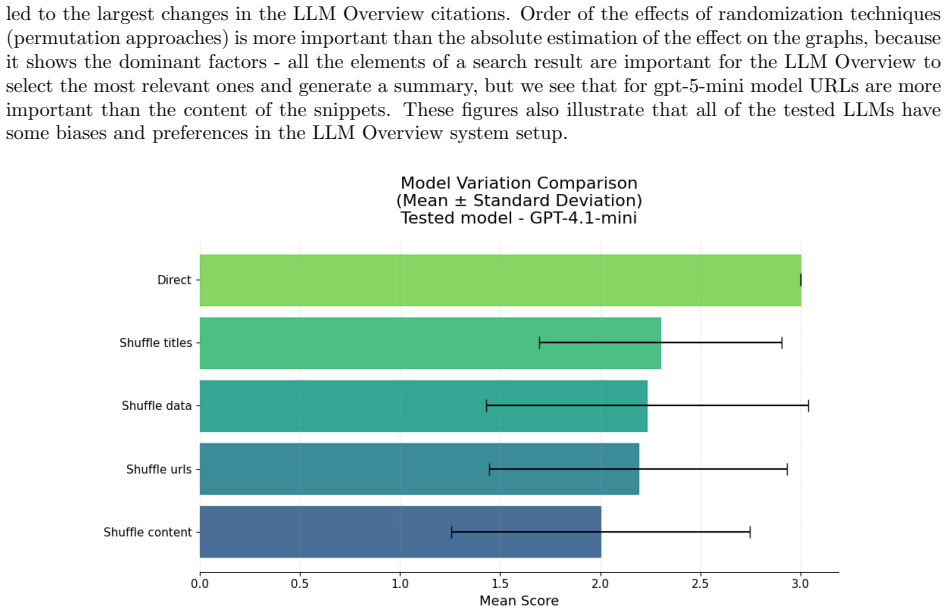
- §6.1 and §6.5 / Figure 4: The primary reward and the main evaluation both use the same simplified overview judge (prompted to return three IDs from URL/title/snippet dicts, predominantly gpt-4.1-nano). This is classic train-on-the-metric circularity. The model-change randomization (GPT-5-nano) and order/URL shuffles only partially break the loop; no held-out correlation is reported between the ID-selector and full multi-stage overview pipelines (query rewriting, page reading, joint selection+generation) that the paper itself diagrams in Figure 1. Without that correlation, the claim that RL manipulates production LLM Overviews does not follow from success against the surrogate.
- §5 binomial model and Table 1: The null assumes every one of N results is equally relevant and that the K randomizations are independent Bernoulli trials with p=3/N. The shopping-query domain and the earned-media pattern in Table 1 make equal relevance implausible; the paper asserts relevance but supplies no independent relevance labels or inter-annotator check. Consequently the reported 48/90 full-persistence and 30/90 never-selected cases cannot be cleanly attributed to model bias versus residual relevance ranking. A load-bearing claim (“LLM Overview is biased”) rests on this untested null.
- §6.5 evaluation and Figure 4: Test-set results are given only as average shares across randomizations with no confidence intervals, no per-query paired significance tests, and no baseline comparison against non-RL rewriters (e.g., zero-shot or SFT-only). The claim that “reinforcement learning in most of the cases can optimize snippet’s content” therefore lacks a quantitative statistical footing on the 90-sample test set.
- §7 Attacks: The only successful attack (reference poisoning) is illustrated with a single query and a single generated snippet; the authors themselves state the experiments “are not broad enough” and were run on “a very limited dataset.” The safety claim that “context poisoning attacks can lead to inaccurate or harmful results” is therefore anecdotal and cannot support the abstract-level assertion without a larger, quantified attack success rate and a clear definition of “harmful.”
- §8 and the gpt-5-mini failure: The policy fails to improve reward against gpt-5-mini, which the authors attribute to URL bias. This is an important negative result, yet it is left as an assumption. Because the abstract claims success “in most of the cases,” the manuscript needs either (a) a systematic characterization of which overview models are vulnerable or (b) an explicit scope restriction so that the positive claims are not over-generalized.
Circularity Check
Mild train-on-surrogate-judge loop only; no definitional reduction of the comparative-advantage or bias claims.
specific steps
-
fitted input called prediction
[§6.1 Reward function; §6.5 Results / Figure 4]
"We use LLM Overview generator's output as the main component of the reward function. Taking the generated summary, we evaluated whether the rewritten snippet is cited inside the overview. ... To test the results of the training, we took the resulting policy and tested it on the test dataset. ... We used the same LLM Overview system we used as a reward during the reinforcement learning training, however, we additionally applied randomization (permutation) techniques"
The policy parameters are fitted to maximize citation probability under the surrogate judge; the headline success metric is then the same citation probability (plus randomizations) under that judge. On the surrogate the lift is therefore the optimized objective rather than an independent prediction. The paper mitigates this with held-out queries and model-change, so the reduction is only partial.
full rationale
This is an empirical RL paper, not a first-principles derivation. The sole mild circularity is that the policy is optimized against an LLM Overview ID-selector (mostly gpt-4.1-nano) and then primarily scored by the same class of selector (Section 6.5, Figure 4), so reported lift is the training objective on the surrogate. Randomizations, a model-change condition (GPT-5-nano), and a held-out query set partially break the loop; the paper itself flags the surrogate as a simplification justified by preliminary correlation (Section 6.1). The bias-persistence statistics (Section 5, binomial null) and the comparative-vs-absolute insight (unconditional rewrite failed, reference-conditioned succeeded) are independent experimental observations, not forced by definition or self-citation. No uniqueness theorems, no ansatz smuggling, no load-bearing self-citations, and no renaming of known results. Score 2 reflects only the standard train-eval metric overlap, which does not collapse the central claims by construction.
Axiom & Free-Parameter Ledger
free parameters (6)
- length_reward_weight =
0.2
- GRPO_sampling_temperature =
3.0
- candidates_per_sample =
8
- base_learning_rate =
1e-5
- urls_k_cited =
3
- similarity_embedder_and_optional_weight =
dropped / optional
axioms (5)
- domain assumption A simplified ID-selection overview prompt on URL/title/snippet dicts correlates strongly enough with real LLM Overview selection/generation to support manipulation claims.
- ad hoc to paper Under a null of unbiased selection among N relevant results, each snippet is cited with p=3/N independently across K randomizations (binomial model).
- domain assumption Search-engine snippets have strict length limits and the policy may only edit snippets, not titles/URLs/pages—matching realistic web constraints.
- ad hoc to paper Rewriting snippets to be preferred by an overview model is largely within the base small LM’s capability distribution, so SFT warmup can be dropped.
- standard math Standard RL fine-tuning machinery (LoRA on gemma-3-1b-it, Dr.GRPO without KL, DAPO-style length shaping) is an appropriate optimizer for this preference.
invented entities (1)
-
LLM Overview (as experimental system class)
independent evidence
read the original abstract
Modern large language models (LLMs) are used in many business applications in general, and specifically in web search systems and applications that generate overviews of search results - LLM Overview systems. Such systems are using an LLM to select most relevant sources from search results and generate an answer to the user's query. It is known from many studies that LLMs have different biases, in LLM Overview application both the source selection and answer generation stages may be affected by the biases of LLMs (here we are focusing mainly on the selection stage). This research is focused on investigating the presence of the biases in LLM Overview systems and on biases exploitation to manipulate LLM Overview results. Here we train a small language model using reinforcement learning to rewrite search snippets to increase their likelihood of being preferred by an LLM Overview. Our experimental setup intentionally restricts the policy to operate only on snippets and limits reward-hacking strategies, reflecting realistic constraints of web search environments. The results prove that LLM Overview systems have biases and that reinforcement learning in most of the cases can optimize snippet's content to manipulate LLM Overview results. We also prove that LLM Overview selections are driven by comparative rather than absolute advantages among candidate sources. In addition, we examine safety aspects of LLM Overview manipulation possibilities and show that context poisoning attacks can lead to inaccurate or harmful results.
Figures




Forward citations
Cited by 1 Pith paper
-
Optimizing Visibility in Generative Engines: A Critical Survey of Generative Engine Optimization (2023-2026)
A critical review of GEO research concludes that already-retrieved content can improve citation and use, but no tested technique reliably raises organic discoverability or downstream traffic across engines.
Reference graph
Works this paper leans on
-
[1]
Google ai overviews publisher traffic decline analysis, 2026
ALMCORP. Google ai overviews publisher traffic decline analysis, 2026. Accessed: 2026-03-15
2026
-
[2]
Esci dataset, 2023
Amazon Science. Esci dataset, 2023. GitHub repository
2023
-
[3]
Generative engine optimization: How to dominate ai search, 2025
Mahe Chen, Xiaoxuan Wang, Kaiwen Chen, and Nick Koudas. Generative engine optimization: How to dominate ai search, 2025. 12
2025
-
[4]
Qlora: Efficient finetuning of quantized llms, 2023
Tim Dettmers, Artidoro Pagnoni, Ari Holtzman, and Luke Zettlemoyer. Qlora: Efficient finetuning of quantized llms, 2023
2023
-
[5]
google/gemma-3-1b-it, 2026
Google. google/gemma-3-1b-it, 2026
2026
-
[6]
Rewrite-to-rank: Optimizing ad visibility via retrieval-aware text rewriting, 2025
Chloe Ho, Ishneet Sukhvinder Singh, Diya Sharma, Tanvi Reddy Anumandla, Michael Lu, Vasu Sharma, and Kevin Zhu. Rewrite-to-rank: Optimizing ad visibility via retrieval-aware text rewriting, 2025
2025
-
[7]
intfloat/e5-small, 2026
intfloat. intfloat/e5-small, 2026. Accessed: 2026-03-20
2026
-
[8]
Understanding r1-zero-like training: A critical perspective, 2025
Zichen Liu, Changyu Chen, Wenjun Li, Penghui Qi, Tianyu Pang, Chao Du, Wee Sun Lee, and Min Lin. Understanding r1-zero-like training: A critical perspective, 2025
2025
-
[9]
Adversarial search engine optimization for large language models, 2024
Fredrik Nestaas, Edoardo Debenedetti, and Florian Tram` er. Adversarial search engine optimization for large language models, 2024
2024
-
[10]
Zhihong Shao, Peiyi Wang, Qihao Zhu, Runxin Xu, Junxiao Song, Xiao Bi, Haowei Zhang, Mingchuan Zhang, Y. K. Li, Y. Wu, and Daya Guo. Deepseekmath: Pushing the limits of mathematical reasoning in open language models, 2024
2024
-
[11]
What generative search engines like and how to optimize web content cooperatively, 2025
Yujiang Wu, Shanshan Zhong, Yubin Kim, and Chenyan Xiong. What generative search engines like and how to optimize web content cooperatively, 2025
2025
-
[12]
Justice or prejudice? quantifying biases in llm-as-a-judge, 2024
Jiayi Ye, Yanbo Wang, Yue Huang, Dongping Chen, Qihui Zhang, Nuno Moniz, Tian Gao, Werner Geyer, Chao Huang, Pin-Yu Chen, Nitesh V Chawla, and Xiangliang Zhang. Justice or prejudice? quantifying biases in llm-as-a-judge, 2024
2024
-
[13]
"" The user will provide a d i c t i o n a r y of search results in JSON format for search query \
Qiying Yu, Zheng Zhang, Ruofei Zhu, Yufeng Yuan, Xiaochen Zuo, Yu Yue, Weinan Dai, Tiantian Fan, Gaohong Liu, Lingjun Liu, Xin Liu, Haibin Lin, Zhiqi Lin, Bole Ma, Guangming Sheng, Yuxuan Tong, Chi Zhang, Mofan Zhang, Wang Zhang, Hang Zhu, Jinhua Zhu, Jiaze Chen, Jiangjie Chen, Chengyi Wang, Hongli Yu, Yuxuan Song, Xiangpeng Wei, Hao Zhou, Jingjing Liu, W...
2025
discussion (0)
Sign in with ORCID, Apple, or X to comment. Anyone can read and Pith papers without signing in.