REVIEW 3 major objections 5 minor 1 cited by
A 4B model trained for terminal execution can replace frontier LLMs as coding-agent subagents and cut main-agent tokens by ~30%.
Reviewed by Pith at T0; open to challenge. T0 means a machine referee read the full paper against a public rubric. the ladder, T0–T4 →
T0 review · grok-4.5
2026-07-12 17:41 UTC pith:EYGETUQ3
load-bearing objection Solid systems result: a 4B terminal subagent can cut main-agent frontier tokens ~30% on SWE-Bench-style tasks without hurting resolve rate, with clean ablations; transfer beyond pre-provisioned Docker is the real open question. the 3 major comments →
Terminus-4B: Can a Smaller Model Replace Frontier LLMs at Agentic Execution Tasks?
The pith
A machine-rendered reading of the paper's core claim, the machinery that carries it, and where it could break.
Core claim
A 4B model post-trained with SFT plus GRPO under a rubric-based LLM-as-judge reward can serve as the Execution Subagent of a coding agent and match or exceed frontier models on that role, cutting main-agent token usage by up to ~30% with no loss of resolve rate on SWE-Bench Pro and SWE-Bench C#.
What carries the argument
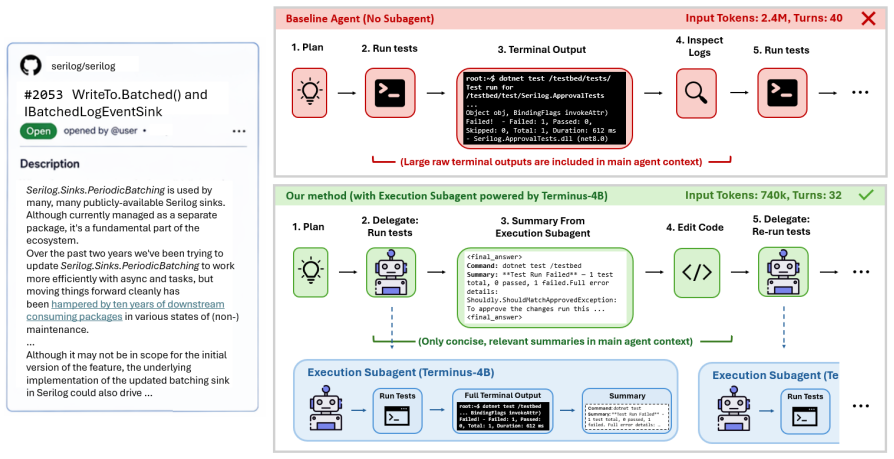
Execution Subagent plus Terminus-4B: a single-tool, turn-bounded agentic loop that runs terminal commands and returns structured <final_answer> summaries, trained by a decoupled rollout framework whose reward compares condensed Execution Plans against frontier reference trajectories along execution-quality, failure-mode, and final-answer dimensions.
Load-bearing premise
That success measured on SWE-Bench-style GitHub issues inside pre-provisioned Docker containers with Unix shells and frontier-judge rewards will hold for real messy agent use across other shells, platforms, and infrastructure tasks.
What would settle it
Run the same main-agent configurations on a held-out suite of non-Unix, multi-shell, or infrastructure-heavy tasks outside the SWE-Bench Docker regime; if Terminus-4B’s resolve rate or main-agent token savings collapse relative to a frontier subagent, the replacement claim fails outside the benchmark setting.
If this is right
- Coding agents can keep the same resolve rates while routing the bulk of terminal tokens through a 4B model instead of a frontier model.
- Main agents can be instructed to prefer the Execution Subagent over direct Terminal, reducing context bloat from build and test logs.
- The same SFT-then-rubric-RL recipe can be reused to train other narrow subagents (search, debug) without full main-agent rollouts.
- Behavioral metrics such as Subagent→Terminal and final-answer rate become practical monitors of whether a small subagent is actually trusted.
Where Pith is reading between the lines
- If the pattern generalizes, cost curves for long-horizon coding agents may be dominated by small specialized models rather than frontier calls for every tool loop.
- Rubric-based LLM judges over condensed Execution Plans may be a reusable template for any agentic task that lacks a single binary success signal.
- The evaluation gap the authors flag (Unix Docker SWE-Bench vs real multi-shell work) is the natural next stress test before production claims harden.
Editorial analysis
A structured set of objections, weighed in public.
Referee Report
Summary. The paper introduces an Execution Subagent for coding agents and Terminus-4B, a Qwen3-4B model post-trained with SFT on telemetry trajectories plus GRPO with a rubric-based LLM-as-judge reward over structured Execution Plans. The central claim is that this 4B subagent can replace frontier models for agentic terminal execution: on SWE-Bench Pro and an internal SWE-Bench C# suite, main-agent (frontier) token use falls by up to ~30% versus a No-Subagent baseline with resolve rates essentially unchanged, while behavioral metrics (main-agent Terminal calls, Subagent→Terminal / Sub→Sub distrust, final-answer rate, and a 5-dimension LLM judge) improve over Vanilla-4B and approach or sometimes match Claude Sonnet/Opus and GPT-5.3-Codex as subagents. Supporting contributions include a decoupled subagent rollout framework (pass-through 4B main agent, fixed query, Dockerized repo state) and multi-dimensional reward design (execution quality, failure modes, final-answer quality).
Significance. If the reported results hold under standard scrutiny, the work is a concrete, practical demonstration that a narrowly scoped agentic skill—terminal execution and summarization—can be offloaded to a cheap SLM without harming end-to-end resolve rate on hard coding benchmarks. The decoupled rollout design and Execution-Plan intermediate representation are reusable for other subagent types and make RL training cost-effective. Strengths include systematic ablations (Vanilla / SFT / RL; multiple main agents; Subagent+Terminal vs Subagent-only), alignment between distrust metrics and the LLM-judge scores, and an honest Limitations section. This is useful systems evidence for the broader thesis that SLMs can carry repetitive agentic subtasks.
major comments (3)
- Tables 3–6 and §6.2 assert “no impact” on resolve rate and that Terminus-4B “matches or exceeds” frontier subagents, but no confidence intervals, bootstrap estimates, or multi-seed variance are reported. SWE-Bench C# has only 150 instances; swings of 1–3 points (e.g., Table 3: 30.0% No Subagent vs 31.5% Terminus vs 32.6% Sonnet; Table 4 Codex column) are within plausible sampling noise. Please add uncertainty estimates (or at least multiple evaluation seeds) and state statistical tests for the “no impact / matches” claims so that token savings are not over-interpreted relative to resolve-rate noise.
- The abstract and §1 claim that Terminus-4B “often even exceeds” frontier subagent performance. On resolve rate this is sometimes true within noise, and on main-agent token reduction Terminus often beats Opus/Sonnet-as-subagent (Tables 3, 5). On the load-bearing reliance metrics, however, Terminus still trails frontier subagents: Subagent→Terminal is 0.14 vs 0.04–0.06 (Table 3) and 0.17–0.23 vs 0.06–0.13 (Table 5); only in the No-Terminal ablation does Sub→Sub match Opus (Table 6). Please qualify “exceeds” by metric (token cost vs. distrust vs. judge score) rather than as a blanket claim.
- Half of the end-to-end evidence is the internal SWE-Bench C# suite (§5.2.1, Tables 4–6). Without a public instance list, harness, or release plan, those results are not independently verifiable. Either release the benchmark (or a documented subset) or move primary quantitative claims to SWE-Bench Pro and treat C# as supplementary, with enough protocol detail for replication of the collection pipeline.
minor comments (5)
- §4.2.3 / Eq. (2): α=0.5 and the hard penalties (−100 / −50) are free parameters; a short sensitivity note (or appendix) would strengthen the reward-design contribution.
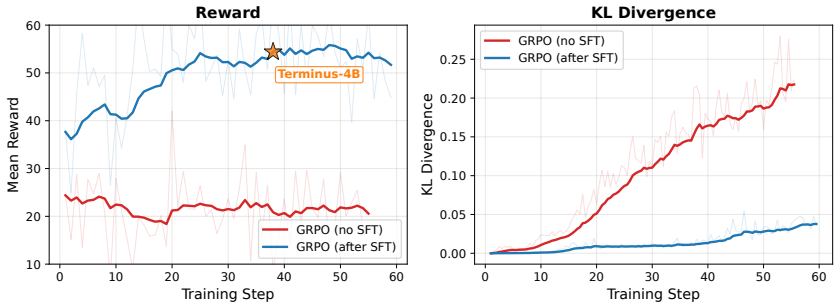
- Figure 6: y-axis “Mean Reward” scale and absolute units are hard to interpret relative to the 14 rubric dimensions (0–1 averages blended in Eq. 2). Clarify the reward scale after penalties and averaging.
- Typos / wording: “suality” → “quality” (contributions list); “MOTIV ATING” spacing; “rrollouts” / “perfom” / “hte” / “subseqeunt” / “subagnet”; “Terminal-4B” once in §2.2 should be Terminus-4B; TerminalBench citation is “[?]”.
- §5.2.2 lists “Claude Sonnet 4.6” as a main agent while Table 4/5 headers say “Claude Sonnet 4.5”—align version labels throughout.
- §7 already flags Unix/Bash and Docker/pre-provisioned scope; a single sentence in the abstract or introduction that the ~30% claim is measured in that regime would better match the title’s generality.
Circularity Check
No circular derivation: empirical SFT+RL system paper evaluated on external resolve rates and token metrics independent of the training reward.
full rationale
Terminus-4B is an empirical systems paper, not a first-principles derivation. The training chain (SFT on telemetry trajectories, then GRPO with a rubric LLM-as-judge that scores rollouts against frontier-generated reference Execution Plans) optimizes the subagent toward useful terminal behavior; that is ordinary imitation/RL, not a claim that X derives Y when X is defined as Y. End-to-end claims—resolve rate on SWE-Bench Pro and SWE-Bench C#, main-agent token reduction vs No Subagent, Main Terminal and Subagent→Terminal counts, Final Answer %—are measured outside the reward formula on held-out agent trajectories and benchmark harnesses. Matching or exceeding frontier subagents on those metrics is therefore not forced by construction from the fitted reward. There is no self-definitional equation, no fitted parameter renamed as a prediction, no load-bearing uniqueness theorem imported from overlapping authors, and no ansatz smuggled in via self-citation. Self-citations (e.g. Debug2LS) are peripheral. Residual concerns about distribution shift (pre-provisioned Docker/GitHub-issue regime) are evaluation-scope limitations, not circularity. Score 0; steps empty.
Axiom & Free-Parameter Ledger
free parameters (3)
- reward blend α
- GRPO asymmetric clip (ε_low, ε_high) and KL β
- subagent turn limit and hard reward penalties
axioms (4)
- domain assumption Terminal execution for coding agents is narrow enough that a 4B tool-calling model can match frontier subagent utility after SFT+RL.
- domain assumption Rubric-based LLM-as-judge scores against frontier reference Execution Plans are a valid multi-dimensional reward for subagent quality.
- standard math GRPO with group-normalized advantages and KL to SFT is a correct on-policy RL update for multi-turn tool agents.
- domain assumption SWE-Bench Pro and internal SWE-Bench C# resolve rates plus token/behavior metrics are adequate proxies for real agentic terminal competence.
invented entities (2)
-
Execution Subagent (query/description tool + single Terminal tool + <final_answer> contract)
no independent evidence
-
Execution Plan (structured intermediate summary of a trajectory for judging)
no independent evidence
read the original abstract
Modern coding agents increasingly delegate specialized subtasks to subagents, which are smaller, focused agentic loops that handle narrow responsibilities like search, debugging or terminal execution. This architectural pattern keeps the main agent's context window clean by isolating verbose outputs (e.g. build logs, test results, etc.) within the subagent context. Typically when agents employ subagents for such tasks, they use frontier models as these subagents. In this paper, we investigate whether a finetuned small language model (SLM) can achieve comparable performance to frontier models in the task of agentic terminal execution. We present Terminus-4B, which is a post-trained Qwen3-4B model via Supervised Finetuning (SFT) and Reinforcement Learning (RL) using rubric-based LLM-as-judge reward, specifically for this task. In our extensive evaluation spanning various frontier models, training ablations and main agent configurations, we find that Terminus-4B is able to reduce the token usage of the main agent by up to ~30% compared to the No Subagent baseline with no impact to agent performance on benchmarks like SWE-Bench Pro and our internal SWE-Bench C# benchmark, which tends to be heavy in verbose execution tasks. Furthermore, Terminus-4B improves key metrics showing the main agent relying on the outputs of the subagent and doing fewer terminal execution tasks by itself. We see that our model not only closes the gap between the Vanilla Qwen model and frontier models like Claude Sonnet / Opus / GPT-5.3-Codex, but often even exceeds their performance.
Figures




Forward citations
Cited by 1 Pith paper
-
Think Big, Search Small: Where Capacity Matters in Hierarchical Search Agents?
Scaling the delegation backbone in hierarchical search agents improves EM by ~11 points while scaling the executor moves EM by only ~2.6 points, and a 1.7B SFT executor matches a frontier sub-agent at 37% fewer tokens.
Reference graph
Works this paper leans on
-
[1]
VSCode Agent Mode,
Microsoft, “VSCode Agent Mode, ” https://code.visualstudio.com/blogs/ 2025/04/07/agentMode, 2025, accessed: 2025-09-28
2025
-
[2]
Opendevin: An open platform for ai software developers as generalist agents,
X. Wang, B. Li, Y. Song, F. F. Xu, X. Tang, M. Zhuge, J. Pan, Y. Song, B. Li, J. Singh, H. H. Tran, F. Li, R. Ma, M. Zheng, B. Qian, Y. Shao, N. Muennighoff, Y. Zhang, B. Hui, J. Lin, R. Brennan, H. Peng, H. Ji, and G. Neubig, “Opendevin: An open platform for ai software developers as generalist agents, ” 2024. [Online]. Available: https://arxiv.org/abs/2...
Pith/arXiv arXiv 2024
-
[3]
Claude for Coding,
Anthropic, “Claude for Coding, ” https://www.anthropic.com/claude-code, 2024, accessed: 2025-07-14
2024
-
[4]
Swe-agent: Agent-computer interfaces enable automated software engineering,
J. Yang, C. E. Jimenez, A. Wettig, K. Lieret, S. Yao, K. Narasimhan, and O. Press, “Swe-agent: Agent-computer interfaces enable automated software engineering, ” 2024. [Online]. Available: https://arxiv.org/abs/ 2405.15793
Pith/arXiv arXiv 2024
-
[5]
Debug2fix: Can interactive debugging help coding agents fix more bugs?
S. Garg and Y. Huang, “Debug2fix: Can interactive debugging help coding agents fix more bugs?” 2026. [Online]. Available: https: //arxiv.org/abs/2602.18571
Pith/arXiv arXiv 2026
-
[6]
A. Yang, A. Li, B. Yang, B. Zhang, B. Hui, B. Zheng, B. Yu, C. Gao, C. Huang, C. Lv, C. Zheng, D. Liu, F. Zhou, F. Huang, F. Hu, H. Ge, H. Wei, H. Lin, J. Tang, J. Yang, J. Tu, J. Zhang, J. Yang, J. Yang, J. Zhou, J. Zhou, J. Lin, K. Dang, K. Bao, K. Yang, L. Yu, L. Deng, M. Li, M. Xue, 12 M. Li, P. Zhang, P. Wang, Q. Zhu, R. Men, R. Gao, S. Liu, S. Luo, ...
Pith/arXiv arXiv 2025
-
[7]
Deepseekmath: Pushing the limits of mathematical reasoning in open language models,
Z. Shao, P. Wang, Q. Zhu, R. Xu, J. Song, X. Bi, H. Zhang, M. Zhang, Y. K. Li, Y. Wu, and D. Guo, “Deepseekmath: Pushing the limits of mathematical reasoning in open language models, ” 2024. [Online]. Available: https://arxiv.org/abs/2402.03300
Pith/arXiv arXiv 2024
-
[8]
Judging llm-as-a-judge with mt-bench and chatbot arena,
L. Zheng, W.-L. Chiang, Y. Sheng, S. Zhuang, Z. Wu, Y. Zhuang, Z. Lin, Z. Li, D. Li, E. P. Xing, H. Zhang, J. E. Gonzalez, and I. Stoica, “Judging llm-as-a-judge with mt-bench and chatbot arena, ” 2023. [Online]. Available: https://arxiv.org/abs/2306.05685
Pith/arXiv arXiv 2023
-
[9]
H. Hashemi, J. Eisner, C. Rosset, B. Van Durme, and C. Kedzie, “Llm-rubric: A multidimensional, calibrated approach to automated evaluation of natural language texts, ” inProceedings of the 62nd Annual Meeting of the Association for Computational Linguistics (Volume 1: Long Papers). Association for Computational Linguistics, 2024, p. 13806–13834. [Online]...
-
[10]
Training language models to follow instructions with human feedback,
L. Ouyang, J. Wu, X. Jiang, D. Almeida, C. L. Wainwright, P. Mishkin, C. Zhang, S. Agarwal, K. Slama, A. Ray, J. Schulman, J. Hilton, F. Kelton, L. Miller, M. Simens, A. Askell, P. Welinder, P. Christiano, J. Leike, and R. Lowe, “Training language models to follow instructions with human feedback, ” 2022. [Online]. Available: https://arxiv.org/abs/2203.02155
Pith/arXiv arXiv 2022
-
[11]
Autogen: Enabling next-gen llm applications via multi-agent conversation,
Q. Wu, G. Bansal, J. Zhang, Y. Wu, B. Li, E. Zhu, L. Jiang, X. Zhang, S. Zhang, J. Liu, A. H. Awadallah, R. W. White, D. Burger, and C. Wang, “Autogen: Enabling next-gen llm applications via multi-agent conversation, ” 2023. [Online]. Available: https://arxiv.org/abs/2308.08155
Pith/arXiv arXiv 2023
-
[12]
Metagpt: Meta programming for a multi-agent collaborative framework,
S. Hong, M. Zhuge, J. Chen, X. Zheng, Y. Cheng, C. Zhang, J. Wang, Z. Wang, S. K. S. Yau, Z. Lin, L. Zhou, C. Ran, L. Xiao, C. Wu, and J. Schmidhuber, “Metagpt: Meta programming for a multi-agent collaborative framework, ” 2024. [Online]. Available: https: //arxiv.org/abs/2308.00352
Pith/arXiv arXiv 2024
-
[13]
Chatdev: Communicative agents for software development,
C. Qian, W. Liu, H. Liu, N. Chen, Y. Dang, J. Li, C. Yang, W. Chen, Y. Su, X. Cong, J. Xu, D. Li, Z. Liu, and M. Sun, “Chatdev: Communicative agents for software development, ” 2024. [Online]. Available: https://arxiv.org/abs/2307.07924
Pith/arXiv arXiv 2024
-
[14]
J. He, C. Treude, and D. Lo, “Llm-based multi-agent systems for software engineering: Literature review, vision and the road ahead, ” 2025. [Online]. Available: https://arxiv.org/abs/2404.04834
Pith/arXiv arXiv 2025
-
[15]
(2025) How we built our multi-agent research system
Anthropic. (2025) How we built our multi-agent research system. Published June 13, 2025. [Online]. Available: https://www.anthropic.com/ engineering/built-multi-agent-research-system
2025
-
[16]
Small language models are the future of agentic ai,
P. Belcak, G. Heinrich, S. Diao, Y. Fu, X. Dong, S. Muralidharan, Y. C. Lin, and P. Molchanov, “Small language models are the future of agentic ai, ”
-
[17]
Available: https://arxiv.org/abs/2506.02153
[Online]. Available: https://arxiv.org/abs/2506.02153
-
[18]
Deepseek-r1 incentivizes reasoning in llms through reinforcement learning,
D. Guo, D. Yang, H. Zhang, J. Song, P. Wang, Q. Zhu, R. Xu, R. Zhang, S. Ma, X. Bi, X. Zhang, X. Yu, Y. Wu, Z. F. Wu, Z. Gou, Z. Shao, Z. Li, Z. Gao, A. Liu, B. Xue, B. Wang, B. Wu, B. Feng, C. Lu, C. Zhao, C. Deng, C. Ruan, D. Dai, D. Chen, D. Ji, E. Li, F. Lin, F. Dai, F. Luo, G. Hao, G. Chen, G. Li, H. Zhang, H. Xu, H. Ding, H. Gao, H. Qu, H. Li, J. Gu...
-
[19]
Available: http://dx.doi.org/10.1038/s41586-025-09422-z
[Online]. Available: http://dx.doi.org/10.1038/s41586-025-09422-z
-
[20]
Reinforcement learning for reasoning in small llms: What works and what doesn’t,
Q.-A. Dang and C. Ngo, “Reinforcement learning for reasoning in small llms: What works and what doesn’t, ” 2026. [Online]. Available: https://arxiv.org/abs/2503.16219
arXiv 2026
-
[21]
Qwen3-coder-next technical report,
R. Cao, M. Chen, J. Chen, Z. Cui, Y. Feng, B. Hui, Y. Jing, K. Li, M. Li, J. Lin, Z. Ma, K. Shum, X. Wang, J. Wei, J. Yang, J. Zhang, L. Zhang, Z. Zhang, W. Zhao, and F. Zhou, “Qwen3-coder-next technical report, ”
-
[22]
Available: https://arxiv.org/abs/2603.00729
[Online]. Available: https://arxiv.org/abs/2603.00729
-
[23]
Skyrl-agent: Efficient rl training for multi-turn llm agent,
S. Cao, D. Li, F. Zhao, S. Yuan, S. R. Hegde, C. Chen, C. Ruan, T. Griggs, S. Liu, E. Tang, R. Liaw, P. Moritz, M. Zaharia, J. E. Gonzalez, and I. Stoica, “Skyrl-agent: Efficient rl training for multi-turn llm agent, ” 2025. [Online]. Available: https://arxiv.org/abs/2511.16108
arXiv 2025
-
[24]
Endless terminals: Scaling rl environments for terminal agents,
K. Gandhi, S. Garg, N. D. Goodman, and D. Papailiopoulos, “Endless terminals: Scaling rl environments for terminal agents, ” 2026. [Online]. Available: https://arxiv.org/abs/2601.16443
arXiv 2026
-
[25]
Active context compression: Autonomous memory management in llm agents,
N. Verma, “Active context compression: Autonomous memory management in llm agents, ” 2026. [Online]. Available: https: //arxiv.org/abs/2601.07190
arXiv 2026
-
[26]
Scaling long-horizon llm agent via context-folding,
W. Sun, M. Lu, Z. Ling, K. Liu, X. Yao, Y. Yang, and J. Chen, “Scaling long-horizon llm agent via context-folding, ” 2025. [Online]. Available: https://arxiv.org/abs/2510.11967
arXiv 2025
-
[27]
Memex(rl): Scaling long-horizon llm agents via indexed experience memory,
Z. Wang, H. Chen, J. Wang, and W. Wei, “Memex(rl): Scaling long-horizon llm agents via indexed experience memory, ” 2026. [Online]. Available: https://arxiv.org/abs/2603.04257
arXiv 2026
-
[28]
Swe context bench: A benchmark for context learning in coding,
J. Zhu, M. Hu, and J. Wu, “Swe context bench: A benchmark for context learning in coding, ” 2026. [Online]. Available: https: //arxiv.org/abs/2602.08316
Pith/arXiv arXiv 2026
-
[29]
Fireworks AI: Fast inference platform,
Fireworks AI, “Fireworks AI: Fast inference platform, ” https://fireworks.ai, 2025
2025
-
[30]
Slime: Distributed training framework,
THUDM, “Slime: Distributed training framework, ” https://github.com/ THUDM/slime, 2025
2025
-
[31]
Dapo: An open-source llm reinforcement learning system at scale,
Q. Yu, Z. Zhang, R. Zhu, Y. Yuan, X. Zuo, Y. Yue, W. Dai, T. Fan, G. Liu, L. Liu, X. Liu, H. Lin, Z. Lin, B. Ma, G. Sheng, Y. Tong, C. Zhang, M. Zhang, W. Zhang, H. Zhu, J. Zhu, J. Chen, J. Chen, C. Wang, H. Yu, Y. Song, X. Wei, H. Zhou, J. Liu, W.-Y. Ma, Y.-Q. Zhang, L. Yan, M. Qiao, Y. Wu, and M. Wang, “Dapo: An open-source llm reinforcement learning sy...
Pith/arXiv arXiv 2025
-
[32]
Swe-bench pro: Can ai agents solve long-horizon software engineering tasks?
X. Deng, J. Da, E. Pan, Y. Y. He, C. Ide, K. Garg, N. Lauffer, A. Park, N. Pasari, C. Rane, K. Sampath, M. Krishnan, S. Kundurthy, S. Hendryx, Z. Wang, V. Bharadwaj, J. Holm, R. Aluri, C. B. C. Zhang, N. Jacobson, B. Liu, and B. Kenstler, “Swe-bench pro: Can ai agents solve long-horizon software engineering tasks?” 2025. [Online]. Available: https://arxiv...
Pith/arXiv arXiv 2025
-
[33]
Introducing swe-bench verified,
OpenAI, “Introducing swe-bench verified, ” https://openai.com/index/ introducing-swe-bench-verified/, 2024, published August 13, 2024; updated February 24, 2025. [Online]. Available: https://openai.com/index/ introducing-swe-bench-verified/ 13
2024
discussion (0)
Sign in with ORCID, Apple, or X to comment. Anyone can read and Pith papers without signing in.