REVIEW 3 major objections 2 minor 1 cited by
FP8 only becomes practical for large recommendation models when you co-design probing, model changes, and kernel dispatch—not when you swap in better low-precision kernels alone.
Reviewed by Pith at T0; open to challenge. T0 means a machine referee read the full paper against a public rubric. the ladder, T0–T4 →
T0 review · grok-4.5
2026-07-12 17:03 UTC pith:KNP64ZBZ
load-bearing objection We only have LoKA’s abstract; the cached “full text” is a different paper, so the co-design claim is coherent but uncheckable. the 3 major comments →
LoKA: Low-precision Kernel Applications for Recommendation Models At Scale
The pith
A machine-rendered reading of the paper's core claim, the machinery that carries it, and where it could break.
Core claim
Direct FP8 adoption degrades LRM quality and can lengthen training; the path that works is a system–model co-design that first measures where low precision is safe under realistic distributions, then changes the model to expand that safe set, then dispatches the fastest accurate kernel for each site.
What carries the argument
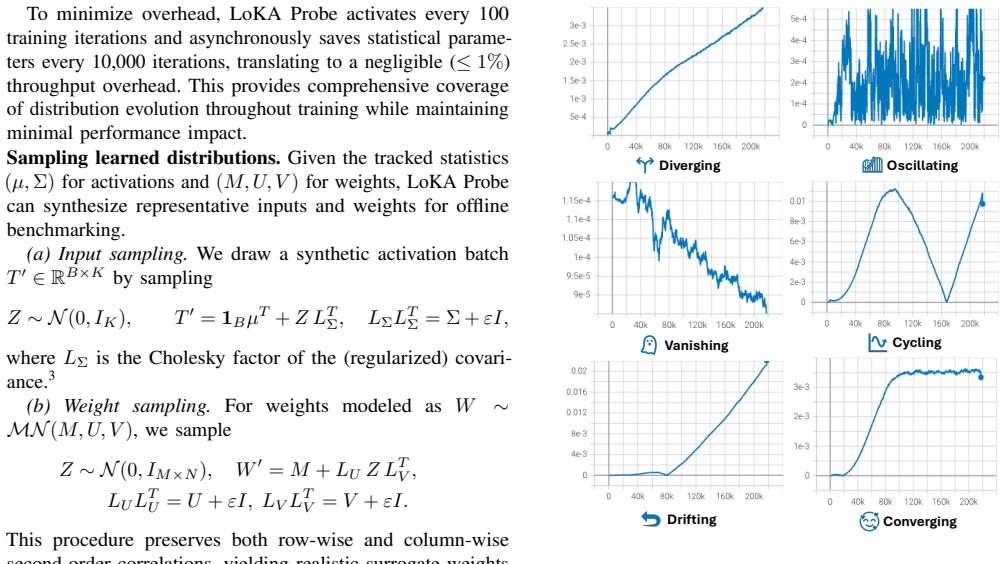
LoKA: LoKA Probe (online statistical benchmarking of activations, weights, and per-layer error), LoKA Mods (reusable model adaptations for stability and efficiency), and LoKA Dispatch (runtime selection of the fastest FP8 kernel that still satisfies accuracy).
Load-bearing premise
The paper treats as given that LRM FP8 failures are inherent to the workload and cannot be solved by better FP8 kernels alone, so co-designed probing, model changes, and dispatch are required.
What would settle it
Show an LRM training run that reaches equal or better quality and wall-clock speed than the LoKA pipeline by swapping only improved FP8 kernels (no Probe-driven site selection, no Mods, no accuracy-aware Dispatch) under the same communication and small-GEMM regime the paper describes.
If this is right
- Production LRM stacks can adopt FP8 selectively by layer once Probe has labeled safe and unsafe sites under live statistics.
- Reusable Mods become a standard way to enlarge the FP8-safe region without redesigning the whole model.
- Kernel libraries are no longer chosen globally; Dispatch chooses per site by measured error and speed.
- If the three principles hold, further hardware FLOPs gains at low precision transfer to recommendation training, not only to LLMs.
Where Pith is reading between the lines
- The same profile-under-real-distributions idea could be applied to other numerically fragile, communication-heavy models beyond recommenders (e.g., ranking or multi-task towers).
- If Probe error estimates are cheap enough online, they might also drive mixed-precision decisions for formats other than FP8 as new GPU generations appear.
- Failure modes concentrated in small GEMMs plus normalization suggest that fusion or reordering of those ops may matter as much as the numeric format itself.
Editorial analysis
A structured set of objections, weighed in public.
Referee Report
Summary. The abstract of LoKA claims that direct FP8 application to large recommendation models (LRMs) degrades quality and slows training because LRMs are numerically sensitive, dominated by small GEMMs followed by normalization, and trained under heavy communication. It asserts these challenges are inherent and cannot be fixed by better FP8 kernels alone, so a system-model co-design is required. LoKA is presented as three components: Probe (online statistical benchmarking of activations/weights and per-layer error quantification to identify safe/unsafe and fast/slow FP8 sites), Mods (reusable model adaptations for numerical stability and efficiency), and Dispatch (runtime selection of the fastest accuracy-satisfying FP8 kernel). The supplied full manuscript body, however, is an unrelated computer-vision paper (Count Anything / multi-grained counting, KubriCount, HieraCount) and contains none of LoKA’s methods, equations, ablations, or results.
Significance. If the LoKA claims held with rigorous evidence, the work would be significant for industrial recommendation training: FP8 FLOPs on modern GPUs are under-used on LRMs, and a practical co-design that restores quality while cutting training time would matter. The three-principle framing (profile under realistic distributions, co-design model with hardware, orchestrate kernels) is a reasonable systems contribution. Because the body of the manuscript does not describe LoKA at all, none of these contributions can be assessed, reproduced, or credited from the provided text.
major comments (3)
- Manuscript identity mismatch: the title, paper_id (2605.10886), and abstract describe LoKA (FP8 for LRMs), but the full manuscript text is an entirely different paper (Count Anything at Any Granularity / multi-grained counting, KubriCount, HieraCount). No LoKA sections, algorithms, equations, tables, or figures exist in the supplied body. A technical review of LoKA’s claims is therefore impossible from the provided materials.
- Abstract premise that LRM FP8 failures are inherent and “cannot be resolved merely by introducing better FP8 kernels” is load-bearing for the necessity of Probe+Mods+Dispatch, yet no kernel-only baselines, error distributions, quality metrics, or training-time measurements appear anywhere in the available text. Without those, the central necessity claim remains an untested assertion.
- LoKA Probe, Mods, and Dispatch are introduced only at the abstract level (statistically grounded online benchmarking; reusable model adaptations; accuracy-constrained kernel selection). There are no formal definitions, pseudocode, error thresholds, ablation tables, or end-to-end quality/throughput results against which the sufficiency claim can be checked.
minor comments (2)
- Even within the abstract, free parameters (per-layer accuracy/error thresholds used by Probe and Dispatch; online activation/weight statistics) are left unspecified, so the claimed “statistically grounded” selection cannot be audited.
- The abstract asserts both quality restoration and training-time reduction under FP8; without any numbers or experimental protocol, these dual claims cannot be evaluated for trade-offs.
Circularity Check
No circular derivation in available LoKA material; abstract describes empirical probing and dispatch, not a result forced by its own inputs.
full rationale
Only the LoKA abstract is available for arXiv:2605.10886; the cached full manuscript is a different paper (Count Anything / 2605.10887) and cannot be used as LoKA’s derivation chain. Within the LoKA abstract, the load-bearing claims are empirical and engineering: LRMs are numerically sensitive (small GEMMs + normalization + communication), direct FP8 hurts quality/time, and LoKA Probe measures activation/weight statistics and per-layer errors to mark safe/unsafe sites; Mods adapt the model; Dispatch picks the fastest kernel meeting accuracy requirements. None of these steps is self-definitional (Probe is not defined as the quantity it “predicts”), none renames a fitted parameter as an independent prediction, and there are no uniqueness theorems, ansatz-via-self-citation, or equation reductions of the form “Eq. X = Eq. Y by construction.” Using Probe statistics to constrain Dispatch is ordinary measurement-driven selection, not circular math. The abstract’s necessity claim (kernels alone insufficient) is an unbacked assertion—an evidence gap, not circularity under the stated patterns. Score 0.
Axiom & Free-Parameter Ledger
free parameters (2)
- Per-layer FP8 accuracy/error thresholds used by Probe and Dispatch
- Activation and weight statistics estimated online by LoKA Probe
axioms (3)
- domain assumption LRMs are numerically sensitive, dominated by small GEMMs followed by normalization, and trained in communication-intensive environments, so direct FP8 often degrades quality and prolongs training.
- ad hoc to paper These challenges cannot be resolved merely by introducing better FP8 kernels; system-model co-design is required.
- domain assumption Profiling under realistic distributions can identify sites where low precision is safe, and co-designed model components can expand that safe set.
invented entities (3)
-
LoKA Probe
no independent evidence
-
LoKA Mods
no independent evidence
-
LoKA Dispatch
no independent evidence
read the original abstract
Recent GPU generations deliver significantly higher FLOPs using lower-precision arithmetic, such as FP8. While successfully applied to large language models (LLMs), its adoption in large recommendation models (LRMs) has been limited. This is because LRMs are numerically sensitive, dominated by small matrix multiplications (GEMMs) followed by normalization, and trained in communication-intensive environments. Applying FP8 directly to LRMs often degrades model quality and prolongs training time. These challenges are inherent to LRM workloads and cannot be resolved merely by introducing better FP8 kernels. Instead, a system-model co-design approach is needed to successfully integrate FP8. We present LoKA (Low-precision Kernel Applications), a framework that makes FP8 practical for LRMs through three principles: profile under realistic distributions to know where low precision is safe, co-design model components with hardware to expand where it is safe, and orchestrate across kernel libraries to maximize the gains. Concretely, LoKA Probe is a statistically grounded, online benchmarking method that learns activation and weight statistics, and quantifies per-layer errors. This process pinpoints safe and unsafe, fast and slow sites for FP8 adoption. LoKA Mods is a set of reusable model adaptations that improve both numerical stability and execution efficiency with FP8. LoKA Dispatch is a runtime that leverages the statistical insights from LoKA Probe to select the fastest FP8 kernel that satisfies the accuracy requirements.
Figures







Forward citations
Cited by 1 Pith paper
-
ROCS: Request-Oriented Compute Sharing for Efficient Large-Scale Recommendation
ROCS restructures recommendation models so user-side computation is shared across all candidate items, yielding up to 3x serving throughput at equal or better prediction quality.
Reference graph
Works this paper leans on
-
[1]
In: Proceedings of the AAAI Conference on Artificial Intelligence (2019) 4, 10
Acharya,M.,Kafle,K.,Kanan,C.:Tallyqa:Answeringcomplexcountingquestions. In: Proceedings of the AAAI Conference on Artificial Intelligence (2019) 4, 10
2019
-
[2]
In: Proceedings of the British Machine Vision Conference (2023) 2, 4
Amini-Naieni, N., Amini-Naieni, K., Han, T., Zisserman, A.: Open-world text- specified object counting. In: Proceedings of the British Machine Vision Conference (2023) 2, 4
2023
-
[3]
In: Conference on Neural Information Processing Systems (2024) 2, 4, 6, 7, 11, 13, 14, 43
Amini-Naieni, N., Han, T., Zisserman, A.: Countgd: Multi-modal open-world counting. In: Conference on Neural Information Processing Systems (2024) 2, 4, 6, 7, 11, 13, 14, 43
2024
-
[4]
In: Proceedings of the IEEE Conference on Computer Vision and Pattern Recognition (2025) 4, 11, 13, 14
Amini-Naieni, N., Zisserman, A.: Countgd++: Generalized prompting for open- world counting. In: Proceedings of the IEEE Conference on Computer Vision and Pattern Recognition (2025) 4, 11, 13, 14
2025
-
[5]
Anthropic: Claude haiku 4.5 system card (2025),�������������������������� �����������������������������11, 13
2025
-
[6]
Anthropic: Claude opus 4.5 system card (2025),�������������������������� ���������������������������11, 13
2025
-
[7]
Anthropic: System card: Claude sonnet 4.5 (2025),�������������������������� �����������������������������11, 13
2025
-
[8]
In: Proceedings of the European Conference on Computer Vision (2014) 3
Arteta, C., Lempitsky, V., Noble, J.A., Zisserman, A.: Interactive object counting. In: Proceedings of the European Conference on Computer Vision (2014) 3
2014
-
[9]
In: Proceedings of the European Conference on Computer Vision (2016) 2, 3
Arteta, C., Lempitsky, V., Zisserman, A.: Counting in the wild. In: Proceedings of the European Conference on Computer Vision (2016) 2, 3
2016
-
[10]
arXiv preprint arXiv:2511.21631 (2025) 1, 4, 11, 13
Bai, S., Cai, Y., Chen, R., Chen, K., Chen, X., Cheng, Z., Deng, L., Ding, W., Gao, C., Ge, C., et al.: Qwen3-vl technical report. arXiv preprint arXiv:2511.21631 (2025) 1, 4, 11, 13
Pith/arXiv arXiv 2025
-
[11]
arXiv preprint arXiv:2502.13923 (2025) 1, 4, 11, 13
Bai, S., Chen, K., Liu, X., Wang, J., Ge, W., Song, S., Dang, K., Wang, P., Wang, S., Tang, J., et al.: Qwen2.5-vl technical report. arXiv preprint arXiv:2502.13923 (2025) 1, 4, 11, 13
Pith/arXiv arXiv 2025
-
[12]
IEEE Transactions on Pattern Analysis and Machine In- telligence (2012) 3
Barinova, O., Lempitsky, V., Kholi, P.: On detection of multiple object instances using hough transforms. IEEE Transactions on Pattern Analysis and Machine In- telligence (2012) 3
2012
-
[13]
In:ProceedingsoftheInternationalConferenceonLearningRepresentations(2026) 1
Carion, N., Gustafson, L., Hu, Y.T., Debnath, S., Hu, R., Suris, D., Ryali, C., Alwala,K.V.,Khedr,H.,Huang,A.,etal.:Sam3:Segmentanythingwithconcepts. In:ProceedingsoftheInternationalConferenceonLearningRepresentations(2026) 1
2026
-
[14]
arXiv preprint arXiv:1512.03012 (2015) 8
Chang, A.X., Funkhouser, T., Guibas, L., Hanrahan, P., Huang, Q., Li, Z., Savarese, S., Savva, M., Song, S., Su, H., et al.: Shapenet: An information-rich 3d model repository. arXiv preprint arXiv:1512.03012 (2015) 8
Pith/arXiv arXiv 2015
-
[15]
In: Proceedings of the British Machine Vision Conference (2022) 2, 4, 11, 13
Chang, L., Yujie, Z., Andrew, Z., Weidi, X.: Countr: Transformer-based generalised visual counting. In: Proceedings of the British Machine Vision Conference (2022) 2, 4, 11, 13
2022
-
[16]
In: Proceedings of the IEEE Conference on Computer Vision and Pattern Recognition (2024) 13
Chen, B., Xu, Z., Kirmani, S., Ichter, B., Sadigh, D., Guibas, L., Xia, F.: Spa- tialvlm: Endowing vision-language models with spatial reasoning capabilities. In: Proceedings of the IEEE Conference on Computer Vision and Pattern Recognition (2024) 13
2024
-
[17]
ACM Transactions on Graphics (TOG) (2022) 8
Chen, Z., Wang, G., Liu, Z.: Text2light: Zero-shot text-driven hdr panorama gen- eration. ACM Transactions on Graphics (TOG) (2022) 8
2022
-
[18]
arXiv preprint arXiv:2412.05271 (2024) 1, 11, 13
Chen, Z., Wang, W., Cao, Y., Liu, Y., Gao, Z., Cui, E., Zhu, J., Ye, S., Tian, H., Liu, Z., et al.: Expanding performance boundaries of open-source multimodal Abbreviated paper title 17 models with model, data, and test-time scaling. arXiv preprint arXiv:2412.05271 (2024) 1, 11, 13
Pith/arXiv arXiv 2024
-
[19]
In: Win- ter Conference on Applications of Computer Vision (2025) 4
Ciampi, L., Messina, N., Pierucci, M., Amato, G., Avvenuti, M., Falchi, F.: Mind the prompt: A novel benchmark for prompt-based class-agnostic counting. In: Win- ter Conference on Applications of Computer Vision (2025) 4
2025
-
[20]
arXiv preprint arXiv:2601.10611 (2026) 11, 13
Clark, C., Zhang, J., Ma, Z., Park, J.S., Salehi, M., Tripathi, R., Lee, S., Ren, Z., Kim, C.D., Yang, Y., et al.: Molmo2: Open weights and data for vision-language models with video understanding and grounding. arXiv preprint arXiv:2601.10611 (2026) 11, 13
Pith/arXiv arXiv 2026
-
[21]
arXiv preprint arXiv:2507.06261 (2025) 4, 11, 13
Comanici, G., Bieber, E., Schaekermann, M., Pasupat, I., Sachdeva, N., Dhillon, I., Blistein, M., Ram, O., Zhang, D., Rosen, E., et al.: Gemini 2.5: Pushing the frontier with advanced reasoning, multimodality, long context, and next generation agentic capabilities. arXiv preprint arXiv:2507.06261 (2025) 4, 11, 13
Pith/arXiv arXiv 2025
-
[22]
In: Proceedings of the IEEE Conference on Computer Vision and Pattern Recognition (2024) 4, 10
Dai, S., Liu, J., Cheung, N.M.: Referring expression counting. In: Proceedings of the IEEE Conference on Computer Vision and Pattern Recognition (2024) 4, 10
2024
-
[23]
In: Proceedings of the IEEE Con- ference on Computer Vision and Pattern Recognition (2025) 4, 8, 10, 11, 12, 13, 29
Deitke, M., Clark, C., Lee, S., Tripathi, R., Yang, Y., Park, J.S., Salehi, M., Muen- nighoff, N., Lo, K., Soldaini, L., et al.: Molmo and pixmo: Open weights and open data for state-of-the-art vision-language models. In: Proceedings of the IEEE Con- ference on Computer Vision and Pattern Recognition (2025) 4, 8, 10, 11, 12, 13, 29
2025
-
[24]
Conference on Neural Information Processing Systems (2023) 8
Deitke, M., Liu, R., Wallingford, M., Ngo, H., Michel, O., Kusupati, A., Fan, A., Laforte, C., Voleti, V., Gadre, S.Y., et al.: Objaverse-xl: A universe of 10m+ 3d objects. Conference on Neural Information Processing Systems (2023) 8
2023
-
[25]
In: Proceedings of the IEEE Conference on Computer Vision and Pattern Recognition (2023) 8
Deitke, M., Schwenk, D., Salvador, J., Weihs, L., Michel, O., VanderBilt, E., Schmidt, L., Ehsani, K., Kembhavi, A., Farhadi, A.: Objaverse: A universe of an- notated 3d objects. In: Proceedings of the IEEE Conference on Computer Vision and Pattern Recognition (2023) 8
2023
-
[26]
International Journal of Computer Vision (2011) 3
Desai, C., Ramanan, D., Fowlkes, C.C.: Discriminative models for multi-class ob- ject layout. International Journal of Computer Vision (2011) 3
2011
-
[27]
In: IEEE International Conference on Robotics and Automation (2022) 8
Downs, L., Francis, A., Koenig, N., Kinman, B., Hickman, R., Reymann, K., McHugh, T.B., Vanhoucke, V.: Google scanned objects: A high-quality dataset of 3d scanned household items. In: IEEE International Conference on Robotics and Automation (2022) 8
2022
-
[28]
In: Proceedings of the European Conference on Computer Vision (2022) 4
Gong, S., Zhang, S., Yang, J., Dai, D., Schiele, B.: Class-agnostic object count- ing robust to intraclass diversity. In: Proceedings of the European Conference on Computer Vision (2022) 4
2022
-
[29]
Google: Introducing gemini 2.5 flash image, our state-of-the-art image model (2025),����� � � � ���������� � ���������� � ��� � ����������� � ������ � � � � � ������������8, 29
2025
-
[30]
Google: Introducing nano banana pro (2025),������������������������������� ��������������������������������3, 9
2025
-
[31]
Google: A new era of intelligence with gemini 3 (2025),�������������������� �������������������������3, 4, 8, 9, 11, 12, 13, 29, 36
2025
-
[32]
arXiv preprint arXiv:2407.21783 (2024) 11, 12, 13
Grattafiori, A., Dubey, A., Jauhri, A., Pandey, A., Kadian, A., Al-Dahle, A., Let- man, A., Mathur, A., Schelten, A., Vaughan, A., et al.: The llama 3 herd of models. arXiv preprint arXiv:2407.21783 (2024) 11, 12, 13
Pith/arXiv arXiv 2024
-
[33]
In: Proceedings of the IEEE Conference on Computer Vision and Pat- tern Recognition (2022) 3, 8 18 C
Greff, K., Belletti, F., Beyer, L., Doersch, C., Du, Y., Duckworth, D., Fleet, D.J., Gnanapragasam, D., Golemo, F., Herrmann, C., et al.: Kubric: A scalable dataset generator. In: Proceedings of the IEEE Conference on Computer Vision and Pat- tern Recognition (2022) 3, 8 18 C. Liu et al
2022
-
[34]
In: Proceedings of the International Conference on Computer Vision (2017) 3
He, K., Gkioxari, G., Dollár, P., Girshick, R.: Mask r-cnn. In: Proceedings of the International Conference on Computer Vision (2017) 3
2017
-
[35]
In: Proceedings of the International Conference on Computer Vision (2017) 3, 4, 10
Hsieh, M.R., Lin, Y.L., Hsu, W.H.: Drone-based object counting by spatially regu- larized regional proposal network. In: Proceedings of the International Conference on Computer Vision (2017) 3, 4, 10
2017
-
[36]
arXiv preprint arXiv:2410.21276 (2024) 11, 13
Hurst, A., Lerer, A., Goucher, A.P., Perelman, A., Ramesh, A., Clark, A., Os- trow, A., Welihinda, A., Hayes, A., Radford, A., et al.: Gpt-4o system card. arXiv preprint arXiv:2410.21276 (2024) 11, 13
Pith/arXiv arXiv 2024
-
[37]
In: Proceedings of the IEEE Conference on Com- puter Vision and Pattern Recognition (2013) 10
Idrees, H., Saleemi, I., Seibert, C., Shah, M.: Multi-source multi-scale counting in extremely dense crowd images. In: Proceedings of the IEEE Conference on Com- puter Vision and Pattern Recognition (2013) 10
2013
-
[38]
In: Proceedings of the European Conference on Computer Vision (2018) 10
Idrees, H., Tayyab, M., Athrey, K., Zhang, D., Al-Maadeed, S., Rajpoot, N., Shah, M.:Compositionlossforcounting,densitymapestimationandlocalizationindense crowds. In: Proceedings of the European Conference on Computer Vision (2018) 10
2018
-
[39]
arXiv preprint arXiv:2510.12798 (2025) 1, 11, 13
Jiang, Q., Huo, J., Chen, X., Xiong, Y., Zeng, Z., Chen, Y., Ren, T., Yu, J., Zhang, L.: Detect anything via next point prediction. arXiv preprint arXiv:2510.12798 (2025) 1, 11, 13
arXiv 2025
-
[40]
In: Proceedings of the European Conference on Computer Vision (2024) 1
Jiang, Q., Li, F., Zeng, Z., Ren, T., Liu, S., Zhang, L.: T-rex2: Towards generic object detection via text-visual prompt synergy. In: Proceedings of the European Conference on Computer Vision (2024) 1
2024
-
[41]
In: ACM Multimedia (2023) 4
Jiang, R., Liu, L., Chen, C.: Clip-count: Towards text-guided zero-shot object counting. In: ACM Multimedia (2023) 4
2023
-
[42]
In: Proceedings of the AAAI Conference on Artificial Intelligence (2024) 2, 4
Kang, S., Moon, W., Kim, E., Heo, J.P.: Vlcounter: Text-aware visual represen- tation for zero-shot object counting. In: Proceedings of the AAAI Conference on Artificial Intelligence (2024) 2, 4
2024
-
[43]
In: Proceedings of the International Conference on Computer Vision (2023) 1
Kirillov, A., Mintun, E., Ravi, N., Mao, H., Rolland, C., Gustafson, L., Xiao, T., Whitehead, S., Berg, A.C., Lo, W.Y., et al.: Segment anything. In: Proceedings of the International Conference on Computer Vision (2023) 1
2023
-
[44]
In: Proceedings of the International Conference on Pattern Recognition (2006) 3
Kong, D., Gray, D., Tao, H.: A viewpoint invariant approach for crowd counting. In: Proceedings of the International Conference on Pattern Recognition (2006) 3
2006
-
[45]
The American Journal of Psychology (1949) 1
L., K.E., W., L.M., W., R.T., J., V.: The discrimination of visual number. The American Journal of Psychology (1949) 1
1949
-
[46]
In: Conference on Neural Information Processing Systems (2010) 3
Lempitsky, V., Zisserman, A.: Learning to count objects in images. In: Conference on Neural Information Processing Systems (2010) 3
2010
-
[47]
arXiv preprint arXiv:2408.03326 (2024) 11, 13
Li, B., Zhang, Y., Guo, D., Zhang, R., Li, F., Zhang, H., Zhang, K., Zhang, P., Li, Y., Liu, Z., et al.: Llava-onevision: Easy visual task transfer. arXiv preprint arXiv:2408.03326 (2024) 11, 13
Pith/arXiv arXiv 2024
-
[48]
In: Proceedings of the International Conference on Computer Vision (2017) 3
Lin, T.Y., Goyal, P., Girshick, R., He, K., Dollár, P.: Focal loss for dense object detection. In: Proceedings of the International Conference on Computer Vision (2017) 3
2017
-
[49]
In: Proceedings of the British Machine Vision Conference (2022) 4
Lin, W., Yang, K., Ma, X., Gao, J., Liu, L., Liu, S., Hou, J., Yi, S., Chan, A.B.: Scale-prior deformable convolution for exemplar-guided class-agnostic counting. In: Proceedings of the British Machine Vision Conference (2022) 4
2022
-
[50]
In: Conference on Neural Information Processing Systems (2023) 11, 12, 13
Liu, H., Li, C., Wu, Q., Lee, Y.J.: Visual instruction tuning. In: Conference on Neural Information Processing Systems (2023) 11, 12, 13
2023
-
[51]
In: Proceedings of the European Conference on Computer Vision (2024) 1, 4, 6 Abbreviated paper title 19
Liu, S., Zeng, Z., Ren, T., Li, F., Zhang, H., Yang, J., Jiang, Q., Li, C., Yang, J., Su, H., et al.: Grounding dino: Marrying dino with grounded pre-training for open-set object detection. In: Proceedings of the European Conference on Computer Vision (2024) 1, 4, 6 Abbreviated paper title 19
2024
-
[52]
In: Asian Conference on Computer Vision (2018) 2, 4
Lu, E., Xie, W., Zisserman, A.: Class-agnostic counting. In: Asian Conference on Computer Vision (2018) 2, 4
2018
-
[53]
In: IEE Colloquium on Image Processing for Security Ap- plications (1997) 3
Marana, A.N., Velastín, S.A., Costa, L., Lotufo, R.: Estimation of crowd density using image processing. In: IEE Colloquium on Image Processing for Security Ap- plications (1997) 3
1997
-
[54]
In: Proceedings of the AAAI Conference on Artificial Intelligence (2025) 3, 4, 10
Mondal, A., Nag, S., Zhu, X., Dutta, A.: Omnicount: Multi-label object count- ing with semantic-geometric priors. In: Proceedings of the AAAI Conference on Artificial Intelligence (2025) 3, 4, 10
2025
-
[55]
In: Proceedings of the European Conference on Computer Vision (2016) 2
Mundhenk, T.N., Konjevod, G., Sakla, W.A., Boakye, K.: A large contextual dataset for classification, detection and counting of cars with deep learning. In: Proceedings of the European Conference on Computer Vision (2016) 2
2016
-
[56]
In: 2025 International Conference on Digital Image Computing: Techniques and Applications (DICTA) (2025) 4, 11, 13
Nguyen, G.K., Huang, Y., Hoai, M.: Can current ai models count what we mean, not what they see? a benchmark and systematic evaluation. In: 2025 International Conference on Digital Image Computing: Techniques and Applications (DICTA) (2025) 4, 11, 13
2025
-
[57]
In: Proceedings of the European Conference on Computer Vision (2022) 3, 4
Nguyen, T., Pham, C., Nguyen, K., Hoai, M.: Few-shot object counting and de- tection. In: Proceedings of the European Conference on Computer Vision (2022) 3, 4
2022
-
[58]
OpenAI: Gpt-5.1: A smarter, more conversational chatgpt (2025),�������� �������������������������11, 13
2025
-
[59]
OpenAI: Introducing gpt-5.2 (2025),������������������������������������� ��������11, 13
2025
-
[60]
arXiv preprint arXiv:2504.01805 (2025) 13
Ouyang, K., Liu, Y., Wu, H., Liu, Y., Zhou, H., Zhou, J., Meng, F., Sun, X.: Spacer: Reinforcing mllms in video spatial reasoning. arXiv preprint arXiv:2504.01805 (2025) 13
Pith/arXiv arXiv 2025
-
[61]
In: Proceedings of the International Conference on Computer Vision (2023) 4, 10
Paiss, R., Ephrat, A., Tov, O., Zada, S., Mosseri, I., Irani, M., Dekel, T.: Teaching clip to count to ten. In: Proceedings of the International Conference on Computer Vision (2023) 4, 10
2023
-
[62]
In: Conference on Neural Information Processing Systems (2024) 2, 11, 13, 14
Pelhan, J., Lukezic, A., Zavrtanik, V., Kristan, M.: A novel unified architecture for low-shot counting by detection and segmentation. In: Conference on Neural Information Processing Systems (2024) 2, 11, 13, 14
2024
-
[63]
In: Proceedings of the IEEE Conference on Computer Vision and Pattern Recognition (2024) 2, 11, 13, 14
Pelhan, J., Zavrtanik, V., Kristan, M., et al.: Dave-a detect-and-verify paradigm for low-shot counting. In: Proceedings of the IEEE Conference on Computer Vision and Pattern Recognition (2024) 2, 11, 13, 14
2024
-
[64]
In: Proceedings of the International Conference on Machine Learning (2021) 2, 4
Radford, A., Kim, J.W., Hallacy, C., Ramesh, A., Goh, G., Agarwal, S., Sastry, G., Askell, A., Mishkin, P., Clark, J., et al.: Learning transferable visual models from natural language supervision. In: Proceedings of the International Conference on Machine Learning (2021) 2, 4
2021
-
[65]
In: Proceedings of the IEEE Conference on Computer Vision and Pattern Recognition (2021) 3, 4, 5, 7, 8, 10, 11, 12, 13, 14, 29
Ranjan, V., Sharma, U., Nguyen, T., Hoai, M.: Learning to count everything. In: Proceedings of the IEEE Conference on Computer Vision and Pattern Recognition (2021) 3, 4, 5, 7, 8, 10, 11, 12, 13, 14, 29
2021
-
[66]
arXiv preprint arXiv:2408.00714 (2024) 1
Ravi, N., Gabeur, V., Hu, Y.T., Hu, R., Ryali, C., Ma, T., Khedr, H., Rädle, R., Rolland, C., Gustafson, L., et al.: Sam 2: Segment anything in images and videos. arXiv preprint arXiv:2408.00714 (2024) 1
Pith/arXiv arXiv 2024
-
[67]
Shi, M., Lu, H., Feng, C., Liu, C., Cao, Z.: Represent, compare, and learn: A similarity-awareframeworkforclass-agnosticcounting.In:ProceedingsoftheIEEE Conference on Computer Vision and Pattern Recognition (2022) 4
2022
-
[68]
IEEE Transactions on Pattern Analysis and Machine Intelligence (2020) 10 20 C
Sindagi, V.A., Yasarla, R., Patel, V.M.: Jhu-crowd++: Large-scale crowd counting dataset and a benchmark method. IEEE Transactions on Pattern Analysis and Machine Intelligence (2020) 10 20 C. Liu et al
2020
-
[69]
arXiv preprint arXiv:2601.03267 (2025) 8, 11, 13, 29, 43
Singh, A., Fry, A., Perelman, A., Tart, A., Ganesh, A., El-Kishky, A., McLaughlin, A., Low, A., Ostrow, A., Ananthram, A., et al.: Openai gpt-5 system card. arXiv preprint arXiv:2601.03267 (2025) 8, 11, 13, 29, 43
Pith/arXiv arXiv 2025
-
[70]
arXiv preprint arXiv:2504.07491 (2025) 1, 13
Team, K., Du, A., Yin, B., Xing, B., Qu, B., Wang, B., Chen, C., Zhang, C., Du, C., Wei, C., et al.: Kimi-vl technical report. arXiv preprint arXiv:2504.07491 (2025) 1, 13
Pith/arXiv arXiv 2025
-
[71]
In: Proceedings of the International Conference on Computer Vision (2023) 2, 3, 4, 11, 13, 14
Ðukić, N., Lukežič, A., Zavrtanik, V., Kristan, M.: A low-shot object counting network with iterative prototype adaptation. In: Proceedings of the International Conference on Computer Vision (2023) 2, 3, 4, 11, 13, 14
2023
-
[72]
IEEE Transactions on Pattern Analysis and Machine Intelligence (2020) 10
Wang,Q.,Gao,J.,Lin,W.,Li,X.:Nwpu-crowd:Alarge-scalebenchmarkforcrowd counting and localization. IEEE Transactions on Pattern Analysis and Machine Intelligence (2020) 10
2020
-
[73]
arXiv preprint arXiv:2508.18265 (2025) 11, 13
Wang, W., Gao, Z., Gu, L., Pu, H., Cui, L., Wei, X., Liu, Z., Jing, L., Ye, S., Shao, J., et al.: Internvl3.5: Advancing open-source multimodal models in versatility, reasoning, and efficiency. arXiv preprint arXiv:2508.18265 (2025) 11, 13
Pith/arXiv arXiv 2025
-
[74]
arXiv preprint arXiv:2512.14692 (2025) 8, 30
Xiang, J., Chen, X., Xu, S., Wang, R., Lv, Z., Deng, Y., Zhu, H., Dong, Y., Zhao, H., Yuan, N.J., et al.: Native and compact structured latents for 3d generation. arXiv preprint arXiv:2512.14692 (2025) 8, 30
Pith/arXiv arXiv 2025
-
[75]
In: Proceedings of the IEEE Conference on Computer Vision and Pattern Recognition (2025) 8
Xiang, J., Lv, Z., Xu, S., Deng, Y., Wang, R., Zhang, B., Chen, D., Tong, X., Yang, J.: Structured 3d latents for scalable and versatile 3d generation. In: Proceedings of the IEEE Conference on Computer Vision and Pattern Recognition (2025) 8
2025
-
[76]
Computer methods in biomechanics and biomedical engineering: Imaging & Visualization (2018) 2, 3
Xie, W., Noble, J.A., Zisserman, A.: Microscopy cell counting and detection with fully convolutional regression networks. Computer methods in biomechanics and biomedical engineering: Imaging & Visualization (2018) 2, 3
2018
-
[77]
In: Proceedings of the International Conference on Computer Vision (2025) 11, 12, 13
Xu, G., Jin, P., Hao, L., Song, Y., Sun, L., Yuan, L.: Llava-cot: Let vision language models reason step-by-step. In: Proceedings of the International Conference on Computer Vision (2025) 11, 12, 13
2025
-
[78]
In: Proceedings of the IEEE Conference on Computer Vision and Pattern Recognition (2023) 4
Xu, J., Le, H., Nguyen, V., Ranjan, V., Samaras, D.: Zero-shot object counting. In: Proceedings of the IEEE Conference on Computer Vision and Pattern Recognition (2023) 4
2023
-
[79]
In: Winter Conference on Applications of Computer Vision (2021) 4
Yang, S.D., Su, H.T., Hsu, W.H., Chen, W.C.: Class-agnostic few-shot object counting. In: Winter Conference on Applications of Computer Vision (2021) 4
2021
-
[80]
In: Winter Conference on Applications of Computer Vision (2023) 4
You, Z., Yang, K., Luo, W., Lu, X., Cui, L., Le, X.: Few-shot object counting with similarity-aware feature enhancement. In: Winter Conference on Applications of Computer Vision (2023) 4
2023
discussion (0)
Sign in with ORCID, Apple, or X to comment. Anyone can read and Pith papers without signing in.