Pith. sign in

REVIEW 2 major objections 2 minor 1 cited by

Standard preference optimization induces spurious feature reliance through mean bias and leakage, creating vulnerability to distribution shifts that more same-distribution data cannot reduce.

Reviewed by Pith at T0; open to challenge. T0 means a machine referee read the full paper against a public rubric. the ladder, T0–T4 →

T0 review · grok-4.3

2026-06-30 22:22 UTC pith:PVG73FUF

load-bearing objection The paper pins down two population-level channels that lock spurious features into preference optimization and shows that tie training can cut the spurious part without hurting causal learning. the 2 major comments →

arxiv 2605.11134 v2 pith:PVG73FUF submitted 2026-05-11 cs.LG cs.AI

Spurious Correlation Learning in Preference Optimization: Mechanisms, Consequences, and Mitigation via Tie Training

classification cs.LG cs.AI
keywords spurious correlationspreference optimizationdirect preference optimizationdistribution shifttie trainingdata augmentationlog-linear policiescausal learning
verification ladder T0 review T1 audit T2 compute T3 formal T4 reserved

The pith

A machine-rendered reading of the paper's core claim, the machinery that carries it, and where it could break.

The paper examines how common preference learning methods cause models to depend on spurious rather than causal features. It identifies two specific channels at the population level that drive this dependence in log-linear policies. The resulting models face an irreducible risk under distribution shift because additional training data drawn from the original distribution leaves the spurious dependence intact. To counter this, the authors introduce tie training, a data augmentation method that adds equal-utility pairs to regularize away spurious learning while preserving causal learning. Experiments confirm the mechanisms in simple models and indicate similar behavior plus mitigation benefits in neural networks and large language models.

Core claim

Standard preference-learning objectives induce reliance on spurious features at the population level through two channels: mean spurious bias and causal-spurious correlation leakage. This reliance creates an irreducible vulnerability to distribution shift because more data from the same training distribution fails to reduce the model's dependence on spurious features. Tie training, a data augmentation strategy using ties (equal-utility preference pairs), introduces data-driven regularization that selectively reduces spurious learning without degrading causal learning.

What carries the argument

Tie training, a data augmentation strategy that adds equal-utility preference pairs to provide regularization against spurious correlations.

Load-bearing premise

The mechanisms derived for log-linear policies extend to neural networks and large language models.

What would settle it

An experiment in which increasing the volume of preference data from the original distribution measurably reduces a trained model's reliance on spurious features would falsify the claim of irreducible vulnerability.

Watch this falsifier — get emailed when new claim-graph text bears on it.

If this is right

  • Models remain vulnerable to distribution shift no matter how much additional data is collected from the training distribution.
  • Spurious learning produces deployment failures such as sycophancy and length bias in language models.
  • Tie training reduces spurious dependence while leaving causal feature learning intact.
  • The identified mechanisms apply at the population level for log-linear policies and receive empirical support in neural networks.

Where Pith is reading between the lines

These are editorial extensions of the paper, not claims the author makes directly.

  • If tie training scales reliably, it could be inserted into existing preference pipelines to improve robustness when user preferences or contexts shift.
  • The same augmentation approach might address spurious correlations in other supervised or reinforcement settings that rely on pairwise comparisons.
  • Early adoption of tie training could limit goal misgeneralization in larger systems by reducing the pathway from training correlations to deployment failures.

Editorial analysis

A structured set of objections, weighed in public.

Desk editor's note, referee report, simulated authors' rebuttal, and a circularity audit.

Referee Report

2 major / 2 minor

Summary. The paper claims that standard preference optimization objectives (e.g., DPO) induce spurious feature reliance in log-linear policies at the population level via two mechanisms—mean spurious bias and causal-spurious correlation leakage—creating an irreducible vulnerability to distribution shift where additional in-distribution data does not mitigate dependence on spurious features. It proposes tie training, a data-augmentation method using equal-utility (tie) preference pairs, as a mitigation that selectively reduces spurious learning while preserving causal learning. The theoretical results are derived and validated for log-linear policies; empirical results are presented to suggest that both the mechanisms and the benefits of tie training extend to neural networks and LLMs.

Significance. If the population-level mechanisms and their consequences generalize beyond log-linear policies, the work supplies a concrete explanation for why spurious correlations persist in preference-tuned models and a targeted, data-driven regularization strategy. The closed-form population analysis for the log-linear case is a clear strength, as it yields falsifiable predictions about the failure of additional in-distribution data.

major comments (2)
  1. [§4 and §5] §4 (theoretical analysis for log-linear policies) and §5 (extension to neural networks): the two channels are derived under the assumption of log-linear policies where population gradients admit closed form; the manuscript asserts that the same channels remain dominant once the policy class becomes non-linear and high-capacity, but provides no derivation showing that mean spurious bias and causal-spurious correlation leakage continue to dominate over optimization dynamics or capacity effects. The empirical results in §5 therefore bear the full weight of the generalization step, yet the reported controls do not isolate the contribution of each identified channel.
  2. [§5.3] §5.3 (empirical validation on NNs/LLMs): the claim that 'more data from the same training distribution fails to reduce the model's dependence on spurious features' is central, but the experiments do not report separate ablations that hold the two population-level channels fixed while varying optimization trajectory or model capacity; without such controls it remains possible that the observed shift vulnerability arises from factors outside the derived mechanisms.
minor comments (2)
  1. [§2] Notation for the tie-training regularizer is introduced without an explicit comparison to existing data-augmentation baselines in the related-work section.
  2. [Figure 3] Figure 3 caption does not state the number of random seeds or the precise definition of the spurious-feature correlation coefficient used on the x-axis.

Simulated Author's Rebuttal

2 responses · 0 unresolved

We thank the referee for the constructive comments. We address each major point below, clarifying the intended scope of the theoretical results and the supporting role of the empirical evidence.

read point-by-point responses
  1. Referee: [§4 and §5] §4 (theoretical analysis for log-linear policies) and §5 (extension to neural networks): the two channels are derived under the assumption of log-linear policies where population gradients admit closed form; the manuscript asserts that the same channels remain dominant once the policy class becomes non-linear and high-capacity, but provides no derivation showing that mean spurious bias and causal-spurious correlation leakage continue to dominate over optimization dynamics or capacity effects. The empirical results in §5 therefore bear the full weight of the generalization step, yet the reported controls do not isolate the contribution of each identified channel.

    Authors: We agree that the closed-form derivations of mean spurious bias and causal-spurious correlation leakage in §4 apply specifically to log-linear policies. The manuscript does not provide (and does not claim to provide) a general derivation showing these channels dominate for arbitrary non-linear policy classes, because population gradients lack closed form outside the log-linear setting. Section 5 instead supplies empirical evidence that the predicted phenomena—persistent spurious reliance under additional in-distribution data and the selective benefit of tie training—appear in neural networks and LLMs. We will revise the text in §5 and the conclusion to state explicitly that generalization beyond log-linear policies rests on empirical support rather than theoretical derivation, and we will note that the experiments do not isolate the individual contribution of each channel. revision: partial

  2. Referee: [§5.3] §5.3 (empirical validation on NNs/LLMs): the claim that 'more data from the same training distribution fails to reduce the model's dependence on spurious features' is central, but the experiments do not report separate ablations that hold the two population-level channels fixed while varying optimization trajectory or model capacity; without such controls it remains possible that the observed shift vulnerability arises from factors outside the derived mechanisms.

    Authors: The experiments in §5.3 are designed to test the central, falsifiable prediction that follows directly from the population-level analysis: that additional data drawn from the same training distribution does not reduce dependence on spurious features. While the reported runs do not include the specific ablations that hold the two channels fixed while varying capacity or optimization trajectory, the observed outcomes are consistent with the log-linear predictions and demonstrate the practical consequence in higher-capacity models. We will add a limitations paragraph in the revised §5.3 acknowledging that the empirical section does not isolate the channels and that other factors could contribute; we do not plan to rerun the full experimental suite with the suggested controls at this stage. revision: partial

Circularity Check

0 steps flagged

No significant circularity; derivation self-contained for log-linear case

full rationale

The paper performs a population-level theoretical analysis of spurious learning mechanisms (mean spurious bias and causal-spurious correlation leakage) under standard preference objectives restricted to log-linear policies, where closed-form gradients are tractable. This yields explicit results on irreducible vulnerability to distribution shift and the effect of tie training. No equations or claims reduce by construction to fitted parameters renamed as predictions, self-definitions, or load-bearing self-citations. The extension to neural networks and LLMs is presented as empirical validation rather than a derived claim, with no ansatz smuggling or renaming of known results. The derivation chain for the stated policy class is independent and falsifiable against external benchmarks.

Axiom & Free-Parameter Ledger

0 free parameters · 1 axioms · 1 invented entities

Based on abstract only; limited details on assumptions or parameters.

axioms (1)
  • domain assumption The theoretical analysis applies to log-linear policies
    Explicitly stated focus on log-linear policies in the abstract.
invented entities (1)
  • tie training no independent evidence
    purpose: Data augmentation strategy using ties to introduce data-driven regularization
    Proposed as a new mitigation approach without external validation mentioned.

pith-pipeline@v0.9.1-grok · 5733 in / 1235 out tokens · 32122 ms · 2026-06-30T22:22:35.519863+00:00 · methodology

0 comments
read the original abstract

Preference learning methods like Direct Preference Optimization (DPO) are known to induce reliance on spurious correlations, leading to sycophancy and length bias in today's language models and potentially severe goal misgeneralization in future systems. In this work, we provide a unified theoretical analysis of this phenomenon, characterizing the mechanisms of spurious learning, its consequences on deployment, and a provable mitigation strategy. Focusing on log-linear policies, we show that standard preference-learning objectives induce reliance on spurious features at the population level through two channels: mean spurious bias and causal-spurious correlation leakage. We then show that this reliance creates an irreducible vulnerability to distribution shift: more data from the same training distribution fails to reduce the model's dependence on spurious features. To address this, we propose tie training, a data augmentation strategy using ties (equal-utility preference pairs) to introduce data-driven regularization. We demonstrate that this approach selectively reduces spurious learning without degrading causal learning. Finally, we validate our theory on log-linear models and provide empirical evidence that both the spurious learning mechanisms and the benefits of tie training persist for neural networks and large language models.

Figures

Figures reproduced from arXiv: 2605.11134 by Alex Semendinger, Christian Moya, Elliott Thornley, Guang Lin.

Figure 2
Figure 2. Figure 2: Neural network validation. Left: Spurious gap (accuracy on aligned minus misaligned spurious conditions) decreases mono￾tonically with tie mixing fraction α. Right: Strict training exhibits a persistent adversarial accuracy plateau despite increasing data; tie training breaks this plateau, improving robustness from ≈ 0.18 to ≈ 0.7 [PITH_FULL_IMAGE:figures/full_fig_p008_2.png] view at source ↗
Figure 1
Figure 1. Figure 1: Quantitative validation of linear theory. (a) Norm of learned spurious parameters against theoretical prediction (Theo￾rem 4.1) (top). Second-order corrections restore agreement when the local regime is violated (bottom). (b) Deployment suboptimal￾ity decomposition: estimation error decays as O(1/n) while shift error persists, demonstrating irreducibility. As predicted by Theo￾rem 5.3, empirical deployment… view at source ↗
Figure 3
Figure 3. Figure 3: Population scaling of spurious parameters in DPO. We compare empirical spurious parameter norms with the population prediction from Theorem 4.1. Left: Including curvature yields accurate predictions across β. Right: Ignoring curvature systematically underestimates spurious reliance, leading to large relative error even with infinite data. This confirms that curvature is necessary for correct population sca… view at source ↗
Figure 3
Figure 3. Figure 3: Population scaling of spurious parameters in DPO. We compare empirical spurious parameter norms with the population prediction from Theorem 4.1. Left: Including curvature yields accurate predictions across β. Right: Ignoring curvature systematically underestimates spurious reliance, leading to large relative error even with infinite data. This confirms that curvature helps correct population scaling when t… view at source ↗
Figure 4
Figure 4. Figure 4: Empirical deployment suboptimality and its decomposition under distribution shift. The figure shows four quantities as a function of the number of training samples n: (i) empirical deployment suboptimality SubOptQ( ˆθ); (ii) shift error estimate; (iii) estimation error estimate; (iv) estimated upper bound. As n grows, estimation error decays while the shift error persists, demonstrating that deployment err… view at source ↗
Figure 4
Figure 4. Figure 4: SGD ablation, NO BT. The margin stays below 1 throughout training and the trajectory approaches the Linear/DPO prediction. 0 2000 4000 6000 8000 10000 12000 14000 SGD iteration 0.00 0.05 0.10 0.15 0.20 0.25 s SGD mean Linear DPO (GD) (a) Spurious-norm trajectory. 0 2000 4000 6000 8000 10000 12000 14000 SGD iteration 0.0 0.2 0.4 0.6 0.8 1.0 1.2 1.4 1.6 m a x | x| mean max | x| = 1 = 0.5 (b) Local-regime mar… view at source ↗
Figure 5
Figure 5. Figure 5: Theoretical prediction for spurious reliance under tie training. The curve shows the reduction factor rth(α) = αλ0 αλ0+(1−α)σ2 as a function of the strict-preference fraction α, for different spurious variance ratios σ 2 /λ0. Increasing the proportion of tie examples (1 − α) monotonically suppresses reliance on spurious features, with stronger suppression when ties inject higher spurious variance. This bou… view at source ↗
Figure 5
Figure 5. Figure 5: SGD ablation, BT CAUSAL. The margin grows past 1, the trajectory overshoots, and the final SGD norm lies above the closed-form predictions, reflecting departure from the local regime [PITH_FULL_IMAGE:figures/full_fig_p034_5.png] view at source ↗
Figure 6
Figure 6. Figure 6: Spurious gap (accuracy difference between aligned and misaligned spurious conditions) as a function of the fraction of strict preferences α. Note that as α decreases, the number of ties increases. Thus, tie training reduces spurious reliance despite hidden representations. F.2.3. PROXY METRICS Spurious Gap. We measure the spurious gap as the difference between accuracy on pairs where spurious features alig… view at source ↗
Figure 6
Figure 6. Figure 6: SGD ablation, BT FULL. The margin sits well above the boundary of the local regime; the curvature-corrected prediction (ζ-corr) recovers the empirical norm where the uncorrected Linear bar undershoots. 0.85 0.90 0.95 In-distr. (P) Out-of-distr. (Q) 10 3 10 4 Number of Training Samples 0.3 0.4 0.5 Accuracy [PITH_FULL_IMAGE:figures/full_fig_p035_6.png] view at source ↗
Figure 7
Figure 7. Figure 7: Tie training reduces spurious reliance. Counterfactual margin E[|r(ϕ) − r(ϕcf)|] as a function of the fraction of strict preferences α. As α decreases (more tie comparisons), the counterfactual margin drops sharply, indicating reduced sensitivity of the learned model to spurious features. 10 4 10 5 Number of Training Samples 0.3 0.4 0.5 0.6 0.7 A d v ers arial A c c ura c y o n Qadv Strict Training ( = 1.0… view at source ↗
Figure 8
Figure 8. Figure 8: Strict-only training plateaus under distribution shift; tie training improves robustness. Adversarial accuracy on Qadv, where spurious correlations flip, as a function of the number of training samples. Strict-only training (α = 1.0) exhibits a persistent accuracy plateau despite increasing data. In contrast, tie training (α = 0.75) improves adversarial accuracy, breaking the plateau. Dataset: Synthetic Ho… view at source ↗
Figure 8
Figure 8. Figure 8: Empirical deployment suboptimality and its decomposition under distribution shift, for β = 1. The figure shows four quantities as a function of the number of training samples n: (i) empirical deployment suboptimality SubOptQ( ˆθ); (ii) shift error J˜(Q) (θ ⋆ Q) − J˜(Q) (θtrain); (iii) measured parameter estimation error ∥ ˆθ − θtrain∥HP ; (iv) theoretical upper bound from Theorem C.8. As n grows, the estim… view at source ↗
Figure 9
Figure 9. Figure 9: Under standard RLHF reward learning, the learned policy exhibits nonzero reliance on spurious features (θs ̸= 0), and this reliance does not vanish with additional data drawn from the training distribution P. Tie training explicitly counteracts this effect, driving spurious reliance toward zero. 0 1000 2000 3000 4000 5000 Number of Training Examples 10 1 Estimation Error Strict Training Tie Training [PITH… view at source ↗
Figure 9
Figure 9. Figure 9: Theoretical prediction for spurious reliance under tie training. The curve shows the reduction factor rth(α) = αλ0 αλ0+(1−α)σ2 as a function of the strict-preference fraction α, for different spurious variance ratios σ 2 /λ0. Increasing the proportion of tie examples (1 − α) monotonically suppresses reliance on spurious features, with stronger suppression when ties inject higher spurious variance. This bou… view at source ↗
Figure 10
Figure 10. Figure 10: As the number of training samples increases, estimation error, defined as the weighted norm ∥ ˆθ−θ ∗ ∥Σ, decreases at comparable rates for strict MLE training and tie training, showing that tie training reduces spurious reliance without sacrificing estimation accuracy. Results. Without tie training, [PITH_FULL_IMAGE:figures/full_fig_p039_10.png] view at source ↗
Figure 10
Figure 10. Figure 10: Causal decontamination (dc = ds = 5). As the tie contribution 1 − α increases, the causal block moves toward the pure-causal solution (relative distance, red), closely following the linearized prediction (blue) and the isotropic factor αλ0/(αλ0 + (1 − α)σ 2 ). The causal norm ratio (grey) changes much less and does not track this contraction, confirming that tie training decontaminates rather than merely … view at source ↗
Figure 11
Figure 11. Figure 11: Greedy decoding of a log-linear RLHF policy does not introduce additional error mechanisms, but exposes spurious reward learning under shift: performance, measured as SubOptQ(π) := V ⋆ (π ⋆ ) − V ⋆ (π) degrades in both adversarial and suppression settings, and this error does not vanish with more data from P. Tie training reduces this shift-induced error. H. Limitations and Future Work Local regime and li… view at source ↗
Figure 11
Figure 11. Figure 11: Near-tie robustness (τ 2 = 0.1 ≪ σ 2 = 5). Near ties introduce small causal leakage but much larger spurious variation. As the tie contribution 1 − α increases, spurious reliance is suppressed and the causal block moves closer to the pure-causal solution. Both DPO curves closely follow the corresponding linearized predictions. The causal norm ratio changes much less, showing that the effect is not simple … view at source ↗
Figure 12
Figure 12. Figure 12: Spurious gap (accuracy difference between aligned and misaligned spurious conditions) as a function of the fraction of strict preferences α. Note that as α decreases, the number of ties increases. Thus, tie training reduces spurious reliance despite hidden representations. F.2.3. PROXY METRICS Spurious gap. We measure the spurious gap as the difference between accuracy on pairs where spurious features ali… view at source ↗
Figure 13
Figure 13. Figure 13: Tie training reduces spurious reliance. Counterfactual margin E[|r(ϕ) − r(ϕcf)|] as a function of the fraction of strict preferences α. As α decreases (more tie comparisons), the counterfactual margin drops sharply, indicating reduced sensitivity of the learned model to spurious features. Hyperparameters [PITH_FULL_IMAGE:figures/full_fig_p041_13.png] view at source ↗
Figure 14
Figure 14. Figure 14: Strict-only training plateaus under distribution shift; tie training improves robustness. Adversarial accuracy on Qadv, where spurious correlations flip, as a function of the number of training samples. Strict-only training (α = 1.0) exhibits a persistent accuracy plateau despite increasing data. In contrast, tie training (α = 0.75) improves adversarial accuracy, breaking the plateau. These attributes do … view at source ↗
Figure 15
Figure 15. Figure 15: Tie augmentation improves adversarial robustness. Adversarial accuracy (Qadv, anti-correlated spurious feature) of Llama-3.2- 1B-Instruct fine-tuned with DPO, as a function of the tie fraction 1 − α, where α = nstrict/(nstrict + nties) is the share of strict pairs in the training set. The leftmost point (1 − α = 0, i.e. α = 1.0) is the strict-only baseline (dashed line). Adding decorrelated ties raises ac… view at source ↗
Figure 16
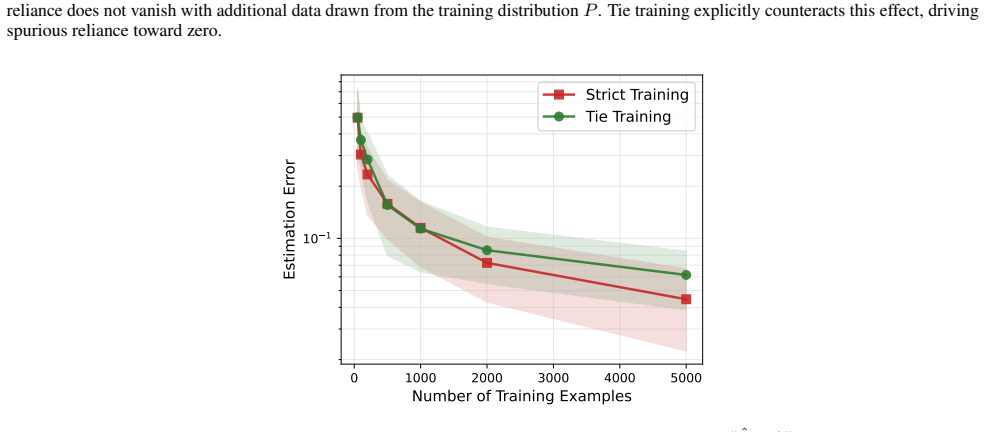
Figure 16. Figure 16: Under standard RLHF learning training, the learned policy exhibits nonzero reliance on spurious features (θs ̸= 0), and this reliance does not vanish with additional data drawn from the training distribution P. Tie training explicitly counteracts this effect, driving spurious reliance toward zero. 0 1000 2000 3000 4000 5000 Number of Training Examples 10 1 Estimation Error Strict Training Tie Training [P… view at source ↗
Figure 17
Figure 17. Figure 17: As the number of training samples increases, estimation error, defined as the weighted norm ∥ ˆθ−θ ⋆ ∥Σ decreases at comparable rates for strict MLE training and tie training, showing that tie training reduces spurious reliance without sacrificing estimation accuracy. Results. Without tie training, [PITH_FULL_IMAGE:figures/full_fig_p047_17.png] view at source ↗
Figure 18
Figure 18. Figure 18: Greedy decoding of a log-linear RLHF policy does not introduce additional error mechanisms, but exposes spurious reward learning under shift: performance, measured as SubOptQ(π) := V ⋆ (π ⋆ ) − V ⋆ (π) degrades in both adversarial and suppression settings, and this error does not vanish with more data from P. Tie training reduces this shift-induced error. H. Limitations and Future Work Local regime and li… view at source ↗

discussion (0)

Sign in with ORCID, Apple, or X to comment. Anyone can read and Pith papers without signing in.

Forward citations

Cited by 1 Pith paper

Reviewed papers in the Pith corpus that reference this work. Sorted by Pith novelty score.

  1. Out-of-Distribution Generalization of Risk Aversion in Language Models

    cs.LG 2026-07 conditional novelty 6.5

    Risk aversion trained on ≤$100 gambles partially generalizes across 98 orders of magnitude in LMs, raising astronomical-stakes Cooperate rates from ~2% to ~39–70% depending on method.

Reference graph

Works this paper leans on

5 extracted references · 5 canonical work pages · cited by 1 Pith paper

  1. [1]

    It justifies the first-order expansion of the surrogate in terms of the margin (Proposition C.5)

  2. [2]

    The local regime is also naturally satisfied for tie and near-tie pairs, since these pairs have small margins by construction

    It ensures that the pairwise Fisher curvature remains close to a constant multiple of the unweighted second moment, enabling the geometry transfer (Assumption C.4). The local regime is also naturally satisfied for tie and near-tie pairs, since these pairs have small margins by construction. 17 Spurious Correlation Learning in Preference Optimization Quant...

  3. [3]

    Shift term:The irreducible gap between the P -optimal and Q-optimal parameters, driven by ˜θ⊤ s,train(µ(Q) s −µ (P) s ) when causal statistics are stable (Proposition C.6)

  4. [4]

    This quantity GQ measures how far the population training optimizer θtrain is from stationarity under Q

    Gradient term:The first-order cost of deploying a P -trained estimator under Q. This quantity GQ measures how far the population training optimizer θtrain is from stationarity under Q. It is small when P≈Q near θtrain and grows with distribution shift

  5. [5]

    Excellent service, prime location

    Quadratic term:The second-order estimation penalty, controlled by the geometry transfer constant κΠ and the statistical rateΓ 2 n =O(d/n+B 2λ). Tie training (Appendix D) reduces the shift term by suppressing ∥˜θ⋆ s,train∥ and simultaneously reduces the gradient term by making the estimator less sensitive to spurious distributional changes. 22 Spurious Cor...