When Symmetries Twist: Anomaly Inflow on Monodromy Defects
Pith reviewed 2026-06-30 19:13 UTC · model grok-4.3
The pith
Monodromy defects in anomalous theories must be defined as domain walls between symmetry generators and anomaly-induced topological order.
A machine-rendered reading of the paper's core claim, the machinery that carries it, and where it could break.
Core claim
Monodromy defects describe a dynamical termination of topological symmetry operators sourced by a localized background magnetic flux. The background flux acts as a source for the anomaly, impacting the definition of the monodromy defect, which can only be defined as a domain wall between the symmetry generator and a topological order induced by the anomaly. The topological dressing has several consequences, such as the presence of protected chiral edge modes on the defect's worldvolume, and the adiabatic pumping of gapless degrees of freedom bound to the localized flux.
What carries the argument
Monodromy defects redefined as domain walls between symmetry generators and anomaly-induced topological orders via anomaly inflow from the localized flux.
If this is right
- The defect worldvolume hosts protected chiral edge modes.
- Gapless degrees of freedom bound to the localized flux undergo adiabatic pumping.
- The definition of the monodromy defect changes in the presence of anomalies compared to the non-anomalous case.
- Predictions hold in both gapped SPT phases and gapless anomalous theories, verified explicitly for chiral symmetries in continuum and lattice settings.
Where Pith is reading between the lines
- The same inflow mechanism could be applied to defects in higher spacetime dimensions or to other classes of anomalous symmetries beyond chiral ones.
- The topological dressing may provide a new way to classify symmetry defects in SPT phases by their anomaly inflow properties.
- These results suggest concrete lattice models where moving a flux thread could pump observable gapless modes across a sample.
Load-bearing premise
Monodromy defects describe a dynamical termination of topological symmetry operators that can be sourced by a localized background magnetic flux, allowing anomaly inflow to apply directly.
What would settle it
A calculation or lattice simulation showing that monodromy defects for an anomalous chiral symmetry lack protected chiral edge modes on their worldvolume or show no pumping of gapless modes when the flux is adiabatically moved would falsify the central claim.
Figures


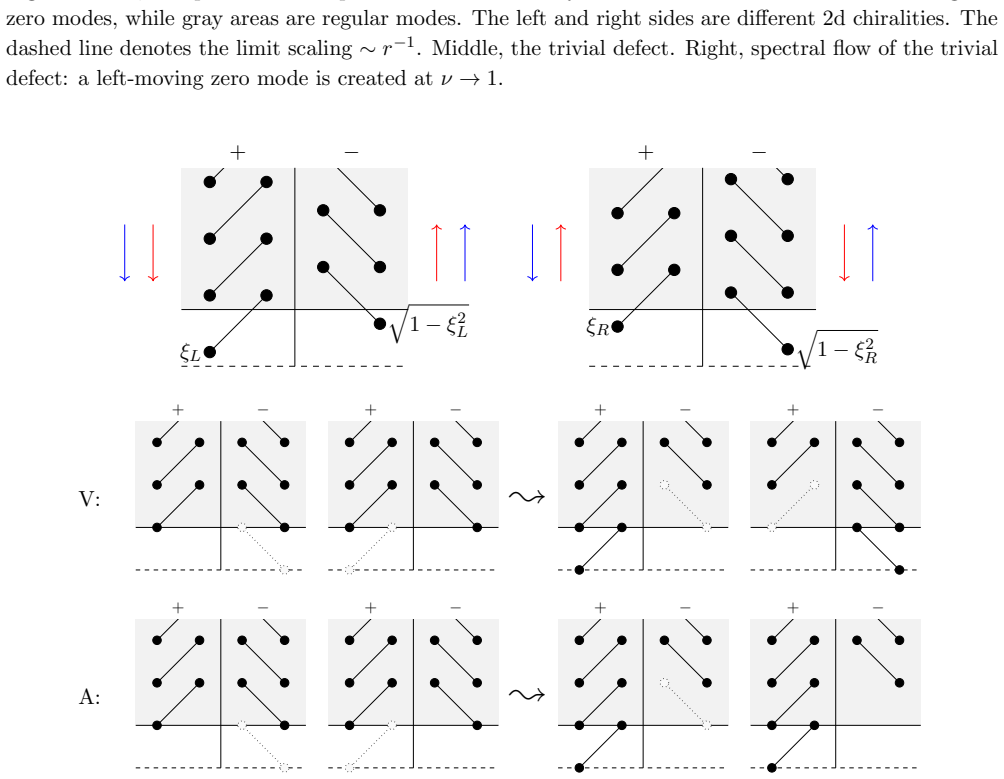


read the original abstract
Monodromy defects describe a dynamical termination of topological symmetry operators, and are sourced by a localized background magnetic flux. We study their properties in gapped SPT phases and, by inflow, in gapless theories with an anomalous symmetry. The background flux acts as a source for the anomaly, impacting the definition of the monodromy defect, which can only be defined as a domain wall between the symmetry generator and a topological order induced by the anomaly. The topological dressing has several consequences, such as the presence of protected chiral edge modes on the defect's worldvolume, and the adiabatic pumping of gapless degrees of freedom bound to the localized flux. We verify our predictions in several examples, focusing on monodromy defects for anomalous chiral symmetries, both in the continuum and on the lattice.
Editorial analysis
A structured set of objections, weighed in public.
Referee Report
Summary. The paper studies monodromy defects, defined as dynamical terminations of topological symmetry operators sourced by localized background magnetic flux. It analyzes their properties in gapped SPT phases and, via anomaly inflow, in gapless theories with anomalous symmetries. The background flux sources the anomaly and requires the defect to be realized as a domain wall between the symmetry generator and an anomaly-induced topological order. This topological dressing implies protected chiral edge modes on the defect worldvolume and adiabatic pumping of gapless degrees of freedom bound to the flux. The claims are verified through explicit examples of anomalous chiral symmetries in both continuum and lattice constructions.
Significance. If the derivations and examples hold, the work provides a concrete framework for incorporating anomaly inflow into the definition of monodromy defects, with direct consequences for edge modes and pumping phenomena. The explicit verification in chiral-symmetry examples (continuum and lattice) supplies reproducible checks that strengthen the central claims. This contributes a useful perspective on defect anomalies in both gapped and gapless settings.
minor comments (3)
- [§3] §3 (or wherever the domain-wall definition is introduced): the statement that the defect 'can only be defined' as a dressed domain wall would benefit from a short paragraph contrasting this with the naive undressed case to clarify the necessity.
- [lattice examples section] The lattice examples in the final section would be easier to follow if the specific lattice regularization (e.g., staggered fermions or Wilson fermions) and the precise anomaly-matching condition were stated explicitly in a dedicated paragraph.
- Figure captions should include a brief reminder of the anomaly coefficient or flux value used in each panel to aid quick cross-reference with the text.
Simulated Author's Rebuttal
We thank the referee for their positive summary of our work, the assessment of its significance, and the recommendation for minor revision. No specific major comments were listed in the report.
Circularity Check
No significant circularity detected
full rationale
The provided abstract and context describe anomaly inflow applied to monodromy defects defined via domain walls between symmetry generators and anomaly-induced topological order, with consequences like chiral modes and flux pumping verified in chiral symmetry examples. No equations, self-citations, fitted parameters renamed as predictions, or load-bearing uniqueness theorems are exhibited in the given material. The derivation chain relies on standard anomaly inflow reasoning applied to a physically motivated defect definition, remaining self-contained against external benchmarks without reducing to its own inputs by construction. This is the expected honest non-finding for papers lacking explicit self-referential structure.
Axiom & Free-Parameter Ledger
axioms (1)
- domain assumption Anomaly inflow principle applies to monodromy defects in gapped SPT phases and gapless anomalous theories
Forward citations
Cited by 1 Pith paper
-
Boundary Layers and One-point Functions in the Presence of Monodromy Defects
Computes one-point functions of charge-e operators in free massless/massive theories and holographic N=4 SYM with U(1) monodromy defects, finding sin and sin² dependencies plus boundary-layer resolution of anchored saddles.
Reference graph
Works this paper leans on
-
[1]
D. Gaiotto, A. Kapustin, N. Seiberg, and B. Willett, “Generalized Global Symmetries,”JHEP02(2015) 172,arXiv:1412.5148 [hep-th]
work page internal anchor Pith review Pith/arXiv arXiv 2015
-
[2]
Topological constraints on defect dynamics,
A. Antinucci, C. Copetti, G. Galati, and G. Rizi, “Topological constraints on defect dynamics,”Phys. Rev. D111no. 6, (2025) 065025,arXiv:2412.18652 [hep-th]
-
[3]
Defect Anomalies, a Spin-Flux Duality, and Boson-Kondo Problems,
Z. Komargodski, F. K. Popov, and B. C. Rayhaun, “Defect Anomalies, a Spin-Flux Duality, and Boson-Kondo Problems,”arXiv:2508.14963 [hep-th]
-
[4]
Noninvertible Symmetries, Anomalies, and Scattering Amplitudes,
C. Copetti, L. Cordova, and S. Komatsu, “Noninvertible Symmetries, Anomalies, and Scattering Amplitudes,”Phys. Rev. Lett.133no. 18, (2024) 181601,arXiv:2403.04835 [hep-th]
-
[5]
S-matrix bootstrap and non-invertible symmetries,
C. Copetti, L. Cordova, and S. Komatsu, “S-matrix bootstrap and non-invertible symmetries,”JHEP03 (2025) 204,arXiv:2408.13132 [hep-th]
-
[6]
Particle-soliton degeneracies from spontaneously broken non-invertible symmetry,
C. Cordova, D. Garc´ ıa-Sep´ ulveda, and N. Holfester, “Particle-soliton degeneracies from spontaneously broken non-invertible symmetry,”JHEP07(2024) 154,arXiv:2403.08883 [hep-th]
-
[7]
Representation Theory of Solitons
C. Cordova, N. Holfester, and K. Ohmori, “Representation Theory of Solitons,” (8, 2024) , arXiv:2408.11045 [hep-th]
work page internal anchor Pith review Pith/arXiv arXiv 2024
-
[8]
Monopoles, scattering, and generalized symmetries,
M. van Beest, P. Boyle Smith, D. Delmastro, Z. Komargodski, and D. Tong, “Monopoles, scattering, and generalized symmetries,”JHEP03(2025) 014,arXiv:2306.07318 [hep-th]
-
[9]
Fermion-monopole scattering in the Standard Model,
M. van Beest, P. Boyle Smith, D. Delmastro, R. Mouland, and D. Tong, “Fermion-monopole scattering in the Standard Model,”JHEP08(2024) 004,arXiv:2312.17746 [hep-th]
-
[10]
Dynamics of the Fermion-Rotor System,
V. Loladze, T. Okui, and D. Tong, “Dynamics of the Fermion-Rotor System,”arXiv:2508.21059 [hep-th]
-
[11]
Universal Constraints for Conformal Line Defects,
B. Gabai, A. Sever, and D.-l. Zhong, “Universal Constraints for Conformal Line Defects,” (1, 2025) , arXiv:2501.06900 [hep-th]
-
[12]
Integral Identities from Symmetry Breaking of Conformal Defects,
Z. Kong, “Integral Identities from Symmetry Breaking of Conformal Defects,” in14th International Workshop on Lie Theory and Its Applications in Physics. 9, 2025.arXiv:2509.23797 [hep-th]
-
[13]
There and Back Again: Bulk-to-Defect via Ward Identities,
J. Belton and Z. Kong, “There and Back Again: Bulk-to-Defect via Ward Identities,”arXiv:2510.08519 [hep-th]
-
[14]
't Hooft anomalies and boundaries
K. Jensen, E. Shaverin, and A. Yarom, “’t Hooft anomalies and boundaries,”JHEP01(2018) 085, arXiv:1710.07299 [hep-th]
work page internal anchor Pith review Pith/arXiv arXiv 2018
-
[15]
Anomalous symmetries end at the boundary,
R. Thorngren and Y. Wang, “Anomalous symmetries end at the boundary,”JHEP09(2021) 017, arXiv:2012.15861 [hep-th]
-
[16]
Y. Choi, H. Ha, D. Kim, Y. Kusuki, S. Ohyama, and S. Ryu, “Higher Structures on Boundary Conformal Manifolds: Higher Berry Phase and Boundary Conformal Field Theory,”arXiv:2507.12525 [hep-th]
-
[17]
C. Copetti, “’t Hooft Anomalies and Defect Conformal Manifolds: Topological Signatures from Modulated Effective Actions,”arXiv:2507.15466 [hep-th]
-
[18]
Charge pumps, pivot Hamiltonians, and symmetry-protected topological phases,
N. G. Jones, R. Thorngren, R. Verresen, and A. Prakash, “Charge pumps, pivot Hamiltonians, and symmetry-protected topological phases,”Phys. Rev. B112no. 16, (2025) 165123,arXiv:2507.00995 [cond-mat.str-el]
-
[19]
A. Debray, S. K. Devalapurkar, C. Krulewski, Y. L. Liu, N. Pacheco-Tallaj, and R. Thorngren, “A long exact sequence in symmetry breaking: order parameter constraints, defect anomaly-matching, and higher Berry phases,”JHEP07(2025) 007,arXiv:2309.16749 [hep-th]
work page internal anchor Pith review Pith/arXiv arXiv 2025
-
[20]
Higher Gauging and Non-invertible Condensation Defects
K. Roumpedakis, S. Seifnashri, and S.-H. Shao, “Higher gauging and non-invertible condensation defects,” Commun. Math. Phys.401(2023) 3043–3107,arXiv:2204.02407 [hep-th]
work page internal anchor Pith review Pith/arXiv arXiv 2023
-
[21]
Higher Structure of Chiral Symmetry,
C. Copetti, M. Del Zotto, K. Ohmori, and Y. Wang, “Higher Structure of Chiral Symmetry,” arXiv:2305.18282 [hep-th]
-
[22]
Symmetry Fractionalization, Defects, and Gauging of Topological Phases,
M. Barkeshli, P. Bonderson, M. Cheng, and Z. Wang, “Symmetry Fractionalization, Defects, and Gauging of Topological Phases,”Phys. Rev. B100no. 11, (2019) 115147,arXiv:1410.4540 [cond-mat.str-el]. 38
-
[23]
The holography of non-invertible self-duality symmetries,
A. Antinucci, F. Benini, C. Copetti, G. Galati, and G. Rizi, “The holography of non-invertible self-duality symmetries,”arXiv:2210.09146 [hep-th]
-
[24]
S. Gukov and E. Witten, “Rigid Surface Operators,”Adv. Theor. Math. Phys.14no. 1, (2010) 87–178, arXiv:0804.1561 [hep-th]
work page internal anchor Pith review Pith/arXiv arXiv 2010
-
[25]
Surface Defects and Chiral Algebras
C. Cordova, D. Gaiotto, and S.-H. Shao, “Surface Defects and Chiral Algebras,”JHEP05(2017) 140, arXiv:1704.01955 [hep-th]
work page internal anchor Pith review Pith/arXiv arXiv 2017
-
[26]
Superconformal surfaces in four dimensions,
L. Bianchi and M. Lemos, “Superconformal surfaces in four dimensions,”JHEP06(2020) 056, arXiv:1911.05082 [hep-th]
-
[27]
Superconformal monodromy defects in N=4 SYM and LS theory,
I. Arav, J. P. Gauntlett, Y. Jiao, M. M. Roberts, and C. Rosen, “Superconformal monodromy defects in N=4 SYM and LS theory,”JHEP08(2024) 177,arXiv:2405.06014 [hep-th]
-
[28]
Superconformal monodromy defects in ABJM and mABJM theory,
I. Arav, J. P. Gauntlett, Y. Jiao, M. M. Roberts, and C. Rosen, “Superconformal monodromy defects in ABJM and mABJM theory,”JHEP11(2024) 008,arXiv:2408.11088 [hep-th]
-
[29]
Monodromy defects in free field theories,
L. Bianchi, A. Chalabi, V. Proch´ azka, B. Robinson, and J. Sisti, “Monodromy defects in free field theories,” JHEP08(2021) 013,arXiv:2104.01220 [hep-th]
-
[30]
The $\epsilon$-expansion of the codimension two twist defect from conformal field theory
S. Yamaguchi, “Theϵ-expansion of the codimension two twist defect from conformal field theory,”PTEP 2016no. 9, (2016) 091B01,arXiv:1607.05551 [hep-th]
work page internal anchor Pith review Pith/arXiv arXiv 2016
-
[31]
Anomalous Dimensions in the WF O($N$) Model with a Monodromy Line Defect
A. S¨ oderberg, “Anomalous Dimensions in the WF O(N) Model with a Monodromy Line Defect,”JHEP03 (2018) 058,arXiv:1706.02414 [hep-th]
work page internal anchor Pith review Pith/arXiv arXiv 2018
-
[32]
Monodromy defects from hyperbolic space,
S. Giombi, E. Helfenberger, Z. Ji, and H. Khanchandani, “Monodromy defects from hyperbolic space,” JHEP02(2022) 041,arXiv:2102.11815 [hep-th]
-
[33]
The O(N)-flavoured replica twist defect,
A. S¨ oderberg Rousu, “The O(N)-flavoured replica twist defect,”JHEP07(2023) 022,arXiv:2304.08116 [hep-th]
-
[34]
Bootstrapping line defects with O(2) global symmetry,
A. Gimenez-Grau, E. Lauria, P. Liendo, and P. van Vliet, “Bootstrapping line defects with O(2) global symmetry,”JHEP11(2022) 018,arXiv:2208.11715 [hep-th]
-
[35]
Monodromy Pinning Defects in the Critical $\mathrm{O}(2N)$ Model
P. Kravchuk and A. Radcliffe, “Monodromy Pinning Defects in the Critical O(2N) Model,” arXiv:2510.02281 [hep-th]
work page internal anchor Pith review Pith/arXiv arXiv
-
[36]
Line defects in the 3d Ising model
M. Bill´ o, M. Caselle, D. Gaiotto, F. Gliozzi, M. Meineri, and R. Pellegrini, “Line defects in the 3d Ising model,”JHEP07(2013) 055,arXiv:1304.4110 [hep-th]
work page internal anchor Pith review Pith/arXiv arXiv 2013
-
[37]
Bootstrapping the 3d Ising twist defect
D. Gaiotto, D. Mazac, and M. F. Paulos, “Bootstrapping the 3d Ising twist defect,”JHEP03(2014) 100, arXiv:1310.5078 [hep-th]
work page internal anchor Pith review Pith/arXiv arXiv 2014
-
[38]
Scaling of the disorder operator at (2+1)d U(1) quantum criticality,
Y.-C. Wang, M. Cheng, and Z. Y. Meng, “Scaling of the disorder operator at (2+1)d U(1) quantum criticality,”Phys. Rev. B104no. 8, (2021) 081109,arXiv:2101.10358 [cond-mat.str-el]
-
[39]
Scaling of the disorder operator at deconfined quantum criticality,
Y.-C. Wang, N. Ma, M. Cheng, and Z. Y. Meng, “Scaling of the disorder operator at deconfined quantum criticality,”SciPost Phys.13no. 6, (2022) 123,arXiv:2106.01380 [cond-mat.str-el]
-
[40]
Symmetry fractionalization and twist defects
L. Fidkowski, N. H. Lindner, and N. Tarantino, “Symmetry fractionalization and twist defects,”New J. Phys.18no. 3, (2016) 035006,arXiv:1506.06754 [cond-mat.str-el]
work page internal anchor Pith review Pith/arXiv arXiv 2016
-
[41]
Disclinations, Dislocations, and Emanant Flux at Dirac Criticality,
M. Barkeshli, C. Fechisin, Z. Komargodski, and S. Zhong, “Disclinations, Dislocations, and Emanant Flux at Dirac Criticality,”Phys. Rev. X16no. 1, (2026) 011017,arXiv:2501.13866 [cond-mat.str-el]
-
[42]
Pinning the order: the nature of quantum criticality in the Hubbard model on honeycomb lattice
F. F. Assaad and I. F. Herbut, “Pinning the order: the nature of quantum criticality in the Hubbard model on honeycomb lattice,”Phys. Rev. X3(2013) 031010,arXiv:1304.6340 [cond-mat.str-el]
work page internal anchor Pith review Pith/arXiv arXiv 2013
-
[43]
Factorizing Defects from Generalized Pinning Fields,
F. K. Popov and Y. Wang, “Factorizing Defects from Generalized Pinning Fields,” (4, 2025) , arXiv:2504.06203 [hep-th]
-
[44]
M. Z. Hasan and C. L. Kane, “Colloquium: Topological insulators,”Rev. Mod. Phys.82(2010) 3045, arXiv:1002.3895 [cond-mat.mes-hall]
work page internal anchor Pith review Pith/arXiv arXiv 2010
-
[45]
Symmetry protected topological orders and the group cohomology of their symmetry group
X. Chen, Z.-C. Gu, Z.-X. Liu, and X.-G. Wen, “Symmetry protected topological orders and the group cohomology of their symmetry group,”Phys. Rev. B87no. 15, (2013) 155114,arXiv:1106.4772 [cond-mat.str-el]
work page internal anchor Pith review Pith/arXiv arXiv 2013
-
[46]
Preroughening transitions in crystal surfaces and valence-bond-solid phases in quantum spin chains,
M. den Nijs and K. Rommelse, “Preroughening transitions in crystal surfaces and valence-bond-solid phases in quantum spin chains,”Phys. Rev. B40(1989) 4709
1989
-
[47]
Hidden symmetry breaking and the Haldane phase inS=1 quantum spin chains,
T. Kennedy and H. Tasaki, “Hidden symmetry breaking and the Haldane phase inS=1 quantum spin chains,”Commun. Math. Phys.147no. 3, (1992) 431–484. 39
1992
-
[48]
Symmetry protection of topological order in one-dimensional quantum spin systems
F. Pollmann, E. Berg, A. M. Turner, and M. Oshikawa, “Symmetry protection of topological phases in one-dimensional quantum spin systems,”Phys. Rev. B85no. 7, (2012) 075125,arXiv:0909.4059 [cond-mat.str-el]
work page internal anchor Pith review Pith/arXiv arXiv 2012
-
[49]
S.-H. Shao and S. Zhong, “Where Non-Invertible Symmetries End: Twist Defects for Electromagnetic Duality,”arXiv:2509.21279 [hep-th]
-
[50]
Monodromy Defects for Electric-Magnetic Duality, Hyperbolic Space, and Lines
V. Bashmakov, “Monodromy Defects for Electric-Magnetic Duality, Hyperbolic Space, and Lines,” arXiv:2604.15117 [hep-th]
work page internal anchor Pith review Pith/arXiv arXiv
-
[51]
Anomalies in the space of coupling constants and their dynamical applications I,
C. C´ ordova, D. S. Freed, H. T. Lam, and N. Seiberg, “Anomalies in the space of coupling constants and their dynamical applications I,”SciPost Phys.8(2020) 001,arXiv:1905.09315 [hep-th]
-
[52]
Anomalies in the Space of Coupling Constants and Their Dynamical Applications II,
C. C´ ordova, D. S. Freed, H. T. Lam, and N. Seiberg, “Anomalies in the Space of Coupling Constants and Their Dynamical Applications II,”SciPost Phys.8no. 1, (2020) 002,arXiv:1905.13361 [hep-th]
-
[53]
Anomalies and fermion zero modes on strings and domain walls,
C. G. Callan, Jr. and J. A. Harvey, “Anomalies and fermion zero modes on strings and domain walls,” Nucl. Phys. B250(1985) 427–436
1985
-
[54]
To appear,
P. Boyle Smith, M. Caramanti, G. Cuomo, M. Tortora, and Y. Wang, “To appear,” (2026)
2026
-
[55]
The extraordinary boundary transition in the 3d O(N) model via conformal bootstrap,
J. Padayasi, A. Krishnan, M. A. Metlitski, I. A. Gruzberg, and M. Meineri, “The extraordinary boundary transition in the 3d O(N) model via conformal bootstrap,”SciPost Phys.12no. 6, (2022) 190, arXiv:2111.03071 [cond-mat.stat-mech]
-
[56]
Boundary conformal field theory at large charge,
G. Cuomo, M. Mezei, and A. Raviv-Moshe, “Boundary conformal field theory at large charge,”JHEP10 (2021) 143,arXiv:2108.06579 [hep-th]
-
[57]
Broken Global Symmetries and Defect Conformal Manifolds,
N. Drukker, Z. Kong, and G. Sakkas, “Broken Global Symmetries and Defect Conformal Manifolds,”Phys. Rev. Lett.129no. 20, (2022) 201603,arXiv:2203.17157 [hep-th]
-
[58]
Tilting space of boundary conformal field theories,
C. P. Herzog and V. Schaub, “Tilting space of boundary conformal field theories,”Phys. Rev. D109no. 6, (2024) L061701,arXiv:2301.10789 [hep-th]
-
[59]
Symmetry protected topological phases from decorated domain walls
X. Chen, Y.-M. Lu, and A. Vishwanath, “Symmetry-protected topological phases from decorated domain walls,”Nature Communications5(2014) 3507,arXiv:1303.4301 [cond-mat.str-el]
work page internal anchor Pith review Pith/arXiv arXiv 2014
-
[60]
Domain Wall Decorations, Anomalies and Spectral Sequences in Bosonic Topological Phases,
Q.-R. Wang, S.-Q. Ning, and M. Cheng, “Domain Wall Decorations, Anomalies and Spectral Sequences in Bosonic Topological Phases,”arXiv:2104.13233 [cond-mat.str-el]
-
[61]
Anomaly Obstructions to Symmetry Preserving Gapped Phases,
C. C´ ordova and K. Ohmori, “Anomaly Obstructions to Symmetry Preserving Gapped Phases,” arXiv:1910.04962 [hep-th]
-
[62]
Symmetric Gapped Interfaces of SPT and SET States: Systematic Constructions
J. Wang, X.-G. Wen, and E. Witten, “Symmetric Gapped Interfaces of SPT and SET States: Systematic Constructions,”Phys. Rev. X8no. 3, (2018) 031048,arXiv:1705.06728 [cond-mat.str-el]
work page internal anchor Pith review Pith/arXiv arXiv 2018
-
[63]
Quantum Orders and Symmetric Spin Liquids
X.-G. Wen, “Quantum orders and symmetric spin liquids,”Phys. Rev. B65no. 16, (2002) 165113, arXiv:cond-mat/0107071 [cond-mat.str-el]
work page internal anchor Pith review Pith/arXiv arXiv 2002
-
[64]
Classifying fractionalization: symmetry classification of gapped Z2 spin liquids in two dimensions
A. M. Essin and M. Hermele, “Classifying fractionalization: symmetry classification of gappedZ 2 spin liquids in two dimensions,”Phys. Rev. B87(2013) 104406,arXiv:1212.0593 [cond-mat.str-el]
work page internal anchor Pith review Pith/arXiv arXiv 2013
-
[65]
Anomalous Symmetry Fractionalization and Surface Topological Order
X. Chen, F. J. Burnell, A. Vishwanath, and L. Fidkowski, “Anomalous Symmetry Fractionalization and Surface Topological Order,”Phys. Rev. X5(2015) 041013,arXiv:1403.6491 [cond-mat.str-el]
work page internal anchor Pith review Pith/arXiv arXiv 2015
-
[66]
On 2-Group Global Symmetries and Their Anomalies
F. Benini, C. C´ ordova, and P.-S. Hsin, “On 2-group global symmetries and their anomalies,”JHEP03 (2019) 118,arXiv:1803.09336 [hep-th]
work page internal anchor Pith review Pith/arXiv arXiv 2019
-
[67]
Line Defect Quantum Numbers and Anomalies,
T. D. Brennan, C. C´ ordova, and T. T. Dumitrescu, “Line Defect Quantum Numbers and Anomalies,” (2022) ,arXiv:2206.15401 [hep-th]
-
[68]
Anomalies and Symmetry Fractionalization,
D. Delmastro, J. Gomis, P.-S. Hsin, and Z. Komargodski, “Anomalies and Symmetry Fractionalization,” SciPost Phys.15(2023) 079,arXiv:2206.15118 [hep-th]
-
[69]
Y. Tachikawa, “On gauging finite subgroups,”SciPost Phys.8no. 1, (2020) 015,arXiv:1712.09542 [hep-th]
-
[70]
Anomalous (3+1)d Fermionic Topological Quantum Field Theories via Symmetry Extension,
Z. Wan and J. Wang, “Anomalous (3+1)d Fermionic Topological Quantum Field Theories via Symmetry Extension,”arXiv:2512.25038 [hep-th]
-
[71]
How to Build Anomalous (3+1)d Topological Quantum Field Theories,
A. Debray, W. Ye, and M. Yu, “How to Build Anomalous (3+1)d Topological Quantum Field Theories,” arXiv:2510.24834 [math-ph]
-
[72]
Symmetric Gapped States and Symmetry-Enforced Gaplessness in 3-dimension,
A. Debray, M. Yu, and W. Ye, “Symmetric Gapped States and Symmetry-Enforced Gaplessness in 3-dimension,”arXiv:2602.12335 [hep-th]. 40
-
[73]
Models for gapped boundaries and domain walls
A. Kitaev and L. Kong, “Models for Gapped Boundaries and Domain Walls,”Commun. Math. Phys.313 no. 2, (2012) 351–373,arXiv:1104.5047 [cond-mat.str-el]
work page internal anchor Pith review Pith/arXiv arXiv 2012
-
[74]
Gauging spatial symmetries and the classification of topological crystalline phases
R. Thorngren and D. V. Else, “Gauging Spatial Symmetries and the Classification of Topological Crystalline Phases,”Phys. Rev. X8no. 1, (2018) 011040,arXiv:1612.00846 [cond-mat.str-el]
work page internal anchor Pith review Pith/arXiv arXiv 2018
-
[75]
Crystalline topological phases as defect networks
D. V. Else and R. Thorngren, “Crystalline topological phases as defect networks,”Phys. Rev. B99no. 11, (2019) 115116,arXiv:1810.10539 [cond-mat.str-el]
work page internal anchor Pith review Pith/arXiv arXiv 2019
-
[76]
Quantization of particle transport,
D. J. Thouless, “Quantization of particle transport,”Phys. Rev. B27(May, 1983) 6083–6087
1983
-
[77]
1+1d SPT phases with fusion category symmetry: interface modes and non-abelian Thouless pump,
K. Inamura and S. Ohyama, “1+1d SPT phases with fusion category symmetry: interface modes and non-abelian Thouless pump,”arXiv:2408.15960 [cond-mat.str-el]
-
[78]
Kramers-Wannier-like Duality Defects in (3+1)D Gauge Theories,
J. Kaidi, K. Ohmori, and Y. Zheng, “Kramers-Wannier-like Duality Defects in (3+1)D Gauge Theories,” Phys. Rev. Lett.128no. 11, (2022) 111601,arXiv:2111.01141 [hep-th]
-
[79]
Topological Operators and Completeness of Spectrum in Discrete Gauge Theories,
T. Rudelius and S.-H. Shao, “Topological Operators and Completeness of Spectrum in Discrete Gauge Theories,”JHEP12(2020) 172,arXiv:2006.10052 [hep-th]
-
[80]
Symmetries and strings of adjoint QCD2,
Z. Komargodski, K. Ohmori, K. Roumpedakis, and S. Seifnashri, “Symmetries and strings of adjoint QCD2,”JHEP03(2021) 103,arXiv:2008.07567 [hep-th]
discussion (0)
Sign in with ORCID, Apple, or X to comment. Anyone can read and Pith papers without signing in.