Rebalancing Reference Frame Dominance to Improve Motion in Image-to-Video Models
Pith reviewed 2026-06-30 18:30 UTC · model grok-4.3
The pith
Non-reference frames in image-to-video models over-attend to the reference frame, suppressing motion; rebalancing attention in early denoising steps restores dynamics without retraining or fidelity loss.
A machine-rendered reading of the paper's core claim, the machinery that carries it, and where it could break.
Core claim
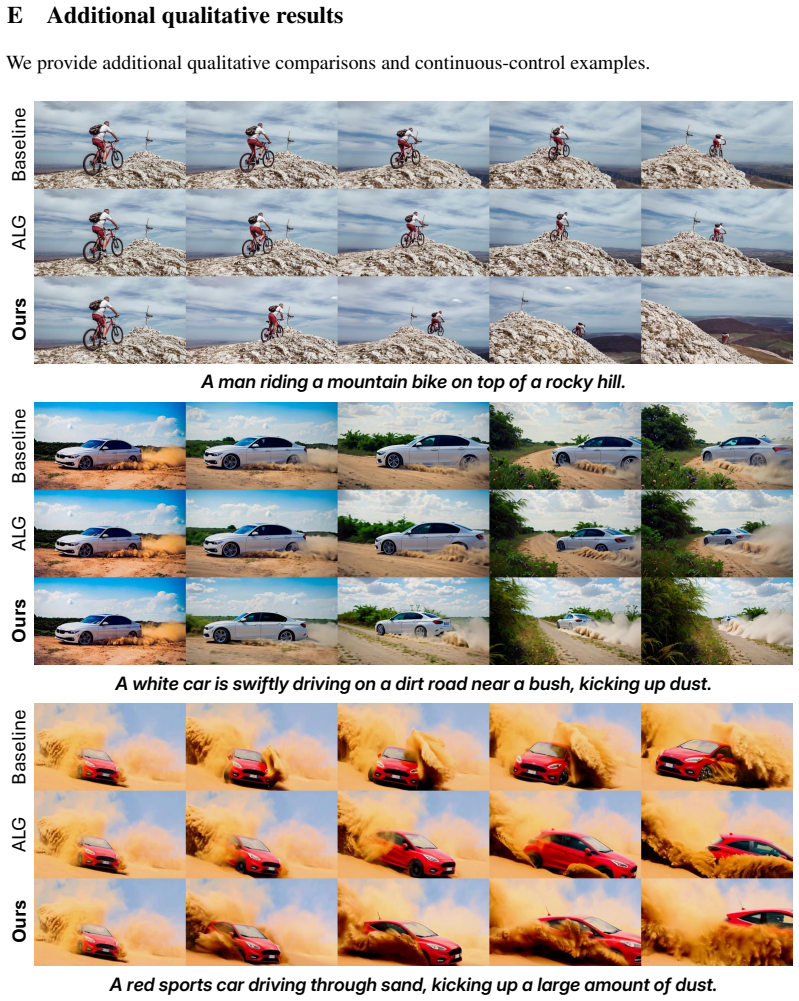
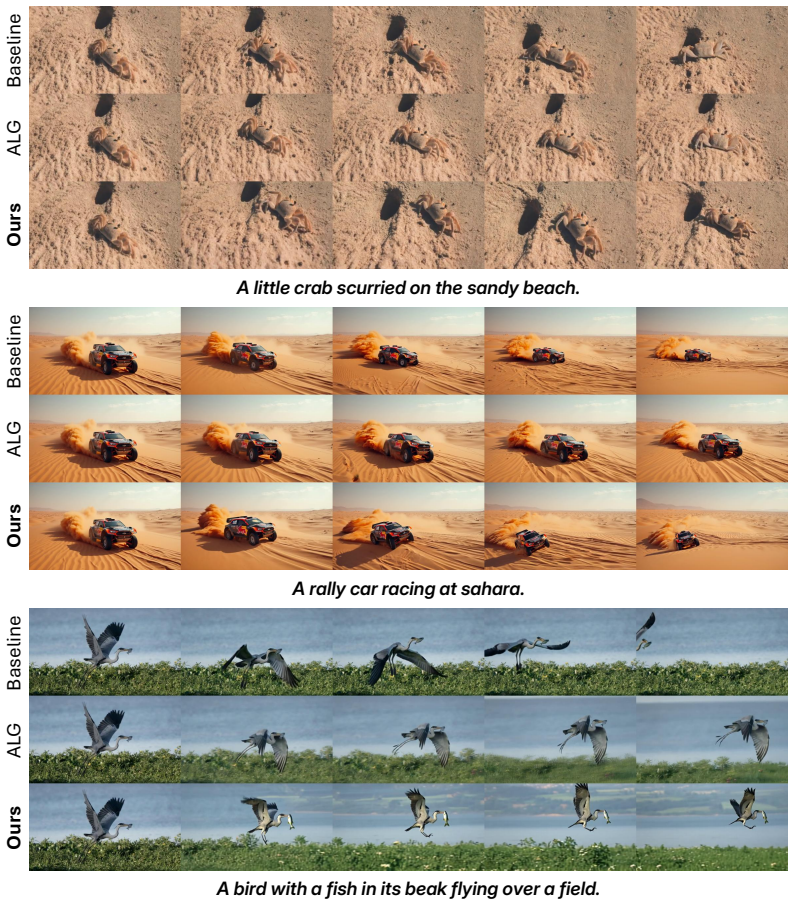
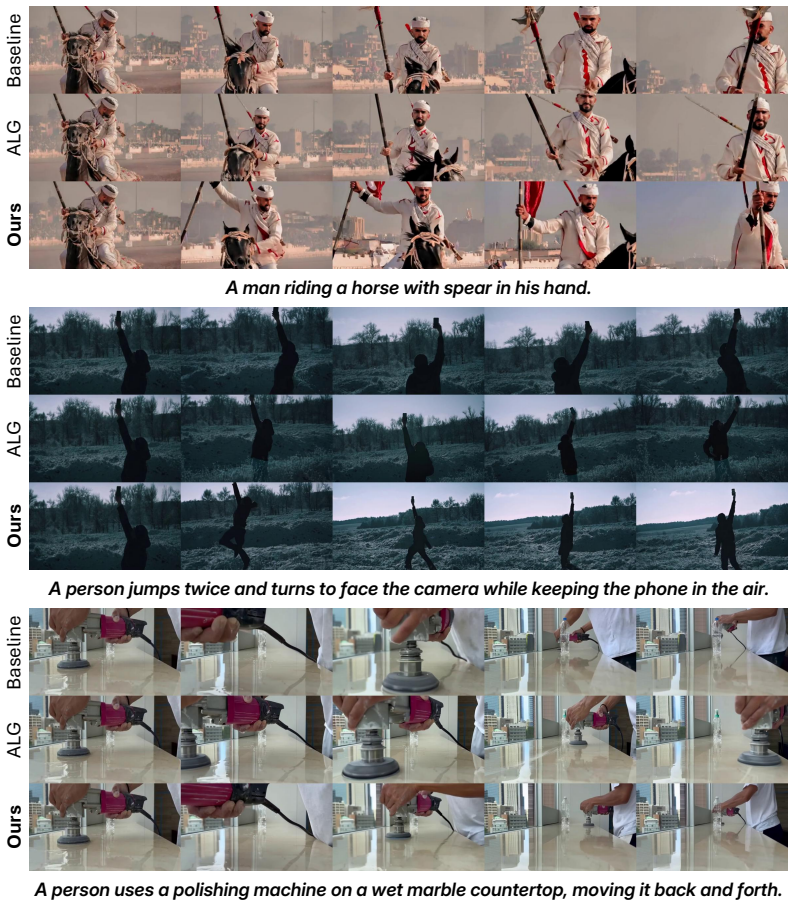
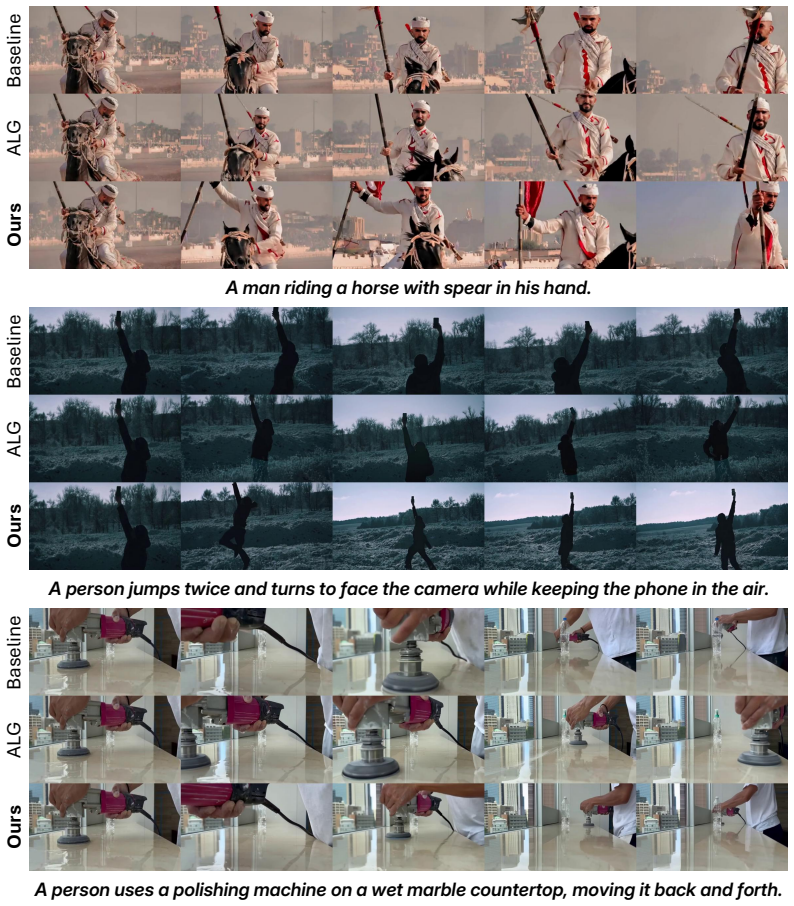
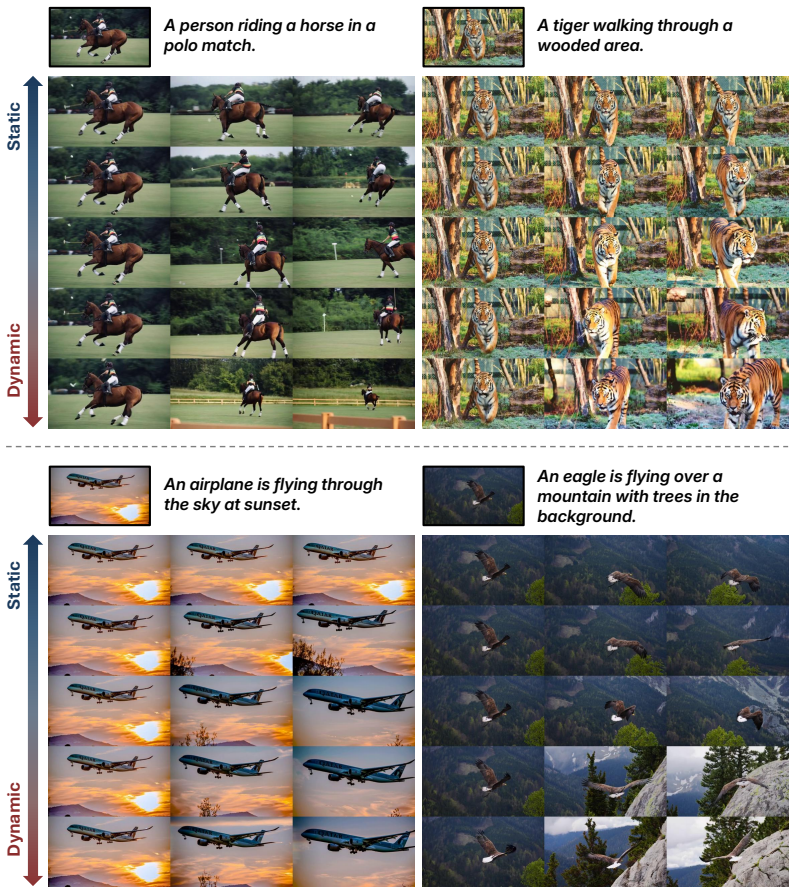
Non-reference frames in I2V models allocate excessive self-attention to reference-frame key tokens, causing reference information to be over-propagated across time and suppressing inter-frame dynamics. DyMoS rebalances the attention pathway from generated frames to the reference frame during initial denoising steps, introduces one scalar for continuous motion control, and leaves both the input image and model weights unchanged. Experiments across multiple state-of-the-art I2V backbones show consistent gains in motion dynamics while preserving visual quality and reference fidelity.
What carries the argument
DyMoS (Dynamic Motion Slider), a training-free adjustment that reduces attention scores from non-reference frames to the reference frame's keys in the first denoising steps.
If this is right
- Motion dynamics increase across multiple I2V backbones without any model retraining.
- Reference image fidelity and overall visual quality stay intact.
- A single scalar parameter provides continuous, user-controllable motion strength.
- The method applies at inference time only and requires no changes to input conditioning.
- The same rebalancing principle can be applied to any diffusion-based I2V architecture.
Where Pith is reading between the lines
- The same dominance pattern may appear in other conditioned generation tasks where one input strongly anchors the output sequence.
- Extending the rebalancing window beyond the initial steps might be needed for very long video outputs.
- Combining the scalar adjustment with existing motion-regularization losses could produce additive improvements.
- Measuring attention maps directly before and after DyMoS would confirm the proposed causal link between reference dominance and static outputs.
Load-bearing premise
Reference-frame dominance is the primary cause of motion suppression, and rebalancing attention only in the initial denoising steps will reliably increase inter-frame dynamics without degrading visual quality or reference fidelity.
What would settle it
Generate videos with and without DyMoS on the same seeds and reference images, then measure whether motion metrics such as average optical flow between consecutive frames rise while CLIP similarity to the reference image and perceptual quality scores remain statistically unchanged.
Figures




read the original abstract
Image-to-video models often generate videos that remain overly static, compared to text-to-video models. While prior approaches mitigate this issue by weakening or modifying the image-conditioning signal, they often require additional training or sacrifice fidelity to the reference image. In this work, we identify reference-frame dominance as a key mechanism behind motion suppression. We observe that non-reference frames in I2V models allocate excessive self-attention to reference-frame key tokens, causing reference information to be over-propagated across time and suppressing inter-frame dynamics. Based on this finding, we propose DyMoS (Dynamic Motion Slider), a training-free and model-agnostic method that rebalances the attention pathway from generated frames to the reference frame during initial denoising steps. DyMoS leaves both the input image and model weights unchanged and introduces a single scalar parameter for continuous control over motion strength. Experiments across multiple state-of-the-art I2V backbones demonstrate that DyMoS consistently improves motion dynamics while maintaining visual quality and fidelity to the reference image.
Editorial analysis
A structured set of objections, weighed in public.
Referee Report
Summary. The manuscript claims that image-to-video (I2V) diffusion models produce overly static outputs because non-reference frames over-allocate self-attention to reference-frame key tokens, over-propagating static reference information across time. The authors introduce DyMoS (Dynamic Motion Slider), a training-free, model-agnostic inference-time intervention that rebalances attention scores from generated frames toward the reference frame by means of a scalar multiplier applied only during the initial denoising steps. The method leaves model weights and the conditioning image unchanged and exposes a single continuous parameter for motion strength. Experiments on multiple state-of-the-art I2V backbones are reported to show improved inter-frame dynamics while preserving visual quality and reference fidelity.
Significance. If the attention observation and the reported gains hold, the work supplies a lightweight, immediately deployable remedy for a widespread practical limitation in I2V generation. Its training-free and model-agnostic character, together with the continuous scalar control, distinguishes it from prior approaches that require retraining or trade off fidelity. The mechanistic account of reference-frame dominance could also inform architectural refinements in future video diffusion models.
major comments (2)
- [attention analysis / method description] The central claim that reference-frame dominance is the primary driver of motion suppression (stated in the abstract and the opening of the method section) rests on an observational attention analysis. The manuscript does not supply quantitative statistics, cross-model attention histograms, or causal ablations that isolate this mechanism from other factors such as overall conditioning strength; without such evidence the attribution remains correlational and load-bearing for the proposed fix.
- [DyMoS subsection] DyMoS restricts the rebalancing scalar to the initial denoising steps (described in the DyMoS subsection). No ablation is presented on the precise cutoff (fixed timestep count versus noise-level threshold), nor on whether applying the scalar throughout denoising would degrade fine-detail synthesis or reference fidelity; this choice is therefore not yet shown to be optimal.
minor comments (2)
- [method] The single scalar parameter is introduced without an explicit equation showing how it modulates the attention matrix (e.g., scaling the reference-frame key contributions). Adding this equation would improve reproducibility.
- [experiments / figures] Figure captions and axis labels for any attention visualizations or motion-metric plots should explicitly state the number of samples and random seeds used.
Simulated Author's Rebuttal
We thank the referee for the careful review and the recommendation for minor revision. We address each major comment below and will make the corresponding changes to the manuscript.
read point-by-point responses
-
Referee: [attention analysis / method description] The central claim that reference-frame dominance is the primary driver of motion suppression (stated in the abstract and the opening of the method section) rests on an observational attention analysis. The manuscript does not supply quantitative statistics, cross-model attention histograms, or causal ablations that isolate this mechanism from other factors such as overall conditioning strength; without such evidence the attribution remains correlational and load-bearing for the proposed fix.
Authors: We acknowledge that the attention analysis presented is observational. In the revised manuscript we will add quantitative statistics (mean and standard deviation of attention scores allocated to reference-frame tokens versus non-reference tokens) together with cross-model attention histograms. While a full causal ablation isolating the mechanism from conditioning strength would require retraining and therefore falls outside the training-free scope of the work, we will include supplementary experiments that modulate conditioning strength to provide further supporting evidence. These additions will strengthen the mechanistic claim. revision: yes
-
Referee: [DyMoS subsection] DyMoS restricts the rebalancing scalar to the initial denoising steps (described in the DyMoS subsection). No ablation is presented on the precise cutoff (fixed timestep count versus noise-level threshold), nor on whether applying the scalar throughout denoising would degrade fine-detail synthesis or reference fidelity; this choice is therefore not yet shown to be optimal.
Authors: We agree that an ablation study on the application window is needed. In the revision we will add experiments comparing fixed-timestep cutoffs against noise-level thresholds and will also report results obtained when the scalar is applied across the entire denoising trajectory, quantifying any effects on fine-detail synthesis and reference fidelity. These results will justify the current design choice of restricting the intervention to the initial steps. revision: yes
Circularity Check
No significant circularity detected
full rationale
The paper's central contribution is an observational identification of reference-frame dominance in attention maps of I2V models, followed by a training-free inference-time intervention (DyMoS) that applies a single scalar reweighting to attention pathways during early denoising steps. No derivation chain, equations, or fitted parameters are described that reduce by construction to the inputs; the method is presented as a heuristic fix whose effect is externally verifiable on multiple backbones while leaving model weights and reference image unchanged. No self-citations, uniqueness theorems, or ansatzes are invoked as load-bearing premises. The argument is therefore self-contained against external benchmarks.
Axiom & Free-Parameter Ledger
free parameters (1)
- motion strength scalar
axioms (1)
- domain assumption Reference-frame dominance via excessive self-attention to reference key tokens is the primary mechanism suppressing motion in I2V models
Forward citations
Cited by 1 Pith paper
-
TriMotion: Modality-Agnostic Camera Control for Video Generation
TriMotion is a modality-agnostic framework that maps video, pose, and text descriptions of the same camera trajectory into a shared motion embedding space, trained with a new triplet dataset and latent consistency obj...
Reference graph
Works this paper leans on
-
[1]
Denoising diffusion probabilistic models.Advances in neural information processing systems, 33:6840–6851, 2020
Jonathan Ho, Ajay Jain, and Pieter Abbeel. Denoising diffusion probabilistic models.Advances in neural information processing systems, 33:6840–6851, 2020
2020
-
[2]
Score-based generative modeling through stochastic differential equations
Yang Song, Jascha Sohl-Dickstein, Diederik P Kingma, Abhishek Kumar, Stefano Ermon, and Ben Poole. Score-based generative modeling through stochastic differential equations. In International Conference on Learning Representations, 2021. URL https://openreview. net/forum?id=PxTIG12RRHS
2021
-
[3]
Deep unsuper- vised learning using nonequilibrium thermodynamics
Jascha Sohl-Dickstein, Eric Weiss, Niru Maheswaranathan, and Surya Ganguli. Deep unsuper- vised learning using nonequilibrium thermodynamics. InInternational conference on machine learning, pages 2256–2265. pmlr, 2015
2015
-
[4]
Diffusion models beat gans on image synthesis
Prafulla Dhariwal and Alexander Nichol. Diffusion models beat gans on image synthesis. Advances in neural information processing systems, 34:8780–8794, 2021
2021
-
[5]
Flow Straight and Fast: Learning to Generate and Transfer Data with Rectified Flow
Xingchao Liu, Chengyue Gong, and Qiang Liu. Flow straight and fast: Learning to generate and transfer data with rectified flow.arXiv preprint arXiv:2209.03003, 2022
work page internal anchor Pith review Pith/arXiv arXiv 2022
-
[6]
Yaron Lipman, Ricky T. Q. Chen, Heli Ben-Hamu, Maximilian Nickel, and Matthew Le. Flow matching for generative modeling. InThe Eleventh International Conference on Learning Representations, 2023. URLhttps://openreview.net/forum?id=PqvMRDCJT9t
2023
-
[7]
Building normalizing flows with stochastic interpolants
Michael Samuel Albergo and Eric Vanden-Eijnden. Building normalizing flows with stochastic interpolants. InThe Eleventh International Conference on Learning Representations, 2023. URLhttps://openreview.net/forum?id=li7qeBbCR1t
2023
-
[8]
Scaling rectified flow trans- formers for high-resolution image synthesis
Patrick Esser, Sumith Kulal, Andreas Blattmann, Rahim Entezari, Jonas Müller, Harry Saini, Yam Levi, Dominik Lorenz, Axel Sauer, Frederic Boesel, et al. Scaling rectified flow trans- formers for high-resolution image synthesis. InForty-first international conference on machine learning, 2024
2024
-
[9]
HunyuanVideo 1.5 Technical Report
Tencent Hunyuan Foundation Model Team. Hunyuanvideo 1.5 technical report, 2025. URL https://arxiv.org/abs/2511.18870
work page internal anchor Pith review Pith/arXiv arXiv 2025
-
[10]
Wan: Open and Advanced Large-Scale Video Generative Models
Team Wan, Ang Wang, Baole Ai, Bin Wen, Chaojie Mao, Chen-Wei Xie, Di Chen, Feiwu Yu, Haiming Zhao, Jianxiao Yang, et al. Wan: Open and advanced large-scale video generative models.arXiv preprint arXiv:2503.20314, 2025
work page internal anchor Pith review Pith/arXiv arXiv 2025
-
[11]
Cogvideox: Text-to-video diffusion models with an expert transformer
Zhuoyi Yang, Jiayan Teng, Wendi Zheng, Ming Ding, Shiyu Huang, Jiazheng Xu, Yuanming Yang, Wenyi Hong, Xiaohan Zhang, Guanyu Feng, Da Yin, Yuxuan.Zhang, Weihan Wang, Yean Cheng, Bin Xu, Xiaotao Gu, Yuxiao Dong, and Jie Tang. Cogvideox: Text-to-video diffusion models with an expert transformer. InThe Thirteenth International Conference on Learning Represen...
2025
-
[12]
Stable Video Diffusion: Scaling Latent Video Diffusion Models to Large Datasets
Andreas Blattmann, Tim Dockhorn, Sumith Kulal, Daniel Mendelevitch, Maciej Kilian, Do- minik Lorenz, Yam Levi, Zion English, Vikram V oleti, Adam Letts, et al. Stable video diffusion: Scaling latent video diffusion models to large datasets.arXiv preprint arXiv:2311.15127, 2023
work page internal anchor Pith review Pith/arXiv arXiv 2023
-
[13]
Video diffusion models.Advances in neural information processing systems, 35: 8633–8646, 2022
Jonathan Ho, Tim Salimans, Alexey Gritsenko, William Chan, Mohammad Norouzi, and David J Fleet. Video diffusion models.Advances in neural information processing systems, 35: 8633–8646, 2022
2022
-
[14]
Open-Sora Plan: Open-Source Large Video Generation Model
Bin Lin, Yunyang Ge, Xinhua Cheng, Zongjian Li, Bin Zhu, Shaodong Wang, Xianyi He, Yang Ye, Shenghai Yuan, Liuhan Chen, et al. Open-sora plan: Open-source large video generation model.arXiv preprint arXiv:2412.00131, 2024. 10
work page internal anchor Pith review Pith/arXiv arXiv 2024
-
[15]
Imagen Video: High Definition Video Generation with Diffusion Models
Jonathan Ho, William Chan, Chitwan Saharia, Jay Whang, Ruiqi Gao, Alexey Gritsenko, Diederik P Kingma, Ben Poole, Mohammad Norouzi, David J Fleet, et al. Imagen video: High definition video generation with diffusion models.arXiv preprint arXiv:2210.02303, 2022
work page internal anchor Pith review Pith/arXiv arXiv 2022
-
[16]
Animatediff: Animate your personalized text-to-image diffusion models without specific tuning
Yuwei Guo, Ceyuan Yang, Anyi Rao, Zhengyang Liang, Yaohui Wang, Yu Qiao, Maneesh Agrawala, Dahua Lin, and Bo Dai. Animatediff: Animate your personalized text-to-image diffusion models without specific tuning. InThe Twelfth International Conference on Learning Representations, 2024. URLhttps://openreview.net/forum?id=Fx2SbBgcte
2024
-
[17]
LTX-Video: Realtime Video Latent Diffusion
Yoav HaCohen, Nisan Chiprut, Benny Brazowski, Daniel Shalem, Dudu Moshe, Eitan Richard- son, Eran Levin, Guy Shiran, Nir Zabari, Ori Gordon, et al. Ltx-video: Realtime video latent diffusion.arXiv preprint arXiv:2501.00103, 2024
work page internal anchor Pith review Pith/arXiv arXiv 2024
-
[18]
Conditional image-to-video generation with latent flow diffusion models
Haomiao Ni, Changhao Shi, Kai Li, Sharon X Huang, and Martin Renqiang Min. Conditional image-to-video generation with latent flow diffusion models. In2023 IEEE/CVF Conference on Computer Vision and Pattern Recognition (CVPR), pages 18444–18455. IEEE, 2023
2023
-
[19]
Motion-i2v: Consistent and controllable image-to-video generation with explicit motion modeling
Xiaoyu Shi, Zhaoyang Huang, Fu-Yun Wang, Weikang Bian, Dasong Li, Yi Zhang, Manyuan Zhang, Ka Chun Cheung, Simon See, Hongwei Qin, et al. Motion-i2v: Consistent and controllable image-to-video generation with explicit motion modeling. InACM SIGGRAPH 2024 Conference Papers, pages 1–11, 2024
2024
-
[20]
MAGI-1: Autoregressive Video Generation at Scale
Hansi Teng, Hongyu Jia, Lei Sun, Lingzhi Li, Maolin Li, Mingqiu Tang, Shuai Han, Tianning Zhang, WQ Zhang, Weifeng Luo, et al. Magi-1: Autoregressive video generation at scale.arXiv preprint arXiv:2505.13211, 2025
work page internal anchor Pith review Pith/arXiv arXiv 2025
-
[21]
Dynamicrafter: Animating open-domain images with video diffusion priors
Jinbo Xing, Menghan Xia, Yong Zhang, Haoxin Chen, Wangbo Yu, Hanyuan Liu, Gongye Liu, Xintao Wang, Ying Shan, and Tien-Tsin Wong. Dynamicrafter: Animating open-domain images with video diffusion priors. InEuropean Conference on Computer Vision, pages 399–417. Springer, 2024
2024
-
[22]
I2VGen-XL: High-Quality Image-to-Video Synthesis via Cascaded Diffusion Models
Shiwei Zhang, Jiayu Wang, Yingya Zhang, Kang Zhao, Hangjie Yuan, Zhiwu Qin, Xiang Wang, Deli Zhao, and Jingren Zhou. I2vgen-xl: High-quality image-to-video synthesis via cascaded diffusion models.arXiv preprint arXiv:2311.04145, 2023
work page internal anchor Pith review Pith/arXiv arXiv 2023
-
[23]
Track4gen: Teaching video diffusion models to track points improves video generation
Hyeonho Jeong, Chun-Hao P Huang, Jong Chul Ye, Niloy J Mitra, and Duygu Ceylan. Track4gen: Teaching video diffusion models to track points improves video generation. In Proceedings of the Computer Vision and Pattern Recognition Conference, pages 7276–7287, 2025
2025
-
[24]
Identifying and solving conditional image leakage in image-to-video diffusion model
Min Zhao, Hongzhou Zhu, Chendong Xiang, Kaiwen Zheng, Chongxuan Li, and Jun Zhu. Identifying and solving conditional image leakage in image-to-video diffusion model. InThe Thirty-eighth Annual Conference on Neural Information Processing Systems, 2024. URL https://openreview.net/forum?id=o9Lkiv1qpc
2024
-
[25]
Yunyang Ge, Xinhua Cheng, Chengshu Zhao, Xianyi He, Shenghai Yuan, Bin Lin, Bin Zhu, and Li Yuan. Flashi2v: Fourier-guided latent shifting prevents conditional image leakage in image-to-video generation.arXiv preprint arXiv:2509.25187, 2025
-
[26]
June Suk Choi, Kyungmin Lee, Sihyun Yu, Yisol Choi, Jinwoo Shin, and Kimin Lee. Enhancing motion dynamics of image-to-video models via adaptive low-pass guidance.arXiv preprint arXiv:2506.08456, 2025
-
[27]
Scalable diffusion models with transformers
William Peebles and Saining Xie. Scalable diffusion models with transformers. InProceedings of the IEEE/CVF international conference on computer vision, pages 4195–4205, 2023
2023
-
[28]
Sit: Exploring flow and diffusion-based generative models with scalable interpolant transformers
Nanye Ma, Mark Goldstein, Michael S Albergo, Nicholas M Boffi, Eric Vanden-Eijnden, and Saining Xie. Sit: Exploring flow and diffusion-based generative models with scalable interpolant transformers. InEuropean Conference on Computer Vision, pages 23–40. Springer, 2024
2024
-
[29]
Auto-Encoding Variational Bayes
Diederik P Kingma and Max Welling. Auto-encoding variational bayes.arXiv preprint arXiv:1312.6114, 2013. 11
work page internal anchor Pith review Pith/arXiv arXiv 2013
-
[30]
Exploring the limits of transfer learning with a unified text-to-text transformer.Journal of machine learning research, 21(140):1–67, 2020
Colin Raffel, Noam Shazeer, Adam Roberts, Katherine Lee, Sharan Narang, Michael Matena, Yanqi Zhou, Wei Li, and Peter J Liu. Exploring the limits of transfer learning with a unified text-to-text transformer.Journal of machine learning research, 21(140):1–67, 2020
2020
-
[31]
Classifier-Free Diffusion Guidance
Jonathan Ho and Tim Salimans. Classifier-free diffusion guidance.arXiv preprint arXiv:2207.12598, 2022
work page internal anchor Pith review Pith/arXiv arXiv 2022
-
[32]
History-guided video diffusion
Kiwhan Song, Boyuan Chen, Max Simchowitz, Yilun Du, Russ Tedrake, and Vincent Sitzmann. History-guided video diffusion. InForty-second International Conference on Machine Learning,
-
[33]
URLhttps://openreview.net/forum?id=j8Vr3E3vhy
-
[34]
T2v- compbench: A comprehensive benchmark for compositional text-to-video generation
Kaiyue Sun, Kaiyi Huang, Xian Liu, Yue Wu, Zihan Xu, Zhenguo Li, and Xihui Liu. T2v- compbench: A comprehensive benchmark for compositional text-to-video generation. In Proceedings of the Computer Vision and Pattern Recognition Conference, pages 8406–8416, 2025
2025
-
[35]
Byungjun Kim, Soobin Um, and Jong Chul Ye. Motioncfg: Boosting motion dynamics via stochastic concept perturbation.arXiv preprint arXiv:2603.14073, 2026
-
[36]
Motion prior distillation in time reversal sampling for generative inbetweening
Wooseok Jeon, Seunghyun Shin, Dongmin Shin, and Hae-Gon Jeon. Motion prior distillation in time reversal sampling for generative inbetweening. InThe Fourteenth International Con- ference on Learning Representations, 2026. URL https://openreview.net/forum?id= GRElsj9W2t
2026
-
[37]
Vbench: Comprehensive benchmark suite for video generative models
Ziqi Huang, Yinan He, Jiashuo Yu, Fan Zhang, Chenyang Si, Yuming Jiang, Yuanhan Zhang, Tianxing Wu, Qingyang Jin, Nattapol Chanpaisit, et al. Vbench: Comprehensive benchmark suite for video generative models. InProceedings of the IEEE/CVF Conference on Computer Vision and Pattern Recognition, pages 21807–21818, 2024
2024
-
[38]
Divergence measures based on the shannon entropy.IEEE Transactions on Information theory, 37(1):145–151, 2002
Jianhua Lin. Divergence measures based on the shannon entropy.IEEE Transactions on Information theory, 37(1):145–151, 2002
2002
-
[39]
Videoscore: Building automatic metrics to simulate fine-grained human feedback for video generation
Xuan He, Dongfu Jiang, Ge Zhang, Max Ku, Achint Soni, Sherman Siu, Haonan Chen, Abhranil Chandra, Ziyan Jiang, Aaran Arulraj, et al. Videoscore: Building automatic metrics to simulate fine-grained human feedback for video generation. InProceedings of the 2024 Conference on Empirical Methods in Natural Language Processing, pages 2105–2123, 2024
2024
-
[40]
Internvid: A large-scale video-text dataset for multimodal understanding and generation
Yi Wang, Yinan He, Yizhuo Li, Kunchang Li, Jiashuo Yu, Xin Ma, Xinhao Li, Guo Chen, Xinyuan Chen, Yaohui Wang, Ping Luo, Ziwei Liu, Yali Wang, Limin Wang, and Yu Qiao. Internvid: A large-scale video-text dataset for multimodal understanding and generation. In The Twelfth International Conference on Learning Representations, 2024. URL https:// openreview.n...
2024
-
[41]
Visionreward: Fine-grained multi-dimensional human preference learning for image and video generation
Jiazheng Xu, Yu Huang, Jiale Cheng, Yuanming Yang, Jiajun Xu, Yuan Wang, Wenbo Duan, Shen Yang, Qunlin Jin, Shurun Li, et al. Visionreward: Fine-grained multi-dimensional human preference learning for image and video generation. InProceedings of the AAAI Conference on Artificial Intelligence, volume 40, pages 11269–11277, 2026
2026
-
[42]
Perception encoder: The best visual embeddings are not at the output of the network
Daniel Bolya, Po-Yao Huang, Peize Sun, Jang Hyun Cho, Andrea Madotto, Chen Wei, Tengyu Ma, Jiale Zhi, Jathushan Rajasegaran, Hanoona Abdul Rasheed, Junke Wang, Marco Monteiro, Hu Xu, Shiyu Dong, Nikhila Ravi, Shang-Wen Li, Piotr Dollar, and Christoph Feichtenhofer. Perception encoder: The best visual embeddings are not at the output of the network. In The...
2026
-
[43]
Vidprom: A million-scale real prompt-gallery dataset for text-to- video diffusion models.Advances in Neural Information Processing Systems, 37:65618–65642, 2024
Wenhao Wang and Yi Yang. Vidprom: A million-scale real prompt-gallery dataset for text-to- video diffusion models.Advances in Neural Information Processing Systems, 37:65618–65642, 2024
2024
-
[44]
Flux.https://github.com/black-forest-labs/flux, 2024
Black Forest Labs. Flux.https://github.com/black-forest-labs/flux, 2024
2024
-
[45]
Raft: Recurrent all-pairs field transforms for optical flow
Zachary Teed and Jia Deng. Raft: Recurrent all-pairs field transforms for optical flow. In European conference on computer vision, pages 402–419. Springer, 2020. 12
2020
-
[46]
Dohun Lee, Chun-Hao Paul Huang, Xuelin Chen, Jong Chul Ye, Duygu Ceylan, and Hyeonho Jeong. Memory-v2v: Augmenting video-to-video diffusion models with memory.arXiv preprint arXiv:2601.16296, 2026
-
[47]
Amazon mechanical turk: A research tool for organizations and information systems scholars
Kevin Crowston. Amazon mechanical turk: A research tool for organizations and information systems scholars. InShaping the Future of ICT Research. Methods and Approaches: IFIP WG 8.2, Working Conference, Tampa, FL, USA, December 13-14, 2012. Proceedings, 2012
2012
-
[48]
Video color grading via look-up table generation
Seunghyun Shin, Dongmin Shin, Jisu Shin, Hae-Gon Jeon, and Joon-Young Lee. Video color grading via look-up table generation. InProceedings of the IEEE/CVF International Conference on Computer Vision, pages 19141–19152, 2025
2025
-
[49]
Close imitation of expert retouching for black-and-white photography
Seunghyun Shin, Jisu Shin, Jihwan Bae, Inwook Shim, and Hae-Gon Jeon. Close imitation of expert retouching for black-and-white photography. InProceedings of the IEEE/CVF Conference on Computer Vision and Pattern Recognition, pages 25037–25046, June 2024
2024
-
[50]
Kinetic typography diffusion model
Seonmi Park, Inhwan Bae, Seunghyun Shin, and Hae-Gon Jeon. Kinetic typography diffusion model. InEuropean Conference on Computer Vision, pages 166–185. Springer, 2024
2024
-
[51]
Chanhui Lee, Seunghyun Shin, Donggyu Choi, Hae-gon Jeon, and Jeany Son. Universal image immunization against diffusion-based image editing via semantic injection.arXiv preprint arXiv:2602.14679, 2026
work page internal anchor Pith review arXiv 2026
-
[52]
Reangle-a-video: 4d video generation as video-to-video translation
Hyeonho Jeong, Suhyeon Lee, and Jong Chul Ye. Reangle-a-video: 4d video generation as video-to-video translation. In2025 IEEE/CVF International Conference on Computer Vision (ICCV), pages 11164–11175. IEEE, 2025. 13 A Full algorithm of DyMoS Algorithm 1DyMoS Input: Reference image Iref, text prompt c, total inference steps N, guidance scale ω, modulation ...
2025
-
[53]
Motion:Which video has the most dynamic and realistic motion? Examples include water ripples, cloth movement, human action, and camera motion
-
[54]
Fidelity:Which video best preserves the appearance of the reference image throughout the sequence? Examples include the subject, background, and colors. 3.Text alignment:Which video most faithfully reflects the content described in the text prompt? 4.Overall preference:Overall, which video do you prefer? We collect 30 responses for each question over 25 r...
discussion (0)
Sign in with ORCID, Apple, or X to comment. Anyone can read and Pith papers without signing in.